

The DOI matches its Crossref record; 188 of the 199 references it cites were found in a registry or an index.
The Role of Macrophages in Cancer Development and Therapy
Open accessAbstract
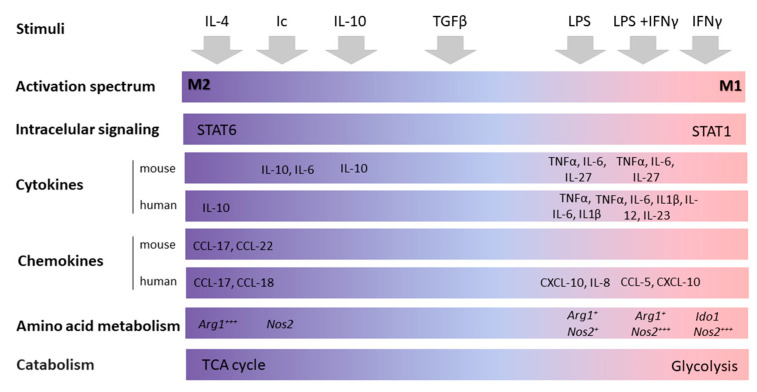
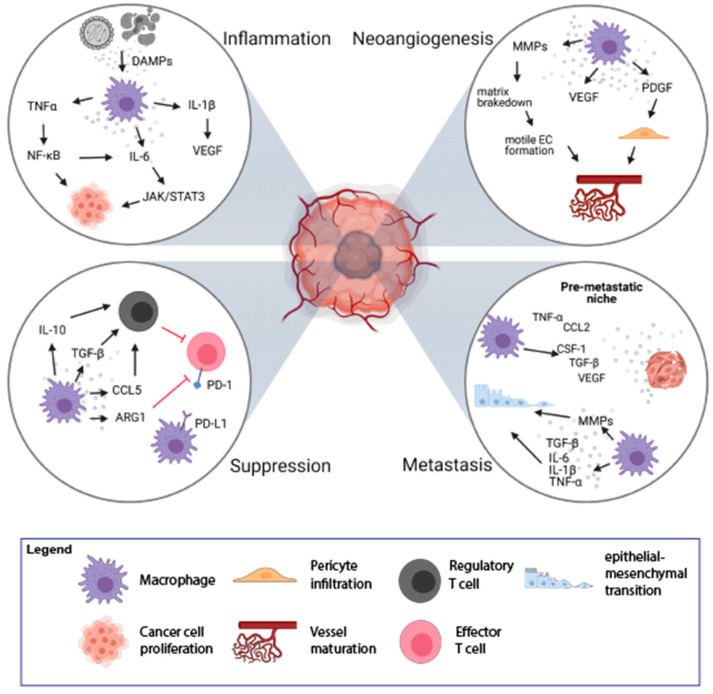
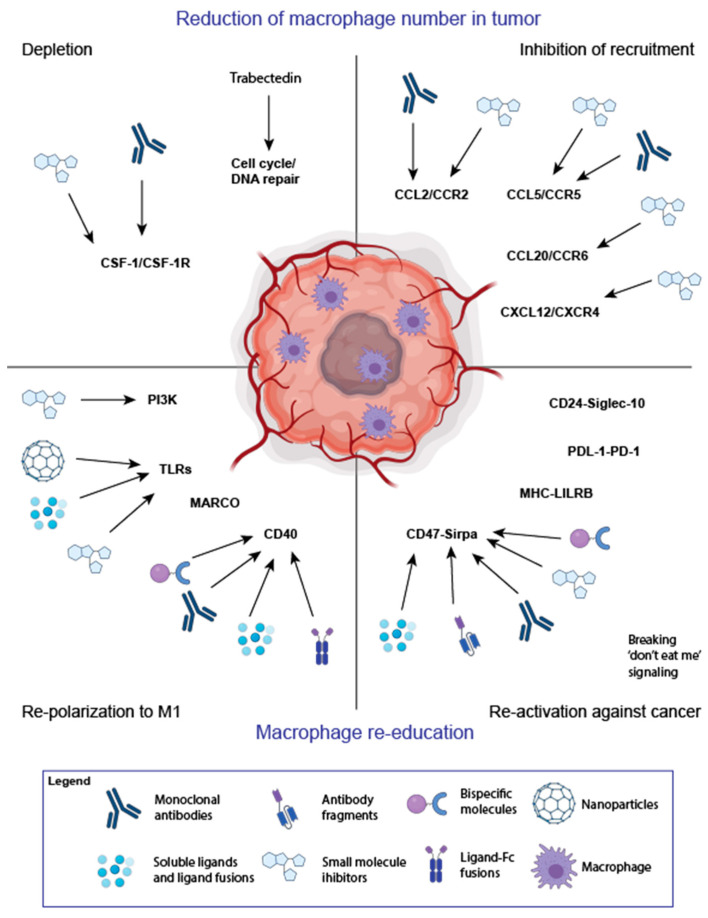
Macrophages are critical mediators of tissue homeostasis and influence various aspects of immunity. Tumor-associated macrophages are one of the main cellular components of the tumor microenvironment. Depending on their activation status, macrophages can exert a dual influence on tumorigenesis by either antagonizing the cytotoxic activity of immune cells or, less frequently, by enhancing antitumor responses. In most situations, TAMs suppress T cell recruitment and function or regulate other aspects of tumor immunity. The importance of TAMs targeting in cancer therapy is derived from the strong association between the high infiltration of TAMs in the tumor tissue with poor patient prognosis. Several macrophage-targeting approaches in anticancer therapy are developed, including TAM depletion, inhibition of new TAM differentiation, or re-education of TAM activation for cancer cell phagocytosis. In this review, we will describe the role of TAMs in tumor development, including such aspects as protumorigenic inflammation, immune suppression, neoangiogenesis, and enhancement of tissue invasion and distant metastasis. Furthermore, we will discuss therapeutic approaches that aim to deplete TAMs or, on the contrary, re-educate TAMs for cancer cell phagocytosis and antitumor immunity.
Overview
The claims and statistics of this paper haven’t been checked yet.
Run the check — free, no account needed. It reads the open-access text and checks the sources it cites.
Integrity signals
Registry
Cites
Statistics
Figures
Verification
Claims the paper makes
The claims and statistics of this paper haven’t been checked yet.
Run the check — free, no account needed. It reads the open-access text and checks the sources it cites.
Claims other papers make about this one
Each is checked against this paper’s own text: does it say what the citing paper says it does?
The source backs part of the claim, not all of it — or backs it for a different population, condition or comparison.
In the citing paper
“Tumor-derived cues generally favor M2 polarization, resulting in the secretion of cytokines such as IL-4, IL-6, IL-1β, and TNFα. These cytokines support tumor growth by enhancing cellular proliferation, remodeling the ECM, and inhibiting effector T-cell responses. Thus, TAMs serve as both immunological suppressors and facilitators of malignant progression [70,71].”
From Modeling Tumor Microenvironment Complexity In Vitro: Spheroids as Physiologically Relevant Tumor Models and Strategies for Their Analysis (2025) · cites this paper as [70]
Experimental — accuracy not yet measured
Self-check
Percentages, sums and reported differences re-computed from the paper’s own numbers.
The self-check needs the paper’s full text.
Citations
Cites
Coussens, L. M., & Werb, Z. (2002) · Nature · doi:10.1038/nature01322 · Cited by 15,111
Immunity, Inflammation, and Cancer
Grivennikov, S. I., Greten, F. R., & Karin, M. (2010) · Cell · doi:10.1016/j.cell.2010.01.025 · Cited by 10,755
Myeloid-derived-suppressor cells as regulators of the immune system
Gabrilovich, D. I., & Nagaraj, S. (2009) · Nature Reviews Immunology · doi:10.1038/nri2506 · Cited by 6,753
Macrophage activation and polarization: nomenclature and experimental guidelines
Murray, P. J., Allen, J. E., Biswas, S. K., Fisher, E. A., Gilroy, D. W., Goerdt, S., Gordon, S., Hamilton, J. A., Ivashkiv, L. B., Lawrence, T., et al. (2014) · Immunity · doi:10.1016/j.immuni.2014.06.008 · Cited by 6,337
Toll-like receptors: critical proteins linking innate and acquired immunity
Akira, S., Takeda, K., & Kaisho, T. (2001) · Nature Immunology · doi:10.1038/90609 · Cited by 4,777
Tumor-Associated Macrophages: From Mechanisms to Therapy
Noy, R., & Pollard, J. W. (2014) · Immunity · doi:10.1016/j.immuni.2014.06.010 · Cited by 4,089
Macrophage plasticity and interaction with lymphocyte subsets: cancer as a paradigm
Biswas, S. K., & Mantovani, A. (2010) · Nature Immunology · doi:10.1038/ni.1937 · Cited by 3,840
Inflammation and cancer: triggers, mechanisms, and consequences
Greten, F. R., & Grivennikov, S. I. (2019) · Immunity · doi:10.1016/j.immuni.2019.06.025 · Cited by 3,806
CSF-1R inhibition alters macrophage polarization and blocks glioma progression
Pyonteck, S. M., Akkari, L., Schuhmacher, A. J., Bowman, R. L., Sevenich, L., Quail, D. F., Olson, O. C., Quick, M. L., Huse, J. T., Teijeiro, V., et al. (2013) · Nature Medicine · doi:10.1038/nm.3337 · Cited by 2,463
The tumor microenvironment and its role in promoting tumor growth
Whiteside, T. L. (2008) · Oncogene · doi:10.1038/onc.2008.271 · Cited by 2,376
Research works printed but not linked: 1
- Yue, 2010, NIH Public Access, Bone, 23, 1
Cited by
Sorted by citations
Tumor-associated macrophages: an effective player of the tumor microenvironment
Basak, U., Sarkar, T., Mukherjee, S., Chakraborty, S., Dutta, A., Dutta, S., Nayak, D., Kaushik, S., Das, T., & Sa, G. (2023) · Frontiers in Immunology · doi:10.3389/fimmu.2023.1295257 · Cited by 356
Kundu, M., Butti, R., Panda, V. K., Malhotra, D., Das, S., Mitra, T., Kapse, P., Gosavi, S., & Kundu, G. C. (2024) · Molecular Cancer · doi:10.1186/s12943-024-01990-4 · Cited by 284
The role of tumor-associated macrophages in tumor immune evasion
Huang, R., Kang, T., & Chen, S. (2024) · Journal of Cancer Research and Clinical Oncology · doi:10.1007/s00432-024-05777-4 · Cited by 230
Roles of macrophages on ulcerative colitis and colitis-associated colorectal cancer
Zhang, M., Li, X., Zhang, Q., Yang, J., & Liu, G. (2023) · Frontiers in Immunology · doi:10.3389/fimmu.2023.1103617 · Cited by 205
Sas, Z., Cendrowicz, E., Weinhäuser, I., & Rygiel, T. P. (2022) · International Journal of Molecular Sciences · doi:10.3390/ijms23073778 · Cited by 184
Self-citation
Metadata
- Authors
- Cendrowicz, E., Sas, Z., Bremer, E., & Rygiel, T. P.
- Affiliations
- University Medical Center Groningen (NL)
- Medical University of Warsaw (PL)
- Corresponding author
- Rygiel, Tomasz P.
- Venue
- Cancers
- Publisher
- MDPI AG
- Published
- 2021-04-18
- Volume
- 13
- Issue
- 8
- Pages
- 1946
- ISSN
- 2072-6694 (ISSN-L)
- PMC
- PMC8073377
- OpenAlex
- W3156547118
- Cited by
- 332
- References
- 199
- Citations by year
- 2026: 33 · 2025: 68 · 2024: 106 · 2023: 72 · 2022: 42 · 2021: 11
- FWCI
- 5.91
- Type
- journal article
- Language
- en
- Open access
- gold
- doi.org
- Licence
- Locations
- Cancers (publishedVersion, cc-by)
- PubMed Central (publishedVersion, cc-by)
- PubMed (publishedVersion)
- University of Groningen research database (University of Groningen / Centre for Information Technology) (publishedVersion, cc-by)
- DOAJ (DOAJ: Directory of Open Access Journals) (submittedVersion, cc-by-sa)
- University of Groningen research database (University of Groningen / Centre for Information Technology) (submittedVersion, cc-by)
- Funders
- Fundacja na rzecz Nauki Polskiej (TEAM TECH/2016-1/8)
- Topics
- Life Sciences › Immunology and Microbiology › Immunology › Immune cells in cancer
- Life Sciences › Immunology and Microbiology › Immunology › Phagocytosis and Immune Regulation
- Life Sciences › Biochemistry, Genetics and Molecular Biology › Cancer Research › Cancer, Stress, Anesthesia, and Immune Response
- Keywords
- tumor-associated macrophages, tumor microenvironment, TAM depletion, TAM reprogramming, tumor immunosuppression, neoangiogenesis, metastasis, antitumor immunity, T cell recruitment
About these checks
Registry, retraction, Cites and statistics results are computed, not judged, with one exception: a printed reference that no index lists is read once by a model before it counts as a citation error. Claims are extracted by a model and kept only when their quote appears verbatim in the text; each cited source is then checked, with a model’s help, for whether it says what the claim relies on. Those verdicts can be wrong — read the claim’s quote and the cited source before relying on one.
Statistics and arithmetic are recomputed, not judged.
Confidence bands are shown only for fields calibrated on our annotated test set. None is calibrated yet, so no band is shown.
What counts as a claim ›How we measure confidence ›How we check this ›
Are you an author, or do you see a problem with this page? Request a review
