

The Therapeutic Landscape for KRAS-Mutated Colorectal Cancers
Open accessThe DOI matches its Crossref record; 91 of the 91 references it cites were found in a registry or an index.
Abstract
Colorectal cancer is one of the world’s most prevalent and lethal cancers. Mutations of the KRAS gene occur in ~40% of metastatic colorectal cancers. While this cohort has historically been difficult to manage, the last few years have shown exponential growth in the development of selective inhibitors targeting KRAS mutations. Their foremost mechanism of action utilizes the Switch II binding pocket and Cys12 residue of GDP-bound KRAS proteins in G12C mutants, confining them to their inactive state. Sotorasib and Adagrasib, both FDA-approved for the treatment of non-small cell lung cancer (NSCLC), have been pivotal in paving the way for KRAS G12C inhibitors in the clinical setting. Other KRAS inhibitors in development include a multi-targeting KRAS-mutant drug and a G12D mutant drug. Treatment resistance remains an issue with combination treatment regimens including indirect pathway inhibition and immunotherapy providing possible ways to combat this. While KRAS-mutant selective therapy has come a long way, more work is required to make this an effective and viable option for patients with colorectal cancer.
Overview
The claims and statistics of this paper haven’t been checked yet.
Free: it reads the open-access text and checks the first 5 claims that cite a source we can check. Create a free account to check every claim.
Integrity signals
Registry
Cites
Statistics
Figures
Verification
Claims the paper makes
The claims and statistics of this paper haven’t been checked yet.
Free: it reads the open-access text and checks the first 5 claims that cite a source we can check. Create a free account to check every claim.
Claims other papers make about this one
Each is checked against this paper’s own text: does it say what the citing paper says it does?
The cited source says what the claim attributes to it.
In the citing paper
“There are additional drugs currently in development for targeting G12C, G12V, or other mutations (e.g., G12D), as well as non-selective, multi-KRAS mutant inhibitors (active against G12C, G12D, G12V, and G12X) [121].”
From Mechanisms and Strategies to Overcome Drug Resistance in Colorectal Cancer (2025) · cites this paper as [121]
The cited source says what the claim attributes to it.
In the citing paper
“Clinical trials for MRTX-1133 against KRAS G12D solid tumors are ongoing [58].”
From KRAS: Biology, Inhibition, and Mechanisms of Inhibitor Resistance (2024) · cites this paper as [58]
Self-check
Percentages, sums and reported differences re-computed from the paper’s own numbers.
The self-check needs the paper’s full text.
Citations
Cites
PD-1 Blockade in Tumors with Mismatch-Repair Deficiency
Le, D. T., Uram, J. N., Wang, H., Bartlett, B. R., Kemberling, H., Eyring, A. D., Skora, A. D., Luber, B. S., Azad, N. S., Laheru, D., et al. (2015) · New England Journal of Medicine · doi:10.1056/nejmoa1500596 · Cited by 9,377
Mismatch repair deficiency predicts response of solid tumors to PD-1 blockade
Le, D. T., Durham, J. N., Smith, K. N., Wang, H., Bartlett, B. R., Aulakh, L. K., Lu, S., Kemberling, H., Wilt, C., Luber, B. S., et al. (2017) · Science · doi:10.1126/science.aan6733 · Cited by 6,645
The consensus molecular subtypes of colorectal cancer
Guinney, J., Dienstmann, R., Wang, X., de Reyniès, A., Schlicker, A., Soneson, C., Marisa, L., Roepman, P., Nyamundanda, G., Angelino, P., et al. (2015) · Nature Medicine · doi:10.1038/nm.3967 · Cited by 5,170 · cited 1×
“Molecularly diverse subtypes influence prognosis and response to therapy [1,2].”
BackgroundK-ras Mutations and Benefit from Cetuximab in Advanced Colorectal Cancer
Karapetis, C. S., Khambata-Ford, S., Jonker, D. J., O'Callaghan, C. J., Tu, D., Tebbutt, N. C., Simes, R. J., Chalchal, H., Shapiro, J. D., Robitaille, S., et al. (2008) · New England Journal of Medicine · doi:10.1056/nejmoa0804385 · Cited by 3,622 · cited 1×
“The targeting of KRAS has been extensively investigated since its discovery as an oncogene, and more earnestly after the discovery that KRAS-mutant cancers are resistant to anti-EGFR therapy [19,20].”
BackgroundK-Ras(G12C) inhibitors allosterically control GTP affinity and effector interactions
Ostrem, J. M., Peters, U., Sos, M. L., Wells, J. A., & Shokat, K. M. (2013) · Nature · doi:10.1038/nature12796 · Cited by 2,557 · cited 2×
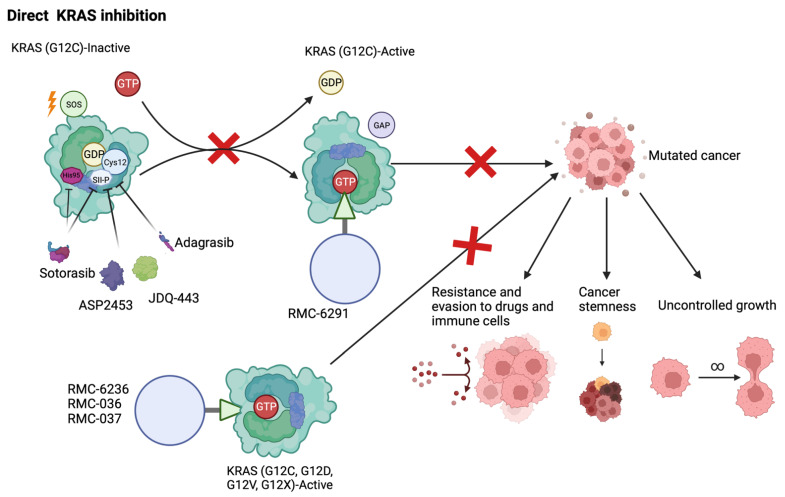
“The first generation KRAS inhibitors selectively targeted G12C mutants by binding the Switch II pocket (SII-P) (Figure 2) [27].”
BackgroundThe Clinical KRAS(G12C) Inhibitor AMG 510 Drives Anti-Tumour Immunity
Canon, J., Rex, K., Saiki, A. Y., Mohr, C., Cooke, K., Bagal, D., Gaida, K., Holt, T., Knutson, C. G., Koppada, N., et al. (2019) · Nature · doi:10.1038/s41586-019-1694-1 · Cited by 2,277 · cited 9×
“Tested in vivo, ARS-1620 induced significant tumor growth inhibition and regression selectively with KRAS G12C-mutated xenografts with no response in G12V-mutated xenografts.”
BackgroundMethodInfluentialImmunotherapy in colorectal cancer: Rationale, challenges and potential
Ganesh, K., Stadler, Z. K., Cercek, A., Mendelsohn, R. B., Shia, J., Segal, N. H., & Diaz, L. A. (2019) · Nature Reviews Gastroenterology & Hepatology · doi:10.1038/s41575-019-0126-x · Cited by 1,954 · cited 8×
“The benefit is seen in this subtype because of the increased tumor mutational burden in these dMMR cancers that create more neoantigens that can better activate the immune system and induce lymphocyte tumor infiltration [107].”
BackgroundInfluentialEmergence of KRAS mutations and acquired resistance to anti-EGFR therapy in colorectal cancer
Misale, S., Yaeger, R., Hobor, S., Scala, E., Janakiraman, M., Liska, D., Valtorta, E., Schiavo, R., Buscarino, M., Siravegna, G., et al. (2012) · Nature · doi:10.1038/nature11156 · Cited by 1,889 · cited 1×
“The targeting of KRAS has been extensively investigated since its discovery as an oncogene, and more earnestly after the discovery that KRAS-mutant cancers are resistant to anti-EGFR therapy [19,20].”
BackgroundSotorasib for Lung Cancers with KRAS p.G12C Mutation
Skoulidis, F., Li, B. T., Dy, G. K., Price, T. J., Falchook, G. S., Wolf, J., Italiano, A., Schuler, M., Borghaei, H., Barlesi, F., et al. (2021) · New England Journal of Medicine · doi:10.1056/nejmoa2103695 · Cited by 1,849 · cited 1×
“Sotorasib was the first selective inhibitor of G12C-mutant KRAS to reach Phase I and Phase II clinicals trials, demonstrating anti-tumor activity, with tolerable toxicity and safety parameters [35,36].”
BackgroundKRAS G12C Inhibition with Sotorasib in Advanced Solid Tumors
Hong, D. S., Fakih, M. G., Strickler, J. H., Desai, J., Durm, G. A., Shapiro, G. I., Falchook, G. S., Price, T. J., Sacher, A., Denlinger, C. S., et al. (2020) · New England Journal of Medicine · doi:10.1056/nejmoa1917239 · Cited by 1,733
Cited by
Mechanisms and Strategies to Overcome Drug Resistance in Colorectal Cancer
Haynes, J., & Manogaran, P. (2025) · International Journal of Molecular Sciences · doi:10.3390/ijms26051988 · Cited by 82
“There are additional drugs currently in development for targeting G12C, G12V, or other mutations (e.g., G12D), as well as non-selective, multi-KRAS mutant inhibitors (active against G12C, G12D, G12V, and G12X) [121].”
Selection of Nucleotide-Encoded Mass Libraries of Macrocyclic Peptides for Inaccessible Drug Targets
Colas, K., Bindl, D., & Suga, H. (2024) · Chemical Reviews · doi:10.1021/acs.chemrev.4c00422 · Cited by 81
Comprehensive analysis of oncogenic determinants across tumor types via multi-omics integration
Ubaid, S., Kushwaha, R., Kashif, M., & Singh, V. K. (2025) · Cancer Genetics · doi:10.1016/j.cancergen.2025.08.010 · Cited by 86
KRAS: Biology, Inhibition, and Mechanisms of Inhibitor Resistance
Ash, L. J., Busia-Bourdain, O., Okpattah, D., Kamel, A., Liberchuk, A., & Wolfe, A. L. (2024) · Current Oncology · doi:10.3390/curroncol31040150 · Cited by 68
“Furthermore, the Shokat lab identified electrophiles with the potential for developing G12R-selective inhibitors [60].”
BackgroundTargeting KRAS mutations: orchestrating cancer evolution and therapeutic challenges
Choucair, K., Imtiaz, H., Uddin, M. H., Nagasaka, M., Al-Hallak, M. N., Philip, P. A., El-Rayes, B., Pasche, B., & Azmi, A. S. (2025) · Signal Transduction and Targeted Therapy · doi:10.1038/s41392-025-02473-8 · Cited by 83
Colorectal Cancer: Therapeutic Approaches and Their Complications
Adebayo, A. S., Adeleke, A., Adesina, S. K., Agbaje, K. O., & Olajubutu, O. (2025) · Biomedicines · doi:10.3390/biomedicines13071646 · Cited by 32
“These drugs are often combined with EGFR inhibitors like cetuximab or panitumumab [97].”
Jafary, B., Akbarzadeh-Khiavi, M., Farzi-Khajeh, H., Safary, A., & Adibkia, K. (2025) · Scientific Reports · doi:10.1038/s41598-025-85856-9 · Cited by 11
Greasing the Wheels of Pharmacotherapy for Colorectal Cancer: the Role of Natural Polyphenols
Niu, C., Zhang, J., & Okolo, P. I., III (2023) · Current Nutrition Reports · doi:10.1007/s13668-023-00512-w · Cited by 11
“Currently, KRAS itself remains undruggable due to its high affinity for GTP [32].”
Adagrasib in the treatment of colorectal cancer
Haddad, S. F., Bouferraa, Y., & Nair, K. G. (2025) · Future Oncology · doi:10.1080/14796694.2025.2524311 · Cited by 10
“These inhibitors are still in the early stages of development, but preclinical studies have shown promising results, suggesting that they may offer a more comprehensive approach to KRAS -mutated cancers [37].”
Shaykevich, A., Chae, D., Silverman, I., Bassali, J., Louloueian, N., Siegman, A., Bandyopadhyaya, G., Goel, S., & Maitra, R. (2024) · Investigational New Drugs · doi:10.1007/s10637-024-01418-2 · Cited by 9
“Few treatments are available for patients with the KRAS mutation, and only two KRAS-mutant-inhibitors, Sotorasib and Adagrasib, are currently FDA approved, both of which specifically target the G12C mutation [5–7].”
Targeting KRAS in colorectal cancer (Review)
Zhang, M., Wu, D., Tang, C. Y. L., Zhang, L., Zhang, S., Li, W., Li, N., & Yan, X. (2025) · Molecular and Clinical Oncology · doi:10.3892/mco.2025.2873 · Cited by 9
Piper, A., Penney, C., Holliday, J., Tincknell, G., Ma, Y., Napaki, S., Pantel, K., Brungs, D., & Ranson, M. (2024) · International Journal of Molecular Sciences · doi:10.3390/ijms25105565 · Cited by 7
“AGS cells have a gain-of-function mutation in KRAS , a downstream effector in the EGFR pathway, leading to hyper-activation of ERK in these cells via resistance to upstream inhibition of EGFR [45], which was confirmed in our hands (Figure 3A).”
BackgroundEstablishment and genomic profiling of cholangiocarcinoma cells with functional characterization
Jaidee, R., Jusakul, A., Pocasap, P., Kukongviriyapan, V., Senggunprai, L., Prawan, A., Loilome, W., Titapun, A., Jareanrat, A., Thanasukarn, V., et al. (2025) · Scientific Reports · doi:10.1038/s41598-025-93192-1 · Cited by 6
Anaplastic carcinoma of the ovary: A single-institution experience and molecular analysis
Sullivan, M. W., Chui, M. H., Selenica, P., Roche, K. L., Sonoda, Y., Grisham, R. N., Kyi, C., Boroujeni, A. M., Abu‐Rustum, N. R., Weigelt, B., et al. (2025) · Gynecologic Oncology · doi:10.1016/j.ygyno.2025.03.021 · Cited by 5
Adorisio, R., Ciardiello, D., Rappa, A., Gervaso, L., Pelizzari, G., Marinucci, L., Fusco, N., Zampino, M. G., Fazio, N., Venetis, K., et al. (2024) · Journal of Molecular Diagnostics · doi:10.1016/j.jmoldx.2024.11.007 · Cited by 5
The Role of Targeted Therapy in the Multi-Disciplinary Approach to Colorectal Liver Metastasis
Ruff, S. M., Shannon, A. H., & Pawlik, T. M. (2023) · Cancers · doi:10.3390/cancers15133513 · Cited by 6
“While not yet approved for mCRC, KRAS-targeted therapy has demonstrated effectiveness in other cancers [79].”
BackgroundKe, J., Li, Y., Qi, L., Li, X., Wang, W., ten Hoorn, S., Zhu, Y., Huang, H., Gao, F., Vermeulen, L., et al. (2025) · ESMO Gastrointestinal Oncology · doi:10.1016/j.esmogo.2025.100181 · Cited by 4
“58 The decision tree classi fi er we developed demonstrated a signi fi cant mapping between MSI and CMS1, MSS þ low miR-200s methylation þ KRAS WT and CMS2, MSS þ low miR-200s methylation þ KRAS mutation and CMS3, and MSI þ high miR-200s methylation and CMS4.”
Real‐world genomic landscape of colon and rectal cancer
Schulze, M., Wang, X., Hamad, J., Quintanilha, J. C. F., Pasquina, L. W., Hopkins, J. F., Scheuenpflug, J., & Feng, Z. (2025) · FEBS Open Bio · doi:10.1002/2211-5463.13957 · Cited by 4
“KRAS G12V and G12D inhibitors are also being developed [14].”
Kamel, E. M., Khadrawy, S. M., Ali, M. A. M., Abukhadra, M. R., Yassin, N. Y. S., Alkhedhairi, S., Alkhayl, F. F. A., & Lamsabhi, A. M. (2026) · Frontiers in Chemistry · doi:10.3389/fchem.2026.1808601 · Cited by 3
“…(a SOS1 KRAS interaction inhibitor) is being studied as monotherapy and in combination with the MEK inhibitor trametinib, and MRTX0902 is being evaluated alone and in combination with adagrasib in advanced solid tumors with KRAS-MAPK pathway alterations (Sütcüoğlu et al., 2025; Tria et al., 2023).”
Rekowska, A. K., Rola, P., Kwiatkowska, A., Wójcik-Superczyńska, M., Gil, M., Krawczyk, P. A., & Milanowski, J. (2024) · Biomedicines · doi:10.3390/biomedicines12020325 · Cited by 7
Sharma, V., Kumar, A., Rawat, R., Gulati, M., Behl, T., Khalid, A., Najmi, A., Zoghebi, K. A., Halawi, M. A., & Mohan, S. (2024) · Journal of Biomolecular Structure and Dynamics · doi:10.1080/07391102.2024.2321237 · Cited by 3
“These include AMG 510 (NCT05638295) (Tria et al., 2023), currently in a phase 2 clinical trial targeting KRAS G12C mutant solid tumor cancers (Tria et al., 2023).”
Mechanisms of treatment resistance in colorectal cancer
Mosoane, B., Lolas, G., & Dlamini, Z. (2024) · Elsevier eBooks · doi:10.1016/b978-0-443-33475-7.00014-7 · Cited by 3
Pinto, C., Lonardi, S., Maiello, E., Martinelli, E., Prisciandaro, M., Salvatore, L., Bianchi, A. S., Scartozzi, M., Aprile, G., Cremolini, C., et al. (2025) · Frontiers in Oncology · doi:10.3389/fonc.2024.1502185 · Cited by 4
Lin, Y. (2025) · American Journal of Cancer Research · doi:10.62347/zzuw3272 · Cited by 3
Elton, E., Tavakoli, N., Çetin, H., & Finley, S. D. (2026) · npj Systems Biology and Applications · doi:10.1038/s41540-026-00673-8 · Cited by 2
“These mutations are notoriously dif fi cult to target and often reduce the ef fi cacy of other therapies 4 .”
Systemic Therapy for Metastatic Colon Cancer: New Frontiers
Pumpalova, Y. S. (2024) · Clinics in Colon and Rectal Surgery · doi:10.1055/s-0044-1787826 · Cited by 2
Precision peptide disruptors: The next generation of targeted therapeutics in oncology
O'Gorman, B., Cooke, S. F., & Blair, C. M. (2025) · Cellular Signalling · doi:10.1016/j.cellsig.2025.111783 · Cited by 2
Prevalence and breakdown of KRAS driver mutations in a large UK non-small cell lung cancer cohort
Niesner, I. C. C., Balbi, K. J., Poskitt, B., Gemma, C., Linares, J., Allen, D., Shutkever, O., Lindsay, C. R., Bennett, P., & Moore, D. A. (2025) · Journal of Clinical Pathology · doi:10.1136/jcp-2024-209972 · Cited by 1
“…for locally advanced and metastatic KRAS G12C mutant NSCLC, alongside the development of further selective inhibitors for other KRAS mutations 8 makes routine identification of KRAS mutation subtype critical in NSCLC to identify patients who may benefit from selective inhibitors, both for…”
Morouei, R. J., & Mortazavi, R. (2025) · The Cancer Review · doi:10.61882/tcr.202501.02.03 · Cited by 1
A Comprehensive Review of Marketed KRAS Inhibitors and Degraders: Challenges and Opportunities
Xu, Y.-X., Bai, Y.-R., Rui-fang, L., Peng, Y., Liu, T., Yang, X., Chen, K., Jin, Z., Liu, H., & Yuan, S. (2026) · Medicinal Research Reviews · doi:10.1002/med.70035 · Cited by 2
“Elironrasib overcame the resistance associated with first‐generation KRAS G12C inhibitors and even maintained the efficacy in cells harboring secondary mutations [74, 75].”
Liu, X., Xiao, Y., Zhou, Y., Teng, Y., Zou, J., Zhou, Y., Fan, X., Zhao, J., Qiu, J., Tang, L., et al. (2026) · Journal of Medicinal Chemistry · doi:10.1021/acs.jmedchem.6c00196 · Cited by 2
Morris, L., Pappas, L., Pandey, A., Singh, H., Klempner, S. J., & Caughey, B. A. (2024) · JCO Precision Oncology · doi:10.1200/po-24-00547 · Cited by 2
Piri, J., Ma, R., La, K., Barnajian, M., Meyer, R., & Nasseri, Y. Y. (2025) · Journal of the American College of Surgeons · doi:10.1097/xcs.0000000000001549
KRAS, APC, and TP53 mutations define opposing immune archetypes in stage III colorectal cancerPreprint
Chaiboonchoe, A., Tanjak, P., Suwatthanarak, T., Thanormjit, K., Acharayothin, O., Vorasan, N., Sakamula, R., Likhityungyuen, T., Suktitipat, B., Korphaisarn, K., et al. (2025) · Research Square · doi:10.21203/rs.3.rs-7903094/v1
KIAA1429 Stabilizes FAM84B mRNA to Enhance Colorectal Cancer Tumorigenesis via Wnt/β-Catenin Pathway
Lü, Y., Wang, W., Peng, L., & Wang, Z. (2025) · Biochemical Genetics · doi:10.1007/s10528-025-11297-8 · Cited by 1
“Its development is driven by the accumulation of genetic alterations—most notably in adenomatous polyposis coli (APC), KRAS, and TP53—which facilitate the transition from benign adenomas to invasive carcinomas (Jass et al. 2003 ; Kim et al. 2022; Tria et al. 2023 ).”
Alamri, A. M., Mir, S. A., Khan, M. S., Ahmad, M. I., Razzokov, J., & Nayak, B. (2026) · European Biophysics Journal · doi:10.1007/s00249-026-01817-8
“Further we prepare the complexes as KRas WT, G12C, G12D, G12R, and G12V bound to GDP , and KRas WT, G12C, G12D, G12R, and G12V bound to both GDP and MRTX1133.”
InfluentialFuture perspective of nanoparticles in gene delivery and gene therapy
Naghib, S. M., Kashani, G. K., Shamaeizadeh, A., & Mahdavi, H. (2026) · Elsevier eBooks · doi:10.1016/b978-0-443-31490-2.00009-5
LNA GapmeR silencing of KRAS G12V impairs growth and function in SW480 cells
Khudeir, J. F., & Tlili, A. (2026) · Molecular and Cellular Biochemistry · doi:10.1007/s11010-026-05545-7
Glasspool, R. M., Bell, S., Hollis, R. L., & Gourley, C. (2026) · Springer eBooks · doi:10.1007/978-3-032-14420-1_5
Zhu, Y., Liu, K., Chang, L., Lu, J., Tang, H., Zhu, Z., Chen, Z., Wang, X., & Xiao, J. (2026) · Cell Death and Disease · doi:10.1038/s41419-026-09001-8
“All clinical samples were collected with informed consent under Health Insurance Portability and Accountability Act (HIPAA)-approved protocols.”
INVESTIGATING MONO-DRIVER VERSUS MULTI-DRIVER ONCOGENESIS VIA ALTERATIONS TO CELL SIGNALING PATHWAYS
Chapdelaine, A. G. (2025) · Digital Commons - URI (University of Rhode Island) · doi:10.23860/diss-4446
KRAS in Colorectal Cancer: Tumorigenesis, Surgical Implications and Evolving Treatment Target
Iftikhar, S., Xiao, A. H., Jin, Z., & Aly, E. H. (2026) · Current Oncology · doi:10.3390/curroncol33090514
“Among all subtypes, G12C appears to confer the most unfavourable prognosis [21,22].”
Metadata
- Authors
- Tria, S. M., Burge, M. E., & Whitehall, V. L. J.
- Affiliations
- QIMR Berghofer Medical Research Institute (AU)
- The University of Queensland (AU)
- Queensland Health (AU)
- Corresponding author
- Tria, Simon Manuel
- Whitehall, Vicki L. J.
- Venue
- Cancers
- Publisher
- MDPI AG
- Published
- 2023-04-19
- Volume
- 15
- Issue
- 8
- Pages
- 2375
- ISSN
- 2072-6694 (ISSN-L)
- PMC
- PMC10136970
- OpenAlex
- W4366549009
- Cited by
- 38
- References
- 91
- Citations by year
- 2026: 8 · 2025: 18 · 2024: 10 · 2023: 2
- FWCI
- 1.23
- Type
- journal article
- Language
- en
- Open access
- gold
- doi.org
- Licence
- Locations
- Cancers (publishedVersion, cc-by)
- PubMed Central (publishedVersion, cc-by)
- PubMed (publishedVersion)
- Funders
- Tour de Cure (RSP-248-18/19)
- Garry Whyte Sea Angel PAF (RSP-248-18/19)
- Topics
- Health Sciences › Medicine › Oncology › Colorectal Cancer Treatments and Studies
- Life Sciences › Biochemistry, Genetics and Molecular Biology › Molecular Biology › Protein Kinase Regulation and GTPase Signaling
- Life Sciences › Biochemistry, Genetics and Molecular Biology › Molecular Biology › Protein Tyrosine Phosphatases
- Keywords
- KRAS mutation, metastatic colorectal cancer, KRAS G12C inhibitors, sotorasib, adagrasib, KRAS G12D, immunotherapy, treatment resistance, combination therapy
About these checks
Registry, retraction, Cites and statistics results are computed, not judged, with one exception: a printed reference that no index lists is read once by a model before it counts as a citation error. Claims are extracted by a model and kept only when their quote appears verbatim in the text; each cited source is then checked, with a model’s help, for whether it says what the claim relies on. Those verdicts can be wrong — read the claim’s quote and the cited source before relying on one.
Statistics and arithmetic are recomputed, not judged.
Confidence bands are shown only for fields calibrated on our annotated test set. None is calibrated yet, so no band is shown.
What counts as a claim ›How we measure confidence ›How we check this ›
Are you an author, or do you see a problem with this page? Request a review
Data sources
Bibliographic data: Semantic Scholar, OpenAlex, Crossref.
Contains information from the Semantic Scholar Academic Graph Datasets, made available under the ODC Attribution License (ODC-BY 1.0).
Semantic Scholar’s data is described in: Kinney, R., et al. (2023). The Semantic Scholar Open Data Platform. arXiv:2301.10140.
