

COVID-19 and Alzheimer’s Disease Share Common Neurological and Ophthalmological Manifestations: A Bidirectional Risk in the Post-Pandemic Future
Open accessThe DOI matches its Crossref record; 278 of the 278 references it cites were found in a registry or an index; none of the 236 sources its claims cite is checked for support yet.
Abstract
A growing body of evidence indicates that a neuropathological cross-talk takes place between the coronavirus disease 2019 (COVID-19) -the pandemic severe pneumonia that has had a tremendous impact on the global economy and health since three years after its outbreak in December 2019- and Alzheimer’s Disease (AD), the leading cause of dementia among human beings, reaching 139 million by the year 2050. Even though COVID-19 is a primary respiratory disease, its causative agent, the so-called Severe Acute Respiratory Syndrome coronavirus 2 (SARS-CoV-2), is also endowed with high neuro-invasive potential (Neurocovid). The neurological complications of COVID-19, resulting from the direct viral entry into the Central Nervous System (CNS) and/or indirect systemic inflammation and dysregulated activation of immune response, encompass memory decline and anosmia which are typically associated with AD symptomatology. In addition, patients diagnosed with AD are more vulnerable to SARS-CoV-2 infection and are inclined to more severe clinical outcomes. In the present review, we better elucidate the intimate connection between COVID-19 and AD by summarizing the involved risk factors/targets and the underlying biological mechanisms shared by these two disorders with a particular focus on the Angiotensin-Converting Enzyme 2 (ACE2) receptor, APOlipoprotein E (APOE), aging, neuroinflammation and cellular pathways associated with the Amyloid Precursor Protein (APP)/Amyloid beta (Aβ) and tau neuropathologies. Finally, the involvement of ophthalmological manifestations, including vitreo-retinal abnormalities and visual deficits, in both COVID-19 and AD are also discussed. Understanding the common physiopathological aspects linking COVID-19 and AD will pave the way to novel management and diagnostic/therapeutic approaches to cope with them in the post-pandemic future.
Overview
CoChat Summary
TL;DR
This narrative review argues that COVID-19 and Alzheimer's disease (AD) share neurological and ophthalmological manifestations and that the relationship is bidirectional: AD patients are more vulnerable to severe SARS-CoV-2 infection, while COVID-19 survivors appear at greater risk of AD-like cognitive decline. It catalogs shared risk factors and mechanisms—ACE2, APOE4, aging/senescence, neuroinflammation, oxidative stress, hypoxia, serotonin, and APP/Aβ and tau pathways—plus ocular involvement in both conditions.
Key findings
- A bidirectional association is documented: elderly AD patients show increased chance of severe COVID-19 complications and mortality, while people who have experienced COVID-19 are at greater risk of AD with reduced attention and executive/visuospatial function.
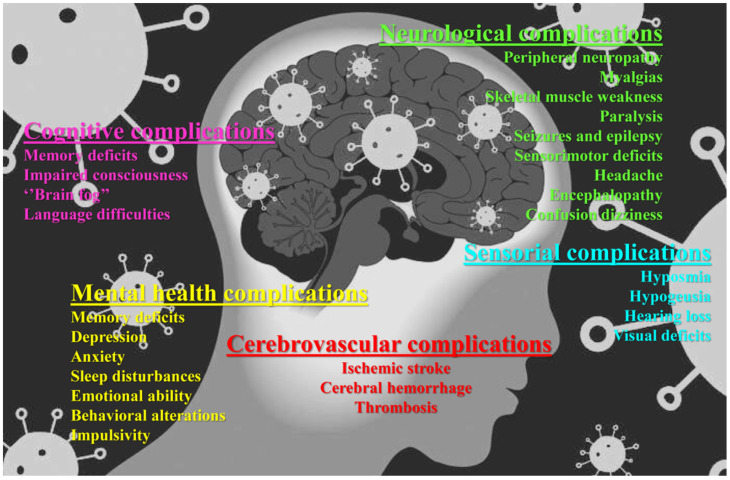
- Neurological complications persisting more than 2 years after acute infection include memory deficits (73%) and cognitive impairment/"brain fog" (85%), occurring at similar rates in hospitalized and non-hospitalized adults.
- ACE2 expression is significantly increased in brain tissue of AD subjects versus healthy controls, correlating with dementia severity and neuropathological parameters (dystrophic neurite density, Aβ plaques, NFT accumulation); Aβ1-42 (but not Aβ1-40) binds both the viral S1 protein and ACE2.
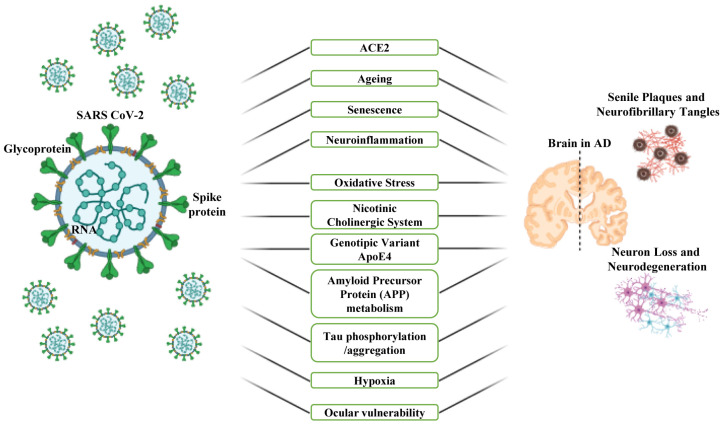
- Shared mechanisms include APOE4 (increased BBB permeability, pro-inflammatory cytokines, elevated SARS-CoV-2 infectivity in neurons/astrocytes, downregulated ACE2), NLRP3 inflammasome activation, α7nAChR impairment by the S1 glycoprotein, HIF-1α/hypoxia-driven AβPP processing, and tau hyperphosphorylation at AD-like epitopes (e.g., pSer262, pSer214, pSer356, pSer199/202) in COVID-19 brains.
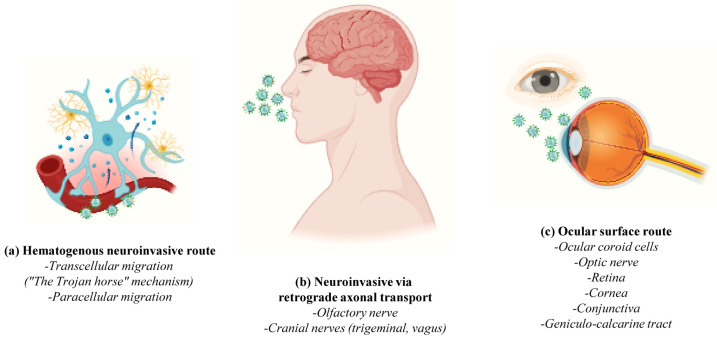
- Ocular involvement is proposed as a shared feature: ACE2/neuropilin-1 in cornea, conjunctiva, retina and RPE; SARS-CoV-2 RNA detected in retina, cornea, conjunctiva, lacrimal sacs and tears; and Aβ/pTau deposits found in AD retinas, sometimes before clinical cognitive symptoms.
Methods
- Narrative review (no primary data collection); the authors synthesize clinical, epidemiological, molecular, histological and experimental literature on COVID-19 and AD.
- Evidence cited spans autopsy/CSF studies, iPSC and brain organoid models, animal models (hACE2 mice, Syrian golden hamsters, MHV-1 mice, 3xTg-AD mice), transcriptomic/interactomic profiling, and clinical follow-up cohorts.
- The review is organized around shared risk factors/mechanisms (ACE2 and aging, neuroinflammation/oxidative stress/cholinergic system, APOE and signaling pathways, hypoxia, serotonin) and a dedicated section on neuro-ophthalmic complications.
Limitations
- Stated by the paper: whether SARS-CoV-2 is actually present in the brain remains debated—some studies identify direct neuroinvasion while others find no viral RNA or particles in human tissues and CSF, or only very low levels, suggesting neuropathology may be mediated by systemic cytokines; not all inoculated animals show neurological complications or full-blown CNS infection.
- Stated by the paper: whether the reciprocal SARS-CoV-2/AD association reflects direct causality or chronic systemic inflammation remains to be determined, and how post-infection sequelae affect memory processes needs clarification; clinical follow-up studies in large cohorts and further organoid work are called for.
- Evident from the text: as a narrative review it presents no systematic search strategy, inclusion criteria, or quantitative synthesis, and several cited mechanisms (e.g., kynurenine pathway, serotonin, hyperbaric oxygen) rest on small or preliminary studies; the authors also note that some proposed links (e.g., the "infection hypothesis of AD") are hypotheses rather than established findings.
Model-written summary. Check it against the paper before relying on it.
Integrity signals
Registry
Cites
Statistics
Figures
Verification
Claims the paper makes
0 Valid · 3 Not valid · 94 Not checked · 8 Own results and interpretations
None of the sources cited for this claim have been checked yet.
In the paper
“the neurotropism and the replication capacity of SARS-CoV-2 have been confirmed in neuronal cultures, brain organoids, mice and human brain autopsies”
§ COVID-19 and Alzheimer’s Disease Share Common Neurological and Ophthalmological Manifestations: A Bidirectional Risk in the Post-Pandemic Future > 1. Introduction
What the sources say
- Not checked yetcites [14] Ackermann M. Verleden S.E. Kuehnel M. Haverich A. Welte T. Laenger F. Vanstapel A. Werlein C. Stark H. Tzankov A. Pulmonary vascular endothelialitis, thrombosis, and angiogenesis in COVID-19 N. Engl. J. Med. 2020 383 120 128 10.1056/NEJMoa2015432 32437596 PMC7412750 source
- Not checked yetcites [15] Chu H. Chan J.F. Yuen T.T. Shuai H. Yuan S. Wang Y. Hu B. Yip C.C.-Y. Tsang J.O.-L. Huang X. Comparative tropism, replication kinetics, and cell damage profiling of SARS-CoV-2 and SARS-CoV with implications for clinical manifestations, transmissibility, and laboratory studies of COVID-19: An observational study Lancet Microbe 2020 1 e14 e23 10.1016/S2666-5247(20)30004-5 32835326 PMC7173822 source
- Not checked yetcites [16] Sun S.-H. Chen Q. Gu H.-J. Yang G. Wang Y.-X. Huang X.-Y. Liu S.-S. Zhang N.-N. Li X.-F. Xiong R. A Mouse Model of SARS-CoV-2 Infection and Pathogenesis Cell Host Microbe 2020 28 124 133.e4 10.1016/j.chom.2020.05.020 32485164 PMC7250783 source
- Not checked yetcites [17] Von Weyhern C.H. Kaufmann I. Neff F. Kremer M. Early evidence of pronounced brain involvement in fatal COVID-19 outcomes Lancet 2020 395 e109 10.1016/S0140-6736(20)31282-4 32505222 PMC7272176 source
- Not checked yetcites [18] Zhang B.-Z. Chu H. Han S. Shuai H. Deng J. Hu Y.-F. Gong H.-R. Lee A.C.-Y.K. Zou Z. Yau T. SARS-CoV-2 infects human neural progenitor cells and brain organoids Cell Res. 2020 30 928 931 10.1038/s41422-020-0390-x 32753756 PMC7399356 source
plain- Asserted: passes — The authors put it forward as true.
- Checkable: passes — It can be checked against evidence.
- Load-bearing: passes — The paper’s conclusions depend on it.
- Based: passes — The paper gives a reason why it holds.
A conclusion the paper draws from its own results — it cites no other source for it, so there is none to check. The quote shows it is in the paper.
In the paper
“A growing body of evidence indicates that a neuropathological cross-talk takes place between the coronavirus disease 2019 (COVID-19) -the pandemic severe pneumonia that has had a tremendous impact on the global economy and health since three years after its outbreak in December 2019- and Alzheimer’s Disease (AD)”
§ COVID-19 and Alzheimer’s Disease Share Common Neurological and Ophthalmological Manifestations: A Bidirectional Risk in the Post-Pandemic Future > Abstract
hedgedstates an association- Asserted: passes — The authors put it forward as true.
- Checkable: passes — It can be checked against evidence.
- Load-bearing: passes — The paper’s conclusions depend on it.
- Based: unclear — It is unclear why the paper says it holds.
None of the sources cited for this claim have been checked yet.
In the paper
“the definite evidence of SARS-CoV-2’s presence in the nervous system is a matter of debate since neither viral RNA nor particles have been found in human tissues and CSFs by other researchers”
§ COVID-19 and Alzheimer’s Disease Share Common Neurological and Ophthalmological Manifestations: A Bidirectional Risk in the Post-Pandemic Future > 2. Neuroinvasive Mechanisms of SARS-CoV-2 and Neurological Manifestations of COVID-19
What the sources say
- Not checked yetcites [39] Kremer S. Lersy F. Anheim M. Merdji H. Schenck M. Oesterlé H. Bolognini F. Messie J. Khalil A. Gaudemer A. Neurologic and neuroimaging findings in patients with COVID-19: A retrospective multicenter study Neurology 2020 95 e1868 e1882 10.1212/WNL.0000000000010112 32680942 source
- Not checked yetcites [40] Edén A. Kanberg N. Gostner J. Fuchs D. Hagberg L. Andersson L.-A. Lindh M. Price R.W. Zetterberg H. Gisslén M. CSF Biomarkers in Patients with COVID-19 and Neurologic Symptoms: A Case Series Neurology 2021 96 e294 e300 10.1212/WNL.0000000000012530 33004602
- Not checked yetcites [41] Destras G. Bal A. Escuret V. Morfin F. Lina B. Josset L. COVID-Diagnosis HCL Study Group. Systematic SARS-CoV-2 screening in cerebrospinal fluid during the COVID-19 pandemic Lancet Microbe 2020 1 e149 10.1016/S2666-5247(20)30066-5 32835345 PMC7289579 source
- Not checked yetcites [42] Espíndola O.M. Siqueira M. Soares C.N. Lima M.A.S.D. Leite A.C.C.B. Araujo A.Q.C. Brandão C.O. Silva M.T.T. Patients with COVID-19 and neurological manifestations show undetectable SARS-CoV-2 RNA levels in the cerebrospinal fluid Int. J. Infect. Dis. 2020 96 567 569 10.1016/j.ijid.2020.05.123 32505878 PMC7271861 source
- Not checked yetcites [43] Lee M.H. Perl D.P. Steiner J. Pasternack N. Li W. Maric D. Safavi F. Horkayne-Szakaly I. Jones R. Stram M.N. Neurovascular injury with complement activation and inflammation in COVID-19 Brain 2022 145 2555 2568 10.1093/brain/awac151 35788639 PMC9278212 source
hedged- Asserted: passes — The authors put it forward as true.
- Checkable: passes — It can be checked against evidence.
- Load-bearing: unclear — It is unclear whether the paper’s conclusions depend on it.
- Based: passes — The paper gives a reason why it holds.
None of the sources cited for this claim have been checked yet.
In the paper
“a strong bidirectional relationship existing between the COVID-19 infection and AD development has been clearly documented”
§ COVID-19 and Alzheimer’s Disease Share Common Neurological and Ophthalmological Manifestations: A Bidirectional Risk in the Post-Pandemic Future > 3. Bidirectional Relationships between Long COVID-19 and AD
What the sources say
- Not checked yetcites [69] Ferini-Strambi L. Salsone M. COVID-19 and neurological disorders: Are neurodegenerative or neuroimmunological diseases more vulnerable? J. Neurol. 2021 268 409 419 10.1007/s00415-020-10070-8 32696341 PMC7372546 source
- Not checked yetcites [70] Daroische R. Hemminghyth M.S. Eilertsen T.H. Breitve M.H. Chwiszczuk L.J. Cognitive Impairment after COVID-19—A Review on Objective Test Data Front. Neurol. 2021 12 699582 10.3389/fneur.2021.699582 34393978 PMC8357992 source
boostedstates an association- Asserted: passes — The authors put it forward as true.
- Checkable: passes — It can be checked against evidence.
- Load-bearing: passes — The paper’s conclusions depend on it.
- Based: passes — The paper gives a reason why it holds.
The paper states this without a source or data behind it here, so there is nothing to check it against. The quote shows it is in the paper.
In the paper
“its causative agent, the so-called Severe Acute Respiratory Syndrome coronavirus 2 (SARS-CoV-2), is also endowed with high neuro-invasive potential (Neurocovid).”
§ COVID-19 and Alzheimer’s Disease Share Common Neurological and Ophthalmological Manifestations: A Bidirectional Risk in the Post-Pandemic Future > Abstract
boosted- Asserted: passes — The authors put it forward as true.
- Checkable: passes — It can be checked against evidence.
- Load-bearing: passes — The paper’s conclusions depend on it.
- Based: unclear — It is unclear why the paper says it holds.
54 more claims
Create a free account to see all 105 claims and to verify the 236 references still open.
- It may state two separate claims as one. 37
- Probably not a substantial claim. 9
Citations
Cites
Hamming, I., Timens, W., Bulthuis, M., Lely, A., Navis, G., & van Goor, H. (2004) · The Journal of Pathology · doi:10.1002/path.1570 · Cited by 5,676
Pulmonary Vascular Endothelialitis, Thrombosis, and Angiogenesis in Covid-19
Ackermann, M., Verleden, S. E., Kuehnel, M., Haverich, A., Welte, T., Laenger, F., Vanstapel, A., Werlein, C., Stark, H., Tzankov, A., et al. (2020) · New England Journal of Medicine · doi:10.1056/nejmoa2015432 · Cited by 5,613
Scheltens, P., De Strooper, B., Kivipelto, M., Holstege, H., Chételat, G., Teunissen, C. E., Cummings, J., & van der Flier, W. M. (2021) · The Lancet · doi:10.1016/s0140-6736(20)32205-4 · Cited by 5,465
Nalbandian, A., Sehgal, K., Gupta, A., Madhavan, M. V., McGroder, C., Stevens, J. S., Cook, J. R., Nordvig, A. S., Shalev, D., Sehrawat, T. S., et al. (2021) · Nature Medicine · doi:10.1038/s41591-021-01283-z · Cited by 4,862
Dysregulation of Immune Response in Patients With Coronavirus 2019 (COVID-19) in Wuhan, China
Qin, C., Zhou, L., Hu, Z., Zhang, S., Yang, S., Tao, Y., Xie, C., Ma, K., Shang, K., Wang, W., et al. (2020) · Clinical Infectious Diseases · doi:10.1093/cid/ciaa248 · Cited by 4,775
Long COVID: major findings, mechanisms and recommendations
Davis, H. E., McCorkell, L., Vogel, J. M., & Topol, E. J. (2023) · Nature Reviews Microbiology · doi:10.1038/s41579-022-00846-2 · Cited by 4,153
Ageing as a risk factor for neurodegenerative disease
Hou, Y., Dan, X., Babbar, M., Wei, Y., Hasselbalch, S. G., Croteau, D. L., & Bohr, V. A. (2019) · Nature Reviews Neurology · doi:10.1038/s41582-019-0244-7 · Cited by 3,310
Comprehensive Review on Alzheimer’s Disease: Causes and Treatment
Breijyeh, Z., & Karaman, R. (2020) · Molecules · doi:10.3390/molecules25245789 · Cited by 2,789 · cited 1×
“…Alzheimer’s Disease (AD)—the most prevalent form of neurodegenerative dementia among the elderly with more than 55 million people world-wide [1,2]—and the global pandemic coronavirus disease 2019 (COVID-19), caused by the novel etiological agent known as Severe Acute Respiratory Syndrome…”
BackgroundNeurologic features in severe SARS-CoV-2 infection
Helms, J., Kremer, S., Merdji, H., Clere-Jehl, R., Schenck, M., Kummerlen, C., Collange, O., Boulay, C., Fafi-Kremer, S., Ohana, M., et al. (2020) · New England Journal of Medicine · doi:10.1056/nejmc2008597 · Cited by 2,674
Inflammation as a central mechanism in Alzheimer's disease
Kinney, J. W., Bemiller, S. M., Murtishaw, A. S., Leisgang, A. M., Salazar, A. M., & Lamb, B. T. (2018) · Alzheimer's & Dementia: Translational Research & Clinical Interventions · doi:10.1016/j.trci.2018.06.014 · Cited by 2,253
Cited by
Gusev, E., & Sarapultsev, A. (2024) · International Journal of Molecular Sciences · doi:10.3390/ijms25126389 · Cited by 46
Maggiore, A., Latina, V., D’Erme, M., Amadoro, G., & Coccurello, R. (2024) · Ageing Research Reviews · doi:10.1016/j.arr.2024.102578 · Cited by 27
Self-citationLi, J., KONG, X., Liu, T., Xian, M., & Wei, J. (2024) · International Journal of Molecular Sciences · doi:10.3390/ijms25189960 · Cited by 20
Pulliam, L., Sun, B., McCafferty, E., Soper, S. A., Witek, M. A., Hu, M., Ford, J. M., Song, S., Kapogiannis, D., Glesby, M. J., et al. (2024) · International Journal of Molecular Sciences · doi:10.3390/ijms25073830 · Cited by 18
Ilić, I., Jakovljevic, V. L., Mačužić, I. Ž., Ravić‐Nikolić, A., Ilić, M., Šorak, M., & Milicic, V. M. (2024) · Medicina · doi:10.3390/medicina60111783 · Cited by 18
Metadata
- Authors
- Amadoro, G., Latina, V., Stigliano, E., & Micera, A.
- Affiliations
- Istituto di Farmacologia Traslazionale (IT)
- Università Cattolica del Sacro Cuore (IT)
- Fondazione G.B. Bietti (IT)
- Corresponding author
- Amadoro, Giuseppina
- Micera, Alessandra
- Venue
- Cells
- Publisher
- MDPI AG
- Published
- 2023-11-10
- Volume
- 12
- Issue
- 22
- Pages
- 2601
- ISSN
- 2073-4409 (ISSN-L)
- PMC
- PMC10670749
- OpenAlex
- W4388636296
- Cited by
- 22
- References
- 274
- Citations by year
- 2026: 4 · 2025: 6 · 2024: 12
- FWCI
- 0.77
- Type
- journal article
- Language
- en
- Open access
- gold
- doi.org
- Licence
- Locations
- Cells (publishedVersion, cc-by)
- PubMed Central (publishedVersion, cc-by)
- PubMed (publishedVersion)
- DOAJ (DOAJ: Directory of Open Access Journals) (submittedVersion)
- Funders
- Regione Lazio, POR FESR Lazio 2014–2020 (T0002E0001 G04014_13_04_2021, 971925, RF-2021-12374301, FOE D.M865/2019)
- “Progetti di Gruppi di Ricerca 2020” (Determinazione dirigenziale n.G08487 del 19 luglio 2020) Project (T0002E0001 G04014_13_04_2021, 971925, RF-2021-12374301, FOE D.M865/2019)
- Alzheimer’s Association Research Grant (T0002E0001 G04014_13_04_2021, 971925, RF-2021-12374301, FOE D.M865/2019)
- Ministry of Health (T0002E0001 G04014_13_04_2021, 971925, RF-2021-12374301, FOE D.M865/2019)
- PNRR (National Plan for Recovery and Resilience Next Generation EU) (T0002E0001 G04014_13_04_2021, 971925, RF-2021-12374301, FOE D.M865/2019)
- Fondo Ordinario Enti (T0002E0001 G04014_13_04_2021, 971925, RF-2021-12374301, FOE D.M865/2019)
- Fondazione Roma and Italian Ministry of Health (Ricerca Corrente) (Italy) (T0002E0001 G04014_13_04_2021, 971925, RF-2021-12374301, FOE D.M865/2019)
- Topics
- Health Sciences › Medicine › Clinical Neurology › Long-Term Effects of COVID-19
- Life Sciences › Neuroscience › Cellular and Molecular Neuroscience › Alzheimer's disease research and treatments
- Health Sciences › Medicine › Infectious Diseases › COVID-19 Clinical Research Studies
- Keywords
- COVID-19 pandemic, Alzheimer's disease, SARS-CoV-2, neuroinvasion, ACE2 receptor, apolipoprotein E, aging, neuroinflammation, amyloid-beta, tau pathology, ocular manifestations, anosmia, memory decline, dementia risk
- MeSH terms
- COVID-19, SARS-CoV-2, Alzheimer Disease, Humans, Nervous System Diseases, Amyloid beta-Peptides, Pandemics
About these checks
Registry, retraction, Cites and statistics results are computed, not judged, with one exception: a printed reference that no index lists is read once by a model before it counts as a citation error. Claims are extracted by a model and kept only when their quote appears verbatim in the text; each cited source is then checked, with a model’s help, for whether it says what the claim relies on. Those verdicts can be wrong — read the claim’s quote and the cited source before relying on one.
A language model drew the claims from the paper on 2026-11-26, under version 3 of the claim definition (model deepseek-v4.1-flash, prompt extract-v3).
A second model labelled each claim on 2026-11-26 (model jev-1.13-20260917, definition revision gold-guideline-v0.2).
Statistics and arithmetic are recomputed, not judged.
Confidence bands are shown only for fields calibrated on our annotated test set. None is calibrated yet, so no band is shown.
What counts as a claim ›How we measure confidence ›How we check this ›
Are you an author, or do you see a problem with this page? Request a review
How to cite
Cite CoChat for the checks on this page, and the paper for its own findings.
- This page
- CoChat. (2026). Citation check: COVID-19 and Alzheimer’s Disease Share Common Neurological and Ophthalmological Manifestations: A Bidirectional Risk in the Post-Pandemic Future. https://app.cochat.ai/papers/10.3390/cells12222601
- The paper
- Amadoro, G., Latina, V., Stigliano, E., & Micera, A. (2023). COVID-19 and Alzheimer’s Disease Share Common Neurological and Ophthalmological Manifestations: A Bidirectional Risk in the Post-Pandemic Future. Cells. https://doi.org/10.3390/cells12222601
Data sources
Bibliographic data: Semantic Scholar, OpenAlex, Crossref.
Contains information from the Semantic Scholar Academic Graph Datasets, made available under the ODC Attribution License (ODC-BY 1.0).
Semantic Scholar’s data is described in: Kinney, R., et al. (2023). The Semantic Scholar Open Data Platform. arXiv:2301.10140.
