

The DOI matches its Crossref record; 118 of the 118 references it cites were found in a registry or an index.
Chaperone-Mediated Autophagy and Its Emerging Role in Hematological Malignancies
Abstract
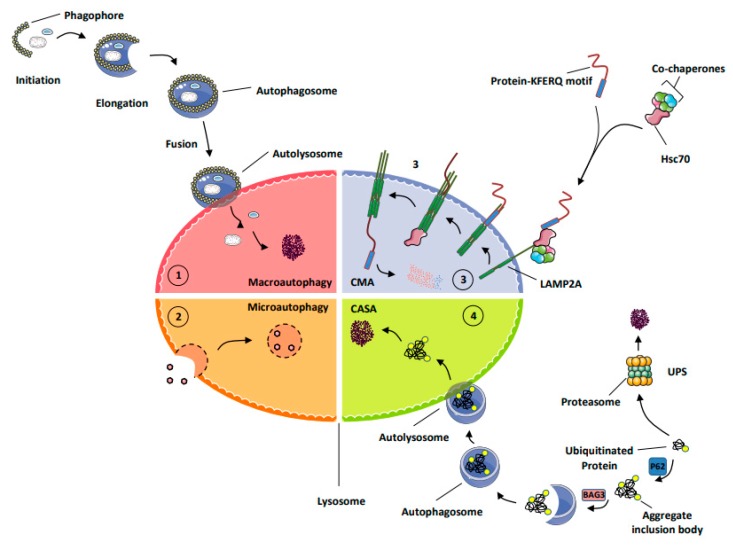
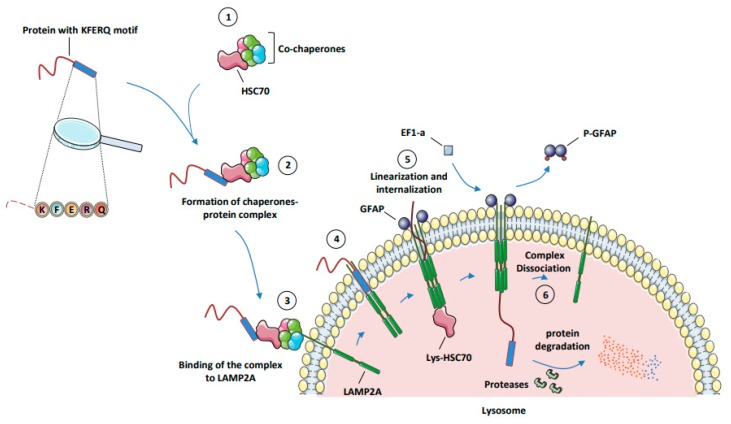
Chaperone-mediated autophagy (CMA) ensures the selective degradation of cellular proteins endowed with a KFERQ-like motif by lysosomes. It is estimated that 30% of all cellular proteins can be directed to the lysosome for CMA degradation, but only a few substrates have been formally identified so far. Mechanistically, the KFERQ-like motifs present in substrate proteins are recognized by the molecular chaperone Hsc70c (Heat shock cognate 71 kDa protein cytosolic), also known as HSPA8, and directed to LAMP2A, which acts as the CMA receptor at the lysosomal surface. Following linearization, the protein substrate is next transported to the lumen of the lysosomes, where it is degraded by resident proteases, mainly cathepsins and eventually recycled to sustain cellular homeostasis. CMA is induced by different stress conditions, including energy deprivation that also activates macro-autophagy (MA), that may make it difficult to decipher the relative impact of both pathways on cellular homeostasis. Besides common inducing triggers, CMA and MA might be induced as compensatory mechanisms when either mechanism is altered, as it is the often the case in different pathological settings. Therefore, CMA activation can compensate for alterations of MA and vice versa. In this context, these compensatory mechanisms, when occurring, may be targeted for therapeutic purposes. Both processes have received particular attention from scientists and clinicians, since modulation of MA and CMA may have a profound impact on cellular proteostasis, metabolism, death, differentiation, and survival and, as such, could be targeted for therapeutic intervention in degenerative and immune diseases, as well as in cancer, including hematopoietic malignancies. The role of MA in cancer initiation and progression is now well established, but whether and how CMA is involved in tumorigenesis has been only sparsely explored. In the present review, we encompass the description of the mechanisms involved in CMA, its function in the physiology and pathogenesis of hematopoietic cells, its emerging role in cancer initiation and development, and, finally, the potential therapeutic opportunity to target CMA or CMA-mediated compensatory mechanisms in hematological malignancies.
Overview
The claims and statistics of this paper haven’t been checked yet.
Run the check — free, no account needed. It reads the open-access text and checks the sources it cites.
Integrity signals
Registry
Cites
Statistics
Figures
Verification
Claims the paper makes
The claims and statistics of this paper haven’t been checked yet.
Run the check — free, no account needed. It reads the open-access text and checks the sources it cites.
Claims other papers make about this one
Each is checked against this paper’s own text: does it say what the citing paper says it does?
In the citing paper
“This approach can be applied to RhoH as the presence of the inserted domain, LFSINE, at the C-terminal was shown to act as a recognition signal for lysosomal uptake and CMA-mediated degradation, while not affecting its function on both T cells and B cells [26].”
From The Role of RhoH in TCR Signalling and Its Involvement in Diseases (2021) · cites this paper as [112]
In the citing paper
“Additionally, deregulated RhoH protein expression can be corrected by using the current approach that relies on the potential therapeutic opportunity to target CMA [112].”
From The Role of RhoH in TCR Signalling and Its Involvement in Diseases (2021) · cites this paper as [112]
Self-check
Percentages, sums and reported differences re-computed from the paper’s own numbers.
The self-check needs the paper’s full text.
Citations
Cites
1 retracted
RETRACTED ARTICLE: LAMP2 expression dictates azacytidine response and prognosis in MDS/AML
Dubois, A., Furstoss, N., Calleja, A., Zerhouni, M., Cluzeau, T., Savy, C., Marchetti, S., Hamouda, M. A., Boulakirba, S., Orange, F., et al. (2019) · Leukemia · doi:10.1038/s41375-018-0336-1 · Cited by 24
Self-citationRetractedRepertoires of Autophagy in the Pathogenesis of Ocular Diseases
Li, Y.-J., Jiang, Q., Cao, G.-F., Yao, J., & Yan, B. (2015) · Cellular Physiology and Biochemistry · doi:10.1159/000373980 · Cited by 16,304
Genomic classification and prognosis in acute myeloid leukemia
Papaemmanuil, E., Gerstung, M., Bullinger, L., Gaidzik, V. I., Paschka, P., Roberts, N. D., Potter, N. E., Heuser, M., Thol, F., Bolli, N., et al. (2016) · New England Journal of Medicine · doi:10.1056/nejmoa1516192 · Cited by 4,350
Tissue fractionation studies. 6. Intracellular distribution patterns of enzymes in rat-liver tissue
de Duve, C., Pressman, B. C., Gianetto, R., Wattiaux, R., & Appelmans, F. (1955) · Biochemical Journal · doi:10.1042/bj0600604 · Cited by 4,174
de Duve, C., & Wattiaux, R. (1966) · Annual Review of Physiology · doi:10.1146/annurev.ph.28.030166.002251 · Cited by 3,033 · cited 1×
“The term micro-autophagy was introduced by de Duve and Wattiaux at the end of the sixties to describe a process involving the invagination of the lysosomal membrane to sequestrate small cytoplasmic constituents for degradation [7].”
BackgroundAdapting Proteostasis for Disease Intervention
Balch, W. E., Morimoto, R. I., Dillin, A., & Kelly, J. W. (2008) · Science · doi:10.1126/science.1141448 · Cited by 2,495
Rel/NF-kappa B/I kappa B family: intimate tales of association and dissociation.
Verma, I. M., Stevenson, J. K., Schwarz, E. M., Van Antwerp, D., & Miyamoto, S. (1995) · Genes & Development · doi:10.1101/gad.9.22.2723 · Cited by 1,724
Lysosome biogenesis and lysosomal membrane proteins: trafficking meets function
Saftig, P., & Klumperman, J. (2009) · Nature Reviews Molecular Cell Biology · doi:10.1038/nrm2745 · Cited by 1,648
Accumulation of autophagic vacuoles and cardiomyopathy in LAMP-2-deficient mice
Tanaka, Y., Guhde, G., Suter, A., Eskelinen, E.-L., Hartmann, D., Lüllmann-Rauch, R., Janssen, P. M. L., Blanz, J., von Figura, K., & Saftig, P. (2000) · Nature · doi:10.1038/35022595 · Cited by 925
Microautophagy of Cytosolic Proteins by Late Endosomes
Sahu, R., Kaushik, S., Clement, C. C., Cannizzo, E. S., Scharf, B., Follenzi, A., Potolicchio, I., Nieves, E., Cuervo, A. M., & Santambrogio, L. (2011) · Developmental Cell · doi:10.1016/j.devcel.2010.12.003 · Cited by 902
Patra, K. C., Wang, Q., Bhaskar, P. T., Miller, L., Wang, Z., Wheaton, W., Chandel, N., Laakso, M., Muller, W. J., Allen, E. L., et al. (2013) · Cancer Cell · doi:10.1016/j.ccr.2013.06.014 · Cited by 853
Chaperone-mediated autophagy: a unique way to enter the lysosome world
Kaushik, S., & Cuervo, A. M. (2012) · Trends in Cell Biology · doi:10.1016/j.tcb.2012.05.006 · Cited by 850
Pyruvate kinase type M2 and its role in tumor growth and spreading
Mazurek, S., Boschek, C. B., Hugo, F., & Eigenbrodt, E. (2005) · Seminars in Cancer Biology · doi:10.1016/j.semcancer.2005.04.009 · Cited by 812
Vogiatzi, T., Xilouri, M., Vekrellis, K., & Stefanis, L. (2008) · Journal of Biological Chemistry · doi:10.1074/jbc.m801992200 · Cited by 683
Age-related decline in chaperone-mediated autophagy
Cuervo, A. M., & Dice, J. F. (2000) · Journal of Biological Chemistry · doi:10.1074/jbc.m002102200 · Cited by 665
The autophagy protein Atg7 is essential for hematopoietic stem cell maintenance
Mortensen, M., Soilleux, E. J., Djordjevic, G., Tripp, R., Lutteropp, M., Sadighi-Akha, E., Stranks, A. J., Glanville, J., Knight, S., W. Jacobsen, S.-E., et al. (2011) · Journal of Experimental Medicine · doi:10.1084/jem.20101145 · Cited by 657
A heat-stable polypeptide component of an ATP-dependent proteolytic system from reticulocytes
Ciehanover, A., Hod, Y., & Hershko, A. (1978) · Biochemical and Biophysical Research Communications · doi:10.1016/0006-291x(78)91249-4 · Cited by 648
Activation of Chaperone-mediated Autophagy during Oxidative Stress
Kiffin, R., Christian, C., Knecht, E., & Cuervo, A. M. (2004) · Molecular Biology of the Cell · doi:10.1091/mbc.e04-06-0477 · Cited by 612
Lv, L., Li, D., Zhao, D., Lin, R., Chu, Y., Zhang, H., Zha, Z., Liu, Y., Li, Z., Xu, Y., et al. (2011) · Molecular Cell · doi:10.1016/j.molcel.2011.04.025 · Cited by 610
Dice, J. F. (2007) · Autophagy · doi:10.4161/auto.4144 · Cited by 569
Bandyopadhyay, U., Kaushik, S., Varticovski, L., & Cuervo, A. M. (2008) · Molecular and Cellular Biology · doi:10.1128/mcb.02070-07 · Cited by 561
Chaperone-Mediated Autophagy Markers in Parkinson Disease Brains
Alvarez-Erviti, L., Rodriguez-Oroz, M. C., Cooper, J. M., Caballero, C., Ferrer, I., Obeso, J. A., & Schapira, A. H. V. (2010) · Archives of Neurology · doi:10.1001/archneurol.2010.198 · Cited by 554
Consequences of the selective blockage of chaperone-mediated autophagy
Massey, A. C., Kaushik, S., Sovak, G., Kiffin, R., & Cuervo, A. M. (2006) · Proceedings of the National Academy of Sciences · doi:10.1073/pnas.0507436103 · Cited by 529
Shikonin and its analogs inhibit cancer cell glycolysis by targeting tumor pyruvate kinase-M2
Chen, J., Xie, J., Jiang, Z., Wang, B., Wang, Y., & Hu, X. (2011) · Oncogene · doi:10.1038/onc.2011.137 · Cited by 512
Autophagy: Many paths to the same end
Cuervo, A. M. (2004) · Molecular and Cellular Biochemistry · doi:10.1023/b:mcbi.0000041848.57020.57 · Cited by 476
The ubiquitin‐proteasome pathway and proteasome inhibitors
Myung, J., Kim, K. B., & Crews, C. M. (2001) · Medicinal Research Reviews · doi:10.1002/med.1009 · Cited by 446
McAfee, Q., Zhang, Z., Samanta, A., Levi, S. M., Ma, X.-H., Piao, S., Lynch, J. P., Uehara, T., Sepulveda, A. R., Davis, L. E., et al. (2012) · Proceedings of the National Academy of Sciences · doi:10.1073/pnas.1118193109 · Cited by 422
Structural Basis for Tumor Pyruvate Kinase M2 Allosteric Regulation and Catalysis,
Dombrauckas, J. D., Santarsiero, B. D., & Mesecar, A. D. (2005) · Biochemistry · doi:10.1021/bi0474923 · Cited by 409
A molecular chaperone complex at the lysosomal membrane is required for protein translocation
Agarraberes, F. A., & Dice, J. F. (2001) · Journal of Cell Science · doi:10.1242/jcs.114.13.2491 · Cited by 404
Protein homeostasis and aging in neurodegeneration
Douglas, P. M., & Dillin, A. (2010) · Journal of Cell Biology · doi:10.1083/jcb.201005144 · Cited by 372
Akt inhibitors in cancer treatment: The long journey from drug discovery to clinical use (Review)
NITULESCU, G. M., MARGINA, D., JUZENAS, P., PENG, Q., OLARU, O. T., SALOUSTROS, E., FENGA, C., SPANDIDOS, D. A., LIBRA, M., & TSATSAKIS, A. M. (2016) · International Journal of Oncology · doi:10.3892/ijo.2015.3306 · Cited by 364
The p65 subunit of NF-kappa B regulates I kappa B by two distinct mechanisms.
Scott, M. L., Fujita, T., Liou, H. C., Nolan, G. P., & Baltimore, D. (1993) · Genes & Development · doi:10.1101/gad.7.7a.1266 · Cited by 354
Eradication of acute promyelocytic leukemia-initiating cells through PML-RARA degradation
Nasr, R., Guillemin, M.-C., Ferhi, O., Soilihi, H., Peres, L., Berthier, C., Rousselot, P., Robledo-Sarmiento, M., Lallemand-Breitenbach, V., Gourmel, B., et al. (2008) · Nature Medicine · doi:10.1038/nm.1891 · Cited by 354
Deficient Chaperone-Mediated Autophagy in Liver Leads to Metabolic Dysregulation
Schneider, J. L., Suh, Y., & Cuervo, A. M. (2014) · Cell Metabolism · doi:10.1016/j.cmet.2014.06.009 · Cited by 340
Constitutive Activation of Chaperone-mediated Autophagy in Cells with Impaired Macroautophagy
Kaushik, S., Massey, A. C., Mizushima, N., & Cuervo, A. M. (2008) · Molecular Biology of the Cell · doi:10.1091/mbc.e07-11-1155 · Cited by 335
Chaperone-mediated autophagy in aging and disease
Massey, A. C., Zhang, C., & Cuervo, A. M. (2006) · Current Topics in Developmental Biology · doi:10.1016/s0070-2153(05)73007-6 · Cited by 315
Regulation of Neuronal Survival Factor MEF2D by Chaperone-Mediated Autophagy
Yang, Q., She, H., Gearing, M., Colla, E., Lee, M., Shacka, J. J., & Mao, Z. (2009) · Science · doi:10.1126/science.1166088 · Cited by 304
Cuervo, A. M., Dice, J. F., & Knecht, E. (1997) · Journal of Biological Chemistry · doi:10.1074/jbc.272.9.5606 · Cited by 298
Harnessing chaperone-mediated autophagy for the selective degradation of mutant huntingtin protein
Bauer, P. O., Goswami, A., Wong, H. K., Okuno, M., Kurosawa, M., Yamada, M., Miyazaki, H., Matsumoto, G., Kino, Y., Nagai, Y., et al. (2010) · Nature Biotechnology · doi:10.1038/nbt.1608 · Cited by 280
Lysosomal mTORC2/PHLPP1/Akt Regulate Chaperone-Mediated Autophagy
Arias, E., Koga, H., Diaz, A., Mocholi, E., Patel, B., & Cuervo, A. M. (2015) · Molecular Cell · doi:10.1016/j.molcel.2015.05.030 · Cited by 280
Chaperone-Mediated Autophagy Is Required for Tumor Growth
Kon, M., Kiffin, R., Koga, H., Chapochnick, J., Macian, F., Varticovski, L., & Cuervo, A. M. (2011) · Science Translational Medicine · doi:10.1126/scitranslmed.3003182 · Cited by 261
Chaperone-mediated autophagy. Molecular mechanisms and physiological relevance
Orenstein, S. J., & Cuervo, A. M. (2010) · Seminars in Cell & Developmental Biology · doi:10.1016/j.semcdb.2010.02.005 · Cited by 260
TFEB regulates autophagy: An integrated coordination of cellular degradation and recycling processes
Settembre, C., & Ballabio, A. (2011) · Autophagy · doi:10.4161/auto.7.11.17166 · Cited by 260
Valdor, R., Mocholi, E., Botbol, Y., Guerrero-Ros, I., Chandra, D., Koga, H., Gravekamp, C., Cuervo, A. M., & Macian, F. (2014) · Nature Immunology · doi:10.1038/ni.3003 · Cited by 244 · cited 1×
“More recently, this pathway was also identified as one of the mechanism of CMA activation under oxidative stress [15,21].”
BackgroundPyruvate kinase M2-specific siRNA induces apoptosis and tumor regression
Goldberg, M. S., & Sharp, P. A. (2012) · The Journal of Experimental Medicine · doi:10.1084/jem.20111487 · Cited by 238
A photoconvertible fluorescent reporter to track chaperone-mediated autophagy
Koga, H., Martínez‐Vicente, M., Macián, F., Verkhusha, V. V., & Cuervo, A. M. (2011) · Nature Communications · doi:10.1038/ncomms1393 · Cited by 228
Lysosome membrane lipid microdomains: novel regulators of chaperone‐mediated autophagy
Kaushik, S., Massey, A. C., & Cuervo, A. M. (2006) · The EMBO Journal · doi:10.1038/sj.emboj.7601283 · Cited by 223
Chemical modulation of chaperone-mediated autophagy by retinoic acid derivatives
Anguiano, J., Garner, T. P., Mahalingam, M., Das, B. C., Gavathiotis, E., & Cuervo, A. M. (2013) · Nature Chemical Biology · doi:10.1038/nchembio.1230 · Cited by 222
Pajares, M., Rojo, A. I., Arias, E., Díaz-Carretero, A., Cuervo, A. M., & Cuadrado, A. (2018) · Autophagy · doi:10.1080/15548627.2018.1474992 · Cited by 218
A Unified Approach to Targeting the Lysosome's Degradative and Growth Signaling Roles
Rebecca, V. W., Nicastri, M. C., McLaughlin, N. P., Fennelly, C., Mcafee, Q. W., Ronghe, A. M., Nofal, M., Lim, C.-Y., Witze, E. S., Chude, C. I., et al. (2017) · Cancer Discovery · doi:10.1158/2159-8290.cd-17-0741 · Cited by 213
Chaperone-mediated autophagy degrades mutant p53Preprint
Vakifahmetoglu-Norberg, H., Kim, M., Xia, H., Iwanicki, M., Ofengeim, D., Coloff, J. L., Pan, L., Ince, T. A., Kroemer, G., Brugge, J. S., et al. (2013) · Genes & Development · doi:10.1101/gad.220897.113 · Cited by 212
Pathophysiology of chaperone-mediated autophagy
Massey, A. C., Kiffin, R., & Cuervo, A. M. (2004) · The International Journal of Biochemistry & Cell Biology · doi:10.1016/j.biocel.2004.04.010 · Cited by 210
Alvarez‐Erviti, L., Seow, Y., Schapira, A. H. V., Rodríguez-Oroz, M. C., Obeso, J. A., & Cooper, J. A. D. (2013) · Cell Death and Disease · doi:10.1038/cddis.2013.73 · Cited by 208
Wang, C., Wang, H., Zhang, D., Luo, W., Liu, R., Xu, D., Diao, L., Liao, L., & Liu, Z. (2018) · Nature Communications · doi:10.1038/s41467-018-05449-1 · Cited by 206
Loss of hepatic chaperone‐mediated autophagy accelerates proteostasis failure in aging
Schneider, J. L., Villarroya, J., Díaz-Carretero, A. M., Patel, B., Urbanska, A. M., Thi, M. M., Villarroya, F., Santambrogio, L., & Cuervo, A. M. (2015) · Aging Cell · doi:10.1111/acel.12310 · Cited by 202
STUB1/CHIP is required for HIF1A degradation by chaperone-mediated autophagy
Ferreira, J. V., Fofo, H., Bejarano, E., Bento, C. F., Ramalho, J. S., Girão, H., & Pereira, P. (2013) · Autophagy · doi:10.4161/auto.25190 · Cited by 191
Cathepsin A regulates chaperone‐mediated autophagy through cleavage of the lysosomal receptor
Cuervo, A. M., Mann, L., Bonten, E. J., d'Azzo, A., & Dice, J. F. (2003) · The EMBO Journal · doi:10.1093/emboj/cdg002 · Cited by 182
Constitutive Upregulation of Chaperone-Mediated Autophagy in Huntington's Disease
Koga, H., Martínez‐Vicente, M., Arias, E., Kaushik, S., Sulzer, D., & Cuervo, A. M. (2011) · Journal of Neuroscience · doi:10.1523/jneurosci.3219-11.2011 · Cited by 178
Saha, T. (2012) · Autophagy · doi:10.4161/auto.21654 · Cited by 164
Uptake and degradation of glyceraldehyde-3-phosphate dehydrogenase by rat liver lysosomes
Aniento, F., Roche, E., Cuervo, A. M., & Knecht, E. (1993) · Journal of Biological Chemistry · doi:10.1016/s0021-9258(18)82222-0 · Cited by 161
Wing, S. S., Chiang, H. L., Goldberg, A. L., & Dice, J. F. (1991) · Biochemical Journal · doi:10.1042/bj2750165 · Cited by 154
Effects of Small Molecules on Chaperone-Mediated Autophagy
Finn, P. F., Mesires, N. T., Vine, M., & Dice, J. F. (2005) · Autophagy · doi:10.4161/auto.1.3.2000 · Cited by 153
Autophagy, a key mechanism of oncogenesis and resistance in leukemia
Auberger, P., & Puissant, A. (2016) · Blood · doi:10.1182/blood-2016-07-692707 · Cited by 153
Self-citationIκB Is a Substrate for a Selective Pathway of Lysosomal Proteolysis
Cuervo, A. M., Hu, W., Lim, B., & Dice, J. F. (1998) · Molecular Biology of the Cell · doi:10.1091/mbc.9.8.1995 · Cited by 152
Goussetis, D. J., Gounaris, E. G., Wu, E. J., Vakana, E., Sharma, B., Bogyo, M. S., Altman, J. K., & Platanias, L. C. (2012) · Blood · doi:10.1182/blood-2012-01-402578 · Cited by 144
DJ-1 Inhibits α-Synuclein Aggregation by Regulating Chaperone-Mediated Autophagy
Xu, C., Kang, W., Chen, Y., Jiang, T., Zhang, J., Zhang, L., Ding, J., Liu, J., & Chen, S. (2017) · Frontiers in Aging Neuroscience · doi:10.3389/fnagi.2017.00308 · Cited by 144
Phosphorylation of LAMP2A by p38 MAPK couples ER stress to chaperone-mediated autophagy
Li, W., Zhu, J., Dou, J., She, H., Tao, K. X., Xu, H., Yang, Q., & Mao, Z. (2017) · Nature Communications · doi:10.1038/s41467-017-01609-x · Cited by 144
The Role of Chaperone-Mediated Autophagy in Huntingtin Degradation
Qi, L., Zhang, X., Wu, J.-C., Lin, F., Wang, J., DiFiglia, M., & Qin, Z.-H. (2012) · PLoS ONE · doi:10.1371/journal.pone.0046834 · Cited by 140
Targeting quiescent leukemic stem cells using second generation autophagy inhibitors
Baquero, P., Dawson, A., Mukhopadhyay, A., Kuntz, E. M., Mitchell, R., Olivares, O., Ianniciello, A., Scott, M. T., Dunn, K. M., Nicastri, M. C., et al. (2018) · Leukemia · doi:10.1038/s41375-018-0252-4 · Cited by 132
Impairment of chaperone-mediated autophagy induces dopaminergic neurodegeneration in rats
Xilouri, M., Brekk, O. R., Polissidis, A., Chrysanthou‐Piterou, M., Kloukina, I., & Stefanis, L. (2016) · Autophagy · doi:10.1080/15548627.2016.1214777 · Cited by 129
Degradation of HK2 by chaperone-mediated autophagy promotes metabolic catastrophe and cell death
Xia, H.-G., Najafov, A., Geng, J., Galan-Acosta, L., Han, X., Guo, Y., Shan, B., Zhang, Y., Norberg, E., Zhang, T., et al. (2015) · Journal of Cell Biology · doi:10.1083/jcb.201503044 · Cited by 122
Protein translocation across membranes
Agarraberes, F. A., & Dice, J. F. (2001) · Biochimica et Biophysica Acta (BBA) - Biomembranes · doi:10.1016/s0304-4157(01)00005-3 · Cited by 115
Antiapoptotic potency of Bcl-2 proteins primarily relies on their stability, not binding selectivity
Rooswinkel, R. W., van de Kooij, B., de Vries, E., Paauwe, M., Braster, R., Verheij, M., & Borst, J. G. (2014) · Blood · doi:10.1182/blood-2013-08-519470 · Cited by 114
Gomes, L. R., Menck, C. F. M., & Cuervo, A. M. (2017) · Autophagy · doi:10.1080/15548627.2017.1293767 · Cited by 107
Chaperone-mediated autophagy regulates proliferation by targeting RND3 in gastric cancer
Zhou, J., Yang, J., Fan, X., Hu, S., Zhou, F., Dong, J., Zhang, S., Shang, Y., Jiang, X., Guo, H., et al. (2016) · Autophagy · doi:10.1080/15548627.2015.1136770 · Cited by 104
Pathobiology, classification, and diagnosis of myelodysplastic syndrome
Mufti, G. J. (2004) · Best Practice & Research Clinical Haematology · doi:10.1016/j.beha.2004.08.007 · Cited by 100
Protein kinase C inhibits autophagy and phosphorylates LC3
Jiang, H., Cheng, D., Liu, W., Peng, J., & Feng, J. (2010) · Biochemical and Biophysical Research Communications · doi:10.1016/j.bbrc.2010.04.030 · Cited by 99
Chaperone-mediated autophagy: Dice's 'wild' idea about lysosomal selectivity
Cuervo, A. M. (2011) · Nature Reviews Molecular Cell Biology · doi:10.1038/nrm3150 · Cited by 95
BCL2L10 is a predictive factor for resistance to Azacitidine in MDS and AML patients
Cluzeau, T., Robert, G., Mounier, N., Karsenti, J. M., Dufies, M., Puissant, A., Jacquel, A., Renneville, A., Preudhomme, C., Cassuto, J. P., et al. (2012) · Oncotarget · doi:10.18632/oncotarget.481 · Cited by 93
Self-citationTargetome analysis of chaperone-mediated autophagy in cancer cells
Hao, Y., Kacal, M., Ouchida, A. T., Zhang, B., Norberg, E., & Vakifahmetoglu-Norberg, H. (2019) · Autophagy · doi:10.1080/15548627.2019.1586255 · Cited by 92
Wang, Y., Martinez-Vicente, M., Krüger, U., Kaushik, S., Wong, E., Mandelkow, E.-M., Cuervo, A. M., & Mandelkow, E. (2010) · Autophagy · doi:10.4161/auto.6.1.10815 · Cited by 90
Zhang, J., Johnson, J. L., He, J. N., Napolitano, G., Ramadass, M., Rocca, C. J., Kiosses, W. B., Bucci, C., Xin, Q., Gavathiotis, E., et al. (2017) · Journal of Biological Chemistry · doi:10.1074/jbc.m116.764076 · Cited by 88
Chaperone-mediated autophagy prevents apoptosis by degrading BBC3/PUMA
Xie, W. D., Zhang, L., Jiao, H., Guan, L., Zha, J., Li, X., Wu, M., Wang, Z., Han, J., & You, H. (2015) · Autophagy · doi:10.1080/15548627.2015.1075688 · Cited by 83
Chasing the elusive mammalian microautophagy
Santambrogio, L., & Cuervo, A. M. (2011) · Autophagy · doi:10.4161/auto.7.6.15287 · Cited by 80
Razidlo, G. L., Wang, Y., Chen, J., Krueger, E. W., Billadeau, D. D., & McNiven, M. A. (2013) · Developmental Cell · doi:10.1016/j.devcel.2013.02.010 · Cited by 79
Mechanistic roles of autophagy in hematopoietic differentiation
Riffelmacher, T., & Simon, A. K. (2016) · FEBS Journal · doi:10.1111/febs.13962 · Cited by 75
Myelodysplastic syndromes: from pathogenesis and prognosis to treatment
Fenaux, P. (2004) · Seminars in Hematology · doi:10.1053/j.seminhematol.2004.02.002 · Cited by 73
Zhang, L., Sun, Y., Fei, M., Tan, C., Wu, J., Zheng, J., Tang, J., Sun, W., Lv, Z., Bao, J., et al. (2014) · Autophagy · doi:10.4161/auto.28477 · Cited by 65
The different roles of selective autophagic protein degradation in mammalian cells
Wang, D., Peng, Z.-J., Ren, G.-F., & Wang, G. (2015) · Oncotarget · doi:10.18632/oncotarget.5776 · Cited by 64
New roles for pyruvate kinase M2: working out the Warburg effect
Ferguson, E. C., & Rathmell, J. C. (2008) · Trends in Biochemical Sciences · doi:10.1016/j.tibs.2008.05.006 · Cited by 63
The anti-apoptotic Bcl-B protein inhibits BECN1-dependent autophagic cell death
Robert, G., Gastaldi, C., Puissant, A., Hamouda, M. A., Jacquel, A., Dufies, M., Belhacène, N., Colosetti, P., Reed, J. C., Auberger, P., et al. (2012) · Autophagy · doi:10.4161/auto.19084 · Cited by 63
Self-citationQuintavalle, C., Costanzo, S. D., Zanca, C., Tasset, I., Fraldi, A., Incoronato, M., Mirabelli, P., Monti, M., Ballabio, A., Pucci, P., et al. (2014) · Journal of Cellular Physiology · doi:10.1002/jcp.24569 · Cited by 62
Ding, Q., Xie, X., Wang, M., Yin, J., Tian, J.-M., Jiang, X., Zhang, D., Han, J., Bai, Y., Cui, Z., et al. (2019) · Experimental & Molecular Medicine · doi:10.1038/s12276-018-0199-6 · Cited by 60
Ali, A. B., Nin, D. S., Tam, J. K. C., & Khan, M. (2011) · PLoS ONE · doi:10.1371/journal.pone.0025268 · Cited by 57
Trocoli, A., Mathieu, J., Priault, M., Reiffers, J., Souquère, S., Pierron, G., Besançon, F., & Djavaheri-Mergny, M. (2011) · Autophagy · doi:10.4161/auto.7.10.16623 · Cited by 54
Therapeutic Modulation of Autophagy in Leukaemia and Lymphoma
Djavaheri‐Mergny, M., Giuriato, S., Tschan, M. P., & Humbert, M. (2019) · Cells · doi:10.3390/cells8020103 · Cited by 52
Clearance of PML/RARA-bound promoters suffice to initiate APL differentiation
Vitaliano-Prunier, A., Halftermeyer, J., Ablain, J., de Reyniès, A., Pérès, L., Bras, M. L., METZGER, D., & de Thé, H. (2014) · Blood · doi:10.1182/blood-2014-03-561852 · Cited by 46
Eps8 is recruited to lysosomes and subjected to chaperone-mediated autophagy in cancer cells
Welsch, T., Younsi, A., Disanza, A., Rodriguez, J. A., Cuervo, A. M., Scita, G., & Schmidt, J. (2010) · Experimental Cell Research · doi:10.1016/j.yexcr.2010.02.020 · Cited by 45
M2-PK as a novel marker in ovarian cancer. A prospective cohort study.
Ahmed, A. S., Dew, T. K., Lawton, F., Papadopoulos, A., Devaja, O., Raju, K. S., & Sherwood, R. A. (2007) · PubMed · Cited by 36
Chaperone-mediated autophagy: roles in neuroprotection
Cai, Z., Zeng, W., Tao, K. X., Zhen, E., Wang, B., & Yang, Q. (2015) · Neuroscience Bulletin · doi:10.1007/s12264-015-1540-x · Cited by 35
Hamouda, M.-A., Jacquel, A., Robert, G., Puissant, A., Richez, V., Cassel, R., Fenouille, N., Roulland, S., Gilleron, J., Griessinger, E., et al. (2016) · The Journal of Experimental Medicine · doi:10.1084/jem.20150983 · Cited by 33
Self-citationSynergistic effect of a novel autophagy inhibitor and Quizartinib enhances cancer cell death
Ouchida, A. T., Li, Y.-B., Geng, J., Najafov, A., Ofengeim, D., Sun, X., Yu, Q., & Yuan, J. (2018) · Cell Death and Disease · doi:10.1038/s41419-017-0170-9 · Cited by 32
Metabolic stress controls mutant p53 R248Q stability in acute myeloid leukemia cells
Allende-Vega, N., & Villalba, M. (2019) · Scientific Reports · doi:10.1038/s41598-019-42220-y · Cited by 32
Koss, K., Harrison, R. F., Gregory, J., Darnton, S. J., Anderson, M., & Jankowski, J. A. (2004) · Journal of Clinical Pathology · doi:10.1136/jcp.2004.018150 · Cited by 31
Degradation of AF1Q by chaperone-mediated autophagy
Li, P., Ji, M., Lu, F., Zhang, J., Li, H., Cui, T., Wang, X. L., Tang, D., & Ji, C. (2014) · Experimental Cell Research · doi:10.1016/j.yexcr.2014.05.013 · Cited by 30
Suljagić, M., Laurenti, L., Tarnani, M., Alam, M. M., Malek, S. N., & Efremov, D. G. (2010) · Leukemia · doi:10.1038/leu.2010.201 · Cited by 29
Polyubiquitination and proteasomal turnover controls the anti-apoptotic activity of Bcl-B
van de Kooij, B., Rooswinkel, R. W., Kok, F. K., Herrebout, M. A. C., de Vries, E., Paauwe, M., Janssen, G. M. C., van Veelen, P. A., & Borst, J. G. (2013) · Oncogene · doi:10.1038/onc.2013.99 · Cited by 29
Age-related decrease of the LAMP-2 gene expression in human leukocytes
Huang, J. A., Xu, J., Pang, S., Bai, B., & Yan, B. (2012) · Clinical Biochemistry · doi:10.1016/j.clinbiochem.2012.06.016 · Cited by 27
M2-Pk As A Novel Marker In Ovarian Cancer, A Prospective Cohort Study
Ahmed, A. S., Dew, T. K., Papadopoulos, A., Devaja, O., Lawton, F., Raju, K. S., & Sherwood, R. A. (2006) · International Journal of Gynecological Cancer · doi:10.1136/ijgc-00009577-200610001-00264 · Cited by 26
Vidal, V., Robert, G., Goursaud, L., Durand, L., Ginet, C., Karsenti, J. M., Luciano, F., Gastaud, L., Garnier, G., Braun, T., et al. (2017) · Oncotarget · doi:10.18632/oncotarget.17482 · Cited by 22
Self-citationGodoi, P. H., Wilkie-Grantham, R. P., Hishiki, A., Sano, R., Matsuzawa, Y., Yanagi, H., Munte, C. E., Chen, Y., Yao, Y., Marassi, F. M., et al. (2016) · Journal of Biological Chemistry · doi:10.1074/jbc.m116.715235 · Cited by 21
Mechanisms and consequences of the loss of PHLPP1 phosphatase in chronic lymphocytic leukemia (CLL)
O’Hayre, M., Niederst, M. J., Fecteau, J.-F., Nguyen, V., Kipps, T. J., Messmer, D., Newton, A. C., & Handel, T. M. (2012) · Leukemia · doi:10.1038/leu.2012.6 · Cited by 19
Dembitz, V., Lalić, H., & Višnjić, D. (2017) · Cell Death Discovery · doi:10.1038/cddiscovery.2017.66 · Cited by 19
Humbert, M., Federzoni, E. A., & Tschan, M. P. (2017) · Journal of Leukocyte Biology · doi:10.1189/jlb.1a0317-132r · Cited by 19
Wu, D., Shao, K., Zhou, Q., Sun, J., Wang, Z., Yan, F., Liu, T., Wu, X., Ye, B., Huang, H., et al. (2018) · Cellular Physiology and Biochemistry · doi:10.1159/000492646 · Cited by 16
BCR-ABL1-induced leukemogenesis and autophagic targeting by arsenic trioxide
Goussetis, D. J., Gounaris, E. G., & Platanias, L. C. (2012) · Autophagy · doi:10.4161/auto.22259 · Cited by 13
Pro-survival role of p62 during granulocytic differentiation of acute myeloid leukemia cells
Ségal-Bendirdjian, E., Tschan, M. P., Reiffers, J. J., & Djavaheri‐Mergny, M. (2014) · Molecular & Cellular Oncology · doi:10.4161/23723548.2014.970066 · Cited by 9
BCR-ABL/p62/SQSTM1: a cannibal embrace
Auberger, P. (2012) · Blood · doi:10.1182/blood-2012-08-451492 · Cited by 8
Self-citation
Cited by
The Role of RhoH in TCR Signalling and Its Involvement in Diseases
Ahmad Mokhtar, A. M., Hashim, I. F., Mohd Zaini Makhtar, M., Salikin, N. H., & Amin-Nordin, S. (2021) · Cells · doi:10.3390/cells10040950 · Cited by 25
Metadata
- Authors
- Robert, G., Jacquel, A., & Auberger, P.
- Affiliations
- Mediterranean Center for Molecular Medicine ,Université Nice Côte d’Azur, C3M/Inserm1065, 06100 Nice, France
- Venue
- Cells
- Publisher
- MDPI AG
- Published
- 2019-10-16
- Volume
- 8
- Issue
- 10
- Pages
- 1260
- ISSN
- 2073-4409
- PMC
- PMC6830112
- Cited by
- 45
- References
- 118
- Language
- en
- Funders
- Fondation ARC pour la Recherche sur le Cancer (Equipe labellisée 2017-19-PGA1 RF20170205389)
- Institut National Du Cancer (PRTK 2017-2019)
About these checks
Registry, retraction, Cites and statistics results are computed, not judged, with one exception: a printed reference that no index lists is read once by a model before it counts as a citation error. Claims are extracted by a model and kept only when their quote appears verbatim in the text; each cited source is then checked, with a model’s help, for whether it says what the claim relies on. Those verdicts can be wrong — read the claim’s quote and the cited source before relying on one.
Statistics and arithmetic are recomputed, not judged.
Confidence bands are shown only for fields calibrated on our annotated test set. None is calibrated yet, so no band is shown.
What counts as a claim ›How we measure confidence ›How we check this ›
Are you an author, or do you see a problem with this page? Request a review
Data sources
Bibliographic data: Semantic Scholar, OpenAlex, Crossref.
Contains information from the Semantic Scholar Academic Graph Datasets, made available under the ODC Attribution License (ODC-BY 1.0).
Semantic Scholar’s data is described in: Kinney, R., et al. (2023). The Semantic Scholar Open Data Platform. arXiv:2301.10140.
