

Loneliness and Well-Being in Children and Adolescents during the COVID-19 Pandemic: A Systematic Review
Open accessThe DOI matches its Crossref record; 75 of the 78 references it cites were found in a registry or an index, and 1 are not checked yet; 51 of the 100 sources its claims cite were checked for support.
Abstract
Concerns have been raised about the loneliness and well-being of children and adolescents during the COVID-19 pandemic. The extent to which the ongoing pandemic has impacted loneliness and the association between loneliness and well-being is unclear. Therefore, a systematic review of empirical studies on the COVID-19 pandemic was conducted to examine the (1) prevalence of loneliness in children and adolescents, (2) associations between loneliness and indicators of well-being, and (3) moderators of these associations. Five databases (MEDLINE, Embase, PsycInfo, Web of Science, ERIC) were searched from 1 January 2020 to 28 June 2022 and 41 studies met our inclusion criteria (cross-sectional: n = 30; longitudinal: n = 11; registered on PROSPERO: CRD42022337252). Cross-sectional prevalence rates of pandemic loneliness varied, with some finding that over half of children and adolescents experienced at least moderate levels of loneliness. Longitudinal results reflected significant mean increases in loneliness compared to pre-pandemic levels. Cross-sectional results indicated that higher levels of loneliness were significantly associated with poorer well-being, including higher depression symptoms, anxiety symptoms, gaming addiction, and sleep problems. Longitudinal associations between loneliness and well-being were more complex than cross-sectional associations, varying by assessment timing and factors in the statistical analyses. There was limited diversity in study designs and samples, preventing a thorough examination of moderating characteristics. Findings highlight a broader challenge with child and adolescent well-being that predates the pandemic and the need for future research to examine underrepresented populations across multiple timepoints.
Verified 2026-10-05 · 1 reference not checked yet
Overview
CoChat Summary
TL;DR
This systematic review of 41 studies found that loneliness was common among children and adolescents during the COVID-19 pandemic and often increased from pre-pandemic levels. Higher loneliness was cross-sectionally associated with poorer well-being, but longitudinal associations were more complex and varied by timing and analysis.
Key findings
- Across 41 studies (30 cross-sectional, 11 longitudinal), cross-sectional loneliness prevalence varied widely: 38.7% of adolescents reported feeling moderately to extremely lonely, 33.9% of Chinese adolescents reported feeling lonely, 53.4% of U.S. adolescents felt they did not feel close to people at school, and 67.6% of Italian parents reported their child felt lonely; one longitudinal parent-report study found over 66% of children/adolescents felt lonely at least a few times or more.
- Longitudinal results reflected significant mean increases in loneliness from pre-pandemic levels to during the pandemic in some studies (e.g., 2018/2019 to April–July 2020), although one study found no significant mean-level changes from before school closures to approximately 3–6 months later.
- Cross-sectional higher loneliness was significantly associated with poorer well-being, including depression symptoms (14/30 studies; correlations from r = 0.08, p = 0.03 to r = 0.65, p < 0.001), anxiety symptoms (12/30 studies; r = 0.20, p < 0.001 to r = 0.52, p < 0.01), overall well-being/mental health, internalizing symptoms (r = 0.35, p < 0.05 to r = 0.90, p < 0.001), and some technology-related and sleep problems; externalizing findings were mixed and often non-significant after covariates.
- Longitudinal associations were more complex than cross-sectional ones, varying by assessment timing and statistical controls; some studies found loneliness predicted later depression/anxiety symptoms, social connection mitigated lockdown effects, and effects differed by pre-pandemic well-being.
Methods
- PRISMA systematic review registered on PROSPERO (CRD42022337252); searched MEDLINE, Embase, PsycInfo, Web of Science, and ERIC from 1 January 2020 to 28 June 2022.
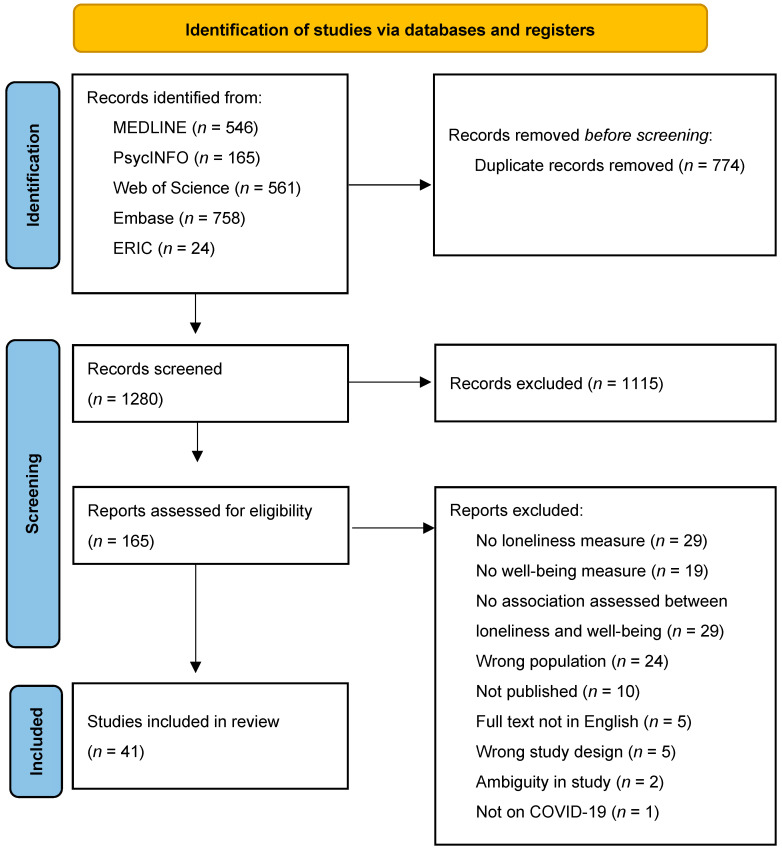
- Included peer-reviewed quantitative English studies conducted on the COVID-19 pandemic, with samples ages 0–20, assessing loneliness or a similar construct and well-being and examining their association; 2054 studies were screened and 41 met inclusion criteria.
- Data were extracted descriptively and narratively synthesized by study design; quality was assessed with a 9-item NIH-based tool (plus 1 longitudinal retention item), with mean quality scores of 5.90/9 for cross-sectional studies and 7.18/10 for longitudinal studies.
Limitations
- Stated: search terms combined loneliness with social isolation, belonging, and mattering despite these being distinct constructs; well-being search terms may have missed outcomes such as post-traumatic stress symptoms, sleep disorder symptoms, and online game addiction; the broad age range and inability to infer causality are also noted.
- Stated: limited diversity in study designs and samples prevented a thorough examination of moderators; most studies were from Europe (n = 14), the United States (n = 8), Australia (n = 6), and China (n = 5), and most were adolescent (n = 27) and community (n = 37) samples.
- Evident: the review is a narrative synthesis without meta-analytic pooling; many included studies were cross-sectional, and heterogeneity in assessment timing and measures complicates comparisons.
Model-written summary. Check it against the paper before relying on it.
Integrity signals
Registry
Cites
Statistics
Figures
Verification
Claims the paper makes
20 Valid · 17 Not valid · 39 Not checked · 52 Own results and interpretations
Some cited sources support this claim and some don’t — read each source’s verdict below.
In the paper
“Other longitudinal studies did not provide formal comparisons across time (e.g., [61,63]).”
§ Loneliness and Well-Being in Children and Adolescents during the COVID-19 Pandemic: A Systematic Review > 5. Prevalence of Loneliness
What the sources say
- Disputedcites [61] Cooper K. Hards E. Moltrecht B. Reynolds S. Shum A. McElroy E. Loades M. Loneliness, social relationships, and mental health in adolescents during the COVID-19 pandemic J. Affect. Disord. 2021 289 98 10.1016/j.jad.2021.04.016 33962368 PMC9310699 sourceExperimental — accuracy not yet measured
Our copy of Magson et al. (2021) shows the study DID provide formal comparisons across time: the Methods > Data Analysis section states a paired samples t-test was conducted 'to determine whether levels of depressive symptoms, anxiety, and life satisfaction significantly increased or decreased in the period before the pandemic began and two months into the pandemic', with change scores additionally modelled via the MEMORE moderation macro. Results > Overall Changes in Mental Health reports those formal pre-post statistics (e.g., depression t(1,247)=6.26, p<0.001, d=0.15; anxiety t(1,244)=5.26, p<0.001, d=0.40; life satisfaction t(1,244)=−5.26, p<0.001, d=0.61, T1 to T2). The only 'missing comparison' the paper concedes (Discussion > Limitations) is a control/comparison CONDITION for attributing change to COVID-19, not a comparison across time — so citing this paper as an example of a longitudinal study that 'did not provide formal comparisons across time' runs contrary to what it reports. (LLM, conf=0.80)
Checked by a reasoning model — may be wrong.
- Supportedcites [63] Houghton S. Kyron M. Lawrence D. Hunter S.C. Hattie J. Carroll A. Zadow C. Chen W. Longitudinal trajectories of mental health and loneliness for Australian adolescents with-or-without neurodevelopmental disorders: The impact of COVID-19 school lockdowns J. Child Psychol. Psychiatry 2022 63 1332 10.1111/jcpp.13579 35194802 PMC9790479 source
Our copy shows Cooper et al. (2021) is a two-wave longitudinal study (baseline and one-month follow-up) whose Analysis plan (Method, p. n/a) enumerates only chi-square tests of selective attrition between participants completing each time point, baseline partial correlations, and hierarchical regressions predicting follow-up scores with the baseline measure entered as a predictor — no within-person test of change between time points. Table 4 (Results) presents baseline and follow-up means and SDs for all eight main variables purely descriptively, with no test statistic or p-value comparing the two occasions. The Discussion likewise reasons about change over time ('the short window between baseline and follow-up meant that there was not enough time for mental health symptoms to change') without having formally tested it, consistent with the citing sentence. (LLM, conf=0.85)
plain- Asserted: passes — The authors put it forward as true.
- Checkable: passes — It can be checked against evidence.
- Load-bearing: unclear — It is unclear whether the paper’s conclusions depend on it.
- Based: passes — The paper gives a reason why it holds.
- Disputed
At least one cited source doesn’t support this claim or points to a different paper, and none confirmed it — see the verdicts below.
In the paper
“In other studies, when controlling for indicators of well-being from the first three months of the pandemic, loneliness did not significantly predict these aspects of well-being one month later [61].”
§ Loneliness and Well-Being in Children and Adolescents during the COVID-19 Pandemic: A Systematic Review > 6. Discussion
What the sources say
- Disputedcites [61] Cooper K. Hards E. Moltrecht B. Reynolds S. Shum A. McElroy E. Loades M. Loneliness, social relationships, and mental health in adolescents during the COVID-19 pandemic J. Affect. Disord. 2021 289 98 10.1016/j.jad.2021.04.016 33962368 PMC9310699 sourceExperimental — accuracy not yet measured
Our copy of Magson et al. (2021) contains no analysis in which loneliness predicts well-being one month after a baseline taken in the first three months of the pandemic; its design is two waves, T1 pre-pandemic to T2 two months into the pandemic (Results, 'Overall Changes in Mental Health'; Methods, 'Data Analysis'), and it measures social connectedness/disconnectedness (Social Connectedness Scale, Methods, 'Measures'), not loneliness. On the closest analogue the paper reports the opposite of a null: social disconnection significantly moderated change in depressive symptoms (t = 5.41, p < .001), anxiety (t = −3.20, p < .001) and life satisfaction (t = 3.05, p = .003) (Results, 'Potential Moderating Factors', Table 3), and the Discussion ('Social Connection and Familial Conflict') states feeling socially disconnected was associated with higher anxiety and depression and lower life satisfaction. The only mention of loneliness as a study variable is a summary of another work (Ellis et al. 2020, Introduction, 'Previous COVID-19 Studies'), where it is reported as associated with COVID-19 concerns, not as a non-significant predictor. (LLM, conf=0.65)
Checked by a reasoning model — may be wrong.
plain- Asserted: passes — The authors put it forward as true.
- Checkable: passes — It can be checked against evidence.
- Load-bearing: unclear — It is unclear whether the paper’s conclusions depend on it.
- Based: passes — The paper gives a reason why it holds.
- Disputed
At least one cited source doesn’t support this claim or points to a different paper, and none confirmed it — see the verdicts below.
In the paper
“However, in a hierarchical multiple regression, loneliness in March to June of 2020 did not significantly predict these indicators of well-being one month later after controlling for these indicators at the first time point (all p > 0.05).”
§ Loneliness and Well-Being in Children and Adolescents during the COVID-19 Pandemic: A Systematic Review > 5. Prevalence of Loneliness > 5.1. Associations between Loneliness and Well-Being
What the sources say
- Disputedcites [61] Cooper K. Hards E. Moltrecht B. Reynolds S. Shum A. McElroy E. Loades M. Loneliness, social relationships, and mental health in adolescents during the COVID-19 pandemic J. Affect. Disord. 2021 289 98 10.1016/j.jad.2021.04.016 33962368 PMC9310699 sourceExperimental — accuracy not yet measured
Our copy of Magson et al. (2021) reports the opposite of the claimed null: Results > Potential Moderating Factors ('Social connectedness') states that feeling socially connected/disconnected during the lockdown significantly moderated changes in depressive symptoms, anxiety and life satisfaction, and Table 3 gives social disconnection as significant for depression (p < 0.001), anxiety (p < 0.001) and life satisfaction (p = 0.003). The design also does not match the claim: Methods > Data Analysis describes paired-samples t-tests plus MEMORE Model 2 moderation analyses, not a hierarchical multiple regression; outcomes are depressive symptoms, anxiety and life satisfaction, not internalizing/externalizing symptoms; and Methods > Procedure dates T1 to throughout 2019 (pre-pandemic) and T2 to 5-14 May 2020 (~two months after stay-at-home orders), not 'March to June 2020' predicting well-being 'one month later'. No passage in our copy frames loneliness as a non-significant prospective predictor. (LLM, conf=0.85)
Checked by a reasoning model — may be wrong.
plain- Asserted: passes — The authors put it forward as true.
- Checkable: passes — It can be checked against evidence.
- Load-bearing: unclear — It is unclear whether the paper’s conclusions depend on it.
- Based: passes — The paper gives a reason why it holds.
- Disputed
At least one cited source doesn’t support this claim or points to a different paper, and none confirmed it — see the verdicts below.
In the paper
“Overall, the researchers found few changes in the loneliness subscales of friendship quality and positive and negative attitudes of being alone between adolescents with and without neurodevelopmental disorders.”
§ Loneliness and Well-Being in Children and Adolescents during the COVID-19 Pandemic: A Systematic Review > 5. Prevalence of Loneliness > 5.1. Associations between Loneliness and Well-Being
What the sources say
- Disputedcites [63] Houghton S. Kyron M. Lawrence D. Hunter S.C. Hattie J. Carroll A. Zadow C. Chen W. Longitudinal trajectories of mental health and loneliness for Australian adolescents with-or-without neurodevelopmental disorders: The impact of COVID-19 school lockdowns J. Child Psychol. Psychiatry 2022 63 1332 10.1111/jcpp.13579 35194802 PMC9790479 sourceExperimental — accuracy not yet measured
Our copy shows this study measured loneliness with the four-item UCLA Short Loneliness Scale (Method > Measures), a single 4–12 score with no subscales, and the Discussion (p. n/a) states explicitly that 'our loneliness measure did not discriminate between friend-related loneliness and family-related loneliness', so it could not report subscales of 'friendship quality' or 'positive and negative attitudes of being alone'. The sample is also a community cohort of 894 adolescents aged 11–16 from the Co-SPACE study (Method > Participants; Study design), with no grouping or comparison by neurodevelopmental disorder, and the analyses (Results; Method > Analysis plan) controlled only for gender, age, income and completion date. Thus the between-group finding attributed here is contrary to what the paper reports it measured and analysed. (LLM, conf=0.66)
Checked by a reasoning model — may be wrong.
plain- Asserted: passes — The authors put it forward as true.
- Checkable: passes — It can be checked against evidence.
- Load-bearing: unclear — It is unclear whether the paper’s conclusions depend on it.
- Based: passes — The paper gives a reason why it holds.
- Disputed
At least one cited source doesn’t support this claim or points to a different paper, and none confirmed it — see the verdicts below.
In the paper
“Higher increases in loneliness from the first time point assessed between 2018 and 2019 to the second time point assessed between May and July 2020 significantly predicted an increase in negative mood (β = 0.44, p < 0.001, 95% CI [0.39, 0.54]) and anhedonia (β = 0.38, p < 0.001, 95% CI [0.37, 0.54]) across those same two time points.”
§ Loneliness and Well-Being in Children and Adolescents during the COVID-19 Pandemic: A Systematic Review > 5. Prevalence of Loneliness > 5.1. Associations between Loneliness and Well-Being
What the sources say
- Disputedcites [60] Alt P. Reim J. Walper S. Fall from grace: Increased loneliness and depressiveness among extraverted youth during the German COVID-19 lockdown J. Res. Adolesc. 2021 31 678 10.1111/jora.12648 34448311 PMC8646507 sourceExperimental — accuracy not yet measured
Our copy of Li et al. (2022) describes a single-wave cross-sectional online survey, not a two-timepoint longitudinal design: Method > Participants states data were collected via Qualtrics from 22 June 2020 to 5 August 2020, with no 2018-2019 baseline assessment, and the Discussion concedes that consequences of social deprivation 'will need to be addressed by future longitudinal studies'. Method > Measures lists loneliness (one UCLA item), ISI, K6, SWEMWBS and the Illness Preoccupation Scale for health anxiety — no negative mood or anhedonia measure appears anywhere, and the reported outcomes (Results; Table 2, Table 3) are descriptive comparisons with normative data plus t-tests by prior diagnosis. Method > Statistical analyses limits analyses to descriptive statistics, independent-samples t tests and zero-order correlations, so no regression producing beta weights and 95% CIs predicting change in mood or anhedonia exists in this paper; the closest statement is that loneliness correlated positively with psychological distress (Results, Association between COVID-fears, behaviour, lifestyle factors and mental health). (LLM, conf=0.80)
Checked by a reasoning model — may be wrong.
plainstates a cause- Asserted: passes — The authors put it forward as true.
- Checkable: passes — It can be checked against evidence.
- Load-bearing: unclear — It is unclear whether the paper’s conclusions depend on it.
- Based: passes — The paper gives a reason why it holds.
- Disputed
62 more claims · 22 with their cited sources checked
Create a free account to see all 128 claims and to verify the 49 references still open.
- It may state two separate claims as one. 37
- Probably not a substantial claim. 32
- The quote only partly states this claim. 1
Claims other papers make about this one
Each is checked against this paper’s own text: does it say what the citing paper says it does?
The source backs part of the claim, not all of it — or backs it for a different population, condition or comparison.
In the citing paper
“For adolescents during the COVID-19 pandemic, a systematic review reported that there were close associations between elevated feelings of loneliness and increased depressive symptoms, anxiety symptoms, gaming addiction and insomnia in cross-sectional studies.”
From A Longitudinal Study of Loneliness Before the End of the COVID-19 Pandemic: Trajectories, Predictors, and Impact on Chinese Adolescent Mental Health (2024) · cites this paper as [45]
Experimental — accuracy not yet measuredThe source backs part of the claim, not all of it — or backs it for a different population, condition or comparison.
In the citing paper
“Although longitudinal associations were more complex, most of the prospective studies in the review found that loneliness predicted symptoms of depression and anxiety amid the pandemic period”
From A Longitudinal Study of Loneliness Before the End of the COVID-19 Pandemic: Trajectories, Predictors, and Impact on Chinese Adolescent Mental Health (2024) · cites this paper as [45]
Experimental — accuracy not yet measured
Statistics recomputed
Every reported test result, recomputed from its test statistic and degrees of freedom. A result shows as not adding up only once an independent check has confirmed it.
- Consistentt(663) = -5.61reported p < .01 · recomputed p < .001
“t(663) = −5.61, p < .01”
- ConsistentF(1, 116) = 1.71reported p = .19 · recomputed p = .194
“F(1, 116) = 1.71, p = .19”
- ConsistentF(1, 137) = 0.25reported p = .62 · recomputed p = .618
“F(1, 137) = 0.25, p = .62”
Self-check
Percentages, sums and reported differences re-computed from the paper’s own numbers.
Each contradiction between two passages listed here was confirmed by an independent check.
Rated minor: it would not touch a result — a value no result rests on, a p-value that stays on the same side of the significance level, or a conflict that is clerical, resolved elsewhere in the paper, or outside its own findings.
In the paper
§ Loneliness and Well-Being in Children and Adolescents during the COVID-19 Pandemic: A Systematic Review > 5. Prevalence of Loneliness > 5.2. Potential Moderating Study Characteristics
“There were 18 out of 31 studies conducted within the first six months of the pandemic (March to September 2020).”
§ Loneliness and Well-Being in Children and Adolescents during the COVID-19 Pandemic: A Systematic Review > 4. Results > 4.2. Summary of Studies and Quality Assessment
“Of the 41 studies, 30 were cross-sectional and 11 were longitudinal.”
Rated minor: it would not touch a result — a value no result rests on, a p-value that stays on the same side of the significance level, or a conflict that is clerical, resolved elsewhere in the paper, or outside its own findings.
In the paper
§ Loneliness and Well-Being in Children and Adolescents during the COVID-19 Pandemic: A Systematic Review > 6. Discussion
“Third, we kept our initial search age range of children and adolescents between 0 and 18 to be consistent with previous systematic reviews and meta-analyses (e.g., [21]).”
§ Loneliness and Well-Being in Children and Adolescents during the COVID-19 Pandemic: A Systematic Review > 2. Materials and Methods > 2.1. Search Strategy and Inclusion Criteria
“The search strategy was based on four main themes: (1) the COVID-19 pandemic, (2) child or adolescent samples (ages 0–20)”
Rated minor: it would not touch a result — a value no result rests on, a p-value that stays on the same side of the significance level, or a conflict that is clerical, resolved elsewhere in the paper, or outside its own findings.
In the paper
§ Loneliness and Well-Being in Children and Adolescents during the COVID-19 Pandemic: A Systematic Review > 5. Prevalence of Loneliness > 5.1. Associations between Loneliness and Well-Being
“Two studies found significant positive associations between loneliness and technology-based pathologies”
§ Loneliness and Well-Being in Children and Adolescents during the COVID-19 Pandemic: A Systematic Review > 5. Prevalence of Loneliness > 5.1. Associations between Loneliness and Well-Being
“including mobile addiction [45], social media disorder [42], excessive game addiction, and pathological game addiction [59]”
Citations
Cites
The need to belong: Desire for interpersonal attachments as a fundamental human motivation.
Baumeister, R. F., & Leary, M. R. (1995) · Psychological Bulletin · doi:10.1037//0033-2909.117.3.497 · Cited by 23,245 · cited 1×
“Loneliness is a significant problem because humans are evolutionarily “wired” to belong to stable and secure social relationships [5].”
BackgroundThe PRISMA 2020 statement: an updated guideline for reporting systematic reviews
Page, M. J., McKenzie, J. E., Bossuyt, P. M., Boutron, I., Hoffmann, T. C., Mulrow, C. D., Shamseer, L., Tetzlaff, J. M., Akl, E. A., Brennan, S. E., et al. (2021) · Systematic Reviews · doi:10.1186/s13643-021-01626-4 · Cited by 13,874
Loneliness matters: a theoretical and empirical review of consequences and mechanisms
Hawkley, L. C., & Cacioppo, J. T. (2010) · Annals of Behavioral Medicine · doi:10.1007/s12160-010-9210-8 · Cited by 4,782 · cited 1×
“…of 31 used by researchers, in this review, well-being will be used subsequently as an overarching term that encompasses indicators of global well-being and/or mental health and specific indicators such as depressive symptoms, anxiety symptoms, internalizing symptoms, and externalizing symptoms [6].”
BackgroundAge at onset of mental disorders worldwide: Large-scale meta-analysis of 192 epidemiological studies
Solmi, M., Radua, J., Olivola, M., Croce, E., Soardo, L., Salazar de Pablo, G., Il Shin, J., Kirkbride, J. B., Jones, P., Kim, J. H., et al. (2022) · Molecular Psychiatry · doi:10.1038/s41380-021-01161-7 · Cited by 3,835
Age of onset of mental disorders: a review of recent literature
Kessler, R. C., Amminger, G. P., Aguilar-Gaxiola, S., Alonso, J., Lee, S., & ??st??n, T. B. (2007) · Current Opinion in Psychiatry · doi:10.1097/yco.0b013e32816ebc8c · Cited by 3,457 · cited 1×
“Considering that over 50% of mental health problems develop during childhood and adolescence [12], with the mean age of onset of mental disorders being 14.5 [13], poorer well-being that results from loneliness may have long-term implications for health and wellness in adulthood.”
BackgroundInfluentialLoades, M. E., Chatburn, E., Higson-Sweeney, N., Reynolds, S., Shafran, R., Brigden, A., Linney, C., McManus, M. N., Borwick, C., & Crawley, E. (2020) · Journal of the American Academy of Child & Adolescent Psychiatry · doi:10.1016/j.jaac.2020.05.009 · Cited by 2,906 · cited 5×
“However, only some of these systematic reviews and meta-analyses included the prevalence of child and adolescent loneliness (e.g., [15]) and even fewer have focused on loneliness with the well-being of children and adolescents (e.g., [16]).”
BackgroundResultInfluentialRacine, N., McArthur, B. A., Cooke, J. E., Eirich, R., Zhu, J., & Madigan, S. (2021) · JAMA Pediatrics · doi:10.1001/jamapediatrics.2021.2482 · Cited by 2,805
Taylor, R. D., Oberle, E., Durlak, J. A., & Weissberg, R. P. (2017) · Child Development · doi:10.1111/cdev.12864 · Cited by 2,345 · cited 1×
“Social and emotional learning programs have shown promising results before the pandemic [73] and have been encouraged during the pandemic [74].”
BackgroundWhere is the child's environment? A group socialization theory of development.
Harris, J. R. (1995) · Psychological Review · doi:10.1037/0033-295x.102.3.458 · Cited by 1,885 · cited 2×
“During March to June of 2020, Cooper et al. [61] found that loneliness was significantly and concurrently positively correlated with internalizing and externalizing symptoms (range r = 0.25 to r = 0.43, p < 0.001). However, in a hierarchical multiple regression, loneliness in March to June of 2020 did not significantl…”
ResultInfluentialMagson, N. R., Freeman, J. Y. A., Rapee, R. M., Richardson, C. E., Oar, E. L., & Fardouly, J. (2021) · Journal of Youth and Adolescence · doi:10.1007/s10964-020-01332-9 · Cited by 1,498
Research works printed but not linked: 2
- Perlman D. Peplau L.A. Toward a Social Psychology of Loneliness Personal Relationships in Disorder Gilour R. Duck S. Academic Press London, UK 1981 31 56
- Covidence Systematic Review Software, Veritas Health Innovation 2022 Available online: www.covidence.org (accessed on 28 June 2022)
Cited by
Madigan, S., Racine, N., Vaillancourt, T., Korczak, D. J., Hewitt, J. M. A., Pador, P., Park, J. L., McArthur, B. A., Holy, C., & Neville, R. D. (2023) · JAMA Pediatrics · doi:10.1001/jamapediatrics.2023.0846 · Cited by 354
Self-citationEducational Research and Innovation
OECD, & Centre for Educational Research and Innovation (2009) · Educational research and innovation · doi:10.1787/20769679 · Cited by 134
Mazrekaj, D., & Witte, K. D. (2023) · Perspectives on Psychological Science · doi:10.1177/17456916231181108 · Cited by 154
“…countries, the United States, Australia, China, Hong Kong, Brazil, Israel, and Chile (six of which were rated 8 or 9 on a 9-point quality scale), Farrell et al. (2023) reported that higher rates of loneliness during the COVID-19 pandemic were associated with higher depression symptoms among…”
BackgroundMadigan, S., Vaillancourt, T., Dimitropoulos, G., Premji, S., Kahlert, S. M., Zumwalt, K., Korczak, D. J., von Ranson, K. M., Pador, P., Ganshorn, H., et al. (2025) · Journal of the American Academy of Child & Adolescent Psychiatry · doi:10.1016/j.jaac.2024.02.009 · Cited by 48
Self-citationEffects of Online Fan Community Interactions on Well-Being and Sense of Virtual Community
Wang, S., Kim, M. S., & Kim, S. (2023) · Behavioral Sciences · doi:10.3390/bs13110897 · Cited by 78
“A high level of loneliness has the potential to trigger psychological disorders such as depression, stress, and anxiety [4–6], ultimately negatively impacting an individual’s overall well-being [7,8].”
BackgroundBullying before and during the COVID-19 pandemic
Vaillancourt, T., Farrell, A. H., Brittain, H. L., Krygsman, A., Vitoroulis, I., & Pepler, D. J. (2023) · Current Opinion in Psychology · doi:10.1016/j.copsyc.2023.101689 · Cited by 49
Self-citationZhong, B., Yuan, M.-D., Li, F., & Sun, P. (2023) · Psychology Research and Behavior Management · doi:10.2147/prbm.s424565 · Cited by 33
Ghanayem, L. K., Shannon, H., Khodr, L., McQuaid, R. J., & Hellemans, K. G. C. (2024) · Frontiers in Psychiatry · doi:10.3389/fpsyt.2024.1247807 · Cited by 43
“Loneliness is consistently linked with poorer mental health and long-term implications on mental well-being (62).”
BackgroundInfluentialMagis‐Weinberg, L., Vargas, M. A., Carrizales, A., Trinh, C. T., Lopez, D. E. M., Hussong, A. M., & Lansford, J. E. (2024) · Journal of Research on Adolescence · doi:10.1111/jora.12931 · Cited by 42
Subramaniam, M., Vaingankar, J. A., Tan, B., Abdin, E., Chang, S. H. S., Tan, Y., Samari, E., Archana, S., Chua, Y., Lee, J., et al. (2025) · Asian Journal of Psychiatry · doi:10.1016/j.ajp.2025.104405 · Cited by 28
Understanding the development of chronic loneliness in youth
Hang, S., Jost, G. M., Guyer, A. E., Robins, R. W., Hastings, P. D., & Hostinar, C. E. (2024) · Child Development Perspectives · doi:10.1111/cdep.12496 · Cited by 32
Reliability and validity evaluation of the stigma of loneliness scale in Chinese college students
Fan, Z., Shi, X., Yang, S., Sun, Y., & Chen, R. (2024) · BMC Public Health · doi:10.1186/s12889-024-17738-0 · Cited by 24
“Meanwhile, loneliness is significantly negatively correlated with quality of life, mental health, happiness, optimism, hope, and self-efficacy [4, 15–17].”
BackgroundWang, J.-A., Wang, H., Cao, B., Lei, X., & Long, C. (2024) · Journal of Youth and Adolescence · doi:10.1007/s10964-024-01977-w · Cited by 25
“Firstly, loneliness, isolation, and ostracism were used to search for studies which is related to loneliness because they are similar constructs to loneliness (Farrell et al., 2023).”
The impact of the COVID-19 pandemic on adolescent sleep behavior
Rocha, S., & Fuligni, A. J. (2023) · Current Opinion in Psychology · doi:10.1016/j.copsyc.2023.101648 · Cited by 24
“On the other hand, the increased flexibility in morning routines and sleep-wake schedules during periods of school closure were offset by heightened feelings of loneliness and psychological distress as youth were isolated from their peers [5].”
Devos, S., Schrijvers, K., Dierckens, M., Cauwenberg, J. V., Deforche, B. I., Derluyn, I., & Delaruelle, K. (2024) · International Journal of Adolescence and Youth · doi:10.1080/02673843.2024.2395388 · Cited by 21
“…the dramatic changes in response to the COVID-19 pandemic, including lockdowns and school-closures, resulted in poorer general mental health and elevated anxiety, depression and loneliness levels in adolescents (Cooper et al., 2021; Farrell et al., 2023; Loades et al., 2020; Scott et al., 2021).”
Krygsman, A., Farrell, A. H., Brittain, H. L., & Vaillancourt, T. (2023) · Journal of Anxiety Disorders · doi:10.1016/j.janxdis.2023.102769 · Cited by 15
Self-citationDearth‐Wesley, T., Herman, A. N., & Whitaker, R. C. (2023) · International Journal of Adolescence and Youth · doi:10.1080/02673843.2023.2254136 · Cited by 21
“…target adolescents, given the continued importance of adult relationships during this period of development (Chhuon & Wallace, 2014; García-Moya, 2020) and the concerning decline in adolescent mental health (Farrell et al., 2023; Racine et al., 2021; Twenge et al., 2021; Wolf & Schmitz, 2023).”
BackgroundEpidemiology of Mental Health Challenges in Children and Adolescents
Farrell, A. H., Szatmári, P., & Vaillancourt, T. (2024) · Pediatric Clinics of North America · doi:10.1016/j.pcl.2024.07.009 · Cited by 15
Self-citationZoellner, F., Erhart, M., Schütz, R., Napp, A.-K., Devine, J., Reiss, F., Ravens‐Sieberer, U., & Kaman, A. (2025) · European Child & Adolescent Psychiatry · doi:10.1007/s00787-025-02779-6 · Cited by 17
Hu, W., Li, B., Li, X., Luo, S., Xu, Z., Li, J., Chen, W., & Guo, V. Y. (2025) · European Child & Adolescent Psychiatry · doi:10.1007/s00787-025-02698-6 · Cited by 11
Pecora, G., Laghi, F., Baumgartner, E., Norcia, A. D., & Sette, S. (2024) · Current Psychology · doi:10.1007/s12144-024-05805-z · Cited by 13
“This provides further support to previous research indicating a heightened risk of mental health problems for those who reported higher loneliness during the COVID-19 pandemic (e.g., Farrell et al., 2023; Santini & Koyanagi, 2021).”
InfluentialSystematic review: Impact of parental decision on paediatric COVID‐19 vaccination
Garbín, A. J. Í., Chiba, E. K., Garbin, C. A. S., Chiba, F. Y., Moimaz, S. A. S., & Saliba, T. A. (2023) · Child Care Health and Development · doi:10.1111/cch.13124 · Cited by 13
The impact of loneliness on mental and physical health outcomes: An umbrella review
Molinera, V. G., Khan, K. S., Núñez‐Núñez, M., & Kouiti, M. (2024) · Medicina de Familia SEMERGEN · doi:10.1016/j.semerg.2024.102261 · Cited by 11
Rejoinder 1: Advocating for children in the presence of imperfect evidence: A reply to Black et al.
Vaillancourt, T., Korczak, D. J., Madigan, S. L., Cost, K. T., Racine, N. M., & Szatmári, P. (2023) · PubMed Central · Cited by 9
Self-citationFerreira, P., Gameiro, F. C. D. S. R., & Faria, M. N. P. S. (2024) · Psychology International · doi:10.3390/psycholint6030046 · Cited by 13
“…indicated that social isolation, lack of contact with friends and family, and uncertainty about the future had a negative impact on adolescents’ SEC during the COVID-19 pandemic [11,12], leading to increased anxiety, loneliness, depression, and decreased empathy and pro-social behavior [13–16].”
BackgroundResultSchütz, R., Reiß, F., Moor, I., Kaman, A., Bilz, L., & HBSC Study Group Germany (2025) · BMC Public Health · doi:10.1186/s12889-025-23247-5 · Cited by 17
Schneider, V., Norris, T., Nugawela, M. D., Dalrymple, E., Hargreaves, D. S., Käll, A., McOwat, K., Shafran, R., Stephenson, T. J., Xu, L., et al. (2023) · Psychology Research and Behavior Management · doi:10.2147/prbm.s421165 · Cited by 10
Hu, Y., Pei, M., Wang, D., Wu, X. C., & Wang, D. (2025) · Journal of Behavioral Addictions · doi:10.1556/2006.2025.00016 · Cited by 11
“A meta-analysis has shown an increase in the prevalence of loneliness during COVID-19, and almost 8.5% adolescents showed extreme loneliness (Ernst et al., 2022; Farrell, Vitoroulis, Eriksson, & Vaillancourt, 2023).”
InfluentialThe changing impacts of social determinants on youth mental health in Australia
Baker, D. G., Wang, M., Filia, K., Teo, S. M., Morgan, R., Ziou, M., McGorry, P. D., Browne, V., & Gao, C. X. (2024) · International Journal of Social Psychiatry · doi:10.1177/00207640241280910 · Cited by 7
“While the COVID-19 pandemic has markedly highlighted loneliness and lack of social support as significant contributors to the current surge in mental health issues (Farrell et al., 2023), it is crucial to emphasise that these trends were already in motion before the pandemic.”
Walsh, S. D., Elgar, F. J., Craig, W., Cosma, A. P., Donnelly, P., Harel‐Fisch, Y., Molcho, M., Malinowska-Cieślik, M., Ng, K., & Pickett, W. (2025) · International Journal of Bullying Prevention · doi:10.1007/s42380-025-00296-3 · Cited by 7
“Others have shown that being isolated and lonely during the pandemic, as many young people were (Farrell et al., 2023), may have also made young people more appreciative of their peers.”
Schütz, R., & Bilz, L. (2024) · Journal of Public Health · doi:10.1007/s10389-024-02356-2 · Cited by 8
Rose, A. L., Goldberg, J. O., Flett, G. L., Nepon, T. B., & Besser, A. (2024) · Psychology Research and Behavior Management · doi:10.2147/prbm.s433211 · Cited by 10
“13 Parenthetically, the research described in this article was conducted during the COVID-19 pandemic period and this may have heightened the salience of loneliness and the thoughts related to it.”
BackgroundAssociations between adolescent perceived loneliness and hair cortisol concentration
Anderson, A. M., Sherman, J. P., Fitzpatrick, M. M., Browning, C. R., Kertes, D. A., Mackos, A. R., Pickler, R. H., Smith, L., & Ford, J. L. (2024) · Psychoneuroendocrinology · doi:10.1016/j.psyneuen.2024.107184 · Cited by 5
The Influence of Loneliness on Pain Outcomes for Adolescents: A Cross-Sectional Survey
Forgeron, P. A., Stinson, J., Birnie, K. A., Finley, G. A., Jordan, A. L., Qualter, P., de Cândido, L. K., Lamont, M., Bradley, C., Linkiewich, D., et al. (2024) · Canadian Journal of Pain · doi:10.1080/24740527.2024.2404615 · Cited by 7
Wang, J., Zhang, W., Song, P., Wang, T., Yao, Y., Chen, Y., Lin, H., Yang, X., Chen, X., & Fu, C. (2024) · Psychology Research and Behavior Management · doi:10.2147/prbm.s484113 · Cited by 6
“45 47 Consequently, the potential ramifications of COVID-19 on loneliness are not only pertinent to population well-being, but also relevant to mental health problems which could occur or deteriorate as a result.”
Alanko, K., Kuhlberg, L., & Lagerström, M. (2024) · European Journal of Psychology Open · doi:10.1024/2673-8627/a000062 · Cited by 7
Hansel, T. C., Murphy, J. L., Whaley, G. L., & Saltzman, L. Y. (2025) · Current Psychiatry Reports · doi:10.1007/s11920-025-01641-5 · Cited by 8
“Other research has noted loneliness to be a global epidemic for children and adolescents [ 38, 39 ].”
Fehkührer, S., Humer, E. C., Kaltschik, S., Pieh, C., Probst, T., Diestler, G., & Jesser, A. (2023) · Healthcare · doi:10.3390/healthcare11162242 · Cited by 7
Bullying victimization and mental health before and during the COVID-19 pandemic
Farrell, A. H., Brittain, H. L., Krygsman, A., & Vaillancourt, T. (2024) · Frontiers in Child and Adolescent Psychiatry · doi:10.3389/frcha.2024.1411265 · Cited by 7
Self-citationMajor, D., Falus, M., Árva, D., Eörsi, D., Terebessy, A., Tabák, Á. G., & Fazekas‐Pongor, V. (2024) · Frontiers in Public Health · doi:10.3389/fpubh.2024.1474893 · Cited by 5
“Several studies confirmed the negative impact of pandemic-related factors on adolescents’ mental health (8–10).”
BackgroundDevelopment of subjective well-being in adolescents before and during the COVID-19 pandemic
Eckert, H., Paschke, P., Wirthwein, L., & Steinmayr, R. (2025) · Frontiers in Education · doi:10.3389/feduc.2025.1485289 · Cited by 5
Hurd, N. M., & Billingsley, J. T. (2023) · American Journal of Community Psychology · doi:10.1002/ajcp.12701 · Cited by 5
Zhou, T., Kong, X., Bian, X., Wang, S., Liu, J., & Schmidt, L. A. (2023) · Journal of Research on Adolescence · doi:10.1111/jora.12885 · Cited by 4
Andreu-Bernabeu, Á., González‐Peñas, J., Perdiguero, A. M., Bernardo, M., Mezquida, G., Amoretti, S., Bobes, J., Sáiz, P. A., García‐Portilla, M. P., Sanjuán, J., et al. (2025) · The British Journal of Psychiatry · doi:10.1192/bjp.2025.100 · Cited by 7
Ko, S.-L., Cheng, L., Hsu, J.-W., Chen, L., Bai, Y., Tu, P., & Chen, M. (2025) · Journal of the Formosan Medical Association · doi:10.1016/j.jfma.2025.10.039 · Cited by 3
Novaković, I. Z., Streicher, A., Ajduković, D., Ajduković, M., Lacković, J. K., Lotzin, A., & Lueger‐Schuster, B. (2023) · International Journal of Environmental Research and Public Health · doi:10.3390/ijerph20196861 · Cited by 4
“Moreover, depression and anxiety symptoms were among the most common indicators of well-being in longitudinal COVID-19 studies [30].”
BackgroundGender and socioeconomic perspectives on students’ emotional well-being during the COVID-19 pandemic
Christensen, J. H. (2024) · Research in Comparative and International Education · doi:10.1177/17454999241265966 · Cited by 5
“Notably, this study does not address gender differences, which is also the case for other recent systematic reviews on student well-being during the pandemic (Farrell et al., 2023; Panchal et al., 2023), yet they emphasize the strong impact of SES.”
Predictors of loneliness among middle childhood and adolescence during the COVID-19 pandemic
Benhayoun, A., Olsavsky, A. L., Akard, T. F., Gerhardt, C. A., & Skeens, M. A. (2024) · PLoS ONE · doi:10.1371/journal.pone.0308091 · Cited by 4
The Role of Family Climate in Adolescents’ Well-Being during the COVID-19 Pandemic
Reim, J., Alt, P., Gniewosz, G., & Walper, S. (2024) · Journal of Child and Family Studies · doi:10.1007/s10826-024-02868-1 · Cited by 5
“These fi ndings are in line with previous research suggesting elevated levels of loneliness (Farrell et al., 2023; Rauschenberg et al., 2021) and a deterioration in activity levels (Orgilés et al., 2020) during the pandemic.”
Wirtz, M. A., Devine, J., Erhart, M., Reiß, F., Böcker, M., Schulz, A. A., Zöllner, F., Napp, A.-K., Ravens‐Sieberer, U., & Kaman, A. (2025) · Frontiers in Psychology · doi:10.3389/fpsyg.2025.1444524 · Cited by 2
Adolescent Loneliness Trends and Contextual Correlates Across 38 Countries From 2000 to 2022
Freije, S. L., Rhew, I. C., Evans, Y. N., Chan, K. C. G., & Enquobahrie, D. A. (2025) · Journal of Adolescent Health · doi:10.1016/j.jadohealth.2025.06.017 · Cited by 2
Boettcher, J., Radzuweit, D., Mey, M., Rauch, P., Kogler, A., Barkmann, C., Goth, K., Hohmann, S., Bindt, C., & Voelker, U. (2023) · Children · doi:10.3390/children10111743 · Cited by 3
“Importantly, the results must be considered in light of the COVID-19 pandemic, during which social isolation among adolescents increased markedly and was associated with a significant reduction in well-being [40], the latter being linked to specific personality traits [41].”
BackgroundDoes the Easing of COVID-19 Restrictive Measures Improve Loneliness Conditions? Evidence from Japan
Nabeshima, H., Kuramoto, Y., Khan, M. S. R., & Kadoya, Y. (2023) · Sustainability · doi:10.3390/su152416891 · Cited by 2
Mental Health Impact of Pandemics and Other Public Health Emergencies in Children
Schonfeld, D. J., & Demaria, T. P. (2024) · Pediatric Clinics of North America · doi:10.1016/j.pcl.2024.01.015 · Cited by 3
Jokić, B., Dedić, Z. R., & Šimon, J. (2024) · Psihologijske teme · doi:10.31820/pt.33.1.2 · Cited by 5
“One of the most negative aspects of the COVID-19 pandemic was an increase in perceived loneliness among adolescents from various age cohorts (Farell et al., 2023).”
BackgroundImplementing ChatGPT to Support Teachers and Promote Learning
Morgan, H. (2024) · The Clearing House A Journal of Educational Strategies Issues and Ideas · doi:10.1080/00098655.2024.2404859 · Cited by 2
“A systematic review on the effects of loneliness during the pandemic indicated that higher levels of loneliness were significantly associated with sleep problems and higher anxiety and depression symptoms (Farrell et al. 2023).”
Carradore, M., Gosetti, G., & Lonardi, C. (2025) · Children and Youth Services Review · doi:10.1016/j.childyouth.2024.108117 · Cited by 2
Nagi, S., Kempe, S., Barriault, S., Masri, L. M., Dyyat, S., Muhl, C., Bennett, S., & Racine, N. M. (2025) · BMC Public Health · doi:10.1186/s12889-025-21847-9 · Cited by 7
“On the contrary, poor social relationships in childhood and early adolescence have been associated with substance abuse, depression, and anxiety in early adulthood [30], as well as perceived social isolation and loneliness [28].”
Prospective, Directional Associations Between Social Media Intensity and Loneliness in Adolescence
Sherwin, E. B., Barendse, M. E. A., Dahl, R. E., & Magis‐Weinberg, L. (2025) · Infant and Child Development · doi:10.1002/icd.70000 · Cited by 3
Delaruelle, K., Devos, S., Saelens, L., Bracke, P., Verhaeghe, F., Derluyn, I., & Deforche, B. I. (2025) · International Journal of Intercultural Relations · doi:10.1016/j.ijintrel.2025.102294 · Cited by 2
Goossens, L. (2023) · Elsevier eBooks · doi:10.1016/b978-0-323-96023-6.00062-2 · Cited by 3
Co-Creation of Mental Health Intervention for Adolescents: A Social Hackathon Approach
Baumann, H., & Ksiezarczyk, A.-M. (2026) · Healthcare · doi:10.3390/healthcare14101315 · Cited by 1
“This pattern mirrors the broader adolescent mental health literature, where anxiety-related distress, self-evaluative concerns, loneliness, and peer victimization are prominent sources of burden [4–6].”
Szczęśniak, M., Świątek, A. H., Szczerba, A., Szpunar, K., & Falewicz, A. (2025) · Brain Sciences · doi:10.3390/brainsci15090946 · Cited by 3
“Studies measuring loneliness rates during the COVID-19 pandemic have shown that approximately half of adolescents and children experience at least moderate loneliness and a significant average increase in loneliness compared to pre-pandemic levels [14].”
The disclosure of child psychological maltreatment: A systematic review
Kilkku, I., Liias, I., Laajasalo, T., Ellonen, N., & Ikonen, R. (2025) · Child Protection and Practice · doi:10.1016/j.chipro.2025.100233 · Cited by 3
Loneliness in vietnamese and russian students: scale validation and cross-cultural comparisons
Tran, T. (2025) · Social Psychology and Society · doi:10.17759/sps.2025160311 · Cited by 1
Stories and Voice Agents to Support Social Roleplay for Preschool Children
Hourcade, J. P., Suárez, C., Vázquez, E., Bakała, E., Gerosa, A., & Currin, F. H. (2025) · Proceedings of the ACM on Human-Computer Interaction · doi:10.1145/3757506 · Cited by 1
Paat, Y., Hope, T. L., Wagovich, S. A., Cheon, H., Cruz, E. M., & Orezzoli, M. C. E. (2025) · Discover Public Health · doi:10.1186/s12982-025-00922-x · Cited by 4
“Social disconnectedness and isolation among youth were common in the wake of the global COVID-19 pandemic [25].”
The Well-Being Value of Sport for Loneliness and Depression
Schoemaker, J., de Boer, W. I. J., Davies, L. E., & Kokolakakis, T. (2025) · Journal of Sports Economics · doi:10.1177/15270025251396496 · Cited by 1
“Given the increasing acknowledgment of loneliness and depression as pivotal determinants of well-being (Farrell et al., 2023; Kinderman et al., 2015), the inquiry into whether sport can elevate well-being in these groups becomes paramount.”
Veldin, M., & Pertoci, N. (2025) · Frontiers in Education · doi:10.3389/feduc.2025.1648564 · Cited by 2
Loneliness Before and After the COVID-19 Pandemic
Ernst, M. (2025) · Springer eBooks · doi:10.1007/978-3-032-02959-1_8 · Cited by 1
Schwartz, A. E., Lewis, H., Gagliardi, L. J., Martin, S., Jaskiw, N., Jaskiw, N. J., & Hasson, R. E. (2025) · Frontiers in Psychology · doi:10.3389/fpsyg.2025.1559497 · Cited by 1
Lee, J., & Lee, M. A. (2025) · Journal of Child and Adolescent Psychiatric Nursing · doi:10.1111/jcap.70047 · Cited by 3
Lin, T., Cash, T. N., Lee, H. J., Kim, S., Anderman, E. M., Cha, W., Liu, X., & Wen, Z. (2025) · Gifted Child Quarterly · doi:10.1177/00169862251392225 · Cited by 1
“…evidence supporting the negative impacts of the pandemic on students’ well-being and mental health (Gruber et al., 2021; Kozák et al., 2023; Larsen et al., 2023), few longitudinal studies have examined how students’ school well-being changed throughout the pandemic years (Farrell et al., 2023).”
Gaming Addiction and Compulsive Gaming Behavior: Psychological Perspectives
Cheng, C., & Zhang, H. (2025) · Springer eBooks · doi:10.1007/978-3-032-00325-6_7 · Cited by 2
Rowlinson, K., Grummitt, L. R., Newton, N. C., Chapman, C. E., Maratos, F. A., Kelly, E. V., & Barrett, E. L. (2026) · Australian Psychologist · doi:10.1080/00050067.2025.2603448 · Cited by 2
“These feelings of loneliness among adolescents during COVID-19 have also been associated with poorer well-being (Cooper et al., 2021; Farrell et al., 2023), and it is likely that the stressors associated with the pandemic have exacerbated the relationship in our findings between self-compassion,…”
Yang, Q., Jiang, Z., Xu, H., Niu, G., Yang, H., & Li, H. (2026) · Frontiers in Public Health · doi:10.3389/fpubh.2025.1688824 · Cited by 2
“Consequently, children’s loneliness has garnered substantial attention, especially during and after the COVID-19 pandemic (4, 13).”
Schütz, R., Dadaczynski, K., Rathmann, K., Bilz, L., HBSC Study Group Germany, Anghel, J., Bargholz, K., Böhm, M., Braun, N., Dernbach, M., et al. (2026) · Journal of Technology in Behavioral Science · doi:10.1007/s41347-026-00605-7 · Cited by 1
Zhang, S., Zhang, J., Yan, C., Zhang, T., Zhang, F., & Xie, H. (2026) · Child and Adolescent Psychiatry and Mental Health · doi:10.1186/s13034-026-01143-z · Cited by 1
“A recent systematic review published in 2023, which included 41 studies (30 cross-sectional and 11 longitudinal), found that more than half of adolescents reported experiencing moderate levels of loneliness [3].”
Challenges Related to the Postulates of Students Towards Education in Post-Pandemic Times
Popławska, A., Бочарова, О., & Sufa, B. (2023) · International Journal of Research in E-learning · doi:10.31261/ijrel.2023.9.1.07 · Cited by 1
Salciunaite-Nikonove, L., Žemaitaitytė, M., & Šmigelskas, K. (2023) · Children · doi:10.3390/children11010032 · Cited by 4
“These results were in line with the recent literature review revealing that higher levels of loneliness during the COVID-19 pandemic were significantly associated with poorer well-being, including higher depression symptoms, anxiety symptoms, gaming addiction, and sleep problems [56].”
ResultBoat, A. A., Hsieh, T., & Wu, C. (2024) · Children and Youth Services Review · doi:10.1016/j.childyouth.2024.107797 · Cited by 6
Maßnahmen gegen Einsamkeit – Beispiele aus einer international vergleichenden Perspektive
Wendt, C. (2024) · Bundesgesundheitsblatt - Gesundheitsforschung - Gesundheitsschutz · doi:10.1007/s00103-024-03945-y · Cited by 1
Network analysis of loneliness, mental, and physical health in Czech adolescents
Meier, Z., Helvich, J., Fürstová, J., Novák, L., Purova, D., Žídková, R., & Tavel, P. (2025) · Child and Adolescent Psychiatry and Mental Health · doi:10.1186/s13034-025-00884-7 · Cited by 1
“In the Czech Republic specifically, stringent social-distancing measures and repeated school closures greatly reduced adolescents’ opportunities for in-person interaction [165, 168].”
Durak, F., Tezol, Ö., Aksu, G. G., & Bozlu, G. (2025) · The Journal of Pediatric Academy · doi:10.4274/jpea.2025.398 · Cited by 1
“Mental health issues, including anxiety, depression, suicide attempts, and eating disorders, have risen among young children and adolescents beyond pre-pandemic forecasts 10,11 .”
Razak, M. A. A., Hamid, H. A. A., Sahril, N., & Rahim, F. A. A. (2025) · Psychology in the Schools · doi:10.1002/pits.70017 · Cited by 2
“A systematic review reported that the prevalence of loneliness among adolescents across countries varies from 8.5% to 67.6% (Farrell et al. 2023).”
InfluentialLi, X. (2023) · Education Research and Development · doi:10.57237/j.edu.2023.04.001
Impactos do isolamento social durante a pandemia de COVID-19 em crianças e adolescentes
Martins, M. B., Mota, G. A., de Oliveira, M. C., & de Souza, M. M. (2024) · Contribuciones a las Ciencias Sociales · doi:10.55905/revconv.17n.3-332
Schütz, R., & Bilz, L. (2024) · Research Square · doi:10.21203/rs.3.rs-4183346/v1
Wang, J., Zhang, W., Wang, T., Yao, Y., Lin, H., Yang, X., Song, P., Chen, X., & Fu, C. (2024) · Research Square · doi:10.21203/rs.3.rs-4210447/v1
Addictive behaviors among youth and adolescents in the digital age
(2024) · Frontiers research topics · doi:10.3389/978-2-8325-4853-0 · Cited by 2
Mendoza-Martínez, I. A., Marroquín-Tovar, E., Rivas-Díaz, J. P., Durand, A., Sauri-Alpuche, G. E., & Rivera, B. R. G. (2024) · COVID · doi:10.3390/covid4050041
“Therefore, the fear of infection was socially complemented by the fear of the impossibility of maintaining the economic livelihood of families [68].”
BackgroundDemographic and coping predictors of severe forms of loneliness in young people aged 12-25 yearsPreprint
Jong, A., Riddleston, L., Fuhrmann, D., & Lau, J. Y. F. (2024) · Research Square · doi:10.21203/rs.3.rs-4406667/v1
Flett, G. L., Rose, A. L., Goldberg, J. O., & Nepon, T. B. (2024) · Advances in mental health and addiction · doi:10.1007/978-3-031-56192-4_1 · Cited by 2
Childhood Loneliness: A Step Towards Maladaptive Well-Being
Ganesh Kumar, J., & Aman, A. (2024) · Advances in higher education and professional development book series · doi:10.4018/979-8-3693-4417-0.ch003
Loneliness in Bereaved Children and Adolescents
Soetioso, V. B., & Fithriyah, I. (2024) · Jurnal Psikiatri Surabaya · doi:10.20473/jps.v13is1.62655 · Cited by 1
Konduru, D., Lowrey, K. M., & Hager, E. R. (2025) · American Journal of Health Promotion · doi:10.1177/08901171251319847
Warneken, F., & McAuliffe, K. (2025) · Current Directions in Psychological Science · doi:10.1177/09637214241306057
“Social spaces such as those found in schools are critical for children in terms of their educational attainment, and the socialization with other peers is difficult to replace (Farrell et al., 2023; Mazrekaj & De Witte, 2023; Viner et al., 2022).”
Rempel, K., Schwartz, K. D., & Exner‐Cortens, D. (2025) · Canadian Journal of School Psychology · doi:10.1177/08295735251336409
“…for emotional support (Magson et al., 2020), but disruptions to peer relationships related to COVID-19 health measures (e.g., lockdowns, social distancing) reduced most adolescents’ ability to interact with their peers in developmentally-typical ways (Farrell et al., 2023; Orben et al., 2020).”
Hansen, K. Y., & Čaprić, G. (2025) · IEA research for education · doi:10.1007/978-3-031-88002-5_5 · Cited by 1
Layman, H. M., Lilly, C. L., Dino, G., Jarrett, T. D., Rishel, C. W., & Kristjánsson, Á. L. (2025) · AJPM Focus · doi:10.1016/j.focus.2025.100390 · Cited by 1
“16,17 Reduced access to informal and formal emotional support during the pandemic may lead young people to turn to substance use as a coping mechanism.”
Metadata
- Authors
- Farrell, A. H., Vitoroulis, I., Eriksson, M., & Vaillancourt, T.
- Affiliations
- Brock University (CA)
- University of Ottawa (CA)
- DePaul University (US)
- Corresponding author
- Vaillancourt, Tracy
- Venue
- Children
- Publisher
- MDPI AG
- Published
- 2023-01-31
- Volume
- 10
- Issue
- 2
- Pages
- 279
- ISSN
- 2227-9067 (ISSN-L)
- PMC
- PMC9955087
- OpenAlex
- W4318777544
- Cited by
- 130
- References
- 78
- Citations by year
- 2026: 24 · 2025: 45 · 2024: 37 · 2023: 23
- FWCI
- 6.54
- Type
- journal article
- Language
- en
- Open access
- gold
- doi.org
- Licence
- Locations
- Children (publishedVersion, cc-by)
- PubMed Central (publishedVersion, cc-by)
- PubMed (publishedVersion)
- DOAJ (DOAJ: Directory of Open Access Journals) (submittedVersion, cc-by-sa)
- Funders
- Social Sciences and Humanities Research Council of Canada and Employment and Social Development Canada (872-2021-0019)
- Topics
- Social Sciences › Psychology › Clinical Psychology › COVID-19 and Mental Health
- Social Sciences › Psychology › Clinical Psychology › Child and Adolescent Psychosocial and Emotional Development
- Social Sciences › Health › Health disparities and outcomes
- Keywords
- loneliness, well-being, adolescents, COVID-19 pandemic, depressive symptoms, anxiety symptoms, gaming addiction, sleep disorders, prevalence of loneliness, moderators
About these checks
Registry, retraction, Cites and statistics results are computed, not judged, with one exception: a printed reference that no index lists is read once by a model before it counts as a citation error. Claims are extracted by a model and kept only when their quote appears verbatim in the text; each cited source is then checked, with a model’s help, for whether it says what the claim relies on. Those verdicts can be wrong — read the claim’s quote and the cited source before relying on one.
The claim verdicts this report counts are experimental: their accuracy is not yet measured.
A language model drew the claims from the paper on 2026-10-05, under version 3 of the claim definition (model deepseek-v4.1-flash, prompt extract-v3).
A second model labelled each claim on 2026-10-05 (model jev-1.13-20260917, definition revision gold-guideline-v0.2).
Cited sources are checked with a language model’s help (qwen3.8-omni-flash).
Statistics and arithmetic are recomputed, not judged.
Confidence bands are shown only for fields calibrated on our annotated test set. None is calibrated yet, so no band is shown.
What counts as a claim ›How we measure confidence ›How we check this ›
Are you an author, or do you see a problem with this page? Request a review
Data sources
Bibliographic data: Semantic Scholar, OpenAlex, Crossref.
Contains information from the Semantic Scholar Academic Graph Datasets, made available under the ODC Attribution License (ODC-BY 1.0).
Semantic Scholar’s data is described in: Kinney, R., et al. (2023). The Semantic Scholar Open Data Platform. arXiv:2301.10140.
