

A Scoping Review of Implemented Innovations in Cancer Care: Implications for Pan-Canadian Scaling
Open accessThe DOI matches its Crossref record; 66 of the 66 references it cites were found in a registry or an index; 51 of the 91 sources its claims cite were checked for support.
Abstract
The Canadian cancer care landscape faces rising cancer incidence, persistent inequities, and increasing system pressures. Led by the Canadian Association of Provincial Cancer Agencies (CAPCA), this scoping review applied an implementation science lens to evaluate the scalability of innovative cancer care models across Canada. Using a mixed-methods design, innovations were identified through a scoping review (n = 42), grey literature analysis (>50), a pan-Canadian survey (n = 72), and key informant interviews (n = 24). Guided by the Consolidated Framework for Implementation Research (CFIR), this review assessed feasibility, barriers, and facilitators influencing adoption and scale-up of identified innovations. Results revealed widespread adoption across various domains including virtual oncology, artificial intelligence (AI)-driven tools, and expansion of team-based care. At-home models, including home infusion, palliative care, and pharmacist-led chronic disease clinics, demonstrated improved access, patient satisfaction, and reduced hospital burden. CFIR mapping revealed cross-cutting facilitators including strong stakeholder engagement, structured training, and demonstrated patient benefits. However, persistent barriers include regulatory variability, funding instability, digital infrastructure gaps, and workforce capacity constraints. This paper highlights implemented innovations in cancer care and identifies strategic scaling opportunities needed to ensure all people living in Canada benefit from high-quality, person-centred equitable cancer care.
Overview
CoChat Summary
TL;DR
This scoping review synthesized implemented cancer care innovations across Canada using a mixed-methods implementation science approach, identifying over 30 innovations such as virtual care, AI, team-based care, at-home care, and expanded scopes of practice. It found that these innovations improve access, patient satisfaction, and hospital pressure, but scaling is constrained by inconsistent funding, digital infrastructure gaps, regulatory variability, and workforce shortages.
Key findings
- The review identified over 30 innovations and found that over 80% of provinces and territories now have permanent virtual oncology services, improving access for rural, remote, and underserved populations and reducing travel-related burdens.
- Common facilitators across innovations included strong leadership support, early patient and stakeholder engagement, dedicated funding, workforce training and competency development, supportive regulatory environments, and ongoing monitoring and evaluation.
- Common barriers included workforce shortages, digital infrastructure limitations, inconsistent funding mechanisms, regulatory variability, interoperability challenges, and limited implementation capacity.
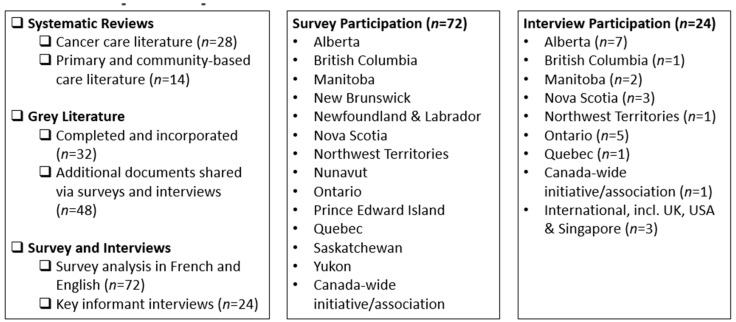
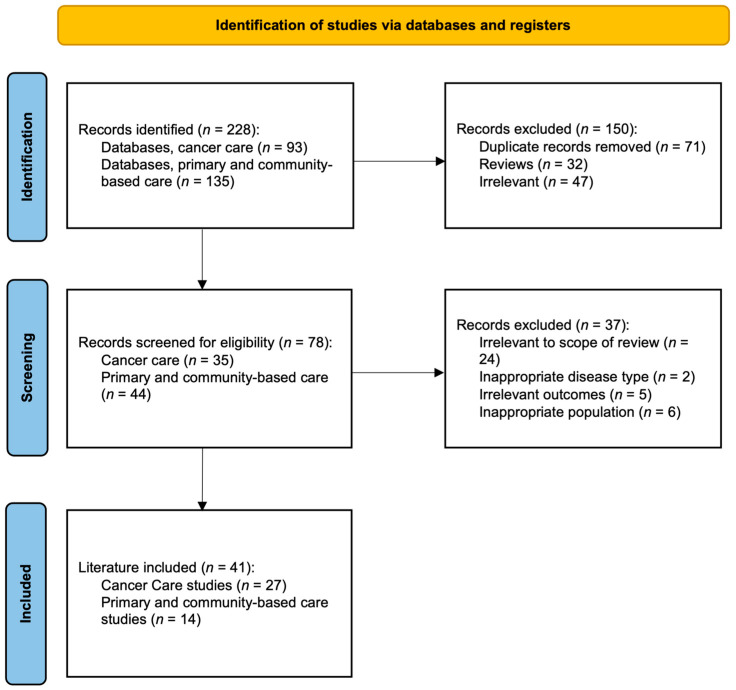
- The review synthesized 27 included cancer care systematic reviews (from 36 retrieved), 14 included primary/community care reviews (from 135 retrieved), 32 completed grey literature documents plus 48 additional sources, 72 survey responses, and 24 key informant interviews, with representation from all provinces and territories.
Methods
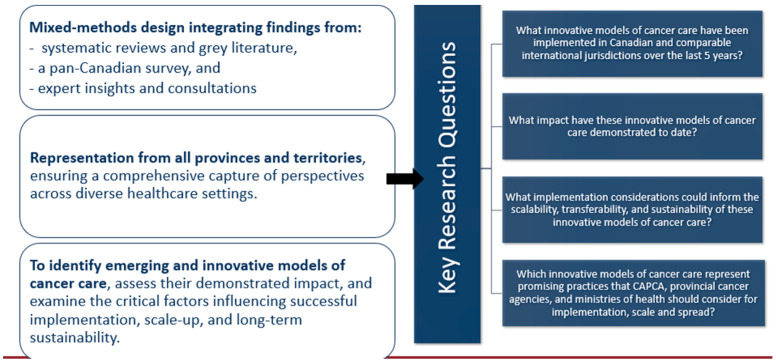
- Convergent mixed-methods implementation science design integrating four evidence streams: a scoping review of systematic reviews, a grey literature review and environmental scan, a pan-Canadian stakeholder survey, and semi-structured key informant interviews.
- Academic searches covered PubMed, Medline, Web of Science, Cochrane Library, and SCOPUS; cancer care systematic reviews were limited from 2020 to 28 November 2024, and primary/community care reviews from 2023 to 27 February 2025; grey literature followed Godin et al.’s methodology.
- Findings were analyzed independently and then triangulated, with implementation-related findings mapped deductively to the Consolidated Framework for Implementation Research (CFIR) domains and informed by the Quintuple Aim and Proctor’s Implementation Outcomes Framework.
Limitations
- The paper states that the umbrella review relied on existing systematic reviews rather than primary studies, may have omitted recent institutional pilots or localized rollouts, and did not conduct a formal methodological quality appraisal or risk-of-bias assessment of included reviews.
- It also states high heterogeneity across sources, an English-language restriction, grey literature limitations including reporting inconsistency and publication bias, and survey/interview respondent and selection biases due to CAPCA network recruitment and voluntary self-selection, with no direct first-hand patient or caregiver perspectives.
- The paper states that generalizability beyond Canada is constrained by Canada’s specific policy levers, regulatory frameworks, funding models, and health human resource roadmaps.
Model-written summary. Check it against the paper before relying on it.
Integrity signals
Registry
Cites
Statistics
Figures
Verification
Claims the paper makes
21 Valid · 9 Not valid · 11 Not checked · 72 Own results and interpretations
The cited sources support only part of this claim — read each source’s verdict below.
In the paper
“Emerging evidence suggests that workforce-related factors including staffing shortages, role optimization, competency development, training requirements, leadership support, change management, and regulatory alignment are among the most important determinants of implementation success [9,10,11].”
§ A Scoping Review of Implemented Innovations in Cancer Care: Implications for Pan-Canadian Scaling > 1. Introduction
What the sources say
- Partly supportedcites [9] Georgescu I. Dricu A. Artene S.-A. Vrăjitoru N.-R. Barcan E. Tache D.E. Giubelan L.-I. Staicu G.-A. Manea E.-V. Pană C. Digital-Focused Approaches in Cancer Patients’ Management in the Post-COVID Era: Challenges and Solutions Appl. Sci. 2024 14 8097 10.3390/app14188097 sourceExperimental — accuracy not yet measured
Section 3.3 says that integrating machine learning into cancer care requires cooperation among engineers, medical professionals, patients, and caregivers; section 3.4 identifies legislation and lack of trust as barriers to adoption. These passages support a limited point about professional coordination and regulatory barriers, but the paper does not identify staffing shortages, role optimization, competency development, training, leadership, or change management as determinants, nor rank workforce factors among the most important determinants of implementation success. No page numbers were available in our copy. (LLM, conf=0.82)
- Partly supportedcites [10] Urquhart R. Kendell C. Cornelissen E. Horne B. Martin M. Hovey R. Williamson T. Cuthbertson D. Porter G.A. Identifying factors influencing sustainability of innovations in cancer survivorship care: A qualitative study BMJ Open 2021 11 e042503 10.1136/bmjopen-2020-042503 33550249 PMC7925907 sourceExperimental — accuracy not yet measured
The Results (page not provided) identify management support, key people and expertise, adaptation, and ongoing education and training as necessary for sustaining cancer survivorship innovations; they also discuss staff turnover and coordination roles. The paper addresses sustainability rather than implementation success generally, and these passages do not establish staffing shortages, role optimization, or regulatory alignment as among its most important determinants. (LLM, conf=0.86)
- Partly supportedcites [11] Ramachandran S. Chang H.-J. Worthington C. Kushniruk A. Ibáñez-Carrasco F. Davies H. McKee G. Brown A. Gilbert M. Iyamu I. Digital Competencies and Training Approaches to Enhance the Capacity o f Practitioners to Support the Digital Transformation of Public Health: Rapid Review of Current Recommendations JMIR Public Health Surveill. 2024 10 e52798 10.2196/52798 39248660 PMC11403915 sourceExperimental — accuracy not yet measured
The Discussion (Principal Findings; page not available) identifies competency development and training as needs for public health digital transformation, and the Results (Practice Competency Recommendations Related to Digital Technologies; page not available) includes leadership competencies. The paper does not establish the full listed set of workforce factors—particularly staffing shortages, role optimization, change management, and regulatory alignment—as determinants of implementation success, or rank them among the most important. (LLM, conf=0.85)
hedgedstates an association- Asserted: passes — The authors put it forward as true.
- Checkable: passes — It can be checked against evidence.
- Load-bearing: passes — The paper’s conclusions depend on it.
- Based: passes — The paper gives a reason why it holds.
- Partly supported
The cited sources support only part of this claim — read each source’s verdict below.
In the paper
“Variations in funding models, digital infrastructure, regulatory frameworks, workforce availability, training opportunities, and data systems continue to affect implementation and spread across jurisdictions [9,10].”
§ A Scoping Review of Implemented Innovations in Cancer Care: Implications for Pan-Canadian Scaling > 1. Introduction
What the sources say
- Partly supportedcites [9] Georgescu I. Dricu A. Artene S.-A. Vrăjitoru N.-R. Barcan E. Tache D.E. Giubelan L.-I. Staicu G.-A. Manea E.-V. Pană C. Digital-Focused Approaches in Cancer Patients’ Management in the Post-COVID Era: Challenges and Solutions Appl. Sci. 2024 14 8097 10.3390/app14188097 sourceExperimental — accuracy not yet measured
Section 3.5 (page unavailable) identifies data-standardisation problems and costs for resource-limited providers; Section 3.4 says legislative barriers slowed adoption, and Section 4 calls for stronger digital infrastructure. The paper does not substantiate the claim about variations in funding models, workforce availability, training opportunities, or implementation and spread across jurisdictions. (LLM, conf=0.84)
- Partly supportedcites [10] Urquhart R. Kendell C. Cornelissen E. Horne B. Martin M. Hovey R. Williamson T. Cuthbertson D. Porter G.A. Identifying factors influencing sustainability of innovations in cancer survivorship care: A qualitative study BMJ Open 2021 11 e042503 10.1136/bmjopen-2020-042503 33550249 PMC7925907 sourceExperimental — accuracy not yet measured
The Results (Table 2 and ‘Necessary processes’; page unavailable) identify funding, staffing turnover, training, and data-collection procedures as factors in sustaining cancer survivorship innovations. The Discussion (page unavailable) also mentions adaptations to information systems and policies. The study does not establish the claimed cross-jurisdictional variations in digital infrastructure or regulatory frameworks, and its findings concern sustainability more directly than implementation and spread. (LLM, conf=0.85)
plainstates a cause- Asserted: passes — The authors put it forward as true.
- Checkable: passes — It can be checked against evidence.
- Load-bearing: passes — The paper’s conclusions depend on it.
- Based: passes — The paper gives a reason why it holds.
- Partly supported
Every source the paper cites for this claim was checked and supports it.
In the paper
“Evidence from implementation science demonstrates that successful innovations do not scale automatically”
§ A Scoping Review of Implemented Innovations in Cancer Care: Implications for Pan-Canadian Scaling > 1. Introduction
What the sources say
- Supportedcites [12] Bauer M.S. Kirchner J. Implementation science: What is it and why should I care? Psychiatry Res. 2020 283 112376 10.1016/j.psychres.2019.04.025 31036287 source
The section 'Everything went right. What went wrong?' (p. 1-2) states plainly that 'Establishing effectiveness of an innovation does not guarantee its uptake into routine usage', citing the 17-20 year lag and fewer than 50% of clinical innovations reaching general usage. The same section adds (Colditz & Emmons 2018; Ferlie et al. 2005) that contextual factors, not treatment effectiveness, dominate whether and how quickly an innovation becomes widely used, and Section 3.1 notes the non-adoption problem is longstanding and 'likely the rule rather than the exception'. This is the content the citing sentence attributes to implementation-science evidence; 'scale' maps onto the paper's 'uptake into routine/general usage' and 'widely used'. (LLM, conf=0.88)
- Supportedcites [13] Damschroder L.J. Aron D.C. Keith R.E. Kirsh S.R. Alexander J.A. Lowery J.C. Fostering implementation of health services research findings into pra ctice: A consolidated framework for advancing implementation science Implement. Sci. 2009 4 50 10.1186/1748-5908-4-50 19664226 PMC2736161 source
The Background states that many interventions shown effective in health services research fail to produce meaningful patient-care outcomes across multiple contexts. It also describes barriers to implementation, supporting the point that a successful innovation does not spread automatically. (LLM, conf=0.93)
- Supportedcites [14] Proctor E. Silmere H. Raghavan R. Hovmand P. Aarons G. Bunger A. Griffey R. Hensley M. Outcomes for Implementation Research: Conceptual Distinctions, Measurement Challenges, and Research Agenda Adm. Policy Ment. Health Ment. Health Serv. Res. 2011 38 65 76 10.1007/s10488-010-0319-7 20957426 PMC3068522 source
In “Modeling Attainment of Implementation Outcomes,” the paper states that evidence for a proven treatment does not ensure successful implementation and identifies system penetration as a further implementation outcome. This supports the claim that a successful innovation does not scale automatically. (LLM, conf=0.92)
boosted- Asserted: passes — The authors put it forward as true.
- Checkable: passes — It can be checked against evidence.
- Load-bearing: passes — The paper’s conclusions depend on it.
- Based: passes — The paper gives a reason why it holds.
- Supported
The cited sources support only part of this claim — read each source’s verdict below.
In the paper
“Despite this progress, translating successful innovations into sustainable, system-wide practice remains challenging.”
§ A Scoping Review of Implemented Innovations in Cancer Care: Implications for Pan-Canadian Scaling > 1. Introduction
What the sources say
- Partly supportedcites [9] Georgescu I. Dricu A. Artene S.-A. Vrăjitoru N.-R. Barcan E. Tache D.E. Giubelan L.-I. Staicu G.-A. Manea E.-V. Pană C. Digital-Focused Approaches in Cancer Patients’ Management in the Post-COVID Era: Challenges and Solutions Appl. Sci. 2024 14 8097 10.3390/app14188097 sourceExperimental — accuracy not yet measured
The Abstract and Discussion describe obstacles to permanently integrating digital cancer-care technologies into clinical practice, including cost, reluctance, and the need for robust infrastructure. They support the difficulty of sustaining those innovations, but the claim broadens this to successful innovations generally and to system-wide practice, which the paper does not establish. (LLM, conf=0.79)
- Supportedcites [10] Urquhart R. Kendell C. Cornelissen E. Horne B. Martin M. Hovey R. Williamson T. Cuthbertson D. Porter G.A. Identifying factors influencing sustainability of innovations in cancer survivorship care: A qualitative study BMJ Open 2021 11 e042503 10.1136/bmjopen-2020-042503 33550249 PMC7925907 source
The Discussion describes sustaining cancer survivorship innovations as dependent on several interrelated organisational and system-level factors, despite investment in implementing and scaling beneficial innovations across Canadian jurisdictions. The Results also identify shifting system priorities and limited resources as challenges to sustaining and expanding programmes beyond their pilot phase. No page numbers are available in our copy. (LLM, conf=0.88)
plain- Asserted: passes — The authors put it forward as true.
- Checkable: passes — It can be checked against evidence.
- Load-bearing: passes — The paper’s conclusions depend on it.
- Based: passes — The paper gives a reason why it holds.
- Partly supported
The cited sources support only part of this claim — read each source’s verdict below.
In the paper
“implementation outcomes are influenced by a complex interaction of contextual, organizational, workforce, policy, and system-level factors [12,13,14].”
§ A Scoping Review of Implemented Innovations in Cancer Care: Implications for Pan-Canadian Scaling > 1. Introduction
What the sources say
- Supportedcites [12] Bauer M.S. Kirchner J. Implementation science: What is it and why should I care? Psychiatry Res. 2020 283 112376 10.1016/j.psychres.2019.04.025 31036287 source
Section 3.2 ('Defining implementation science') states the crux of implementation science is to 'identify uptake barriers and facilitators across multiple levels of context (individuals in treatment, providers, organization, and other stakeholder groups)', and Section 4.3 ('The scope of implementation science') says targets of investigation 'may also include the provider, clinic, facility, organization, community, and even the policy environment', with healthcare system leaders, administrators and staff as essential partners. The narrative section ('Everything went right. What went wrong?') adds that contextual factors, not treatment effectiveness, dominate uptake, including the professional disciplines of intended recipients. Together our copy clearly treats uptake (i.e., implementation outcomes) as determined by interacting contextual, organizational, workforce/provider, system and policy-level factors; only the exact phrase 'complex interaction' is the citing authors' gloss. (LLM, conf=0.82)
- Supportedcites [13] Damschroder L.J. Aron D.C. Keith R.E. Kirsh S.R. Alexander J.A. Lowery J.C. Fostering implementation of health services research findings into pra ctice: A consolidated framework for advancing implementation science Implement. Sci. 2009 4 50 10.1186/1748-5908-4-50 19664226 PMC2736161 source
The Results (Overview of the CFIR; page unavailable) describe interacting inner- and outer-setting factors that influence implementation. The Results sections on Characteristics of individuals and Outer setting address staff attributes and external policies, while the Discussion identifies contextual factors at system, facility, and team levels. (LLM, conf=0.92)
- Partly supportedcites [14] Proctor E. Silmere H. Raghavan R. Hovmand P. Aarons G. Bunger A. Griffey R. Hensley M. Outcomes for Implementation Research: Conceptual Distinctions, Measurement Challenges, and Research Agenda Adm. Policy Ment. Health Ment. Health Serv. Res. 2011 38 65 76 10.1007/s10488-010-0319-7 20957426 PMC3068522 sourceExperimental — accuracy not yet measured
The “Level of Analysis for Outcomes” section describes implementation as multilevel, involving provider behavior, care organizations, and policy. “Modeling Attainment of Implementation Outcomes” also identifies provider attitudes, professional behavior, and the service system as contextual factors. The paper does not establish that these factors interact with one another to influence implementation outcomes; its discussion of complex interrelationships concerns the outcomes themselves. Page numbers were not supplied in our copy. (LLM, conf=0.82)
plainstates a cause- Asserted: passes — The authors put it forward as true.
- Checkable: passes — It can be checked against evidence.
- Load-bearing: passes — The paper’s conclusions depend on it.
- Based: passes — The paper gives a reason why it holds.
- Supported
37 more claims · 5 with their cited sources checked
Create a free account to see all 113 claims and to verify the 7 references still open.
- It may state two separate claims as one. 50
- Probably not a substantial claim. 37
- The quote only partly states this claim. 1
Citations
Cites
The PRISMA 2020 statement: An updated guideline for reporting systematic reviews
Page, M. J., McKenzie, J. E., Bossuyt, P. M., Boutron, I., Hoffmann, T. C., Mulrow, C. D., Shamseer, L., Tetzlaff, J. M., Akl, E. A., Brennan, S. E., et al. (2021) · BMJ · doi:10.1136/bmj.n71 · Cited by 108,283
Scoping studies: towards a methodological framework
Arksey, H., & O'Malley, L. (2005) · International Journal of Social Research Methodology · doi:10.1080/1364557032000119616 · Cited by 36,742 · cited 1×
“The academic literature was reviewed using a structured scoping review approach aligned with PRISMA 2020 guidance for evidence synthesis, supplemented by an environ-https mental scan [18].”
Damschroder, L. J., Aron, D. C., Keith, R. E., Kirsh, S. R., Alexander, J. A., & Lowery, J. C. (2009) · Implementation Science · doi:10.1186/1748-5908-4-50 · Cited by 14,496 · cited 7×
“…by two complementary frameworks: the Quintuple Aim Framework, which informed the assessment of innovation outcomes, and the Consolidated Framework for Implementation Research (CFIR), which informed the assessment of implementation processes, contextual factors, barriers, and facilitators [13,17].”
InfluentialProctor, E., Silmere, H., Raghavan, R., Hovmand, P., Aarons, G., Bunger, A., Griffey, R., & Hensley, M. (2011) · Administration and Policy in Mental Health and Mental Health Services Research · doi:10.1007/s10488-010-0319-7 · Cited by 8,721 · cited 7×
“Implementation science bridges the gap between evidence-based innovations and their adoption into healthcare systems by identifying barriers, facilitators, and targeted strategies for sustainable uptake [12–14].”
InfluentialGray literature: An important resource in systematic reviews
Paez, A. (2017) · Journal of Evidence-Based Medicine · doi:10.1111/jebm.12266 · Cited by 1,459
Implementation science: What is it and why should I care?
Bauer, M. S., & Kirchner, J. (2020) · Psychiatry Research · doi:10.1016/j.psychres.2019.04.025 · Cited by 1,167
Godin, K., Stapleton, J., Kirkpatrick, S. I., Hanning, R. M., & Leatherdale, S. T. (2015) · Systematic Reviews · doi:10.1186/s13643-015-0125-0 · Cited by 959 · cited 1×
“Over 50 sources such as government reports and policy briefs were included to capture real-world implementation experiences often absent from the peer-reviewed literature [19,20].”
The Quintuple Aim for Health Care Improvement: A New Imperative to Advance Health Equity
Nundy, S., Cooper, L. A., & Mate, K. S. (2022) · JAMA · doi:10.1001/jama.2021.25181 · Cited by 834 · cited 5×
“…by two complementary frameworks: the Quintuple Aim Framework, which informed the assessment of innovation outcomes, and the Consolidated Framework for Implementation Research (CFIR), which informed the assessment of implementation processes, contextual factors, barriers, and facilitators [13,17].”
InfluentialDigital health and telehealth in cancer care: A scoping review of reviews
Shaffer, K. M., Turner, K. L., Siwik, C., Gonzalez, B. D., Upasani, R., Glazer, J. V., Ferguson, R. J., Joshua, C., & Low, C. A. (2023) · The Lancet Digital Health · doi:10.1016/s2589-7500(23)00049-3 · Cited by 263 · cited 2×
“…initially introduced as emergency responses, are moving towards becoming sustainable and are being increasingly recognized as important strategies for addressing ongoing workforce shortages, improving access, and strengthening health system resilience in the post-pandemic era [2,3,5,6].”
The role of digital health technology in rural cancer care delivery: A systematic review
Morris, B. B., Rossi, B., & Fuemmeler, B. (2022) · The Journal of Rural Health · doi:10.1111/jrh.12619 · Cited by 104 · cited 7×
“…initially introduced as emergency responses, are moving towards becoming sustainable and are being increasingly recognized as important strategies for addressing ongoing workforce shortages, improving access, and strengthening health system resilience in the post-pandemic era [2,3,5,6].”
InfluentialPatient reported outcomes in oncology: changing perspectives—a systematic review
Silveira, A., Sequeira, T., Gonçalves, J. J., & Ferreira, P. L. (2022) · Health and Quality of Life Outcomes · doi:10.1186/s12955-022-01987-x · Cited by 84
Elkefi, S., Trapani, D., & Ryan, S. (2023) · International Journal of Medical Informatics · doi:10.1016/j.ijmedinf.2023.105065 · Cited by 64
Yin, R., Martinengo, L., Smith, H. E., Subramaniam, M., Griva, K., & Car, L. T. (2024) · The Lancet Healthy Longevity · doi:10.1016/j.lanhl.2024.08.007 · Cited by 57
Kwok, C., Degen, C., Moradi, N., & Stacey, D. (2022) · Supportive Care in Cancer · doi:10.1007/s00520-022-07052-z · Cited by 56
The application and use of artificial intelligence in cancer nursing: A systematic review
O'Connor, S., Vercell, A., Wong, D., Yorke, J., Fallatah, F. A., Cave, L., & Anny Chen, L.-Y. (2024) · European Journal of Oncology Nursing · doi:10.1016/j.ejon.2024.102510 · Cited by 51
Franzoi, M. A., Ferreira, A. R., Lemaire, A., Rodriguez, J., Grosjean, J., Ribeiro, J. M., Polastro, L., Grellety, T., Artignan, X., Le Du, K., et al. (2024) · The Lancet Regional Health - Europe · doi:10.1016/j.lanepe.2024.101005 · Cited by 50 · cited 3×
“The main barrier during implementation was a lack of standardized billing, but there is now a regulated fee per patient [63] AI in Cancer Care In Alberta (2025), BC (2024), Quebec (2023), Manitoba (2025) and Ontario (2024), AI platforms are now being used to enhance chemotherapy scheduling by…”
Webster, C. S., Coomber, T., Liu, S., Allen, K., & Jowsey, T. (2023) · Journal of Patient Safety · doi:10.1097/pts.0000000000001170 · Cited by 50
Ambrosi, E., Mezzalira, E., Canzan, F., Leardini, C., Vita, G., Marini, G., & Longhini, J. (2025) · International Journal of Medical Informatics · doi:10.1016/j.ijmedinf.2025.105820 · Cited by 50
Macheka, S., Ng, P. Y., Ginsburg, O., Hope, A., Sullivan, R., & Aggarwal, A. (2024) · BMJ Oncology · doi:10.1136/bmjonc-2023-000255 · Cited by 45
Artificial intelligence in colorectal surgery: an AI-powered systematic review
Spinelli, A., Carrano, F. M., Laino, M. E., Andreozzi, M., Koleth, G., Hassan, C., Repici, A., Chand, M., Savevski, V., & Pellino, G. (2023) · Techniques in Coloproctology · doi:10.1007/s10151-023-02772-8 · Cited by 38
Tu, Q., Lin, S., Hyun, K. K., Hafiz, N., Manandi, D., Koh, A. S.-M., & Redfern, J. (2024) · Primary care diabetes · doi:10.1016/j.pcd.2024.05.003 · Cited by 37 · cited 2×
“…this review are consistent with emerging international evidence demonstrating that successful cancer care transformation increasingly relies on digital health, workforce innovation, team-based care, and community-oriented models of service delivery (Supplementary Material S4 Table S1 [6, 22– 61 ]).”
Pilla, A. D., Cozzolino, M. R., Mannocci, A., Carini, E., Spina, F., Castrini, F., Grieco, A., Messina, R., Damiani, G., & Specchia, M. L. (2022) · International Journal of Environmental Research and Public Health · doi:10.3390/ijerph192214990 · Cited by 37
Huang, Y., Li, Q., Zhou, F., & Song, J. (2022) · BMJ Open · doi:10.1136/bmjopen-2021-057664 · Cited by 36
Brick, R., Padgett, L., Jones, J., Wood, K. C., Pergolotti, M., Marshall, T. F., Campbell, G., Eilers, R., Keshavarzi, S., Flores, A. M., et al. (2023) · Journal of Cancer Survivorship · doi:10.1007/s11764-022-01181-4 · Cited by 36
Application of Artificial Intelligence for Nasopharyngeal Carcinoma Management – A Systematic Review
Ng, W. T., But, B., Choi, H. C., de Bree, R., Lee, A. W., Lee, V. H., López, F., Mäkitie, A. A., Rodrigo, J. P., Saba, N. F., et al. (2022) · Cancer Management and Research · doi:10.2147/cmar.s341583 · Cited by 33
Urquhart, R., Kendell, C., Cornelissen, E., Powell, B. J., Madden, L. L., Kissmann, G., Richmond, S. A., & Bender, J. L. (2021) · BMJ Open · doi:10.1136/bmjopen-2020-042503 · Cited by 32 · cited 1×
“Variations in funding models, digital infrastructure, regulatory frameworks, workforce availability, training opportunities, and data systems continue to affect implementation and spread across jurisdictions [9,10].”
Job satisfaction of advanced practice nurses in cancer care: A systematic review
Geese, F., Zwakhalen, S., Lucien, B., & Hahn, S. (2022) · European Journal of Oncology Nursing · doi:10.1016/j.ejon.2021.102089 · Cited by 30 · cited 3×
“In addition, digital governance policies, cybersecurity measures, and AI integration strategies must be embedded within competency frameworks to protect sensitive patient data [4–6 , 11].”
Team-Based Care for Cancer Survivors With Comorbidities: A Systematic Review
Doose, M., Verhoeven, D. C., Sanchez, J. I., Livinski, A. A., Mollica, M. A., Chollette, V. Y., & Weaver, S. J. (2022) · Journal for Healthcare Quality · doi:10.1097/jhq.0000000000000354 · Cited by 30
A systematic review of eHealth technologies for breast cancer supportive care
Gyawali, B., Bowman, M., Sharpe, I., Jalink, M., Srivastava, S., & Wijeratne, D. T. (2023) · Cancer Treatment Reviews · doi:10.1016/j.ctrv.2023.102519 · Cited by 28 · cited 2×
“…this review are consistent with emerging international evidence demonstrating that successful cancer care transformation increasingly relies on digital health, workforce innovation, team-based care, and community-oriented models of service delivery (Supplementary Material S4 Table S1 [6, 22– 61 ]).”
Bu, S., Smith, A. ‘., Janssen, A., Donnelly, C., Dadich, A., Mackenzie, L. J., Smith, A. L., Young, A. L., Wu, V. S., Smith, S. J., et al. (2022) · Critical Reviews in Oncology/Hematology · doi:10.1016/j.critrevonc.2022.103869 · Cited by 27
Telemedicine Implementation for Safety Net Populations: A Systematic Review
Tierney, A. A., Mosqueda, M., Cesena, G., Frehn, J. L., Payán, D. D., & Rodriguez, H. P. (2024) · Telemedicine and e-Health · doi:10.1089/tmj.2023.0260 · Cited by 26
Chagas, M. E. V., Jacovas, V. C., Moreira, T. D. C., Constant, H. M. R. M., Rohden, S. F., Alves, S. S., Santini, F. D. O., Dall'Agnol, S., Klever, E. K., Cabral, F. C., et al. (2024) · Telemedicine Journal and e-Health · doi:10.1089/tmj.2023.0530 · Cited by 26
A systematic review of smartphone applications for cancer survivors
Changrani, K., Chima, S., Sharma, A. K., Han, G.-G., Sharma, A., McNamara, M., Jefford, M., Emery, J. D., & Druce, P. (2023) · Journal of Cancer Survivorship · doi:10.1007/s11764-023-01435-9 · Cited by 24
The impact of AI on modern oncology from early detection to personalized cancer treatment
Li, J., Zhang, L., Yu, Z., Bao, Z., Li, D., & Wang, L. (2026) · npj Precision Oncology · doi:10.1038/s41698-026-01276-6 · Cited by 24 · cited 1×
“…et al. (2026) highlight the expanding role of AI across early detection, imaging, pathology, clinical decision support, precision medicine, drug discovery, and treatment personalization, while also emphasizing the need for validation, governance, and trust before routine clinical integration [73].”
da Silva, H. E. C., Santos, G. N. M., Ferreira Leite, A., Mesquita, C. R. M., de Souza Figueiredo, P. T., Miron Stefani, C., & de Santos Melo, N. (2022) · Supportive Care in Cancer · doi:10.1007/s00520-022-07109-z · Cited by 24
Ramachandran, S., Chang, H.-J., Worthington, C., Kushniruk, A., Ibáñez-Carrasco, F., Davies, H., McKee, G., Brown, A., Gilbert, M., & Iyamu, I. (2024) · JMIR Public Health and Surveillance · doi:10.2196/52798 · Cited by 23 · cited 4×
“In addition, digital governance policies, cybersecurity measures, and AI integration strategies must be embedded within competency frameworks to protect sensitive patient data [4–6 , 11].”
InfluentialRokhshad, R., Salehi, S. N., Yavari, A., Shobeiri, P., Esmaeili, M., Manila, N., Motamedian, S. R., & Mohammad-Rahimi, H. (2024) · Oral Radiology · doi:10.1007/s11282-023-00715-5 · Cited by 23
Mostafaei, A., Sadeghi-Ghyassi, F., Kabiri, N., & Hajebrahimi, S. (2022) · Supportive Care in Cancer · doi:10.1007/s00520-022-07415-6 · Cited by 22
Asgary, R., Garland, V., Ro, V., Stribling, J. C., & Waldman, R. (2022) · Preventive Medicine · doi:10.1016/j.ypmed.2022.107154 · Cited by 20
The implementation of an advanced practice radiation therapy (APRT) program in Singapore
Wong, S. M. M., Sin, S. Y., Lim, L. H., Nurul Tassha, B. M. A., Lin, J., Melissa, K., Koh, W. Y., Ho, F., Quah, D. S. C., Sommat, K., et al. (2021) · Technical Innovations & Patient Support in Radiation Oncology · doi:10.1016/j.tipsro.2021.02.002 · Cited by 20 · cited 2×
“Both the United Kingdom (2002) and Singapore (2012) have implemented the APRT role nationally; in both countries, the role has been strategically expanded during and since COIVD-19 as a solution to cancer care backlog [66,67].”
Howland, K., Edvardsson, K., Lees, H., & Hooker, L. (2024) · International Journal of Nursing Studies Advances · doi:10.1016/j.ijnsa.2024.100277 · Cited by 18
Patient attrition in Molecular Tumour Boards: a systematic review
Frost, H., Graham, D. M., Carter, L., O’Regan, P., Landers, D., & Freitas, A. (2022) · British Journal of Cancer · doi:10.1038/s41416-022-01922-3 · Cited by 17
Ma, Z., Shi, Y., Yao, S., Lu, N., & Cheng, F. (2023) · Supportive Care in Cancer · doi:10.1007/s00520-023-08052-3 · Cited by 17
A systematic review of m-health apps on managing side effects of breast cancer treatment
Wanchai, A., Anderson, E. A., & Armer, J. M. (2023) · Supportive Care in Cancer · doi:10.1007/s00520-022-07464-x · Cited by 17
Rine, S., Lara, S. T., Bikomeye, J. C., Beltrán-Ponce, S., Kibudde, S., Niyonzima, N., Lawal, O. O., Mulamira, P., & Beyer, K. M. (2023) · Journal of Global Health · doi:10.7189/jogh.13.06048 · Cited by 16
Evaluating the Effectiveness of Mobile Health in Breast Cancer Care: A Systematic Review
Flaucher, M., Zakreuskaya, A., Nissen, M., Mocker, A., Fasching, P. A., Beckmann, M. W., Eskofier, B. M., & Leutheuser, H. (2023) · The Oncologist · doi:10.1093/oncolo/oyad217 · Cited by 15
Optimized drug regimen and chemotherapy scheduling for cancer treatment using swarm intelligence
Dhieb, N., Abdulrashid, I., Ghazzai, H., & Massoud, Y. (2023) · Annals of Operations Research · doi:10.1007/s10479-021-04234-6 · Cited by 14 · cited 1×
“The United Kingdom’s (UK) National Health Service (NHS) (2023) has moved toward AI-led care that automates non-clinical workflows including complex scheduling and triage [64].”
The Roles of Cloud-Based Systems on the Cancer-Related Studies: A Systematic Literature Review
Xu, B., & Zhou, F. (2022) · IEEE Access · doi:10.1109/access.2022.3181147 · Cited by 13
Uzzaman, N., Hammersley, V., McClatchey, K., Sheringham, J., Singh, D., Habib, G. M., & Pinnock, H. (2024) · Journal of Medical Internet Research · doi:10.2196/57708 · Cited by 13
Fang, H., Sun, Y., Yu, D., & Xu, Y. (2024) · Asia-Pacific Journal of Oncology Nursing · doi:10.1016/j.apjon.2024.100515 · Cited by 12
Interventions for Concerning Patient-Reported Outcomes in Routine Cancer Care: A Systematic Review
Sampieri, G., Li, H., Ataalla, P., Merriman, K., Noel, C. W., Hallet, J. I., Coburn, N. G., Karam, I., Smoragiewicz, M., Wong, B. M., et al. (2023) · Annals of Surgical Oncology · doi:10.1245/s10434-023-14576-z · Cited by 12
Underhill, C., Parente, P., McArthur, G., Haydon, A., McLachlan, S., Wong, Z. W., Segelov, E., & Victorian COVID‐19 Cancer Network (2020) · Internal Medicine Journal · doi:10.1111/imj.15012 · Cited by 11 · cited 3×
“Other common barriers, shared with the Australian home-based model of care, are safety concerns, geographical challenges, and resourcing constraints [71].”
Characteristics and Outcomes of mHealth Interventions in Psychosis: Systematic Mapping Review
Loh, P. Y., Martinengo, L., Heaukulani, C., Tan, X., Hng, M., Cheah, Y. Y., Morris, R. J. T., Car, L. T., & Lee, J. (2024) · Journal of Medical Internet Research · doi:10.2196/55924 · Cited by 10
Putrik, P., Grobler, L., LALOR, A. F., Ramsay, H., Gorelik, A., Karnon, J. D., Parker, D., Morgan, M. A. J., Buchbinder, R., & O’Connor, D. A. (2024) · Cochrane Database of Systematic Reviews · doi:10.1002/14651858.cd013880.pub2 · Cited by 10
Kumar, S. S., Connolly, P. M., & Maier, A. M. (2024) · Journal of Medical Internet Research · doi:10.2196/54405 · Cited by 9
Wingfield, L. R., Salaün, A., Khan, A., Webb, H., Zhu, T., & Knight, S. R. (2023) · Transplantation · doi:10.1097/tp.0000000000004627 · Cited by 7
Georgescu, I., Dricu, A., Artene, S.-A., Vrăjitoru, N.-R., Barcan, E., Tache, D. E., Giubelan, L.-I., Staicu, G.-A., Manea (Carneluti), E.-V., Pană, C., et al. (2024) · Applied Sciences · doi:10.3390/app14188097 · Cited by 6 · cited 2×
“Emerging evidence suggests that workforce-related factors including staffing shortages, role optimization, competency development, training requirements, leadership support, change management, and regulatory alignment are among the most important determinants of implementation success [9–11].”
Rivera, D. I. C., Suárez, S. M. P., Herrera, M. S. C., Sandoval, J. P. R., Romero, M. K. R., & López-Romero, L. A. (2024) · Public Health · doi:10.1016/j.puhe.2024.06.033 · Cited by 6
Gebremeskel, T. G., Romeo, F., Shama, A. T., Bonevski, B., & Trigg, J. (2024) · International Journal of Environmental Research and Public Health · doi:10.3390/ijerph21050534 · Cited by 6
Home-based treatment for patients with hematological cancer in Denmark–A national overview
Nørskov, K. H., Bødtcher, H., Rosenberg, T., Damgaard, C. T., Nielsen, I. H., Enggaard, H., & Dalton, S. O. (2025) · Supportive Care in Cancer · doi:10.1007/s00520-025-10048-0 · Cited by 6
Springer, F., Hambsch, P. K., Mehnert-Theuerkauf, A., & Nicolay, N. H. (2025) · Frontiers in Oncology · doi:10.3389/fonc.2025.1546221 · Cited by 5
Tene, T., Vique López, D. F., Valverde Aguirre, P. E., & Serrano Avalos, K. V. (2026) · Frontiers in Digital Health · doi:10.3389/fdgth.2026.1764390 · Cited by 5 · cited 1×
“Tene et al. (2026) similarly demonstrate that AI is increasingly being incorporated into oncology education and clinical practice, underscoring the need for formal AI curricula, standardized competencies, and equitable access to training for oncology professionals [74].”
A development framework for the consultant radiographer in oncology: The Leeds experience
Roberts, N. (2016) · Journal of Radiotherapy in Practice · doi:10.1017/s1460396916000042 · Cited by 4 · cited 1×
“Both the United Kingdom (2002) and Singapore (2012) have implemented the APRT role nationally; in both countries, the role has been strategically expanded during and since COIVD-19 as a solution to cancer care backlog [66,67].”
Pilla, A. D., Cozzolino, M. R., Mannocci, A., et al. (2022) · Research Square · doi:10.21203/rs.3.rs-1673353/v1 · Cited by 4
Jones, L., Colwell, B., Hao, D., Welch, S., Campbell, A., & Gill, S. (2024) · Current Oncology · doi:10.3390/curroncol31080319 · Cited by 3
Pai, N. P., Rahimi, S. A., Tulsi, J., Bartlett, S., Grover, S., & Sejdic, E. (2026) · FACETS · doi:10.1139/facets-2025-0142 · Cited by 3 · cited 1×
“Pant Pai et al. (2026) argue that Canada requires foundational investments in interoperability, a unified digital health core, scalable health data systems, data governance, and continuous workforce training to support equitable “Smart Care Everywhere” models [72].”
Metadata
- Authors
- Sampalli, T., Tomblin Murphy, G., Peacock, S., Navaratnam, S., Domm, D., & MacKenzie, K.
- Affiliations
- Dalhousie University (CA)
- School of Nursing, Dalhousie University, 5869 University Avenue, Halifax, NS B3H 4R2, Canada
- Simon Fraser University (CA)
- Health Sciences Centre (CA)
- Canadian Association of Provincial Cancer Agencies (CA)
- Corresponding author
- Sampalli, Tara
- Venue
- Current Oncology
- Publisher
- MDPI AG
- Published
- 2026-07-01
- Volume
- 33
- Issue
- 7
- Pages
- 395
- ISSN
- 1198-0052 (ISSN-L)
- 1718-7729
- PMC
- PMC13408933
- OpenAlex
- W7166824210
- Cited by
- 0
- References
- 57
- FWCI
- 0.00
- Type
- journal article
- Language
- en
- Open access
- gold
- doi.org
- Licence
- Locations
- Current Oncology (publishedVersion, cc-by)
- PubMed (publishedVersion)
- PubMed Central (publishedVersion, cc-by)
- DOAJ (DOAJ: Directory of Open Access Journals) (submittedVersion)
- Funders
- Canadian Partnership Against Cancer Corporation (#13254)
- Topics
- Health Sciences › Health Professions › General Health Professions › Health Policy Implementation Science
- Health Sciences › Medicine › Public Health, Environmental and Occupational Health › Telemedicine and Telehealth Implementation
- Health Sciences › Medicine › Public Health, Environmental and Occupational Health › Clinical practice guidelines implementation
- Keywords
- scalability, implementation barriers and facilitators, artificial intelligence in oncology, team-based care, home infusion, palliative care, pharmacist-led clinic, health equity, Consolidated Framework for Implementation Research, workforce capacity, digital infrastructure
- MeSH terms
- Canada, Delivery of Health Care, Humans, Medical Oncology, Neoplasms
About these checks
Registry, retraction, Cites and statistics results are computed, not judged, with one exception: a printed reference that no index lists is read once by a model before it counts as a citation error. Claims are extracted by a model and kept only when their quote appears verbatim in the text; each cited source is then checked, with a model’s help, for whether it says what the claim relies on. Those verdicts can be wrong — read the claim’s quote and the cited source before relying on one.
The claim verdicts this report counts are experimental: their accuracy is not yet measured.
A language model drew the claims from the paper on 2026-10-10, under version 3 of the claim definition (model deepseek-v4.1-flash, prompt extract-v3).
A second model labelled each claim on 2026-10-10 (model jev-1.13-20260917, definition revision gold-guideline-v0.2).
Cited sources are checked with a language model’s help (gpt-6-sol and qwen3.8-omni-flash).
Statistics and arithmetic are recomputed, not judged.
Confidence bands are shown only for fields calibrated on our annotated test set. None is calibrated yet, so no band is shown.
What counts as a claim ›How we measure confidence ›How we check this ›
Are you an author, or do you see a problem with this page? Request a review
Data sources
Bibliographic data: Semantic Scholar, OpenAlex, Crossref.
Contains information from the Semantic Scholar Academic Graph Datasets, made available under the ODC Attribution License (ODC-BY 1.0).
Semantic Scholar’s data is described in: Kinney, R., et al. (2023). The Semantic Scholar Open Data Platform. arXiv:2301.10140.
