

Continuous Hydrothermal Liquefaction of Biomass: A Critical Review
Open accessThe DOI matches its Crossref record; 99 of the 99 references it cites were found in a registry or an index.
Abstract
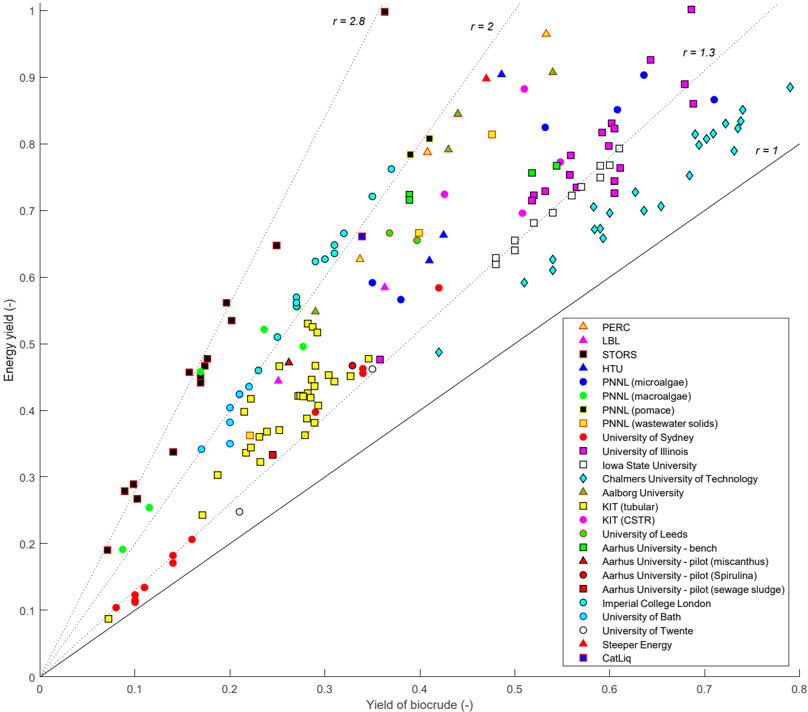
Hydrothermal liquefaction (HTL) of biomass is emerging as an effective technology to efficiently valorize different types of (wet) biomass feedstocks, ranging from lignocellulosics to algae and organic wastes. Significant research into HTL has been conducted in batch systems, which has provided a fundamental understanding of the different process conditions and the behavior of different biomass. The next step towards continuous plants, which are prerequisites for an industrial implementation of the process, has been significantly less explored. In order to facilitate a more focused future development, this review—based on the sources available in the open literature—intends to present the state of the art in the field of continuous HTL as well as to suggest means of interpretation of data from such plants. This contributes to a more holistic understanding of causes and effects, aiding next generation designs as well as pinpointing research focus. Additionally, the documented experiences in upgrading by catalytic hydrotreating are reported. The study reveals some interesting features in terms of energy densification versus the yield of different classes of feedstocks, indicating that some global limitations exist irrespective of processing implementations. Finally, techno-economic considerations, observations and remarks for future studies are presented.
Overview
The claims and statistics of this paper haven’t been checked yet.
Free: it reads the open-access text and checks the first 5 claims that cite a source we can check. Create a free account to check every claim.
Integrity signals
Registry
Cites
Statistics
Figures
Verification
Claims the paper makes
The claims and statistics of this paper haven’t been checked yet.
Free: it reads the open-access text and checks the first 5 claims that cite a source we can check. Create a free account to check every claim.
Claims other papers make about this one
Each is checked against this paper’s own text: does it say what the citing paper says it does?
The source backs part of the claim, not all of it — or backs it for a different population, condition or comparison.
In the citing paper
“In addition, the reaction temperature also influences certain reaction mechanisms and the kinetics of various competing reactions; subcritical water properties prefer ionic reactions, whereas gas-like density in a supercritical water condition favors radical reactions [22,107,117].”
From Sub- and Supercritical Water Liquefaction of Kraft Lignin and Black Liquor Derived Lignin (2020) · cites this paper as [22]
Experimental — accuracy not yet measuredThe source backs part of the claim, not all of it — or backs it for a different population, condition or comparison.
In the citing paper
“HTL is a thermochemical process in which the main product obtained is a biocrude - an oxygenated precursor of hydrocarbon fuels - that can be further upgraded to meet product specifications using standard refinery technology.”
From Integration of hydrothermal liquefaction and carbon capture and storage for the production of advanced liquid biofuels with negative CO2 emissions (2020) · cites this paper as [4]
Experimental — accuracy not yet measuredThe source backs part of the claim, not all of it — or backs it for a different population, condition or comparison.
In the citing paper
“In a subsequent hydrotreating step, excess hydrogen is used for heteroatom removal, bonds saturation and overall improvement of the biocrude quality towards the final drop-in fuels [4].”
From Integration of hydrothermal liquefaction and carbon capture and storage for the production of advanced liquid biofuels with negative CO2 emissions (2020) · cites this paper as [4]
Experimental — accuracy not yet measuredThe cited source says what the claim attributes to it.
In the citing paper
“The reaction temperature of HTL varies from 523 K up to 723 K as the pressure range varies between 10 MPa and 35 MPa [22,52].”
From Sub- and Supercritical Water Liquefaction of Kraft Lignin and Black Liquor Derived Lignin (2020) · cites this paper as [22]
The cited source says what the claim attributes to it.
In the citing paper
“Most studies have focused on batch HTL systems, but in order to make the process commercially viable a continuous system is desirable and the issues that need to be addressed have been reviewed [107].”
From Key Targets for Improving Algal Biofuel Production (2021) · cites this paper as [107]
2 more claims about this paper
Create a free account to see every claim other papers make about this one.
Self-check
Percentages, sums and reported differences re-computed from the paper’s own numbers.
The self-check needs the paper’s full text.
Citations
Cites
The Path Forward for Biofuels and Biomaterials
Ragauskas, A. J., Williams, C. K., Davison, B. H., Britovsek, G., Cairney, J., Eckert, C. A., Frederick, W. J., Hallett, J. P., Leak, D. J., Liotta, C. L., et al. (2006) · Science · doi:10.1126/science.1114736 · Cited by 5,741 · cited 1×
“Among the different energy sources, biomass represents a very important part, including into its definition a wide range of materials such as forestry and agricultural residues, energy crops, but also organic wastes such as sewage sludge, food and sorted organic waste can be all considered as biomass [1,2].”
BackgroundWagner, W., & Pruß, A. (2002) · Journal of Physical and Chemical Reference Data · doi:10.1063/1.1461829 · Cited by 4,884
Energy production from biomass (part 1): overview of biomass
McKendry, P. (2002) · Bioresource Technology · doi:10.1016/s0960-8524(01)00118-3 · Cited by 4,860 · cited 1×
“Among the different energy sources, biomass represents a very important part, including into its definition a wide range of materials such as forestry and agricultural residues, energy crops, but also organic wastes such as sewage sludge, food and sorted organic waste can be all considered as biomass [1,2].”
BackgroundProduction of first and second generation biofuels: A comprehensive review
Naik, S. N., Goud, V. V., Rout, P. K., & Dalai, A. K. (2010) · Renewable and Sustainable Energy Reviews · doi:10.1016/j.rser.2009.10.003 · Cited by 3,264 · cited 1×
“Particularly for applications in the field of transportation, for example, this is preferred in order to feed internal combustion engines or turbines [6].”
BackgroundA unified correlation for estimating HHV of solid, liquid and gaseous fuels
Channiwala, S. A., & Parikh, P. P. (2002) · Fuel · doi:10.1016/s0016-2361(01)00131-4 · Cited by 2,489
Peterson, A. A., Vogel, F., Lachance, R. P., Fröling, M., Antal, Jr., & Tester, J. W. (2008) · Energy & Environmental Science · doi:10.1039/b810100k · Cited by 2,132
Renewable Fuels and Chemicals by Thermal Processing of Biomass
Bridgwater, A. V. (2003) · Chemical Engineering Journal · doi:10.1016/s1385-8947(02)00142-0 · Cited by 1,920 · cited 1×
“Biomass can thus be considered the natural substitute for fossil crude oil in the production of liquid fuels and petrochemicals [5].”
BackgroundHydrothermal liquefaction of biomass: A review of subcritical water technologies
Toor, S. S., Rosendahl, L., & Rudolf, A. (2011) · Energy · doi:10.1016/j.energy.2011.03.013 · Cited by 1,840 · cited 2×
“On the other hand, hydrothermal liquefaction is potentially able to yield a liquid with a considerably lower oxygen content and to work also with wet biomass, showing great flexibility in terms of feedstock [9,10].”
BackgroundSelf-citationA review of catalytic upgrading of bio-oil to engine fuels
Mortensen, P. M., Grunwaldt, J.-D., Jensen, P. A., Knudsen, K. G., & Jensen, A. D. (2011) · Applied Catalysis A: General · doi:10.1016/j.apcata.2011.08.046 · Cited by 1,768 · cited 1×
“Therefore, these liquids would rapidly polymerize when heated up, which would make their utilization in internal combustion engines quite challenging [8].”
BackgroundOrganic Chemical Reactions in Supercritical Water
Savage, P. E. (1999) · Chemical Reviews · doi:10.1021/cr9700989 · Cited by 1,416
Research works printed but not linked: 3
- 71. Caretta, A.; Riccò, M.; Bosetti, A.; Burattini, M.; Carnelli, L.; Miglio, R.; Volpato, C.B. Waste to fuel-Conversion of waste into energy. In Proceedings of the 9th European Congress of Chemical Engineering, The Hague, The Netherlands, 21-24 April 2013.
- 75. Roberts, M.; Williams, J.; Halberstadt, P.; Sanders, D.; Adams, T. Animal waste to marketable products. In Proceedings of the Natural Gas Technologies Conference, Phoenix, AZ, USA, 8-11 February 2004.
- 97. Anastasakis, K.; Johannsen, I.; Madsen, R.B.; Biller, P. Assessing hydrothermal liquefaction of lignocellulosic biomass, microalgae and sewage sludge at pilot scale. In Proceedings of the 26th European Biomass Conference and Exhibition, Copenhagen, Denmark, 14-17 May 2018. 125.
Cited by
Items 301–387 of 387
Seehar, T. H. (2021) · VBN Forskningsportal (Aalborg Universitet) · doi:10.54337/aau466209855 · Cited by 2
“, described the importance of the removal of HMs from HTL biocrude because the concentration of HMs may impact on the efficiency and life of catalyst used during the upgrading process [52].”
BackgroundMethodNon-catalytic hydrosolvolysis of Delonix regia biomass waste and analysis of products
Gupta, D. S., Acharya, S., & Kishore, N. (2025) · Renewable Energy · doi:10.1016/j.renene.2025.122754 · Cited by 1
Poli, J. V., Tabaka, D. V., Garcia, M. R., Sturm, B., & Stagg‐Williams, S. M. (2025) · Journal of environmental chemical engineering · doi:10.1016/j.jece.2025.118085 · Cited by 1
Khare, S., Lewandowski, M. T., Bjørgen, K. O. P., & Løvås, T. (2025) · Combustion Science and Technology · doi:10.1080/00102202.2025.2554904 · Cited by 1
Integrating Renewable-diesel Biorefineries with Existing Petroleum Refineries: Scope and Challenges
Dimitriadis, A., Chrysikou, L. P., & Bezergianni, S. (2025) · Royal Society of Chemistry eBooks · doi:10.1039/9781837675616-00343 · Cited by 1
Semi-continuous subcritical hydrothermal conversion of lignin-rich defatted olive pomace
Schulz, A., Fagundes, W. S., Caten, L. R. T., Vezaro, F. D., Draszewski, C. P., Brondani, L. N., Brondani, M., Wancura, J. H. C., Mayer, F. D., & ABAIDE, E. R. (2025) · The Journal of Supercritical Fluids · doi:10.1016/j.supflu.2025.106874 · Cited by 1
Hydrodynamic behavior and design implications in continuous-flow hydrothermal liquefaction systems
Cronin, D. J., dos Passos, J. S., Zacher, A. H., Kilgore, U. J., Schmidt, A. J., Fox, S., & Thorson, M. R. (2026) · Fuel · doi:10.1016/j.fuel.2026.138528 · Cited by 1
Ayazi, A., Daud, W. M. A. W., Patah, M. F. A., Amir, Z., & Javanmard, A. (2026) · Process Safety and Environmental Protection · doi:10.1016/j.psep.2026.108542 · Cited by 1
Solvothermal Liquefaction of Sargassum: Optimization via Response Surface Methodology
Moreno, K. J. P., Hadhoum, L., Briand, M., & Loubar, K. (2026) · BioEnergy Research · doi:10.1007/s12155-026-10974-9 · Cited by 1
Natale, V., Kamenos, S., Harkou, E., Adamou, P., Panagi, S., Manos, G., Al-Salem, S. M., Dimitratos, N., & Constantinou, A. (2026) · Journal of Cleaner Production · doi:10.1016/j.jclepro.2026.148396 · Cited by 1
Said, T. O., Şenol, H., Hassaan, M. A., Çolak, E., & Nemr, A. E. (2026) · Springer eBooks · doi:10.1007/978-981-95-6071-4_9 · Cited by 1
Oat Hull Valorization: Integrated Biofuel and Hydrochar Production via Hydrothermal Processing
Singh, M., Pattnaik, F., & Dalai, A. K. (2026) · Energy & Fuels · doi:10.1021/acs.energyfuels.6c01055 · Cited by 1
Kim, M. S., Wang, P., Kew, W., Wang, H., & dos Passos, J. S. (2026) · Chemical Engineering Journal · doi:10.1016/j.cej.2026.178775 · Cited by 1
Moser, L., Schuck, C. E., Batteiger, V., Biller, P., & Burger, J. (2026) · Journal of Water Process Engineering · doi:10.1016/j.jwpe.2026.110539 · Cited by 1
Hydrothermal liquefaction of soy protein – differences between batch and continuous reactors
Scott, T. B. H., Lewis, D. M., & van Eyk, P. J. (2026) · Biofuels · doi:10.1080/17597269.2026.2697627 · Cited by 1
Mainali, K., Dahal, K., Kazem‐Rostami, M., Chen, S., & Garcìa-Pèrez, M. (2026) · Fuels · doi:10.3390/fuels7030049 · Cited by 1
“On the other hand, batch reactors have some drawbacks, such as thermal instability [156].”
Wodołażski, A., & Smoliński, A. (2026) · Processes · doi:10.3390/pr14152408 · Cited by 1
Appleberry, M. C., Gao, H., Lin, J., Yin, Q., & Chen, Z. (2026) · Advanced Materials · doi:10.1002/adma.75071 · Cited by 1
Dimitriadis, A., Tuler, F. E., & Bezergianni, S. (2026) · ACS Omega · doi:10.1021/acsomega.6c05037 · Cited by 1
Hydrothermal Technology in Biomass Utilization & Conversion
Chiaramonti, D., Kruse, A., & Klemm, M. (2020) · MDPI eBooks · doi:10.3390/books978-3-03928-677-5 · Cited by 1
Koteru, B. K. R., Kumar, B. P., & Govindasamy, G. (2021) · Springer proceedings in earth and environmental sciences · doi:10.1007/978-3-030-79065-3_13 · Cited by 1
Subashchandrabose, G. (2019) · ResearchOnline - JCU (James Cook University) · doi:10.25903/5efe962e7d004 · Cited by 1
Catalytic Upgrading of Wood Bio-Oil and Co-Processing with Petroleum Vacuum Gas Oil.
Santana Tijo, N. (2022) · Libraries and Cultural Resources (University of Calgary) · doi:10.11575/prism/40327 · Cited by 1
Numerical and experimental studies for the conception of a robust hydrothermal liquefaction reactor
Bast, M. E. (2022) · theses.fr (ABES) · doi:10.70675/39d3dc72zed4cz4cebza0edzacb2287dcf90 · Cited by 1
Reactivity of Sugars over Homogeneous Tungstate and Molybdate-Based Catalysts
Mohammad, S. E. (2022) · theses.fr (ABES) · doi:10.70675/b9ceb5aazd34az4363zac83z058c7aba3373 · Cited by 1
Wielligh, J. V. (2019) · Boloka Institutional Repository (North-west University)
Godwin, J. A. (2019) · NVA (Nasjonalt vitenarkiv)
Byproducts, Waste Biomass and Products to form Green Diesel and Biocrude Oils
Sharma, B. K., & Kohli, K. (2020) · MDPI eBooks · doi:10.3390/books978-3-03943-518-0
Sriram, A. R., Mouli, D., Irfan, S., Vijayalakshmi, S. P., & Ranjitha, J. (2021) · AIP conference proceedings · doi:10.1063/5.0066517
Shah, A. A. (2021) · VBN Forskningsportal (Aalborg Universitet) · doi:10.54337/aau455017119
A Review on Innovative Methods of Plastic Waste-To-Energy Conversion for Sustainable Development
Adizue, F. C., Fidel-Anekwe, T. H., & Osuofia, A. C. (2024) · SPE Nigeria Annual International Conference and Exhibition · doi:10.2118/221624-ms
A Generalized Optimization Approach for the Characterization of Non-Conventional Streams
Vasilaki, M., Marcoulaki, E., & Kokossis, A. C. (2025) · Systems and Control Transactions · doi:10.69997/sct.184171
Biocrude Upgrading Technology and Challenges
Sousa, P. D. S., Filho, J. R. D. M., Silva, L. D. C., Vieira, R. D. S., Salamba, M. Q., & dos Santos, J. C. S. (2025) · Advances in sustainability science and technology · doi:10.1007/978-981-96-5198-6_15
Thermochemical approaches for energy generation from biomass
Yamajala, R. B. R. D., Tiruveedhi, V. L. N. B. G., Gedda, G., & Pang, M. (2025) · Elsevier eBooks · doi:10.1016/b978-0-443-29275-0.00001-3
A Review on Techno-Economic Study on Pelletization of Biomass Residue for an Efficient Fuel
Kaur, K., Ahuja, S. M., & Jawa, G. K. (2025) · Springer Proceedings in Materials · doi:10.1007/978-981-96-7606-4_47
Blasio, C. D., Kumar, S., & Palange, R. (2025) · Elsevier eBooks · doi:10.1016/b978-0-443-24714-9.00020-4
Azin, R., Borazjani, Z., & Osfouri, S. (2025) · Elsevier eBooks · doi:10.1016/b978-0-443-33128-2.00007-0
Analysis of Blockage in Tubes during Bamboo Powder Processing using a Valveless Hydrothermal Reactor
Yang, J., Matsuno, N., Ishikawa, D., Nonaka, T., Watanabe, M., Okimura, S., & Fujii, T. (2025) · Bulletin of Applied Glycoscience · doi:10.5458/bag.15.3_231
Ezenwa, O. N., Okolie, P. C., Okonkwo, C. A., Umembamalu, C. J., Chinweze, A. E., & Anyaora, S. C. (2025) · Scientia. Technology, science and society. · doi:10.59324/stss.2025.2(11).26
Construction and commissioning of a novel aqueous phase reforming process demonstration unit
Hochgerner, S. (2023) · reposiTUm (TU Wien) · doi:10.34726/hss.2023.88082
Zimmermann, J. (2024) · Repository KITopen (Karlsruhe Institute of Technology) · doi:10.5445/ir/1000172120
Experimental and modeling study for hydrothermal liquefaction of wet biowaste
Aierzhati, A. (2020) · Illinois Digital Environment for Access to Learning and Scholarship (University of Illinois at Urbana-Champaign)
Hydrothermal liquefaction of pulp and paper mill residues for renewable biocrude production
Adetunji, T. (2024) · oURspace (University of Regina) · doi:10.82465/5346
Edifor, S. Y. (2021) · Adelaide Research & Scholarship (AR&S) (University of Adelaide)
Social Life Cycle Assessment of Marine Biofuels in Namibia: Insights from a Charcoal Value Chain
van Rechteren Limpurg, E. (. (2023) · Research Repository (Delft University of Technology)
Hydrothermal Liquefaction of Kraft Lignin - The influence of capping agents and residence time
Ahlbom, A. (2021) · Chalmers Research (Chalmers University of Technology)
Refining of phenolic and polyaromatic compounds from lignocellulosic bio-oils
Falck, M. (2023) · LUTPub (LUT University)
Niska, J. E. (2025) · University Libraries (University of Maryland) · doi:10.13016/3aha-sywr
Syarifah, S. M., Aripin, A. M., Noorintan, S. T., Fardhani, D. M., & Kassim, A. S. M. (2026) · Royal Society of Chemistry eBooks · doi:10.1039/9781837677252-00160
Heat release analysis of dual-fuel direct injected ammonia and HTL fuels
Zilles, D., Emberson, D. R., Castello, D., & Achour, A. (2026) · Fuel · doi:10.1016/j.fuel.2026.138870
Self-citationSustainable biofeedstock supply chains for advanced biofuels in Europe towards 2050
Hoefnagels, R., Kwakernaak, S., van der Hilst, F., Junginger, M., Vera, I., Neokosmidis, T., & Economy, B. (2025) · TNO Repository
Hydrothermal liquefaction of biowaste: Case study on a continuous test system
Vieraankivi, E. (2024) · Tampere University Institutional Repository (Tampere University)
BEYOND THE REACTOR: A CROSS-DISCIPLINARY INVESTIGATION OF HYDROTHERMAL VALORIZATION OF BIOMASS
Adair, J. L. (2025) · eCommons (Cornell University) · doi:10.7298/pggs-dw80
Catalytic hydroconversion of algal oils for biofuel production
Magalhães, B. D. C. (2023) · theses.fr (ABES) · doi:10.70675/5973aaa8z8a3ez4642z9bb5z07da7f52d0a5
Culture de microalgues sur phase aqueuse issue de liquéfaction hydrothermale
Ramírez-Romero, A. (2023) · theses.fr (ABES) · doi:10.70675/416df9e8z539ez4702zbfa9z0e13f1fb959b
Advances in hydrothermal liquefication and gasification technologies
Cheataini, N., Labaki, M., Jeguirim, M., & Homsi, D. (2026) · Elsevier eBooks · doi:10.1016/b978-0-443-33600-3.00008-x
Hydrothermal Liquefaction and Pyrolysis for Biofuel Production
Maurya, A., Pradhan, N., & Yadav, M. (2026) · Royal Society of Chemistry eBooks · doi:10.1039/9781837676781-00161
Hydrothermal Liquefaction: A Novel Biofuel Production Technique
Rakesh, S. (2026) · Springer eBooks · doi:10.1007/978-981-95-6071-4_18
(2025) · De Gruyter eBooks · doi:10.1515/9781501520129-003
Biomass gasification for microalgae cultivation and energy generation
Alprol, A. E., & Mohsen, M. (2026) · Elsevier eBooks · doi:10.1016/b978-0-443-29269-9.00006-x
Yang, C., Xu, D., Zhang, J., Qian, L., Li, G., & Chen, H. (2026) · Journal of the Energy Institute · doi:10.1016/j.joei.2026.102662
Ronda, A., Moreno, S., Blázquez, G., Moliner, C., Aratto, E., & Haro, P. (2026) · Biomass and Bioenergy · doi:10.1016/j.biombioe.2026.109793
Kujore, A. A., & Iheonye, K. A. (2026) · Journal of Chemical Engineering Research Progress · doi:10.9767/jcerp.20749
“Catalyst design, whether involving sulfide NiMo/CoMo or noble metal approaches, involves trade-offs in activity, selectivity, and cost [27,28,58].”
Thermochemical valorization of Musa agro-industrial waste: advances, challenges and applications
Vélez-Gómez, J. M., Orozco, L. M., & Veloza, L. A. (2026) · Chemical Papers · doi:10.1007/s11696-026-05354-8
Waste biomass conversion through hydrothermal processes: Industrial potential and barriers
Baloyi, H., & Patel, B. (2026) · Elsevier eBooks · doi:10.1016/b978-0-443-41813-6.00014-4
Hydrothermal Liquefaction of Sewage Sludge for Renewable Fuel Production
Usman, M. (2026) · Elsevier eBooks · doi:10.1016/b978-0-443-41813-6.00012-0
Introduction to wastewater valorization: Transforming effluents into valuable resources
Igwegbe, C. A., & Rasaq, W. A. (2026) · Elsevier eBooks · doi:10.1016/b978-0-443-41813-6.00013-2
Hussain, M., Rayamajhi, V., Shabbir, A., Aslam, F., Siddiqui, F., Khan, H., Shin, H., & Jung, S.-M. (2026) · Waste and Biomass Valorization · doi:10.1007/s12649-026-03779-6
Martins, M. D. J. O., Fernandes, M., Rodrigues, A. J., Costa, P., & Gírio, F. M. (2026) · Processes · doi:10.3390/pr14172710
Jiang, G., Wei, Y., Liu, Q., Liu, L., Xu, A., Guo, Y., Wang, S., & Xu, D. (2026) · Biomass and Bioenergy · doi:10.1016/j.biombioe.2026.110027
Parsoya, R., Bisht, B., Jaiswal, K. K., Huang, J., Rajput, V., Verma, M., Kim, H., Chauhan, P. K., & Kumar, V. (2026) · Journal of Analytical and Applied Pyrolysis · doi:10.1016/j.jaap.2026.108079
Cavenaghi, M. G. L., NETTO, G. C. D. A., Tamagno, I. J., Santoro, B. F., & dos Santos, M. T. (2026) · Bioresources and Bioproducts · doi:10.3390/bioresourbioprod2030018
“These processes are generally well-established, with combustion and gasification at the highest technology readiness level (TRL 9), pyrolysis ranging from TRL 5–8, and HTL at TRL 6–7 [74,75].”
Separation of Hydrothermal Liquefaction Product Emulsions by Continuous-Flow Solvent ExtractionPreprint
Rosenfeld, N. A., Diaz, E., dos Passos, J. S., Schmidt, A., & Kilgore, U. J. (2026) · SSRN Electronic Journal · doi:10.2139/ssrn.7506761
Gutiérrez-Sánchez, P., Sanz-Santos, E., Jiménez-Corrochano, M., Miranda, M. P. S., Marin, J. L. M., Bautista, L. F., & Vicente, G. (2026) · IntechOpen eBooks · doi:10.5772/intechopen.1017530
Papamatthaiakis, N. (2026) · Dissertationes Forestales · doi:10.14214/df.399
Wu, D., Save, S., Liu, J., & Chauhan, G. (2026) · Process Safety and Environmental Protection · doi:10.1016/j.psep.2026.109647
Advancing biomass residue valorization for sustainable energy and material production
Muhammed, K. O., Aderibigbe, V. D., Iwuozor, K. O., Amusa, H. K., Emenike, E. C., & Adeniyi, A. G. (2026) · Biofuels · doi:10.1080/17597269.2026.2725471
Use of metal-loaded catalysts in the biomass pyrolysis
Tatman, A. (2023) · Bilecik Şeyh Edebali University Institutional Repository
Χρήση υδροθερμικής υγροποίησης για ανάκτηση βιοκαυσίμων και βιοπροϊόντων από υπολείμματα καφέ
Βερβέρη, Ε. (2023) · Institutional Repository Hellanicus
Aqueous phase reforming for biorefinery stream valorization
Zoppi, G. (2022) · PORTO@Iris
Advanced strategies for the valorization of biomass into high-value liquid fuels
Martínez, A., Velázquez, H. D., Paone, E., Avelino-Jiménez, I. A., & Amezcua‐Allieri, M. A. (2026) · Elsevier eBooks · doi:10.1016/b978-0-443-34088-8.00179-8
Dutzi, J. (2026) · Repository KITopen (Karlsruhe Institute of Technology) · doi:10.5445/ir/1000198723
Synergistic hydrothermal liquefaction of waste materials
Juliano; Aarhus University Souza dos Passos (2022) · AUL
Özcan, B., Hoşgün, E. Z., Hoşgün, H. L., & Bozan, B. (2026) · International Journal of Environmental Science and Technology · doi:10.1007/s13762-026-07560-z
Metadata
- Authors
- Castello, D., Pedersen, T. H., & Rosendahl, L. A.
- Affiliations
- Aalborg University (DK)
- Corresponding author
- Rosendahl, Lasse Aistrup
- Venue
- Energies
- Publisher
- MDPI AG
- Published
- 2018-11-15
- Volume
- 11
- Issue
- 11
- Pages
- 3165
- ISSN
- 1996-1073 (ISSN-L)
- OpenAlex
- W2900917918
- Cited by
- 343
- References
- 99
- Citations by year
- 2026: 46 · 2025: 49 · 2024: 43 · 2023: 43 · 2022: 58 · 2021: 47 · 2020: 41 · 2019: 15 · 2018: 1
- FWCI
- 10.41
- Type
- journal article
- Language
- en
- Open access
- gold
- doi.org
- Licence
- Locations
- Energies (publishedVersion, cc-by)
- VBN Forskningsportal (Aalborg Universitet) (publishedVersion, cc-by)
- RePEc: Research Papers in Economics (submittedVersion)
- DOAJ (DOAJ: Directory of Open Access Journals) (submittedVersion, cc-by-sa)
- Funders
- Horizon 2020 Framework Programme (727531)
- Innovationsfonden (1305-00030B)
- Topics
- Physical Sciences › Energy › Fuel Technology › Thermochemical Biomass Conversion Processes
- Physical Sciences › Chemical Engineering › Catalysis › Catalysis and Hydrodesulfurization Studies
- Physical Sciences › Engineering › Biomedical Engineering › Biofuel production and bioconversion
- Keywords
- hydrothermal liquefaction, biomass valorization, lignocellulosic biomass, algae, organic waste, catalytic hydrotreating, energy densification, techno-economic analysis, industrial scale-up
About these checks
Registry, retraction, Cites and statistics results are computed, not judged, with one exception: a printed reference that no index lists is read once by a model before it counts as a citation error. Claims are extracted by a model and kept only when their quote appears verbatim in the text; each cited source is then checked, with a model’s help, for whether it says what the claim relies on. Those verdicts can be wrong — read the claim’s quote and the cited source before relying on one.
Statistics and arithmetic are recomputed, not judged.
Confidence bands are shown only for fields calibrated on our annotated test set. None is calibrated yet, so no band is shown.
What counts as a claim ›How we measure confidence ›How we check this ›
Are you an author, or do you see a problem with this page? Request a review
Data sources
Bibliographic data: Semantic Scholar, OpenAlex, Crossref.
Contains information from the Semantic Scholar Academic Graph Datasets, made available under the ODC Attribution License (ODC-BY 1.0).
Semantic Scholar’s data is described in: Kinney, R., et al. (2023). The Semantic Scholar Open Data Platform. arXiv:2301.10140.
