

The DOI matches its Crossref record; 3 of the 3 references it cites were found in a registry or an index.
Impact Assessment of Electric Vehicle Charging in an AC and DC Microgrid: A Comparative Study
Abstract
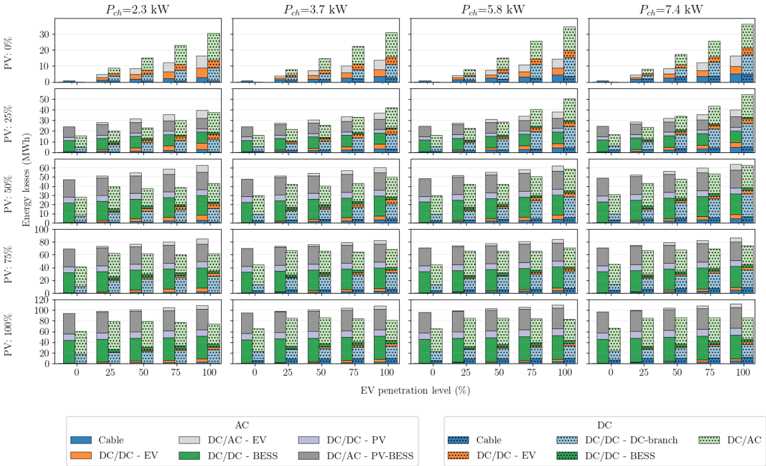
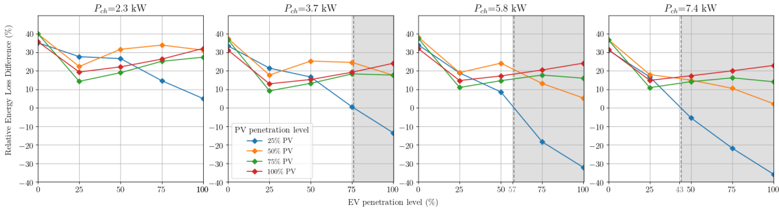
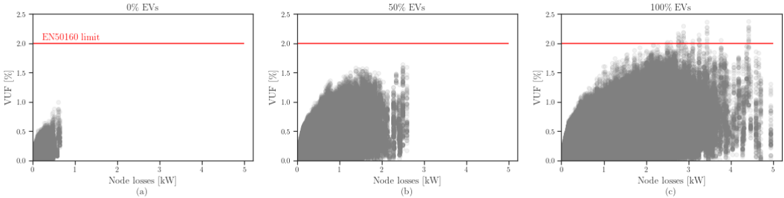
This paper presents an in-depth comparison of the benefits and limitations of using a low-voltage DC (LVDC) microgrid versus an AC microgrid with regard to the integration of low-carbon technologies. To this end, a novel approach for charging electric vehicles (EVs) on low-voltage distribution networks by utilizing an LVDC backbone is discussed. The global aim of the conducted study is to investigate the overall energy losses as well as voltage stability problems on DC and AC microgrids. Both architectures are assessed and compared to each other by performing a power flow analysis. Along this line, an actual low-voltage distribution network with various penetration levels of EVs, combined with photovoltaic (PV) systems and battery energy storage systems is considered. Obtained results indicate significant power quality improvements in voltage imbalances and conversion losses thanks to the proposed backbone. Moreover, the study concludes with a discussion of the impact level of EVs and PVs penetration degrees on energy efficiency, besides charging power levels’ impact on local self-consumption reduction of the studied system. The outcomes of the study can provide extensive insights for hybrid microgrid and EV charging infrastructure designers in a holistic manner in all aspects.
Overview
The claims and statistics of this paper haven’t been checked yet.
Run the check — free, no account needed. It reads the open-access text and checks the sources it cites.
Integrity signals
Registry
Cites
Statistics
Figures
Verification
Claims the paper makes
The claims and statistics of this paper haven’t been checked yet.
Run the check — free, no account needed. It reads the open-access text and checks the sources it cites.
Claims other papers make about this one
Each is checked against this paper’s own text: does it say what the citing paper says it does?
In the citing paper
“These studies propose using a DC backbone as an alternative to alternative current (AC) backbones in smart grids by connecting various DC-based renewable energy generation systems, storage systems [39], and loads such as EV chargers [40,41].”
From Smart, circular and renewable: The role of cooperative governance in accelerating a sustainable energy transition (2025) · cites this paper as [41]
Self-check
Percentages, sums and reported differences re-computed from the paper’s own numbers.
The self-check needs the paper’s full text.
Citations
Cites
An open source platform for collaborating on smart grid research
Dugan, R. C., & McDermott, T. E. (2011) · 2011 IEEE Power and Energy Society General Meeting · doi:10.1109/pes.2011.6039829 · Cited by 533
Brinkel, N. B. G., Gerritsma, M. K., AlSkaif, T. A., Lampropoulos, I., van Voorden, A. M., Fidder, H. A., & van Sark, W. G. J. H. M. (2020) · International Journal of Electrical Power & Energy Systems · doi:10.1016/j.ijepes.2019.105741 · Cited by 166
Held, L., Märtz, A., Krohn, D., Wirth, J., Zimmerlin, M., Suriyah, M. R., Leibfried, T., Jochem, P., & Fichtner, W. (2019) · World Electric Vehicle Journal · doi:10.3390/wevj10040088 · Cited by 28
Research works printed but not linked: 34
- Monteiro, V., Gonçalves, H., and Afonso, J.a.L. (2011, January 17–19). Impact of Electric Vehicles on power quality in a Smart Grid context. Proceedings of the 11th International Conference on Electrical Power Quality and Utilisation, Lisbon, Portugal. · DOI
- Lopes, 2011, Integration of Electric Vehicles in the Electric Power System, Proc. IEEE, 99, 168, 10.1109/JPROC.2010.2066250 · DOI · Paper page
- Codani, 2017, Measurement of power loss during electric vehicle charging and discharging, Energy, 127, 730, 10.1016/j.energy.2017.03.015 · DOI · Paper page
- Bollen, 2016, Power quality issues in the electric power system of the future, Electr. J., 29, 49, 10.1016/j.tej.2016.11.006 · DOI
- Leemput, 2014, Impact of Electric Vehicle On-Board Single-Phase Charging Strategies on a Flemish Residential Grid, IEEE Trans. Smart Grid, 5, 1815, 10.1109/TSG.2014.2307897 · DOI
- Ploumpidou, E. (2017). Supporting the Transition to DC Micro Grids in the Built Environment. [Ph.D. Thesis, Technische Universiteit Eindhoven].
- Yang, 2011, An industry-based survey of reliability in power electronic converters, IEEE Trans. Ind. Appl., 47, 1441, 10.1109/TIA.2011.2124436 · DOI
- Rekola, J. (2015). Factors Affecting Efficiency of LVDC Distribution Network–Power Electronics Perspective. [Ph.D. Thesis, Tampere University of Technology].
- Azaioud, H., Claeys, R., Knockaert, J., Vandevelde, L., and Desmet, J. (2021). A Low-Voltage DC Backbone with Aggregated RES and BESS: Benefits Compared to a Traditional Low-Voltage AC System. Energies, 14. · DOI · Paper page
- Kabus, M., Nolting, L., Mortimer, B.J., Koj, J.C., Kuckshinrichs, W., De Doncker, R.W., and Praktiknjo, A. (2020). Environmental impacts of charging concepts for battery electric vehicles: A comparison of on-board and off-board charging systems based on a life cycle assessment. Energies, 13. · DOI
- Huynh, W., Hoang, T., Abhisek, U., and Nirmal-Kumar, C.N. (December, January 29). Comparison of Low-Voltage AC and DC Distribution Networks for EV Charging. Proceedings of the 2022 7th IEEE Workshop on the Electronic Grid (eGRID), Auckland, New Zealand. · DOI
- Konstantinos, 2020, Electrical system architectures for building-integrated photovoltaics: A comparative analysis using a modelling framework in Modelica, Appl. Energy, 261, 114247, 10.1016/j.apenergy.2019.114247 · DOI
- Gerber, 2018, A simulation-based efficiency comparison of AC and DC power distribution networks in commercial buildings, Appl. Energy, 210, 1167, 10.1016/j.apenergy.2017.05.179 · DOI
- 2017, and Ruiz-Rodriguez, F.J. and Jurado, F.. Modelling and assessment of the combined technical impact of electric vehicles and photovoltaic generation in radial distribution systems, Energy, 141, 316, 10.1016/j.energy.2017.09.025 · DOI
- Fachrizal, 2021, Combined PV–EV hosting capacity assessment for a residential LV distribution grid with smart EV charging and PV curtailment, Sustain. Energy Grids Netw., 26, 100445, 10.1016/j.segan.2021.100445 · DOI · Paper page
- Masoum, M.A., Moses, P.S., and Hajforoosh, S. (2012, January 16–22). Distribution transformer stress in smart grid with coordinated charging of Plug-In Electric Vehicles. Proceedings of the 2012 IEEE PES Innovative Smart Grid Technologies (ISGT), Washington, DC, USA. · DOI
- Alpcan, 2015, Optimal Charging of Electric Vehicles Taking Distribution Network Constraints Into Account, IEEE Trans. Power Syst., 30, 365, 10.1109/TPWRS.2014.2318293 · DOI
- Gemassmer, J., Daam, C., and Reibsch, R. (2021). Challenges in Grid Integration of Electric Vehicles in Urban and Rural Areas. World Electr. Veh. J., 12. · DOI
- Bhattacharyya, S., Wijnand, M., and Slangen, T. (2022, January 2–3). Estimating the future impact of residential EV loads on low voltage distribution networks. Proceedings of the CIRED Porto Workshop 2022: E-mobility and power distribution systems, Porto, Portugal. · DOI
- Marah, B., Bhavanam, Y., Taylor, G., and Ekwue, A. (2016, January 6–9). Impact of electric vehicle charging systems on low voltage distribution networks. Proceedings of the 2016 51st International Universities Power Engineering Conference (UPEC), Coimbra, Portugal. · DOI
- Alame, D., Azzouz, M., and Kar, N. (2020). Assessing and mitigating impacts of electric vehicle harmonic currents on distribution systems. Energies, 13. · DOI
- Khaligh, 2019, Global Trends in High-Power On-Board Chargers for Electric Vehicles, IEEE Trans. Veh. Technol., 68, 3306, 10.1109/TVT.2019.2897050 · DOI · Paper page
- Claeys, R., Azaioud, H., Cleenwerck, R., Knockaert, J., and Desmet, J. (2021). A Novel Feature Set for Low-Voltage Consumers, Based on the Temporal Dependence of Consumption and Peak Demands. Energies, 14. · DOI
- Claeys, R., Delerue, T., and Desmet, J. (October, January 29). Assessing the influence of the aggregation level of residential consumers through load duration curves. Proceedings of the 2019 IEEE PES Innovative Smart Grid Technologies Europe (ISGT-Europe), Bucharest, Romania. · DOI
- Pelletier, 2017, Battery degradation and behaviour for electric vehicles: Review and numerical analyses of several models, Transp. Res. B: Methodol., 103, 158, 10.1016/j.trb.2017.01.020 · DOI
- Tremblay, O., Louis, -A.D., and Dekkiche, A.I. (2007, January 9–12). A Generic Battery Model for the Dynamic Simulation of Hybrid Electric Vehicles. Proceedings of the 2007 IEEE Vehicle Power and Propulsion Conference, Arlington, TX, USA. · DOI
- Villalva, 2009, Comprehensive Approach to Modeling and Simulation of Photovoltaic Arrays, IEEE Trans. Power Electron., 24, 1198, 10.1109/TPEL.2009.2013862 · DOI
- Azaioud, H., Desmet, J., and Vandevelde, L. (2020). Benefit Evaluation of PV Orientation for Individual Residential Consumers. Energies, 13. · DOI
- Li, K., and Tseng, K.J. (2015, January 9–12). Energy efficiency of lithium-ion battery used as energy storage devices in micro-grid. Proceedings of the IECON 2015—41st Annual Conference of the IEEE Industrial Electronics Society, Yokohama, Japan. · DOI
- Trichakis, P., Taylor, P., Cipcigan, L., Lyons, P., Hair, R., and Ma, T. (2006, January 6–8). An Investigation of Voltage Unbalance in Low Voltage Distribution Networks with High Levels of SSEG. Proceedings of the 41st International Universities Power Engineering Conference, Newcastle Upon Tyne, UK. · DOI
- Hariri, 2017, Open-source python-OpenDSS interface for hybrid simulation of PV impact studies, IET Gener. Trans. Distrib., 11, 3125, 10.1049/iet-gtd.2016.1572 · DOI
- Cleenwerck, 2022, An approach to the impedance modelling of low-voltage cables in digital twins, Electr. Power Syst. Res., 210, 108075, 10.1016/j.epsr.2022.108075 · DOI
- Girigoudar, 2020, On the impact of different voltage unbalance metrics in distribution system optimization, Electr. Power Syst. Res., 189, 106656, 10.1016/j.epsr.2020.106656 · DOI · Paper page
- Azaioud, H., Farnam, A., Knockaert, J., Vandevelde, L., and Desmet, J. (2023). Efficiency optimisation and converterless PV integration by applying a dynamic voltage on an LVDC backbone, submitted. · DOI · Paper page
Cited by
Sorted by citations
Kumar, M., Panda, K. P., Naayagi, R. T., Thakur, R., & Panda, G. (2023) · Applied Sciences · doi:10.3390/app13158919 · Cited by 221
Van Opstal, W., Bocken, N., & Brusselaers, J. (2025) · Energy Research & Social Science · doi:10.1016/j.erss.2025.104049 · Cited by 20
Metadata
- Authors
- Cleenwerck, R., Azaioud, H., Vafaeipour, M., Coosemans, T., & Desmet, J.
- Affiliations
- EELab/Lemcko, Deptartment of Electromechanical, Systems and Metal Engineering, Ghent University, 8500 Kortrijk, Belgium
- EVERGi, MOBI Research Centre & ETEC Deptartment, Vrije Universiteit Brussel, 1050 Brussel, Belgium
- Venue
- Energies
- Publisher
- MDPI AG
- Published
- 2023-04-02
- Volume
- 16
- Issue
- 7
- Pages
- 3205
- ISSN
- 1996-1073
- Cited by
- 15
- References
- 3
- Language
- en
About these checks
Registry, retraction, Cites and statistics results are computed, not judged, with one exception: a printed reference that no index lists is read once by a model before it counts as a citation error. Claims are extracted by a model and kept only when their quote appears verbatim in the text; each cited source is then checked, with a model’s help, for whether it says what the claim relies on. Those verdicts can be wrong — read the claim’s quote and the cited source before relying on one.
Statistics and arithmetic are recomputed, not judged.
Confidence bands are shown only for fields calibrated on our annotated test set. None is calibrated yet, so no band is shown.
What counts as a claim ›How we measure confidence ›How we check this ›
Are you an author, or do you see a problem with this page? Request a review
