

The DOI matches its Crossref record; 156 of the 156 references it cites were found in a registry or an index.
Fermented Soy Products: Beneficial Potential in Neurodegenerative Diseases
Open accessAbstract
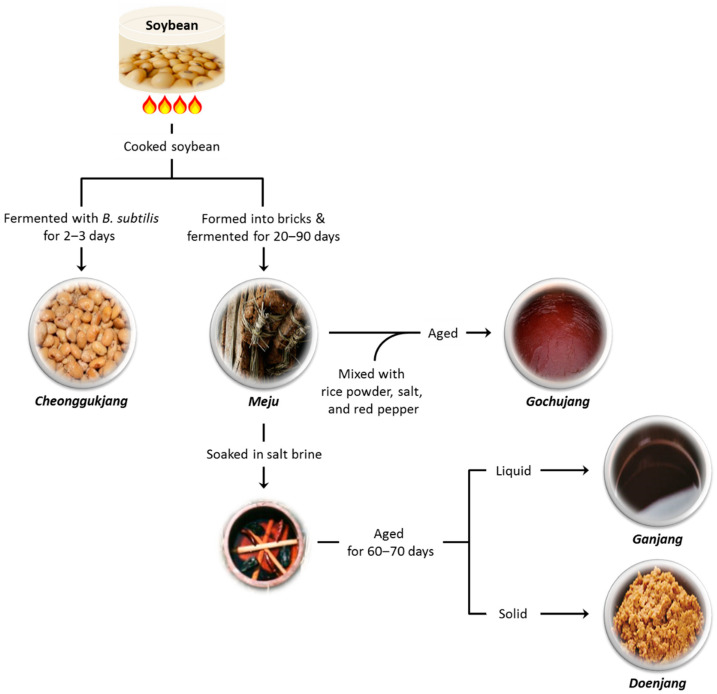
Fermented soybean products, such as cheonggukjang (Japanese natto), doenjang (soy paste), ganjang (soy sauce), and douchi, are widely consumed in East Asian countries and are major sources of bioactive compounds. The fermentation of cooked soybean with bacteria (Bacillus spp.) and fungi (Aspergillus spp. and Rhizopus spp.) produces a variety of novel compounds, most of which possess health benefits. This review is focused on the preventive and ameliorative potential of fermented soy foods and their components to manage neurodegenerative diseases, including Alzheimer’s and Parkinson’s diseases.
Overview
The claims and statistics of this paper haven’t been checked yet.
Run the check — free, no account needed. It reads the open-access text and checks the sources it cites.
Integrity signals
Registry
Cites
Statistics
Figures
Verification
Claims the paper makes
The claims and statistics of this paper haven’t been checked yet.
Run the check — free, no account needed. It reads the open-access text and checks the sources it cites.
Claims other papers make about this one
Each is checked against this paper’s own text: does it say what the citing paper says it does?
In the citing paper
“Soy sauce is also rich in lactic acid bacteria and has multifarious health benefits, such as lowering serum cholesterol and anti-diabetic, anti-hypertensive, anti-cardiovascular, and anti-neuroinflammatory effects [195].”
From The Potential Impact of Probiotics on Human Health: An Update on Their Health-Promoting Properties (2024) · cites this paper as [195]
Self-check
Percentages, sums and reported differences re-computed from the paper’s own numbers.
The self-check needs the paper’s full text.
Citations
Cites
Diet rapidly and reproducibly alters the human gut microbiome
David, L. A., Maurice, C. F., Carmody, R. N., Gootenberg, D. B., Button, J. E., Wolfe, B. E., Ling, A. V., Devlin, A. S., Varma, Y., Fischbach, M. A., et al. (2014) · Nature · doi:10.1038/nature12820 · Cited by 10,100
Diversity, stability and resilience of the human gut microbiota
Lozupone, C. A., Stombaugh, J. I., Gordon, J. I., Jansson, J. K., & Knight, R. (2012) · Nature · doi:10.1038/nature11550 · Cited by 5,533
Formation of propionate and butyrate by the human colonic microbiota
Louis, P., & Flint, H. J. (2017) · Environmental Microbiology · doi:10.1111/1462-2920.13589 · Cited by 3,028
Gut microbiome alterations in Alzheimer’s disease
Vogt, N. M., Kerby, R. L., Dill-McFarland, K. A., Harding, S. J., Merluzzi, A. P., Johnson, S. C., Carlsson, C. M., Asthana, S., Zetterberg, H., Blennow, K., et al. (2017) · Scientific Reports · doi:10.1038/s41598-017-13601-y · Cited by 2,137
Diet Drives Convergence in Gut Microbiome Functions Across Mammalian Phylogeny and Within Humans
Muegge, B. D., Kuczynski, J., Knights, D., Clemente, J. C., González, A., Fontana, L., Henrissat, B., Knight, R., & Gordon, J. I. (2011) · Science · doi:10.1126/science.1198719 · Cited by 1,988
Interactions between the microbiota, immune and nervous systems in health and disease
Fung, T. C., Olson, C. A., & Hsiao, E. Y. (2017) · Nature Neuroscience · doi:10.1038/nn.4476 · Cited by 1,900
World Population Prospects 2019: Highlights
Nations, U. (2019) · Statistical papers - United Nations. Series A, Population and vital statistics report · doi:10.18356/13bf5476-en · Cited by 1,879
Pathology of Neurodegenerative Diseases
Dugger, B. N., & Dickson, D. W. (2017) · Cold Spring Harbor Perspectives in Biology · doi:10.1101/cshperspect.a028035 · Cited by 1,665
Impact of the gut microbiota on inflammation, obesity, and metabolic disease
Boulangé, C. L., Neves, A. L., Chilloux, J., Nicholson, J. K., & Dumas, M.-E. (2016) · Genome Medicine · doi:10.1186/s13073-016-0303-2 · Cited by 1,438
Selective neuronal vulnerability in Parkinson disease
Surmeier, D. J., Obeso, J. A., & Halliday, G. M. (2017) · Nature Reviews Neuroscience · doi:10.1038/nrn.2016.178 · Cited by 1,116
Research works printed but not linked: 1
- Lee, 2017, Development of Lentil Cheonggukjang Fermented by Bacillus subtilis Isolated from Traditional Soy Sauce, J. Korean Soc. Food Cult., 32, 566
Cited by
Sorted by citations
A review on plant-based proteins from soybean: Health benefits and soy product development
Qin, P., Wang, T., & Luo, Y. (2022) · Journal of Agriculture and Food Research · doi:10.1016/j.jafr.2021.100265 · Cited by 623
The Potential Impact of Probiotics on Human Health: An Update on Their Health-Promoting Properties
Maftei, N.-M., Raileanu, C. R., Balta, A. A., Ambrose, L., Boev, M., Marin, D. B., & Lisa, E. L. (2024) · Microorganisms · doi:10.3390/microorganisms12020234 · Cited by 381
Anti-Inflammatory and Immunomodulatory Properties of Fermented Plant Foods
Shahbazi, R., Sharifzad, F., Bagheri, R., Alsadi, N., Yasavoli‐Sharahi, H., & Matar, C. (2021) · Nutrients · doi:10.3390/nu13051516 · Cited by 216
Beneficial Effects of Soybean-Derived Bioactive Peptides
Kim, I.-S., Yang, W., & Kim, C. (2021) · International Journal of Molecular Sciences · doi:10.3390/ijms22168570 · Cited by 155
Microbial Fermentation for Improving the Sensory, Nutritional and Functional Attributes of Legumes
Senanayake, D., Torley, P. J., Chandrapala, J., & Terefe, N. S. (2023) · Fermentation · doi:10.3390/fermentation9070635 · Cited by 136
Metadata
- Authors
- Jang, C. H., Oh, J., Lim, J. S., Kim, H. J., & Kim, J.-S.
- Affiliations
- Kyungpook National University (KR)
- National Development Institute of Korean Medicine (KR)
- Corresponding author
- Kim, Jong-Sang
- Venue
- Foods
- Publisher
- MDPI AG
- Published
- 2021-03-18
- Volume
- 10
- Issue
- 3
- Pages
- 636
- ISSN
- 2304-8158 (ISSN-L)
- PMC
- PMC8003083
- OpenAlex
- W3138727705
- Cited by
- 100
- References
- 156
- Citations by year
- 2026: 14 · 2025: 17 · 2024: 13 · 2023: 30 · 2022: 18 · 2021: 8
- FWCI
- 1.81
- Type
- journal article
- Language
- en
- Open access
- gold
- doi.org
- Licence
- Locations
- Foods (publishedVersion, cc-by)
- PubMed Central (publishedVersion, cc-by)
- PubMed (publishedVersion)
- DOAJ (DOAJ: Directory of Open Access Journals) (submittedVersion, cc-by-sa)
- Funders
- the Korea Institute of Planning and Evaluation for Technology in Food, Agriculture, Forestry and Fisheries (IPET) (319103042HD020)
- Topics
- Life Sciences › Agricultural and Biological Sciences › Food Science › Protein Hydrolysis and Bioactive Peptides
- Life Sciences › Agricultural and Biological Sciences › Food Science › Food Quality and Safety Studies
- Life Sciences › Agricultural and Biological Sciences › Food Science › Probiotics and Fermented Foods
- Keywords
- fermented soybean, neurodegenerative diseases, Alzheimer's disease, Parkinson's disease, natto, doenjang, soy sauce, douchi, bioactive compounds, Bacillus, Aspergillus, Rhizopus, fermented foods
About these checks
Registry, retraction, Cites and statistics results are computed, not judged, with one exception: a printed reference that no index lists is read once by a model before it counts as a citation error. Claims are extracted by a model and kept only when their quote appears verbatim in the text; each cited source is then checked, with a model’s help, for whether it says what the claim relies on. Those verdicts can be wrong — read the claim’s quote and the cited source before relying on one.
Statistics and arithmetic are recomputed, not judged.
Confidence bands are shown only for fields calibrated on our annotated test set. None is calibrated yet, so no band is shown.
What counts as a claim ›How we measure confidence ›How we check this ›
Are you an author, or do you see a problem with this page? Request a review
