

The DOI matches its Crossref record; 63 of the 63 references it cites were found in a registry or an index.
Explaining Chinese Consumers’ Green Food Purchase Intentions during the COVID-19 Pandemic: An Extended Theory of Planned Behaviour
Open accessAbstract
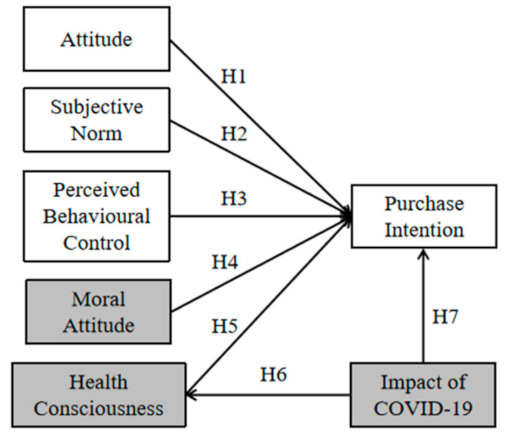
The outbreak of the COVID-19 pandemic has strongly influenced consumers’ habits and behaviours, creating a more sustainable and healthier era of consumption. Hence, there is a potential for further expanding the green food sector in China. The theory of planned behaviour (TPB) is one widely used framework to explain consumers’ food choices. Considering consumers’ internal norms, their perceptions of green food attributes, and the shifting consumer behaviour, our study has extended the TPB framework (E-TPB) by adding constructs of moral attitude, health consciousness, and the impact of COVID-19 (IOC). The results of structural equation modelling among 360 functional samples revealed that the E-TPB model has a superior explanatory and predictive power, compared with the original TPB model regarding Chinese consumers’ green food buying intentions in the current and post-pandemic periods. The path analysis demonstrated that attitude, perceived behavioural control, moral attitude, health consciousness, and IOC have significant positive effects on green food purchase intentions. However, the association between subjective norm and purchase intention varies within the TPB and E-TPB models, which showed a non-significant impact in E-TPB. These findings can generate more suitable managerial implications to promote green food consumption in China during the current and post-pandemic periods.
Overview
The claims and statistics of this paper haven’t been checked yet.
Run the check — free, no account needed. It reads the open-access text and checks the sources it cites.
Integrity signals
Registry
Cites
Statistics
Figures
Verification
Claims the paper makes
The claims and statistics of this paper haven’t been checked yet.
Run the check — free, no account needed. It reads the open-access text and checks the sources it cites.
Claims other papers make about this one
Each is checked against this paper’s own text: does it say what the citing paper says it does?
The source backs part of the claim, not all of it — or backs it for a different population, condition or comparison.
In the citing paper
“This psychological factor directly affects the purchase intention and operates through various psychological and social mechanisms [2,43,66].”
From Psychological Determinants of Healthy Food Purchase Intention: An Integrative Model Based on Health Consciousness (2025) · cites this paper as [2]
Experimental — accuracy not yet measuredThe source backs part of the claim, not all of it — or backs it for a different population, condition or comparison.
In the citing paper
“with heightened health consciousness emerging as a key driver of purchase decisions [1,2,3,4,5,6]”
From Psychological Determinants of Healthy Food Purchase Intention: An Integrative Model Based on Health Consciousness (2025) · cites this paper as [2]
Experimental — accuracy not yet measured
Self-check
Percentages, sums and reported differences re-computed from the paper’s own numbers.
The self-check needs the paper’s full text.
Citations
Cites
The theory of planned behavior
Ajzen, I. (1991) · Organizational Behavior and Human Decision Processes · doi:10.1016/0749-5978(91)90020-t · Cited by 90,587
On the Evaluation of Structural Equation Models
Bagozzi, R. P., & Yi, Y. (1988) · Journal of the Academy of Marketing Science · doi:10.1007/bf02723327 · Cited by 26,163 · cited 1×
“Note: * Source from Bagozzi and Yi [57]; GFI, goodness-of-fit index; NFI, normative fit index; TLI, Tucker–Lewis index; CFI, comparative fit index; IFI, incremental fit index; RMSEA, root mean square error approximation.”
Efficacy of the Theory of Planned Behaviour: A meta‐analytic review
Armitage, C. J., & Conner, M. (2001) · British Journal of Social Psychology · doi:10.1348/014466601164939 · Cited by 9,970 · cited 1×
“A possible explanation of this incongruence is due to the unstable, poor predictive power of subjective norms, and variation in different contexts [60,61], especially regarding organic and green food purchases [32,39].”
BackgroundNormative Influences on Altruism
Schwartz, S. H. (1977) · Advances in Experimental Social Psychology · doi:10.1016/s0065-2601(08)60358-5 · Cited by 5,364 · cited 1×
“Moral attitude refers to a person’s self-evaluation resulting from their expected compliance with their moral principles [37].”
BackgroundExtending the Theory of Planned Behavior: A Review and Avenues for Further Research
Conner, M., & Armitage, C. J. (1998) · Journal of Applied Social Psychology · doi:10.1111/j.1559-1816.1998.tb01685.x · Cited by 3,344 · cited 2×
“Moreover, some nonnegligible limitations of applying TPB exist, and therefore, various refinements and extensions of TPB theory have been suggested to improve its effectiveness and applicability [20,21].”
BackgroundHan, H., Hsu, L.-T. J., & Sheu, C. (2009) · Tourism Management · doi:10.1016/j.tourman.2009.03.013 · Cited by 2,146 · cited 2×
“[54] PBC2 I have all resources for buying green food.”
BackgroundAnother Decade, Another Coronavirus
Perlman, S. M. (2020) · New England Journal of Medicine · doi:10.1056/nejme2001126 · Cited by 1,113 · cited 1×
“In March 2020, the World Health Organization (WHO) announced the outbreak of the highly transmittable Coronavirus (COVID-19) as a pandemic [1], which is considered to be the third pandemic in the 21st century [2].”
BackgroundChin, W. W., Gopal, A., & Salisbury, W. D. (1997) · Information Systems Research · doi:10.1287/isre.8.4.342 · Cited by 1,060 · cited 1×
“In addition, the values of factors loading for all variables ranged from 0.719 to 0.944 and exceeded the acceptable value of 0.6 [58].”
BackgroundInfluentialArvola, A., Vassallo, M., Dean, M., Lampila, P., Saba, A., Lähteenmäki, L., & Shepherd, R. (2007) · Appetite · doi:10.1016/j.appet.2007.09.010 · Cited by 1,019 · cited 1×
“[55] MA2 If I purchase green food rather than non-green food, it feels like I’m doing the morally right thing.”
BackgroundThe Health Belief Model and Prediction of Dietary Compliance: A Field Experiment
Becker, M. H., Maiman, L. A., Kirscht, J. P., Haefner, D. P., & Drachman, R. H. (1977) · Journal of Health and Social Behavior · doi:10.2307/2955344 · Cited by 808
Research works printed but not linked: 4
- Paull, 2008, Green Food in China, Elem. J. Bio Dyn. Tasma., 91, 48
- Kline, R.B. (2011). Principals and Practice of Structural Equation Modeling, The Guilford Press. [3rd ed.].
- Hair, J.F., Black, W.C., Babin, B.J., and Anderson, R.E. (2014). Multivariate Data Analysis, Pearson.
- Belk, 1985, Issues in the intention-behavior discrepancy, Res. Consum. Behav., 1, 1
Cited by
Sorted by citations
Items 101–146 of 146
Istiasih, H., & Faisol, F. (2022) · Jurnal Aplikasi Manajemen · doi:10.21776/ub.jam.2022.020.04.19 · Cited by 3
Exploring the Antecedents of Employee Green Behaviors: A Conceptual Framework
Nuswanto, V. B., Gustomo, A., Aprianingsih, A., & Febriansyah, H. (2023) · Espergesia · doi:10.18050/rev.espergesia.v10i1.2510 · Cited by 3
Climate Change Worry and Purchase Behavior Towards Biodegradable Plastic Bags: The New Approach
Le, N., & Bui, T. T. (2025) · International Journal of Sustainable Development and Planning · doi:10.18280/ijsdp.200116 · Cited by 2
Hossain, K. K., & Joshi, N. P. (2025) · Environmental and Sustainability Indicators · doi:10.1016/j.indic.2025.100756 · Cited by 2
ORGANIC FOOD IN THE AGE OF UNCERTAINTY: FACTORS IMPACTING CONSUMER INTENTIONS DURING THE PANDEMIC
Nwobodo, S., Ee, Y. S., Ohueri, C. C., & Ahmed, J. (2024) · International Journal of Business Society · doi:10.33736/ijbs.6901.2024 · Cited by 1
The Role of Planned Behavior in Predicting Customer Orientation
Hasanbarog, Z. M., Rasouli, E., Ardabili, F. S., & Azadi, B. (2022) · Management · doi:10.2478/manment-2019-0095 · Cited by 1
Shopping for fresh food online during Covid-19 in Shanghai
Janssens, K., & Semeijn, J. (2023) · The Central European Review of Economics and Management · doi:10.29015/cerem.964 · Cited by 1
Jaafar, N., Sulaiman, N., Badari, S. A. Z., & Sabran, M. (2023) · International Journal of Academic Research in Business and Social Sciences · doi:10.6007/ijarbss/v13-i8/17823 · Cited by 1
del Castillo, E. J. S., Armas, R. J. D., Taño, D. G., & (España), U. D. L. L. (2024) · Universidad de La Laguna (España) eBooks · doi:10.25145/b.2024.01 · Cited by 1
Determinants of Purchase Intention in Plant-Based Seafood Products among Generation Z in Malaysia
Hoo, W. C., Madhavedi, S., Yi, T.-C., Hossain, S. F. A., & Prompanyo, M. (2024) · Journal of Ecohumanism · doi:10.62754/joe.v3i4.3833 · Cited by 6
“Scholars including Qi and Ploeger (2021) and Iqbal et al. (2021) have established a substantial correlation between FS and the intention to purchase sustainable food items, including organic and green foods.”
BackgroundWu, J.-W. (2024) · J. Comput. Methods Sci. Eng. · doi:10.1177/14727978241299656 · Cited by 3
Chen, X., & Xu, Y. B. (2025) · Innovative Food Science & Emerging Technologies · doi:10.1016/j.ifset.2025.104176 · Cited by 1
Yuan, T., Lin, L., Xiao, X., Yang, D., Su, F., & Li, Y. (2026) · Frontiers in Psychology · doi:10.3389/fpsyg.2026.1797026 · Cited by 1
“The scale items for all three constructs, i.e., ATT, SN and PBC, are taken from various pre-tested scales present in the literature (Qi and Ploeger, 2021; Imani et al., 2021; Ulker-Demirel et al., 2018).”
Candel, O. S., Prundeanu, O., & Pascal, E. A. (2026) · Sustainability · doi:10.3390/su18178902 · Cited by 1
Kamela, H., Alam, R. S., & Nugroho, A. P. (2022) · Jurnal Ilmiah Ekonomi Dan Bisnis · doi:10.31849/jieb.v19i1.6230 · Cited by 1
Witek, L., Kędzia, G., & Staniec, I. (2024) · Economics and Environment · doi:10.34659/eis.2023.87.4.629 · Cited by 4
de Aragão, C. G., Ferreira, F., da Silva, H. M. R., & Belé, T. G. D. A. (2024) · Production · doi:10.1590/0103-6513.20230026 · Cited by 1
Byrne, D. V. (2022) · Foods · doi:10.3390/foods11121738 · Cited by 1
“Hence, the authors conclude there is a potential for further expanding the green food sector in China [12].”
BackgroundResultInfluentialA teoria do comportamento planejado como proxy para estratégias de green marketing
Lopes, R. D. C., Ferretto, L. R., Dias, V. D. V., de Callegaro, D. C., Kindlein, L., & Révillion, J. P. P. (2022) · Cuyonomics Investigaciones en Economía Regional · doi:10.48162/rev.42.050
The Role Of Social Media In Improving Hygiene Practices Among General Public During COVID-19
Hassan, A., Hussain, T., & Basit, A. (2022) · Pakistan Journal of Gender Studies · doi:10.46568/pjgs.v22i1.586
Choy, E. D. M., & Laura, S. A. R. (2022) · Universidad Peruana de Ciencias Aplicadas (UPC) · doi:10.19083/tesis/668558
Surjandy, S., Billman, A., Rumangkit, S., Teng, A. H., & Dwiangraini, T. (2023) · International Conference on Information Technology, Computer, and Electrical Engineering · doi:10.1109/icitacee58587.2023.10277429
“Social influence means the degree to which people related to the users believe that the user will create content based on trending topics [12][13].”
BackgroundJaafar, N. A. A., Sulaiman, N., Badari, S. A. Z., & Sabran, M. R. (2023) · International Journal of Academic Research in Business and Social Sciences · doi:10.6007/ijarbss/v13-i10/18848
(2023) · Borneo Journal of Social Sciences and Humanities · doi:10.35370/bjssh.2023.5.2-06
“…utilised as the foundation to investigate the PI and behaviour of different products, such as certified food products (Qi, Tian, & Ploeger, 2021), green food (Qi & Ploeger, 2021), organic foods (Prakash, Singh, Ahmad, & Kumar, 2023; Zayed, Gaber, & Essawi, 2022; Tran & Nguyen, 2021), and others.”
BackgroundA Study on The Relationship of Smart Light Design Characteristics with Consumer Behavior
Zhao, H., & Halabi, K. N. M. (2023) · International Journal of Academic Research in Business and Social Sciences · doi:10.6007/ijarbss/v13-i12/20387
Phuyal, P. (2024) · Dristikon A Multidisciplinary Journal · doi:10.3126/dristikon.v14i1.66052
Chinese Consumers’ Green Purchase Practices: A Review
Hu, L., & -, E. B. A. (2024) · International Journal For Multidisciplinary Research · doi:10.36948/ijfmr.2024.v06i04.24976
Khaerunisa, A. C., Tinaprilla, N., & Purwono, J. (2025) · Forum Agribisnis · doi:10.29244/fagb.15.1.64-75
Chatterjee, A. D., & Sur, S. (2025) · Springer eBooks · doi:10.1007/978-981-96-5415-4_22
Çabuk, S., & Gür, D. (2025) · Çukurova Üniversitesi Sosyal Bilimler Enstitüsü Dergisi · doi:10.35379/cusosbil.1589455
Arancibia, S., May, D. E., Tremma, O., & Zhao, S. (2025) · Journal of Chinese Economic and Foreign Trade Studies · doi:10.1108/jcefts-10-2024-0082
Measuring Health-Conscious Consumers
Remr, J. (2025) · Elsevier eBooks · doi:10.1016/b978-0-443-29139-5.00071-9
Yin, Y., Han, C., & Zhang, S. (2025) · Sustainability · doi:10.3390/su172411305
Amber, E., Papasolomou, I., Thrassou, A., & Melanthiou, Y. (2026) · Emerald Group Publishing Limited eBooks · doi:10.1108/s2754-586520260000005004
Effect of lifestyle, and health consciousness on street food purchase intention using the TPB model
Trivedi, J. C., Soni, B. K., & Batra, P. (2026) · Rajagiri Management Journal · doi:10.1108/ramj-10-2025-0185
Cavazos‐Arroyo, J., Pérez–Villarreal, H. H., & Tapia, C. G. (2026) · Emerald Group Publishing Limited eBooks · doi:10.1108/978-1-83708-214-820261013
The influence of religious beliefs on gen Z’s intentions to choose Islamic higher education
Agustiningsih, M. D., Zaini, M. A., Islami, N. N., Amal, M. K., & Setyawan, R. A. (2026) · Journal of Management and Digital Business · doi:10.53088/jmdb.v6i1.2077
AYKILIÇ, P., & Tolon, M. (2026) · 3 SEKTÖR SOSYAL EKONOMİ DERGİSİ · doi:10.63556/tisej.2026.1712
Su, W., & Guo, X. (2026) · Frontiers in Nutrition · doi:10.3389/fnut.2026.1726176
“By contrast, green foods can provide more robust safety guarantees, thus becoming the preferred “safe haven” for risk-averse consumers (30, 31).”
Fitriani, F., Ratnasari, R. T., Wahab, A., Alimusa, L. O., & ARISKA, A. (2026) · Journal of Islamic accounting and business research · doi:10.1108/jiabr-03-2025-0189
Understanding sustainable organic food repurchase through behavioral and health factors
Christian, M., Wibowo, S. A., Muzammil, O. M., Yulita, H., & Rembulan, G. D. (2026) · Agrarian Bulletin of the North Caucasus · doi:10.31279/abnc-2026-16-3-129
Drivers of residents’ low-carbon consumption intention: an integrated theoretical model
Jing, H., & Rasiah, R. (2026) · Mitigation and Adaptation Strategies for Global Change · doi:10.1007/s11027-026-10353-x
“In contrast, the effect of subjective norm on LCI is non-significant, echoing findings that SN does not always reflect personal prescriptions for specific behaviors (Hu et al. 2021 , Qi and Ploeger 2021).”
How environmental knowledge and concern shape Chinese consumers’ green purchase intention?
Zhang, Y., Rasiah, R., Song, L., & Sorooshian, S. (2026) · Cleaner and Responsible Consumption · doi:10.1016/j.clrc.2026.100495
“Despite TPB-based assumptions that subjective norms (SN) influence GPI (Qi & Ploeger, 2021; Kamalanon et al., 2022; Lavuri, 2021), empirical evidence remains mixed, with many studies reporting non-significant effects (Hamzah & Tanwir, 2021; Kamalanon et al., 2022; Kumar & Mohan, 2021; Rausch &…”
Why wanting sustainable food is not enough: the habit barrier to green eating
Duy, P. K., & Quốc, V. H. (2026) · British Food Journal · doi:10.1108/bfj-01-2026-0109
Crowding and green choice: Understanding a U-shaped relationship in China’s organic food market
Pan, G., Wang, J., & Liu, H. (2026) · Journal of Retailing and Consumer Services · doi:10.1016/j.jretconser.2026.105157
CHIANG, C., Tsaih, L. S.-J., & Perng, Y. (2026) · International Journal of Building Pathology and Adaptation · doi:10.1108/ijbpa-06-2026-0192
Metadata
- Authors
- Qi, X., & Ploeger, A.
- Affiliations
- University of Kassel (DE)
- Corresponding author
- Qi, Xin
- Venue
- Foods
- Publisher
- MDPI AG
- Published
- 2021-05-26
- Volume
- 10
- Issue
- 6
- Pages
- 1200
- ISSN
- 2304-8158 (ISSN-L)
- PMC
- PMC8227529
- OpenAlex
- W3164929864
- Cited by
- 146
- References
- 63
- Citations by year
- 2026: 15 · 2025: 24 · 2024: 38 · 2023: 28 · 2022: 34 · 2021: 7
- FWCI
- 24.59
- Type
- journal article
- Language
- en
- Open access
- gold
- doi.org
- Licence
- Locations
- Foods (publishedVersion, cc-by)
- PubMed Central (publishedVersion, cc-by)
- PubMed (publishedVersion)
- DOAJ (DOAJ: Directory of Open Access Journals) (submittedVersion, cc-by-sa)
- Kobra (Universitätsbibliothek Kassel) (cc-by)
- Funders
- Deutsche Forschungsgemeinschaft
- Universität Kassel
- Topics
- Social Sciences › Business, Management and Accounting › Marketing › Environmental Sustainability in Business
- Life Sciences › Agricultural and Biological Sciences › Plant Science › Organic Food and Agriculture
- Social Sciences › Sociology and Political Science › Consumer behavior in food and health
- Keywords
- green food, purchase intention, theory of planned behavior, COVID-19 pandemic, moral attitudes, health consciousness, perceived behavioral control, subjective norms, attitudes, green food consumption, Chinese consumers, sustainable consumption
About these checks
Registry, retraction, Cites and statistics results are computed, not judged, with one exception: a printed reference that no index lists is read once by a model before it counts as a citation error. Claims are extracted by a model and kept only when their quote appears verbatim in the text; each cited source is then checked, with a model’s help, for whether it says what the claim relies on. Those verdicts can be wrong — read the claim’s quote and the cited source before relying on one.
Statistics and arithmetic are recomputed, not judged.
Confidence bands are shown only for fields calibrated on our annotated test set. None is calibrated yet, so no band is shown.
What counts as a claim ›How we measure confidence ›How we check this ›
Are you an author, or do you see a problem with this page? Request a review
