

The DOI matches its Crossref record; 227 of the 229 references it cites were found in a registry or an index.
Algae as Food in Europe: An Overview of Species Diversity and Their Application
Open accessAbstract
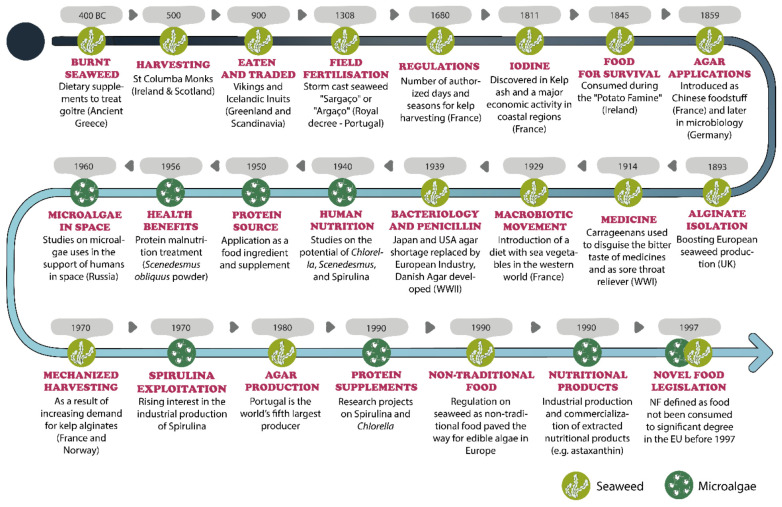
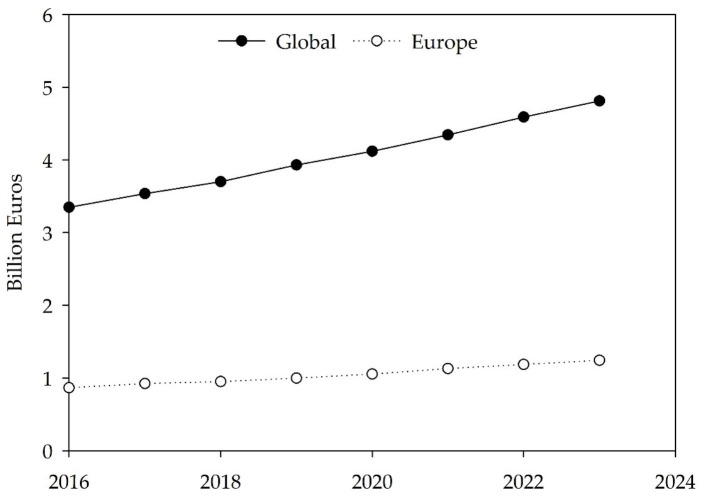
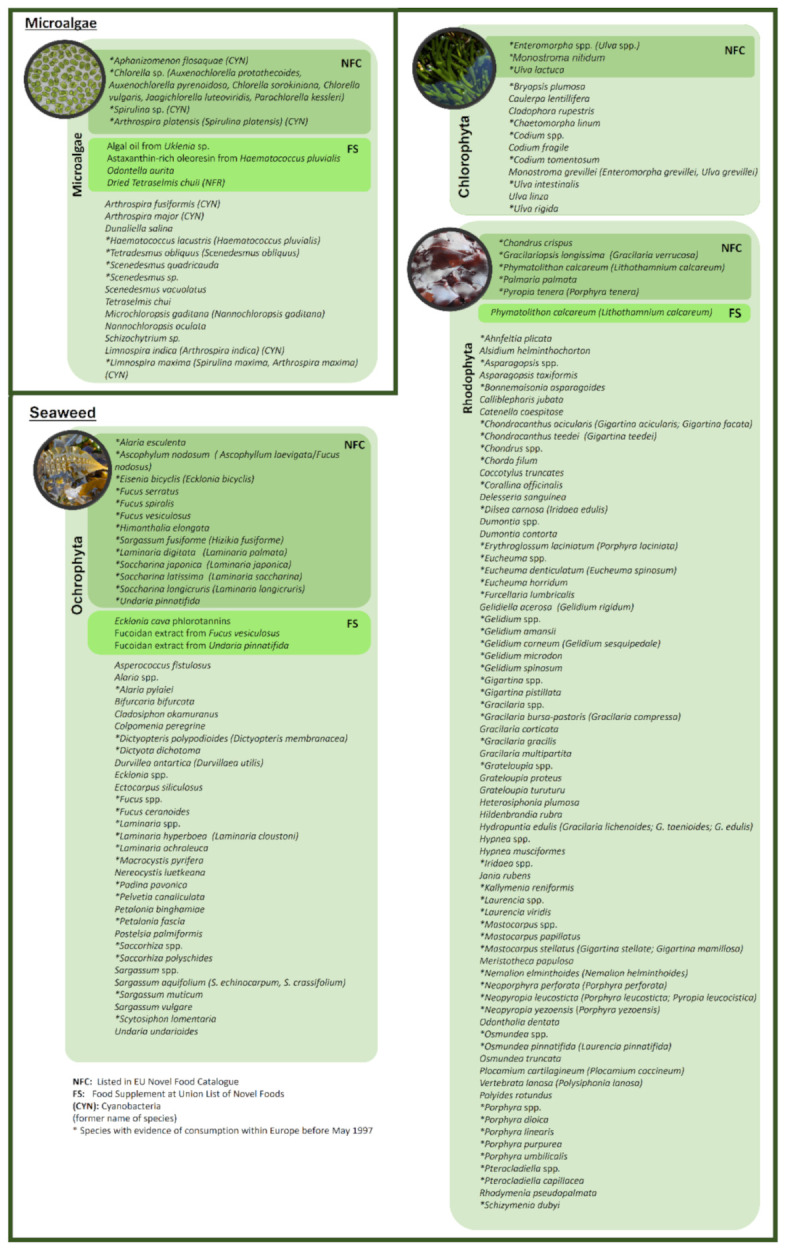
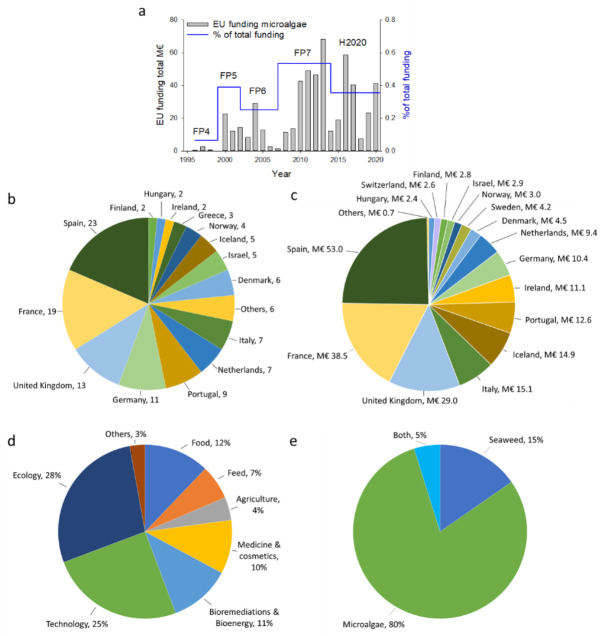
Algae have been consumed for millennia in several parts of the world as food, food supplements, and additives, due to their unique organoleptic properties and nutritional and health benefits. Algae are sustainable sources of proteins, minerals, and fiber, with well-balanced essential amino acids, pigments, and fatty acids, among other relevant metabolites for human nutrition. This review covers the historical consumption of algae in Europe, developments in the current European market, challenges when introducing new species to the market, bottlenecks in production technology, consumer acceptance, and legislation. The current algae species that are consumed and commercialized in Europe were investigated, according to their status under the European Union (EU) Novel Food legislation, along with the market perspectives in terms of the current research and development initiatives, while evaluating the interest and potential in the European market. The regular consumption of more than 150 algae species was identified, of which only 20% are approved under the EU Novel Food legislation, which demonstrates that the current legislation is not broad enough and requires an urgent update. Finally, the potential of the European algae market growth was indicated by the analysis of the trends in research, technological advances, and market initiatives to promote algae commercialization and consumption.
Overview
The claims and statistics of this paper haven’t been checked yet.
Run the check — free, no account needed. It reads the open-access text and checks the sources it cites.
Integrity signals
Registry
Cites
Statistics
Figures
Verification
Claims the paper makes
The claims and statistics of this paper haven’t been checked yet.
Run the check — free, no account needed. It reads the open-access text and checks the sources it cites.
Claims other papers make about this one
Each is checked against this paper’s own text: does it say what the citing paper says it does?
The cited source says what the claim attributes to it.
In the citing paper
“Ongoing regulatory gaps related to algae as raw materials led to the formation of CEN/TC 454 in 2017, tasked with developing standards for algal biomass, extracts, and purified compounds, including terminology, processing methods, and quality criteria [238].”
From Navigating the potential of algal peptides: health effects, market applications, and scientific challenges (2026) · cites this paper as [238]
Self-check
Percentages, sums and reported differences re-computed from the paper’s own numbers.
The self-check needs the paper’s full text.
Citations
Cites
1 retracted
Koyande, A. K., Show, P.-L., Guo, R., Tang, B., Ogino, C., & Chang, J.-S. (2019) · Bioengineered · doi:10.1080/21655979.2019.1679697 · Cited by 182
RetractedCommercial Applications of Microalgae
Spolaore, P., Joannis-Cassan, C., Duran, E., & Isambert, A. (2006) · Journal of Bioscience and Bioengineering · doi:10.1263/jbb.101.87 · Cited by 4,285
Micro-algae as a source of protein
Becker, E. W. (2007) · Biotechnology Advances · doi:10.1016/j.biotechadv.2006.11.002 · Cited by 2,311
Going green to be seen: status, reputation, and conspicuous conservation
Griskevicius, V., Tybur, J. M., & Van den Bergh, B. (2010) · Journal of Personality and Social Psychology · doi:10.1037/a0017346 · Cited by 2,174
Bioactive compounds in seaweed: functional food applications and legislation
Holdt, S. L., & Kraan, S. (2011) · Journal of Applied Phycology · doi:10.1007/s10811-010-9632-5 · Cited by 2,135
Valuable Products from Biotechnology of Microalgae
Pulz, O., & Gross, W. (2004) · Applied Microbiology and Biotechnology · doi:10.1007/s00253-004-1647-x · Cited by 2,132
Duncan, T. V. (2011) · Journal of Colloid and Interface Science · doi:10.1016/j.jcis.2011.07.017 · Cited by 2,042
Seaweed Ecology and Physiology
Hurd, C. L., Harrison, P. J. H., Bischof, K., & Lobban, C. S. (2014) · Cambridge University Press eBooks · doi:10.1017/cbo9781139192637 · Cited by 1,593
Algae as nutritional and functional food sources: revisiting our understanding.
Wells, M. L., Potin, P., Craigie, J. S., Raven, J. A., Merchant, S. S., Helliwell, K. E., Smith, A. G., Camire, M. E., & Brawley, S. H. (2017) · Journal of Applied Phycology · doi:10.1007/s10811-016-0974-5 · Cited by 1,562
Algal Proteins: Extraction, Application, and Challenges Concerning Production
Bleakley, S., & Hayes, M. (2017) · Foods · doi:10.3390/foods6050033 · Cited by 1,092
Research works printed but not linked: 28
- Mintel (2016, March 09). Seaweed-flavoured food and drink launches increased by 147% in Europe between 2011 and 2015. Available online: http://www.mintel.com/press-centre/food-and-drink/seaweed-flavoured-food-and-drink-launches-increased-by-147-in-europe-between-2011-and-2015.
- Hallsson, S. (1961, January 18–24). The uses of seaweeds in iceland. Proceedings of the Fourth International Seaweed Symposium, Biarritz, France.
- Johnston, 1966, The Biological and Economic Importance of Algae, Part 2, Tuatara, 14, 4
- McDowell, L.R. (1992). Iodine. Minerals in Animal and Human Nutrition, Academic Press.
- Dickens, 1856, The Purple Shore, Househ. Words, XIV, 391
- Ferdouse, 2018, The global status of seaweed production, trade and utilization, Globefish Res. Programme, 124, 120
- Palminha, 1971, Exploração e utilização de Algas Marinhas na Plataforma Portuguesa e nas Ilhas do Arquipélago dos Açores, Junta Nac. Fom. Das Pescas, 7, 25
- Palminha, 1982, A existência de Gelidium sesquipedale (Clem.) Born et Thur. na costa sul do Algarve. I. Distribuição local, Bol. INIP., 8, 93
- Palminha, 1985, A existência de Gelidium sesquipedale (Clem.) Born et Thur. na costa sul do Algarve. II. Biomassa total, Bol. INIP., 13, 77
- Tamiya, H. Growing Chlorella for Food and Feed. Proceedings of the World Symposium on Applied Solar Energy, Phoenix, AZ, USA.
- Helvey, T.C. (1964, January 27–30). Nutrition in Space and Related Waste Problems. Proceedings of the Conference on Nutrition in Space and Related Waste problems, Universtiy of South Florida, Tampa, FL, USA.
- Bychkov, 1966, The aus der Alge Dunaliella of dried biomass of unicellular algae in human food rations, Vopr. Pitan., 25, 9
- Ahsan, M., Habib, B., Parvin, M., Huntington, T.C., and Hasan, M. (2008). A Review on Culture, Production and Use of Spirulina as Food for Humans and Feeds for Domestic Animals and Fish, FAO.
- Guiry, M.D., and Blunden, G. (1991). Animal and human nutrition. Seaweed Resources in Europe: Uses and Potential, John Wiley & Sons, Ltd.
- McIrvine, D. (2021, April 10). An Erne in Erin: William Blake Depicts a “Sea Eagle” and Dillisk from County Antrim’s ‘Giants Caus[e]way’ in Plate 78 of *Jerusalem*, and Japanese Women Abalone-Diving in Plate 89; 2019; Volume 1. Available online: https://www.academia.edu/41485060/An_Erne_in_Erin_William_Blake_Depicts_a_Sea_Eagle_and_Dillisk_from_County_Antrims_Giants_caus_e_way_in_Plate_78_of_Jerusalem_and_Japanese_Women_Abalone_Diving_in_Plate_89.
- Sautier, 1975, Valeur alimentaire des algues spirulines chez l’homme, Ann. Nutr. Aliment., 29, 517
- Pokrovskaia, 1968, Effect of a Vegetable Diet Including a Biomass of Unicellular Algae on the Excretion and Balance of Mineral Elements (Vegetable Diet, Including 210 g of Dry Chlorella Biomass, Decreases Effect on Calcium and Magnesium Assimilation to Produce Insignificant, Kosm. Biol. I Meditsina, 2, 78
- Badar, 2016, Effect of Boiling on Removing of Botulinum Toxins from Drinking Water Samples, Int. J. Sci. Res., 5, 1969
- Joseph, M. (2016). The Seaweed Cookbook, Penguin UK.
- Moons, I., De Pelsmacker, P., and Barbarossa, C. (2017, January 26–28). The Drivers of the Usage Intention of Spirulina Algae in Food in Different Market Segments. Proceedings of the 16th International Marketing Trends Conference, Madrid, Spain.
- (2021, April 20). (Instrumentalities of the State Council) China Administrative Measures for the Safety Review of New Food Raw Materials. Available online: http://www.lawinfochina.com/display.aspx?lib=law&id=15358&CGid&EncodingName=big5.
- 1947, Sobre a utilização de algumas algas marinhas da nossa costa, Brotéria Ciências Nat., 16, 77
- McKenna, J. (2013). Extreme Greens: Understanding Seaweeds: Cooking, Foraging, Cosmetic, Estragon Press. [1st ed.].
- Hairon, D. (2021, February 17). Edible seaweeds in Jersey. Available online: https://jerseywalkadventures.co.uk/press-office/edible-seaweeds-in-jersey/.
- Pereira, L. (2010). University of C. Algas à mesa. Workshop Sobre Algas Comestíveis. IMAR-CMA/Universidade de Coimbra, Museu do Traje.
- Palminha, F. As algas marinhas nos costumes faialenses. 1958; pp. 113–116.
- C-, C., Gmbh, N., Nordrhein-westfalen, L., German, T., Drink, S., Land, T., Rhine-westphalia, N., Bundesverwaltungsgericht, T., and Court, F.A. (2021). Court of Justice of the European Union PRESS RELEASE No 69/21 EU Law Prohibits the Addition of the alga Lithothamnium Calcareum in the Processing of Organic Foodstuffs Such as rice- and Soya-Based Organic Drinks for the Purpose of Their Enrichment with Calcium, Court of Justice of the European Union.
- (2021, February 01). (Expolab Centro Ciência Viva) Workshop “Alimentação do Oceano: Algas Como Fonte Alternativa de Proteína”. Available online: https://www.youtube.com/watch?v=wvMHcSjKHPc&ab_channel=ExpolabCentroCiênciaViva.
Cited by
Sorted by citations
Astaxanthin: Past, Present, and Future
Nishida, Y., Berg, P., Shakersain, B., Hecht, K. A., Takikawa, A., Tao, R., Kakuta, Y., Uragami, C., Hashimoto, H., Misawa, N., et al. (2023) · Marine Drugs · doi:10.3390/md21100514 · Cited by 180
Wu, J. Y., Tso, R., Teo, H. S., & Haldar, S. (2023) · Frontiers in Nutrition · doi:10.3389/fnut.2023.1277343 · Cited by 126
Cardoso, B. D., Nóbrega, G., Afonso, I. S., Ribeiro, J., & Lima, R. A. (2025) · Journal of environmental chemical engineering · doi:10.1016/j.jece.2025.116921 · Cited by 129
Cadâr, E., Popescu, A., Dragan, A.-M.-L., Pesterau, A.-M., Pascale, C., Anuța, V., Prasacu, I., Velescu, B. Ș., Tomescu, C. L., Bogdan-Andreescu, C. F., et al. (2025) · Marine Drugs · doi:10.3390/md23040152 · Cited by 129
Eilam, Y., Khattib, H., Pintel, N., & Avni, D. (2023) · Global Challenges · doi:10.1002/gch2.202200177 · Cited by 101
Metadata
- Authors
- Mendes, M., Navalho, S., Ferreira, A., Paulino, C., Figueiredo, D., Silva, D., Gao, F., Gama, F., Bombo, G., Jacinto, R., Aveiro, S., Schulze, P., Gonçalves, A. T., Pereira, H., Gouveia, L., Patarra, R., Abreu, M. H., Silva, J., Navalho, J., Varela, J., & Speranza, L.
- Affiliations
- GreenCoLab (PT)
- National Laboratory of Energy and Geology (PT)
- Wageningen University & Research (NL)
- Nord University (NO)
- GreenCoLab—Associação Oceano Verde, Universidade do Algarve, Campus de Gambelas, 8005-139 Faro, Portugal
- Universidade dos Açores (PT)
- ALGAplus, Produção e Comercialização de Algas e Seus Derivados, Lda., 3830-196 Ílhavo, Portugal
- Allmicroalgae—Natural Products, 2445-413 Pataias, Portugal
- Necton (Portugal) (PT)
- Centro de Ciências do Mar do Algarve (PT)
- Corresponding author
- Speranza, Lais
- ORCID
- Venue
- Foods
- Publisher
- MDPI AG
- Published
- 2022-06-24
- Volume
- 11
- Issue
- 13
- Pages
- 1871
- ISSN
- 2304-8158 (ISSN-L)
- PMC
- PMC9265617
- OpenAlex
- W4283461407
- Cited by
- 234
- References
- 229
- Citations by year
- 2026: 47 · 2025: 63 · 2024: 66 · 2023: 48 · 2022: 10
- FWCI
- 3.95
- Type
- journal article
- Language
- en
- Open access
- gold
- doi.org
- Licence
- Locations
- Foods (publishedVersion, cc-by)
- PubMed Central (publishedVersion, cc-by)
- PubMed (publishedVersion)
- Socio-Environmental Systems Modeling (submittedVersion, cc-by)
- DOAJ (DOAJ: Directory of Open Access Journals) (submittedVersion, cc-by-sa)
- Portuguese National Funding Agency for Science, Research and Technology (RCAAP Project by FCT) (submittedVersion, cc-by)
- Portuguese National Funding Agency for Science, Research and Technology (RCAAP Project by FCT) (submittedVersion, other-oa)
- Data Archiving and Networked Services (DANS) (submittedVersion, other-oa)
- Funders
- ProFuture project (2019–2023 “Microagae protein-rich ingredients for the food and feed of the future”) (862980, UID/BIA/00329/2020–2023, UID/Multi/04326/2020, SFRH/BGCT/135478/2018, SFRH/BD/144122/2019)
- National Funds through FCT—Fundação para a Ciência e Tecnologia (862980, UID/BIA/00329/2020–2023, UID/Multi/04326/2020, SFRH/BGCT/135478/2018, SFRH/BD/144122/2019)
- FCT Science and Technology Management Fellowship (862980, UID/BIA/00329/2020–2023, UID/Multi/04326/2020, SFRH/BGCT/135478/2018, SFRH/BD/144122/2019)
- FCT Ph.D. (862980, UID/BIA/00329/2020–2023, UID/Multi/04326/2020, SFRH/BGCT/135478/2018, SFRH/BD/144122/2019)
- Topics
- Life Sciences › Agricultural and Biological Sciences › Aquatic Science › Seaweed-derived Bioactive Compounds
- Life Sciences › Agricultural and Biological Sciences › Food Science › Food Industry and Aquatic Biology
- Health Sciences › Medicine › Public Health, Environmental and Occupational Health › Consumer Attitudes and Food Labeling
- Keywords
- edible algae, species diversity, consumer acceptance, dietary supplements, food additives
About these checks
Registry, retraction, Cites and statistics results are computed, not judged, with one exception: a printed reference that no index lists is read once by a model before it counts as a citation error. Claims are extracted by a model and kept only when their quote appears verbatim in the text; each cited source is then checked, with a model’s help, for whether it says what the claim relies on. Those verdicts can be wrong — read the claim’s quote and the cited source before relying on one.
Statistics and arithmetic are recomputed, not judged.
Confidence bands are shown only for fields calibrated on our annotated test set. None is calibrated yet, so no band is shown.
What counts as a claim ›How we measure confidence ›How we check this ›
Are you an author, or do you see a problem with this page? Request a review
