

The DOI matches its Crossref record; 147 of the 147 references it cites were found in a registry or an index.
Microalgae Proteins as Sustainable Ingredients in Novel Foods: Recent Developments and Challenges
Open accessAbstract
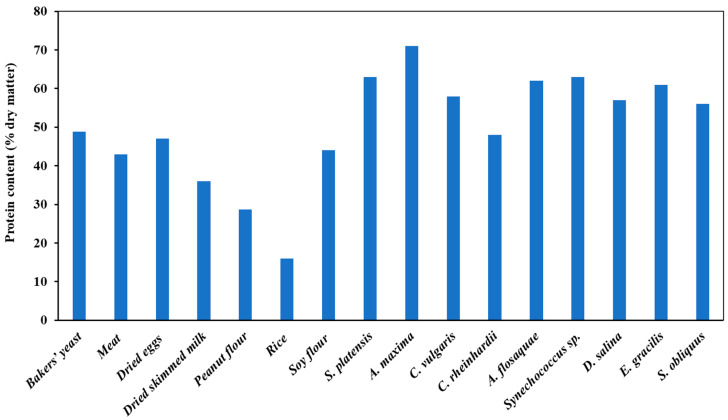
Microalgae are receiving increased attention in the food sector as a sustainable ingredient due to their high protein content and nutritional value. They contain up to 70% proteins with the presence of all 20 essential amino acids, thus fulfilling human dietary requirements. Microalgae are considered sustainable and environmentally friendly compared to traditional protein sources as they require less land and a reduced amount of water for cultivation. Although microalgae's potential in nutritional quality and functional properties is well documented, no reviews have considered an in-depth analysis of the pros and cons of their addition to foods. The present work discusses recent findings on microalgae with respect to their protein content and nutritional quality, placing a special focus on formulated food products containing microalgae proteins. Several challenges are encountered in the production, processing, and commercialization of foods containing microalgae proteins. Solutions presented in recent studies highlight the future research and directions necessary to provide solutions for consumer acceptability of microalgae proteins and derived products.
Overview
The claims and statistics of this paper haven’t been checked yet.
Run the check — free, no account needed. It reads the open-access text and checks the sources it cites.
Integrity signals
Registry
Cites
Statistics
Figures
Verification
Claims the paper makes
The claims and statistics of this paper haven’t been checked yet.
Run the check — free, no account needed. It reads the open-access text and checks the sources it cites.
Claims other papers make about this one
Each is checked against this paper’s own text: does it say what the citing paper says it does?
The source backs part of the claim, not all of it — or backs it for a different population, condition or comparison.
In the citing paper
“species like Spirulina and Chlorella offering up to 70% protein by dry weight and a complete amino acid profile, alongside their richness in essential fatty acids (notably omega-3 and omega-6 PUFAs); a wide spectrum of vitamins (A, B complex, C, E, and K); minerals (e.g., iron, magnesium, and zinc); and antioxidant compounds such as carotenoids and phycobiliproteins [56,90,121,122,123].”
From Microalgae Bioactives for Functional Food Innovation and Health Promotion (2025) · cites this paper as [121]
Experimental — accuracy not yet measuredThe source backs part of the claim, not all of it — or backs it for a different population, condition or comparison.
In the citing paper
“They can be grown on non-arable land and utilise non-potable or saline water, thereby avoiding competition with traditional crops for critical resources [121,124].”
From Microalgae Bioactives for Functional Food Innovation and Health Promotion (2025) · cites this paper as [121]
Experimental — accuracy not yet measuredThe cited source says what the claim attributes to it.
In the citing paper
“Incorporating microalgae as an ingredient in formulations increases protein content, provides peptides and bioactive pigments, and improves water retention and texture properties in bakery and dairy matrices (Verni et al., 2023; Mosibo et al., 2024).”
From Microalgae biotechnology and its role in sustainable and healthy food design (2025) · cites this paper as Mosibo et al., 2024
The cited source says what the claim attributes to it.
In the citing paper
“Efficient cultivation, cost-effective harvesting, and the preservation of nutritional integrity during processing remain major technical challenges [104,121].”
From Microalgae Bioactives for Functional Food Innovation and Health Promotion (2025) · cites this paper as [121]
Self-check
Percentages, sums and reported differences re-computed from the paper’s own numbers.
The self-check needs the paper’s full text.
Citations
Cites
Commercial Applications of Microalgae
Spolaore, P., Joannis-Cassan, C., Duran, E., & Isambert, A. (2006) · Journal of Bioscience and Bioengineering · doi:10.1263/jbb.101.87 · Cited by 4,285
Sheehan, J., Dunahay, T., Benemann, J., & Roessler, P. (1998) · doi:10.2172/15003040 · Cited by 1,753
Algal Proteins: Extraction, Application, and Challenges Concerning Production
Bleakley, S., & Hayes, M. (2017) · Foods · doi:10.3390/foods6050033 · Cited by 1,092
Flocculation as a low-cost method for harvesting microalgae for bulk biomass production
Vandamme, D., Foubert, I., & Muylaert, K. (2013) · Trends in Biotechnology · doi:10.1016/j.tibtech.2012.12.005 · Cited by 928
Microalgae: A potential alternative to health supplementation for humans
Koyande, A. K., Chew, K. W., Rambabu, K., Tao, Y., Chu, D.-T., & Show, P.-L. (2019) · Food Science and Human Wellness · doi:10.1016/j.fshw.2019.03.001 · Cited by 908
Trends in Microalgae Incorporation Into Innovative Food Products With Potential Health Benefits
Caporgno, M. P., & Mathys, A. (2018) · Frontiers in Nutrition · doi:10.3389/fnut.2018.00058 · Cited by 639
Microalgae as a future food source
Torres-Tiji, Y., Fields, F. J., & Mayfield, S. P. (2020) · Biotechnology Advances · doi:10.1016/j.biotechadv.2020.107536 · Cited by 559
The Protein Digestibility–Corrected Amino Acid Score
Schaafsma, G. (2000) · The Journal of Nutrition · doi:10.1093/jn/130.7.1865s · Cited by 537 · cited 1×
“This method is based on the amino acid requirements of humans and the ability to digest proteins [59].”
MethodComparison of microalgal biomass profiles as novel functional ingredient for food products
Batista, A. P., Gouveia, L., Bandarra, N. M., Franco, J. M., & Raymundo, A. (2013) · Algal Research · doi:10.1016/j.algal.2013.01.004 · Cited by 450
Batista, A. P., Niccolai, A., Fradinho, P., Fragoso, S., Bursic, I., Rodolfi, L., Biondi, N., Tredici, M. R., Sousa, I., & Raymundo, A. (2017) · Algal Research · doi:10.1016/j.algal.2017.07.017 · Cited by 407
Research works printed but not linked: 3
- Becker, E.W. (2013). Handbook of Microalgal Culture, John Wiley & Sons, Ltd.
- Hu, Q. (2013). Handbook of Microalgal Culture: Applied Phycology and Biotechnology, John Wiley & Sons, Ltd.. [2nd ed.].
- Hoogenkamp, H., Kumagai, H., and Wanasundara, J.P.D. (2017). Sustainable Protein Sources, Elsevier.
Cited by
Sorted by citations
Ali, S. S., Al-Tohamy, R., Al-Zahrani, M., Schagerl, M., Kornaros, M., & Sun, J. (2025) · Microbial Cell Factories · doi:10.1186/s12934-025-02685-1 · Cited by 88
Proteins from Microalgae: Nutritional, Functional and Bioactive Properties
García-Encinas, J. P., Ruíz‐Cruz, S., Juárez, J., Ornelas‐Paz, J. D. J., Del‐Toro‐Sánchez, C. L., & Márquez‐Ríos, E. (2025) · Foods · doi:10.3390/foods14060921 · Cited by 98
Podgórska-Kryszczuk, I. (2024) · Molecules · doi:10.3390/molecules29225387 · Cited by 88
Seaweed Proteins: A Step towards Sustainability?
Pereira, L., Cotas, J., & Gonçalves, A. M. M. (2024) · Nutrients · doi:10.3390/nu16081123 · Cited by 93
Song, Y., Hu, Z., Liu, S., Luo, S., He, R., Yang, X., Li, S., Yang, X., An, Y., & Lu, Y. (2025) · Journal of Agricultural and Food Chemistry · doi:10.1021/acs.jafc.4c11610 · Cited by 80
Metadata
- Authors
- Mosibo, O. K., Ferrentino, G., & Udenigwe, C. C.
- Affiliations
- University of Ottawa (CA)
- Free University of Bozen-Bolzano (IT)
- Corresponding author
- Ferrentino, Giovanna
- Venue
- Foods
- Publisher
- MDPI AG
- Published
- 2024-02-28
- Volume
- 13
- Issue
- 5
- Pages
- 733
- ISSN
- 2304-8158 (ISSN-L)
- PMC
- PMC10930894
- OpenAlex
- W4392232297
- Cited by
- 140
- References
- 146
- Citations by year
- 2026: 60 · 2025: 59 · 2024: 21
- FWCI
- 2.92
- Type
- journal article
- Language
- en
- Open access
- gold
- doi.org
- Licence
- Locations
- Foods (publishedVersion, cc-by)
- PubMed Central (publishedVersion, cc-by)
- PubMed (publishedVersion)
- Open Research (University of Surrey) (submittedVersion, other-oa)
- DOAJ (DOAJ: Directory of Open Access Journals) (submittedVersion)
- Open Research (University of Surrey) (submittedVersion, cc-by)
- Funders
- Open Access Publishing Fund of the Free University of Bozen-Bolzano
- Topics
- Physical Sciences › Energy › Renewable Energy, Sustainability and the Environment › Algal biology and biofuel production
- Life Sciences › Agricultural and Biological Sciences › Food Science › Food Industry and Aquatic Biology
- Life Sciences › Agricultural and Biological Sciences › Food Science › Food Nutrient Composition and Product Development
- Keywords
- microalgal proteins, novel foods, sustainable food ingredients, essential amino acids, nutritional value, functional properties, microalgae cultivation, consumer acceptance, commercialization challenges
About these checks
Registry, retraction, Cites and statistics results are computed, not judged, with one exception: a printed reference that no index lists is read once by a model before it counts as a citation error. Claims are extracted by a model and kept only when their quote appears verbatim in the text; each cited source is then checked, with a model’s help, for whether it says what the claim relies on. Those verdicts can be wrong — read the claim’s quote and the cited source before relying on one.
Statistics and arithmetic are recomputed, not judged.
Confidence bands are shown only for fields calibrated on our annotated test set. None is calibrated yet, so no band is shown.
What counts as a claim ›How we measure confidence ›How we check this ›
Are you an author, or do you see a problem with this page? Request a review
