

Aromatic Profiles of Essential Oils from Five Commonly Used Thai Basils
Open accessPublished version of a preprint
The DOI matches its Crossref record; 53 of the 55 references it cites were found in a registry or an index; 3 of the 12 sources its claims cite were checked for support.
Abstract
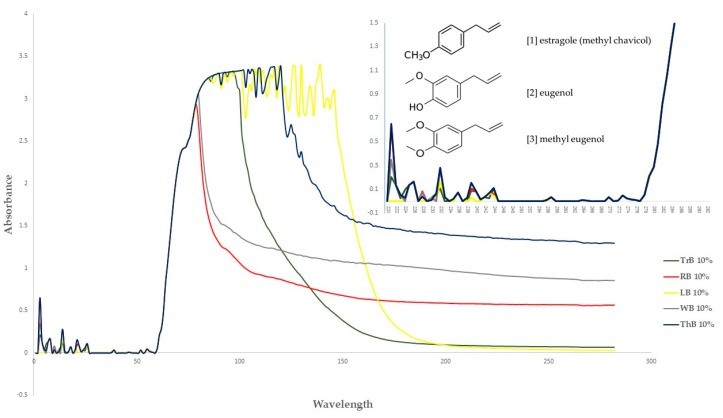
The research objectives of this study are to analyse the volatile compositions of different basil types available in Thai markets and to descriptively determine their aromatic qualities. Essential oils were hydro-distillated from fresh leaves of two Holy basil (Ocimum sanctum) varieties namely, white and red and other basil species, including Tree basil (O. gratissimum), Thai basil (O. basilicum var. thyrsiflorum), and Lemon basil (O. citriodorum). Oil physiochemical characteristics and volatile chromatograms from Gas Chromatography–Mass Spectrometry (GC-MS) were used to qualitatively and quantitatively describe the chemical compositions. Estragole, eugenol, and methyl eugenol were among the major volatiles found in the essential oils of these basil types. Classification by Principal Component Analysis (PCA) advised that these Ocimum spp. samples are grouped based on either the distinctive anise, citrus aroma (estragole, geranial and neral), or spice-like aroma (methyl eugenol, β-caryophyllene, and α-cubebene). The essential oils were also used for descriptive sensorial determination by five semi-trained panellists, using the following developed terms: anise, citrus, herb, spice, sweet, and woody. The panellists were able to differentiate essential oils of white Holy basil from red Holy basil based on the intensity of the anisic attribute, while the anise and citrus scents were detected as dominant in the Lemon basil, Tree basil, and Thai basil essential oils. The overall benefit from this research was the elucidation of aromatic qualities from Thai common Ocimum species in order to assess their potential as the raw materials for new food products.
Overview
CoChat Summary
TL;DR
This study hydro-distilled essential oils from five Thai *Ocimum* types and combined GC-MS volatile profiling with descriptive sensory analysis. Estragole, eugenol, and methyl eugenol dominated, and PCA separated samples into citrus/anise versus spice-like aroma groups, with panellists distinguishing white from red Holy basil by anisic intensity.
Key findings
- Essential oil yields were highest for white Holy basil and Thai basil (~0.4%), followed by Lemon basil and red Holy basil (~0.33%), while Tree basil gave the least (<~0.2%).
- GC-MS identified 67 compounds. Major volatiles included: Lemon basil — estragole 98.22 µg/mL, citral 9.55 µg/mL, neral 6.32 µg/mL; red Holy basil — methyl eugenol 683.90 µg/mL, β-caryophyllene 145.81 µg/mL, α-cubebene 104.70 µg/mL; Thai basil — estragole 452.80 µg/mL, geranial 180.57 µg/mL, neral 151.16 µg/mL; Tree basil — eugenol 408.00 µg/mL, α-ocimene 256.45 µg/mL, γ-muurolene 91.57 µg/mL; white Holy basil — methyl eugenol 98.44 µg/mL, α-cubebene 9.94 µg/mL, α-copaene 4.74 µg/mL.
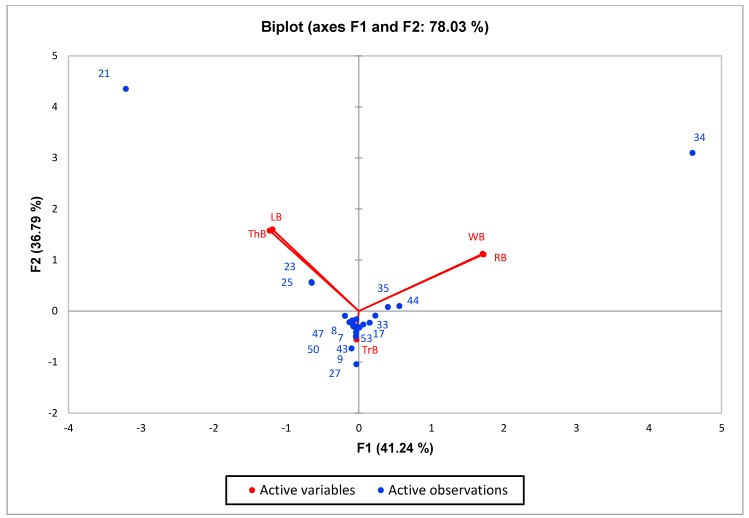
- PCA grouped Thai basil and Lemon basil with estragole, geranial, and neral; white and red Holy basil with methyl eugenol, β-caryophyllene, and α-cubebene; Tree basil did not correlate with the other groups.
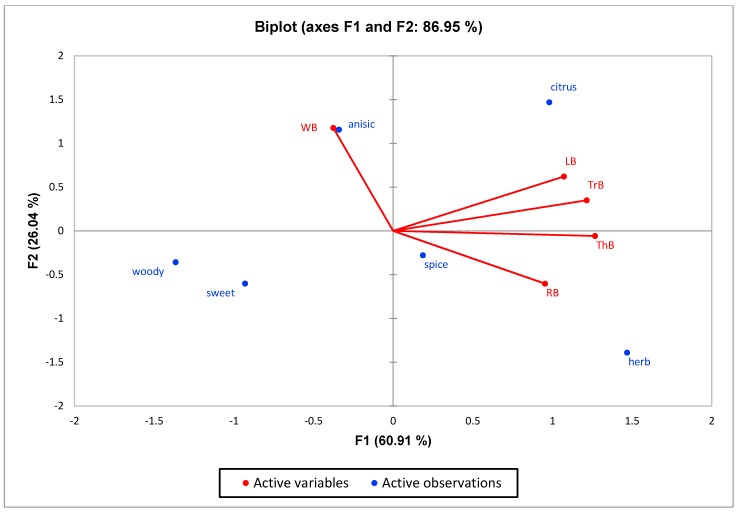
- Sensory scores showed sweet was not significantly different among oils (~2.4–3.4); herb was highest in Tree and Thai basil (~9.0–11.0); woody was highest in white and red Holy basil (~2.2–3.4); anisic dominated Tree basil and white Holy basil (~5.9–7.4); spice was highest in Tree and Thai basil (~6.4–7.3); citrus was highest in Lemon basil (12.8). Panellists differentiated white Holy basil from red Holy basil by anisic intensity.
Methods
- Five *Ocimum* types (white and red Holy basil, Thai basil, Lemon basil, Tree basil) were grown at Mae-Hia Agricultural Training and Research Centre, Chiang Mai University, with 100 plants/type; fresh leaves (~300 g) were hydro-distilled in a 5 L Clevenger apparatus for 2 h at 150 °C, and yields were averaged from three extractions.
- Volatiles were analysed by GC-MS (Bruker-scion 436, Rxi-5Sil MS column), injecting 2 µL of 1% v/v oil in dichloromethane with 0.003% w/v toluene as internal standard in split mode 1:20; compounds were identified by NIST 05.L and NIST 98.L libraries with >70% similarity and confirmed by retention indices.
- Descriptive analysis used five semi-trained panellists (two males, three females, age 25–37) after a 3-day orientation and 12 h training; 200 µL oil on cotton balls was evaluated in triplicate on a 15-point intensity scale, with ANOVA at α = 0.05 and PCA in XLSTAT.
Limitations
- The paper does not state a limitations section. Evident from the text: the sensory panel was very small (five semi-trained panellists), limiting generalizability of the descriptive results.
- Evident from the text: plants were grown at a single site and collected at flowering, so location, season, and phenological variation are not assessed.
- Evident from the methods: volatile quantification was relative to an internal standard, and identification relied on library similarity >70% plus retention indices, without reported external calibration for each compound.
Model-written summary. Check it against the paper before relying on it.
Integrity signals
Registry
Cites
Statistics
Figures
Verification
Claims the paper makes
2 Valid · 0 Not valid · 5 Not checked · 31 Own results and interpretations
A result the paper reports from its own data — it cites no other source for it, so there is none to check. The quote shows it is in the paper.
In the paper
“However, there was no correlation of woody and sweet attributes across the five essential oil types.”
§ Aromatic Profiles of Essential Oils from Five Commonly Used Thai Basils > 3. Results and Discussion > 3.3. Sensory Profile of the Essential Oil
plain- Asserted: passes — The authors put it forward as true.
- Checkable: passes — It can be checked against evidence.
- Load-bearing: unclear — It is unclear whether the paper’s conclusions depend on it.
- Based: passes — The paper gives a reason why it holds.
A result the paper reports from its own data — it cites no other source for it, so there is none to check. The quote shows it is in the paper.
In the paper
“The PCA was able to split aromatic profile of white Holy basil relating with the higher intensity of anisic attribute (Figure 3).”
§ Aromatic Profiles of Essential Oils from Five Commonly Used Thai Basils > 3. Results and Discussion > 3.3. Sensory Profile of the Essential Oil
plainstates an association- Asserted: passes — The authors put it forward as true.
- Checkable: passes — It can be checked against evidence.
- Load-bearing: unclear — It is unclear whether the paper’s conclusions depend on it.
- Based: passes — The paper gives a reason why it holds.
A result the paper reports from its own data — it cites no other source for it, so there is none to check. The quote shows it is in the paper.
In the paper
“Tree basil and Thai basil oils illustrated the highest spice aroma intensity (score ~6.4–7.3).”
§ Aromatic Profiles of Essential Oils from Five Commonly Used Thai Basils > 3. Results and Discussion > 3.3. Sensory Profile of the Essential Oil
plain- Asserted: passes — The authors put it forward as true.
- Checkable: passes — It can be checked against evidence.
- Load-bearing: unclear — It is unclear whether the paper’s conclusions depend on it.
- Based: passes — The paper gives a reason why it holds.
A result the paper reports from its own data — it cites no other source for it, so there is none to check. The quote shows it is in the paper.
In the paper
“while the Tree basil and white Holy basil dominated anisic attribute (score ~5.9–7.4).”
§ Aromatic Profiles of Essential Oils from Five Commonly Used Thai Basils > 3. Results and Discussion > 3.3. Sensory Profile of the Essential Oil
plainstates an association- Asserted: passes — The authors put it forward as true.
- Checkable: passes — It can be checked against evidence.
- Load-bearing: unclear — It is unclear whether the paper’s conclusions depend on it.
- Based: passes — The paper gives a reason why it holds.
A result the paper reports from its own data — it cites no other source for it, so there is none to check. The quote shows it is in the paper.
In the paper
“Estragole, eugenol, and methyl eugenol were among the major volatiles found in the essential oils of these basil types.”
- Also stated in: § 4. Conclusions · boosted
“From this research, we conclude that the major components of essential oils from the five types of basils used as food ingredients in Thailand are estragole, eugenol, and methyl eugenol.”
§ Aromatic Profiles of Essential Oils from Five Commonly Used Thai Basils > Abstract
boosted- Asserted: passes — The authors put it forward as true.
- Checkable: passes — It can be checked against evidence.
- Load-bearing: passes — The paper’s conclusions depend on it.
- Based: passes — The paper gives a reason why it holds.
- Also stated in: § 4. Conclusions · boosted
15 more claims
Create a free account to see all 38 claims and every source verdict.
- Probably not a substantial claim. 12
- It may state two separate claims as one. 9
- The quote only partly states this claim. 1
Claims other papers make about this one
Each is checked against this paper’s own text: does it say what the citing paper says it does?
The source backs part of the claim, not all of it — or backs it for a different population, condition or comparison.
In the citing paper
“Principal Component Analysis (PCA) and Hierarchical Clustering Analysis (HCA) are valuable statistical techniques employed to derive insights from intricate datasets, particularly when managing a substantial number of variables, such as the volatile compounds present in Ocimum oils [29] .”
From Untargeted metabolomics and targeted approach of essential oils to differentiate five Ocimum species using gas chromatography coupled with mass spectrometry (2024) · cites this paper as [29]
Experimental — accuracy not yet measured
Self-check
Percentages, sums and reported differences re-computed from the paper’s own numbers.
Each contradiction between two passages listed here was confirmed by an independent check.
Rated minor: it would not touch a result — a value no result rests on, a p-value that stays on the same side of the significance level, or a conflict that is clerical, resolved elsewhere in the paper, or outside its own findings.
In the paper
§ Aromatic Profiles of Essential Oils from Five Commonly Used Thai Basils > 3. Results and Discussion > 3.1. Plant Identification and Physiochemical Characteristics of the Essential Oils
“White Holy basil (O. sanctum var. Rama) and Thai basil (O. basilicum var. thyrsiflorum) illustrated maximum yield ~0.4%, Lemon basil (O. citriodorum) and red Holy basil (O. sanctum var. Shyama) yielded the essential oil of ~0.33%.”
§ Aromatic Profiles of Essential Oils from Five Commonly Used Thai Basils > 2. Materials and Methods > 2.1. Plant Material
“O. sanctum var. Rama (red), O. sanctum var. Shyama (white)”
Citations
Cites
Stability of Essential Oils: A Review
Turek, C., & Stintzing, F. C. (2013) · Comprehensive Reviews in Food Science and Food Safety · doi:10.1111/1541-4337.12006 · Cited by 1,315
Comprehensive Reviews Food Science and food Safety
(2003) · Journal of Food Science · doi:10.1111/j.1365-2621.2003.tb05778.x · Cited by 925
Journal of Plant Nutrition and Soil Science
(2006) · Journal of Plant Nutrition and Soil Science · doi:10.1002/(issn)1522-2624 · Cited by 744
Basil: A Source of Aroma Compounds and a Popular Culinary and Ornamental Herb*
Simon, J. E., Morales, M. R., Phippen, W. B., Vieira, R. F., & Hao, Z. (1999) · Cited by 340
ANALYSIS OF THE ESSENTIAL OILS OF TWO CULTIVATED BASIL (OCIMUM BASILICUM L.) FROM IRAN
Sajjadi, S. E. (2006) · DARU Journal of Pharmaceutical Sciences · Cited by 315
Chemistry and bioactivities of essential oils of some Ocimum species: an overview
Pandey, A. K., Singh, P., & Tripathi, N. N. (2014) · Asian Pacific Journal of Tropical Biomedicine · doi:10.12980/apjtb.4.2014c77 · Cited by 296
Kwee, E. M., & Niemeyer, E. D. (2011) · Food Chemistry · doi:10.1016/j.foodchem.2011.04.011 · Cited by 275
A review on phytochemical and pharmacological properties of holy basil (Ocimum sanctum L.)
Singh, D., & Chaudhuri, P. K. (2018) · Industrial Crops and Products · doi:10.1016/j.indcrop.2018.03.048 · Cited by 218 · cited 1×
“plants are estragole (methyl chavicol), eugenol, and methyl eugenol [11,32,33].”
BackgroundThe antioxidative properties of holy basil and galangal in cooked ground pork
Juntachote, T., Berghofer, E., Siebenhandl, S., & Bauer, F. (2006) · Meat Science · doi:10.1016/j.meatsci.2005.08.009 · Cited by 199 · cited 1×
“gratissimum) are frequently cultivated in several countries of South and South-East Asia including Thailand as culinary herbs [3,4].”
BackgroundAvetisyan, A., Markosian, A., Petrosyan, M., Sahakyan, N., Babayan, A., Aloyan, S., & Trchounian, A. (2017) · BMC Complementary and Alternative Medicine · doi:10.1186/s12906-017-1587-5 · Cited by 186
Research works printed but not linked: 3
- Beltramea J.M. Angnesa R.A. Chiavellib L.U.R. Costab W.F.d. Rosac M.F.d. Loboa V.d.S. Pominib A.M. Photodegradation of essential oil from marjoram (Origanum majorana L.) studied by GC-MS and UV-Vis spectroscopy Rev. Latinoam. Quím. 2013 41 81 88
- Mondawi B. Duprey R. Magboul A. Satti A. Constituents of essential oil of Ocimum basilicum var. Thyrsiflorum Fitoterapia 1984 55 60 61
- Khatri L. Nasir M. Saleem R. Noor F. Evaluation of pakistani sweet basil oil for commercial exploitation Pak. J. Sci. Ind. Res. 1995 38 281 282
Cited by
Sommano, S. R., Chittasupho, C., Ruksiriwanich, W., & Jantrawut, P. (2020) · Molecules · doi:10.3390/molecules25245792 · Cited by 192
Self-citationLin, L.-Y., Chuang, C., Chen, H., & Yang, K. (2019) · Foods · doi:10.3390/foods8090398 · Cited by 126
Melo, R. S., Albuquerque Azevedo, Á. M., Gomes Pereira, A. M., Rocha, R. R., Bastos Cavalcante, R. M., Carneiro Matos, M. N., Ribeiro Lopes, P. H., Gomes, G. A., Soares Rodrigues, T. H., Santos, H. S. D., et al. (2019) · Molecules · doi:10.3390/molecules24213864 · Cited by 106
Majdi, C., Pereira, C., Dias, M. I., Calhelha, R. C., Alves, M. J., Rhourri-Frih, B., Charrouf, Z., Barros, L., Amaral, J. S., & Ferreira, I. C. F. R. (2020) · Antioxidants · doi:10.3390/antiox9050369 · Cited by 88
Rizvi, A., Ahmed, B., Khan, M. S., EL-BELTAGI, H. S., Umar, S., & Lee, J. (2022) · Molecules · doi:10.3390/molecules27041407 · Cited by 94
Mohammed, A. B. A., Yagi, S. M. A., Tzanova, T., Schohn, H., Abdelgadir, H., Stefanucci, A., Mollica, A., Mahomoodally, M. F., Adlan, T. A., & Zengin, G. (2020) · South African Journal of Botany · doi:10.1016/j.sajb.2020.06.006 · Cited by 72
Tamfu, A. N., Küçükaydın, S., Ceylan, Ö., Saraç, N., & Duru, M. E. (2021) · Chemistry Africa · doi:10.1007/s42250-021-00265-5 · Cited by 53
Kačániová, M., Galovičová, L., Borotová, P., Vuković, N. L., Vukić, M., Kunová, S., Hanus, P., Bakay, L., Zagrobelna, E., Kluz, M., et al. (2022) · Plants · doi:10.3390/plants11081030 · Cited by 56
Pheko-Ofitlhile, T., & Makhzoum, A. B. (2024) · Journal of Essential Oil Research · doi:10.1080/10412905.2024.2320350 · Cited by 63
“Essential oils yield and quality are dependent on the species and the different variations within species (14– 16).”
BackgroundChallenges in Medicinal and Aromatic Plants DNA Barcoding—Lessons from the Lamiaceae
Nazar, N., Howard, C., Slater, R. J., & Sgamma, T. (2022) · Plants · doi:10.3390/plants11010137 · Cited by 62
Deng, X., Shi, B., Ye, Z., Huang, M., Chen, R., Cai, Y., Kuang, Z., Sun, X., Bian, G., Deng, Z., et al. (2021) · Metabolic Engineering · doi:10.1016/j.ymben.2021.11.005 · Cited by 46
Tangpao, T., Charoimek, N., Teerakitchotikan, P., Leksawasdi, N., Jantanasakulwong, K., Rachtanapun, P., Seesuriyachan, P., Phimolsiripol, Y., Chaiyaso, T., Ruksiriwanich, W., et al. (2022) · Horticulturae · doi:10.3390/horticulturae8020144 · Cited by 51
Self-citationDu, P., Yuan, H., Chen, Y., Zhou, H., Zhang, Y., Huang, M., Jiangfang, Y., Su, R., Chen, Q., Lai, J., et al. (2023) · Metabolites · doi:10.3390/metabo13010085 · Cited by 46
Zebrafish as a Useful Tool in the Research of Natural Products With Potential Anxiolytic Effects
Cueto‐Escobedo, J., Germán-Ponciano, L. J., Guillén-Ruiz, G., Soria-Fregozo, C., & Herrera-Huerta, E. V. (2022) · Frontiers in Behavioral Neuroscience · doi:10.3389/fnbeh.2021.795285 · Cited by 49
Chinnaiyan, S. K., Pandiyan, R., Natesan, S., et al. (2022) · Journal of Drug Delivery Science and Technology · doi:10.1016/j.jddst.2022.103129 · Cited by 34
Ciriello, M., Kyriacou, M. C., Pascale, S. D., & Rouphael, Y. (2022) · Journal of Food Composition and Analysis · doi:10.1016/j.jfca.2022.104582 · Cited by 40
Growth of Hydroponic Sweet Basil (O. basilicum L.) Using Plasma-Activated Nutrient Solution (PANS)
Date, M. B., Rivero, W. C., Tan, J., Specca, D., Simon, J. E., Salvi, D., & Karwe, M. V. (2023) · Agriculture · doi:10.3390/agriculture13020443 · Cited by 27
Chemical determinants of dried Thai basil (O. basilicum var. thyrsiflora) aroma quality
Łyczko, J., Masztalerz, K., Lipan, L., Lech, K., Carbonell-Barrachina, Á. A., & Szumny, A. J. (2020) · Industrial Crops and Products · doi:10.1016/j.indcrop.2020.112769 · Cited by 29
Chutimanukul, P., Jindamol, H., Thongtip, A., Korinsak, S., Romyanon, K., Toojinda, T., Darwell, C. T., Wanichananan, P., Panya, A., Kaewsri, W., et al. (2022) · Frontiers in Plant Science · doi:10.3389/fpls.2022.1008917 · Cited by 33
Boonyanugomol, W., Rukseree, K., Prapatpong, P., Reamtong, O., Baik, S., Jung, M., Shin, M., Kang, H., & Lee, W. (2021) · Medicina · doi:10.3390/medicina57080784 · Cited by 29
Walters, K. J., López, R. G., & Behe, B. K. (2021) · Frontiers in Plant Science · doi:10.3389/fpls.2020.598519 · Cited by 27
“and to characterize basil cultivars (D’Antuono et al., 2007; de Costa et al., 2014; Bernhardt et al., 2015; Tangpao et al., 2018).”
BackgroundMethodPhenotypic Variations and Bioactive Constituents among Selected Ocimum Species
Musie, S., Pluhár, Z., & Radácsi, P. (2023) · Plants · doi:10.3390/plants13010064 · Cited by 37
Xie, Y., Zhang, C., Mei, J., & Xie, J. (2023) · International Journal of Molecular Sciences · doi:10.3390/ijms241311066 · Cited by 27
Qiu, L., Ma, H., Luo, Q., et al. (2022) · Foods · doi:10.3390/foods11152306 · Cited by 19
Functional Coatings by Natural and Synthetic Agents for Insect Control and Their Applications
Coetzee, D., Militký, J., & Venkataraman, M. (2022) · Coatings · doi:10.3390/coatings12040476 · Cited by 24
Recovery of Crocins From Floral Tissue of Gardenia jasminoides Ellis
Sommano, S. R., Suppakittpaisarn, P., Sringarm, K., Junmahasathien, T., & Ruksiriwanich, W. (2020) · Frontiers in Nutrition · doi:10.3389/fnut.2020.00106 · Cited by 20
“The absorption spectra of the extracts were evaluated with wavelengths in the range 200–700 nm by means of an ultraviolet (UV)-visible spectrophotometer (SPECTROstar Nano; BMG LABTECH, Offenburg, Germany) (22, 23).”
BackgroundMethodSelf-citationFlavonoid Profiles of Two New Approved Romanian Ocimum Hybrids
Bălănescu, F., Mihaila, M. D. I., Cârâc, G., Furdui, B., Vînătoru, C., Avramescu, S. M., Lisă, E. L., Cudalbeanu, M. D., & Dinică, R. M. (2020) · Molecules · doi:10.3390/molecules25194573 · Cited by 18
Tyagi, A., Yadav, A. K., Yadav, A., Saini, L., Kumar, V., Jain, P., Mohammad, I., Ansari, M. J., El Enshasy, H. A., Abdel-Gawad, F. K., et al. (2022) · Journal of King Saud University: Science · doi:10.1016/j.jksus.2022.102355 · Cited by 17
Yang, J., Yuan, J., Yu, M., Mao, Y., Liu, M., Guan, L., & Liu, L. (2025) · Food Research International · doi:10.1016/j.foodres.2025.116985 · Cited by 16
Lamiaceae Family Plants: One of the Potentially Richest Sources of Antimicrobials
Sahakyan, N. Z. (2023) · Pharmaceutical Chemistry Journal · doi:10.1007/s11094-023-02921-1 · Cited by 23
Ocimum Phytochemicals and Their Potential Impact on Human Health
Bhattacharjya, D., Adhikari, S., Biswas, A., Bhuimali, A., Ghosh, P., & Saha, S. (2020) · IntechOpen eBooks · doi:10.5772/intechopen.88555 · Cited by 24
Sharifi‐Rad, J., Adetunji, C. O., Olaniyan, O. T., Ojo, S. K. S., Micheal, O. S., Banjo, T. T., Roli, O. I., Nimota, O. O., Banjo, T. O., Adetunji, J. B., et al. (2021) · Food Reviews International · doi:10.1080/87559129.2021.1934693 · Cited by 23
Beigi, S., Azizi, M., & Iriti, M. (2020) · Molecules · doi:10.3390/molecules25112503 · Cited by 14
Tangpao, T., Krutmuang, P., Kumpoun, W., Jantrawut, P., Pusadee, T., Cheewangkoon, R., Sommano, S. R., & Chuttong, B. (2021) · Insects · doi:10.3390/insects12070633 · Cited by 15
Self-citationSaelao, T., Chutimanukul, P., Suratanee, A., & Plaimas, K. (2023) · Horticulturae · doi:10.3390/horticulturae9101094 · Cited by 17
Wongpraneekul, A., Havananda, T., & Luengwilai, K. (2021) · Journal of Applied Research on Medicinal and Aromatic Plants · doi:10.1016/j.jarmap.2021.100347 · Cited by 14
Piva, R. C., Verdan, M. H., Branquinho, L. S., Kassuya, C. A. L., & Cardoso, C. A. L. (2021) · Journal of Ethnopharmacology · doi:10.1016/j.jep.2021.114136 · Cited by 12
Aromatic Profile Variation of Essential Oil from Dried Makwhaen Fruit and Related Species
Sriwichai, T., Wisetkomolmat, J., Pusadee, T., Sringarm, K., Duangmal, K., Prasad, S. K., Chuttong, B., & Sommano, S. R. (2021) · Plants · doi:10.3390/plants10040803 · Cited by 10
Self-citationBorah, G., Bora, P. K., Mahanta, B. P., et al. (2023) · Food Chemistry Advances · doi:10.1016/j.focha.2023.100370 · Cited by 10
Ciriello, M., Formisano, L., Graziani, G., Romano, R., Pascale, S. D., Rouphael, Y., & Corrado, G. (2023) · Scientia Horticulturae · doi:10.1016/j.scienta.2023.112382 · Cited by 13
Evaluation of the Optimum Harvesting Maturity of Makhwaen Fruit for the Perfumery Industry
Sriwichai, T., Junmahasathien, T., Sookwong, P., et al. (2019) · Agriculture · doi:10.3390/agriculture9040078 · Cited by 9
Self-citationAjmal, M., Nijabat, A., Sajjad, I., Haider, S. Z., Bedale, W. A., Yu, J., Shah, M. A., Ukozehasi, C., Alwaili, M. A., & Elkelish, A. (2025) · Scientific Reports · doi:10.1038/s41598-025-87397-7 · Cited by 24
“3), as reported previously 60,70,71 .”
Yaldız, G., Çamlıca, M., & Erdönmez, D. (2023) · Microbial Pathogenesis · doi:10.1016/j.micpath.2023.106247 · Cited by 9
Chotikakham, S., Janhom, N., & Tangjitman, K. (2023) · Postharvest Biology and Technology · doi:10.1016/j.postharvbio.2023.112555 · Cited by 10
Li, K., Yu, L., Gao, L., Zhu, L., Feng, X., & Deng, S. (2024) · Food Chemistry Molecular Sciences · doi:10.1016/j.fochms.2024.100209 · Cited by 7
“They are also used as natural photosen-sitizers in solar cell manufacturing industries (Shen et al., 2014; Choi et al., 2001; Tangpao et al., 2018; Sangare et al., 2023).”
BackgroundAromatic profile of rhizomes from the ginger family used in food
Sommano, S. R., & Tangpao, T. (2021) · Elsevier eBooks · doi:10.1016/b978-0-12-822716-9.00004-4 · Cited by 6
Self-citationRole of plant metabolites in plant protection and their potential in integrated pest management
Barak, D. (2022) · The Pharma Innovation · doi:10.22271/tpi.2022.v11.i5i.12469 · Cited by 6
“The essential oils of these basils are mostly phenylpropanoids like estragole, methyl eugenol and eugenol, however, they also contain monoterpenes like neral,ocimene and geranial,, as well as sesquiterpenes like alpha- caryophyllene, gama- muurolene and beta- cubebene (Tangpao et al., 2018) [50].”
BackgroundHamad, A., Ramadhan, M. B., Dewi, D. Y. S., Djalil, A. D., & Hartanti, D. (2020) · IOP Conference Series Materials Science and Engineering · doi:10.1088/1757-899x/771/1/012037 · Cited by 9
Composition of the metabolomic bio-coronas isolated from Ocimum sanctum and Rubia tinctorum
Kurepa, J., & Smalle, J. (2021) · BMC Research Notes · doi:10.1186/s13104-020-05420-8 · Cited by 6
Li, X., Zhao, Q., Chen, H., Lai, M., Zhao, S., Feng, W., Liu, W., Li, Y., & Zhao, M. (2025) · Industrial Crops and Products · doi:10.1016/j.indcrop.2025.121840 · Cited by 11
Vural, N. (2021) · Journal of Food Measurement & Characterization · doi:10.1007/s11694-021-01072-9 · Cited by 8
Baković, M., Perković, L., Matijević, G., Martić, A., Vujović, T., Ekić, S., Fumić, M., Jurić, S., Čož‐Rakovac, R., Roje, M., et al. (2023) · Pharmaceuticals · doi:10.3390/ph16070981 · Cited by 6
Jiang, R., Liu, J. T., Liu, Q., et al. (2024) · Processes · doi:10.3390/pr12122789 · Cited by 5
Selection of Suitable Accession ofOcimum africanumLour for Herbage and Citral Production
Saran, P. L., Damor, H. I., Lal, M., Sarkar, R., & Kalariya, K. A. (2022) · Journal of Essential Oil Bearing Plants · doi:10.1080/0972060x.2022.2107404 · Cited by 6
Combination of Clove and Lemon Basil Essential Oils for Preservation of Chicken Meat
Hartanti, D., Septiyaningrum, N. A., & Hamad, A. (2020) · Journal of Food Quality and Hazards Control · doi:10.18502/jfqhc.7.2.2888 · Cited by 5
“The major constituents of lemon basil EO in this study were similar with a report (Tangpao et al., 2018) in which estragole (68.5), E-citral (6.7%), and Z-citral (4.4”
ResultInfluentialAiemsaard, J., Kamollert, C., Singh, R., Suwannathada, P., Suwannathada, P., & Thongkham, E. (2020) · ScienceAsia · doi:10.2306/scienceasia1513-1874.2020.062 · Cited by 5
Głuchowski, A., Czarniecka‐Skubina, E., Tambor, K., & Jariené, E. (2021) · Molecules · doi:10.3390/molecules27010005 · Cited by 4
Issues of Safe Use of Plant-Based Food Supplements: A Review
Korotkova, A. I., Bagryantseva, O. V., Sokolov, I. E., & Glinenko, V. M. (2022) · ЗДОРОВЬЕ НАСЕЛЕНИЯ И СРЕДА ОБИТАНИЯ - ЗНиСО / PUBLIC HEALTH AND LIFE ENVIRONMENT · doi:10.35627/2219-5238/2022-30-7-24-32 · Cited by 4
Fatimura, M., & Fitriiyanti, R. (2021) · CHEESA Chemical Engineering Research Articles · doi:10.25273/cheesa.v4i1.8274.65-74 · Cited by 4
Tangpao, T., Kumpoun, W., Withee, P., Cheewangkoon, R., & Sommano, S. R. (2022) · Acta Horticulturae · doi:10.17660/actahortic.2022.1336.29 · Cited by 4
Self-citationJaiswal, R. P., Chugh, V., Nagar, S., Purwar, S., Azam, A., & Verma, A. (2025) · Biochemistry Research International · doi:10.1155/bri/7121687 · Cited by 4
Sun, Y., Wu, T., Wang, B., et al. (2026) · Food Chemistry · doi:10.1016/j.foodchem.2026.147906 · Cited by 3
Sommano, S. R., Thomya, S., ai, P. N., et al. (2025) · Diversity · doi:10.3390/d17040224 · Cited by 3
Self-citationFormulation, Physical and Chemical Stability of Ocimum gratissimum L. Leaf Oil Nanoemulsion
Ontao, N., Athikomkulchai, S., Tadtong, S., Leesawat, P., & Chittasupho, C. (2021) · Key engineering materials · doi:10.4028/www.scientific.net/kem.901.117 · Cited by 3
“gratissimum grown in Thailand was eugenol [9].”
Bianchi, A., Farina, P., Venturi, F., Trusendi, F., Flamini, G., Ascrizzi, R., Sarrocco, S., Ortega-Andrade, S., Echeverría, M. C., Conti, B., et al. (2025) · Foods · doi:10.3390/foods14040572 · Cited by 4
Rana, L., Tewari, G., & Pande, C. (2021) · Journal of Essential Oil Bearing Plants · doi:10.1080/0972060x.2021.1939168 · Cited by 4
Khattra, A. K., Wason, S., Gowda, N. A. N., Lafontaine, S., Subbiah, J., & Acuff, J. C. (2026) · Journal of Food Protection · doi:10.1016/j.jfp.2026.100750 · Cited by 2
Investigation of the efficacy of essential oils used in pest control
Uçkun, A. A., & Karakoyun, S. (2023) · Journal of Entomology and Zoology Studies · doi:10.22271/j.ento.2023.v11.i1c.9154 · Cited by 5
GC/MS Profiling of Becium grandiflorum Essential Oil and Evaluation of Its Antiviral Activity
Fahim, C., Ibrahim, N., Swilam, N., & Labib, R. M. (2023) · Archives of Pharmaceutical Sciences Ain Shams University · doi:10.21608/aps.2023.202342.1114 · Cited by 3
Theanphong, O., Jenjittikul, T., Mingvanish, W., et al. (2023) · Journal of Herbs Spices & Medicinal Plants · doi:10.1080/10496475.2023.2294720 · Cited by 2
“4] Elsholtzia species (Lamiaceae) are small annual or perennial herbs.”
BackgroundResultJaiswal, R. P., Pasrija, A., Mishra, B., Gupta, P. K., & Mitra, R. (2024) · The Journal of Phytopharmacology · doi:10.31254/phyto.2024.13602 · Cited by 2
Kahlaoui, S., Hcini, K., Haddada, A., et al. (2024) · Chemistry & Biodiversity · doi:10.1002/cbdv.202401360 · Cited by 1
Essential Oil and Phylogenetic Positions of Five Medicinal Litsea Species (Lauraceae)
Chaisoung, N., Balslev, H., Suksathan, R., Panyadee, P., Long, C., Ngernsaengsaruay, C., Chaowasku, T., & Inta, A. (2025) · Diversity · doi:10.3390/d17030168 · Cited by 4
PRESERVATION POTENTIAL OF COMBINATION OF CLOVE AND LEMON BASIL ESSENTIAL OILS ON FRESH CHICKEN MEAT
Hartanti, D., Septiyaningrum, N. A., & Hamad, A. (2020) · Indonesian Food and Nutrition Progress · doi:10.22146/ifnp.50381 · Cited by 1
“Our result is following a previously reported study, that estragole, E-citral, and Z-citral were the principal components of lemon basil essential oil collected in Chiang Mai, Thailand (Tangpao et al., 2018).”
ResultPremakumari, P. D., Sarayu, M. G., & Kumaraswamy, M. (2020) · International Journal of Pharmaceutical Sciences and Drug Research · doi:10.25004/ijpsdr.2020.120508 · Cited by 1
“Tangpao et al.[15] compared aromatic profiles of essential oils from five commonly used at Thai Basils.”
Background(2021) · Current Science International · doi:10.36632/csi/2021.10.4.62
Effect of Genotypic and Phenotypic Variations on Essential Oil Aromatic Profiles of Makwhaen FruitsPreprint
Sriwichai, T., Phusadee, T., Wisetkomolmat, J., Sringarm, K., Mekchay, S., Jantanasakulwong, K., Duangmal, K., & Sommano, S. R. (2020) · Preprints.org · doi:10.20944/preprints202002.0274.v1 · Cited by 1
“02± ND ND ND ND RIRef: Retention index from the referent [5,12].”
BackgroundSelf-citationComparison of aroma active compounds in fresh Thai holy basil leaves from 2 varieties
Vichienkalayarat, T., Ngamchuachit, P., & Keeratipibul, S. (2022) · Chula Digiverse · doi:10.58837/chula.the.2022.164 · Cited by 1
“In several studies, the extraction methods of holy basil were hydro-distillation and SPME (Raina et al., 2013; Tangpao et al., 2018; Wongpraneekul et al., 2022).”
MethodInfluentialBodhipadma, K., Noichinda, S., Chalermwanitkul, P., Chanunpanich, N., & Leung, D. W. M. (2021) · Journal of Applied Science · doi:10.14416/j.appsci.2021.01.001
Effects of selected aroma compounds on physiological activities and emotions
Sivaphongthongchai, A. (2021) · Chula Digiverse · doi:10.58837/chula.the.2021.354
น้อยจินดา, ว., & สรรพวรสถิตย์, อ. (2019) · Chula Digiverse · doi:10.58837/chula.the.2019.624
Phewpan, A., Ruedee, P., Sriprom, C., et al. (2025) · CyTA - Journal of Food · doi:10.1080/19476337.2025.2457417
“…the 13 compounds reported in Table 2, 8 compounds (eugenol, borneol, caryophyllene oxide, α-pinene, camphene, sabinene, limonene and 1,8-cineole) had been reported in holy basil leaves using other extraction methods (Raina et al., 2013; Tangpao et al., 2018; Wongpraneekul et al., 2022) (Table 4).”
Li, X., Zhao, Q., Chen, H., Lai, M., Zhao, S., Feng, W., Liu, W., Li, Y., & Zhao, M. (2025) · SSRN Electronic Journal · doi:10.2139/ssrn.5159031
Antala, P. A., Patel, N., Kumar, S., Pandya, H. V., Baria, K., & Dobariya, J. (2025) · International Journal of Advanced Biochemistry Research · doi:10.33545/26174693.2025.v9.i7j.4836
Thongphak, D., Piangsuwan, P., Jornsanoh, P., et al. (2026) · Journal of Stored Products Research · doi:10.1016/j.jspr.2026.103075
Mechmechani, S., Shaito, A. A., Karousa, M. M. M., Rocha, M. A. M., Pinto, D. C. G. A., Al-Khater, M., Ali, M., Hassona, M. M., & Karam, L. (2026) · Molecules · doi:10.3390/molecules31172940
“[51], reinforcing that warm environments optimize the enzymatic oxidation of monoterpene alcohols into their corresponding aldehydes.”
Vassallo, V., Giustino, E., Finamore, R., Stellavato, A., Alessio, N., Giuliano, M., Galderisi, U., & Schiraldi, C. (2026) · Molecules · doi:10.3390/molecules31193470
Metadata
- Authors
- Tangpao, T., Chung, H.-H., & Sommano, S. R.
- Affiliations
- Chiang Mai University (TH)
- National Ilan University (TW)
- Corresponding author
- Sommano, Sarana Rose
- Venue
- Foods
- Publisher
- MDPI AG
- Published
- 2018-10-24
- Volume
- 7
- Issue
- 11
- Pages
- 175
- ISSN
- 2304-8158 (ISSN-L)
- PMC
- PMC6262289
- OpenAlex
- W2898351857
- Cited by
- 87
- References
- 55
- Citations by year
- 2026: 5 · 2025: 10 · 2024: 4 · 2023: 14 · 2022: 16 · 2021: 19 · 2020: 13 · 2019: 5 · 2018: 1
- FWCI
- 8.92
- Type
- journal article
- Language
- en
- Open access
- gold
- doi.org
- Licence
- Locations
- Foods (publishedVersion, cc-by)
- Preprints.org (acceptedVersion, cc-by)
- Europe PMC (PubMed Central) (publishedVersion, cc-by)
- PubMed Central (publishedVersion, cc-by)
- PubMed (publishedVersion)
- DOAJ (DOAJ: Directory of Open Access Journals) (submittedVersion)
- Funders
- Thai Research Fund (TRF) (602205)
- Topics
- Life Sciences › Agricultural and Biological Sciences › Food Science › Essential Oils and Antimicrobial Activity
- Physical Sciences › Chemistry › Organic Chemistry › Edible Oils Quality and Analysis
- Health Sciences › Medicine › Complementary and alternative medicine › Phytochemicals and Medicinal Plants
- Keywords
- basil essential oil, Ocimum, Ocimum sanctum, lemon basil, volatile composition, aroma profile, estragole, eugenol, methyl eugenol, sensory evaluation, citrus aroma, food raw materials
About these checks
Registry, retraction, Cites and statistics results are computed, not judged, with one exception: a printed reference that no index lists is read once by a model before it counts as a citation error. Claims are extracted by a model and kept only when their quote appears verbatim in the text; each cited source is then checked, with a model’s help, for whether it says what the claim relies on. Those verdicts can be wrong — read the claim’s quote and the cited source before relying on one.
The claim verdicts this report counts are experimental: their accuracy is not yet measured.
A language model drew the claims from the paper on 2026-10-10, under version 3 of the claim definition (model deepseek-v4.1-flash, prompt extract-v3).
A second model labelled each claim on 2026-10-10 (model jev-1.13-20260917, definition revision gold-guideline-v0.2).
Statistics and arithmetic are recomputed, not judged.
Confidence bands are shown only for fields calibrated on our annotated test set. None is calibrated yet, so no band is shown.
What counts as a claim ›How we measure confidence ›How we check this ›
Are you an author, or do you see a problem with this page? Request a review
Data sources
Bibliographic data: Semantic Scholar, OpenAlex, Crossref.
Contains information from the Semantic Scholar Academic Graph Datasets, made available under the ODC Attribution License (ODC-BY 1.0).
Semantic Scholar’s data is described in: Kinney, R., et al. (2023). The Semantic Scholar Open Data Platform. arXiv:2301.10140.
