

Aromatic Profiles of Essential Oils from Five Commonly Used Thai Basils
Open accessPublished version of a preprint
The DOI matches its Crossref record; 53 of the 55 references it cites were found in a registry or an index; 3 of the 12 sources its claims cite were checked for support.
Abstract
The research objectives of this study are to analyse the volatile compositions of different basil types available in Thai markets and to descriptively determine their aromatic qualities. Essential oils were hydro-distillated from fresh leaves of two Holy basil (Ocimum sanctum) varieties namely, white and red and other basil species, including Tree basil (O. gratissimum), Thai basil (O. basilicum var. thyrsiflorum), and Lemon basil (O. citriodorum). Oil physiochemical characteristics and volatile chromatograms from Gas Chromatography–Mass Spectrometry (GC-MS) were used to qualitatively and quantitatively describe the chemical compositions. Estragole, eugenol, and methyl eugenol were among the major volatiles found in the essential oils of these basil types. Classification by Principal Component Analysis (PCA) advised that these Ocimum spp. samples are grouped based on either the distinctive anise, citrus aroma (estragole, geranial and neral), or spice-like aroma (methyl eugenol, β-caryophyllene, and α-cubebene). The essential oils were also used for descriptive sensorial determination by five semi-trained panellists, using the following developed terms: anise, citrus, herb, spice, sweet, and woody. The panellists were able to differentiate essential oils of white Holy basil from red Holy basil based on the intensity of the anisic attribute, while the anise and citrus scents were detected as dominant in the Lemon basil, Tree basil, and Thai basil essential oils. The overall benefit from this research was the elucidation of aromatic qualities from Thai common Ocimum species in order to assess their potential as the raw materials for new food products.
Overview
CoChat Summary
TL;DR
This study hydro-distilled essential oils from five Thai *Ocimum* types and combined GC-MS volatile profiling with descriptive sensory analysis. Estragole, eugenol, and methyl eugenol dominated, and PCA separated samples into citrus/anise versus spice-like aroma groups, with panellists distinguishing white from red Holy basil by anisic intensity.
Key findings
- Essential oil yields were highest for white Holy basil and Thai basil (~0.4%), followed by Lemon basil and red Holy basil (~0.33%), while Tree basil gave the least (<~0.2%).
- GC-MS identified 67 compounds. Major volatiles included: Lemon basil — estragole 98.22 µg/mL, citral 9.55 µg/mL, neral 6.32 µg/mL; red Holy basil — methyl eugenol 683.90 µg/mL, β-caryophyllene 145.81 µg/mL, α-cubebene 104.70 µg/mL; Thai basil — estragole 452.80 µg/mL, geranial 180.57 µg/mL, neral 151.16 µg/mL; Tree basil — eugenol 408.00 µg/mL, α-ocimene 256.45 µg/mL, γ-muurolene 91.57 µg/mL; white Holy basil — methyl eugenol 98.44 µg/mL, α-cubebene 9.94 µg/mL, α-copaene 4.74 µg/mL.
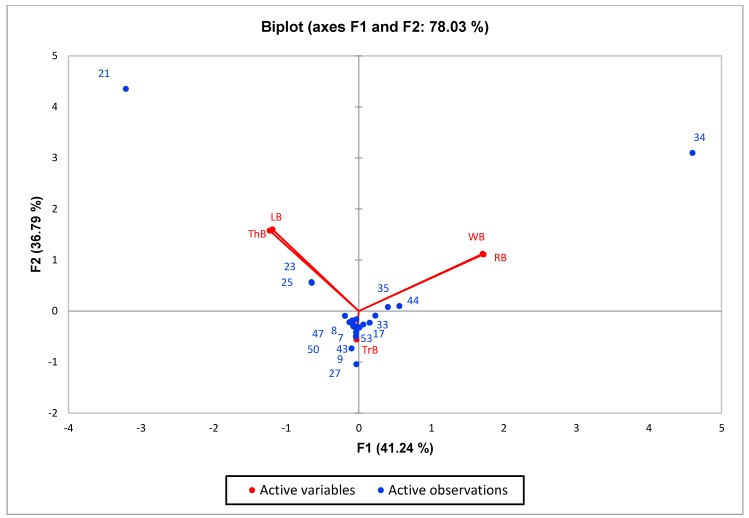
- PCA grouped Thai basil and Lemon basil with estragole, geranial, and neral; white and red Holy basil with methyl eugenol, β-caryophyllene, and α-cubebene; Tree basil did not correlate with the other groups.
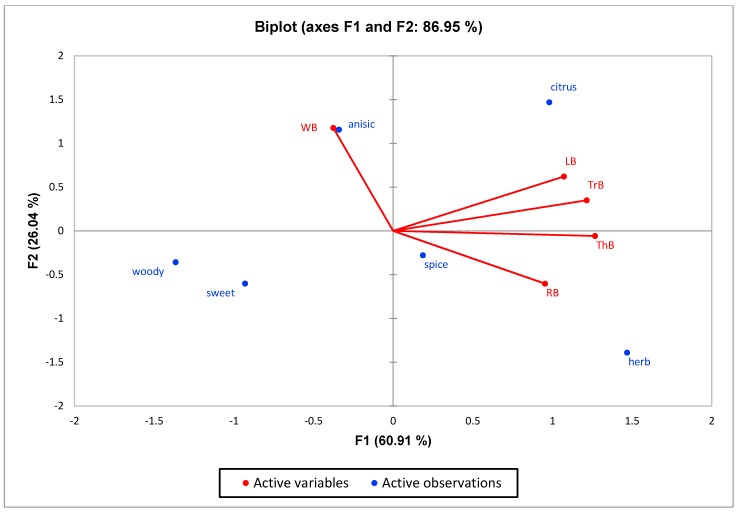
- Sensory scores showed sweet was not significantly different among oils (~2.4–3.4); herb was highest in Tree and Thai basil (~9.0–11.0); woody was highest in white and red Holy basil (~2.2–3.4); anisic dominated Tree basil and white Holy basil (~5.9–7.4); spice was highest in Tree and Thai basil (~6.4–7.3); citrus was highest in Lemon basil (12.8). Panellists differentiated white Holy basil from red Holy basil by anisic intensity.
Methods
- Five *Ocimum* types (white and red Holy basil, Thai basil, Lemon basil, Tree basil) were grown at Mae-Hia Agricultural Training and Research Centre, Chiang Mai University, with 100 plants/type; fresh leaves (~300 g) were hydro-distilled in a 5 L Clevenger apparatus for 2 h at 150 °C, and yields were averaged from three extractions.
- Volatiles were analysed by GC-MS (Bruker-scion 436, Rxi-5Sil MS column), injecting 2 µL of 1% v/v oil in dichloromethane with 0.003% w/v toluene as internal standard in split mode 1:20; compounds were identified by NIST 05.L and NIST 98.L libraries with >70% similarity and confirmed by retention indices.
- Descriptive analysis used five semi-trained panellists (two males, three females, age 25–37) after a 3-day orientation and 12 h training; 200 µL oil on cotton balls was evaluated in triplicate on a 15-point intensity scale, with ANOVA at α = 0.05 and PCA in XLSTAT.
Limitations
- The paper does not state a limitations section. Evident from the text: the sensory panel was very small (five semi-trained panellists), limiting generalizability of the descriptive results.
- Evident from the text: plants were grown at a single site and collected at flowering, so location, season, and phenological variation are not assessed.
- Evident from the methods: volatile quantification was relative to an internal standard, and identification relied on library similarity >70% plus retention indices, without reported external calibration for each compound.
Model-written summary. Check it against the paper before relying on it.
Integrity signals
Registry
Cites
Statistics
Figures
Verification
Claims the paper makes
2 Valid · 0 Not valid · 5 Not checked · 31 Own results and interpretations
A result the paper reports from its own data — it cites no other source for it, so there is none to check. The quote shows it is in the paper.
In the paper
“However, there was no correlation of woody and sweet attributes across the five essential oil types.”
§ Aromatic Profiles of Essential Oils from Five Commonly Used Thai Basils > 3. Results and Discussion > 3.3. Sensory Profile of the Essential Oil
plain- Asserted: passes — The authors put it forward as true.
- Checkable: passes — It can be checked against evidence.
- Load-bearing: unclear — It is unclear whether the paper’s conclusions depend on it.
- Based: passes — The paper gives a reason why it holds.
A result the paper reports from its own data — it cites no other source for it, so there is none to check. The quote shows it is in the paper.
In the paper
“The PCA was able to split aromatic profile of white Holy basil relating with the higher intensity of anisic attribute (Figure 3).”
§ Aromatic Profiles of Essential Oils from Five Commonly Used Thai Basils > 3. Results and Discussion > 3.3. Sensory Profile of the Essential Oil
plainstates an association- Asserted: passes — The authors put it forward as true.
- Checkable: passes — It can be checked against evidence.
- Load-bearing: unclear — It is unclear whether the paper’s conclusions depend on it.
- Based: passes — The paper gives a reason why it holds.
A result the paper reports from its own data — it cites no other source for it, so there is none to check. The quote shows it is in the paper.
In the paper
“Tree basil and Thai basil oils illustrated the highest spice aroma intensity (score ~6.4–7.3).”
§ Aromatic Profiles of Essential Oils from Five Commonly Used Thai Basils > 3. Results and Discussion > 3.3. Sensory Profile of the Essential Oil
plain- Asserted: passes — The authors put it forward as true.
- Checkable: passes — It can be checked against evidence.
- Load-bearing: unclear — It is unclear whether the paper’s conclusions depend on it.
- Based: passes — The paper gives a reason why it holds.
A result the paper reports from its own data — it cites no other source for it, so there is none to check. The quote shows it is in the paper.
In the paper
“while the Tree basil and white Holy basil dominated anisic attribute (score ~5.9–7.4).”
§ Aromatic Profiles of Essential Oils from Five Commonly Used Thai Basils > 3. Results and Discussion > 3.3. Sensory Profile of the Essential Oil
plainstates an association- Asserted: passes — The authors put it forward as true.
- Checkable: passes — It can be checked against evidence.
- Load-bearing: unclear — It is unclear whether the paper’s conclusions depend on it.
- Based: passes — The paper gives a reason why it holds.
A result the paper reports from its own data — it cites no other source for it, so there is none to check. The quote shows it is in the paper.
In the paper
“Estragole, eugenol, and methyl eugenol were among the major volatiles found in the essential oils of these basil types.”
- Also stated in: § 4. Conclusions · boosted
“From this research, we conclude that the major components of essential oils from the five types of basils used as food ingredients in Thailand are estragole, eugenol, and methyl eugenol.”
§ Aromatic Profiles of Essential Oils from Five Commonly Used Thai Basils > Abstract
boosted- Asserted: passes — The authors put it forward as true.
- Checkable: passes — It can be checked against evidence.
- Load-bearing: passes — The paper’s conclusions depend on it.
- Based: passes — The paper gives a reason why it holds.
- Also stated in: § 4. Conclusions · boosted
15 more claims
Create a free account to see all 38 claims and every source verdict.
- Probably not a substantial claim. 12
- It may state two separate claims as one. 9
- The quote only partly states this claim. 1
Claims other papers make about this one
Each is checked against this paper’s own text: does it say what the citing paper says it does?
The source backs part of the claim, not all of it — or backs it for a different population, condition or comparison.
In the citing paper
“Principal Component Analysis (PCA) and Hierarchical Clustering Analysis (HCA) are valuable statistical techniques employed to derive insights from intricate datasets, particularly when managing a substantial number of variables, such as the volatile compounds present in Ocimum oils [29] .”
From Untargeted metabolomics and targeted approach of essential oils to differentiate five Ocimum species using gas chromatography coupled with mass spectrometry (2024) · cites this paper as [29]
Experimental — accuracy not yet measured
Self-check
Percentages, sums and reported differences re-computed from the paper’s own numbers.
Each contradiction between two passages listed here was confirmed by an independent check.
Rated minor: it would not touch a result — a value no result rests on, a p-value that stays on the same side of the significance level, or a conflict that is clerical, resolved elsewhere in the paper, or outside its own findings.
In the paper
§ Aromatic Profiles of Essential Oils from Five Commonly Used Thai Basils > 3. Results and Discussion > 3.1. Plant Identification and Physiochemical Characteristics of the Essential Oils
“White Holy basil (O. sanctum var. Rama) and Thai basil (O. basilicum var. thyrsiflorum) illustrated maximum yield ~0.4%, Lemon basil (O. citriodorum) and red Holy basil (O. sanctum var. Shyama) yielded the essential oil of ~0.33%.”
§ Aromatic Profiles of Essential Oils from Five Commonly Used Thai Basils > 2. Materials and Methods > 2.1. Plant Material
“O. sanctum var. Rama (red), O. sanctum var. Shyama (white)”
Citations
Cites
Stability of Essential Oils: A Review
Turek, C., & Stintzing, F. C. (2013) · Comprehensive Reviews in Food Science and Food Safety · doi:10.1111/1541-4337.12006 · Cited by 1,315
Comprehensive Reviews Food Science and food Safety
(2003) · Journal of Food Science · doi:10.1111/j.1365-2621.2003.tb05778.x · Cited by 925
Journal of Plant Nutrition and Soil Science
(2006) · Journal of Plant Nutrition and Soil Science · doi:10.1002/(issn)1522-2624 · Cited by 744
Basil: A Source of Aroma Compounds and a Popular Culinary and Ornamental Herb*
Simon, J. E., Morales, M. R., Phippen, W. B., Vieira, R. F., & Hao, Z. (1999) · Cited by 340
ANALYSIS OF THE ESSENTIAL OILS OF TWO CULTIVATED BASIL (OCIMUM BASILICUM L.) FROM IRAN
Sajjadi, S. E. (2006) · DARU Journal of Pharmaceutical Sciences · Cited by 315
Chemistry and bioactivities of essential oils of some Ocimum species: an overview
Pandey, A. K., Singh, P., & Tripathi, N. N. (2014) · Asian Pacific Journal of Tropical Biomedicine · doi:10.12980/apjtb.4.2014c77 · Cited by 296
Kwee, E. M., & Niemeyer, E. D. (2011) · Food Chemistry · doi:10.1016/j.foodchem.2011.04.011 · Cited by 275
A review on phytochemical and pharmacological properties of holy basil (Ocimum sanctum L.)
Singh, D., & Chaudhuri, P. K. (2018) · Industrial Crops and Products · doi:10.1016/j.indcrop.2018.03.048 · Cited by 218 · cited 1×
“plants are estragole (methyl chavicol), eugenol, and methyl eugenol [11,32,33].”
BackgroundThe antioxidative properties of holy basil and galangal in cooked ground pork
Juntachote, T., Berghofer, E., Siebenhandl, S., & Bauer, F. (2006) · Meat Science · doi:10.1016/j.meatsci.2005.08.009 · Cited by 199 · cited 1×
“gratissimum) are frequently cultivated in several countries of South and South-East Asia including Thailand as culinary herbs [3,4].”
BackgroundAvetisyan, A., Markosian, A., Petrosyan, M., Sahakyan, N., Babayan, A., Aloyan, S., & Trchounian, A. (2017) · BMC Complementary and Alternative Medicine · doi:10.1186/s12906-017-1587-5 · Cited by 186
Essential oil composition of Ocimum basilicum L. and Ocimum minimum L. in Turkey
Özcan, M., & Chalchat, J.-C. (2002) · Czech Journal of Food Sciences · doi:10.17221/3536-cjfs · Cited by 166
Beilstein Journal of Organic Chemistry
Clayden, J. (2005) · Beilstein Journal of Organic Chemistry · doi:10.1186/1860-5397-1-1 · Cited by 156
A phytopharmacological overview on Ocimum species with special emphasis on Ocimum sanctum
Mahajan, N., Rawal, S., Verma, M., Poddar, M., & Alok, S. (2013) · Biomedicine & Preventive Nutrition · doi:10.1016/j.bionut.2012.08.002 · Cited by 148 · cited 2×
“These herbaceous plants are of annual type, usually propagated through seeds [4].”
BackgroundVolatile composition of sweet basil essential oil (Ocimum basilicum L.) as affected by drying method
Calín-Sánchez, Á., Lech, K., Szumny, A., Figiel, A., & Carbonell-Barrachina, Á. A. (2012) · Food Research International · doi:10.1016/j.foodres.2012.03.015 · Cited by 146 · cited 2×
“[53] evaluated the same attributes that are herbaceous (herb), spice, woody, and sweet.”
BackgroundDevelopment of a “living” lexicon for descriptive sensory analysis of brewed coffee
Chambers, E., Sanchez, K., Phan, U. X. T., Miller, R., Civille, G. V., & Di Donfrancesco, B. (2016) · Journal of Sensory Studies · doi:10.1111/joss.12237 · Cited by 137 · cited 1×
“5 g 8/15 [22] Sweet vanilla flavour (McCormick), 200 μL 10/15 [23] Woody peanut peel 2 g with 100 μL DI water 7/15 *”
A LEXICON FOR FLAVOR DESCRIPTIVE ANALYSIS OF GREEN TEA
LEE, J., & CHAMBERS, D. H. (2007) · Journal of Sensory Studies · doi:10.1111/j.1745-459x.2007.00105.x · Cited by 124 · cited 1×
“Anise anise powder, 2 g 10/15 * Citrus lemon extract (McCormick), 200 μL 8/15 [21] Herb thyme (McCormick), 0.”
BackgroundMondello, L., Zappia, G., Cotroneo, A., Bonaccorsi, I., Chowdhury, J. U., Yusuf, M., & Dugo, G. (2002) · Flavour and Fragrance Journal · doi:10.1002/ffj.1108 · Cited by 108
Zouari, N., Ayadi, I., Fakhfakh, N., Rebai, A., & Zouari, S. (2012) · Lipids in Health and Disease · doi:10.1186/1476-511x-11-28 · Cited by 101 · cited 1×
“In other plants, the factors being geographical differences and phenological stages of raw materials, such as in Thymus algeriensis [49] and Hypericum spp.”
BackgroundChowdhury, T., Mandal, A., Roy, S. C., & De Sarker, D. (2017) · Journal of Genetic Engineering and Biotechnology · doi:10.1016/j.jgeb.2016.12.004 · Cited by 95 · cited 1×
“The genus of Ocimum comprises of more than 65 species and is the biggest genera in Lamiaceae family worldwide [24].”
BackgroundWandersleben, T., Morales, E., Burgos‐Díaz, C., Barahona, T., Labra, E., Rubilar, M., & Salvo-Garrido, H. (2018) · LWT · doi:10.1016/j.lwt.2018.01.029 · Cited by 90 · cited 2×
“Essential oil, as well as any other plant based natural ingredients, have been the beneficiary of legal, regulatory, and consumer preference as the result of a shared opinion on food safety [6,7].”
BackgroundRajabi, Z., Ebrahimi, M., Farajpour, M., Mirza, M., & Ramshini, H. (2014) · Industrial Crops and Products · doi:10.1016/j.indcrop.2014.06.038 · Cited by 83 · cited 1×
“There was also some chemical variability of the essential oil of plants belonging to the Lamiacea family but within the same species, the major constituents can be similar [47,48].”
BackgroundAntimicrobial activities of some Ocimum species grown in rwanda
Janssen, A. M., Scheffer, J. J. C., Ntezurubanza, L., & Svendsen, A. B. (1989) · Journal of Ethnopharmacology · doi:10.1016/0378-8741(89)90113-x · Cited by 82
Muráriková, A., Ťažký, A., Neugebauerová, J., Planková, A., Jampílek, J., Mučaji, P., & Mikuš, P. (2017) · Molecules · doi:10.3390/molecules22071221 · Cited by 82 · cited 1×
“[12] described that variation in the qualitative and quantitative chemical profiles of the basil essential oil may be due to the variety of plant and their growing conditions such as season, climate or soil conditions.”
BackgroundPatel, R. P., Singh, R., Rao, B. R. R., Singh, R. R., Srivastava, A., & Lal, R. K. (2016) · Industrial Crops and Products · doi:10.1016/j.indcrop.2016.04.001 · Cited by 67 · cited 1×
“They are collectively known as the “basils” which are in commercial demand for their nutritional, aromatic, ornamental, culinary, religious, and medicinal importance [2].”
BackgroundDighe, V. V., Gursale, A. A., Sane, R. T., Menon, S., & Patel, P. H. (2005) · Chromatographia · doi:10.1365/s10337-005-0527-6 · Cited by 55 · cited 1×
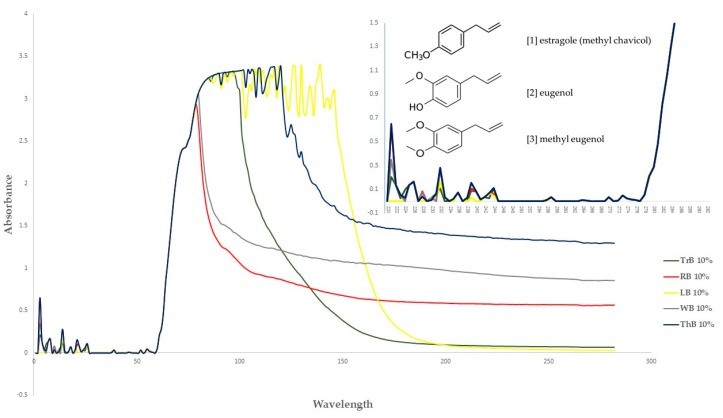
“[34] advised that UV spectrum of eugenol gave the maximum absorption at 220–230 nm and a smaller peak at 278 nm which agree with our results.”
ResultSilva, M. G. D. V., Matos, F. J. D. A., Lopes, P. R. O., Silva, F. O., & Holanda, M. T. (2004) · Arkivoc · doi:10.3998/ark.5550190.0005.609 · Cited by 54
Sensory Evaluation: Sensory Rating and Scoring Methods
Pimentel, T. C., da Cruz, A. G., & Deliza, R. (2015) · Elsevier eBooks · doi:10.1016/b978-0-12-384947-2.00617-6 · Cited by 54 · cited 1×
“They then evaluated the intensity of the given attributes in triplicates on the 15-point interval scale (0 = none, 15 = extra strong) [20].”
BackgroundSiddique, A. B., Rahman, S. M., & Hossain, M. A. (2012) · Arabian Journal of Chemistry · doi:10.1016/j.arabjc.2012.01.004 · Cited by 53 · cited 2×
“[27] suggest d that the chemical compositions of essential oil depend largely on its colour.”
Backgroundde Lira, C. S., Pontual, E. V., de Albuquerque, L. P., Paiva, L. M., Paiva, P. M. G., de Oliveira, J. V., Napoleão, T. H., & Navarro, D. M. D. A. F. (2015) · Crop Protection · doi:10.1016/j.cropro.2015.02.004 · Cited by 50
Yield and Composition of Ocimum basilicum L. and Ocimum sanctum L. Grown at Four Locations
Zheljazkov, V. D., Cantrell, C. L., Evans, W. B., Ebelhar, M. W., & Coker, C. (2008) · HortScience · doi:10.21273/hortsci.43.3.737 · Cited by 50 · cited 1×
“sanctum comprised a higher content of chavicol, eugenol, and eucalyptol [14].”
BackgroundXiao, Z., Chen, J., Niu, Y., & Chen, F. (2017) · Journal of Chromatography B · doi:10.1016/j.jchromb.2017.07.053 · Cited by 50 · cited 1×
“The second cluster was of the white Holy basil and red Holy basil group with methyl eugenol, β-caryophyllene, and α-cubebene (herb and spice) as distinctive compounds [52].”
BackgroundAntimicrobial and antioxidation effects of Thai seasoning, Tom-Yum
Siripongvutikorn, S., Thummaratwasik, P., & Huang, Y. (2004) · LWT · doi:10.1016/j.lwt.2004.06.006 · Cited by 49 · cited 1×
“Therefore, food researchers are focusing on the search for natural products that could replace chemically synthetised food additives [5,6].”
BackgroundEssential oil yield and composition of Lamiaceae species growing in southern Brazil
Agostini, F., Santos, A. C. A. D., Rossato, M., Pansera, M. R., Santos, P. L. D., Serafini, L. A., Molon, R., & Moyna, P. (2009) · Brazilian Archives of Biology and Technology · doi:10.1590/s1516-89132009000200026 · Cited by 47 · cited 1×
“There was also some chemical variability of the essential oil of plants belonging to the Lamiacea family but within the same species, the major constituents can be similar [47,48].”
BackgroundHadaruga, D. I., Hadaruga, N. G., Megyesi, C. I., David, I., & Lukinich-Gruia, A. T. (2014) · Beilstein Journal of Organic Chemistry · doi:10.3762/bjoc.10.298 · Cited by 43
The relationship between growth stages and aroma composition of lemon basil Ocimum citriodorum vis
Al-Kateb, H., & Mottram, D. S. (2014) · Food Chemistry · doi:10.1016/j.foodchem.2013.12.001 · Cited by 42 · cited 4×
“This is consistent with the previous research by Al-Kateb and Mottram [54] who studied the relationship between growth stages and volatile compositions of Lemon basil (O. citriodorum Vis.).”
BackgroundResultInfluentialLedeker, C. N., Suwonsichon, S., Chambers, D. H., & Adhikari, K. (2013) · LWT · doi:10.1016/j.lwt.2013.11.011 · Cited by 40 · cited 1×
“5 g 8/15 [22] Sweet vanilla flavour (McCormick), 200 μL 10/15 [23] Woody peanut peel 2 g with 100 μL DI water 7/15 *”
Tarchoune, I., Baâtour, O., Harrathi, J., Cioni, P. L., Lachaâl, M., Flamini, G., & Ouerghi, Z. (2013) · Journal of Plant Nutrition and Soil Science · doi:10.1002/jpln.201200278 · Cited by 36
Verma, R. S., Bisht, P. S., Padalia, R. C., Saikia, D., & Chauhan, A. (2011) · 亚洲传统医药 · Cited by 31
Jofré Barud, F., López, S., Tapia, A., Feresin, G. E., & López, M. L. (2014) · Industrial Crops and Products · doi:10.1016/j.indcrop.2014.08.045 · Cited by 30
Joshi, R. K., & Hoti, S. L. (2014) · Plant Science Today · doi:10.14719/pst.2014.1.3.52 · Cited by 27 · cited 1×
“Joshi and Si [46] and Murarikova et al.”
BackgroundAwasthi, P. K., & Dixit, S. C. (2007) · Journal of Essential Oil Bearing Plants · doi:10.1080/0972060x.2007.10643557 · Cited by 24
Jordán, M. J., Quílez, M., Luna, M. C., Bekhradi, F., Sotomayor, J. A., Sánchez-Gómez, P., & Gil, M. I. (2016) · Food Chemistry · doi:10.1016/j.foodchem.2016.10.059 · Cited by 24
Sims, C. A. (2014) · ScholarWorks@UMassAmherst (University of Massachusetts Amherst) · doi:10.7275/r5p26w1x · Cited by 21
Characterisation of the odour volatiles in Citrus aurantifolia persa lime oil from Vietnam
Lan Phi, N. T., Minh Tu, N. T., Nishiyama, C., & Sawamura, M. (2006) · Developments in food science · doi:10.1016/s0167-4501(06)80046-4 · Cited by 21 · cited 1×
“, estragole, geranial, and neral) which represent anise, lime-like, and fresh aroma [51].”
BackgroundBernhardt, B., Sipos, L., Kókai, Z., Gere, A., Szabó, K., Bernáth, J., & Sárosi, S. (2015) · Industrial Crops and Products · doi:10.1016/j.indcrop.2015.01.013 · Cited by 20 · cited 2×
“The compounds were confirmed by their RI as well as those from the literature [11].”
BackgroundZoghbi, M. D. G. B., Oliveira, J., Andrade, E. H. A., Trigo, J. R., Fonseca, R. C. M., & Rocha, A. E. S. (2007) · Journal of Essential Oil Bearing Plants · doi:10.1080/0972060x.2007.10643547 · Cited by 19
Ibrar, M. (2012) · Cited by 19
Bağcı, E., & Bekçi, F. (2010) · Acta Botanica Gallica · doi:10.1080/12538078.2010.10516202 · Cited by 13
Our unrequited love for natural ingredients
Burdock, G. A., & Wang, W. (2017) · Food and Chemical Toxicology · doi:10.1016/j.fct.2017.06.006 · Cited by 13 · cited 1×
“Essential oil, as well as any other plant based natural ingredients, have been the beneficiary of legal, regulatory, and consumer preference as the result of a shared opinion on food safety [6,7].”
BackgroundTaraj, K., Delibashi, A., Andoni, A., et al. (2013) · Asian Journal of Chemistry · doi:10.14233/ajchem.2013.14642 · Cited by 13
MORPHO-CHEMICAL DESCRIPTION AND ANTIMICROBIAL ACTIVITY OF DIFFERENT OCIMUM SPECIES
Kakaraparthi, P. S., Kumar, R. R., Kumar, A. N., Gogte, S., & Elizabeth, M. (2012) · DOAJ (DOAJ: Directory of Open Access Journals) · Cited by 12
HPTLC methods for qualitative and quantitative analysis of selected furocoumarins in essential oils
Borgne, E. L., Cicchetti, E., & Bertrand, T. (2017) · Flavour and Fragrance Journal · doi:10.1002/ffj.3394 · Cited by 11
Morphological Variability and Essential Oil Composition of four Ocimum basilicum L. cultivars
Nurzyñska-Wierdak, R. (2014) · Journal of Essential Oil Bearing Plants · doi:10.1080/0972060x.2013.855362 · Cited by 9
Research works printed but not linked: 3
- Beltramea J.M. Angnesa R.A. Chiavellib L.U.R. Costab W.F.d. Rosac M.F.d. Loboa V.d.S. Pominib A.M. Photodegradation of essential oil from marjoram (Origanum majorana L.) studied by GC-MS and UV-Vis spectroscopy Rev. Latinoam. Quím. 2013 41 81 88
- Mondawi B. Duprey R. Magboul A. Satti A. Constituents of essential oil of Ocimum basilicum var. Thyrsiflorum Fitoterapia 1984 55 60 61
- Khatri L. Nasir M. Saleem R. Noor F. Evaluation of pakistani sweet basil oil for commercial exploitation Pak. J. Sci. Ind. Res. 1995 38 281 282
Cited by
Sommano, S. R., Chittasupho, C., Ruksiriwanich, W., & Jantrawut, P. (2020) · Molecules · doi:10.3390/molecules25245792 · Cited by 192
Self-citationLin, L.-Y., Chuang, C., Chen, H., & Yang, K. (2019) · Foods · doi:10.3390/foods8090398 · Cited by 126
Melo, R. S., Albuquerque Azevedo, Á. M., Gomes Pereira, A. M., Rocha, R. R., Bastos Cavalcante, R. M., Carneiro Matos, M. N., Ribeiro Lopes, P. H., Gomes, G. A., Soares Rodrigues, T. H., Santos, H. S. D., et al. (2019) · Molecules · doi:10.3390/molecules24213864 · Cited by 106
Majdi, C., Pereira, C., Dias, M. I., Calhelha, R. C., Alves, M. J., Rhourri-Frih, B., Charrouf, Z., Barros, L., Amaral, J. S., & Ferreira, I. C. F. R. (2020) · Antioxidants · doi:10.3390/antiox9050369 · Cited by 88
Rizvi, A., Ahmed, B., Khan, M. S., EL-BELTAGI, H. S., Umar, S., & Lee, J. (2022) · Molecules · doi:10.3390/molecules27041407 · Cited by 94
Metadata
- Authors
- Tangpao, T., Chung, H.-H., & Sommano, S. R.
- Affiliations
- Chiang Mai University (TH)
- National Ilan University (TW)
- Corresponding author
- Sommano, Sarana Rose
- Venue
- Foods
- Publisher
- MDPI AG
- Published
- 2018-10-24
- Volume
- 7
- Issue
- 11
- Pages
- 175
- ISSN
- 2304-8158 (ISSN-L)
- PMC
- PMC6262289
- OpenAlex
- W2898351857
- Cited by
- 87
- References
- 55
- Citations by year
- 2026: 5 · 2025: 10 · 2024: 4 · 2023: 14 · 2022: 16 · 2021: 19 · 2020: 13 · 2019: 5 · 2018: 1
- FWCI
- 8.92
- Type
- journal article
- Language
- en
- Open access
- gold
- doi.org
- Licence
- Locations
- Foods (publishedVersion, cc-by)
- Preprints.org (acceptedVersion, cc-by)
- Europe PMC (PubMed Central) (publishedVersion, cc-by)
- PubMed Central (publishedVersion, cc-by)
- PubMed (publishedVersion)
- DOAJ (DOAJ: Directory of Open Access Journals) (submittedVersion)
- Funders
- Thai Research Fund (TRF) (602205)
- Topics
- Life Sciences › Agricultural and Biological Sciences › Food Science › Essential Oils and Antimicrobial Activity
- Physical Sciences › Chemistry › Organic Chemistry › Edible Oils Quality and Analysis
- Health Sciences › Medicine › Complementary and alternative medicine › Phytochemicals and Medicinal Plants
- Keywords
- basil essential oil, Ocimum, Ocimum sanctum, lemon basil, volatile composition, aroma profile, estragole, eugenol, methyl eugenol, sensory evaluation, citrus aroma, food raw materials
About these checks
Registry, retraction, Cites and statistics results are computed, not judged, with one exception: a printed reference that no index lists is read once by a model before it counts as a citation error. Claims are extracted by a model and kept only when their quote appears verbatim in the text; each cited source is then checked, with a model’s help, for whether it says what the claim relies on. Those verdicts can be wrong — read the claim’s quote and the cited source before relying on one.
The claim verdicts this report counts are experimental: their accuracy is not yet measured.
A language model drew the claims from the paper on 2026-10-10, under version 3 of the claim definition (model deepseek-v4.1-flash, prompt extract-v3).
A second model labelled each claim on 2026-10-10 (model jev-1.13-20260917, definition revision gold-guideline-v0.2).
Statistics and arithmetic are recomputed, not judged.
Confidence bands are shown only for fields calibrated on our annotated test set. None is calibrated yet, so no band is shown.
What counts as a claim ›How we measure confidence ›How we check this ›
Are you an author, or do you see a problem with this page? Request a review
Data sources
Bibliographic data: Semantic Scholar, OpenAlex, Crossref.
Contains information from the Semantic Scholar Academic Graph Datasets, made available under the ODC Attribution License (ODC-BY 1.0).
Semantic Scholar’s data is described in: Kinney, R., et al. (2023). The Semantic Scholar Open Data Platform. arXiv:2301.10140.
