

The DOI matches its Crossref record; 116 of the 120 references it cites were found in a registry or an index.
The Impact of the COVID-19 Pandemic on Burnout, Compassion Fatigue, and Compassion Satisfaction in Healthcare Personnel: A Systematic Review of the Literature Published during the First Year of the Pandemic
Open accessAbstract
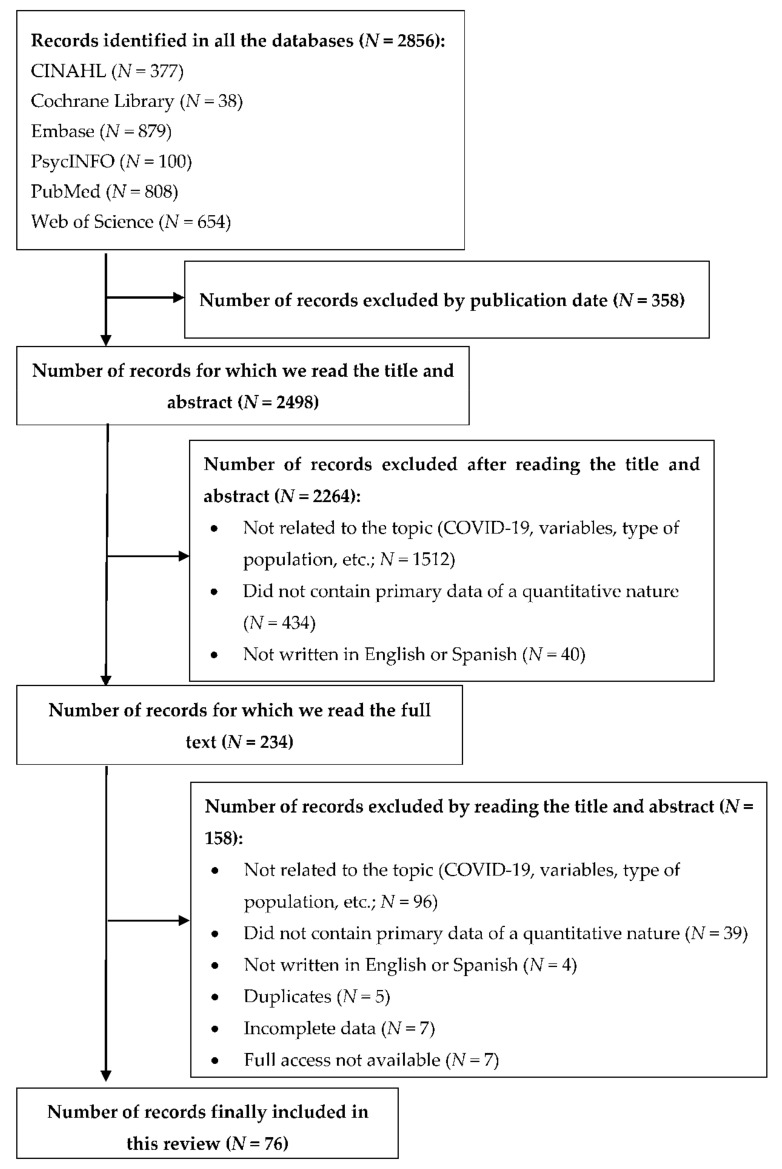
This literature review aimed to determine the level of burnout, compassion fatigue, and compassion satisfaction, as well as their associated risks and protective factors, in healthcare professionals during the first year of the COVID-19 pandemic. We reviewed 2858 records obtained from the CINAHL, Cochrane Library, Embase, PsycINFO, PubMed, and Web of Science databases, and finally included 76 in this review. The main results we found showed an increase in the rate of burnout, dimensions of emotional exhaustion, depersonalization, and compassion fatigue; a reduction in personal accomplishment; and levels of compassion satisfaction similar to those before the pandemic. The main risk factors associated with burnout were anxiety, depression, and insomnia, along with some sociodemographic variables such as being a woman or a nurse or working directly with COVID-19 patients. Comparable results were found for compassion fatigue, but information regarding compassion satisfaction was lacking. The main protective factors were resilience and social support.
Overview
The claims and statistics of this paper haven’t been checked yet.
Run the check — free, no account needed. It reads the open-access text and checks the sources it cites.
Integrity signals
Registry
Cites
Statistics
Figures
Verification
Claims the paper makes
The claims and statistics of this paper haven’t been checked yet.
Run the check — free, no account needed. It reads the open-access text and checks the sources it cites.
Claims other papers make about this one
Each is checked against this paper’s own text: does it say what the citing paper says it does?
The source backs part of the claim, not all of it — or backs it for a different population, condition or comparison.
In the citing paper
“This burden appears to have peaked during the most demanding periods of the COVID-19 pandemic”
From What do we really know about addressing burnout among healthcare workers? Maybe less than we think (2026) · cites this paper as [7]
Experimental — accuracy not yet measuredThe cited source says what the claim attributes to it.
In the citing paper
“although burnout in the healthcare field was already a long-standing issue before the pandemic.6,7”
From What do we really know about addressing burnout among healthcare workers? Maybe less than we think (2026) · cites this paper as [7]
The cited source says what the claim attributes to it.
In the citing paper
“A systematic review of research published in the first year of the pandemic found evidence for increased levels of burnout, emotional exhaustion, depersonalization and compassion fatigue among health care workers, with nurses, women and those working directly with COVID‐19 patients most impacted.”
From 2024 Alzheimer's disease facts and figures (2024) · cites this paper as [820]
Self-check
Percentages, sums and reported differences re-computed from the paper’s own numbers.
The self-check needs the paper’s full text.
Citations
Cites
1 retracted
Panagioti, M., Geraghty, K., Johnson, J., Zhou, A. Y., Panagopoulou, E. P., Chew-Graham, C. A., Peters, D. H., Hodkinson, A., Riley, R. A., & Esmail, A. (2018) · JAMA Internal Medicine · doi:10.1001/jamainternmed.2018.3713 · Cited by 1,059
RetractedPRISMA-P Group, Moher, D., Shamseer, L., Clarke, M., Ghersi, D., Liberati, A., Petticrew, M., Shekelle, P., & Stewart, L. A. (2015) · Systematic Reviews · doi:10.1186/2046-4053-4-1 · Cited by 26,223 · cited 2×
“Although several systematic reviews have recently been published on the impact of the COVID-19 pandemic on the mental health of healthcare professionals [4,30,31], very few of them specifically included dimensions of professional quality of life such as burnout [32–35], only one considered indirect trauma [36] and, to…”
BackgroundFreudenberger, H. J. (1974) · Journal of Social Issues · doi:10.1111/j.1540-4560.1974.tb00706.x · Cited by 5,463
Mental health and the COVID-19 pandemic
Pfefferbaum, B., & North, C. S. (2020) · New England Journal of Medicine · doi:10.1056/nejmp2008017 · Cited by 4,378 · cited 1×
“Among several potentially harmful factors for the health of professionals, some authors have highlighted the lack of access to adequate protective equipment [1], exhaustion resulting from wearing personal protective equipment throughout the working day, the feeling of having inadequate support [2,3], long working hour…”
BackgroundCOVID-19 and mental health: A review of the existing literature
Rajkumar, R. P. (2020) · Asian Journal of Psychiatry · doi:10.1016/j.ajp.2020.102066 · Cited by 3,574 · cited 2×
“Among several potentially harmful factors for the health of professionals, some authors have highlighted the lack of access to adequate protective equipment [1], exhaustion resulting from wearing personal protective equipment throughout the working day, the feeling of having inadequate support [2,3], long working hour…”
BackgroundPrevalence of Burnout Among Physicians: A Systematic Review
Rotenstein, L. S., Torre, M., Ramos, M. A., Rosales, R. C., Guille, C., Sen, S., & Mata, D. A. (2018) · JAMA · doi:10.1001/jama.2018.12777 · Cited by 1,904 · cited 2×
“However, for certain professional profiles such as healthcare professionals in the oncology area, elevated levels of emotional exhaustion and depersonalization had already been identified prior to the pandemic [116].”
BackgroundHealthcare staff wellbeing, burnout, and patient safety: a systematic review
Hall, L. H., Johnson, J., Watt, I., Tsipa, A., & O’Connor, D. B. (2016) · PLOS ONE · doi:10.1371/journal.pone.0159015 · Cited by 1,683 · cited 2×
“Indeed, the first two risk factors have already been recorded elsewhere in the literature [111,119].”
BackgroundResultCompassion fatigue: Psychotherapists’ chronic lack of self care.
Figley, C. R. (2002) · Journal of Clinical Psychology · doi:10.1002/jclp.10090 · Cited by 1,614
Li, Z., Ge, J., Yang, M., Feng, J., Qiao, M., Jiang, R., Bi, J., Zhan, G., Xu, X., Wang, L., et al. (2020) · Brain Behavior and Immunity · doi:10.1016/j.bbi.2020.03.007 · Cited by 1,223 · cited 4×
“Some studies indicated high scores as a consequence of the pandemic on the personal accomplishment subscale [75,78], although these were lower in other studies [7,39,52,60,84].”
BackgroundResultInfluentialHu, D., Kong, Y., Li, W., Han, Q., Zhang, X., Zhu, L. X., Wan, S. W., Liu, Z., Shen, Q., Yang, J., et al. (2020) · EClinicalMedicine · doi:10.1016/j.eclinm.2020.100424 · Cited by 936 · cited 2×
“Hu et al. (2020) [70] To assess mental health (burnout, anxiety, depression, and fear) and its associated factors among frontline nurses caring for COVID-19 patients in Wuhan, China.”
Background
Research works printed but not linked: 1
- Figley, C.R. (1995). Compassion Fatigue: Coping with Secondary Traumatic Stress Disorder in Those Who Treat the Traumatized, Routledge.
Cited by
Sorted by citations
Items 201–281 of 281
Tambun, M. S. M. O. S. S., Tumanggor, A. H. U., & Rizali, M. (2022) · Journal of Industrial Engineering and Operation Management · doi:10.31602/jieom.v5i2.7907 · Cited by 1
Community or commodity? Perceived nurse support during the COVID-19 pandemic
Christianson, J., McCarthy, M., Sommers-Olson, B., Guttormson, J., & Johnson, N. L. (2023) · Nursing Management · doi:10.1097/nmg.0000000000000079 · Cited by 2
Leinwand, J. G., & Vale, G. L. (2023) · Journal of Zoological and Botanical Gardens · doi:10.3390/jzbg5010001 · Cited by 2
Has the COVID-19 Pandemic Affected the Compassion Competence of Midwifery Students?
Şahin, S. A., & Öztürk, S. (2024) · KTO Karatay Üniversitesi Sağlık Bilimleri Dergisi · doi:10.59244/ktokusbd.1401457 · Cited by 1
Substance Use Disorders and Addiction in the Emergency Care Setting
Peta, D. (2024) · Journal of Emergency Nursing · doi:10.1016/j.jen.2023.10.008 · Cited by 1
Hu, Y.-L., Ching, G. S., Chao, P.-C., Castillo, F. A. D., Gungon, J. L., Trajera, S. M., Roberts, A., & Zuo, Y. (2024) · Communications in computer and information science · doi:10.1007/978-3-031-61678-5_20 · Cited by 1
Chao, P.-C., Wen, T.-H., Ching, G. S., Roberts, A., & Zuo, Y. (2024) · Communications in computer and information science · doi:10.1007/978-3-031-61678-5_15 · Cited by 1
Bacon, E., Thiessen, M. E. W., Vogel, J. A., Whitfield, J., Cervantes, L., & Podewils, L. J. (2024) · Journal of Emergency Medicine · doi:10.1016/j.jemermed.2024.06.004 · Cited by 1
The COVID-19 pandemic and the occupational overload of health professionals: Indicators of burnout
Silveira, I. L. M., Osório, F. D. L., & Loureiro, S. R. (2024) · Elsevier eBooks · doi:10.1016/b978-0-323-95650-5.00022-7 · Cited by 1
Belin, B. R., Aron, I., Bhagat, S., Fornari, A. B., & Ahuja, T. K. (2024) · Journal of Patient Experience · doi:10.1177/23743735241272167 · Cited by 1
Antão, H. S., Sacadura‐Leite, E., Aguiar, P. M. V., Góis, C., Marques, J., Pombo›, S., & Figueira, M. L. (2024) · Frontiers in Psychiatry · doi:10.3389/fpsyt.2024.1425792 · Cited by 1
Cheong, D., Chróinín, D. N., Chiang, L., & Rolls, K. (2025) · Australian Journal on Ageing · doi:10.1111/ajag.13412 · Cited by 1
“…in studies of hospital staff caring for COVID-19 patients, which found that the pandemic circumstances created higher levels of depersonalisation and compassion fatigue, 35 and the requirement for PPE impeded the ability to express the body language and facial expressions that create empathy.”
Singh, S., Polavarapu, M., & Arsene, C. (2025) · Medical Science Educator · doi:10.1007/s40670-025-02354-3 · Cited by 3
“It is described as a sense of fulfillment that comes from the joy of helping others by addressing their needs during stressful events [6].”
Galiana, L., Sánchez‐Ruiz, J., Vidal‐Blanco, G., & Sansó, N. (2025) · Nursing and Health Sciences · doi:10.1111/nhs.70173 · Cited by 1
“Regarding results of professional quality of life, women showed greater levels, which somehow contradicts previous literature as men have traditionally displayed higher levels (Lluch et al. 2022; Hall et al. 2016; Rotenstein et al. 2018; Mooney et al. 2017).”
Self-citation2022 Report: Student Affiliates of Seventeen (SAS)
Rhames, A., Troyka, M., & Taylor, K. (2022) · The Counseling Psychologist · doi:10.1177/00110000221118373 · Cited by 1
“…practitioners experienced more burnout, compassion fatigue, and vicarious traumatization as a result of working during the pandemic, with trainees, younger clinicians, and those with less experience being more vulnerable (Aafjes-Van Doorn et al., 2020; Lluch et al., 2022; Schneider et al., 2021).”
BackgroundSalameh, N. (2022) · Psychotherapy and Counselling Journal of Australia · doi:10.59158/001c.71210 · Cited by 1
Impact of COVID-19 Pandemic on Vocational Well-Being of Women in Counseling Psychology
Alshabani, N., Wolfe, G. L., Burke, K. A., Keramidas, N. L., & Gregor, M. A. (2023) · Journal of Mental Health Counseling · doi:10.17744/mehc.45.3.02 · Cited by 1
Hoover, J. (2023) · Cambridge Prisms Global Mental Health · doi:10.1017/gmh.2023.30.pr1 · Cited by 1
What do we really know about addressing burnout among healthcare workers? Maybe less than we think
Goetzel, R. Z., Fazen, L. E., Kent, K. B., Roemer, E. C., & Saldanha, I. J. (2026) · Health affairs scholar · doi:10.1093/haschl/qxag041
“6,7 The potential impacts of burnout are substantial.”
Sam, S. R., Diabet, O., Villa, B., Philipose, J., & Babu, S. M. (2023) · Eastern Journal of Healthcare · doi:10.31557/ejhc.2023.3.1.1-7
COVID-19 AND BURNOUT IN HEALTHCARE PROFESSIONALS
Antunes, J. L. F. (2022) · Psicologia Saúde & Doenças · doi:10.15309/22psd230301
Sheykhangafshe, F. B., Fathi-Ashtiani, A., Niri, V. S., Asef, Z. N., & Bourbour, Z. (2023) · مجله علمی دانشگاه علوم پزشکی رفسنجان · doi:10.52547/jrums.21.11.1115 · Cited by 1
Favorite Quotations as They Apply to Medicine
Scott, J. R. (2023) · Obstetrics and Gynecology · doi:10.1097/aog.0000000000005238
Viola, L., Alibhai, K. M., Chaudry, E., Kemzang, J., & Khamisa, K. (2023) · Cureus · doi:10.7759/cureus.42548
“carried over to social media and contributed to the decrease of supportive tweets toward SMS progressing through CaRMS [23,24].”
Background(2023) · Cambridge Prisms Global Mental Health · doi:10.1017/gmh.2023.30.pr8
(2023) · Cambridge Prisms Global Mental Health · doi:10.1017/gmh.2023.30.pr9
(2023) · Cambridge Prisms Global Mental Health · doi:10.1017/gmh.2023.30.pr7
Clonchmore, A. (2023) · Cambridge Prisms Global Mental Health · doi:10.1017/gmh.2023.30.pr6
(2023) · Cambridge Prisms Global Mental Health · doi:10.1017/gmh.2023.30.pr5
(2023) · Cambridge Prisms Global Mental Health · doi:10.1017/gmh.2023.30.pr4
(2023) · Cambridge Prisms Global Mental Health · doi:10.1017/gmh.2023.30.pr2
(2023) · Cambridge Prisms Global Mental Health · doi:10.1017/gmh.2023.30.pr3
SÍNDROME DE BURNOUT EM PROFISSIONAIS QUE ATUAM NA ATENÇÃO PRIMÁRIA NO SUS
Coutinho, L. R., Nascimento, J. D. S., da Silva, L. P., & Stuart, M. R. (2023) · Anais do Congresso Brasileiro Interdisciplinar em Ciência e Tecnologia. · doi:10.29327/1298891.4-281
Baker, S., & Burke, R. (2023) · Springer eBooks · doi:10.1007/978-3-031-41829-7_6
Nascimento, F. D. C., Larentes, I. D. A., Santiago, U. S., Júnior, F. G. D., Lopes, M. A. G., Cordeiro, G. H. Y., Slemer, P. H. A., & Silva, G. B. D. (2023) · Revista Contemporânea · doi:10.56083/rcv3n12-031
Palliative care, COVID-19, and the suffering quotient
Pilkey, J. L. (2024) · Palliative & Supportive Care · doi:10.1017/s147895152300192x
The Effects of Meditation on Test Anxiety Levels Among High School Students
Lei, N., & Lee, Y. (2023) · Journal of Student Research · doi:10.47611/jsrhs.v12i4.5839
Back to Basics: Re-embracing the Foundations of Clinical Ethics in Healthcare
Wyzynski, D. (2024) · Canadian Journal of Bioethics · doi:10.7202/1110325ar
Andersson, H., Faresjö, T., Levander, V., Didriksson, H., Jonsson, C., Gagnö, G., & Chew, M. S. (2024) · SSRN Electronic Journal · doi:10.2139/ssrn.4781967
Marriage and Family Therapists Relationship Commitment During the COVID-19 Pandemic
Tadros, E., Notice, M. R., Fitzgerald, M., Gomez, E., & canterbury, M. (2024) · Journal of Psychosociological Research in Family and Culture · doi:10.61838/kman.jprfc.2.2.6
Burnout Among West Virginia Art Teachers in a Post-Pandemic World
Trautwein, K. R. (2024) · doi:10.33915/etd.12466
Bordarie, J., & Mourtialon, C. (2024) · doi:10.36315/2024inpact041
Lessons Learned About Trauma Related to Racial Discrimination During COVID-19 in the United States
Strong, M. N., Constantine, M., Donovan, A., & Wong‐Padoongpatt, G. (2024) · Advances in experimental medicine and biology · doi:10.1007/978-3-031-61939-7_19
Rahimi‐Ardabili, H., Magrabi, F., Sanderson, B. J., Schuler, T., & Coiera, E. W. (2024) · BMC Health Services Research · doi:10.1186/s12913-024-11672-y
“The toll of COVID-19 on health systems globally is measured in lost or impaired lives [2], exhausted clinicians [3], degraded services, and delayed care for many patients [4, 5].”
BackgroundBibliotherapie – „Lesen auf Rezept“?
Türp, J. C. (2024) · Springer eBooks · doi:10.1007/978-3-662-70039-6_20
Şenyurt, A. Y., & Kocabaş, D. (2024) · Süleyman Demirel Üniversitesi Vizyoner Dergisi · doi:10.21076/vizyoner.1445757 · Cited by 1
Evaluation of the impact of COVID-19 on the occupational burnout among shift workers in Hong Kong
Wong, S. W., & Kwok, A. W. L. (2025) · Hong Kong Journal of Occupational Therapy · doi:10.1177/15691861251348480
“Anxiety level has been proven an important predictor to burnout (Lluch et al., 2022).”
da Silva, A. F., Batista, J. F., & Lima, J. T. D. O. (2025) · Revista Brasileira de Cancerologia · doi:10.32635/2176-9745.rbc.2025v71n3.5273
Compassion Fatigue in Portuguese Firefighters: Preliminary Results of the Compassion Fatigue Scale
Sousa, L., Antunes, J., Dias, B., Coelho, A., Costa, K., Conceição, A., Carvalho, M., Tomás, C., & Viegas, M. (2025) · doi:10.3390/msf2025037008
“…among health professionals have shown that the determinants of compassion fatigue include individual, organizational and ecosystem-related factors [4] and that, among the main consequences are its impact on the quality of care provided on personal and family life [4,5] and on mental health [5].”
Subramanian, J. V., Venkatakrishnan, R. T., Cattamanchi, S., Kumar, K., Pugazhendhi, S., & Dharuman, K. K. (2025) · Cureus · doi:10.7759/cureus.91426
“Long-term effects include burnout, compassion fatigue, and post-traumatic stress disorder (PTSD), which can persist long after the acute phase of the pandemic [2].”
Turgay, G., Çağatay, H. T., Demirel, Y., & Gülşen, M. (2025) · BMC Nursing · doi:10.1186/s12912-025-03925-w · Cited by 1
“In the literature, it has been reported that healthcare workers who experience compassion fatigue have increased emotional sensitivity and anxiety levels, which causes them to perceive surgical processes as more risky, threatening and damaging [72, 73].”
Abidin, F. A., Prathama, A. G., Fitriana, E., Mayangsari, A., Syam, R. S. P., Hakim, S. A. L., & Tijdink, J. K. (2025) · PLoS ONE · doi:10.1371/journal.pone.0315584
“A similar pattern may be explained by elevated levels of compassion fatigue, particularly in healthcare workers, whose continuous role in providing care and compassion to others can gradually lead to emotional exhaustion [60].”
Deriglazov, D., Halamová, J., & Schroevers, M. J. (2025) · Scientific Reports · doi:10.1038/s41598-025-30397-4 · Cited by 1
“…showed that the level of compassion fatigue has increased worldwide in the past decade and especially after COVID-19 pandemic, with many health care professionals experiencing compassion fatigue in a moderate to severe degree and a reduced sense of compassion satisfaction derived from work 5,6 .”
Well-Being Among Anesthesia Providers: Results from a National Survey
Кузмановска, Б., Brzanov, A. G., Kuzmanovski, I., Brzanov, N., & Srceva, M. J. (2025) · PRILOZI · doi:10.2478/prilozi-2025-0026
Additional file 1 of Compassion fatigue in healthcare providers: a scoping review
Garnett, A., Hui, L., Oleynikov, C., & Boamah, S. A. (2024) · Figshare · doi:10.6084/m9.figshare.26648385
Boss, H., MacInnis, C. C., Simon, R., Jackson, J., Lahtinen, M., & Sinclair, S. (2024) · Figshare · doi:10.6084/m9.figshare.26751185
Zhang, Y., Wu, C., Ma, J., Liu, F., Shen, C., Sun, J., Ma, Z., Hu, W., & Lang, H. (2024) · Figshare · doi:10.6084/m9.figshare.26700062
Vas, A., & Rossato, R. (2025) · The Indian Journal of Occupational Therapy · doi:10.4103/ijoth.ijoth_43_25
Rovithis, M., Koukouli, S., Konstantinou, A., Μουδάτσου, Μ., Rikos, N., Linardakis, M. K., Piliotis, K., & Stavropoulou, A. (2026) · Healthcare · doi:10.3390/healthcare14020279
“Studies conducted during peak periods—characterized by high service demand, inadequate personal protective equipment, and staff shortages—indicate elevated levels of BO and STS compared with research carried out during more stable times [34].”
InfluentialGroff, N. R., Seo, S., Varma-Lenz, S., Anderson, K. M., Kokubun, C. W., Manders, O. C., Sales, J. M., & Kalokhe, A. S. (2026) · Journal of Workplace Behavioral Health · doi:10.1080/15555240.2026.2615424
“Burnout is prevalent among RWCs (A. Kalokhe et al., 2023) and has been amplified by the COVID-19 pandemic (Lluch et al., 2022).”
Fatima, M., Imran, N., Aamer, I., Iqtadar, S., & Shabbir, B. (2026) · PLOS mental health. · doi:10.1371/journal.pmen.0000421
“During the COVID-19 pandemic, health-care providers experienced an increase in clinical burnout, emotional exhaustion, and compassion fatigue in comparison to pre-pandemic levels, largely driven by depression, anxiety, insomnia, and other mental health problems [5].”
Lightfoot, S., Kia, H., Foran, E., Gifford, W., O’Byrne, P., & Vandyk, A. D. (2026) · International Journal of Transgender Health · doi:10.1080/26895269.2026.2628316
Laristan, S. (2026) · Journal of interdisciplinary perspectives · doi:10.69569/jip.2026.005
Striving to Become a Department Chair
Verduzco‐Gutierrez, M., Sosa, J. A., Azocar, R. J., Leon, R. D., & Ortiz, A. O. (2026) · Springer eBooks · doi:10.1007/978-3-032-07570-3_11
Passion at work and compassion satisfaction among highly sensitive speech and language therapists
Bordarie, J., & Mourtialon, C. (2026) · Speech Language and Hearing · doi:10.1080/2050571x.2026.2641852
Burnout levels and associated factors among physicians and dentists in Türkiye
Yildiz, M., AYDIN, M. R., & Aydin, A. (2026) · Medicine · doi:10.1097/md.0000000000048108
“[8,9] In Türkiye, Ergin study revealed that physicians scored higher in EE and DP than individuals in other professions.”
Greškovičová, K., Krizova, K., Strnádelová, B., & Halamová, J. (2026) · Scientific Reports · doi:10.1038/s41598-026-47525-3
“Depression is further associated with increased risk of compassion fatigue—emotional exhaustion resulting from sustained caregiving, comprising burnout and secondary traumatic stress 61–63 .”
Satıl, E. M., UYGUN, T., & Arabacı, L. B. (2026) · Türk hemşireler derneği dergisi. · doi:10.70479/thdd.1834991
Leone, R., Ridgewell, E., Delaney, B., & Dillon, M. P. (2026) · Prosthetics and Orthotics International · doi:10.1097/pxr.0000000000000520
Compassion fatigue among critical care nurses: a literature review
McEwan, T. I. (2026) · Nursing Management · doi:10.7748/nm.2026.e2197
Anxiety and depression among healthcare workers during the COVID-19 pandemic in Khujand, Tajikistan
Silemonshoeva, J., Horth, R., Tilloeva, Z., Abduholik, A., Maes, E. F., Adambekov, S., Millman, A. J., & Nabirova, D. (2026) · Frontiers in Public Health · doi:10.3389/fpubh.2026.1875324
“As the pandemic progressed through 2021–2022, evidence from multiple countries documented a transition toward chronic occupational burnout, organizational fatigue, and cumulative psychological exhaustion (6).”
Dimitrovska, G. R., Srpanova, V. B., Bitoljanu, N., & Ropi, S. (2026) · Seminars in Oncology Nursing · doi:10.1016/j.soncn.2026.152297
Ma, J., Xu, Q., Shi, L., & Zhang, Y. (2026) · Frontiers in Public Health · doi:10.3389/fpubh.2026.1861160
“Medical staff faced a different reality: overwhelming workloads and inadequate resources left many dissatisfied (18, 19).”
Yeşilyurt, K. Ö., Karakoyun, Ö. F., Sivrikaya, İ., & Çelebi, C. (2026) · Hemşirelik Bilimi Dergisi · doi:10.54189/hbd.1607969
da Silva, A. F., Batista, J. F., & Lima, J. T. D. O. (2025) · Revista Brasileira de Cancerologia · doi:10.32635/2176-9745.rbc.2025v71n3.5273es
da Silva, A. F., Batista, J. F., & Lima, J. T. D. O. (2025) · Revista Brasileira de Cancerologia · doi:10.32635/2176-9745.rbc.2025v71n3.5273en
A Narrative Review on Nurse Burnout: Prevalence, Determinants, and Protective Mechanisms
Fazeli, B. (2026) · Journal of Multidisciplinary Care · doi:10.34172/jmdc.1432
Ciriaco, R. N., Cordero, R. P., Aslam, Y. M., Javines, R. G., Molina, E. P., Canapi, J. B., & Abubakar, A. (2026) · Emergency Care Journal · doi:10.4081/ecj.2026.15994
The alternative realism of The Pitt
Krishnan, L. (2026) · BMJ · doi:10.1136/bmj-2026-101218
Metadata
- Authors
- Lluch, C., Galiana, L., Doménech, P., & Sansó, N.
- Affiliations
- Universitat de València (ES)
- Valencian International University (ES)
- Health Research Institute of the Balearic Islands (ES)
- Corresponding author
- Sansó, Noemí
- Venue
- Healthcare
- Publisher
- MDPI AG
- Published
- 2022-02-13
- Volume
- 10
- Issue
- 2
- Pages
- 364
- ISSN
- 2227-9032 (ISSN-L)
- PMC
- PMC8872521
- OpenAlex
- W4213375660
- Cited by
- 281
- References
- 120
- Citations by year
- 2026: 24 · 2025: 62 · 2024: 79 · 2023: 76 · 2022: 40
- FWCI
- 10.74
- Type
- journal article
- Language
- en
- Open access
- gold
- doi.org
- Licence
- Locations
- Healthcare (publishedVersion, cc-by)
- PubMed Central (publishedVersion, cc-by)
- PubMed (publishedVersion)
- Repository of Digital Objects for Teaching Research and Culture (University of Valencia) (submittedVersion, cc-by-nc)
- DOAJ (DOAJ: Directory of Open Access Journals) (submittedVersion, cc-by-sa)
- Funders
- Ministry of Science and Innovation / State Research Agency /FEDER (RTI2018-094089-I00)
- Topics
- Social Sciences › Psychology › Clinical Psychology › COVID-19 and Mental Health
- Health Sciences › Health Professions › General Health Professions › Healthcare professionals’ stress and burnout
- Health Sciences › Medicine › Public Health, Environmental and Occupational Health › Occupational Health and Burnout
- Keywords
- COVID-19 pandemic, burnout, compassion fatigue, compassion satisfaction, healthcare workers, emotional exhaustion, depersonalization, personal accomplishment, risk factors, protective factors, resilience, social support, anxiety, depression, insomnia, nurses
About these checks
Registry, retraction, Cites and statistics results are computed, not judged, with one exception: a printed reference that no index lists is read once by a model before it counts as a citation error. Claims are extracted by a model and kept only when their quote appears verbatim in the text; each cited source is then checked, with a model’s help, for whether it says what the claim relies on. Those verdicts can be wrong — read the claim’s quote and the cited source before relying on one.
Statistics and arithmetic are recomputed, not judged.
Confidence bands are shown only for fields calibrated on our annotated test set. None is calibrated yet, so no band is shown.
What counts as a claim ›How we measure confidence ›How we check this ›
Are you an author, or do you see a problem with this page? Request a review
