

Food Insecurity, Walkability, and Social Determinants of Health: A Cross-Sectional, County-Level Study of Associations with Maternal and Infant Mortality in the United States
Open accessThe DOI matches its Crossref record; 43 of the 43 references it cites were found in a registry or an index; 13 of the 18 sources its claims cite were checked for support.
Abstract
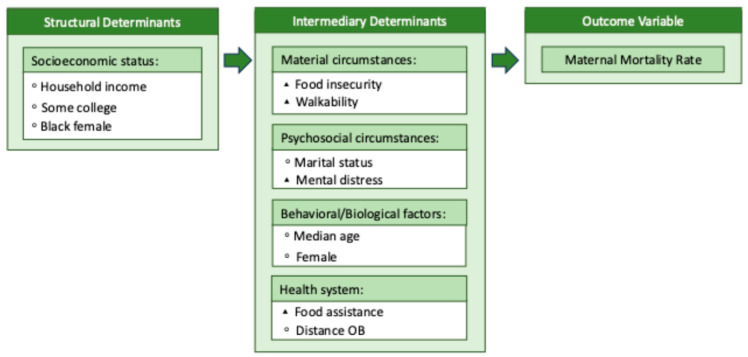
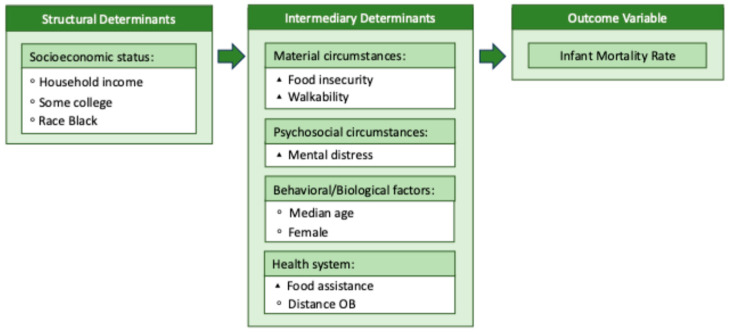
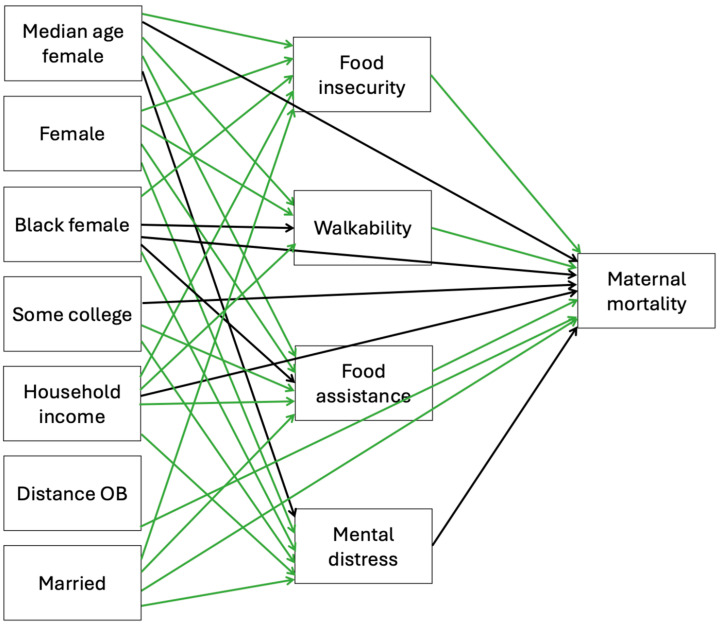
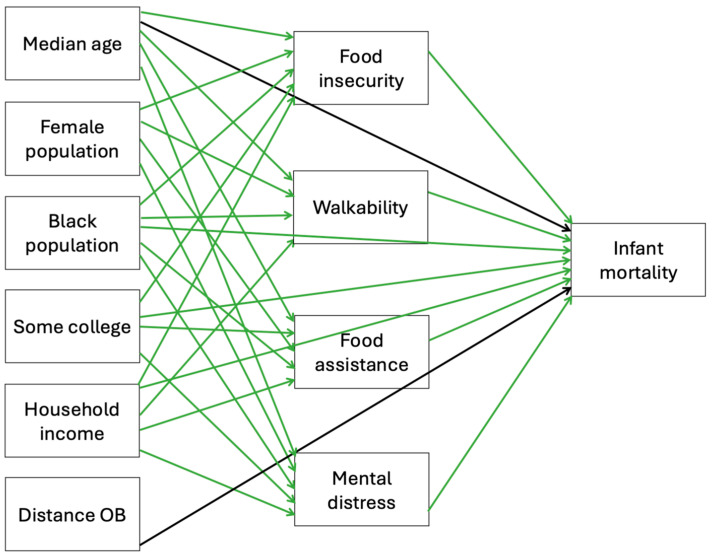
BACKGROUND: Compared to other high-income countries, US women face higher maternal and infant mortality rates. METHODS: This study used structural equation modeling (SEM) to examine cross-sectional, county-level associations between structural and intermediary social determinants of health (SDOHs) and maternal and infant mortalities, based on the World Health Organization's Commission on Social Determinants of Health framework. RESULTS: Our findings suggest maternal mortality may be linked to increased food insecurity, food assistance, distance to obstetric care, and decreased walkability and marriage rates. Our modeling also points toward a connection between infant mortality and increased food insecurity, food assistance, Black race, mental distress, and decreased walkability, education, and income. SEM revealed significant direct and indirect effects of these SDOHs. Notably, food insecurity and walkability had direct associations with both maternal and infant mortality in both SEM models. CONCLUSIONS: The findings underscore the need for policy, practice, and research efforts to address key SDOHs and reduce mortality disparities in the US.
Overview
CoChat Summary
TL;DR
This cross-sectional county-level SEM study examined associations between structural/intermediary social determinants of health and maternal and infant mortality across US counties from 2015–2020. Food insecurity and walkability showed direct associations with both maternal and infant mortality in the two models.
Key findings
- Model 1 predicted 96% of hypothesized associations and explained 83% of variance in maternal mortality; increased food insecurity, food assistance, distance to obstetric care, and decreased walkability and marriage rates were associated with higher maternal mortality.
- Model 2 predicted 83% of associations and explained 39% of variance in infant mortality; higher infant mortality was associated with increased food insecurity, food assistance, Black race, mental distress, and decreased walkability, education, and income.
- County averages included food insecurity 14.12%, walkability NWI score 6.5 (below average), median distance to obstetrics 11 miles, mental distress 12.6%, some college 57%, median household income $50,122, Black race 9%, and married females 48.7%.
- Food insecurity and walkability had direct associations with both maternal and infant mortality in both SEM models.
Methods
- Cross-sectional secondary data analysis of county-level maternal and infant mortality across all 50 US states, using live births from 2015–2020 in counties meeting CDC reporting thresholds (≥10 deaths).
- Data came from national sources including CDC WONDER, NCHS, County Health Rankings, AHRQ SDOH database, EPA National Walkability Index, ACS, and BRFSS.
- Structural equation modeling in StataNow/SE 18.5 tested direct, indirect, and total effects; variables were natural-log transformed, and significance was p < 0.05.
Limitations
- The authors state the design cannot support causation, uses county-level rather than individual-level data, risks ecological fallacy, and that many exposures are not restricted to women of childbearing age.
- The authors note CDC suppression for counties with fewer than ten deaths may underestimate mortality; pooling 2015–2020 improved stability but limits year-to-year assessment, and walkability used a single 2019 index applied across the study period.
- The authors state residual confounding is possible, walkability may proxy unmeasured obesity/diet/lifestyle factors, and findings may not fully translate to other high-income countries; the text also makes evident that Model 2 left most infant mortality variance unexplained (39% explained).
Model-written summary. Check it against the paper before relying on it.
Integrity signals
Registry
Cites
Statistics
Figures
Verification
Claims the paper makes
10 Valid · 1 Not valid · 2 Not checked · 73 Own results and interpretations
The cited sources support only part of this claim — read each source’s verdict below.
In the paper
“Hanson et al. [35] found that unmarried individuals had higher food insecurity.”
§ Food Insecurity, Walkability, and Social Determinants of Health: A Cross-Sectional, County-Level Study of Associations with Maternal and Infant Mortality in the United States > 4. Discussion
What the sources say
- Partly supportedcites [35] Hanson K.L. Sobal J. Frongillo E.A. Gender and marital status clarify associations between food insecurity and body weight J. Nutr. 2007 137 1460 1465 10.1093/jn/137.6.1460 17513407 sourceExperimental — accuracy not yet measured
The Results report lower food security among never-married, cohabiting, separated, and divorced participants, supporting the claim for several unmarried groups. But widowed participants had relatively high food security, and demographic-adjusted differences across marital categories were not found for women. The unqualified claim about all unmarried individuals is therefore too broad. (LLM, conf=0.85)
plainstates an association- Asserted: passes — The authors put it forward as true.
- Checkable: passes — It can be checked against evidence.
- Load-bearing: passes — The paper’s conclusions depend on it.
- Based: passes — The paper gives a reason why it holds.
- Partly supported
Every source the paper cites for this claim was checked and supports it.
In the paper
“Evidence supports that increased food insecurity is associated with increased infant mortality [26].”
§ Food Insecurity, Walkability, and Social Determinants of Health: A Cross-Sectional, County-Level Study of Associations with Maternal and Infant Mortality in the United States > 4. Discussion
What the sources say
- Supportedcites [26] Cassidy Vu L. Way V. Spangler J. The correlation between food insecurity and infant mortality in North Carolina Public. Health Nutr. 2022 25 1038 1044 10.1017/S136898002200026X 35094744 PMC9991794 source
The Abstract Conclusions state that food insecurity is positively correlated with infant mortality. The study describes this as a county-level association in North Carolina, not a causal finding. (LLM, conf=0.93)
plainstates an association- Asserted: passes — The authors put it forward as true.
- Checkable: passes — It can be checked against evidence.
- Load-bearing: passes — The paper’s conclusions depend on it.
- Based: passes — The paper gives a reason why it holds.
- Supported
Every source the paper cites for this claim was checked and supports it.
In the paper
“A report from the NCHS found that food insecurity was increased in unmarried people living with children [36].”
§ Food Insecurity, Walkability, and Social Determinants of Health: A Cross-Sectional, County-Level Study of Associations with Maternal and Infant Mortality in the United States > 4. Discussion
What the sources say
- Supportedcites [36] Weeks J.D. Mykyta L. Madans J.H. Adults living in families experiencing food insecurity in the past 30 days: United States, 2021 NCHS Data Brief 2023 1 8 10.15620/cdc:125707 37093588 source
The Abstract reports that family food insecurity was highest among unmarried adults living with children under 18 (9.8%). This supports the citing sentence’s comparison, though the report describes adults living in food-insecure families rather than measuring each person’s individual food insecurity. (LLM, conf=0.93)
plainstates an association- Asserted: passes — The authors put it forward as true.
- Checkable: passes — It can be checked against evidence.
- Load-bearing: unclear — It is unclear whether the paper’s conclusions depend on it.
- Based: passes — The paper gives a reason why it holds.
- Supported
The cited sources support only part of this claim — read each source’s verdict below.
In the paper
“By modeling mental distress as an endogenous variable, we acknowledge its dual role as both a consequence of social disadvantage and a determinant of adverse maternal and infant outcomes. This specification aligns with social determinant frameworks [13] and provides a more comprehensive understanding of the mechanisms leading to maternal and infant mortality [32,33].”
§ Food Insecurity, Walkability, and Social Determinants of Health: A Cross-Sectional, County-Level Study of Associations with Maternal and Infant Mortality in the United States > 4. Discussion
What the sources say
- Not matchedcites [13] Solar O. Irwin A. A Conceptual Framework for Action on the Social Determinants of Health: Social Determinants of Health Discussion Paper 2 World Health Organization Geneva, Switzerland 2010 Available online: https://iris.who.int/bitstream/handle/10665/44489/9789241500852_eng.pdf (accessed on 6 August 2023)
We searched by its title and found no matching paper.
- Partly supportedcites [32] Daalderop L.A. Lagendijk J. Steegers E.A.P. El Marroun H. Posthumus A.G. Psychological distress during pregnancy and adverse maternal and perinatal health outcomes: The role of socioeconomic status Int. J. Gynaecol. Obstet. 2023 163 920 930 10.1002/ijgo.14891 37259252 sourceExperimental — accuracy not yet measured
The Results (section 3.2) report more psychological distress among pregnant women with low socioeconomic status, and the Discussion (section 4) links distress to adverse perinatal outcomes, including preterm birth. The cited paper does not model distress as an endogenous variable or establish it as a causal determinant. It also does not study maternal or infant mortality; the citing authors describe the modeling choice as their own. (LLM, conf=0.87)
- Partly supportedcites [33] Ruyak S.L. Boursaw B. Cacari Stone L. The social determinants of perinatal maternal distress J. Rural. Ment. Health 2022 46 277 284 10.1037/rmh0000212 36713057 PMC9881014 sourceExperimental — accuracy not yet measured
The Results and Discussion (page unavailable) link social stressors and discrimination to perinatal maternal distress. The Implications section says distress is associated with adverse outcomes for the mother–infant dyad, but the paper’s path model predicts later distress, not adverse maternal or infant outcomes; it does not establish distress as their causal determinant. (LLM, conf=0.84)
plainstates a cause- Asserted: passes — The authors put it forward as true.
- Checkable: passes — It can be checked against evidence.
- Load-bearing: passes — The paper’s conclusions depend on it.
- Based: passes — The paper gives a reason why it holds.
- Not matched
A result the paper reports from its own data — it cites no other source for it, so there is none to check. The quote shows it is in the paper.
In the paper
“In Model 1, 23 of the 31 direct observed relationships between the variables in the model are highly significant.”
§ Food Insecurity, Walkability, and Social Determinants of Health: A Cross-Sectional, County-Level Study of Associations with Maternal and Infant Mortality in the United States > 3. Results
plainstates an association- Asserted: passes — The authors put it forward as true.
- Checkable: passes — It can be checked against evidence.
- Load-bearing: unclear — It is unclear whether the paper’s conclusions depend on it.
- Based: passes — The paper gives a reason why it holds.
54 more claims
Create a free account to see all 86 claims and to verify the 1 reference still open.
- Probably not a substantial claim. 21
- It may state two separate claims as one. 12
- The quote only partly states this claim. 2
Citations
Cites
How to use and assess qualitative research methods
Busetto, L., Wick, W., & Gumbinger, C. (2020) · Neurological Research and Practice · doi:10.1186/s42466-020-00059-z · Cited by 1,429 · cited 1×
“Additionally, qualitative research designs would add a richer understanding of these complex associations through analysis of the experiences of pregnant and postpartum women [55].”
Hood, C. M., Gennuso, K. P., Swain, G. R., & Catlin, B. B. (2016) · American Journal of Preventive Medicine · doi:10.1016/j.amepre.2015.08.024 · Cited by 1,005 · cited 3×
“The social determinants of health (SDOHs) are critical in improving health; socioeconomic status and the conditions in which they live their lives are so important they determine half of all health outcomes [10,11].”
Prevalence of suicidality during pregnancy and the postpartum
Lindahl, V., Pearson, J. L., & Colpe, L. (2005) · Archives of Women’s Mental Health · doi:10.1007/s00737-005-0080-1 · Cited by 795 · cited 1×
“The risk for suicidality (deaths, attempts, and ideation) is increased for pregnant and postpartum women with depression, and suicide is a leading contributor to maternal mortality among depressed women during this time [14,17,18].”
Andermann, A. (2016) · Canadian Medical Association Journal · doi:10.1503/cmaj.160177 · Cited by 710 · cited 1×
“Once structural and intermediary SDOH risks have been identified, the next step is to provide patients with resources both health-related and outside of the health system as needed [54].”
Introduction to mediation analysis with structural equation modeling.
(2013) · PubMed Central · doi:10.3969/j.issn.1002-0829.2013.06.009 · Cited by 661 · cited 2×
“Exogenous variables are given values that may influence endogenous and outcome variables in the model; however, exogenous variables are not influenced by other variables in the SEM [31].”
Hung, P., Henning-Smith, C. E., Casey, M. M., & Kozhimannil, K. B. (2017) · Health Affairs · doi:10.1377/hlthaff.2017.0338 · Cited by 347 · cited 1×
“According to Hung et al. [20], 9% of counties in the US completely lost their obstetrics services between 2004 and 2014, and another 45% of rural counties had no obstetrics services during this time.”
Introduction to mediation analysis with structural equation modeling
Douglas, Gunzler, Tian, T., et al. (2013) · 上海精神医学 · Cited by 342
Kozhimannil, K. B., Hung, P., Henning-Smith, C., Casey, M. M., & Prasad, S. (2018) · JAMA · doi:10.1001/jama.2018.1830 · Cited by 325
Dietary Quality of Americans by Supplemental Nutrition Assistance Program Participation Status
Andreyeva, T., Tripp, A. S., & Schwartz, M. B. (2015) · American Journal of Preventive Medicine · doi:10.1016/j.amepre.2015.04.035 · Cited by 258
Sun, Y., Liu, B., Rong, S., Du, Y., Xu, G., Snetselaar, L. G., Wallace, R. B., & Bao, W. (2020) · Journal of the American Heart Association · doi:10.1161/jaha.119.014629 · Cited by 210 · cited 1×
“Food insecurity has been shown to increase the risk of all-cause and cardiovascular disease mortality in adults [25,34]; however, there is a gap in the literature to support an association between food insecurity and maternal mortality specifically.”
Suicide and other causes of mortality after post-partum psychiatric admission
Appleby, L., Mortensen, P. B., & Faragher, E. B. (1998) · British Journal of Psychiatry · doi:10.1192/bjp.173.3.209 · Cited by 192 · cited 1×
“Hagatulah et al. [14] found an association between postpartum depression (PPD) and an increased risk of death of both natural and unnatural causes compared to women who did not have PPD. Postpartum women with severe psychiatric disorders had an increased risk of maternal mortality [15,16].”
Gender and marital status clarify associations between food insecurity and body weight
Hanson, K. L., Sobal, J., & Frongillo, E. A. (2007) · The Journal of Nutrition · doi:10.1093/jn/137.6.1460 · Cited by 164 · cited 1×
“Hanson et al. [35] found that unmarried individuals had higher food insecurity.”
Social determinants of health–An approach taken at CDC
Hacker, K., Auerbach, J., Ikeda, R., Philip, C., & Houry, D. (2022) · Journal of Public Health Management & Practice · doi:10.1097/phh.0000000000001626 · Cited by 142 · cited 3×
“The social determinants of health (SDOHs) are critical in improving health; socioeconomic status and the conditions in which they live their lives are so important they determine half of all health outcomes [10,11].”
Leung, C. W., Fulay, A. P., Parnarouskis, L., Martinez-Steele, E., Gearhardt, A. N., & Wolfson, J. A. (2022) · The American Journal of Clinical Nutrition · doi:10.1093/ajcn/nqac049 · Cited by 141 · cited 1×
“Leung et al. [40] found that increased food insecurity and SNAP participation were associated with a diet high in un-healthy processed foods.”
Health E-stat: Maternal mortality rates in the United States, 2022
Hoyert, D. L. (2024) · doi:10.15620/cdc/152992 · Cited by 121
Chung, W. T., Gallo, W. T., Giunta, N., Canavan, M. E., Parikh, N. S., & Fahs, M. C. (2012) · Journal of Urban Health · doi:10.1007/s11524-011-9633-y · Cited by 111 · cited 1×
“Chung et al. [45] found that people living in walkable communities had a lower risk of food insecurity due to physical limitations.”
All-cause mortality in women with severe postpartum psychiatric disorders
Johannsen, B. M. W., Larsen, J. T., Laursen, T. M., Bergink, V., Meltzer-Brody, S., & Munk-Olsen, T. (2016) · American Journal of Psychiatry · doi:10.1176/appi.ajp.2015.14121510 · Cited by 110 · cited 1×
“Hagatulah et al. [14] found an association between postpartum depression (PPD) and an increased risk of death of both natural and unnatural causes compared to women who did not have PPD. Postpartum women with severe psychiatric disorders had an increased risk of maternal mortality [15,16].”
Jacques, N., de Mola, C. L., Joseph, G., Mesenburg, M. A., & da Silveira, M. F. (2019) · Journal of Affective Disorders · doi:10.1016/j.jad.2018.09.055 · Cited by 107 · cited 1×
“Mothers with symptoms of depression are more likely to experience infant mortality compared to mothers without depression [12].”
Rural–urban disparities in adverse maternal outcomes in the United States, 2016–2019
Harrington, K. A., Cameron, N. A., Culler, K., Grobman, W. A., & Khan, S. S. (2023) · American Journal of Public Health · doi:10.2105/ajph.2022.307134 · Cited by 88 · cited 1×
“Pregnant women living in rural areas are at increased risk of being admitted to the ICU and maternal mortality than women residing in urban areas [21].”
Hoyert, D. (2025) · doi:10.15620/cdc/174577 · Cited by 79
Structural equation modeling with latent variables.
Hoyle, R. H., & Gottfredson, N. C. (2023) · American Psychological Association eBooks · doi:10.1037/0000319-021 · Cited by 78
Social and economic differences in neighborhood walkability across 500 U.S. cities
Conderino, S. E., Feldman, J. M., Spoer, B., Gourevitch, M. N., & Thorpe, L. E. (2021) · American Journal of Preventive Medicine · doi:10.1016/j.amepre.2021.03.014 · Cited by 77 · cited 1×
“Conderino et al. [46] found variance in the association between walkability and income, revealing that White and Black people of low income had lower walkability.”
Assessing the relationship between food insecurity and mortality among U.S. adults
Walker, R. J., Chawla, A., Garacci, E., Williams, J. S., Mendez, C., Ozieh, M. N., & Egede, L. E. (2019) · Annals of Epidemiology · doi:10.1016/j.annepidem.2019.01.014 · Cited by 76 · cited 2×
“Adults who had very low food insecurity had two times the risk of all-cause mortality compared to food-secure adults [25].”
Perinatal depression and risk of mortality: Nationwide, register-based study in Sweden
Hagatulah, N., Bränn, E., Oberg, A. S., Valdimarsdóttir, U. A., Shen, Q., & Lu, D. (2024) · BMJ · doi:10.1136/bmj-2023-075462 · Cited by 72 · cited 2×
“Hagatulah et al. [14] found an association between postpartum depression (PPD) and an increased risk of death of both natural and unnatural causes compared to women who did not have PPD. Postpartum women with severe psychiatric disorders had an increased risk of maternal mortality [15,16].”
Association of Postpartum Depression with Maternal Suicide: A Nationwide Population-Based Study
Lee, Y.-L., Tien, Y., Bai, Y.-S., Lin, C.-K., Yin, C.-S., Chung, C.-H., Sun, C.-A., Huang, S.-H., Huang, Y.-C., Chien, W.-C., et al. (2022) · International Journal of Environmental Research and Public Health · doi:10.3390/ijerph19095118 · Cited by 61 · cited 1×
“The risk for suicidality (deaths, attempts, and ideation) is increased for pregnant and postpartum women with depression, and suicide is a leading contributor to maternal mortality among depressed women during this time [14,17,18].”
Infant mortality in the United States, 2022: Data from the period linked birth/infant death file
Ely, D. M., & Driscoll, A. K. (2024) · doi:10.15620/cdc/157006 · Cited by 57 · cited 5×
“Black women are particularly affected by maternal and infant mortalities [2,7].”
InfluentialConrad, Z., Rehm, C. D., Wilde, P., & Mozaffarian, D. (2017) · American Journal of Public Health · doi:10.2105/ajph.2016.303608 · Cited by 53 · cited 1×
“Studies have shown that food assistance through food stamps programs (SNAP and WIC) increases positive health outcomes [37] and lower mortality [38]; however, Conrad et al. [39] found that families receiving SNAP had a higher risk of mortality (all-cause, cardiovascular, and diabetes).”
Gebreegziabher, E., Bountogo, M., Sié, A., Zakané, A., Compaoré, G., Ouédraogo, T., Lebas, E., Nyatigo, F., Glymour, M. M., Arnold, B. F., et al. (2023) · International Journal of Epidemiology · doi:10.1093/ije/dyac236 · Cited by 37
Zhu, X., Lu, Z., Yu, C.-Y., Lee, C., & Mann, G. (2013) · PubMed · Cited by 33
Daalderop, L. A., Lagendijk, J., Steegers, E. A. P., El Marroun, H., & Posthumus, A. G. (2023) · International Journal of Gynecology & Obstetrics · doi:10.1002/ijgo.14891 · Cited by 32 · cited 2×
“…an endogenous variable, and it was treated as an endogenous variable in the study because it is influenced by social determinants (e.g., income, education, food insecurity) while also serving as a mediator between these determinants and the outcomes of maternal and infant mortality [32,33].”
Singleton, C. R., Young, S. K., Kessee, N., Springfield, S. E., & Sen, B. P. (2020) · Preventive Medicine Reports · doi:10.1016/j.pmedr.2020.101134 · Cited by 31
Insights into the U.S. Maternal Mortality Crisis: An International Comparison
Gunja, M. Z., Gumas, E., Masitha, R., & Zephyrin, L. (2024) · The Commonwealth Fund Website · doi:10.26099/cthn-st75 · Cited by 31
The correlation between food insecurity and infant mortality in North Carolina
Cassidy-Vu, L., Way, V., & Spangler, J. (2022) · Public Health Nutrition · doi:10.1017/s136898002200026x · Cited by 26
Neighborhood walkability and mortality in a prospective cohort of women
India-Aldana, S., Rundle, A. G., Zeleniuch-Jacquotte, A., Quinn, J. W., Kim, B., Afanasyeva, Y., Clendenen, T. V., Koenig, K. L., Liu, M., Neckerman, K. M., et al. (2021) · Epidemiology · doi:10.1097/ede.0000000000001406 · Cited by 25
Acciai, F., Srinivasan, M., & Ohri-Vachaspati, P. (2021) · American Journal of Preventive Medicine · doi:10.1016/j.amepre.2021.05.008 · Cited by 17 · cited 1×
“Other studies also support the association between an unhealthy diet with more processed sugar products and fewer fruits and vegetables among SNAP participants [41–44].”
Tseng, M., Mastrantonio, C., Glanz, H., Volpe, R., Neill, D. B., & Nazmi, A. (2020) · Journal of the Academy of Nutrition and Dietetics · doi:10.1016/j.jand.2020.05.016 · Cited by 15 · cited 1×
“Other studies also support the association between an unhealthy diet with more processed sugar products and fewer fruits and vegetables among SNAP participants [41–44].”
Chong, S., Mazumdar, S., Jalaludin, B. B., & Hatfield, J. (2022) · Injury · doi:10.1016/j.injury.2022.09.014 · Cited by 13 · cited 1×
“Increasing walkability may help make it possible for people to increase their activity level [50] while increasing access to the community [51], reducing vehicle traffic [51], and increasing opportunities for social interaction [50].”
Shour, A. R., Garacci, E., Palatnik, A., Dawson, A. Z., Anguzu, R., Walker, R. J., & Egede, L. E. (2021) · The Journal of Maternal-Fetal & Neonatal Medicine · doi:10.1080/14767058.2021.1878142 · Cited by 11 · cited 1×
“Non-gestational or pre-gestational diabetes increases the risk of infant mortality [24].”
You’ll never walk alone—The effects of walkability on pregnancy behaviors and outcomes
Conway, K. S., & Menclova, A. K. (2023) · Economics & Human Biology · doi:10.1016/j.ehb.2023.101269 · Cited by 7
The social determinants of perinatal maternal distress
Ruyak, S. L., Boursaw, B., & Cacari Stone, L. (2022) · Journal of Rural Mental Health · doi:10.1037/rmh0000212 · Cited by 3 · cited 2×
“…an endogenous variable, and it was treated as an endogenous variable in the study because it is influenced by social determinants (e.g., income, education, food insecurity) while also serving as a mediator between these determinants and the outcomes of maternal and infant mortality [32,33].”
Adults Living in Families Experiencing Food Insecurity in the Past 30 Days: United States, 2021.
Weeks, J. D., Mykyta, L., & Madans, J. H. (2023) · PubMed · Cited by 3
Adults Living in Families That Experienced Food Insecurity in the Past 30 Days: United States, 2021
Weeks, J., Mykyta, L., & Madans, J. (2023) · doi:10.15620/cdc:125707 · Cited by 2
Snap Linked to Lower Mortality
Rosenberg, K. (2020) · AJN, American Journal of Nursing · doi:10.1097/01.naj.0000656372.74649.b4 · Cited by 1 · cited 1×
“Studies have shown that food assistance through food stamps programs (SNAP and WIC) increases positive health outcomes [37] and lower mortality [38]; however, Conrad et al. [39] found that families receiving SNAP had a higher risk of mortality (all-cause, cardiovascular, and diabetes).”
Research works printed but not linked: 1
- Trost S.L. Beauregard J. Chandra G. Njie F. Berry J. Harvey A. Goodman D.A. Pregnancy-Related Deaths: Data from Maternal Mortality Review Committees in 36 US States, 2017–2019 CDC & US DHHS Atlanta, GA, USA 2022
Cited by
Harding, C. C., Avorgbedor, F., Eliason, E. L., Adeniyi, A., Obioma, E., Brill, S. B., Diamantidis, C. J., Palakshappa, D., Bertoni, A. G., & Stamilio, D. M. (2026) · American Journal of Obstetrics & Gynecology MFM · doi:10.1016/j.ajogmf.2026.102107
Metadata
- Authors
- Stone, B., Amiri, A., Zhao, S., Hamidi, S., Johnson, P., & Bruns, D.
- Affiliations
- University of Alabama (US)
- University of Alabama in Huntsville (US)
- Johns Hopkins University (US)
- Corresponding author
- Stone, Brooklyn
- Venue
- Healthcare
- Publisher
- MDPI AG
- Published
- 2025-09-24
- Volume
- 13
- Issue
- 19
- Pages
- 2407
- ISSN
- 2227-9032 (ISSN-L)
- PMC
- PMC12523423
- OpenAlex
- W4414476982
- Cited by
- 0
- References
- 41
- FWCI
- 0.00
- Type
- journal article
- Language
- en
- Open access
- gold
- doi.org
- Licence
- Locations
- Healthcare (publishedVersion, cc-by)
- Europe PMC (PubMed Central) (publishedVersion, cc-by)
- PubMed (publishedVersion)
- Topics
- Health Sciences › Medicine › Pediatrics, Perinatology and Child Health › Maternal and Neonatal Healthcare
- Health Sciences › Medicine › Public Health, Environmental and Occupational Health › Food Security and Health in Diverse Populations
- Social Sciences › Health › Health disparities and outcomes
- Keywords
- food insecurity, walkability, social determinants of health, maternal mortality, infant mortality, food aid, nuptiality, racial disparities, psychological distress, income, Black women, mortality disparities, United States
About these checks
Registry, retraction, Cites and statistics results are computed, not judged, with one exception: a printed reference that no index lists is read once by a model before it counts as a citation error. Claims are extracted by a model and kept only when their quote appears verbatim in the text; each cited source is then checked, with a model’s help, for whether it says what the claim relies on. Those verdicts can be wrong — read the claim’s quote and the cited source before relying on one.
The claim verdicts this report counts are experimental: their accuracy is not yet measured.
A language model drew the claims from the paper on 2026-10-10, under version 3 of the claim definition (model deepseek-v4.1-flash, prompt extract-v3).
A second model labelled each claim on 2026-10-10 (model jev-1.13-20260917, definition revision gold-guideline-v0.2).
Cited sources are checked with a language model’s help (gpt-6-sol).
Statistics and arithmetic are recomputed, not judged.
Confidence bands are shown only for fields calibrated on our annotated test set. None is calibrated yet, so no band is shown.
What counts as a claim ›How we measure confidence ›How we check this ›
Are you an author, or do you see a problem with this page? Request a review
Data sources
Bibliographic data: Semantic Scholar, OpenAlex, Crossref.
Contains information from the Semantic Scholar Academic Graph Datasets, made available under the ODC Attribution License (ODC-BY 1.0).
Semantic Scholar’s data is described in: Kinney, R., et al. (2023). The Semantic Scholar Open Data Platform. arXiv:2301.10140.
