

The DOI matches its Crossref record; 107 of the 107 references it cites were found in a registry or an index.
The Association between Future Anxiety, Health Literacy and the Perception of the COVID-19 Pandemic: A Cross-Sectional Study
Open accessAbstract
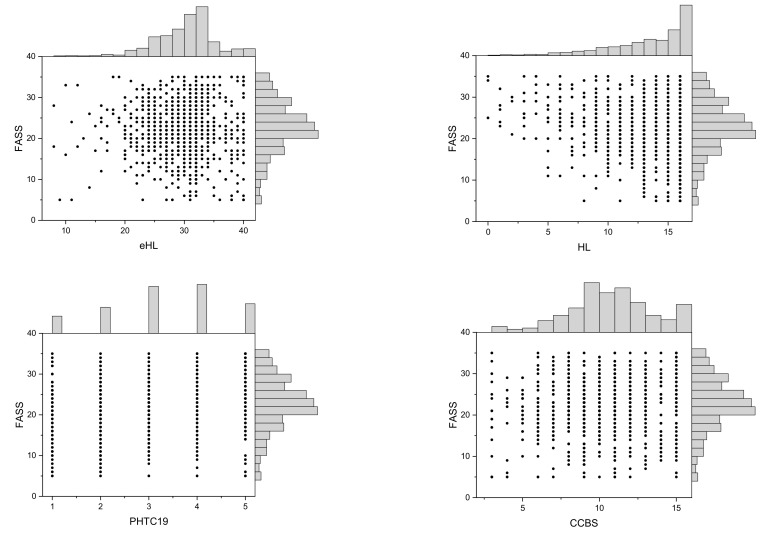
Increased anxiety related to the Coronavirus Disease 2019 (COVID-19) pandemic in society and specific professional groups has been reported by many authors. Most have applied tools enabling assessing the general traits of anxiety. Tools specifically designed for an assessment of anxiety or fear related to COVID-19 have also been developed. However, no study has assessed the future anxiety in relation to the pandemic. This concept was defined by Zaleski in the end of the 20th century as the state of apprehension, fear, worry, and concern regarding unfavourable changes in the more remote personal future. The aim of this study was an analysis to establish the level and the determinants of future anxiety in Polish society related to the COVID-19 pandemic three months after the introduction of the state of epidemic. The analysis reported in the paper is based on the data obtained through a web-based survey carried out on a representative sample of 1002 Polish adults aged 18–74 years. The hierarchical linear regression model was developed for the analysis of the determinants of future anxiety from the responses to a questionnaire consisting of five items. The independent variables selected for inclusion in the model, apart from sociodemographic characteristics, encompassed health literacy (HL) and ehealth literacy (eHL), perceived health threat related to COVID-19 (PHTC19), and a COVID-19-related conspiracy belief score (CCBS) derived from three items asking about the most popular conspiracy theories. The regression model developed in the final step showed that the future anxiety scale score (FASS) was significantly associated with gender, vocational status, HL, PHTC19, and CCBS. The FASS was lower among men than women (regression coefficient (B) (standard error, SE) = −1.28 (0.39), p = 0.001), among entrepreneurs or farmers rather than among employees of the public or private sector (B(SE) = −1.55, p = 0.010), in persons with a higher HL (B(SE) = −0.43 (0.06), p < 0.001). A higher FASS was observed in respondents with higher rather than lower PHTC19 (B(SE) = 1.49 (0.17), p < 0.001) and in those with a higher CCBS (B(SE) = 0.33 (0.07), p < 0.001). The model accounted for 15.2% of the variance of the FASS. In conclusion, the COVID-19 pandemic is not only a cause of increased mental symptoms, but also of increased future anxiety. Health-related measures are significantly associated with the FASS.
Overview
The claims and statistics of this paper haven’t been checked yet.
Run the check — free, no account needed. It reads the open-access text and checks the sources it cites.
Integrity signals
Registry
Cites
Statistics
Figures
Verification
Claims the paper makes
The claims and statistics of this paper haven’t been checked yet.
Run the check — free, no account needed. It reads the open-access text and checks the sources it cites.
Claims other papers make about this one
Each is checked against this paper’s own text: does it say what the citing paper says it does?
The cited source says what the claim attributes to it.
In the citing paper
“The COVID-19 pandemic increased anxiety regarding the future [33,34,35].”
From COVID-19 Victimization Experience and College Students’ Mobile Phone Addiction: A Moderated Mediation Effect of Future Anxiety and Mindfulness (2022) · cites this paper as [33]
Self-check
Percentages, sums and reported differences re-computed from the paper’s own numbers.
The self-check needs the paper’s full text.
Citations
Cites
Diagnostic and Statistical Manual of Mental Disorders
American Psychiatric Association (2013) · doi:10.1176/appi.books.9780890425596 · Cited by 116,369
The psychological impact of the COVID-19 epidemic on college students in China
Cao, W., Fang, Z., Hou, G., Han, M., Xu, X., Dong, J., & Zheng, J. (2020) · Psychiatry Research · doi:10.1016/j.psychres.2020.112934 · Cited by 5,843 · cited 8×
“assessed the psychological consequences of COVID19 pandemic in more than 7000 medical students in Chanzhi, China [17].”
BackgroundMethodInfluentialLow Health Literacy and Health Outcomes: An Updated Systematic Review
Berkman, N. D., Sheridan, S. L., Donahue, K. E., Halpern, D. J., & Crotty, K. (2011) · Annals of Internal Medicine · doi:10.7326/0003-4819-155-2-201107190-00005 · Cited by 5,505
The Fear of COVID-19 Scale: Development and Initial Validation
Ahorsu, D. K., Lin, C.-Y., Imani, V., Saffari, M., Griffiths, M. D., & Pakpour, A. H. (2022) · International Journal of Mental Health and Addiction · doi:10.1007/s11469-020-00270-8 · Cited by 4,332 · cited 2×
“In general, the assessment of fear or stress related to COVID-19 with specific tools, like the FC19S, showed that these scores correlated with the general anxiety scores [22,23,28,29,99].”
MethodPappa, S., Ntella, V., Giannakas, T., Giannakoulis, V. G., Papoutsi, E., & Katsaounou, P. (2020) · Brain Behavior and Immunity · doi:10.1016/j.bbi.2020.05.026 · Cited by 3,617 · cited 1×
“8% that showed symptoms of depression [18].”
Salari, N., Hosseinian-Far, A., Jalali, R., Vaisi-Raygani, A., Rasoulpoor, S., Mohammadi, M., Rasoulpoor, S., & Khaledi-Paveh, B. (2020) · Globalization and Health · doi:10.1186/s12992-020-00589-w · Cited by 3,560 · cited 1×
“[12] showed that during the COVID-19 pandemic, stress was experienced by nearly 30%, anxiety by 32% and depression by 34% of the general population.”
BackgroundCOVID-19 pandemic and mental health consequences: Systematic review of the current evidence
Vindegaard, N., & Benros, M. E. (2020) · Brain, Behavior, and Immunity · doi:10.1016/j.bbi.2020.05.048 · Cited by 3,221
eHEALS: The eHealth Literacy Scale
Norman, C. D., & Skinner, H. A. (2006) · Journal of Medical Internet Research · doi:10.2196/jmir.8.4.e27 · Cited by 2,680 · cited 2×
“The eHL score was determined in line with the instructions given by the authors of the eHealth Literacy Scale (eHEALS) [74].”
MethodHealth literacy in Europe: Comparative results of the european health literacy survey (HLS-EU)
Sørensen, K., Pelikan, J. M., Röthlin, F., Ganahl, K., Slonska, Z., Doyle, G., Fullam, J., Kondilis, B., Agrafiotis, D., Uiters, E., et al. (2015) · The European Journal of Public Health · doi:10.1093/eurpub/ckv043 · Cited by 2,651
eHealth Literacy: Essential Skills for Consumer Health in a Networked World.
Norman, C. D., & Skinner, H. A. (2006) · Journal of Medical Internet Research · doi:10.2196/jmir.8.2.e9 · Cited by 2,643 · cited 1×
“In 2006, Norman and Skinner proposed a definition and a model of eHL originating from a set of six basic competencies including reading and calculating, as well as literacies relevant to health, information, science and information technology [39].”
Background
Research works printed but not linked: 8
- Feldman, M.D., Christensen, J.F., Satterfield, J.M., and Laponis, R. (2020). Anxiety. Behavioral Medicine: A Guide for Clinical Practice, McGraw-Hill Education.
- Spielberger, 1971, Development of the Spanish edition of the State-Trait Anxiety Inventory, Rev. Interam. Psicol., 5, 145
- Zaleski, 1997, Influence strategies used by military and civil supervisors: Empirical research, Pol. Psychol. Bull., 28, 325
- Pelikan, J.M., Röthlin, F., and Ganahl, K. (2014, January 3–4). Measuring Comprehensive Health Literacy in General Populations: Validation of Instrument, Indices and Scales of the HLS-EU Study. Proceedings of the 6th Annual Health Literacy Research Conference, Hyat Regency, Bethesda, MD, USA.
- Stickley, A., Matsubayashi, T., Sueki, H., Ueda, M., and Faculty, M.U. (2020). COVID-19 preventive behaviors among people with anxiety and depression: Findings from Japan. medRxiv. · DOI
- Isautier, J., Ayre, J., Cvejic, E., Meyerowitz-Katz, G., Batcup, C., Bonner, C., Dodd, R., Nickel, B., Pickles, K., and Cornell, S. (2020). Lessons from the COVID-19 pandemic: People’s experiences and satisfaction with telehealth during the COVID-19 pandemic in Australia. medRxiv. · DOI
- Gritsenko, V., Skugarevsky, O., Konstantinov, V., Khamenka, N., Marinova, T., Reznik, A., and Isralowitz, R. (2020). COVID 19 Fear, Stress, Anxiety, and Substance Use Among Russian and Belarusian University Students. Int. J. Ment. Health Addict., 1. · DOI
- Chen, X., Zhang, S.X., Jahanshahi, A.A., Alvarez-Risco, A., Dai, H., Li, J., and Ibarra, V.G. (2020). Belief in Conspiracy Theory about COVID-19 Predicts Mental Health and Well-being-A Study of Healthcare Staff in Ecuador. medRxiv. · DOI
Cited by
Sorted by citations
Items 101–106 of 106
Lin, H., Hu, Q., & Zheng, H. Y. (2026) · Current Psychology · doi:10.1007/s12144-025-08528-x
“This finding is also supported by Duplaga and Grysztar (2021), who surveyed more than 1000 Polish adults and found that COVID-19 risk perception is significantly associated with health literacy.”
Chen, J., Huang, W., & Bai, J. (2026) · Self and Identity · doi:10.1080/15298868.2026.2629796
“Although some studies have explored the association between perceived uncertainty and future anxiety (e.g., Duplaga & Grysztar, 2021; Paredes et al., 2021), few research has yet investigated the underlying mechanisms of this influence.”
Community-Based Dental Education (CBDE)
Bakar, A., Ningrum, V., & Yaacob, H. B. (2026) · Springer eBooks · doi:10.1007/978-981-97-0275-6_55-1
Weist, J. V., Nitsche, J., Ehlers, J. P., & Busse, T. S. (2026) · Journal of Medical Internet Research · doi:10.2196/87461 · Cited by 1
Shen, C., Zhang, Y., & Ding, Y. (2026) · Frontiers in Public Health · doi:10.3389/fpubh.2026.1753674
Üçer, İ., & Çalışır, M. (2026) · Clinical Journal of Health Sciences · doi:10.35365/cjhs.26.2.02
Metadata
- Authors
- Duplaga, M., & Grysztar, M.
- Affiliations
- Jagiellonian University (PL)
- Corresponding author
- Duplaga, Mariusz
- Venue
- Healthcare
- Publisher
- MDPI AG
- Published
- 2021-01-05
- Volume
- 9
- Issue
- 1
- Pages
- 43
- ISSN
- 2227-9032 (ISSN-L)
- PMC
- PMC7824811
- OpenAlex
- W3120587867
- Cited by
- 106
- References
- 105
- Citations by year
- 2026: 7 · 2025: 10 · 2024: 22 · 2023: 16 · 2022: 32 · 2021: 17
- FWCI
- 14.83
- Type
- journal article
- Language
- en
- Open access
- gold
- doi.org
- Licence
- Locations
- Healthcare (publishedVersion, cc-by)
- Europe PMC (PubMed Central) (publishedVersion, other-oa)
- PubMed Central (publishedVersion, cc-by)
- PubMed (publishedVersion)
- Homo Politicus (Academy of Humanities and Economics in Lodz) (submittedVersion, cc-by)
- DOAJ (DOAJ: Directory of Open Access Journals) (submittedVersion, cc-by-sa)
- Funders
- Uniwersytet Jagielloński Collegium Medicum (N43/DBS/000050)
- Topics
- Social Sciences › Psychology › Clinical Psychology › COVID-19 and Mental Health
- Health Sciences › Health Professions › General Health Professions › Health Literacy and Information Accessibility
- Social Sciences › Communication › Communication and COVID-19 Impact
- Keywords
- future anxiety, COVID-19 pandemic, health literacy, digital health literacy, perceived health threat, conspiracy beliefs, COVID-19 conspiracy theories, gender differences, occupational status, Polish adults, public health communication, health education, health policy, health care costs
About these checks
Registry, retraction, Cites and statistics results are computed, not judged, with one exception: a printed reference that no index lists is read once by a model before it counts as a citation error. Claims are extracted by a model and kept only when their quote appears verbatim in the text; each cited source is then checked, with a model’s help, for whether it says what the claim relies on. Those verdicts can be wrong — read the claim’s quote and the cited source before relying on one.
Statistics and arithmetic are recomputed, not judged.
Confidence bands are shown only for fields calibrated on our annotated test set. None is calibrated yet, so no band is shown.
What counts as a claim ›How we measure confidence ›How we check this ›
Are you an author, or do you see a problem with this page? Request a review
