

A Meta-Analysis of Risk Factors for Post-Traumatic Stress Disorder (PTSD) in Adults and Children after Earthquakes
Open accessThe DOI matches its Crossref record, with a small difference in title or year; 75 of the 75 references it cites were found in a registry or an index.
Abstract
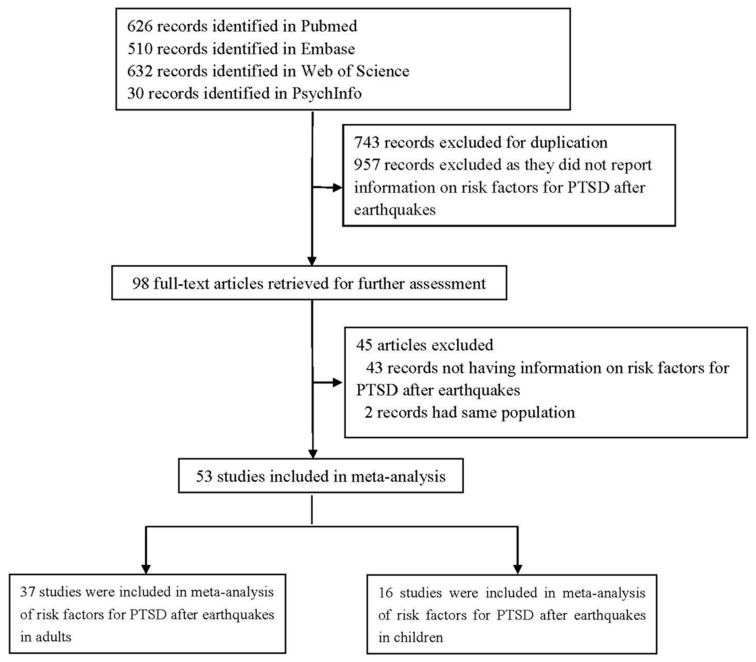
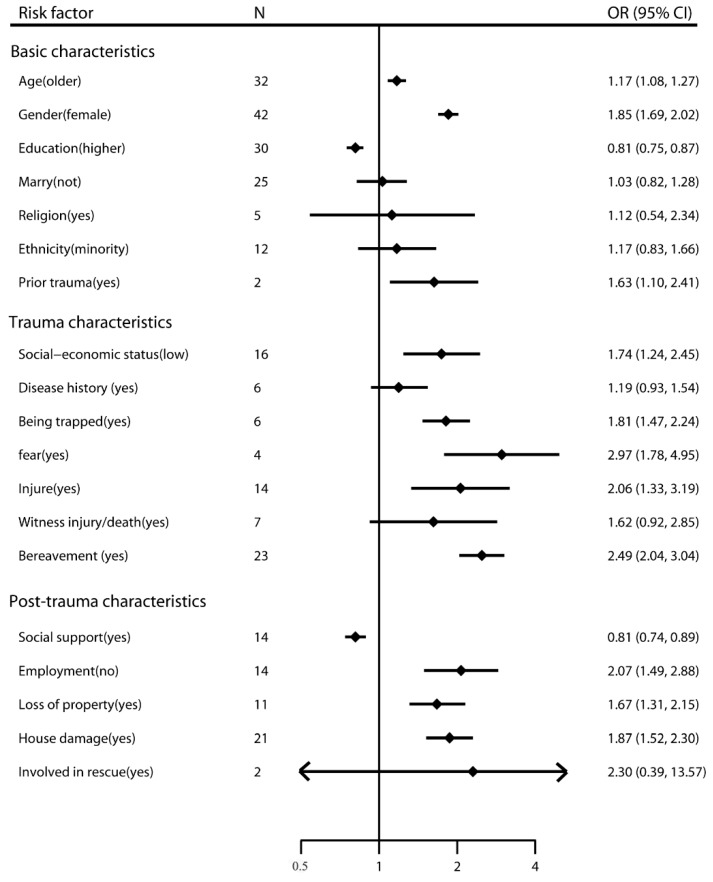
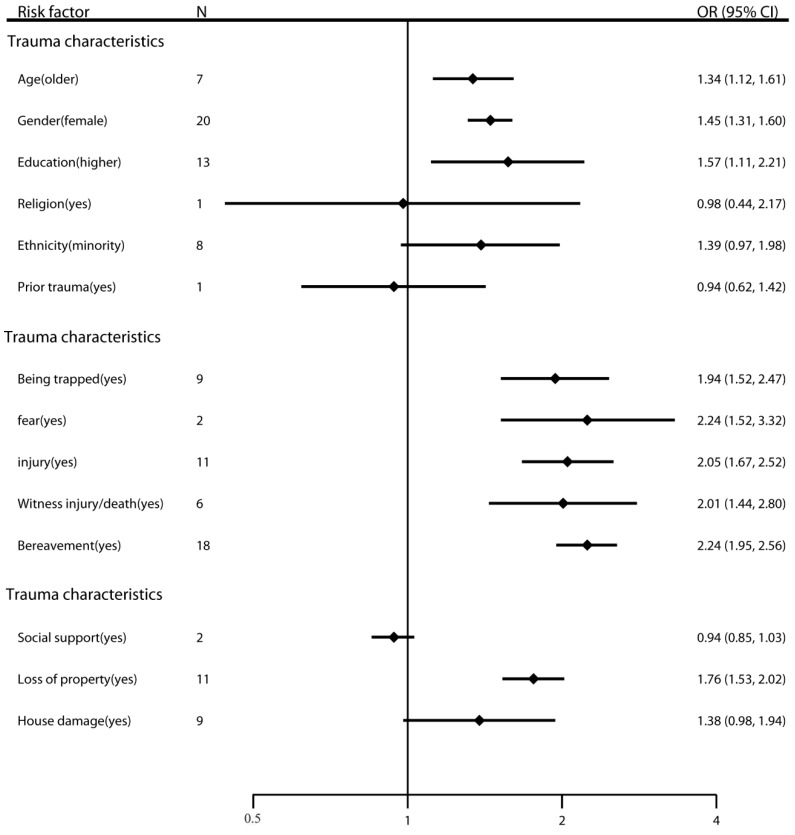
PTSD is considered the most common negative psychological reactions among survivors following an earthquake. The present study sought to find out the determinants of PTSD in earthquake survivors using a systematic meta-analysis. Four electronic databases (PubMed, Embase, Web of Science, and PsycInfo) were used to search for observational studies about PTSD following earthquakes. The literature search, study selection, and data extraction were conducted independently by two authors. 52 articles were included in the study. Summary estimates, subgroup analysis, and publication bias tests were performed on the data. The prevalence of PTSD after earthquakes ranged from 4.10% to 67.07% in adults and from 2.50% to 60.00% in children. For adults, the significant predictors were being female, low education level or socio-economic status, prior trauma; being trapped, experiencing fear, injury, or bereavement during the disaster. For children, the significant predictors were being older age, high education level; being trapped, experiencing fear, injury, or bereavement, witnessing injury/death during the earthquakes. Our study provides implications for the understanding of risk factors for PTSD among earthquake survivors. Post-disaster mental health recovery programs that include early identification, on-going monitoring, and sustained psychosocial support are needed for earthquake survivors.
Overview
The claims and statistics of this paper haven’t been checked yet.
Free: it reads the open-access text and checks the first 5 claims that cite a source we can check. Create a free account to check every claim.
Integrity signals
Registry
Cites
Statistics
Figures
Verification
Claims the paper makes
The claims and statistics of this paper haven’t been checked yet.
Free: it reads the open-access text and checks the first 5 claims that cite a source we can check. Create a free account to check every claim.
Claims other papers make about this one
Each is checked against this paper’s own text: does it say what the citing paper says it does?
The source backs part of the claim, not all of it — or backs it for a different population, condition or comparison.
In the citing paper
“Around the world, earthquake survivors exhibit elevated rates of post-traumatic stress disorder (PTSD), depression, anxiety, and other stress-related symptoms in the months and years following the event (2).”
From Coping strategies and psychological outcomes following the 2023 Kahramanmaraş earthquakes: a systematic review with meta-analytic synthesis (2026) · cites this paper as [2]
Experimental — accuracy not yet measured
Self-check
Percentages, sums and reported differences re-computed from the paper’s own numbers.
The self-check needs the paper’s full text.
Citations
Cites
Diagnostic and Statistical Manual of Mental Disorders
American Psychiatric Association (2013) · doi:10.1176/appi.books.9780890425596 · Cited by 116,369
Measuring inconsistency in meta-analyses
Higgins, J. P. T., Thompson, S. G., Deeks, J. J., & Altman, D. G. (2003) · BMJ · doi:10.1136/bmj.327.7414.557 · Cited by 63,139
Bias in meta-analysis detected by a simple, graphical test
Egger, M., Smith, G. D., Schneider, M., & Minder, C. (1997) · BMJ · doi:10.1136/bmj.315.7109.629 · Cited by 56,722 · cited 1×
“05 were considered statistically publication bias [32].”
Meta-analysis in clinical trials
DerSimonian, R., & Laird, N. (1986) · Controlled Clinical Trials · doi:10.1016/0197-2456(86)90046-2 · Cited by 39,552 · cited 1×
“A random-effects model [30] which assumes that the real potential effect varies among included studies, was used to estimate the pooled RRs with 95% CIs.”
MethodMeta-analysis of risk factors for posttraumatic stress disorder in trauma-exposed adults
Brewin, C. R., Andrews, B., & Valentine, J. D. (2000) · Journal of Consulting and Clinical Psychology · doi:10.1037/0022-006x.68.5.748 · Cited by 5,243 · cited 1×
“These have focused on different kinds of populations such as trauma-exposed adults [21], rescue workers [22], HIV-positive women [23], refugees and internally displaced persons [24], military personnel, and veterans [25].”
BackgroundPredictors of posttraumatic stress disorder and symptoms in adults: a meta-analysis
Ozer, E. J., Best, S. R., Lipsey, T. L., & Weiss, D. S. (2003) · Psychological Bulletin · doi:10.1037/0033-2909.129.1.52 · Cited by 3,322 · cited 1×
“[19] conducted a meta-analysis on seven separate predictors from 68 studies for PTSD among adults.”
MethodPorter, M., & Haslam, N. (2005) · JAMA · doi:10.1001/jama.294.5.602 · Cited by 1,793 · cited 1×
“These have focused on different kinds of populations such as trauma-exposed adults [21], rescue workers [22], HIV-positive women [23], refugees and internally displaced persons [24], military personnel, and veterans [25].”
BackgroundPredictors of posttraumatic stress disorder and symptoms in adults: A meta-analysis.
Ozer, E. J., Best, S. R., Lipsey, T. L., & Weiss, D. S. (2008) · Psychological Trauma: Theory, Research, Practice, and Policy · doi:10.1037/1942-9681.s.1.3 · Cited by 1,247
A meta-analysis of risk factors for post-traumatic stress disorder in children and adolescents
Trickey, D., Siddaway, A. P., Meiser-Stedman, R., Serpell, L., & Field, A. P. (2012) · Clinical Psychology Review · doi:10.1016/j.cpr.2011.12.001 · Cited by 828 · cited 1×
“estimated the population effect sizes of 25 potential risk factors for PTSD in children and adolescents aged 6–18 years across 64 studies (n = 32,238) [20].”
BackgroundBerger, W., Coutinho, E. S. F., Figueira, I., Marques-Portella, C., Luz, M. P., Neylan, T. C., Marmar, C. R., & Mendlowicz, M. V. (2012) · Social Psychiatry and Psychiatric Epidemiology · doi:10.1007/s00127-011-0408-2 · Cited by 712 · cited 1×
“These have focused on different kinds of populations such as trauma-exposed adults [21], rescue workers [22], HIV-positive women [23], refugees and internally displaced persons [24], military personnel, and veterans [25].”
Background
Research works printed but not linked: 2
- Celiac Disease Evidence Reports/Technology Assessments NAD Available online: http://www.ncbi.nlm.nih.gov/books/NBK35156 (accessed on 18 July 2016)
- Wells G.A. Shea B.J. O’Connell D. Peterson J.E. Welch V. Losos M. Tugwell P. The Newcastle–Ottawa Scale (NOS) for Assessing the Quality of Non-Randomized Studies in Meta-Analysis Appl. Eng. Agric. 2014 18 727 734
Cited by
Items 201–300 of 327
Terremotos, salud y sociedad: lecciones aprendidas
Lazcano-Ponce, E. C., & Oropeza-Abúndez, C. (2018) · Salud Pública de México · doi:10.21149/9417 · Cited by 2
Особливості функціонування пам’яті під час травматичних подіїв
Лагутіна, С., & Суббота, С. (2020) · DOAJ (DOAJ: Directory of Open Access Journals) · doi:10.26766/pmgp.v5i1.249 · Cited by 2
Kim, E., Yeo, J., Kim, Y., & Ha, I. (2022) · Journal of Epidemiology · doi:10.2188/jea.je20220171 · Cited by 2
“2,5,6 In contrast, some of our fi ndings were consistent with previous studies, where younger and middle-aged people were more vulnerable than older individuals.”
ResultQuality of Life During the First Three Waves of the COVID-19 Pandemic and Two Earthquakes in Croatia
Petrović, Z. K., Peraica, T., Blažev, M., Tomašić, L., & Kozarić‐Kovačić, D. (2023) · The Journal of Nervous and Mental Disease · doi:10.1097/nmd.0000000000001660 · Cited by 2
Çınaroğlu, M., & Yılmazer, E. (2026) · Frontiers in Public Health · doi:10.3389/fpubh.2026.1776931 · Cited by 1
Shui, X., Zhao, L., Li, W., Jia, Y., Liu, Z., Li, C., Yang, X., Huang, H., Wu, S., Chen, S., et al. (2022) · Frontiers in Pediatrics · doi:10.3389/fped.2022.1046086 · Cited by 1
“00% in children, and bereavement during the disasters is a predominant predictor (28).”
BackgroundFoláyan, M. O., Zúñiga, R. A. A., Virtanen, J. I., Ellakany, P., Al‐Tammemi, A. B., Quadri, M. F. A., Jafer, M. A., Ara, E., Ayanore, M. A., Gaffar, B. O., et al. (2023) · BMC Public Health · doi:10.1186/s12889-023-15933-z · Cited by 2
“The association between educational status and PTSS reported in this study had also been reported elsewhere [90, 91].”
ResultYıldırım, E., & Güdücü, N. (2024) · Disaster Medicine and Public Health Preparedness · doi:10.1017/dmp.2024.330 · Cited by 5
Shared suffering predicts prosocial commitment among Turkish earthquake survivors
Demiroglu, S., White, C., Xygalatas, D., Moralès, D., Ainsworth, A. T., & Whitehouse, H. (2025) · Scientific Reports · doi:10.1038/s41598-025-90921-4 · Cited by 4
“To the best of our knowledge, we found the highest prevalence of post-earthquake PTSD in our sample 25,26 .”
Alcohol Dependence and Quality of Life
Petrović, Z. K., Peraica, T., Blažev, M., & Kozarić‐Kovačić, D. (2025) · The Journal of Nervous and Mental Disease · doi:10.1097/nmd.0000000000001830 · Cited by 1
Üstün, N. S. G. (2025) · Harran Üniversitesi Tıp Fakültesi Dergisi · doi:10.35440/hutfd.1607458 · Cited by 1
“…documented a range of psychiatric symptoms and disorders in children following earthquakes, including depression, anxiety, post-traumatic stress disorder (PTSD), difficulties with anger, cognitive regression, attention problems, decreased academic performance, and learning difficulties (4,6–12).”
InfluentialPost-traumatic Distress Following Physical and Social Stressors: A Comparison of Symptoms Networks
Azoulay, R., Pinus, M., Hay, D. E., & Gilboa‐Schechtman, E. (2025) · Cognitive Therapy and Research · doi:10.1007/s10608-025-10615-z · Cited by 1
“For example, the prevalence of clinically elevated PTD is about 20% following sexual assaults (Scott et al., 2018) and 3% following a natural disaster (Tang et al., 2017 ).”
InfluentialFurutani, N., Murata, Y., Miwa, W., Nakamura, M., & Nakajima‐Ohyama, K. C. (2025) · Frontiers in Psychiatry · doi:10.3389/fpsyt.2025.1631694 · Cited by 1
Zheng, S., Cheng, L., Zhao, X., Fang, J., Li, D., & Wu, F. (2025) · Frontiers in Public Health · doi:10.3389/fpubh.2025.1652569 · Cited by 2
“This demographic detail aligns with literature indicating greater stressors and varying access to health resources in rural settings, often resulting in heightened mental health challenges among children from these backgrounds (43, 44).”
Najem, Y., Saad, H., Malaeb, D. N., Dabbous, M., Sakr, F., Hallit, R. R., Fekih‐Romdhane, F., Obeïd, S., & Hallit, S. R. (2025) · Journal of Child & Adolescent Trauma · doi:10.1007/s40653-025-00777-z · Cited by 1
“Moreover, Tang et al. suggested that psychological distress may persist years after the disaster (Tang et al., 2017a, b).”
Experiences and Biopsychosocial Needs of Women in an Earthquake During the Postpartum Period
Öztürk, R., & Erdogan, R. A. (2025) · Disaster Medicine and Public Health Preparedness · doi:10.1017/dmp.2025.10236 · Cited by 1
From rubble to recovery: Exploring earthquake-affected families’ experiences for hope and healing
GENÇTEN, V. Y., Uyar, R. Ö., Gültekin, M., DOYUMĞAÇ, İ., & Menteş, H. S. (2025) · Journal of Family Trauma Child Custody & Child Development · doi:10.1080/26904586.2025.2580261 · Cited by 1
Alabed, A., Doyya, M., Nouh, S., Bakro, H., Alkhlif, H., & Latifeh, Y. (2025) · Medicine · doi:10.1097/md.0000000000045591 · Cited by 1
“[11,12] Similarly, depression is one of the most common mental health challenges faced by survivors of natural disasters.”
Dixon, T. A. M., Hole, K., Johnson, L., & Nutbeam, T. (2026) · Scandinavian Journal of Trauma Resuscitation and Emergency Medicine · doi:10.1186/s13049-026-01558-9 · Cited by 1
“However, research conducted in non-MVC contexts where entrapment occurs (non-MVC entrapment)—such as natural disasters, mining incidents, and collapsed structures—has identified associations between entrapment and increased risk of PTSD, ASD, anxiety and depression [16–22].”
InfluentialPeritraumatic Reactions and Posttraumatic Psychopathology
Alpay, E. H. (2026) · Psikiyatride Guncel Yaklasimlar - Current Approaches in Psychiatry · doi:10.18863/pgy.1826511 · Cited by 1
Child-centred nursing education in disaster preparedness: Strengthening knowledge and awareness
Özarslan, S., Yayan, E. H., & Günay, U. (2026) · International Emergency Nursing · doi:10.1016/j.ienj.2026.101822 · Cited by 1
Kovan, A. (2026) · OMEGA - Journal of Death and Dying · doi:10.1177/00302228261455423 · Cited by 1
Kerbage, H., Bui, É., Revet, A., Denis, H., Purper‐Ouakil, D., & Rolling, J. (2026) · Discover Mental Health · doi:10.1007/s44192-026-00488-3 · Cited by 1
“Conversely, social support is one of the strongest protective factors, underscoring the multisystemic nature of recovery [56, 63, 64].”
Wijovi, F., Kurniawan, A., Lugito, N., Agung, F. H., Cipta, D., Angelina, S., Halim, D. A., Jodhinata, C., Orlin, S., Hamdoyo, A., et al. (2021) · Medicinus · doi:10.19166/med.v9i2.4703 · Cited by 1
“1,2 In lateDecember 2019, the first case of Coronavirus Disease 2019 (COVID-19) was confirmed in Wuhan, China.(3) On 30 January 2020, the World Health Organization declares COVID-19 to be a public health emergency of international concern.”
BackgroundInfluentialZhang, Q. (2023) · Journal of Child & Adolescent Trauma · doi:10.1007/s40653-023-00518-0 · Cited by 1
“For both adult and child earthquake survivors, exacerbated fearful experience was a significant predictor of higher post-traumatic stress in response to the earthquake (Tang et al., 2017; Wang, Wu, & Lan, 2020).”
BackgroundResultDurand‐Rivera, A., Verduzco-Mendoza, A., Reyes-Legorreta, C., & Alatorre-Miguel, E. (2023) · Anales Médicos de la Asociación Médica del Centro Médico ABC · doi:10.24875/amh.m23000021 · Cited by 1
The traumatic effect and consequences of the earthquake in the political context
Ayhan, Z. (2023) · Revista de Gestão e Secretariado (Management and Administrative Professional Review) · doi:10.7769/gesec.v14i10.2994 · Cited by 2
“The impact of natural disasters on mental health depends on various factors before and after the disaster (Tang et al., 2017).”
BackgroundInfluentialFactors Associated with Posttraumatic Stress Disorder in Adolescents Experiencing Earthquake Trauma
Öztürk, F. Ö. (2024) · Adolescent Psychiatry · doi:10.2174/0122106766308034240605043308 · Cited by 1
CBT Intervention Post-2023 Southeast Türkiye Quake: A Case Study
Çınaroğlu, M. (2024) · Aksaray Üniversitesi Sosyal Bilimler Enstitüsü Dergisi · doi:10.38122/ased.1474770 · Cited by 1
Kuşlu, S., Eminoğlu, A., & Bulut, A. (2024) · Health Care For Women International · doi:10.1080/07399332.2024.2404144 · Cited by 1
“A meta-analysis study conducted by Tang and colleagues found that as women’s age increases, the severity of post-earthquake trauma also increases (Tang et al., 2017).”
Woods, C. F., McIntosh, V. V. W., FRAMPTON, C. M. A., Carter, F. A., Colhoun, H. C., Jordan, J., Smith, R. A., & Bell, C. (2024) · BJPsych Open · doi:10.1192/bjo.2024.819 · Cited by 1
TULUM, A. B. (2025) · Motif Akademi Halk Bilimi Dergisi · doi:10.12981/mahder.1570276 · Cited by 2
Toğuç, H., & Hökelek, B. (2026) · Journal of Eating Disorders · doi:10.1186/s40337-026-01651-5 · Cited by 1
Saygılı, T., & Akbayram, H. T. (2026) · Psychiatric Quarterly · doi:10.1007/s11126-026-10297-0
Disaster Psychological Rehabilitation by the Sustainable Development Approach in Iran
Ehrampoush, M. H., Tafti, A. A. D., & Aminharati, F. (2019) · Journal of Disaster and Emergency Research · doi:10.18502/jder.v2i1.565
Les enfants vague après vague dans les attentats...
Vila, G. (2019) · Perspectives Psy · doi:10.1051/ppsy/201958270
Sharma, V. (2019) · Digital Commons - University of South Florida (University of South Florida) · Cited by 3
Zhdan, V. M., Голованова, І. А., Havlovskу, O. D., & Бєлікова, І. В. (2021) · Wiadomości Lekarskie · doi:10.36740/wlek202106107
Baird, J., & Svarverud, J. (2021) · Evidence-Based Practice · doi:10.1097/ebp.0000000000001466
Ehrenreich, H., Krampe, H., & Sirén, A. (2020) · Wiley eBooks · doi:10.1002/9781119159322.ch24
Exenberger, S., Wenter, A., Taferner, C., Haid-Stecher, N., Schickl, M., Juen, B. H., Sevecke, K., & Siller, H. U. (2022) · Research Square · doi:10.21203/rs.3.rs-1227969/v1 · Cited by 1
Kyaw, T. M., Hatta, M. H. M., Soe, M. M., Win, M. T., Kyaw, Y. W., Noh, U. N. A. B. M., Fadzil, N. A. B. M., Shahrunniza, N. N. S. B., Ganeswaran, R., Gunasegaran, U., et al. (2022) · Archives of Psychiatry Research · doi:10.20471/may.2022.58.01.02
Wang, P., Peng, Z., Liu, L., Li, A., Liu, Y., Cao, Q., Sun, L., Ji, N., Chen, Y., Yang, B., et al. (2020) · Research Square · doi:10.21203/rs.3.rs-92060/v1
Jarkas, D. (2022) · Carleton University's Institutional Repository (MacOdrum Library, Carleton University) · doi:10.22215/etd/2022-15321
Nicole, J., Wahyuni, A. A. S., Ardani, I. G. A. I., & Kurniawan, L. S. (2023) · Intisari Sains Medis · doi:10.15562/ism.v14i2.1680
Urban Environment and Children’s Health
Wu, S., Zhang, Y., & Zhang, K. (2023) · Frontiers research topics · doi:10.3389/978-2-8325-4015-2
Open MDMA: An Open Source Framework and Practical Guide for the Therapeutic use of MDMAPreprint
Groeneveld, M., & Harper, T. (2024) · PsyArXiv (OSF Preprints) · doi:10.31234/osf.io/aps5g
TULUM, A. B. (2024) · Akademik Yaklaşımlar Dergisi · doi:10.54688/ayd.1473174
Préparation à la naissance : est-elle toujours adaptée aux besoins des femmes d’aujourd’hui ?
Avignon, V. (2024) · theses.fr (ABES) · doi:10.70675/074dbbefze51ez4421z90cfzf2206508d7e5
The Hospitalized COVID-19 Subjects and Post-traumatic Stress Disorder
Tarsitani, L., Serra, R., Vassalini, P., Pinucci, I., Ceccarelli, G., & d’Ettorre, G. (2025) · Springer eBooks · doi:10.1007/978-3-031-32046-0_82-1
Zvolensky, M. J., Smit, T., Salwa, A., Clausen, B. K., Robison, J. H., Raines, A. M., & Vujanovic, A. A. (2025) · Substance Use & Misuse · doi:10.1080/10826084.2024.2447418
“…Norris et al., 2002), race (Nguyen-Grozavu et al., 2020; Roberts et al., 2011; Vaeth et al., 2017) education level (Huerta & Borgonovi, 2010; Stewart et al., 2013; Tang et al., 2017), and number of traumatic events reported (Feldner, Babson, & Zvolensky, 2007; Fetzner et al., 2011; Scott, 2007).”
Meeker, S. A., Modestino, A., Ladge, J. J., Molnar, B. E., & Lincoln, A. K. (2025) · COVID · doi:10.3390/covid5030028 · Cited by 1
“Yet, contrary to other studies [64,65], more educated participants had higher PTSD scores, which may suggest that PTSD symptoms related to the COVID-19 pandemic have different risk factors than those previously identified for PTSD.”
Groeneveld, M., & Harper, T. (2024) · PsyArXiv (OSF Preprints) · doi:10.31234/osf.io/aps5g_v1
Kaya, E., & Ünişen, A. (2025) · Uluslararası Türk Eğitim Bilimleri Dergisi · doi:10.46778/goputeb.1585126
Groeneveld, M., & Harper, T. (2025) · PsyArXiv (OSF Preprints) · doi:10.31234/osf.io/aps5g_v3
Pengembangan Model Trauma Healing Berbasis Kearifan Budaya Lokal
Adiwinata, A. H., Rusmana, N., Rohman, Y. N., & Fadhilah, R. (2025) · Jurnal Pembelajaran Bimbingan dan Pengelolaan Pendidikan · doi:10.17977/um065.v5.i4.2025.3
DEPREM SONRASI ÇOCUKLARDA SIK GÖRÜLEN PSİKOSOSYAL SORUNLAR VE HEMŞİRELİK YAKLAŞIMI
GENÇ, M. (2025) · the Journal of Academic Social Sciences · doi:10.29228/asos.80982
Mental health in educational communities following a natural disaster in Chile
Andrades, M., & García, F. E. (2025) · Seminars in Medical Writing and Education · doi:10.56294/mw2025688
Neural correlates and neuroanatomy of juvenile and adult contextual fear memory retention
Odynocki, N. (2022) · Scholars Archive - University at Albany (University at Albany, State University of New York) · doi:10.54014/mr44-43fb
The impact of COVID-19 on quality of life among Lebanese adults: a cross-sectional study
Kharroubi, S. A., Geagea, N., & Zaidan, M. (2025) · Frontiers in Public Health · doi:10.3389/fpubh.2025.1606720
“Contrary to our findings, many studies reported that individuals with a higher education level may utilize more effective coping mechanisms, resulting in lower stress and fear levels being reported (16).”
Ayık, Y., Kaya, H., Sarışahin, S., Öztürk, B., & Kayıhan, H. (2025) · British Journal of Occupational Therapy · doi:10.1177/03080226251347192 · Cited by 1
“The level of exposure to material and human losses caused by the earthquake has also been reported as a risk factor for depressive symptoms in studies (Tang et al., 2014; Tang et al., 2017).”
Yazıcı, M., BARUTÇU, F., Toyğar, R. S., & Gülner, H. (2025) · Ağrı Tıp Fakültesi Dergisi · doi:10.61845/agrimedical.1602368 · Cited by 1
KAHRAMANMARAŞ DEPREMLERİNDEN SAĞ KALAN BİREYLERİN DEPREME YÖNELİK METAFORİK ALGILARININ İNCELENMESİ
AĞCA, M. A., Dinler, H., & Asıcı, E. (2025) · Nişantaşı üniversitesi sosyal bilimler dergisi/Nişantaşı Üniversitesi sosyal bilimler dergisi · doi:10.52122/nisantasisbd.1595940
Arima, H. (2025) · Biostatistics & Epidemiology · doi:10.1080/24709360.2025.2534750
“Previous studies exploring risk factors for developing post-traumatic stress disorder (PTSD) after an earthquake have found that fear and bereavement are significant risk factors for adults, with women being particularly susceptible to PTSD [22–24].”
Groeneveld, M., & Harper, T. (2025) · PsyArXiv (OSF Preprints) · doi:10.31234/osf.io/aps5g_v4 · Cited by 1
Önder, D., & Keskin, G. (2025) · International Journal of Social Psychiatry · doi:10.1177/00207640251356721
Barroca, I., Pinto, I., & Carvalho, P. S. (2025) · Brain and Behavior · doi:10.1002/brb3.70805
“Some posttraumatic factors have been identified as being associated with an increased risk of PTSD, namely, exposure to subsequent adverse events, parental reactions to trauma, coping strategies, and resilience (American Psychiatric Association 2013; Tang et al. 2017).”
The Hospitalized COVID-19 Subjects and Post-traumatic Stress Disorder
Tarsitani, L., Serra, R., Vassalini, P., Pinucci, I., Ceccarelli, G., & d’Ettorre, G. (2025) · Springer eBooks · doi:10.1007/978-3-031-73363-5_82
Analisis Bibliometrik Penelitian tentang Pengaruh Bencana terhadap Kesehatan Mental
Astuti, R. T., Purborini, N., Margono, M., & Amin, M. K. (2025) · Borobudur Nursing Review · doi:10.31603/bnur.13534 · Cited by 1
Aka, P., Kaplan, İ., & Akış, G. (2025) · Çukurova Üniversitesi Sosyal Bilimler Enstitüsü Dergisi · doi:10.35379/cusosbil.1595638
Some features of post-traumatic stress disorder in adolescence
Golovina, A. G. (2025) · Современная терапия в психиатрии и неврологии · doi:10.32416/2304-9707-2025-3-6-10
Jin, W. (2024) · AU-GSB e-JOURNAL · doi:10.14456/augsbejr.2024.27 · Cited by 1
Mental Well-Being of Volunteer Rescue Workers After a Terrorist Attack: A Longitudinal Survey Study
Scheers, H., Vanhove, A.-C., Stroobants, S., Buck, E. D. J. D., Lauwers, K., & Vandekerckhove, P. (2022) · TRC JOURNAL OF HUMANITARIAN ACTION · doi:10.55280/trcjha.2022.1.2.0001
Travma sonrası bilişler travma sonrası stres ve affetme arasındaki ilişki
Karalalı, B. (2021) · Dspace Repository (Marmara Üniversitesi) · Cited by 3
The Impact of the COVID-19 Pandemic on Depression and Anxiety Among Idaho Adults
Henbest, M. M. (2024) · ScholarWorks (Walden University)
Silwal, S. (2021) · UTUPub (University of Turku)
Crecimiento Postraumático y Autocompasión en víctimas adultas de distintos tipos de trauma
Simpson Martijena, A. (2020) · Communities in DSpace (Pontifical Catholic University of Peru) · Cited by 1
Sommer, J., & Sommer, J. (2019) · Mspace (University of Manitoba) · Cited by 1
Lempertz, D. (2024) · Kölner Universitäts PublikationsServer (Universität zu Köln)
The Impact of Oxytocin on the Acquisition and Consolidation of Trauma-Associated Memories
Maslahati Kochesfahani, T. (2025) · Refubium (Universitätsbibliothek der Freien Universität Berlin) · doi:10.17169/refubium-49960
Holmes, S. C., Johnson, N. L., Dalessandro, K. M., & Smith, M. V. (2025) · Journal of Contemporary Psychotherapy · doi:10.1007/s10879-025-09701-w
“Additionally, individuals of low socioeconomic status have both greater exposure to traumatic events (Hatch & Dohrenwend, 2007) and higher risk of PTSD (Brewin et al., 2000; Tang et al., 2017; Visser et al., 2017 ).”
Kent, N. K., Tatlı, Y., Çolak, A., & CENGİZ, S. (2025) · Gümüşhane Üniversitesi Sağlık Bilimleri Dergisi · doi:10.37989/gumussagbil.1707806
Koroglu, S., & Durat, G. (2025) · Ege Üniversitesi Hemşirelik Fakültesi Dergisi · doi:10.53490/egehemsire.1341479
Κoutrouki, A., Mentis, M. N., & Vassilopoulos, S. P. (2026) · International Journal of Psychotherapy Practice and Research · doi:10.14302/issn.2574-612x.ijpr-25-5920
Berktaş, E. B. (2025) · Hasan Kalyoncu University Institutional Repository (Hasan Kalyoncu University)
Çetindaş, K. (2024) · Hasan Kalyoncu University Institutional Repository (Hasan Kalyoncu University)
Paoletti, P., Serantoni, G., Bozkurt, A., Bolattaş, N., Lillo, C., Maculan, A., Perasso, G. F., & Giuseppe, T. D. (2026) · World Futures · doi:10.1080/02604027.2026.2622285
“…or agitation, the urge to talk exclusively about the event, the need to relive the event through play and drawing, episodes of derealisation and depersonalization, difficulty falling asleep or hypersomnia, and regressive attitudes should be observed (Juth et al., 2015; Tang et al., 2017).”
Yalim, A. C., Shaw, S. A., Dinç, Y., & Yalniz, A. (2026) · Research on Social Work Practice · doi:10.1177/10497315251410175 · Cited by 1
“Earthquakes are known to cause various psychological consequences in all age groups beyond physical and material damage (Tang et al., 2017).”
Yılmaz, H. Y., & BAHADIR, E. (2025) · Cumhuriyet Tıp Dergisi/Cumhuriyet Üniversitesi Tıp Fakültesi dergisi
AYDAR, S., Günes, M., & Mete, N. (2026) · Dicle Medical Journal / Dicle Tip Dergisi · doi:10.5798/dicletip.1906536
Is the psychiatric symptom burden higher in individuals with post-earthquake tension-type headache?
Çalışır, T. (2026) · Anatolian Current Medical Journal · doi:10.38053/acmj.1846490
Temelli, G., & Dönmez, Y. E. (2026) · Children · doi:10.3390/children13030423
Turgut, D., Künüroğlu, F., & Erismis, H. (2026) · Psychiatric Quarterly · doi:10.1007/s11126-026-10276-5
Özer, Z. Y., Topuz, A. N., Ünal, İ., Kurdak, H., & Özcan, S. (2026) · Psychiatry International · doi:10.3390/psychiatryint7020073
“Consistent with the prior literature, female sex, previous psychiatric medication use, a history of trauma exposure, and displacement from home were associated with higher odds of probable PTSD [6].”
Öztuna, Ş., Işık, C., & Bucak, F. (2026) · Journal of Academic Research in Nursing · doi:10.55646/jaren.galenos.2025.22590
Which support matters when? Relational functioning and posttraumatic stress in NICU parents
McDermott, K. A., Louis, C. C., Rochon, E. A., & Grunberg, V. A. (2026) · Journal of Reproductive and Infant Psychology · doi:10.1080/02646838.2026.2666573
Arslan, P., & Aslan, M. (2026) · Turkish Journal of Forensic Medicine · doi:10.61970/adlitip.1881752
Remote EMDR versus CBT for PTSD after the Kahramanmaraş earthquakes: a randomized trial
Çınaroğlu, M., Yılmazer, E., Ülker, S. V., & Sayar, G. H. (2026) · Frontiers in Psychiatry · doi:10.3389/fpsyt.2026.1779057 · Cited by 1
Metadata
- Authors
- Tang, B., Deng, Q., Glik, D., Dong, J., & Zhang, L.
- Affiliations
- Second Military Medical University (CN)
- University of California, Los Angeles (US)
- Corresponding author
- Zhang, Lulu
- Venue
- International Journal of Environmental Research and Public Health
- Publisher
- MDPI AG
- Published
- 2017-12-08
- Volume
- 14
- Issue
- 12
- Pages
- 1537
- ISSN
- 1660-4601 (ISSN-L)
- PMC
- PMC5750955
- OpenAlex
- W2772695515
- Cited by
- 299
- References
- 75
- Citations by year
- 2026: 43 · 2025: 72 · 2024: 39 · 2023: 32 · 2022: 25 · 2021: 45 · 2020: 27 · 2019: 10 · 2018: 6
- FWCI
- 1.80
- Type
- journal article
- Language
- en
- Open access
- gold
- doi.org
- Licence
- Locations
- International Journal of Environmental Research and Public Health (publishedVersion, cc-by)
- PubMed Central (publishedVersion, cc-by)
- PubMed (publishedVersion)
- RePEc: Research Papers in Economics (submittedVersion)
- DOAJ (DOAJ: Directory of Open Access Journals) (submittedVersion)
- eScholarship (California Digital Library) (submittedVersion)
- eScholarship (California Digital Library) (submittedVersion, cc-by)
- Funders
- National Natural Science Foundation of China (71573270, 71303249, 91224005, 71774167)
- Topics
- Social Sciences › Psychology › Clinical Psychology › Posttraumatic Stress Disorder Research
- Health Sciences › Health Professions › Emergency Medical Services › Disaster Response and Management
- Social Sciences › Psychology › Clinical Psychology › Migration, Health and Trauma
- Keywords
- post-traumatic stress disorder, earthquake survivors, risk factors, children, adults, disaster mental health, PTSD prevalence, gender differences, socioeconomic status, prior trauma, bereavement, psychosocial support
- MeSH terms
- Adult, Bereavement, Child, Fear, Female, Grief, Humans, Male, Risk Factors, Social Class, Socioeconomic Factors, Stress Disorders, Post-Traumatic, Prevalence, Survivors, Risk Assessment, Earthquakes
About these checks
Registry, retraction, Cites and statistics results are computed, not judged, with one exception: a printed reference that no index lists is read once by a model before it counts as a citation error. Claims are extracted by a model and kept only when their quote appears verbatim in the text; each cited source is then checked, with a model’s help, for whether it says what the claim relies on. Those verdicts can be wrong — read the claim’s quote and the cited source before relying on one.
Statistics and arithmetic are recomputed, not judged.
Confidence bands are shown only for fields calibrated on our annotated test set. None is calibrated yet, so no band is shown.
What counts as a claim ›How we measure confidence ›How we check this ›
Are you an author, or do you see a problem with this page? Request a review
Data sources
Bibliographic data: Semantic Scholar, OpenAlex, Crossref.
Contains information from the Semantic Scholar Academic Graph Datasets, made available under the ODC Attribution License (ODC-BY 1.0).
Semantic Scholar’s data is described in: Kinney, R., et al. (2023). The Semantic Scholar Open Data Platform. arXiv:2301.10140.
