

A Meta-Analysis of Risk Factors for Post-Traumatic Stress Disorder (PTSD) in Adults and Children after Earthquakes
Open accessThe DOI matches its Crossref record, with a small difference in title or year; 75 of the 75 references it cites were found in a registry or an index.
Abstract
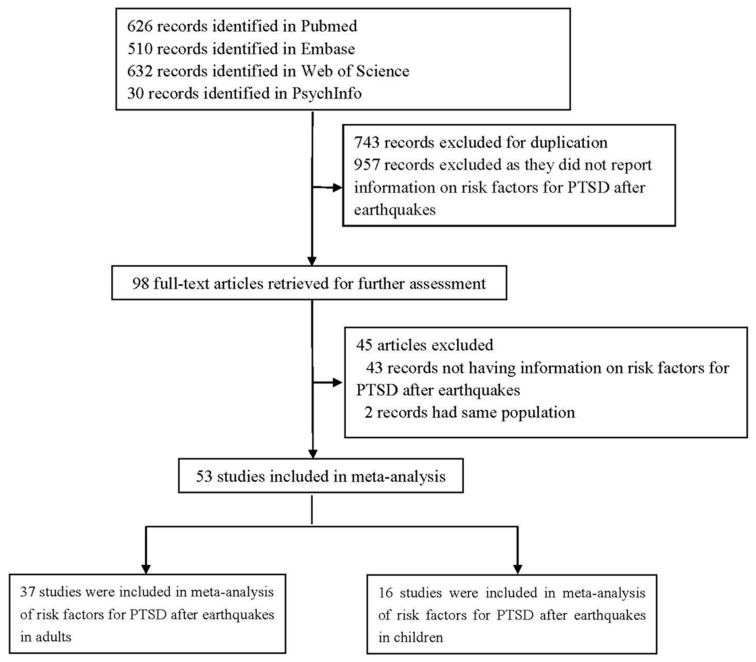
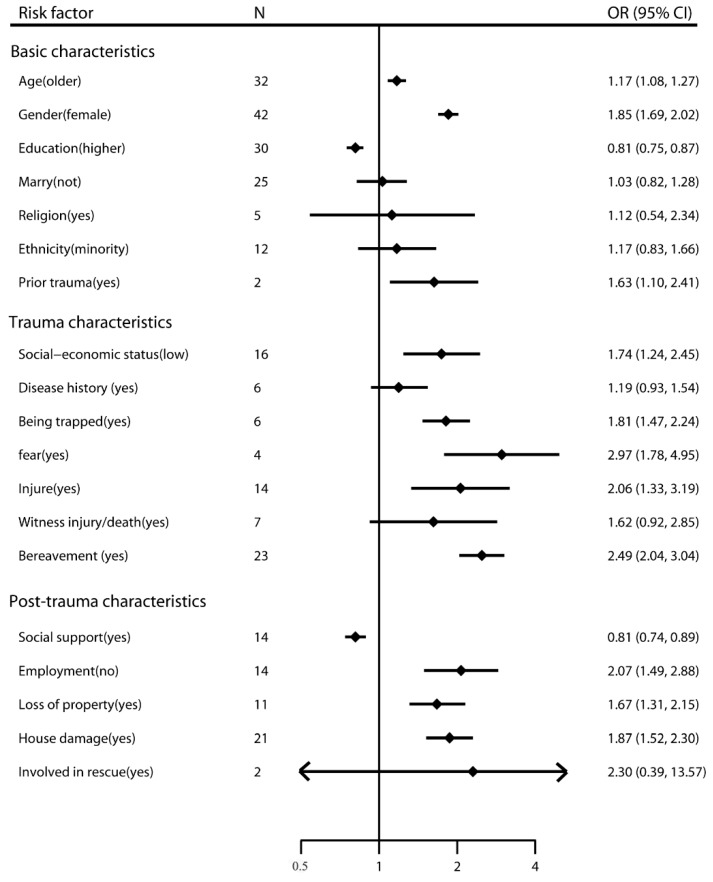
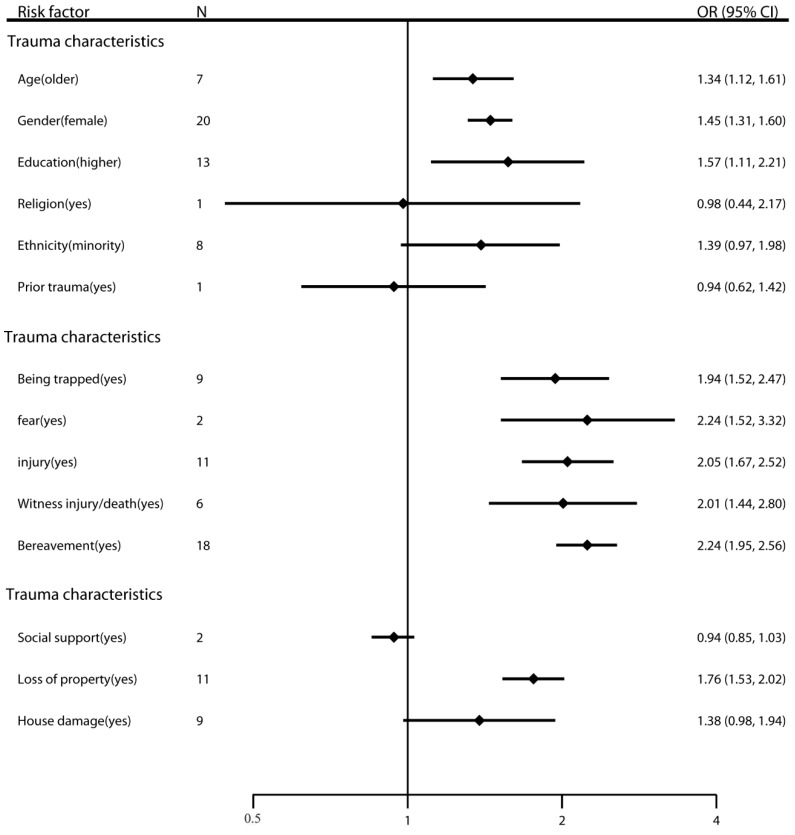
PTSD is considered the most common negative psychological reactions among survivors following an earthquake. The present study sought to find out the determinants of PTSD in earthquake survivors using a systematic meta-analysis. Four electronic databases (PubMed, Embase, Web of Science, and PsycInfo) were used to search for observational studies about PTSD following earthquakes. The literature search, study selection, and data extraction were conducted independently by two authors. 52 articles were included in the study. Summary estimates, subgroup analysis, and publication bias tests were performed on the data. The prevalence of PTSD after earthquakes ranged from 4.10% to 67.07% in adults and from 2.50% to 60.00% in children. For adults, the significant predictors were being female, low education level or socio-economic status, prior trauma; being trapped, experiencing fear, injury, or bereavement during the disaster. For children, the significant predictors were being older age, high education level; being trapped, experiencing fear, injury, or bereavement, witnessing injury/death during the earthquakes. Our study provides implications for the understanding of risk factors for PTSD among earthquake survivors. Post-disaster mental health recovery programs that include early identification, on-going monitoring, and sustained psychosocial support are needed for earthquake survivors.
Overview
The claims and statistics of this paper haven’t been checked yet.
Free: it reads the open-access text and checks the first 5 claims that cite a source we can check. Create a free account to check every claim.
Integrity signals
Registry
Cites
Statistics
Figures
Verification
Claims the paper makes
The claims and statistics of this paper haven’t been checked yet.
Free: it reads the open-access text and checks the first 5 claims that cite a source we can check. Create a free account to check every claim.
Claims other papers make about this one
Each is checked against this paper’s own text: does it say what the citing paper says it does?
The source backs part of the claim, not all of it — or backs it for a different population, condition or comparison.
In the citing paper
“Around the world, earthquake survivors exhibit elevated rates of post-traumatic stress disorder (PTSD), depression, anxiety, and other stress-related symptoms in the months and years following the event (2).”
From Coping strategies and psychological outcomes following the 2023 Kahramanmaraş earthquakes: a systematic review with meta-analytic synthesis (2026) · cites this paper as [2]
Experimental — accuracy not yet measured
Self-check
Percentages, sums and reported differences re-computed from the paper’s own numbers.
The self-check needs the paper’s full text.
Citations
Cites
Diagnostic and Statistical Manual of Mental Disorders
American Psychiatric Association (2013) · doi:10.1176/appi.books.9780890425596 · Cited by 116,369
Measuring inconsistency in meta-analyses
Higgins, J. P. T., Thompson, S. G., Deeks, J. J., & Altman, D. G. (2003) · BMJ · doi:10.1136/bmj.327.7414.557 · Cited by 63,139
Bias in meta-analysis detected by a simple, graphical test
Egger, M., Smith, G. D., Schneider, M., & Minder, C. (1997) · BMJ · doi:10.1136/bmj.315.7109.629 · Cited by 56,722 · cited 1×
“05 were considered statistically publication bias [32].”
Meta-analysis in clinical trials
DerSimonian, R., & Laird, N. (1986) · Controlled Clinical Trials · doi:10.1016/0197-2456(86)90046-2 · Cited by 39,552 · cited 1×
“A random-effects model [30] which assumes that the real potential effect varies among included studies, was used to estimate the pooled RRs with 95% CIs.”
MethodMeta-analysis of risk factors for posttraumatic stress disorder in trauma-exposed adults
Brewin, C. R., Andrews, B., & Valentine, J. D. (2000) · Journal of Consulting and Clinical Psychology · doi:10.1037/0022-006x.68.5.748 · Cited by 5,243 · cited 1×
“These have focused on different kinds of populations such as trauma-exposed adults [21], rescue workers [22], HIV-positive women [23], refugees and internally displaced persons [24], military personnel, and veterans [25].”
BackgroundPredictors of posttraumatic stress disorder and symptoms in adults: a meta-analysis
Ozer, E. J., Best, S. R., Lipsey, T. L., & Weiss, D. S. (2003) · Psychological Bulletin · doi:10.1037/0033-2909.129.1.52 · Cited by 3,322 · cited 1×
“[19] conducted a meta-analysis on seven separate predictors from 68 studies for PTSD among adults.”
MethodPorter, M., & Haslam, N. (2005) · JAMA · doi:10.1001/jama.294.5.602 · Cited by 1,793 · cited 1×
“These have focused on different kinds of populations such as trauma-exposed adults [21], rescue workers [22], HIV-positive women [23], refugees and internally displaced persons [24], military personnel, and veterans [25].”
BackgroundPredictors of posttraumatic stress disorder and symptoms in adults: A meta-analysis.
Ozer, E. J., Best, S. R., Lipsey, T. L., & Weiss, D. S. (2008) · Psychological Trauma: Theory, Research, Practice, and Policy · doi:10.1037/1942-9681.s.1.3 · Cited by 1,247
A meta-analysis of risk factors for post-traumatic stress disorder in children and adolescents
Trickey, D., Siddaway, A. P., Meiser-Stedman, R., Serpell, L., & Field, A. P. (2012) · Clinical Psychology Review · doi:10.1016/j.cpr.2011.12.001 · Cited by 828 · cited 1×
“estimated the population effect sizes of 25 potential risk factors for PTSD in children and adolescents aged 6–18 years across 64 studies (n = 32,238) [20].”
BackgroundBerger, W., Coutinho, E. S. F., Figueira, I., Marques-Portella, C., Luz, M. P., Neylan, T. C., Marmar, C. R., & Mendlowicz, M. V. (2012) · Social Psychiatry and Psychiatric Epidemiology · doi:10.1007/s00127-011-0408-2 · Cited by 712 · cited 1×
“These have focused on different kinds of populations such as trauma-exposed adults [21], rescue workers [22], HIV-positive women [23], refugees and internally displaced persons [24], military personnel, and veterans [25].”
Background
Research works printed but not linked: 2
- Celiac Disease Evidence Reports/Technology Assessments NAD Available online: http://www.ncbi.nlm.nih.gov/books/NBK35156 (accessed on 18 July 2016)
- Wells G.A. Shea B.J. O’Connell D. Peterson J.E. Welch V. Losos M. Tugwell P. The Newcastle–Ottawa Scale (NOS) for Assessing the Quality of Non-Randomized Studies in Meta-Analysis Appl. Eng. Agric. 2014 18 727 734
Cited by
Items 301–327 of 327
Baskiran, D. Y., & Bayır, B. (2026) · BMC Psychology · doi:10.1186/s40359-026-04855-1
“…results align with previous research showing that fear, exposure to material and life losses, gender (e.g., being female), prior trauma, traumatic dis‑ tress, lack of social support, age extremes, and low edu‑ cational level are associated with PTSD, depression, and anxiety symptoms [22, 24–26].”
InfluentialÖzarslan, S., & Günay, U. (2026) · Journal of Child Health Care · doi:10.1177/13674935261457657
Forresi, B., Oppo, A., Misitano, A., Barbieri, A., Koenen, K. C., & Korte, K. J. (2026) · Journal of Traumatic Stress · doi:10.1002/jts.70088 · Cited by 1
Twin, T. M., Htike, K. M., Soe, K. M., & Mahato, R. K. (2026) · Health Science Reports · doi:10.1002/hsr2.72683
“This is consistent with meta‐analytic studies which document that displacement and residence in temporary shelters significantly elevate the risk of anxiety and PTSD in post‐earthquake populations [31].”
Demirkol, H., & Baysal, E. (2026) · European Journal of Trauma & Dissociation · doi:10.1016/j.ejtd.2026.100713
Hannoun, M., Harsi, E. M. E., Benksim, A., & Cherkaoui, M. (2026) · Healthcare · doi:10.3390/healthcare14121787
“This association may be explained by direct exposure to death and the disruption of attachment bonds, both of which may increase psychological vulnerability [19,58].”
InfluentialPost-disaster psychological effects: identifying earthquake-induced trauma in athletes
UĞURLU, F. M., GÜLER, M., ALBAYRAK, V., & Aygören, C. (2026) · Frontiers in Psychology · doi:10.3389/fpsyg.2026.1804335
“A meta-analysis reviewing 52 studies generally indicated the presence of post-traumatic stress disorder in individuals who experienced earth-quakes (Tang et al., 2017).”
Watanabe, Y., Nomura, J., Watanabe, A., Sugano, K., Funami, Y., Sato, T., Yabuki, S., & Hayashi, T. (2026) · FUKUSHIMA JOURNAL OF MEDICAL SCIENCE · doi:10.5387/fms.26-00005
Liang, Y., Ni, Z., Xu, J., Xu, S., Wei, C., Peng, Y., & Xi, J. (2026) · Journal of Affective Disorders · doi:10.1016/j.jad.2026.122177
Arslan, N. (2026) · Nutrition and Health · doi:10.1177/02601060261464033
Albuaini, S., Najjar, M., Mustafa, Y., Hasan, M., Tawfik, M. I. Y., & Saeed, L. (2026) · Journal of International Medical Research · doi:10.1177/03000605261464268
“6,9,69 Experiencing suicidal thoughts was associated with signi fi cantly increased odds of developing PTSD compared with participants who did not have such thoughts (OR: 2.159; p < 0.001).”
InfluentialEmotional and behavioral impacts of the 2023 Turkey earthquake on children: A qualitative study
Yıldırım, F., Mert, Z. T., & POYRAZ, Ş. A. (2026) · Children and Youth Services Review · doi:10.1016/j.childyouth.2026.109168
The role of psychological inflexibility on post-traumatic stress symptoms among COVID-19 survivors
KARAKUŞ, K., Kuru, T., Karakuş, S., & Doğan, V. (2026) · BMC Psychology · doi:10.1186/s40359-026-05228-4
Syukri, U., & Harakan, A. (2026) · Sustainable Future Reports · doi:10.62503/sfr.1.1.1-17
Erbay, M. F., Karan, P., Karayağmurlu, A., & Soylu, N. (2026) · Istanbul University Journal of Health Sciences Research · doi:10.26650/iujhsr2026-1913115
Mwana, E. M., Katalambula, L. K., Emidi, B., & Nyundo, A. (2026) · medRxiv · doi:10.64898/2026.09.01.26361894
Zhang, X., Liu, W., Chen, L., Zuo, C., Lan, H., Li, L., Kemp, G. J., Lui, S., Suo, X., & Gong, Q. (2026) · Psychological Medicine · doi:10.1017/s0033291726105388
“Given the high risk of developing PTSD in females (Tang et al., 2017), and the potential dependency of stress – brain associations on the timing of adverse experiences (Siehl et al., 2022), we (iii) analyzed interactions between sex/age and PTSD diagnosis.”
Psychometric properties of the child posttraumatic stress symptom scale–parent form (C-PTSS-PF)
Kurt, M. B., Kaya, İ., Yıldırım, İ., & Çekiç, A. (2026) · Scientific Reports · doi:10.1038/s41598-026-70670-8
Matzek, T., Fortin, C. A., & Guay, S. (2026) · Journal of Interpersonal Violence · doi:10.1177/08862605261485220
Zampieri, A. M. F., & Cossani, V. D. P. (2026) · Revista Brasileira de Terapia Familiar · doi:10.60114/rbtf.v14.167
Çetinkaya, Ş. Ş., & Aydın, N. (2026) · Eurasian Journal of Family Medicine · doi:10.33880/ejfm.2026150306
Fonte, J., Martins, A. Q., Torres, N., & Ferrajão, P. C. (2026) · Behavioral Sciences · doi:10.3390/bs16101801
“Moreover, pre-existing mental health conditions are often associated with alterations in stress responses, which may further affect adaptation to climate-related challenges (Tang et al., 2017; Yakubu et al., 2026).”
Kriengtuntiwong, T., Tantirangsee, N., Eiamsukawat, K., Rattanawat, W., Phoongarm, N., & Seehanoo, R. (2024) · Journal of Mental Health of Thailand - วารสารสุขภาพจิต แห่งประเทศไทย
Arslan, S. C., Altun, H., Soylu, S., Daş, K. Y., Demir, E., Taş, F. D., Islah, E. M., Gürbüz, A. A., & Doğaner, A. (2026) · Current Psychology · doi:10.1007/s12144-026-10135-3
“CPTS-RI scores were also positively correlated with age, with older adolescents exhibiting higher PTSD scores; consistent with some prior work (Tang et al., 2017; Zhang & Ho, 2011) but not with a study conducted within six months of this same earthquake, which found higher symptom levels among…”
InfluentialBeyond exposure: institutional response, resilience, and mental health after the 2024 Spanish floods
Collazo‐Castiñeira, P., Collado, S., Garrido‐Hernansaiz, H., Sánchez-Izquierdo, M., & Rodríguez‐Rey, R. (2026) · International Journal of Disaster Risk Reduction · doi:10.1016/j.ijdrr.2026.106517
Kurt, A., Namlı, Z., Tamam, L., Demirkol, M. E., Karaytuğ, M. O., Yeşiloğlu, C., Demirtaş, S. Ç., & Sabahi, İ. S. (2026) · Psikiyatride Guncel Yaklasimlar - Current Approaches in Psychiatry · doi:10.18863/pgy.2017674
Yang, M., Cao, R., Guan, Y., Zhao, H., Wang, R., Wang, W., Ji, L., Liu, Y., & Qu, C. (2026) · Behavioral Sciences · doi:10.3390/bs16112058
Metadata
- Authors
- Tang, B., Deng, Q., Glik, D., Dong, J., & Zhang, L.
- Affiliations
- Second Military Medical University (CN)
- University of California, Los Angeles (US)
- Corresponding author
- Zhang, Lulu
- Venue
- International Journal of Environmental Research and Public Health
- Publisher
- MDPI AG
- Published
- 2017-12-08
- Volume
- 14
- Issue
- 12
- Pages
- 1537
- ISSN
- 1660-4601 (ISSN-L)
- PMC
- PMC5750955
- OpenAlex
- W2772695515
- Cited by
- 299
- References
- 75
- Citations by year
- 2026: 43 · 2025: 72 · 2024: 39 · 2023: 32 · 2022: 25 · 2021: 45 · 2020: 27 · 2019: 10 · 2018: 6
- FWCI
- 1.80
- Type
- journal article
- Language
- en
- Open access
- gold
- doi.org
- Licence
- Locations
- International Journal of Environmental Research and Public Health (publishedVersion, cc-by)
- PubMed Central (publishedVersion, cc-by)
- PubMed (publishedVersion)
- RePEc: Research Papers in Economics (submittedVersion)
- DOAJ (DOAJ: Directory of Open Access Journals) (submittedVersion)
- eScholarship (California Digital Library) (submittedVersion)
- eScholarship (California Digital Library) (submittedVersion, cc-by)
- Funders
- National Natural Science Foundation of China (71573270, 71303249, 91224005, 71774167)
- Topics
- Social Sciences › Psychology › Clinical Psychology › Posttraumatic Stress Disorder Research
- Health Sciences › Health Professions › Emergency Medical Services › Disaster Response and Management
- Social Sciences › Psychology › Clinical Psychology › Migration, Health and Trauma
- Keywords
- post-traumatic stress disorder, earthquake survivors, risk factors, children, adults, disaster mental health, PTSD prevalence, gender differences, socioeconomic status, prior trauma, bereavement, psychosocial support
- MeSH terms
- Adult, Bereavement, Child, Fear, Female, Grief, Humans, Male, Risk Factors, Social Class, Socioeconomic Factors, Stress Disorders, Post-Traumatic, Prevalence, Survivors, Risk Assessment, Earthquakes
About these checks
Registry, retraction, Cites and statistics results are computed, not judged, with one exception: a printed reference that no index lists is read once by a model before it counts as a citation error. Claims are extracted by a model and kept only when their quote appears verbatim in the text; each cited source is then checked, with a model’s help, for whether it says what the claim relies on. Those verdicts can be wrong — read the claim’s quote and the cited source before relying on one.
Statistics and arithmetic are recomputed, not judged.
Confidence bands are shown only for fields calibrated on our annotated test set. None is calibrated yet, so no band is shown.
What counts as a claim ›How we measure confidence ›How we check this ›
Are you an author, or do you see a problem with this page? Request a review
Data sources
Bibliographic data: Semantic Scholar, OpenAlex, Crossref.
Contains information from the Semantic Scholar Academic Graph Datasets, made available under the ODC Attribution License (ODC-BY 1.0).
Semantic Scholar’s data is described in: Kinney, R., et al. (2023). The Semantic Scholar Open Data Platform. arXiv:2301.10140.
