

Fear of Missing Out as a Predictor of Problematic Social Media Use and Phubbing Behavior among Flemish Adolescents
Open accessThe DOI matches its Crossref record; 58 of the 58 references it cites were found in a registry or an index.
Abstract
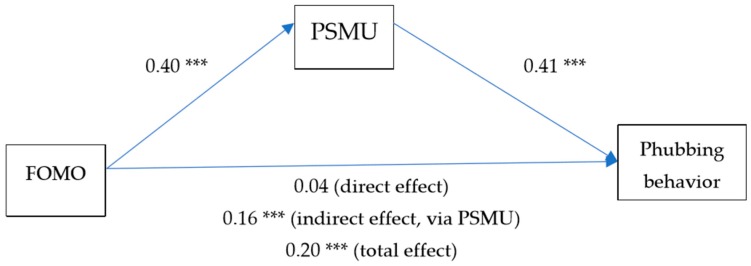
Fear-of-missing-out (FOMO) refers to feelings of anxiety that arise from the realization that you may be missing out on rewarding experiences that others are having. FOMO can be identified as an intra-personal trait that drives people to stay up to date of what other people are doing, among others on social media platforms. Drawing from the findings of a large-scale survey study among 2663 Flemish teenagers, this study explores the relationships between FOMO, social media use, problematic social media use (PSMU) and phubbing behavior. In line with our expectations, FOMO was a positive predictor of both how frequently teenagers use several social media platforms and of how many platforms they actively use. FOMO was a stronger predictor of the use of social media platforms that are more private (e.g., Facebook, Snapchat) than platforms that are more public in nature (e.g., Twitter, Youtube). FOMO predicted phubbing behavior both directly and indirectly via its relationship with PSMU. These findings support extant research that points towards FOMO as a factor explaining teenagers’ social media use.
Overview
The claims and statistics of this paper haven’t been checked yet.
Free: it reads the open-access text and checks the first 5 claims that cite a source we can check. Create a free account to check every claim.
Integrity signals
Registry
Cites
Statistics
Figures
Verification
Claims the paper makes
The claims and statistics of this paper haven’t been checked yet.
Free: it reads the open-access text and checks the first 5 claims that cite a source we can check. Create a free account to check every claim.
Claims other papers make about this one
Each is checked against this paper’s own text: does it say what the citing paper says it does?
In the citing paper
“For example, social network addiction is positively related to FOMO (Franchina et al., 2018; Gezgin, 2018), and this relation is mediated by feelings of envy (Yin et al., 2019).”
From Centennials, FOMO, and loneliness: an investigation of the impact of social networking and messaging/voip apps usage during the initial stage of the coronavirus pandemic (2021) · cites this paper as Franchina et al., 2018
Self-check
Percentages, sums and reported differences re-computed from the paper’s own numbers.
The self-check needs the paper’s full text.
Citations
Cites
The theory of planned behavior
Ajzen, I. (1991) · Organizational Behavior and Human Decision Processes · doi:10.1016/0749-5978(91)90020-t · Cited by 90,587
Intrinsic Motivation and Self-Determination in Human Behavior
Deci, E. L., & Ryan, R. M. (1985) · doi:10.1007/978-1-4899-2271-7 · Cited by 26,772 · cited 1×
“[8], FOMO originates from psychological deficits in people’s competence and relatedness needs [9].”
BackgroundThe need to belong: Desire for interpersonal attachments as a fundamental human motivation.
Baumeister, R. F., & Leary, M. R. (1995) · Psychological Bulletin · doi:10.1037//0033-2909.117.3.497 · Cited by 23,245 · cited 1×
“This desire, which is grounded in people’s need to belong, is an innate and fundamental motivation which humans have [14].”
BackgroundUsers of the world, unite! The challenges and opportunities of Social Media
Kaplan, A. M., & Haenlein, M. (2010) · Business Horizons · doi:10.1016/j.bushor.2009.09.003 · Cited by 17,875 · cited 4×
“0, and that allow the creation and exchange of User Generated Content” [15,16], offer a place where users can keep in touch with their social circles.”
BackgroundMethodInfluentialSocial network sites: definition, history, and scholarship
boyd, D. M., & Ellison, N. B. (2007) · Journal of Computer-Mediated Communication · doi:10.1111/j.1083-6101.2007.00393.x · Cited by 16,251
Making sense of cronbach’s alpha.
Tavakol, M., & Dennick, R. (2011) · International Journal of Medical Education · doi:10.5116/ijme.4dfb.8dfd · Cited by 15,126
Possessions and the Extended Self
Belk, R. W. (1988) · Journal of Consumer Research · doi:10.1086/209154 · Cited by 9,064 · cited 2×
“In addition to the personal mind and physical body, the Self can be thought to include people, places, physical possessions, as well as affiliation groups to which a person feels attached [19].”
BackgroundTests for comparing elements of a correlation matrix
Steiger, J. H. (1980) · Psychological Bulletin · doi:10.1037/0033-2909.87.2.245 · Cited by 4,621 · cited 2×
“Next, we calculated the Pearson correlation coefficients, which form the input for the Steiger’s Z-test.”
MethodKim, H.-Y. (2013) · Restorative Dentistry & Endodontics · doi:10.5395/rde.2013.38.1.52 · Cited by 4,035 · cited 2×
“Advised critical values for skewness, respectively kurtosis in large samples are 2, respectively 7 [56].”
BackgroundMethodMotivational, emotional, and behavioral correlates of fear of missing out
Przybylski, A. K., Murayama, K., DeHaan, C. R., & Gladwell, V. (2013) · Computers in Human Behavior · doi:10.1016/j.chb.2013.02.014 · Cited by 3,932 · cited 3×
“FOMO refers to the “pervasive apprehension that others might be having rewarding experiences from which one is absent” [8].”
BackgroundMethod
Research works printed but not linked: 6
- Katz E. Blumler J.G. The Uses of Mass Communications: Current Perspectives on Gratifications Research Sage Publications Beverly Hills, CA, USA 1974
- Griffiths M.D. Kuss D.J. Adolescent Social Media Addiction (revised) Educ. Health 2017 35 49 52
- Meerkerk G. Pwned by the Internet Explorative research into the causes and consequences of compulsive internet use Ph.D. Thesis Erasmus University Rotterdam, The Netherlands 2007
- Allen I.E. Seaman C.A. Likert scales and data analyses Qual. Prog. 2007 40 64 65
- Hayes A.F. Introduction to Mediation, Moderation, and Conditional Process. Analysis Guilford Press New York, NY, USA 2013
- Beck A.T. Cognitive therapy of depression: New perspectives Treatment of Depression: Old Controversies and New Approaches Clayton P.J. Barrett J.E. Raven Press New York, NY, USA 1983 265 290
Cited by
Items 201–300 of 411
Brand, V. A. G., & Gélvez-García, L. E. (2022) · Revista Estudios Psicológicos · doi:10.35622/j.rep.2022.04.001 · Cited by 23
Üzer, A., & Gürsoy, B. K. (2022) · Kocatepe tıp dergisi. · doi:10.18229/kocatepetip.976765 · Cited by 7
Yossatorn, Y., Binali, T., Weng, C., & Chu, R. J. (2023) · SAGE Open · doi:10.1177/21582440231192951 · Cited by 8
“…approach engage in activities, such as sharing and exchanging information, to compensate for their negative feelings (e.g., anxiety, disappointment, fear of missing out) (Fang et al., 2020; Franchina et al., 2018; Kaufmann & Peil, 2020), and improve psychological well-being (Shensa et al., 2020).”
BackgroundDou, K., Wang, M.-L., Li, Y.-Y., Yuan, X., & Wang, L. (2024) · International Journal of Mental Health and Addiction · doi:10.1007/s11469-024-01304-1 · Cited by 11
“The seven-item Chinese version of the Problematic Social Media Use Scale (Franchina et al., 2018) was used to assess students’ problematic social media use (e.g., “How frequently do you find it difficult to quit using social media”).”
Social Network Sites Usage and Fear of Missing Out among Female Instagram User
Munawaroh, E., Nurmalasari, Y., & Sofyan, A. (2020) · International Seminar on Guidance and Counseling (ISGC) · doi:10.2991/assehr.k.200814.031 · Cited by 6
The fear in desire: linking desire thinking and fear of missing out in the social media context
Brandtner, A., & Wegmann, E. (2023) · BMC Psychology · doi:10.1186/s40359-023-01216-0 · Cited by 7
“Other than that, the identification and modification of online-specific FoMO as part of the emergence of craving might also prevent phubbing [57-59] which, apart from problematic SNS use being primarily harmful to the individual, also brings along a detriment to social interactions.”
BackgroundMEREDUKSI PERILAKU PHUBBING MELALUI KONSELING KELOMPOK REALITA BERBASIS ISLAMI
Kadafi, A., Pratama, B. D., Suharni, S., & Mahmudi, I. (2020) · JBKI (Jurnal Bimbingan Konseling Indonesia) · doi:10.26737/jbki.v5i2.1721 · Cited by 29
Kerse, G., Deniz, V., & Çakıcı, A. B. (2025) · SAGE Open · doi:10.1177/21582440251337617 · Cited by 8
“Excessive smartphone and social media use, as well as alcohol use (Elhai, Yang, Rozgonjuk, & Montag, 2020; Franchina et al., 2018; Riordan et al., 2015) are also associated with different negative behavioral outcomes that can be addictive.”
Türk, N., Batmaz, H., Kaya, A., & Yıldırım, M. (2025) · Psihologija · doi:10.2298/psi230308035t · Cited by 5
de Casteele, M. V., Flamant, N., Morbée, S., van den Bogaard, D., & Vansteenkiste, M. (2025) · Computers in Human Behavior · doi:10.1016/j.chb.2025.108843 · Cited by 6
Casingcasing, M. L., Nuyens, F., Griffiths, M. D., & Park, M. S. (2022) · Journal of Technology in Behavioral Science · doi:10.1007/s41347-022-00289-9 · Cited by 12
Güneş, E., & Ekmekçi, Z. (2024) · Yuksekogretim Dergisi · doi:10.53478/yuksekogretim.1494222 · Cited by 7
“In addition, adolescents with high FOMO levels also have high SMA levels (Franchina et al., 2018).”
Adults social media addiction and phubbing latent profiles and authenticity as outcome
Kırksekiz, A., Yıldız, M., Kıyıcı, M., Emrem, M., Koroglu, S., & Yıldız, M. (2025) · BMC Psychology · doi:10.1186/s40359-025-02858-y · Cited by 7
“Fear of missing out (FOMO) and problematic social media use have been identified as significant predictors of phubbing behavior, suggesting that individuals may prioritize online interactions over face-to-face connections [65, 66].”
Undergraduate Nursing Students' Stress and Fear of Missing Out
Aktura, S. Ç., Özden, G., & Sarıtaş, S. Ç. (2021) · Journal of Nursing Education · doi:10.3928/01484834-20210729-02 · Cited by 6
Gugushvili, N., Täht, K., Rozgonjuk, D., Raudlam, M., Ruiter, R. A. C., & Verduyn, P. (2020) · Cyberpsychology Journal of Psychosocial Research on Cyberspace · doi:10.5817/cp2020-3 · Cited by 5
Depression and Anxiety in the Context of Digital Media
Moreno, M. A., & Jolliff, A. F. (2022) · Cambridge University Press eBooks · doi:10.1017/9781108976237.013 · Cited by 9
Perilaku Phone Snubbing (Phubbing) pada Generasi X, Y, dan Z
Najah, M., Fadilah, A. F., Rachmi, I., & Iskandar, I. (2023) · Intuisi : Jurnal Psikologi Ilmiah · doi:10.15294/intuisi.v14i2.38883 · Cited by 28
Parental Attachment and Fear of Missing Out among Chinese Adolescents: A Moderated Mediation Model
Wang, Y., Li, T., Peng, C., & Wu, H. (2024) · Journal of Child and Family Studies · doi:10.1007/s10826-023-02778-8 · Cited by 6
Topal, M., Avcı, Ş. K., & İstanbullu, A. (2024) · Milli Eğitim Dergisi · doi:10.37669/milliegitim.1260083 · Cited by 6
Understanding FoMO: implications for hospitality and tourism industries
Alisherovna, D. N., & Kim, H. (2025) · Current Issues in Tourism · doi:10.1080/13683500.2025.2498596 · Cited by 10
“The rise of social networking sites (SNS) and the increasing focus on well-being have brought the concept of Fear of Missing Out (FoMO) to the forefront of research, particularly in the context of social media use (Ahmed et al., 2023, p. 202; Franchina et al., 2018).”
GELİŞMELERİ KAÇIRMA KORKUSU (FoMO) ÜZERİNE BİR GÖZDEN GEÇİRME
Bahadır, E., TOHUMCU, M. U., & Kalender, B. (2022) · Trakya Üniversitesi sosyal bilimler dergisi/Trakya Üniversitesi Sosyal Bilimler dergisi · doi:10.26468/trakyasobed.1075175 · Cited by 7
Phubbing in Millennial Generation: Influence of Fear of Missing Out and Self Control
Hikmah, B. P., Rahaju, S., & Yunanto, T. A. R. (2023) · Journal of Educational Health and Community Psychology · doi:10.12928/jehcp.v1i1.25001 · Cited by 18
Predicting Phubbing Through Machine Learning: A Study of Internet Usage and Health Risks
Yalman, A., Arık, M. A., Kayakuş, M., Karaduman, M., Karaduman, S., Açıkgöz, F. Y., LİVBERBER, T., & Kayan, F. (2025) · Applied Sciences · doi:10.3390/app15031157 · Cited by 4
Peker, A., Cengiz, S., & CİNGİL, T. (2025) · Journal of Psychologists and Counsellors in Schools · doi:10.1177/20556365251342024 · Cited by 6
“Örneğin, Franchina et al. (2018) found that FoMO drives excessive smartphone use and, in turn, phubbing behavior.”
Sende, C., Souček, R., & Ebner, K. (2025) · Computers in Human Behavior Reports · doi:10.1016/j.chbr.2025.100619 · Cited by 6
Büttner, C. M., & Lutz, S. (2025) · Computers in Human Behavior · doi:10.1016/j.chb.2025.108774 · Cited by 12
(2022) · Journal of Innovation and Social Science Research · doi:10.53469/jissr.2022.09(09).23 · Cited by 5
Teorik yaklaşımlar çerçevesinde phubbing
ORHAN, A. T. (2023) · Business Economics and Management Research Journal · doi:10.58308/bemarej.1260128 · Cited by 6
Fear of Missing Out in University Students: A Psychometric Study
Sabir, A. S., & Jabeen, A. (2023) · Annals of King Edward Medical University · doi:10.21649/akemu.v29i2.5432 · Cited by 9
“After content analysis by experts, a list of 48 items was converted into a selfreported measure based on the 4-point Likert Rating Scale, (0) not at all, (1) rarely, (2) sometimes, (3) always.”
MethodPirinçci, E., Karaçorlu, F. N., & Kaya, M. O. (2024) · Archives of Current Medical Research · doi:10.47482/acmr.1382922 · Cited by 6
“Other studies in the literature support this finding (36-39).”
BackgroundResultYap, A. U., Kurniawan, F. L., Pragustine, Y., & Marpaung, C. D. (2024) · Acta Odontologica Scandinavica · doi:10.2340/aos.v83.40776 · Cited by 10
Unplugging the threat: how internet addiction among adolescents undermines learning behavior
Islam, M. R. (2024) · SN Social Sciences · doi:10.1007/s43545-024-00966-x · Cited by 11
“This can lead to a cycle of continuous online engagement, reinforcing social isolation in the real world (Franchina et al. 2018).”
Huțul, T., Mațcu-Zaharia, M., Huțul, A., & Karner‐Huțuleac, A. (2025) · Psychological Reports · doi:10.1177/00332941241310983 · Cited by 6
“Many of these papers have signaled negative implications of experiencing FOMO as a teenager, such as phubbing behavior (Franchina et al., 2018), stress (Beyens et al., 2016), decreased emotional well-being (Fabris et al., 2020), internet addiction (Rinaldi, 2024), and even risk of binge-drinking…”
Time to BeReal! Exploring users’ well-being in relation to BeReal use duration
Kaňková, J., Stević, A., Binder, A., & Matthes, J. (2025) · New Media & Society · doi:10.1177/14614448251317689 · Cited by 6
“For example, since FoMO has been found to predict the use of private social media (Franchina et al., 2018), and BeReal is designed for communication with close ties, FoMO might predict the adoption of this platform.”
Internet and psychopathology: A complex paradigm
Balhara, Y. P. S., & Singh, S. (2019) · Journal of Mental Health and Human Behaviour · doi:10.4103/jmhhb.jmhhb_28_20 · Cited by 5
The Effect of Individual and Environmental Motivations on YouTuber Followers’ Behavioral Changes
Deveci, F. G., & Ünal, S. (2021) · Istanbul Business Research · doi:10.26650/ibr.2021.51.844527 · Cited by 4
An Empirical Approach on Pre-roll Advertising through Narrative Ads and FoMO
Çam, M. S. (2020) · Akdeniz Üniversitesi İletişim Fakültesi Dergisi · doi:10.31123/akil.781484 · Cited by 4
Chang, L., Xu, J., Zhang, L., Yin, Y., & Zhang, H. (2025) · The Journal of Genetic Psychology · doi:10.1080/00221325.2025.2522138 · Cited by 4
Şimşek, Ö., & Başaran, B. (2025) · Frontiers in Psychology · doi:10.3389/fpsyg.2025.1510585 · Cited by 7
Nazır, T. (2025) · Anadolu Üniversitesi Eğitim Fakültesi Dergisi · doi:10.34056/aujef.1672999 · Cited by 12
Chen, C., Xiao, Z., & Leung, D. (2025) · Telematics and Informatics · doi:10.1016/j.tele.2025.102323 · Cited by 6
Zhang, J., Ren, L., Wu, Y., Shi, Y., & Liu, J. (2026) · Frontiers in Psychology · doi:10.3389/fpsyg.2026.1763608 · Cited by 4
“The findings indicate that FoMO represents a significant associative pathway linking CPT to SVD. FoMO has been widely recognized as being significantly associated with problematic social media use, smartphone addiction, and SVD (Franchina et al., 2018; Hattingh et al., 2022).”
Bagdady, E., Shahin, E., mohamed, A., & El-said, S. G. (2021) · Port Said Scientific Journal of Nursing · doi:10.21608/pssjn.2021.59431.1081 · Cited by 3
Karataş, İ., Karakoç, E., & Karataş, S. (2024) · Kastamonu İletişim Araştırmaları Dergisi · doi:10.56676/kiad.1533755 · Cited by 4
Motives for Texting During Early Adolescence
Yau, J. C., McPartlan, P., & Reich, S. M. (2021) · Frontiers in Human Dynamics · doi:10.3389/fhumd.2021.602368 · Cited by 4
Rosida, I., Harahap, A. N., Alfiyanti, E., Wattimury, Y. A., & Pratiwi, S. (2022) · E-Journal Syarif Hidayatullah State Islamic University (UIN) Jakarta (Syarif Hidayatullah State Islamic University Jakarta) · doi:10.15408/insaniyat.v6i2.25461
“Thus, when people cannot access their social media accounts, they might feel anxiety because of a fear that they are being socially excluded (Franchina et al. 2018).”
BackgroundZahoor, K. (2022) · Clinical and Counselling Psychology Review · doi:10.32350/ccpr.41.05 · Cited by 3
Trait Self-Control Memoderasi Pengaruh Fear of Missing Out terhadap Prokrastinasi Akademik
Balqis, A. I., & Andina, P. C. (2022) · Psychological Journal Science and Practice · doi:10.22219/pjsp.v2i1.19905 · Cited by 6
Faruk Caner, Y. A. M., & Kumcağız, H. (2023) · MANAS Sosyal Araştırmalar Dergisi · doi:10.33206/mjss.1231104 · Cited by 10
Balancing FOMO and Digital Detoxification
Mewafarosh, R., Agarwal, S., & Dwivedi, D. (2024) · Advances in marketing, customer relationship management, and e-services book series · doi:10.4018/979-8-3693-1107-3.ch001 · Cited by 3
Enginkaya, E., & Sağlam, M. H. (2025) · IEEE Access · doi:10.1109/access.2025.3565127 · Cited by 18
“FoMO was assessed using a 10-item scale developed by Przybylski et al. [7] and further validated by Tandon et al. [81], Hayran et al. [126], Franchina et al. [29], and Li et al. [22].”
InfluentialOral, B., YILDIZ, O., ŞİMŞEK, A., Abrek Zeki, U. R. A. L., Eren Bahadır, A. R. A. S., ASLITÜRK, H., & Çöl, M. (2021) · Celal Bayar Üniversitesi Sağlık Bilimleri Enstitüsü Dergisi · doi:10.34087/cbusbed.885140 · Cited by 3
Fenomena Fear of Missing Out pada Penggemar K-Pop
Marseal, A. P., Fatihah, A. D. A., Lestari, I. A., Christina, S., Wardono, T. S. Z. G., & Cahyono, R. (2022) · Buletin Riset Psikologi dan Kesehatan Mental (BRPKM) · doi:10.20473/brpkm.v2i1.32310 · Cited by 8
Kırık, A., Çetinkaya, A., & Gündüz, U. (2021) · Preprints.org · doi:10.20944/preprints202107.0173.v1 · Cited by 1
“Problematic social media use (PSMU), “is defined as an unhealthy excessive form of social media use, which is characterized by a lack of control over the behavior and continued behavior despite adverse life consequences” [16, 17].”
BackgroundOld Frauds with a New Sauce: Digital Coins and Behavioral ParadigmsPreprint
Dupuis, D., & Gleason, K. C. (2021) · SSRN Electronic Journal · doi:10.2139/ssrn.3904002 · Cited by 6
Impact of Phubbing Behavior on Loneliness: Mediated by Fear of Missing Out among Young Adults
Taj, S., Abbasi, P. N., & Khan, M. (2025) · ACADEMIA International Journal for Social Sciences · doi:10.63056/acad.004.01.0159 · Cited by 5
“Phubbing indicates the action of always remaining connected, and the psychology behind it comes from the impulsion toward this action of compulsively looking into one's smartphones (Roberts & David, 2016; Kushlev et. al., 2019; Franchina et al., 2018).”
When the screen calls: online FoMo as a behavioural and pedagogical problem
Matijašević, B., Penjak, A., & Mališa, S. (2025) · International Journal of Adolescence and Youth · doi:10.1080/02673843.2025.2554284 · Cited by 7
“The strong correlation between internet use – specifically social media use – and FoMo makes this phenomenon a significant predictor of internet and social media addiction (Franchina et al., 2018).”
Mapping Phubbing Research: A 10‐Year Bibliometric Exploration (2014–2024)
Fam, J. Y., Yip, H., Wu, S. L., & Yap, C. C. (2025) · Human Behavior and Emerging Technologies · doi:10.1155/hbe2/6017710 · Cited by 2
Ataç, L. O., Köksal, K., Tetik, H. T., & Gürsoy, A. (2025) · Human Behavior and Emerging Technologies · doi:10.1155/hbe2/8563485 · Cited by 2
Zhou, L., Li, X., & Wang, F. (2025) · Scientific Reports · doi:10.1038/s41598-025-27037-2 · Cited by 4
“Individuals high in FoMO frequently engage in upward social comparison and passive online monitoring, which reduces authentic interpersonal involvement and fosters feelings of exclusion 31,32 .”
Ferdowsi, S., & Moradi, E. (2025) · Acta Psychologica · doi:10.1016/j.actpsy.2025.106081 · Cited by 8
Abudasser, A. M., Al-Garni, A. M., Alamri, H. S., Asiri, W. A., Zarbah, A., Alshahrani, A. S., Badawi, F., Alqahtani, G., Asiri, O. A. S., Almoghamer, H. D., et al. (2026) · Medicine · doi:10.1097/md.0000000000047815 · Cited by 4
“[36] The heavy use of social media, together with its negative impact on body image, may explain the higher rates of BDD in the present study.”
Dijital Hastalıkların Tespitinde Etik Bir Model Önerisi
Aslan, A., & Küçükvardar, M. (2020) · AJIT-e Academic Journal of Information Technology · doi:10.5824/ajit-e.2019.04.001 · Cited by 5
Social Media and Screen Time in the Clinical Interview: What to Ask and What It Means?
Sood, A., & Avari, J. M. (2023) · Springer eBooks · doi:10.1007/978-3-031-24804-7_2 · Cited by 2
Hernandez, C. V., Reyes, R. J. A., Tejada, K. C. M., & Luna, L. R. D. (2022) · International Conference on Education and E-Learning (ICEEL) · doi:10.1145/3578837.3578881 · Cited by 3
Influence of Big 5 Personality Traits on the Use of Social Media
Kothambikar, A. (2023) · Springer eBooks · doi:10.1007/978-3-031-34382-7_4 · Cited by 3
Vlachou, S., & Panagopoulos, M. (2023) · Applied Sciences · doi:10.3390/app131910721 · Cited by 3
Kajian Rintis: Kelaziman dan Akibat Mengalami FOMO dalam Kalangan Warga KUIS
Kasbun, R., Aziz, S. A., & Rahman, N. F. A. (2019) · Malaysian Journal of Information and Communication Technology (MyJICT) · doi:10.53840/myjict4-2-80 · Cited by 3
Rinaldi, M. R. (2024) · Humanitas Indonesian Psychological Journal · doi:10.26555/humanitas.v21i1.580 · Cited by 12
“FoMO has been linked to excessive internet use and the potential for negative impacts on psychological well-being (Elhai et al., 2021; Franchina et al., 2018; Rozgonjuk et al., 2020).”
BackgroundAsuro, D. P. A., & Saloom, G. (2024) · Jurnal Psikologi · doi:10.35760/psi.2024.v17i1.9464 · Cited by 3
Sarıtaş, H., Balcı, Ş., & Solak, E. (2024) · Selçuk Üniversitesi Sosyal Bilimler Enstitüsü Dergisi · doi:10.52642/susbed.1468359 · Cited by 1
Top 50 most cited articles on social media and healthcare: an altmetric analysis
Mukhamediyarov, M., Nurmashev, B., & Bekaryssova, D. (2024) · Central Asian Journal of Medical Hypotheses and Ethics · doi:10.47316/cajmhe.2024.5.3.07 · Cited by 2
“Social media platforms such as Facebook, Instagram, and X (Twitter) have been shown to increase feelings of isolation and the fear of missing out (FoMO), which are linked to adverse mental health outcomes [40].”
BackgroundMorelli, M., Rosati, F., Chirumbolo, A., Baiocco, R., Nappa, M. R., & Cattelino, E. (2024) · Journal of Social and Personal Relationships · doi:10.1177/02654075241303854 · Cited by 5
“…demonstrates FoMO ’ s predictive capacity concerning problematic utilization of social media and online communication (Benzi et al., 2023; Franchina et al., 2018; Gioia et al., 2021; Tomczyk & Szotkowski, 2023), also implying more involvement in online aggressive behaviors, such as…”
Fear of missing out and internet addiction: A survey of dental students
Harorlı, H., & Harorlı, O. T. (2024) · Journal of Dental Education · doi:10.1002/jdd.13809 · Cited by 3
de Menezes, W. J., de Castilho, G. M., & de Souza, W. C. (2025) · Caderno Pedagógico · doi:10.54033/cadpedv22n8-285 · Cited by 3
Shim, S. S., Kim, B., Helsper, C. A., Reas, M., Fisher, R., & Asiegbu, M. (2025) · British Journal of Educational Psychology · doi:10.1111/bjep.70016 · Cited by 2
Husna, S. (2023) · Jurnal Psikologi Sosial · doi:10.7454/jps.2023.03 · Cited by 13
Koululaisten terveys ja muuttuvat haasteet 2022: WHO-Koululaistutkimus 40 vuotta
Gustafsson, J., Kulmala, M., Lahti, H., Lyyra, N., Markkanen, I., Ng, K., Ojala, K., Paakkari, L. T., Paakkari, O., Simonsen, N., et al. (2023) · JYU Reports · doi:10.17011/jyureports/2023/25 · Cited by 36
Putri, T. A. W., & Hapsari, M. T. B. (2024) · Jurnal Consulenza Jurnal Bimbingan Konseling dan Psikologi · doi:10.56013/jcbkp.v7i1.2624 · Cited by 2
“Penelitian lain oleh van Rooij et al., (2018) mengungkapkan hasil dari surve besar-besaran terhadap 2663 remaha Flemish.”
BackgroundElhai, J. D., Yang, H., & Montag, C. (2022) · Debates em Psiquiatria · doi:10.25118/2763-9037.2022.v12.457 · Cited by 7
Social media and adolescent mental health
Charmaraman, L., Delcourt, C. G., Ben-Joseph, E. P., & Smucker, R. (2022) · Elsevier eBooks · doi:10.1016/b978-0-12-818872-9.00171-0 · Cited by 4
Prato, A., & de Andrade, E. A. (2024) · Conhecimento & Diversidade · doi:10.18316/rcd.v16i42.11579 · Cited by 3
Gratitude and Self-Regulation as Predictors of Fear of Missing Out among Generation Z in Indonesia
Damri, R., Oksanda, E., & Rusdi, A. (2024) · PSIKODIMENSIA · doi:10.24167/psidim.v23i1.11979 · Cited by 4
“Meanwhile, FoMO may also increase the risk of problematic behaviors in social media use and phubbing behavior (Coskun & Karayagız Muslu, 2019; Franchina et al., 2018).”
BackgroundPengaruh Perilaku Phubbing terhadap Kompetensi Interpersonal Generasi Z Pengguna Media Sosial
Rahmani, K., Kuntari, C. M. I. S. R., & Zega, T. G. C. (2024) · Humanitas (Jurnal Psikologi) · doi:10.28932/humanitas.v8i2.8818 · Cited by 8
Yuniar, A. D., Danu, R. T., Roziqin, A., & Syahri, M. (2024) · Atlantic Journal of Communication · doi:10.1080/15456870.2024.2433531 · Cited by 5
“This behavior is also positively associated with other intrapersonal traits, including FoMO (Balta et al., 2020; Franchina et al., 2018).”
Mulisa, F., Kejela, M., & Shuku, J. (2025) · Journal of Technology in Behavioral Science · doi:10.1007/s41347-025-00502-5 · Cited by 6
Impacto del síndrome Fomo en la salud mental de los adolescentes: una revisión sistemática
Brand, V. A. G., & Gélvez-García, L. E. (2025) · Pensando Psicología · doi:10.16925/2382-3984.2024.02.03 · Cited by 2
“Además, se ha establecido una conexión entre el uso excesivo de las redes sociales y la manifestación del comportamiento de phubbing (Franchina et al ., 2018; Chi et al ., 2022), así como experimentar el phubbing por parte de los padres (Geng et al ., 2021).”
Üniversite Öğrencilerinde Sosyotelizm (Phubbing) ile Sosyal Kaygı İlişkisinin Değerlendirilmesi
Nalbantoğlu, İ., Turan, S., Koçak, B., & Kocaman, B. (2025) · Batı anadolu eğitim bilimleri dergisi · doi:10.51460/baebd.1586296 · Cited by 1
Doğan, V., Yakut, E., NAZLIOĞLU, S. G., Aydın, A. E., Ayar, B., & Doğan, D. Y. (2025) · SAGE Open · doi:10.1177/21582440251378191 · Cited by 1
“…2016; Fioravanti et al., 2021; Yin et al., 2021), alcohol consumption (Riordan et al., 2015), smartphone use (Coco et al., 2020; Elhai et al., 2021; Franchina et al., 2018; Wolniewicz et al., 2018), narcis-sism (B 1 achnio & Przepio´rka, 2018), well-being (Brown & Kuss, 2020; Reer et al., 2019;…”
Understanding Problematic Social Media Use: Insights Into Telepressure, FMO, Engagement, and Motives
Şahin, F., Doğan, E., Okur, M. R., & Şahin, Y. L. (2025) · Psychological Reports · doi:10.1177/00332941251383495 · Cited by 1
Song, W. (2025) · Child Abuse Review · doi:10.1002/car.70077 · Cited by 4
Fareed, S., & Zülfiqar, N. (2025) · Computers in Human Behavior Reports · doi:10.1016/j.chbr.2025.100906 · Cited by 4
The effect of smombie and phubbing levels on psychological well-being in adolescents
İnci, R., Sağlam, M., Koroglu, S., Oluç, T., Gül, N., & Yıldız, M. (2026) · BMC Psychology · doi:10.1186/s40359-026-04020-8 · Cited by 1
Dongdong, L., & Yuqian, L. (2026) · BMC Medical Education · doi:10.1186/s12909-026-08881-w · Cited by 1
Karakuş, O. B., Cubukcu, H. T., Basli, M., Baltacioglu, D. B. A., ESİN, İ. S., & Dursun, O. B. (2026) · Current Psychology · doi:10.1007/s12144-026-09337-6 · Cited by 1
“This is consistent with socio-cognitive accounts positioning FoMO as a motivational-cognitive state that may co-occur with subsequent behavioral manifestations of problematic engagement in interpersonal contexts (Brand et al., 2019; Franchina et al., 2018; Wegmann et al., 2017).”
Hassan, H. M., Magdy, A., & Salem, I. E. (2026) · Global Knowledge, Memory and Communication · doi:10.1108/gkmc-06-2025-0423 · Cited by 2
Tripopsakul, S. (2026) · International Journal of ADVANCED AND APPLIED SCIENCES · doi:10.21833/ijaas.2026.04.006 · Cited by 7
Alzahrani, F., Raidan, R., Harbi, W. A., Aljutily, S. S., Almuzainy, L., Aljohani, J., Aljohani, E. M., Alrefaei, M., Aljohani, S., Alorfi, Y., et al. (2026) · Frontiers in Psychology · doi:10.3389/fpsyg.2026.1847930 · Cited by 2
Chmiel, M., Cieśluk, M., & Znajdek, J. (2026) · Brain Sciences · doi:10.3390/brainsci16070724 · Cited by 4
The relationship between teacher candidates' fear of missing out levels and behavior on social media
Mıhcı, C., & Gezgin, D. M. (2021) · Journal of Educational Technology and Online Learning · doi:10.31681/jetol.1016364 · Cited by 2
Metadata
- Authors
- Franchina, V., Vanden Abeele, M., Van Rooij, A. J., Lo Coco, G., & De Marez, L.
- Affiliations
- University of Palermo (IT)
- Tilburg School of Humanities and Digital Sciences, Tilburg University, 5037AB Tilburg, The Netherlands
- imec-mict-UGent, Department of Communication Sciences, Ghent University, 9000 Ghent, Belgium
- Department of Psychology and Educational Sciences, University of Palermo, 90133 Palermo, Italy
- Corresponding author
- Franchina, Vittoria
- Venue
- International Journal of Environmental Research and Public Health
- Publisher
- MDPI AG
- Published
- 2018-10-22
- Volume
- 15
- Issue
- 10
- Pages
- 2319
- ISSN
- 1660-4601 (ISSN-L)
- PMC
- PMC6211134
- OpenAlex
- W2800571625
- Cited by
- 411
- References
- 58
- Citations by year
- 2026: 51 · 2025: 60 · 2024: 64 · 2023: 77 · 2022: 61 · 2021: 45 · 2020: 40 · 2019: 13
- FWCI
- 55.63
- Type
- journal article
- Language
- en
- Open access
- gold
- dx.doi.org
- Licence
- Locations
- International Journal of Environmental Research and Public Health (publishedVersion, cc-by)
- Europe PMC (PubMed Central) (publishedVersion, other-oa)
- PubMed Central (publishedVersion, cc-by)
- Research portal (Tilburg University) (publishedVersion, other-oa)
- PubMed (publishedVersion)
- Research portal (Tilburg University) (submittedVersion, cc-by)
- Data Archiving and Networked Services (DANS) (submittedVersion, other-oa)
- Ghent University Academic Bibliography (Ghent University) (submittedVersion, cc-by)
- DOAJ (DOAJ: Directory of Open Access Journals) (submittedVersion, cc-by-sa)
- Nova Science Publishers (Nova Science Publishers, Inc.) (submittedVersion, other-oa)
- Topics
- Social Sciences › Sociology and Political Science › Impact of Technology on Adolescents
- Social Sciences › Communication › Digital Media and Philosophy
- Social Sciences › Education › Child Development and Digital Technology
- Keywords
- fear of missing out, social media addiction, phubbing, adolescents, social media use, social networking sites, Facebook, Snapchat, Twitter, YouTube
- MeSH terms
- Cell Phone Use, Adolescent, Adolescent Behavior, Anxiety, Cross-Sectional Studies, Fear, Female, Humans, Male, Surveys and Questionnaires, Behavior, Addictive, Social Participation, Social Media
About these checks
Registry, retraction, Cites and statistics results are computed, not judged, with one exception: a printed reference that no index lists is read once by a model before it counts as a citation error. Claims are extracted by a model and kept only when their quote appears verbatim in the text; each cited source is then checked, with a model’s help, for whether it says what the claim relies on. Those verdicts can be wrong — read the claim’s quote and the cited source before relying on one.
Statistics and arithmetic are recomputed, not judged.
Confidence bands are shown only for fields calibrated on our annotated test set. None is calibrated yet, so no band is shown.
What counts as a claim ›How we measure confidence ›How we check this ›
Are you an author, or do you see a problem with this page? Request a review
Data sources
Bibliographic data: Semantic Scholar, OpenAlex, Crossref.
Contains information from the Semantic Scholar Academic Graph Datasets, made available under the ODC Attribution License (ODC-BY 1.0).
Semantic Scholar’s data is described in: Kinney, R., et al. (2023). The Semantic Scholar Open Data Platform. arXiv:2301.10140.
