

Fear of Missing Out as a Predictor of Problematic Social Media Use and Phubbing Behavior among Flemish Adolescents
Open accessThe DOI matches its Crossref record; 58 of the 58 references it cites were found in a registry or an index.
Abstract
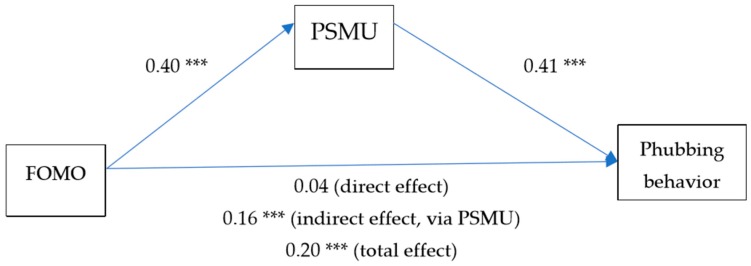
Fear-of-missing-out (FOMO) refers to feelings of anxiety that arise from the realization that you may be missing out on rewarding experiences that others are having. FOMO can be identified as an intra-personal trait that drives people to stay up to date of what other people are doing, among others on social media platforms. Drawing from the findings of a large-scale survey study among 2663 Flemish teenagers, this study explores the relationships between FOMO, social media use, problematic social media use (PSMU) and phubbing behavior. In line with our expectations, FOMO was a positive predictor of both how frequently teenagers use several social media platforms and of how many platforms they actively use. FOMO was a stronger predictor of the use of social media platforms that are more private (e.g., Facebook, Snapchat) than platforms that are more public in nature (e.g., Twitter, Youtube). FOMO predicted phubbing behavior both directly and indirectly via its relationship with PSMU. These findings support extant research that points towards FOMO as a factor explaining teenagers’ social media use.
Overview
The claims and statistics of this paper haven’t been checked yet.
Free: it reads the open-access text and checks the first 5 claims that cite a source we can check. Create a free account to check every claim.
Integrity signals
Registry
Cites
Statistics
Figures
Verification
Claims the paper makes
The claims and statistics of this paper haven’t been checked yet.
Free: it reads the open-access text and checks the first 5 claims that cite a source we can check. Create a free account to check every claim.
Claims other papers make about this one
Each is checked against this paper’s own text: does it say what the citing paper says it does?
In the citing paper
“For example, social network addiction is positively related to FOMO (Franchina et al., 2018; Gezgin, 2018), and this relation is mediated by feelings of envy (Yin et al., 2019).”
From Centennials, FOMO, and loneliness: an investigation of the impact of social networking and messaging/voip apps usage during the initial stage of the coronavirus pandemic (2021) · cites this paper as Franchina et al., 2018
Self-check
Percentages, sums and reported differences re-computed from the paper’s own numbers.
The self-check needs the paper’s full text.
Citations
Cites
The theory of planned behavior
Ajzen, I. (1991) · Organizational Behavior and Human Decision Processes · doi:10.1016/0749-5978(91)90020-t · Cited by 90,587
Intrinsic Motivation and Self-Determination in Human Behavior
Deci, E. L., & Ryan, R. M. (1985) · doi:10.1007/978-1-4899-2271-7 · Cited by 26,772 · cited 1×
“[8], FOMO originates from psychological deficits in people’s competence and relatedness needs [9].”
BackgroundThe need to belong: Desire for interpersonal attachments as a fundamental human motivation.
Baumeister, R. F., & Leary, M. R. (1995) · Psychological Bulletin · doi:10.1037//0033-2909.117.3.497 · Cited by 23,245 · cited 1×
“This desire, which is grounded in people’s need to belong, is an innate and fundamental motivation which humans have [14].”
BackgroundUsers of the world, unite! The challenges and opportunities of Social Media
Kaplan, A. M., & Haenlein, M. (2010) · Business Horizons · doi:10.1016/j.bushor.2009.09.003 · Cited by 17,875 · cited 4×
“0, and that allow the creation and exchange of User Generated Content” [15,16], offer a place where users can keep in touch with their social circles.”
BackgroundMethodInfluentialSocial network sites: definition, history, and scholarship
boyd, D. M., & Ellison, N. B. (2007) · Journal of Computer-Mediated Communication · doi:10.1111/j.1083-6101.2007.00393.x · Cited by 16,251
Making sense of cronbach’s alpha.
Tavakol, M., & Dennick, R. (2011) · International Journal of Medical Education · doi:10.5116/ijme.4dfb.8dfd · Cited by 15,126
Possessions and the Extended Self
Belk, R. W. (1988) · Journal of Consumer Research · doi:10.1086/209154 · Cited by 9,064 · cited 2×
“In addition to the personal mind and physical body, the Self can be thought to include people, places, physical possessions, as well as affiliation groups to which a person feels attached [19].”
BackgroundTests for comparing elements of a correlation matrix
Steiger, J. H. (1980) · Psychological Bulletin · doi:10.1037/0033-2909.87.2.245 · Cited by 4,621 · cited 2×
“Next, we calculated the Pearson correlation coefficients, which form the input for the Steiger’s Z-test.”
MethodKim, H.-Y. (2013) · Restorative Dentistry & Endodontics · doi:10.5395/rde.2013.38.1.52 · Cited by 4,035 · cited 2×
“Advised critical values for skewness, respectively kurtosis in large samples are 2, respectively 7 [56].”
BackgroundMethodMotivational, emotional, and behavioral correlates of fear of missing out
Przybylski, A. K., Murayama, K., DeHaan, C. R., & Gladwell, V. (2013) · Computers in Human Behavior · doi:10.1016/j.chb.2013.02.014 · Cited by 3,932 · cited 3×
“FOMO refers to the “pervasive apprehension that others might be having rewarding experiences from which one is absent” [8].”
BackgroundMethod
Research works printed but not linked: 6
- Katz E. Blumler J.G. The Uses of Mass Communications: Current Perspectives on Gratifications Research Sage Publications Beverly Hills, CA, USA 1974
- Griffiths M.D. Kuss D.J. Adolescent Social Media Addiction (revised) Educ. Health 2017 35 49 52
- Meerkerk G. Pwned by the Internet Explorative research into the causes and consequences of compulsive internet use Ph.D. Thesis Erasmus University Rotterdam, The Netherlands 2007
- Allen I.E. Seaman C.A. Likert scales and data analyses Qual. Prog. 2007 40 64 65
- Hayes A.F. Introduction to Mediation, Moderation, and Conditional Process. Analysis Guilford Press New York, NY, USA 2013
- Beck A.T. Cognitive therapy of depression: New perspectives Treatment of Depression: Old Controversies and New Approaches Clayton P.J. Barrett J.E. Raven Press New York, NY, USA 1983 265 290
Cited by
Items 401–411 of 411
Kim, Y., Dhammasaccakarn, W., Laeheem, K., Rinthaisong, I., & Lila, S. (2026) · Hatyai Academic Journal · doi:10.67884/haj.2026.e278887
From FoMO to clicks: Understanding young people's behavior toward retargeted advertisements
Battista, I. D., Curmi, F., & Konietzny, J. (2026) · Acta Psychologica · doi:10.1016/j.actpsy.2026.107545
Huang, X., Li, L., & Liang, L. (2026) · Current Psychology · doi:10.1007/s12144-026-09930-9
“Large-scale studies among European adolescents have shown that FoMO significantly correlates with adoles - cents’ SMA (Franchina et al., 2018).”
Bargiela, I. M., Carril, P. C. M., Ferreiro, M. L. P., & Irigon, O. C. G. B. (2026) · Research Square · doi:10.21203/rs.3.rs-10484193/v1
Chen, S.-T., & Xu, F.-M. (2026) · Frontiers in Psychiatry · doi:10.3389/fpsyt.2026.1925655
“(4) among Flemish adolescents.”
Budiarto, Y., & Hastuti, R. (2026) · Primenjena psihologija · doi:10.19090/pp.v19i3.2597
Yürük, S. E., Yürük, K. Y., & Türel, Y. K. (2026) · KIRŞEHİR EĞİTİM FAKÜLTESİ DERGİSİ · doi:10.29299/kefad.1939668
Benyahia, M., Aouad, A. B., Mahieddine, A., Cunha, M. N., & Mirčetić, V. (2026) · Tourism and Hospitality · doi:10.3390/tourhosp7100323
Harsh Parenting and Adolescents’ Phubbing Behavior: Depression and Grit Matter
Yin, Y., Chang, L., Tang, Y., & Zhang, H. (2026) · The Journal of Genetic Psychology · doi:10.1080/00221325.2026.2737930
Gu, H., Hu, Y., 钟琦, Cheng, Y., & Fang, J. (2026) · Applied Psychology Health and Well-Being · doi:10.1111/aphw.70242
Analyzing anxiety in decision-making through social media use: the roles of FoMO, FoBO, and FoDA
Corrada, M. S., Ortiz, J. A. F., Dones, V., Marquez, J. B. V., & Mercado, M. C. (2026) · Italian Journal of Marketing · doi:10.1007/s43039-026-00148-y
“Thus, the time spent using social media explains behaviors related to the FoMO phenomenon (Good & Hyman, 2020); in the pursuit of satisfying psychological needs (Osemeahon & Agoyi, 2020), feelings of anxiety become more evident among consumers (Franchina et al., 2018).”
Metadata
- Authors
- Franchina, V., Vanden Abeele, M., Van Rooij, A. J., Lo Coco, G., & De Marez, L.
- Affiliations
- University of Palermo (IT)
- Tilburg School of Humanities and Digital Sciences, Tilburg University, 5037AB Tilburg, The Netherlands
- imec-mict-UGent, Department of Communication Sciences, Ghent University, 9000 Ghent, Belgium
- Department of Psychology and Educational Sciences, University of Palermo, 90133 Palermo, Italy
- Corresponding author
- Franchina, Vittoria
- Venue
- International Journal of Environmental Research and Public Health
- Publisher
- MDPI AG
- Published
- 2018-10-22
- Volume
- 15
- Issue
- 10
- Pages
- 2319
- ISSN
- 1660-4601 (ISSN-L)
- PMC
- PMC6211134
- OpenAlex
- W2800571625
- Cited by
- 411
- References
- 58
- Citations by year
- 2026: 51 · 2025: 60 · 2024: 64 · 2023: 77 · 2022: 61 · 2021: 45 · 2020: 40 · 2019: 13
- FWCI
- 55.63
- Type
- journal article
- Language
- en
- Open access
- gold
- dx.doi.org
- Licence
- Locations
- International Journal of Environmental Research and Public Health (publishedVersion, cc-by)
- Europe PMC (PubMed Central) (publishedVersion, other-oa)
- PubMed Central (publishedVersion, cc-by)
- Research portal (Tilburg University) (publishedVersion, other-oa)
- PubMed (publishedVersion)
- Research portal (Tilburg University) (submittedVersion, cc-by)
- Data Archiving and Networked Services (DANS) (submittedVersion, other-oa)
- Ghent University Academic Bibliography (Ghent University) (submittedVersion, cc-by)
- DOAJ (DOAJ: Directory of Open Access Journals) (submittedVersion, cc-by-sa)
- Nova Science Publishers (Nova Science Publishers, Inc.) (submittedVersion, other-oa)
- Topics
- Social Sciences › Sociology and Political Science › Impact of Technology on Adolescents
- Social Sciences › Communication › Digital Media and Philosophy
- Social Sciences › Education › Child Development and Digital Technology
- Keywords
- fear of missing out, social media addiction, phubbing, adolescents, social media use, social networking sites, Facebook, Snapchat, Twitter, YouTube
- MeSH terms
- Cell Phone Use, Adolescent, Adolescent Behavior, Anxiety, Cross-Sectional Studies, Fear, Female, Humans, Male, Surveys and Questionnaires, Behavior, Addictive, Social Participation, Social Media
About these checks
Registry, retraction, Cites and statistics results are computed, not judged, with one exception: a printed reference that no index lists is read once by a model before it counts as a citation error. Claims are extracted by a model and kept only when their quote appears verbatim in the text; each cited source is then checked, with a model’s help, for whether it says what the claim relies on. Those verdicts can be wrong — read the claim’s quote and the cited source before relying on one.
Statistics and arithmetic are recomputed, not judged.
Confidence bands are shown only for fields calibrated on our annotated test set. None is calibrated yet, so no band is shown.
What counts as a claim ›How we measure confidence ›How we check this ›
Are you an author, or do you see a problem with this page? Request a review
Data sources
Bibliographic data: Semantic Scholar, OpenAlex, Crossref.
Contains information from the Semantic Scholar Academic Graph Datasets, made available under the ODC Attribution License (ODC-BY 1.0).
Semantic Scholar’s data is described in: Kinney, R., et al. (2023). The Semantic Scholar Open Data Platform. arXiv:2301.10140.
