

Fear of Missing Out as a Predictor of Problematic Social Media Use and Phubbing Behavior among Flemish Adolescents
Open accessThe DOI matches its Crossref record; 58 of the 58 references it cites were found in a registry or an index.
Abstract
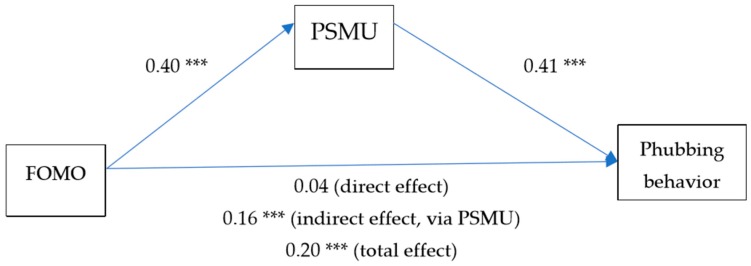
Fear-of-missing-out (FOMO) refers to feelings of anxiety that arise from the realization that you may be missing out on rewarding experiences that others are having. FOMO can be identified as an intra-personal trait that drives people to stay up to date of what other people are doing, among others on social media platforms. Drawing from the findings of a large-scale survey study among 2663 Flemish teenagers, this study explores the relationships between FOMO, social media use, problematic social media use (PSMU) and phubbing behavior. In line with our expectations, FOMO was a positive predictor of both how frequently teenagers use several social media platforms and of how many platforms they actively use. FOMO was a stronger predictor of the use of social media platforms that are more private (e.g., Facebook, Snapchat) than platforms that are more public in nature (e.g., Twitter, Youtube). FOMO predicted phubbing behavior both directly and indirectly via its relationship with PSMU. These findings support extant research that points towards FOMO as a factor explaining teenagers’ social media use.
Overview
The claims and statistics of this paper haven’t been checked yet.
Free: it reads the open-access text and checks the first 5 claims that cite a source we can check. Create a free account to check every claim.
Integrity signals
Registry
Cites
Statistics
Figures
Verification
Claims the paper makes
The claims and statistics of this paper haven’t been checked yet.
Free: it reads the open-access text and checks the first 5 claims that cite a source we can check. Create a free account to check every claim.
Claims other papers make about this one
Each is checked against this paper’s own text: does it say what the citing paper says it does?
In the citing paper
“For example, social network addiction is positively related to FOMO (Franchina et al., 2018; Gezgin, 2018), and this relation is mediated by feelings of envy (Yin et al., 2019).”
From Centennials, FOMO, and loneliness: an investigation of the impact of social networking and messaging/voip apps usage during the initial stage of the coronavirus pandemic (2021) · cites this paper as Franchina et al., 2018
Self-check
Percentages, sums and reported differences re-computed from the paper’s own numbers.
The self-check needs the paper’s full text.
Citations
Cites
The theory of planned behavior
Ajzen, I. (1991) · Organizational Behavior and Human Decision Processes · doi:10.1016/0749-5978(91)90020-t · Cited by 90,587
Intrinsic Motivation and Self-Determination in Human Behavior
Deci, E. L., & Ryan, R. M. (1985) · doi:10.1007/978-1-4899-2271-7 · Cited by 26,772 · cited 1×
“[8], FOMO originates from psychological deficits in people’s competence and relatedness needs [9].”
BackgroundThe need to belong: Desire for interpersonal attachments as a fundamental human motivation.
Baumeister, R. F., & Leary, M. R. (1995) · Psychological Bulletin · doi:10.1037//0033-2909.117.3.497 · Cited by 23,245 · cited 1×
“This desire, which is grounded in people’s need to belong, is an innate and fundamental motivation which humans have [14].”
BackgroundUsers of the world, unite! The challenges and opportunities of Social Media
Kaplan, A. M., & Haenlein, M. (2010) · Business Horizons · doi:10.1016/j.bushor.2009.09.003 · Cited by 17,875 · cited 4×
“0, and that allow the creation and exchange of User Generated Content” [15,16], offer a place where users can keep in touch with their social circles.”
BackgroundMethodInfluentialSocial network sites: definition, history, and scholarship
boyd, D. M., & Ellison, N. B. (2007) · Journal of Computer-Mediated Communication · doi:10.1111/j.1083-6101.2007.00393.x · Cited by 16,251
Making sense of cronbach’s alpha.
Tavakol, M., & Dennick, R. (2011) · International Journal of Medical Education · doi:10.5116/ijme.4dfb.8dfd · Cited by 15,126
Possessions and the Extended Self
Belk, R. W. (1988) · Journal of Consumer Research · doi:10.1086/209154 · Cited by 9,064 · cited 2×
“In addition to the personal mind and physical body, the Self can be thought to include people, places, physical possessions, as well as affiliation groups to which a person feels attached [19].”
BackgroundTests for comparing elements of a correlation matrix
Steiger, J. H. (1980) · Psychological Bulletin · doi:10.1037/0033-2909.87.2.245 · Cited by 4,621 · cited 2×
“Next, we calculated the Pearson correlation coefficients, which form the input for the Steiger’s Z-test.”
MethodKim, H.-Y. (2013) · Restorative Dentistry & Endodontics · doi:10.5395/rde.2013.38.1.52 · Cited by 4,035 · cited 2×
“Advised critical values for skewness, respectively kurtosis in large samples are 2, respectively 7 [56].”
BackgroundMethodMotivational, emotional, and behavioral correlates of fear of missing out
Przybylski, A. K., Murayama, K., DeHaan, C. R., & Gladwell, V. (2013) · Computers in Human Behavior · doi:10.1016/j.chb.2013.02.014 · Cited by 3,932 · cited 3×
“FOMO refers to the “pervasive apprehension that others might be having rewarding experiences from which one is absent” [8].”
BackgroundMethod
Research works printed but not linked: 6
- Katz E. Blumler J.G. The Uses of Mass Communications: Current Perspectives on Gratifications Research Sage Publications Beverly Hills, CA, USA 1974
- Griffiths M.D. Kuss D.J. Adolescent Social Media Addiction (revised) Educ. Health 2017 35 49 52
- Meerkerk G. Pwned by the Internet Explorative research into the causes and consequences of compulsive internet use Ph.D. Thesis Erasmus University Rotterdam, The Netherlands 2007
- Allen I.E. Seaman C.A. Likert scales and data analyses Qual. Prog. 2007 40 64 65
- Hayes A.F. Introduction to Mediation, Moderation, and Conditional Process. Analysis Guilford Press New York, NY, USA 2013
- Beck A.T. Cognitive therapy of depression: New perspectives Treatment of Depression: Old Controversies and New Approaches Clayton P.J. Barrett J.E. Raven Press New York, NY, USA 1983 265 290
Cited by
Digital Wellbeing as a Dynamic Construct
Vanden Abeele, M. M. P. (2021) · Communication Theory · doi:10.1093/ct/qtaa024 · Cited by 516
Elhai, J. D., Yang, H., & Montag, C. (2021) · Brazilian Journal of Psychiatry · doi:10.1590/1516-4446-2020-0870 · Cited by 362
“Foram descobertas relações moderadas a grandes, em vários desses estudos que envolvem amostras de crianças e jovens, estudantes universitários e adultos [35, 37, 42-45].”
BackgroundTandon, A., Dhir, A., Almugren, I., AlNemer, G. N., & Mäntymäki, M. (2021) · Internet Research · doi:10.1108/intr-11-2019-0455 · Cited by 315
Fabris, M. A., Marengo, D., Longobardi, C., & Settanni, M. (2020) · Addictive Behaviors · doi:10.1016/j.addbeh.2020.106364 · Cited by 287
Fear of missing out and social networking sites use and abuse: A meta-analysis
Fioravanti, G., Casale, S., Benucci, S. B., Prostamo, A., Falone, A., Ricca, V., & Rotella, F. (2021) · Computers in Human Behavior · doi:10.1016/j.chb.2021.106839 · Cited by 275
Future of Mental Health in the Metaverse
Usmani, S. S., Sharath, M., & Mehendale, M. (2022) · General Psychiatry · doi:10.1136/gpsych-2022-100825 · Cited by 262
Phubbing: Perceptions, reasons behind, predictors, and impacts
Al‐Saggaf, Y., & O'Donnell, S. B. (2019) · Human Behavior and Emerging Technologies · doi:10.1002/hbe2.137 · Cited by 204
Tandon, A., Dhir, A., Talwar, S., Kaur, P., & Mäntymäki, M. (2022) · Technological Forecasting and Social Change · doi:10.1016/j.techfore.2021.121149 · Cited by 198
“Only limited studies concurrently examine smartphone and social media-related problematic behaviour (e.g. Balta et al., 2020; Franchina et al., 2018).”
Fang, J., Wang, X., Wen, Z., & Zhou, J. (2020) · Addictive Behaviors · doi:10.1016/j.addbeh.2020.106430 · Cited by 186
Problematic Social Media Use and Health among Adolescents
Paakkari, L., Tynjälä, J., Lahti, H., Ojala, K., & Lyyra, N. (2021) · International Journal of Environmental Research and Public Health · doi:10.3390/ijerph18041885 · Cited by 169
“, fear of missing out [15,16]), family-level factors (e.”
BackgroundTime Spent on Social Media and Risk of Depression in Adolescents: A Dose–Response Meta-Analysis
Liu, M., Kamper-DeMarco, K. E., Zhang, J., Xiao, J., Dong, D., & Xue, P. (2022) · International Journal of Environmental Research and Public Health · doi:10.3390/ijerph19095164 · Cited by 167
“Therefore, girls are more likely to experience fear of missing out [72] or being harassed [19,20] on social media, which has been associated with risk of depression [28,29].”
BackgroundResearch trends in social media addiction and problematic social media use: A bibliometric analysis
Pellegrino, A., Stasi, A., & Bhatiasevi, V. (2022) · Frontiers in Psychiatry · doi:10.3389/fpsyt.2022.1017506 · Cited by 153
“(43) and Scott and Woods (44), for example, focus their attention on individual-level factors (like fear of missing out) and family-level factors (like childhood abuse) that have been used to explain why people use social media in a harmful way.”
BackgroundJabeen, F., Tandon, A., Sithipolvanichgul, J., Srivastava, S., & Dhir, A. (2023) · Journal of Business Research · doi:10.1016/j.jbusres.2023.113693 · Cited by 244
Fear of missing out (FoMO) and internet use: A comprehensive systematic review and meta-analysis
(2021) · Journal of Behavioral Addictions · doi:10.1556/2006.2021.00083 · Cited by 134
Psychological and behavioral outcomes of social media-induced fear of missing out at the workplace
Tandon, A., Dhir, A., Islam, N., Talwar, S., & Mäntymäki, M. (2021) · Journal of Business Research · doi:10.1016/j.jbusres.2021.07.036 · Cited by 134
“Since scholars have linked compulsive or excessive social media use to FoMO (Franchina et al., 2018; Müller et al., 2020), it is plausible to theorize the association of exhibitionism with this phenomenon.”
Social Media and Youth Mental Health
Weigle, P. E., & Shafi, R. M. A. (2024) · Current Psychiatry Reports · doi:10.1007/s11920-023-01478-w · Cited by 135
“Individuals prone to engaging in reassurance-seeking or passively scrolling SM, often use SM to manage anxiety, but are predisposed to resultant feelings of loneliness, social isolation and rumina-tions [26, 42, 44 • , 45].”
Effects of Phubbing: Relationships With Psychodemographic Variables
Ergün, N., Göksu, İ., & Sakız, H. (2019) · Psychological Reports · doi:10.1177/0033294119889581 · Cited by 186
Yin, L., Wang, P., Nie, J., Guo, J., Feng, J., & Lei, L. (2021) · Current Psychology · doi:10.1007/s12144-019-00344-4 · Cited by 117
Social Media and Fear of Missing Out in Adolescents: The Role of Family Characteristics
Bloemen, N., & De Coninck, D. (2020) · Social Media + Society · doi:10.1177/2056305120965517 · Cited by 116
“Despite these findings, little research has been carried out into the association between parental influence and family structure, and SNS-related FoMO, which has motivated us to adopt an exploratory attitude by analyzing multiple family characteristics.”
BackgroundMethodInfluentialAlabri, A. (2022) · Human Behavior and Emerging Technologies · doi:10.1155/2022/4824256 · Cited by 202
Harriger, J. A., Evans, J. A., Thompson, J. K., & Tylka, T. L. (2022) · Body Image · doi:10.1016/j.bodyim.2022.03.007 · Cited by 115
Throuvala, M. A., Griffiths, M. D., Rennoldson, M., & Kuss, D. J. (2020) · International Journal of Environmental Research and Public Health · doi:10.3390/ijerph17134842 · Cited by 101
Lo Coco, G., Salerno, L., Franchina, V., La Tona, A., Di Blasi, M., & Giordano, C. (2020) · Addictive Behaviors · doi:10.1016/j.addbeh.2020.106360 · Cited by 100
“The experience of social media use via smartphones may be particularly relevant, given that it seems embedded into FoMO in a kind of vicious circle (Casale, Rugai, & Fioravanti, 2018), because the more often adolescents check their social media, the more often they find events on which they are missing out (Franchina…”
BackgroundSelf-citationGelişmeleri Kaçırma Korkusu (FoMO): Güncel Bir Derleme
Tanhan, F., ÖZOK, H. İ., & Tayiz, V. (2022) · Psikiyatride Guncel Yaklasimlar - Current Approaches in Psychiatry · doi:10.18863/pgy.942431 · Cited by 199
Fumagalli, E., Dolmatzian, M. B., & Shrum, L. J. (2021) · Frontiers in Psychology · doi:10.3389/fpsyg.2021.620739 · Cited by 96
“For example, social network addiction is positively related to FOMO (Franchina et al., 2018; Gezgin, 2018), and this relation is mediated by feelings of envy (Yin et al.”
BackgroundAl-Furaih, S. A. A., & Al-Awidi, H. M. (2020) · Education and Information Technologies · doi:10.1007/s10639-020-10361-7 · Cited by 149
Social Media and Distraction: An Experience Sampling Study among Adolescents
Siebers, T., Beyens, I., Pouwels, J. L., & Valkenburg, P. M. (2022) · Media Psychology · doi:10.1080/15213269.2021.1959350 · Cited by 90
Servidio, R., Soraci, P., Griffiths, M. D., Boca, S., & Demetrovics, Z. (2024) · Addictive Behaviors Reports · doi:10.1016/j.abrep.2024.100536 · Cited by 91
“Previous research has established direct and indirect associations between FoMO and PSMU (e.g., Franchina, Vanden Abeele, Van Rooij, Lo Coco, & De Marez, 2018).”
MethodResultBai, Q., Lei, L., Hsueh, F.-H., Yu, X., Hu, H., Wang, X., & Wang, P. (2020) · Journal of Affective Disorders · doi:10.1016/j.jad.2020.03.156 · Cited by 88
Quaglieri, A., Biondi, S., Roma, P., Varchetta, M., Fraschetti, A., Burrai, J., Lausi, G., Vilar, M. M., González‐Sala, F., Domenico, A. D., et al. (2021) · Journal of Clinical Medicine · doi:10.3390/jcm11010188 · Cited by 114
“FoMO-related overuse of SNs [49,63] may manifest in the problematic use of smartphones [64], resulting in a vicious circle [65] whereby frequent and compulsive checking of social media on one’s smartphone may lead individuals to actively seek out events they have missed [57,66].”
BackgroundDennen, V. P., Choi, H., & Word, K. (2020) · Educational Technology Research and Development · doi:10.1007/s11423-020-09796-z · Cited by 79
Sharma, M., Kaushal, D., & Joshi, S. (2023) · Journal of Retailing and Consumer Services · doi:10.1016/j.jretconser.2023.103256 · Cited by 133
Pagano, M., Bacaro, V., & Crocetti, E. (2023) · Computers in Human Behavior · doi:10.1016/j.chb.2023.107813 · Cited by 74
Elhai, J. D., Rozgonjuk, D., Liu, T., & Yang, H. (2020) · Journal of Affective Disorders · doi:10.1016/j.jad.2019.11.026 · Cited by 74
Ergün, N., Özkan, Z., & Griffiths, M. D. (2023) · Psychological Reports · doi:10.1177/00332941231166609 · Cited by 122
“Individuals generally engage in phubbing behavior by checking various social media platforms and playing mobile games while in front of other people in social situations (Franchina et al., 2018; Guazzini et al., 2019).”
Bui, M., Krishen, A. S., Anlamlier, E., & Berezan, O. (2021) · Psychology and Marketing · doi:10.1002/mar.21611 · Cited by 112
“We utilized adult samples; adolescents are more sensitive to FoMO, so it would also be beneficial to examine these relationships with adolescent samples (Beyens et al., 2016; Franchina et al., 2018).”
BackgroundGao, Y., Dai, H., Jia, G., Liang, C., Tong, T., Zhang, Z., Song, R., Wang, Q., & Zhu, Y. (2020) · JMIR mhealth and uhealth · doi:10.2196/13561 · Cited by 77
Throuvala, M. A., Pontes, H. M., Tsaousis, I., Griffiths, M. D., Rennoldson, M., & Kuss, D. J. (2021) · Frontiers in Psychiatry · doi:10.3389/fpsyt.2021.642634 · Cited by 109
“Therefore, experiences of FOMO and NOMO appear to be associated with distraction and may be driving checking behaviors (125), reflecting the cognitive preoccupation and interpersonal attachment via digital devices (10, 68, 126–131).”
Chi, L.-C., Tang, T.-C., & Tang, E. (2022) · Current Psychology · doi:10.1007/s12144-021-02468-y · Cited by 68
“In line with previous studies, this study determined a prominent relationship between social media addiction and habitual phubbing behavior (Karadağ et al., 2015; Franchina et al., 2018; Błachnio & Przepiórka, 2019; Nazir & Bulut, 2019; Balta et al., 2020).”
BackgroundResultInfluentialAlsaidan, M. S., Altayar, N. S., Alshmmari, S. H., Alshammari, M. M., Alqahtani, F. T., & Mohajer, K. A. (2020) · Dermatology Reports · doi:10.4081/dr.2020.8774 · Cited by 65
Faruk Caner, Y. A. M., Korkmaz, O., & Griffiths, M. D. (2021) · Current Psychology · doi:10.1007/s12144-021-02324-z · Cited by 74
“Prior to the pandemic, studies reported that excessive use of smartphones, internet and social media were associated with anxiety, stress, and depression among a minority of individuals (Bragazzi & Puente, 2014; Çakır & Oğuz, 2017; Franchina et al., 2018; Soni et al., 2017).”
BackgroundGao, Q., Zheng, H., Sun, R., & Lu, S. (2022) · Addictive Behaviors · doi:10.1016/j.addbeh.2022.107260 · Cited by 60
She, R., Mo, P. K. H., Li, J., Liu, X., Jiang, H., Chen, Y., Ma, L., & Lau, J. T. F. (2022) · Computers in Human Behavior · doi:10.1016/j.chb.2022.107555 · Cited by 84
Talan, T., Doğan, Y., & Kalınkara, Y. (2023) · Deviant Behavior · doi:10.1080/01639625.2023.2235870 · Cited by 83
“However, many studies in the literature emphasize that FoMO has a significant and positive influence on phubbing (Balta et al. 2020; Blanca and Bendayan 2018; Davey et al. 2018; Fang et al. 2020; Franchina et al. 2018; Karaş 2019).”
BackgroundResultInfluentialPrediction of problematic social media use (PSU) using machine learning approaches
Savci, M., Tekin, A., & Elhai, J. D. (2022) · Current Psychology · doi:10.1007/s12144-020-00794-1 · Cited by 58
Li, L., Griffiths, M. D., Mei, S., & Niu, Z. (2021) · Cyberpsychology Behavior and Social Networking · doi:10.1089/cyber.2020.0283 · Cited by 80
Bajwa, R. S., Abdullah, H. B., Zaremohzzabieh, Z., Jaafar, W. M. W., & Samah, A. A. (2023) · Frontiers in Psychology · doi:10.3389/fpsyg.2022.1072551 · Cited by 109
“Additionally, certain empirical investigations suggest that SCO and FoMO may be linked to PHUB (Chotpitayasunondh and Douglas, 2016; Davey et al., 2018; Franchina et al., 2018; Balta et al., 2020).”
BackgroundResultInfluentialBottaro, R., & Faraci, P. (2022) · Current Addiction Reports · doi:10.1007/s40429-022-00445-4 · Cited by 102
Koç, H., Gökalp, Z. Ş., & Seki, T. (2023) · Emerging Adulthood · doi:10.1177/21676968231151776 · Cited by 73
“This behavior is known as social media addiction, and it is expressed as an unhealthy excessive use of social media characterized by a lack of control over one’s behavior and continuous activity despite negative effects on one’s life (Franchina et al., 2018).”
BackgroundInfluentialGroenestein, E., Willemsen, L. M., van Koningsbruggen, G. M., Ket, J. C. F., & Kerkhof, P. (2024) · PLoS ONE · doi:10.1371/journal.pone.0308643 · Cited by 95
Phubbing, Fear of Missing out and Boredom
Al‐Saggaf, Y. (2020) · Journal of Technology in Behavioral Science · doi:10.1007/s41347-020-00148-5 · Cited by 58
Alshakhsi, S. A. A., Babiker, A., Montag, C., & Ali, R. (2023) · Acta Psychologica · doi:10.1016/j.actpsy.2023.104026 · Cited by 63
HOŞGÖR, H., Coşkun, F., Çalışkan, F., & Hoşgör, D. G. (2020) · Perspectives In Psychiatric Care · doi:10.1111/ppc.12653 · Cited by 55
Rautela, S., & Sharma, S. (2022) · Journal of Information Communication and Ethics in Society · doi:10.1108/jices-06-2021-0057 · Cited by 70
Bitar, Z., Akel, M., Salameh, P., Obeïd, S., & Hallit, S. R. (2022) · Current Psychology · doi:10.1007/s12144-022-03104-z · Cited by 58
Afraid of Social Exclusion: Fear of Missing Out Predicts Cyberball-Induced Ostracism
Holte, A. J., Fisher, W. N., & Ferraro, F. R. (2022) · Journal of Technology in Behavioral Science · doi:10.1007/s41347-022-00251-9 · Cited by 50
“This has been demonstrated in the empirical literature as prior works have found FoMO is related to social media overuse (Blackwell et al., 2017; Fabris et al., 2020; Franchina et al., 2018).”
Modern Çağın Bütünsel Teknolojik Bağımlılığı: Phubbing
Faruk Caner, Y. A. M., & İlhan, T. (2020) · Psikiyatride Guncel Yaklasimlar - Current Approaches in Psychiatry · doi:10.18863/pgy.551299 · Cited by 72
Who “phubs”? A systematic meta-analytic review of phubbing predictors
Arenz, A., & Schnauber-Stockmann, A. (2023) · Mobile Media & Communication · doi:10.1177/20501579231215678 · Cited by 76
Gugushvili, N., Täht, K., Rozgonjuk, D., Raudlam, M., Ruiter, R., & Verduyn, P. (2020) · Cyberpsychology: Journal of Psychosocial Research on Cyberspace · doi:10.5817/cp2020-2-3 · Cited by 40
“In cross-sectional and experimental studies, positive connections have been found between FoMO and general and problematic types of smartphone usage (Adelhardt et al., 2018; Elhai et al., 2016; Elhai, Levine, et al., 2018; Franchina et al., 2018).”
BackgroundMethodResultInfluentialUnderstanding the genetics and neurobiological pathways behind addiction (Review)
Popescu, A., Marian, M., Drăgoi, A. M., & Costea, R. (2021) · Experimental and Therapeutic Medicine · doi:10.3892/etm.2021.9976 · Cited by 57
Sampasa‐Kanyinga, H., Colman, I., Goldfield, G. S., Hamilton, H. A., & Chaput, J. (2020) · Sleep Health · doi:10.1016/j.sleh.2020.01.017 · Cited by 44
‘Just checking’: Vulnerable and grandiose narcissism subtypes as predictors of phubbing
Grieve, R., & March, E. (2020) · Mobile Media & Communication · doi:10.1177/2050157920942276 · Cited by 44
“This relationship is mediated by problematic social media use, such that FOMO predicts problematic social media use, which in turn predicts phubbing (Franchina et al., 2018).”
BackgroundA ‘Control Model’ of Social Media Engagement in Adolescence: A Grounded Theory Analysis
Throuvala, M. A., Griffiths, M. D., Rennoldson, M., & Kuss, D. J. (2019) · International Journal of Environmental Research and Public Health · doi:10.3390/ijerph16234696 · Cited by 54
“As an example, phubbing has been found to reflect a dependency on smartphones and to be associated with smartphone addiction [71] and problematic social media use [72,73].”
BackgroundCengiz, H., & Şenel, M. (2023) · Journal of Fashion Marketing and Management · doi:10.1108/jfmm-03-2023-0082 · Cited by 102
Tao, Y., Tang, Q., Wang, S., Zou, X., Ma, Z., Zhang, L., Liu, G., & Liu, X. (2024) · Journal of Behavioral Addictions · doi:10.1556/2006.2023.00081 · Cited by 49
“…anxiety (Elhai, Tiamiyu, & Weeks, 2018; Kong, Qin, Huang, Zhang, & Lei, 2020; Pera, 2020) and the fear of missing out (FoMO) (Coskun & Karayag ı z Muslu, 2019; Dempsey, O ’ Brien, Tiamiyu, & Elhai, 2019; Franchina, Vanden Abeele, van Rooij, Lo Coco, & De Marez, 2018) may be the antecedents of PSU.”
Li, L., Griffiths, M. D., Niu, Z., & Mei, S. (2020) · Journal of Affective Disorders · doi:10.1016/j.jad.2020.05.103 · Cited by 36
van Wezel, M. M. C., Abrahamse, E. L., & Vanden Abeele, M. M. P. (2021) · Addictive Behaviors Reports · doi:10.1016/j.abrep.2021.100365 · Cited by 36
Dark Triad Personality and Phubbing: The Mediator Role of Fomo
Akat, M., Arslan, C., & Hamarta, E. (2022) · Psychological Reports · doi:10.1177/00332941221109119 · Cited by 50
“This may cause them to use the internet and social media more (Franchina et al., 2018).”
BackgroundTikTok Brain: An Investigation of Short-Form Video Use, Self-Control, and Phubbing
David, M. E., & Roberts, J. A. (2024) · Social Science Computer Review · doi:10.1177/08944393241279422 · Cited by 59
“Franchina et al. (2018) and Ilhan (2020) argue that phubbing others is the most common outcome of excessive social media use.”
Theoretical Foundations of Social Media Uses and Effects
Valkenburg, P. M. (2022) · Cambridge University Press eBooks · doi:10.1017/9781108976237.004 · Cited by 49
Cyberstalking scale: Development and relations with gender, FOMO and social media engagement
Silva Santos, I. L., Pimentel, C. E., & Mariano, T. E. (2023) · Current Psychology · doi:10.1007/s12144-021-01823-3 · Cited by 33
“FOMO is defined as an anxious reaction to the belief of missing out on rewarding experiences involving their social peers, which leads to a desire to be always connected, commonly through social media, with what others are doing (Franchina et al., 2018; Przybylski et al., 2013).”
BackgroundAssociation of Phubbing Behavior and Fear of Missing Out: A Systematic Review and Meta-Analysis
Ansari, S., Azeem, A., Khan, I., & Iqbal, N. (2024) · Cyberpsychology Behavior and Social Networking · doi:10.1089/cyber.2023.0761 · Cited by 63
“26 There are also some weaknesses and biases in this existing body of research.”
Tang, G. K. Y., Hung, E. P. W., Au-Yeung, H.-K. C., & Yuen, S. (2020) · International Journal of Environmental Research and Public Health · doi:10.3390/ijerph17020633 · Cited by 38
“Being an emotional symptom, FOMO clearly does not just take place online; however, in the online realm, FOMO can intensify problematic use of social media that affects the well-being of both the users and their peers [28].”
BackgroundFlecha-Ortiz, J. A., Santos‐Corrada, M., Perez, S., Dones, V., & Rodriguez, L. H. (2023) · International Journal of Consumer Studies · doi:10.1111/ijcs.12990 · Cited by 63
Nasser, N. S., Sharifat, H., Rashid, A. A., Hamid, S. A., Rahim, E. B. A., Loh, J. L., Ching, S. M., Hoo, F. K., Ismail, S. I. F., Tyagi, R., et al. (2020) · Frontiers in Psychology · doi:10.3389/fpsyg.2020.556060 · Cited by 38
Allen, B. J., Stratman, Z. E., Kerr, B. R., Zhao, Q., & Moreno, M. A. (2021) · JMIR Pediatrics and Parenting · doi:10.2196/25801 · Cited by 37
“FOMO was measured via a 10-item scale that has been used in previous studies [40-42], which includes statements such as “I get worried when I find out my friends are having fun without me” and “It bothers me when I miss an opportunity to meet up with friends” [43].”
MethodAl-Busaidi, A. S., Dauletova, V., & Al-Wahaibi, I. (2022) · Behaviour and Information Technology · doi:10.1080/0144929x.2022.2075791 · Cited by 48
“However, in another study, the effect of gender on FoMO was evident but not age (Franchina et al. 2018).”
BackgroundMethodResultInfluentialProfiles of Internet Use and Health in Adolescence: A Person-Oriented Approach
Lahti, H., Lyyra, N., Hietajärvi, L., Villberg, J. J., & Paakkari, L. T. (2021) · International Journal of Environmental Research and Public Health · doi:10.3390/ijerph18136972 · Cited by 43
“In addition to the type of use, studies suggest that internet use and its effect on adolescents’ health is driven by individual-level factors such as gender, age [8], family affluence [9], and fear of missing out [10].”
BackgroundLi, J., Zhang, R., Wang, L., & Dou, K. (2021) · Current Psychology · doi:10.1007/s12144-021-02072-0 · Cited by 35
“The Problematic Social Media Use (PSMU) Scale (Franchina et al., 2018) was used to measure how much”
MethodLi, J., Zhou, Y., Liu, Y., Yu, Z., & Gao, X. (2023) · Addictive Behaviors · doi:10.1016/j.addbeh.2023.107899 · Cited by 43
Peleg, O., & Boniel‐Nissim, M. (2024) · Scientific Reports · doi:10.1038/s41598-024-55560-1 · Cited by 53
“The Differentiation of Self-Revised scale (DSI-R 77,78 ) was translated into Hebrew and adapted to the Israeli context 20,79 .”
BackgroundMethodInfluentialJamieson, D., Shan, Z., Lagopoulos, J., & Hermens, D. F. (2021) · Sleep Medicine Reviews · doi:10.1016/j.smrv.2021.101450 · Cited by 28
How millennials’ life concerns shape social media behaviour
Dwivedi, A., & Lewis, C. (2020) · Behaviour and Information Technology · doi:10.1080/0144929x.2020.1760938 · Cited by 39
“…research in general (Dolnicar andGrün 2017; Lewis andD’Alessandro 2019), as well as for research focusing on social media behaviour (Al-Jenaibi 2011; Franchina et al. 2018; Wakefield 2016); as they help reach a larger sample in a more cost effective manner, thus supporting their use in this work.”
BackgroundDagher, M., Farchakh, Y., Barbar, S., Haddad, C., Akel, M., Hallit, S. R., & Obeïd, S. (2021) · Head & Face Medicine · doi:10.1186/s13005-021-00260-8 · Cited by 35
“People suffering from anxiety are more at risk of developing addictive disorders such as PSMU [23], and PSMU leads to increased anxiety due to the famous “fear of missing out” [53].”
BackgroundProblem Technology Use, Academic Performance, and School Connectedness among Adolescents
Sampasa‐Kanyinga, H., Hamilton, H. A., Goldfield, G. S., & Chaput, J. (2022) · International Journal of Environmental Research and Public Health · doi:10.3390/ijerph19042337 · Cited by 51
“Research has suggested that health anxiety and fear of missing out are important factors explaining problem use among heavy technology users [28,29].”
BackgroundSiebers, T., Beyens, I., Pouwels, J. L., & Valkenburg, P. M. (2023) · Current Psychology · doi:10.1007/s12144-022-03844-y · Cited by 24
“…contexts, for instance while studying (Al-Furaih & Al-Awidi, 2021; Przybylski et al., 2013), while interacting with others (Chotpitayasunondh & Douglas, 2016; Franchina et al., 2018; Schneider & Hitzfeld, 2021), and during daily ongoing activities (Milyavskaya et al., 2018; Rozgonjuk et al., 2019).”
BackgroundManap, A., Rizzo, A., Yıldırmaz, A., Dilekçi, Ü., & Yıldırım, M. (2023) · International Journal of Environmental Research and Public Health · doi:10.3390/ijerph21010049 · Cited by 42
“Studies examining the relationship between these variables argue that people’s psychological desire to follow others and FoMO leads them to use social media more frequently [6,19,58].”
BackgroundInfluentialRahardjo, W., & Mulyani, I. (2020) · Psikohumaniora Jurnal Penelitian Psikologi · doi:10.21580/pjpp.v5i1.4916 · Cited by 80
Yin, L., Wang, P., Li, H., Mao, N., Hu, H., & Griffiths, M. D. (2024) · Technology in Society · doi:10.1016/j.techsoc.2024.102668 · Cited by 31
Li, J., Qi, J., Wu, L., Shi, N., Li, X., Zhang, Y., & Zheng, Y. (2021) · International Journal of Environmental Research and Public Health · doi:10.3390/ijerph182212254 · Cited by 53
Nurudeen, M., Abdul-Samad, S., Owusu‐Oware, E., Koi-Akrofi, G. Y., & Tanye, H. A. (2022) · Education and Information Technologies · doi:10.1007/s10639-022-11196-0 · Cited by 62
“FOMO involves two specific main aspects: anxiety that others are having rewarding experiences from which one is absent and the persistent desire to stay connected with friends on social media (Barry & Wong, 2020; Franchina et al., 2018).”
BackgroundSommantico, M., Ramaglia, F., & Lacatena, M. (2023) · Healthcare · doi:10.3390/healthcare11121667 · Cited by 54
Patel, V. K., Chaudhary, P., Kumar, P., Vasavada, D. A., & Tiwari, D. S. (2021) · Asian Journal of Social Health and Behavior · doi:10.4103/shb.shb_1_21 · Cited by 25
Mohanan, M., & Shekhar, S. K. (2021) · Journal of Content Community and Communication · doi:10.31620/jccc.12.21/06 · Cited by 33
“Individuals with a high level of FoMO might engage in problematic habits and distorted behaviour to satisfy their emotional demands (Franchina et al., 2018).”
BackgroundKovan, A., & ORMANCI, N. (2021) · Erciyes İletişim Dergisi · doi:10.17680/erciyesiletisim.975976 · Cited by 32
Park, H. J. (2022) · Telematics and Informatics · doi:10.1016/j.tele.2022.101878 · Cited by 27
Fear of Missing Out: An Antecedent of Online Fan Engagement of Sport Teams’ Social Media
Lee, Y., & Na, S. (2023) · Communication & Sport · doi:10.1177/21674795231174565 · Cited by 37
“In an era of increased digitalization, social media channels, such as Facebook, Instagram, and Twitter, provide digital media where people can keep in touch with their social groups (Franchina et al., 2018).”
Tufan, C., Köksal, K., Griffiths, M. D., Erturgut, R., & Mert, İ. S. (2024) · Behaviour and Information Technology · doi:10.1080/0144929x.2024.2434893 · Cited by 31
“Franchina et al. (2018) reported that FoMO increases phubbing through SPA.”
InfluentialZhao, J., Ye, B., Yu, L., & Xia, F. (2022) · Frontiers in Psychiatry · doi:10.3389/fpsyt.2022.917465 · Cited by 27
KOÇAK, M., & Traş, Z. (2021) · MANAS Sosyal Araştırmalar Dergisi · doi:10.33206/mjss.893201 · Cited by 39
Metadata
- Authors
- Franchina, V., Vanden Abeele, M., Van Rooij, A. J., Lo Coco, G., & De Marez, L.
- Affiliations
- University of Palermo (IT)
- Tilburg School of Humanities and Digital Sciences, Tilburg University, 5037AB Tilburg, The Netherlands
- imec-mict-UGent, Department of Communication Sciences, Ghent University, 9000 Ghent, Belgium
- Department of Psychology and Educational Sciences, University of Palermo, 90133 Palermo, Italy
- Corresponding author
- Franchina, Vittoria
- Venue
- International Journal of Environmental Research and Public Health
- Publisher
- MDPI AG
- Published
- 2018-10-22
- Volume
- 15
- Issue
- 10
- Pages
- 2319
- ISSN
- 1660-4601 (ISSN-L)
- PMC
- PMC6211134
- OpenAlex
- W2800571625
- Cited by
- 411
- References
- 58
- Citations by year
- 2026: 51 · 2025: 60 · 2024: 64 · 2023: 77 · 2022: 61 · 2021: 45 · 2020: 40 · 2019: 13
- FWCI
- 55.63
- Type
- journal article
- Language
- en
- Open access
- gold
- dx.doi.org
- Licence
- Locations
- International Journal of Environmental Research and Public Health (publishedVersion, cc-by)
- Europe PMC (PubMed Central) (publishedVersion, other-oa)
- PubMed Central (publishedVersion, cc-by)
- Research portal (Tilburg University) (publishedVersion, other-oa)
- PubMed (publishedVersion)
- Research portal (Tilburg University) (submittedVersion, cc-by)
- Data Archiving and Networked Services (DANS) (submittedVersion, other-oa)
- Ghent University Academic Bibliography (Ghent University) (submittedVersion, cc-by)
- DOAJ (DOAJ: Directory of Open Access Journals) (submittedVersion, cc-by-sa)
- Nova Science Publishers (Nova Science Publishers, Inc.) (submittedVersion, other-oa)
- Topics
- Social Sciences › Sociology and Political Science › Impact of Technology on Adolescents
- Social Sciences › Communication › Digital Media and Philosophy
- Social Sciences › Education › Child Development and Digital Technology
- Keywords
- fear of missing out, social media addiction, phubbing, adolescents, social media use, social networking sites, Facebook, Snapchat, Twitter, YouTube
- MeSH terms
- Cell Phone Use, Adolescent, Adolescent Behavior, Anxiety, Cross-Sectional Studies, Fear, Female, Humans, Male, Surveys and Questionnaires, Behavior, Addictive, Social Participation, Social Media
About these checks
Registry, retraction, Cites and statistics results are computed, not judged, with one exception: a printed reference that no index lists is read once by a model before it counts as a citation error. Claims are extracted by a model and kept only when their quote appears verbatim in the text; each cited source is then checked, with a model’s help, for whether it says what the claim relies on. Those verdicts can be wrong — read the claim’s quote and the cited source before relying on one.
Statistics and arithmetic are recomputed, not judged.
Confidence bands are shown only for fields calibrated on our annotated test set. None is calibrated yet, so no band is shown.
What counts as a claim ›How we measure confidence ›How we check this ›
Are you an author, or do you see a problem with this page? Request a review
Data sources
Bibliographic data: Semantic Scholar, OpenAlex, Crossref.
Contains information from the Semantic Scholar Academic Graph Datasets, made available under the ODC Attribution License (ODC-BY 1.0).
Semantic Scholar’s data is described in: Kinney, R., et al. (2023). The Semantic Scholar Open Data Platform. arXiv:2301.10140.
