

Fear of Missing Out as a Predictor of Problematic Social Media Use and Phubbing Behavior among Flemish Adolescents
Open accessThe DOI matches its Crossref record; 58 of the 58 references it cites were found in a registry or an index.
Abstract
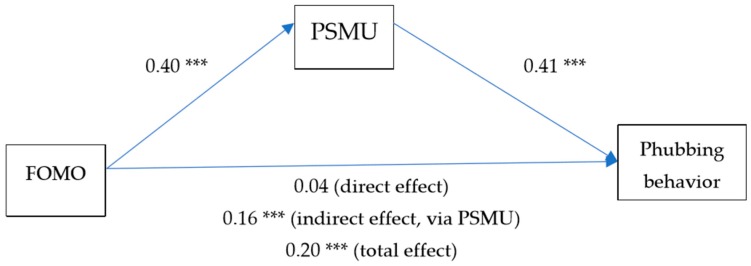
Fear-of-missing-out (FOMO) refers to feelings of anxiety that arise from the realization that you may be missing out on rewarding experiences that others are having. FOMO can be identified as an intra-personal trait that drives people to stay up to date of what other people are doing, among others on social media platforms. Drawing from the findings of a large-scale survey study among 2663 Flemish teenagers, this study explores the relationships between FOMO, social media use, problematic social media use (PSMU) and phubbing behavior. In line with our expectations, FOMO was a positive predictor of both how frequently teenagers use several social media platforms and of how many platforms they actively use. FOMO was a stronger predictor of the use of social media platforms that are more private (e.g., Facebook, Snapchat) than platforms that are more public in nature (e.g., Twitter, Youtube). FOMO predicted phubbing behavior both directly and indirectly via its relationship with PSMU. These findings support extant research that points towards FOMO as a factor explaining teenagers’ social media use.
Overview
The claims and statistics of this paper haven’t been checked yet.
Free: it reads the open-access text and checks the first 5 claims that cite a source we can check. Create a free account to check every claim.
Integrity signals
Registry
Cites
Statistics
Figures
Verification
Claims the paper makes
The claims and statistics of this paper haven’t been checked yet.
Free: it reads the open-access text and checks the first 5 claims that cite a source we can check. Create a free account to check every claim.
Claims other papers make about this one
Each is checked against this paper’s own text: does it say what the citing paper says it does?
In the citing paper
“For example, social network addiction is positively related to FOMO (Franchina et al., 2018; Gezgin, 2018), and this relation is mediated by feelings of envy (Yin et al., 2019).”
From Centennials, FOMO, and loneliness: an investigation of the impact of social networking and messaging/voip apps usage during the initial stage of the coronavirus pandemic (2021) · cites this paper as Franchina et al., 2018
Self-check
Percentages, sums and reported differences re-computed from the paper’s own numbers.
The self-check needs the paper’s full text.
Citations
Cites
The theory of planned behavior
Ajzen, I. (1991) · Organizational Behavior and Human Decision Processes · doi:10.1016/0749-5978(91)90020-t · Cited by 90,587
Intrinsic Motivation and Self-Determination in Human Behavior
Deci, E. L., & Ryan, R. M. (1985) · doi:10.1007/978-1-4899-2271-7 · Cited by 26,772 · cited 1×
“[8], FOMO originates from psychological deficits in people’s competence and relatedness needs [9].”
BackgroundThe need to belong: Desire for interpersonal attachments as a fundamental human motivation.
Baumeister, R. F., & Leary, M. R. (1995) · Psychological Bulletin · doi:10.1037//0033-2909.117.3.497 · Cited by 23,245 · cited 1×
“This desire, which is grounded in people’s need to belong, is an innate and fundamental motivation which humans have [14].”
BackgroundUsers of the world, unite! The challenges and opportunities of Social Media
Kaplan, A. M., & Haenlein, M. (2010) · Business Horizons · doi:10.1016/j.bushor.2009.09.003 · Cited by 17,875 · cited 4×
“0, and that allow the creation and exchange of User Generated Content” [15,16], offer a place where users can keep in touch with their social circles.”
BackgroundMethodInfluentialSocial network sites: definition, history, and scholarship
boyd, D. M., & Ellison, N. B. (2007) · Journal of Computer-Mediated Communication · doi:10.1111/j.1083-6101.2007.00393.x · Cited by 16,251
Making sense of cronbach’s alpha.
Tavakol, M., & Dennick, R. (2011) · International Journal of Medical Education · doi:10.5116/ijme.4dfb.8dfd · Cited by 15,126
Possessions and the Extended Self
Belk, R. W. (1988) · Journal of Consumer Research · doi:10.1086/209154 · Cited by 9,064 · cited 2×
“In addition to the personal mind and physical body, the Self can be thought to include people, places, physical possessions, as well as affiliation groups to which a person feels attached [19].”
BackgroundTests for comparing elements of a correlation matrix
Steiger, J. H. (1980) · Psychological Bulletin · doi:10.1037/0033-2909.87.2.245 · Cited by 4,621 · cited 2×
“Next, we calculated the Pearson correlation coefficients, which form the input for the Steiger’s Z-test.”
MethodKim, H.-Y. (2013) · Restorative Dentistry & Endodontics · doi:10.5395/rde.2013.38.1.52 · Cited by 4,035 · cited 2×
“Advised critical values for skewness, respectively kurtosis in large samples are 2, respectively 7 [56].”
BackgroundMethodMotivational, emotional, and behavioral correlates of fear of missing out
Przybylski, A. K., Murayama, K., DeHaan, C. R., & Gladwell, V. (2013) · Computers in Human Behavior · doi:10.1016/j.chb.2013.02.014 · Cited by 3,932 · cited 3×
“FOMO refers to the “pervasive apprehension that others might be having rewarding experiences from which one is absent” [8].”
BackgroundMethod
Research works printed but not linked: 6
- Katz E. Blumler J.G. The Uses of Mass Communications: Current Perspectives on Gratifications Research Sage Publications Beverly Hills, CA, USA 1974
- Griffiths M.D. Kuss D.J. Adolescent Social Media Addiction (revised) Educ. Health 2017 35 49 52
- Meerkerk G. Pwned by the Internet Explorative research into the causes and consequences of compulsive internet use Ph.D. Thesis Erasmus University Rotterdam, The Netherlands 2007
- Allen I.E. Seaman C.A. Likert scales and data analyses Qual. Prog. 2007 40 64 65
- Hayes A.F. Introduction to Mediation, Moderation, and Conditional Process. Analysis Guilford Press New York, NY, USA 2013
- Beck A.T. Cognitive therapy of depression: New perspectives Treatment of Depression: Old Controversies and New Approaches Clayton P.J. Barrett J.E. Raven Press New York, NY, USA 1983 265 290
Cited by
Items 301–400 of 411
Self-Esteem and Cellphone Interaction Addiction: A Moderated Mediation Model
齐, 欣. (2022) · Advances in Psychology · doi:10.12677/ap.2022.125181 · Cited by 1
Phubbing: revisión sistemática exploratoria
GONZÁLEZ, A. E. S., & Pedraza, S. E. D. C. B. (2022) · Ciencia Latina Revista Científica Multidisciplinar · doi:10.37811/cl_rcm.v6i5.3249 · Cited by 7
Pengaruh Self-esteem terhadap Fear of Missing Out pada Penggemar NCT
Azzahra, A. F., & Halimah, L. (2023) · Bandung Conference Series Psychology Science · doi:10.29313/bcsps.v3i1.5187 · Cited by 4
Social Networking Site Usage of Middle-Aged and Older Deaf Adults
Paglieri, T. A., Schooler, D. E., & Pezzarossi, C. K. (2023) · The Journal of Deaf Studies and Deaf Education · doi:10.1093/deafed/enad003 · Cited by 2
Social Media Engagement as a Mediator of Fear of Missing Out and Self-esteem in Adolescents
Pratiwi, R., Putri, M. N. A. K., Rahmatulloh, A. R., Dewi, N. P. P. A. T., & Sari, N. K. D. P. (2023) · Advances in Social Science, Education and Humanities Research/Advances in social science, education and humanities research · doi:10.2991/978-2-38476-080-0_8 · Cited by 4
Risks Analysis and Internet Perception Among Spanish University Students
Rubio-Hernández, F. J., Giménez-Gualdo, A. M., Díaz‐López, A., & Caba‐Machado, V. (2024) · European Journal of Educational Research · doi:10.12973/eu-jer.13.4.1727 · Cited by 7
Vemuri, V. P. (2024) · IntechOpen eBooks · doi:10.5772/intechopen.1006510 · Cited by 6
Unraveling the Adverse Effects of Social Media on Teenagers: Current and Future Research Directions
Bhardwaj, S., Chopra, R., Donthu, N., & Choudhary, P. (2025) · Journal of Interactive Marketing · doi:10.1177/10949968241288483 · Cited by 8
Adapting the Virtual World Risk Perception Scale to Secondary School Level
Arslankara, V. B., & Usta, E. (2020) · Bartın University Journal of Faculty of Education · doi:10.14686/buefad.632550 · Cited by 1
The Factors of Social Media Usage and Mental Health: A Study on Malaysian Adolescents
Lee, S. C., & Zhooriyati, S. M. (2022) · Asian Journal of Behavioural Sciences · doi:10.55057/ajbs.2022.4.2.4 · Cited by 8
Vivaldie, Y., & Agustin, L. (2022) · Jurnal Psikologi · doi:10.24014/jp.v18i2.16568 · Cited by 1
Phone Use, Offline Neglect, and Reachability: A Qualitative Study in Denmark, Lithuania, and Spain
Schilhab, T. S. S., Esbensen, G. L., Levratto, V., & Šuminas, A. (2023) · Postmodernism Problems · doi:10.46324/pmp2302118
The Effects of Social Media on Anxiety, Reward Sensitivity, and Risk-Taking on Emerging Adults
Medrano, V. (2022) · FHSU Scholars Repository (Fort Hays State University) · doi:10.58809/hlsu6505 · Cited by 4
Bermejo‐Martins, E., Torres-Sahli, M., Madsen, K. R., Tabs-Damgraads, M., Nielsen, L., Meilstrup, C., Toftager, M., & Santini, Z. I. (2023) · medRxiv · doi:10.1101/2023.08.31.23294835 · Cited by 1
Ortaokul Öğrencilerinin Sanal Risk Algılarının Çeşitli Değişkenler Açısından İncelenmesi
Arslankara, V. B., & Usta, E. (2019) · Bilgi ve İletişim Teknolojileri Dergisi
Reconstructing Social Identity Through Physical Attractiveness
Kim, Y. A., & Li, Q. (2020) · Advances in intelligent systems and computing · doi:10.1007/978-3-030-51194-4_51 · Cited by 1
An Interactive Design Solution Based on AR Technology for Mobile Phone Addicted User
Luo, J., Luximon, Y., & Fang, H. (2021) · Lecture notes in networks and systems · doi:10.1007/978-3-030-80094-9_28
USE OF SOCIAL MEDIA AND PHUBBING BEHAVIOR AGAINST FEAR OF LOSING
Rifayanti, R., Yorinda, A., Alkatiri, Z. A., & Hasan, M. Q. (2021) · International Journal of Innovative Technologies in Social Science · doi:10.31435/rsglobal_ijitss/30092021/7641
CURIOSITY KILLED THE CAT: ROLE OF FEAR OF MISSING OUT (FOMO) ON DEPRESSION MEDIATED BY ANXIETY
Fitrazaphyra, A., & Hamsyah, S. P. F. (2020)
Dadiotis, A., & Ρούσσος, Π. (2022) · SSRN Electronic Journal · doi:10.2139/ssrn.4076950 · Cited by 1
How Covid-19 Exposed the Entrenchment of Neoliberal Ideals Within Female Friendship
Goddard, I. (2022) · Journal of Business Anthropology · doi:10.22439/jba.v11i1.6623 · Cited by 1
أحمد, ر. ي., & عجاجه, ص. أ. (2022) · مجلة جامعة الفيوم للعلوم التربوية والنفسية · doi:10.21608/jfust.2022.116189.1553
أحمد, م. ف. ر. (2022) · مجلة البحوث الإعلامیة · doi:10.21608/jsb.2022.161257.1499 · Cited by 1
Al‐Saggaf, Y. (2022) · SpringerBriefs in psychology · doi:10.1007/978-981-19-7045-0_6
Li, R., Tang, L., Chen, L., Wang, C., & Tian, R. (2022) · Proceedings of the 2022 2nd International Conference on Modern Educational Technology and Social Sciences (ICMETSS 2022) · doi:10.2991/978-2-494069-45-9_6
Einfluss von Big-Five-Persönlichkeitsmerkmalen auf die Nutzung sozialer Medien
Kothambikar, A. (2022) · Springer eBooks · doi:10.1007/978-3-658-39489-9_4
Envy and Self-Worth as Predictors of Social Media Misuse Among U.S. College Students
Prosek, E. A., Diaz, A. M., Shao, H., & Giordano, A. L. (2023) · International Journal for the Advancement of Counselling · doi:10.1007/s10447-023-09504-5 · Cited by 3
“Beyond frequency, Franchina et al. (2018) purported excessive use of social media becomes misuse when associated with a loss of control and in unhealthy life outcomes.”
BackgroundGugushvili, N. (2023) · Research Publications (Maastricht University) · doi:10.26481/dis.20230320ng · Cited by 7
KÜÇÜKTOPUZLU, E. U., & KÖSKÜN, T. (2023) · Klinik Psikoloji Dergisi · doi:10.57127/kpd.26024438.1274750
อ่อนละออ, ป. (2020) · Chula Digiverse · doi:10.58837/chula.the.2020.681
Mert, M. (2023) · Akademik Hassasiyetler · doi:10.58884/akademik-hassasiyetler.1258779 · Cited by 1
Syihab, A., & Rani, D. (2023) · Psikologika Jurnal Pemikiran dan Penelitian Psikologi · doi:10.20885/psikologika.vol28.iss1.art2 · Cited by 8
Soeharso, S. Y., Moningka, C., & Selviana, S. (2023) · Journal An-Nafs Kajian Penelitian Psikologi · doi:10.33367/psi.v8i1.2969 · Cited by 4
Mental Health and Mobile Internet Access. Evidence from MexicoPreprint
Morales, G. A. R. (2023) · SSRN Electronic Journal · doi:10.2139/ssrn.4527067
Qolbi, A. N., & Hatta, M. I. (2023) · Bandung Conference Series Psychology Science · doi:10.29313/bcsps.v3i2.7358 · Cited by 3
Rathore, M. A., Mashhadi, S. F., Moeed, L., Ahmad, S., Mehmood, M., Abbasi, A., Sajjad, H., Dilshad, S. A., & Naseer, M. (2024) · Pakistan Armed Forces Medical Journal · doi:10.51253/pafmj.v72isuppl-4.9656 · Cited by 1
School Leadership in an Increasingly Diversifying Ecosystem of Student Needs
Mugabe, D. D., & Lopez, A. E. (2023) · Journal of School Leadership · doi:10.1177/10526846231208759
“FOMO can be identi fi ed as an intra-personal trait that drives people to stay up to date on what other people are doing, among others on social media platforms (Franchina et al., 2018).”
BackgroundAl‐Saggaf, Y. (2023) · Springer eBooks · doi:10.1007/978-981-99-5917-4_6
Botelho, H. S. D. J., Guimarães, L., Sena, R. K. R., Fonseca, R. L., Moreira, R. A., de Oliveira, F. P. S. L., & Rocha, J. S. B. (2024) · Contribuciones a las Ciencias Sociales · doi:10.55905/revconv.17n.4-042 · Cited by 1
Johnson, R. J., & Meenakshy (2024) · International Journal For Multidisciplinary Research · doi:10.36948/ijfmr.2024.v06i02.16754
“The more people check their phones to calm their worry, the more they discover that they are socially isolated and are missing out on many events, which makes them feel even more anxious (Abel et al., 2016; Franchina et al., 2018).”
BackgroundDetermining the Influence of Information Irrelevance and Fear of Missing Out on Social OverloadPreprint
Khan, R., Warriach, N. F., & Arshad, A. (2024) · SSRN Electronic Journal · doi:10.2139/ssrn.4809129
متلازمة “الفومو “FOMO في ظل التعليم الإلكتروني لدى طلبة الجامعة
كنوش, م. ح. (2023) · Journal of Tikrit University for Humanities · doi:10.25130/jtuh.30.10.1.2023.20 · Cited by 1
Karila, L., Scher, N., Draghi, C., Lichte, D., Darmon, I., Boudabous, H., Lamallem, H., Bauduceau, O., Bollet, M. A., & Tolédano, A. (2024) · doi:10.2196/preprints.63431
FOMO syndrome in adolescents – threats and prevention: Theoretical review
Kleszczewska-Albińska, A., & Ptak, K. (2023) · Problemy Opiekuńczo-Wychowawcze · doi:10.5604/01.3001.0054.6609
Yang, N., Zhu, F., Zhuang, L., Liu, L., & Bao, Y. (2024) · Research Square · doi:10.21203/rs.3.rs-4585878/v1
Youth Anxiety in the Digital Age: Present Status and Future Considerations
Ariefdjohan, M. W., Nesi, J. L., Mullin, B. C., Pesko, M. J., & Fritsch, S. L. (2024) · Springer eBooks · doi:10.1007/978-3-031-69362-5_18 · Cited by 2
Aktaş, Ö., & Yavuzyılmaz, O. (2024) · Erciyes Üniversitesi İktisadi ve İdari Bilimler Fakültesi Dergisi · doi:10.18070/erciyesiibd.1507729 · Cited by 1
Iqbal, M., Abdillah, Y., & Mawardi, M. K. (2025) · Profit · doi:10.21776/ub.profit.2025.019.01.3 · Cited by 1
Ortaöğretim Öğrencilerinin Günceli Kaçırma Korkusu Deneyimleri ve Günlük Yaşamlarına Yansımaları
Yavrutürk, A. R. (2025) · Batı anadolu eğitim bilimleri dergisi · doi:10.51460/baebd.1578417
The Influence of Personality Traits on Smartphone Addiction, Phubbing, and Mental Well-Being
Kaviya, G., & Likitha, S. (2025) · Advances in human and social aspects of technology book series · doi:10.4018/979-8-3693-8804-4.ch009 · Cited by 2
Wang, Y., Zhang, L., Elhai, J. D., Montag, C., Lau, J. T. F., & Yang, H. (2025) · doi:10.2196/preprints.77981
de Casteele, M. V., Flamant, N., Morbée, S., van den Bogaard, D., & Vansteenkiste, M. (2025) · SSRN Electronic Journal · doi:10.2139/ssrn.5357608
Impact of Social Media on Mental Health with Reference to Fear of Missing Out
Mishra, D. (2025) · Synthesis lectures on engineers, technology, and society · doi:10.1007/978-3-031-95619-5_9
Does FoMO matter with impulsive travel in live streaming? The role of marketing communication
Zhou, J., & Ho, H.-W. (2025) · Journal of Hospitality and Tourism Insights · doi:10.1108/jhti-11-2024-1246 · Cited by 8
Şahin, E., & Güvercin, F. K. (2025) · İzmir İktisat Dergisi · doi:10.24988/ije.1566589
Song, W. (2025) · Research Square · doi:10.21203/rs.3.rs-7387328/v1
RetractedYILDIRIM, Y. O. (2025) · Anadolu Üniversitesi İktisadi ve İdari Bilimler Fakültesi Dergisi · doi:10.53443/anadoluibfd.1642648 · Cited by 1
Belonging at a Click: A Correlational Study on the Fear of Missing Out and Facebook Intensity Usage
Barretto, E., Margarette, P., Nuryawm, A., & Aljelyn, L. (2025) · Psychology and Behavioral Sciences · doi:10.11648/j.pbs.20251405.12 · Cited by 1
Ho, T. T. Q., Nguyễn, H. T., & Dau, M. L. (2025) · Psychology Health & Medicine · doi:10.1080/13548506.2025.2571985 · Cited by 1
“In fact, previous studies have also shown that FOMO is related to SNS use (Li et al., 2022; Liu & Ma, 2020b); meanwhile, SNS use is associated with PD (Al-Dwaikat et al., 2020; Hussain & Griffiths, 2018).”
InfluentialFear of Missing Out and Problematic Social Media Use: A Literature Review
Tantiani, F. F., & Tri Atika Melya., B. (2025) · KnE Social Sciences · doi:10.18502/kss.v10i25.19916 · Cited by 2
Dagher, M., Farchakh, Y., Barbar, S., Haddad, C., Akel, M., Hallit, S., & Obeïd, S. (2021) · Figshare · doi:10.6084/m9.figshare.14100567
Mohammed, A. A. A., Osman, M. M., Ali, M. M. M., Adam, M. O., Mustafa, M. E. E., Babikir, A., Abdulsamad, A. M. I., Abo, M. E. A., Yasein, Y. A. M., Abdelgader, M. S. S., et al. (2024) · Figshare · doi:10.6084/m9.figshare.26648322
Binge-watching jako problemowe oglądanie seriali wśród młodych dorosłych
Rodzeń, W. (2025) · Rozprawy i Studia - Uniwersytet Szczeciński · doi:10.18276/978-83-8419-010-4
Consumos Digitais: Uma Análise de Rotinas de Brasileiros Utilizadores de Instagram
Molica, R. D. S. (2025) · Revista Lusófona de Estudos Culturais · doi:10.21814/rlec.6370
Adnan, K., Setiyowati, N., & Chusniyah, T. (2025) · JURNAL DIVERSITA · doi:10.31289/diversita.v11i1.13724 · Cited by 11
Umgang mit digitalen Medien im Jugendalter
Kurock, R., Jungkeim, L., & Kuhn, N. (2025) · Springer eBooks · doi:10.1007/978-3-642-54061-5_40-1
Caught in the web: how nomophobia mediates the link between neuroticism and phubbing
Saatçı, F., & Koca, F. (2026) · BMC Psychology · doi:10.1186/s40359-026-04023-5 · Cited by 1
Das, P., & Chaudhary, A. (2026) · Journal of Technology in Behavioral Science · doi:10.1007/s41347-025-00590-3 · Cited by 1
Prakoso, E. R. I. W., & Ayriza, Y. (2026) · Integrated Science Education Journal · doi:10.37251/isej.v7i1.2486
“Students who experience FOMO will have a negative impact on their education, mental health, and well-being [18] Referring to previously reported studies, FOMO is one of several factors that can predict phubbing behavior [19], [20] .”
Gezgin, D. M., Lin, C., & Kartol, A. (2026) · International Journal of Human-Computer Interaction · doi:10.1080/10447318.2026.2619923
“Another interesting finding from this study is that both female students (Franchina et al., 2018; Li et al., 2020; Stead & Bibby, 2017) and individuals who use social media for more than four hours a day (Balci & Bal, 2022; Gezgin et al., 2017) had significantly higher levels of both trait and…”
InfluentialMarriages in the Grip of Phubbed: Dyadic Analysis of FoMO and Dyadic Adjustment
Özmen, M. (2026) · American Journal of Family Therapy · doi:10.1080/01926187.2026.2642722
“Among Flemish youth, FoMO predicts phubbing both totally and indirectly (Franchina et al., 2018).”
Fear of Missing Out and Executive Functions: The Role of Self-regulation as a Mediator
Ghosal, A., Chukkali, S., Mukherjee, O., & Krishnamurthy, V. (2026) · Annals of Neurosciences · doi:10.1177/09727531261429764 · Cited by 1
“21 The incessant FoMO on the fun part becomes a precursor for FoMO to be associated with various negative consequences, namely stress, anxiety and depression, 17,22 phub-bing 23,24 and reduced life satisfaction.”
Tan, Z., & He, B. (2026) · BMC Psychology · doi:10.1186/s40359-026-04417-5
“The utilization of the internet and social media further amplifies the likelihood of experiencing FoMO [17, 24, 35].”
Ibáñez, D. B., Castaño, L. C., Garcés-Prettel, M., Arroyave, J., Merchán-Clavellino, A., Saldaña, S. M. V., & Santoya-Montes, Y. (2026) · Media International Australia · doi:10.1177/1329878x261434608
“Franchina et al. (2018) found that when metrics did not reach the volume expected by adolescents, the respondents experienced a negative impact on their self-esteem.”
Malimo, M. (2026) · Research Square · doi:10.21203/rs.3.rs-9060606/v1
Uso problemático de las redes sociales y phubbing: el papel mediador del FoMO y la urgencia
Salguero, F. L., Hidalgo-Fuentes, S., Martínez-Álvarez, I., & González-Fernández, A. (2026) · Revista Complutense de Educación · doi:10.5209/rced.100041 · Cited by 2
Gen Z and FoMO : A Configurational Analysis of Psychological Factors and Digital Dependence
Kurian, R. E., & Basu, M. (2026) · Journal of Personality · doi:10.1111/jopy.70072 · Cited by 1
Knežević, N. K., Kondić, L., & Ljiljak, P. (2026) · doi:10.20867/cromar.29.5
Gündoğan, S. (2026) · American Journal of Family Therapy · doi:10.1080/01926187.2026.2650166 · Cited by 1
“However, studies have shown that phubbing further increases social media-related problems (Chi et al., 2022; Franchina et al., 2018; Oral & Karakurt, 2025).”
Dijital Çağın Yeni Kaygısı: Günceli Kaçırma Korkusu (FoMO)
Yavrutürk, A. R. (2026) · Elektronik Eğitim Bilimleri Dergisi · doi:10.55605/ejedus.1784582
Social media and distraction: An experience sampling study among adolescentsPreprint
Beyens, I., Valkenburg, P. M., Siebers, T., & Pouwels, J. L. (2023) · OSF Preprints (OSF Preprints)
Zhang, J., Fang, M., & Zheng, S. (2026) · BMC Psychology · doi:10.1186/s40359-026-04760-7
“The Chinese version of the Problematic Social Media Use Scale, which was first created and approved by Franchina et al., was used to gauge problematic social media use [33].”
Shankar, R., Srivastava, S., & Mishra, N. (2026) · Journal of the Knowledge Economy · doi:10.1007/s13132-026-03293-z
“Fear of Missing Out (FoMO) is characterized by anxiety, often resulting in frequent phone checks and panic attacks (Franchina et al., 2018 ; Przybylski et al., 2013 ; Vanden Abeele & Van Rooij, 2016).”
Gavcar, E. G., Avunduk, S., Avunduk, S. A., & Büber, A. (2026) · BMC Psychiatry · doi:10.1186/s12888-026-08212-9
“This finding is consistent with the existing literature, as various studies have indicated that addiction tendencies, and most importantly, social media addiction, are among the leading determinants of phubbing behavior [73–76].”
Cabras, C., Girgin, Ç., Muggianu, F., Mirian, A., & Sechi, C. (2026) · Computers in Human Behavior Reports · doi:10.1016/j.chbr.2026.101124 · Cited by 2
Fratiwi, A., Hidayati, A., & Puspita, V. (2026) · Indonesian Journal of Multidisciplinary on Social and Technology · doi:10.69693/ijmst.v4i2.10008
SAIMSARA (2026) · SAIMSARA Journal · doi:10.62487/saimsaraab2dbdf3
Roslan, S. B., Xiao, Y., & Taresh, S. M. (2026) · The Pertanika Journal of Learning Pedagogy and Educational Leadership · doi:10.47836/pjlpel.2.1.09
Roslan, S. B., Guo, G., & Taresh, S. M. (2026) · The Pertanika Journal of Learning Pedagogy and Educational Leadership · doi:10.47836/pjlpel.2.1.10
`Mzabi, S. K., Ignarska, J., Piech, B., Judzińska, A., Sobczyńska, K., Terbosh, M., Trojanowska, E., Dubaj, M., Kwolek, M., & Osipowska, J. (2026) · International Journal of Innovative Technologies in Social Science · doi:10.31435/ijitss.2(50).2026.5602
Tacer, A., & KIZILGEÇİT, M. (2026) · İnsan ve Toplum Bilimleri Araştırmaları Dergisi · doi:10.15869/itobiad.1823653
Bulut, A. (2026) · Journal of Human Behavior in the Social Environment · doi:10.1080/10911359.2026.2695060 · Cited by 1
Soraci, P., Griffiths, M. D., Pisanti, R., Al‐Mamun, F., Mamun, M. A., Bevan, N., & Szabó, A. (2026) · Behaviour and Information Technology · doi:10.1080/0144929x.2026.2699282
GELİŞMELERİ Mİ KAÇIRIYORUZ, AİLEYİ Mİ? LİSE ÖĞRENCİLERİNDE SOSYAL MEDYA KULLANIMININ DETAYLI ANALİZİ
Özlük, İ., & Saltan, F. (2026) · Eğitim Teknolojisi Kuram ve Uygulama · doi:10.17943/etku.1900571
Aydın, D. (2026) · Pamukkale University Journal of Education · doi:10.9779/pauefd.1640570
Weisskirch, R. S. (2026) · Psychological Reports · doi:10.1177/00332941261474793
Digital disconnection: A systematic review of phubbing behavior
Jakhar, M., Gupta, R. K., & Vyas, D. (2026) · Acta Psychologica · doi:10.1016/j.actpsy.2026.107559
Chen, H.-Y. (2026) · Entertainment Computing · doi:10.1016/j.entcom.2026.101205
Metadata
- Authors
- Franchina, V., Vanden Abeele, M., Van Rooij, A. J., Lo Coco, G., & De Marez, L.
- Affiliations
- University of Palermo (IT)
- Tilburg School of Humanities and Digital Sciences, Tilburg University, 5037AB Tilburg, The Netherlands
- imec-mict-UGent, Department of Communication Sciences, Ghent University, 9000 Ghent, Belgium
- Department of Psychology and Educational Sciences, University of Palermo, 90133 Palermo, Italy
- Corresponding author
- Franchina, Vittoria
- Venue
- International Journal of Environmental Research and Public Health
- Publisher
- MDPI AG
- Published
- 2018-10-22
- Volume
- 15
- Issue
- 10
- Pages
- 2319
- ISSN
- 1660-4601 (ISSN-L)
- PMC
- PMC6211134
- OpenAlex
- W2800571625
- Cited by
- 411
- References
- 58
- Citations by year
- 2026: 51 · 2025: 60 · 2024: 64 · 2023: 77 · 2022: 61 · 2021: 45 · 2020: 40 · 2019: 13
- FWCI
- 55.63
- Type
- journal article
- Language
- en
- Open access
- gold
- dx.doi.org
- Licence
- Locations
- International Journal of Environmental Research and Public Health (publishedVersion, cc-by)
- Europe PMC (PubMed Central) (publishedVersion, other-oa)
- PubMed Central (publishedVersion, cc-by)
- Research portal (Tilburg University) (publishedVersion, other-oa)
- PubMed (publishedVersion)
- Research portal (Tilburg University) (submittedVersion, cc-by)
- Data Archiving and Networked Services (DANS) (submittedVersion, other-oa)
- Ghent University Academic Bibliography (Ghent University) (submittedVersion, cc-by)
- DOAJ (DOAJ: Directory of Open Access Journals) (submittedVersion, cc-by-sa)
- Nova Science Publishers (Nova Science Publishers, Inc.) (submittedVersion, other-oa)
- Topics
- Social Sciences › Sociology and Political Science › Impact of Technology on Adolescents
- Social Sciences › Communication › Digital Media and Philosophy
- Social Sciences › Education › Child Development and Digital Technology
- Keywords
- fear of missing out, social media addiction, phubbing, adolescents, social media use, social networking sites, Facebook, Snapchat, Twitter, YouTube
- MeSH terms
- Cell Phone Use, Adolescent, Adolescent Behavior, Anxiety, Cross-Sectional Studies, Fear, Female, Humans, Male, Surveys and Questionnaires, Behavior, Addictive, Social Participation, Social Media
About these checks
Registry, retraction, Cites and statistics results are computed, not judged, with one exception: a printed reference that no index lists is read once by a model before it counts as a citation error. Claims are extracted by a model and kept only when their quote appears verbatim in the text; each cited source is then checked, with a model’s help, for whether it says what the claim relies on. Those verdicts can be wrong — read the claim’s quote and the cited source before relying on one.
Statistics and arithmetic are recomputed, not judged.
Confidence bands are shown only for fields calibrated on our annotated test set. None is calibrated yet, so no band is shown.
What counts as a claim ›How we measure confidence ›How we check this ›
Are you an author, or do you see a problem with this page? Request a review
Data sources
Bibliographic data: Semantic Scholar, OpenAlex, Crossref.
Contains information from the Semantic Scholar Academic Graph Datasets, made available under the ODC Attribution License (ODC-BY 1.0).
Semantic Scholar’s data is described in: Kinney, R., et al. (2023). The Semantic Scholar Open Data Platform. arXiv:2301.10140.
