

The DOI matches its Crossref record; 3 of the 3 references it cites were found in a registry or an index.
The Relationship between Infectious Diseases and Housing Maintenance in Indigenous Australian Households
Abstract
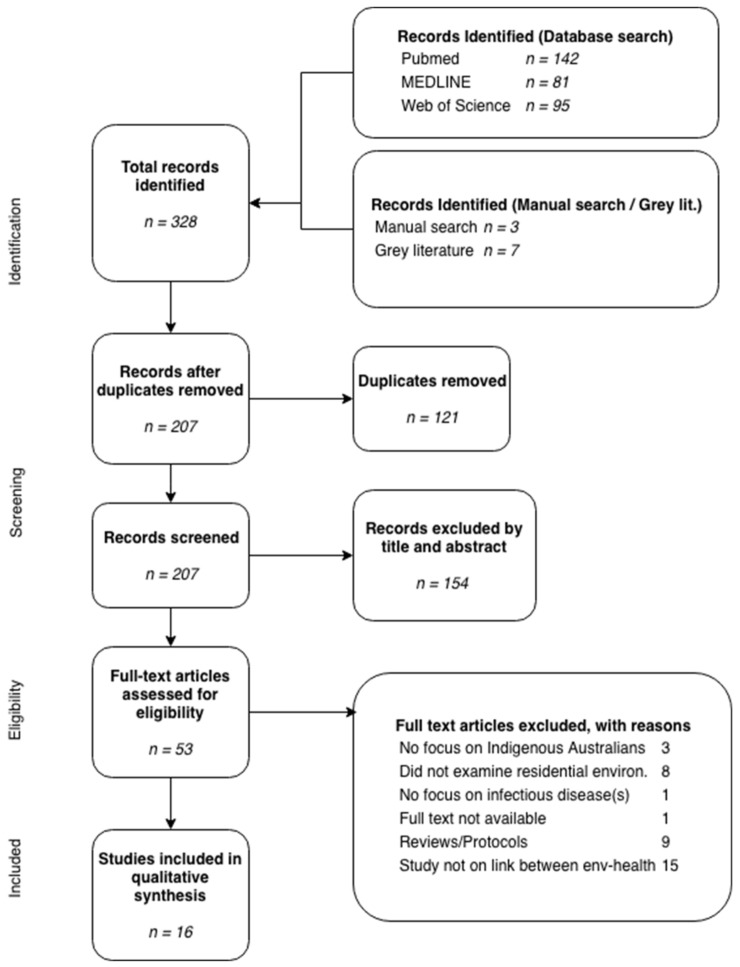
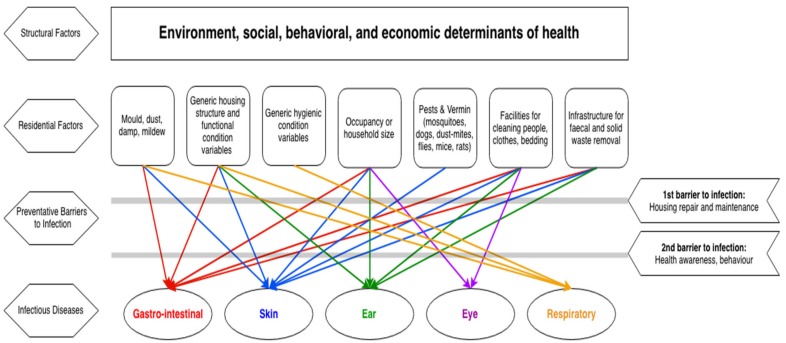
This research aimed to identify systemic housing-level contributions to infectious disease transmission for Indigenous Australians, in response to the Government program to ‘close the gap’ of health and other inequalities. A narrative literature review was performed in accordance to PRISMA guidelines. The findings revealed a lack of housing maintenance was associated with gastrointestinal infections, and skin-related diseases were associated with crowding. Diarrhoea was associated with the state of food preparation and storage areas, and viral conditions such as influenza were associated with crowding. Gastrointestinal, skin, ear, eye, and respiratory illnesses are related in various ways to health hardware functionality, removal and treatment of sewage, crowding, presence of pests and vermin, and the growth of mould and mildew. The research concluded that infectious disease transmission can be reduced by improving housing conditions, including adequate and timely housing repair and maintenance, and the enabling environment to perform healthy behaviours.
Overview
The claims and statistics of this paper haven’t been checked yet.
Run the check — free, no account needed. It reads the open-access text and checks the sources it cites.
Integrity signals
Registry
Cites
Statistics
Figures
Verification
Claims the paper makes
The claims and statistics of this paper haven’t been checked yet.
Run the check — free, no account needed. It reads the open-access text and checks the sources it cites.
Claims other papers make about this one
Each is checked against this paper’s own text: does it say what the citing paper says it does?
The source backs part of the claim, not all of it — or backs it for a different population, condition or comparison.
In the citing paper
“Multiple national studies have found that the primary factors driving this cascade of severe coinfections are low income, exceedingly poor housing conditions in the Australian National Reserve System, and inadequate provision of clean water (Ali et al., 2018; Bailie et al., 2004; Bailie et al., 2010; McDonald et al., 2010).”
From On race, human variation, and who gets and dies of sepsis (2022) · cites this paper as Ali et al., 2018
Experimental — accuracy not yet measuredThe source backs part of the claim, not all of it — or backs it for a different population, condition or comparison.
In the citing paper
“It's a theme repeated in other Anglocolonial states, where crowding, inadequate ventilation, poor cleaning facilities and even lack of running water in rural housing settings that are often under government fiduciary responsibility, are strongly associated with severe infection in Indigenous peoples (Ali et al., 2018; Bailie et al., 2004; Bailie et al., 2010; Baker et al., 2012; Boyd, 2011; Kovesi”
From On race, human variation, and who gets and dies of sepsis (2022) · cites this paper as Ali et al., 2018
Experimental — accuracy not yet measuredThe source backs part of the claim, not all of it — or backs it for a different population, condition or comparison.
In the citing paper
“However, sepsis data from a range of former British colonies that track sepsis incidence by race/ethnicity and class supports the notion that people with racialized/minoritized identities in colonized states also disproportionately experience sepsis for reasons other than income access to healthcare”
From On race, human variation, and who gets and dies of sepsis (2022) · cites this paper as Ali et al., 2018
Experimental — accuracy not yet measured
Self-check
Percentages, sums and reported differences re-computed from the paper’s own numbers.
The self-check needs the paper’s full text.
Citations
Cites
Wohlin, C. (2014) · Proceedings of the 18th International Conference on Evaluation and Assessment in Software Engineering · doi:10.1145/2601248.2601268 · Cited by 4,234 · cited 1×
“A manual search of additional articles was conducted using the ‘snowballing’ technique that investigated relevant citations in the included literature [28].”
Writing narrative literature reviews for peer-reviewed journals: secrets of the trade
Green, B. N., Johnson, C. D., & Adams, A. (2006) · Journal of Chiropractic Medicine · doi:10.1016/s0899-3467(07)60142-6 · Cited by 2,224 · cited 1×
“This study sourced data through a narrative literature review, defined as a comprehensive syntheses of previously-published material [24].”
MethodFreeman, M. C., Stocks, M. E., Cumming, O., Jeandron, A., Higgins, J. P. T., Wolf, J., Prüss‐Ustün, A., Bonjour, S., Hunter, P. R., Fewtrell, L., et al. (2014) · Tropical Medicine & International Health · doi:10.1111/tmi.12339 · Cited by 524
Research works printed but not linked: 30
- APO NT (2017). Sumission to the National Review of the National Partnership Agreement on Remote Indigenous Housing (NPARIH), Aboriginal Peak Organisations-Northern Territory (CLC, NLC, CAALAS, AMSANT and NAAJA). Available online: http://www.amsant.org.au/apont/wp-content/uploads/2017/01/20170109-APO-NT-Submission-on-NPARIH-Remote-Housing-Review.pdf.
- Browett, 2012, Cost Implications of Hard Water on Health Hardware in Remote Indigenous Communities in the Central Desert Region of Australia, Int. Indig. Policy J., 3, 6
- Foster, T. (2017, January 16–20). Unfinished business: Water, sanitation and hygiene in remote Indigenous communities in Australia’s Northern Territory. Proceedings of the Water and Health, Chapel Hill, NC, USA.
- Lange, F., Jones, K., Ritte, R., Brown, H., and Taylor, H. (2017). The impact of health promotion on trachoma knowledge, attitudes and practice (KAP) of staff in three work settings in remote Indigenous communities in the Northern Territory. PLoS Negl. Trop. Dis., 11. · DOI
- Warren, 2016, Trachoma in remote Indigenous Australia: A review and public health perspective, Aust. N. Z. J. Public Health, 40, S48, 10.1111/1753-6405.12396 · DOI
- Commonwealth of Australia (2017). Remote Housing Review: A Review of the National Partnership Agreement on Remote Indigenous Housing and the Remote Housing Strategy (2008–2018).
- Bailie, 2010, Exploring cross-sectional associations between common childhood illness, housing and social conditions in remote Australian Aboriginal communities, BMC Public Health, 10, 147, 10.1186/1471-2458-10-147 · DOI · Paper page
- Buntsma, 2017, Patterns of paediatric emergency presentations to a tertiary referral centre in the Northern Territory, Em. Med. Austr., 29, 678, 10.1111/1742-6723.12853 · DOI
- Clucas, 2008, Disease burden and health-care clinic attendances for young children in remote aboriginal communities of northern Australia, Bull World Health Organ., 86, 275, 10.2471/BLT.07.043034 · DOI
- Kearns, T., Clucas, D., Connors, C., Currie, B.J., Carapetis, J.R., and Andrews, R.M. (2013). Clinic Attendances during the First 12 Months of Life for Aboriginal Children in Five Remote Communities of Northern Australia. PLoS ONE, 8. · DOI
- Mara, D., Lane, J., Scott, B., and Trouba, D. (2010). Sanitation and Health. PLoS Med., 7. · DOI
- Collins, 2005, Balancing the strengths of systematic and narrative reviews, Hum. Reprod. Update, 11, 103, 10.1093/humupd/dmh058 · DOI
- Moher, 2009, Preferred Reporting Items for Systematic Reviews and Meta-Analyses: The PRISMA Statement, Ann. Int. Med., 151, 264, 10.7326/0003-4819-151-4-200908180-00135 · DOI · Paper page
- Pholeros, 2013, Improving the state of health hardware in Australian Indigenous housing: Building more houses is not the only answer, Int. J. Circumpolar Health, 72, 21181, 10.3402/ijch.v72i0.21181 · DOI
- Pappas, 2011, Grey Literature: Its Emerging Importance, J. Hosp. Librariansh., 11, 228, 10.1080/15323269.2011.587100 · DOI
- Jacoby, 2011, Crowding and other strong predictors of upper respiratory tract carriage of otitis media-related bacteria in Australian Aboriginal and non-Aboriginal children, Pediatr. Infect. Dis. J., 30, 480, 10.1097/INF.0b013e318217dc6e · DOI
- Jacoby, 2008, The effect of passive smoking on the risk of otitis media in Aboriginal and non-Aboriginal children in the Kalgoorlie-Boulder region of Western Australia, Med. J. Aust., 188, 599, 10.5694/j.1326-5377.2008.tb01801.x · DOI
- Bailie, 2012, The impact of housing improvement and socio-environmental factors on common childhood illnesses: A cohort study in Indigenous Australian communities, J. Epidemiol. Community Health, 66, 821, 10.1136/jech.2011.134874 · DOI
- Dossetor, P.J., Martiniuk, A.L.C., Fitzpatrick, J.P., Oscar, J., Carter, M., Watkins, R., Elliott, E.J., Jeffery, H.E., and Harley, D. (2017). Pediatric hospital admissions in Indigenous children: A population-based study in remote Australia. BMC Pediatr., 17. · DOI
- Andersen, 2018, Housing conditions associated with recurrent gastrointestinal infection in urban Aboriginal children in NSW, Australia: Findings from SEARCH, Aust. N. Z. J. Public Health, 42, 247, 10.1111/1753-6405.12786 · DOI
- Melody, 2016, A cross-sectional survey of environmental health in remote Aboriginal communities in Western Australia, Int. J. Environ. Health Res., 26, 525, 10.1080/09603123.2016.1194384 · DOI
- Spurling, 2014, Household number associated with middle ear disease at an urban Indigenous health service: A cross-sectional study, Aust. J. Prim. Health, 20, 285, 10.1071/PY13009 · DOI
- McDonald, 2010, Hygiene improvement: Essential to improving child health in remote Aboriginal communities, J. Paediatr. Child Health, 46, 491, 10.1111/j.1440-1754.2010.01846.x · DOI
- Massey, 2011, Australian Aboriginal and Torres Strait Islander communities and the development of pandemic influenza containment strategies: Community voices and community control, Health Policy, 103, 184, 10.1016/j.healthpol.2011.07.004 · DOI
- McDonald, 2010, An ecological approach to health promotion in remote Australian Aboriginal communities, Health Promot. Int., 25, 42, 10.1093/heapro/daq004 · DOI
- Lansingh, 2010, Trachoma control in two Central Australian Aboriginal communities: A case study, Int. Ophthalmol., 30, 367, 10.1007/s10792-010-9360-5 · DOI
- McDonald, E., Bailie, R., Grace, J., and Brewster, D. (2009). A case study of physical and social barriers to hygiene and child growth in remote Australian Aboriginal communities. BMC Public Health, 9. · DOI
- Vino, 2017, Indigenous Australian household structure: A simple data collection tool and implications for close contact transmission of communicable diseases, PeerJ, 5, e3958, 10.7717/peerj.3958 · DOI
- Senge, 1992, Systems thinking and organizational learning: Acting locally and thinking globally in the organization of the future, Eur. J. Oper. Res., 59, 137, 10.1016/0377-2217(92)90011-W · DOI · Paper page
- Hovmand, P. (2014). Community-Based System Dynamics, Springer. · DOI
Cited by
Sorted by citations
Lorentzen, J. C., Johanson, G., Björk, F., & Stensson, S. (2022) · International Journal of Environmental Research and Public Health · doi:10.3390/ijerph192315542 · Cited by 33
On race, human variation, and who gets and dies of sepsis
Brinkworth, J. F., & Shaw, J. G. (2022) · American Journal of Biological Anthropology · doi:10.1002/ajpa.24527 · Cited by 9
Metadata
- Authors
- Ali, S. H., Foster, T., & Hall, N. L.
- Affiliations
- Krieger School of Arts and Sciences, Johns Hopkins University, Baltimore, MD 21218, USA
- Institute for Sustainable Futures, University of Technology Sydney, Sydney 2007, Australia
- School of Public Health, The University of Queensland, Brisbane 4006, Australia
- Venue
- International Journal of Environmental Research and Public Health
- Publisher
- MDPI AG
- Published
- 2018-12-11
- Volume
- 15
- Issue
- 12
- Pages
- 2827
- ISSN
- 1660-4601
- PMC
- PMC6313733
- Cited by
- 57
- References
- 3
- Language
- en
- Funders
- University of Queensland (Global Change Flagship 2017)
About these checks
Registry, retraction, Cites and statistics results are computed, not judged, with one exception: a printed reference that no index lists is read once by a model before it counts as a citation error. Claims are extracted by a model and kept only when their quote appears verbatim in the text; each cited source is then checked, with a model’s help, for whether it says what the claim relies on. Those verdicts can be wrong — read the claim’s quote and the cited source before relying on one.
Statistics and arithmetic are recomputed, not judged.
Confidence bands are shown only for fields calibrated on our annotated test set. None is calibrated yet, so no band is shown.
What counts as a claim ›How we measure confidence ›How we check this ›
Are you an author, or do you see a problem with this page? Request a review
How to cite
Cite CoChat for the checks on this page, and the paper for its own findings.
- This page
- CoChat. (2026). Citation check: The Relationship between Infectious Diseases and Housing Maintenance in Indigenous Australian Households. https://app.cochat.ai/papers/10.3390/ijerph15122827
- The paper
- Ali, S. H., Foster, T., & Hall, N. L. (2018). The Relationship between Infectious Diseases and Housing Maintenance in Indigenous Australian Households. International Journal of Environmental Research and Public Health. https://doi.org/10.3390/ijerph15122827
