

The DOI matches its Crossref record; 117 of the 117 references it cites were found in a registry or an index.
Why Do Consumers Make Green Purchase Decisions? Insights from a Systematic Review
Open accessAbstract
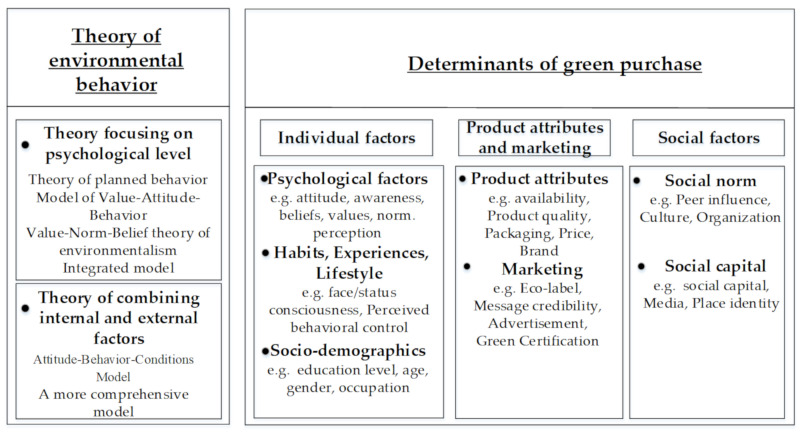
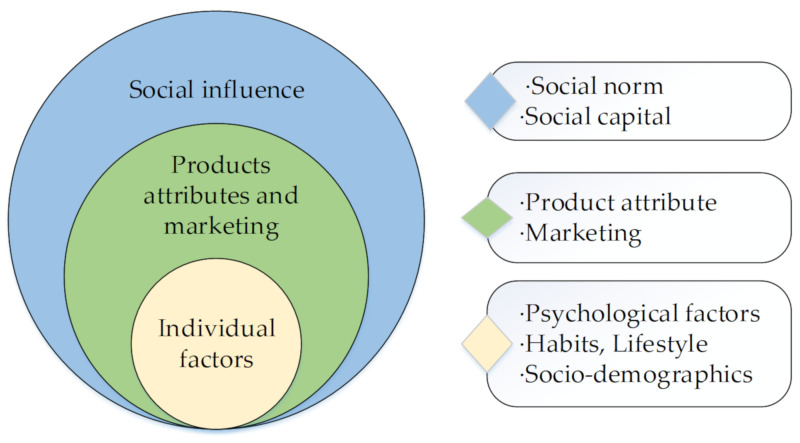
In order to achieve sustainable development to protect the environment and society, an increasing number of scholars have conducted in-depth research on green marketing and green purchases. Although great achievements have been made in this field, there still is room for further progress. This study reviews 97 papers providing empirical research on green purchase behavior from 2015 to 2020. First, we review the widely used consumer theory and its extended application in recent years. Second, we divide the influencing factors of green purchase behavior into the following three categories and discuss them in detail: individual factors, product attributes and marketing, and social factors. Finally, we put forward the following possible directions for future research. (1) The authors can consider adjustment to the survey objects to weaken the subjectivity of the data. (2) Longitudinal research can be used to assess the impact of education and policies with a lagging effect on consumers. (3) The authors can broaden the research direction towards a cross-cultural background. (4) The behavior of various green products (such as recyclable tires, recycled glass containers, recycled paper) could be explored to enrich the research content. (5) It will be beneficial to combine a variety of consumer theories to explore the green purchase behavior of consumers and break through the existing linear hypothesis path to explore new research methods.
Overview
The claims and statistics of this paper haven’t been checked yet.
Run the check — free, no account needed. It reads the open-access text and checks the sources it cites.
Integrity signals
Registry
Cites
Statistics
Figures
Verification
Claims the paper makes
The claims and statistics of this paper haven’t been checked yet.
Run the check — free, no account needed. It reads the open-access text and checks the sources it cites.
Claims other papers make about this one
Each is checked against this paper’s own text: does it say what the citing paper says it does?
The cited source says what the claim attributes to it.
In the citing paper
“Moreover, a recent study (Zhang et al. 2020) stated that the price of green products in the market is relatively higher than that of traditional products.”
From A Study on The Impact of Green Cosmetic, Personal Care Products, And Their Packaging on Consumer’s Purchasing Behavior in Luzon, Philippines (2023) · cites this paper as Zhang et al. 2020
Self-check
Percentages, sums and reported differences re-computed from the paper’s own numbers.
The self-check needs the paper’s full text.
Citations
Cites
The theory of planned behavior
Ajzen, I. (1991) · Organizational Behavior and Human Decision Processes · doi:10.1016/0749-5978(91)90020-t · Cited by 90,587
New Environmental Theories: Toward a Coherent Theory of Environmentally Significant Behavior
Stern, P. C. (2000) · Journal of Social Issues · doi:10.1111/0022-4537.00175 · Cited by 8,682
Normative Influences on Altruism
Schwartz, S. H. (1977) · Advances in Experimental Social Psychology · doi:10.1016/s0065-2601(08)60358-5 · Cited by 5,364
Why we buy what we buy: A theory of consumption values
Sheth, J. N., Newman, B. I., & Gross, B. L. (1991) · Journal of Business Research · doi:10.1016/0148-2963(91)90050-8 · Cited by 4,930
Social Capital: A Theory of Social Structure and Action
Lin, N. (2001) · doi:10.1017/cbo9780511815447 · Cited by 4,535
Mathieson, K. (1991) · Information Systems Research · doi:10.1287/isre.2.3.173 · Cited by 4,216
Bamberg, S., & Möser, G. (2007) · Journal of Environmental Psychology · doi:10.1016/j.jenvp.2006.12.002 · Cited by 4,140
Predicting green product consumption using theory of planned behavior and reasoned action
Paul, J., Modi, A., & Patel, J. (2016) · Journal of Retailing and Consumer Services · doi:10.1016/j.jretconser.2015.11.006 · Cited by 2,399
Factors affecting green purchase behaviour and future research directions
Joshi, Y., & Rahman, Z. (2015) · International Strategic Management Review · doi:10.1016/j.ism.2015.04.001 · Cited by 1,518
Yadav, R., & Pathak, G. S. (2016) · Journal of Cleaner Production · doi:10.1016/j.jclepro.2016.06.120 · Cited by 1,463
Research works printed but not linked: 9
- Sheng, 2018, The impact of consumer’s environmental responsibility on green product purchase behavior—A case of energy saving household appliances, Forum Stat. Inf., 33, 114
- Sheng, 2019, Research on driving mechanism of green consumption behavior of Chinese residents from the perspective of environmental co-governance, Forum Stat. Inf., 34, 109
- Sheng, 2019, A study on the social mechanism driving consumers’ green purchase from the perspective of social interaction, J. Huazhong Agric. Univ., 2, 81
- Megavannan, 2019, A study on green products buying decision among chennai people with respect to their ecological consciousness and challenges to buy, Int. J. Recent Technol. Eng. (IJRTE), 8, 137
- Fishbein, M., and Ajzen, I. (1977). Belief, Attitude, Intention and Behavior: An Introduction to Theory and Research, Addison-Wesley, Publishing Company.
- Lao, 2013, Research on the influence mechanism of consumer innovation on green consumption behavior, Nankai Manag. Rev., 4, 106
- Stkols, D., and Altman, I. (1987). Managing scarce environmental resources. Handbook of Environmental Psychology, Wiley.
- Peng, 2013, A review of the research on Influencing Factors of environmental behavior at home and abroad, China. Popul. Resourc. Environ., 23, 140
- Wang, 2013, The influence of resource conservation consciousness on resource conservation behavior: An interactive and moderating effect model in the context of Chinese culture, J. Manag. World, 8, 77
Cited by
Sorted by citations
Items 401–432 of 432
Wicaksono, K. C. B. (2026) · Inkubis Jurnal Ekonomi dan Bisnis · doi:10.59261/inkubis.v8i2.373
Impact of tourism websites on consumer purchase decisions
Ūsas, A., Štreimikienė, D., & Jasinskas, E. (2026) · Acta Polytechnica Hungarica · doi:10.12700/aph.23.8.2026.10.4
Lo'ong, L. S., Adam, R. P., Sipatu, L., & Abdul Azis, R. (2026) · JMM (Jurnal Masyarakat Mandiri) · doi:10.31764/jmm.v10i4.40197
Khuc, D. L., & Nanere, M. (2026) · Journal of Trade Science · doi:10.1108/jts-01-2026-0008
Sỹ, N. T., Minh, V. T. T., & Bích, P. T. (2026) · NMIMS Management Review · doi:10.1177/09711023261476409
Tanjung, A., Parkhurst, H., Newton, N., Kartini, T. M., & Zed, E. Z. (2026) · Score Jurnal Lentera Manajemen Pemasaran · doi:10.59422/lmp.v4i01.1238
Understanding the Determinants of Malaysian Consumers’ Purchase Intentions Toward Electric Vehicles
Jian, L. Z., Ramachandaran, S. D., Karim, R., & Chaudhery, U. (2026) · World Electric Vehicle Journal · doi:10.3390/wevj17090437
Han, L. B., Lin, C. Y., Wang, C., & Hoang, N. C. (2026) · TEM Journal · doi:10.18421/tem153-71
Suarsa, A., Sutandi, A., Fitriani, I. D., Nu'man, M. H., Gunawan, M. T. K., Syahidatulhaq, S. N., & Hardyanti, Z. (2026) · International Journal of Sustainable Development and Planning · doi:10.18280/ijsdp.210730
Singha, B., & Sood, D. (2026) · International Journal of Research in Marketing Management and Sales · doi:10.33545/26633329.2026.v8.i3a.436
Green Consumption and Sustainable Behaviors among University StudentsPreprint
ERYILMAZ, G. A., GÜLEÇ, Ş. N., & Ertuğ, H. İ. (2026) · Research Square · doi:10.21203/rs.3.rs-10590775/v1
Xiao, F., Sung, B., & Park, S.-D. (2026) · Sustainability · doi:10.3390/su18179063
Sakka, G., Theofanous, G., & Voutsa, M. C. (2026) · Competitiveness Review An International Business Journal incorporating Journal of Global Competitiveness · doi:10.1108/cr-02-2026-0116
From green marketing strategy to green purchase behavior in retail contexts
Nguyen, N. V., Huyen, P. T., Thị, L. P. Đ., & Nguyen, P. T. (2026) · Corporate and Business Strategy Review · doi:10.22495/cbsrv7i3siart6
Siwela, W., & Mchavi, N. D. (2026) · International Journal of Advanced Business Studies · doi:10.59857/5ybx8x61
Suresh, S., & -, M. S. S. (2026) · International Journal For Multidisciplinary Research · doi:10.36948/ijfmr.2026.v08i05.88225
Ameliya, D., & Rahayu, I. (2026) · Ebisma (Economics Business Management & Accounting Journal) · doi:10.61083/ebisma.v6i3.176
Čeryová, D., Ladvenicová, J., Hanušovský, O., Čereš, M., & Švikruhová, P. (2026) · WSEAS TRANSACTIONS ON BUSINESS AND ECONOMICS · doi:10.37394/23207.2026.23.132
Melo, H., Lins, S., & Poeschl, G. (2026) · Psique · doi:10.26619/2183-4806.xxii.2.1
The pedagogy of discomfort: Transformational experiential learning: (First published October 2021)
Mercer, L. E., & McDonagh, D. (2025) · Discern
Lim, J. X., & Azizan, A. Z. (2025) · Research in Management of Technology and Business
A do-it-yourself (DIY) effort towards green innovation and sustainability impact: A case of D’Bag
Anual, N., Karim, Z. H. A., Mustakim, N. A., Sauid, M. K., & Roseli, N. H. M. (2025) · Journal of Islamic Social Economics and Development
Lu, S., & Chaiprasit, K. (2025) · International Journal of Economics and Finance Studies
Febrianti, R. A. M., Chotim, E. R., Nurmansyah, A. A. H., & Oktavian, R. F. (2022) · Central Asia and the Caucasus
THE ROLE OF SOCIAL MEDIA IN GREEN FOOD PURCHASE INTENTION AMONG MALAYSIAN CONSUMERS
Sharan, A. N., Rahmat, N. B., & Ngali, N. B. (2026) · Journal of Tourism Hospitality and Environment Management · doi:10.35631/jthem.1145030
-, V. K. S., & Fikri, M. A. (2025) · Jurnal Manajemen Bisnis dan Keuangan · doi:10.51805/jmbk.v6i2.375
Szulc‐Obłoza, A. (2026) · SAGE Open · doi:10.1177/21582440261487713
Keena, N., Rondinel-Oviedo, D. R., Bouffard, A., & Pomasonco-Alvis, M. (2026) · Sustainable Futures · doi:10.1016/j.sftr.2026.102238
Rahmawati, F., Sunyono, Suyarso, S., Fadiawati, N., & Suyatna, A. (2026) · Primary Jurnal Pendidikan Guru Sekolah Dasar · doi:10.33578/jpfkip.v15i5.1445-1463
Mahowa, V. (2026) · Boloka Institutional Repository (North-west University)
Metadata
- Authors
- Zhang, X., & Dong, F.
- Affiliations
- China University of Mining and Technology (CN)
- Corresponding author
- Dong, Feng
- Venue
- International Journal of Environmental Research and Public Health
- Publisher
- MDPI AG
- Published
- 2020-09-11
- Volume
- 17
- Issue
- 18
- Pages
- 6607
- ISSN
- 1660-4601 (ISSN-L)
- PMC
- PMC7559813
- OpenAlex
- W3084826860
- Cited by
- 337
- References
- 117
- Citations by year
- 2026: 39 · 2025: 89 · 2024: 65 · 2023: 58 · 2022: 60 · 2021: 25
- FWCI
- 4.29
- Type
- journal article
- Language
- en
- Open access
- gold
- doi.org
- Licence
- Locations
- International Journal of Environmental Research and Public Health (publishedVersion, cc-by)
- PubMed Central (publishedVersion, cc-by)
- PubMed (publishedVersion)
- RePEc: Research Papers in Economics (submittedVersion)
- DOAJ (DOAJ: Directory of Open Access Journals) (submittedVersion)
- Funders
- National Natural Science Foundation of China (71974188 and 71573254)
- Humanities and Social Science Fund of Ministry of Education of China (19JDGC011)
- Jiangsu Funds for Social Science (17JDB004)
- Topics
- Social Sciences › Business, Management and Accounting › Marketing › Environmental Sustainability in Business
- Social Sciences › Business, Management and Accounting › Strategy and Management › Sustainable Supply Chain Management
- Physical Sciences › Environmental Science › Management, Monitoring, Policy and Law › Pro-Environmental Behavior and Attitudes
- Keywords
- green purchase behavior, green marketing, consumer behavior, sustainable consumption, consumer theory, influencing factors, product attributes, social factors, environmental policy, cross-cultural research, recycled products
- MeSH terms
- Sustainable Development, Conservation of Natural Resources, Consumer Behavior, Culture, Humans, Problem Solving, Surveys and Questionnaires, Marketing
About these checks
Registry, retraction, Cites and statistics results are computed, not judged, with one exception: a printed reference that no index lists is read once by a model before it counts as a citation error. Claims are extracted by a model and kept only when their quote appears verbatim in the text; each cited source is then checked, with a model’s help, for whether it says what the claim relies on. Those verdicts can be wrong — read the claim’s quote and the cited source before relying on one.
Statistics and arithmetic are recomputed, not judged.
Confidence bands are shown only for fields calibrated on our annotated test set. None is calibrated yet, so no band is shown.
What counts as a claim ›How we measure confidence ›How we check this ›
Are you an author, or do you see a problem with this page? Request a review
