

Exploring the Impact of COVID-19 on Mental Health Outcomes in Children and Adolescents: A Systematic Review
Open accessThe DOI matches its Crossref record; 70 of the 71 references it cites were found in a registry or an index; 38 of the 147 sources its claims cite were checked for support.
Abstract
The psychological impact of the COVID-19 pandemic has been widely discussed during the past few months, with scholars expressing concern about its potential debilitating consequences on youth mental health. Hence, this research aimed to provide a systematic review of the evidence on the COVID-19 pandemic’s impact on youth mental health. We conducted a mixed methods integrated review to identify any empirical study that focused on young people ≤ 18 years old. Eight databases were systematically searched to identify studies of any type of research design. The selection procedure followed the Preferred Reporting Items for Systematic Review and Meta-Analyses (PRISMA) guidelines. The protocol of this systematic review was registered with PROSPERO (protocol ID: CRD4202019375). Twelve studies deemed eligible for data extraction (n = 12,262). The findings show that COVID-19 has an impact on youth mental health and is particularly associated with depression and anxiety in adolescent cohorts. The quality appraisal indicated that all studies were of low or moderate methodological quality. The COVID-19 pandemic is affecting young people’s lives, and thus generating robust research evidence to inform policy decisions is essential. Hence, the methodological quality of future research should be drastically improved.
Overview
CoChat Summary
TL;DR
This systematic review synthesizes 12 studies (n = 12,262) on COVID-19’s impact on youth mental health and concludes that the pandemic affected young people’s mental health, particularly with depression and anxiety in adolescent cohorts. The included evidence was methodologically limited, with all studies rated low or moderate quality.
Key findings
- Across three studies reporting depression prevalence in young people, rates ranged from 22.6% to 43.7%; across two studies reporting anxiety, rates were 18.9% (SCARED) and 37.4% (GAD-7).
- COVID-19-related emotional reactions were present in children and adolescents, with reported rates ranging from 22% to 62.2% across three studies.
- COVID-19-related worry, fear, and stress predicted mental health outcomes including depression, anxiety, OCD symptoms, somatic symptoms, and intensified behaviour problems.
- Quality appraisal rated most included studies as low (n = 3) or moderate (n = 9) methodological quality.
Methods
- Mixed methods integrated systematic review following PRISMA, registered with PROSPERO (CRD4202019375), including quantitative, qualitative, and mixed methods designs.
- Eight databases were searched on 21 June 2020 with no time limit; inclusion required English, peer-reviewed empirical research, human participants aged ≤18 years, and COVID-19 specificity.
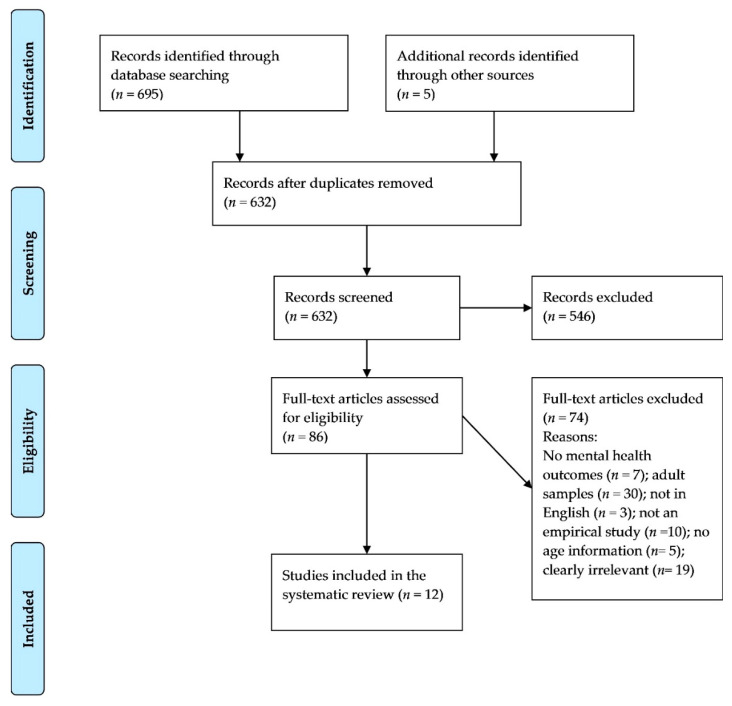
- From 700 records imported, 632 remained after duplicates, 74 underwent full-text review, and 12 studies were included (n = 12,262); findings were synthesized narratively because of heterogeneity, with quality assessed using JBI and MMAT tools.
Limitations
- Stated: included studies had low to moderate methodological quality regarding sampling, unclear validity of measurement, and statistical analysis; studies were excluded due to lacking or unclear information; only English-language studies were included; and few studies were available because COVID-19 was only declared a pandemic in March 2020.
- Evident from the text: five studies targeted the general population and included very small youth subgroups (n = 17–34), and one university study included n = 1118 young people <18 years but reported only descriptive statistics.
- Evident from the text: one included study did not conduct separate analyses for its <18-year subgroup, and heterogeneity prevented a meta-analytical synthesis.
Model-written summary. Check it against the paper before relying on it.
Integrity signals
Registry
Cites
Statistics
Figures
Verification
Claims the paper makes
27 Valid · 2 Not valid · 78 Not checked · 85 Own results and interpretations
Some cited sources support this claim and some don’t — read each source’s verdict below.
In the paper
“No conclusions can be drawn from the studies with very small sample sizes of young people [37,40,43,44].”
§ Exploring the Impact of COVID-19 on Mental Health Outcomes in Children and Adolescents: A Systematic Review > 4. Discussion > 4.2. Age and Gender Differences
What the sources say
- Disputedcites [37] Liu X. Luo W.T. Li Y. Li C.N. Hong Z.S. Chen H.L. Xiao F. Xia J.Y. Psychological status and behavior changes of the public during the COVID-19 epidemic in China Infect. Dis. Poverty 2020 9 58 10.1186/s40249-020-00678-3 32471513 PMC7256340 sourceExperimental — accuracy not yet measured
The paper does not say that its sample of young people was too small to draw conclusions. In “Anxiety by age groups” (page unavailable), it reports findings for respondents aged 19–39; in the Conclusions (page unavailable), it draws the qualified conclusion that this group appears likely to experience psychological stress during an epidemic. (LLM, conf=0.86)
Checked by a reasoning model — may be wrong.
- Partly supportedcites [40] Casanova M. Pagani Bagliacca E. Silva M. Patriarca C. Veneroni L. Clerici C.A. Spreafico F. Luksch R. Terenziani M. Meazza C. How young patients with cancer perceive the COVID-19 (coronavirus) epidemic in Milan, Italy: Is there room for other fears? Pediatr. Blood Cancer 2020 67 e28318 10.1002/pbc.28318 32240567 sourceExperimental — accuracy not yet measured
The Methods (p. 2) report three small groups of 25 young people, and the Discussion (p. 2) says the survey was not intended as an epidemiological study. But the Results (p. 2) explicitly report findings, so the source does not support the categorical assertion that no conclusions can be drawn. (LLM, conf=0.85)
- Not checked yetcites [43] Trzebiński J. Cabański M. Czarnecka J.Z. Reaction to the COVID-19 Pandemic: The Influence of Meaning in Life, Life Satisfaction, and Assumptions on World Orderliness and Positivity J. Loss Trauma. 2020 25 544 557 10.1080/15325024.2020.1765098 source
- Supportedcites [44] Tian F. Li H. Tian S. Yang J. Shao J. Tian C. Psychological symptoms of ordinary Chinese citizens based on SCL-90 during the level I emergency response to COVID-19 Psychiatry Res. 2020 288 112992 10.1016/j.psychres.2020.112992 32302816 PMC7151383 source
Table 3 (Results, ANOVA of different groups; page unavailable) shows that this study included only 22 participants under 18, supporting its citation as an example of a study with a very small sample of minors. The statement that no conclusions can be drawn is the citing authors’ assessment, not a conclusion attributed to Tian et al. (LLM, conf=0.86)
plain- Asserted: passes — The authors put it forward as true.
- Checkable: passes — It can be checked against evidence.
- Load-bearing: unclear — It is unclear whether the paper’s conclusions depend on it.
- Based: passes — The paper gives a reason why it holds.
- Disputed
The sources with a verdict support this claim; the rest weren’t checked yet, have no full text we could read, or their verdicts aren’t rated yet.
In the paper
“With social distancing measures and movement restrictions come serious risks of loneliness.”
§ Exploring the Impact of COVID-19 on Mental Health Outcomes in Children and Adolescents: A Systematic Review > 1. Introduction > 1.3. The Present Study
What the sources say
- Not checked yetcites [21] Caspi A. Harrington H.L. Moffitt T.E. Milne B.J. Poulton R. Socially isolated children 20 years later: Risk of cardiovascular disease Arch. Pediatr. Adolesc. Med. 2006 160 805 811 10.1001/archpedi.160.8.805 16894079 source
- Supportedcites [23] Loades M.E. Chatburn E. Higson-Sweeney N. Reynolds S. Shafran R. Brigden A. Linney C. McManus M.N. Borwick C. Crawley E. Rapid Systematic Review: The Impact of Social Isolation and Loneliness on the Mental Health of Children and Adolescents in the Context of COVID-19 J. Am. Acad. Child. Adolesc. Psychiatry 2020 59 1218 1239 10.1016/j.jaac.2020.05.009 32504808 PMC7267797 source
The paper states that social distancing and school closures are likely to increase loneliness in children and adolescents whose usual social contacts are curtailed (Abstract > Conclusion; page not provided). The Discussion also describes loneliness as an unintended consequence of disease-containment measures. (LLM, conf=0.91)
plainstates a cause- Asserted: passes — The authors put it forward as true.
- Checkable: passes — It can be checked against evidence.
- Load-bearing: passes — The paper’s conclusions depend on it.
- Based: passes — The paper gives a reason why it holds.
The sources with a verdict support this claim; the rest weren’t checked yet, have no full text we could read, or their verdicts aren’t rated yet.
In the paper
“The prevalence of depression in young people across the three studies that reported such information ranged from 22.6% to 43.7% [36,37,39].”
§ Exploring the Impact of COVID-19 on Mental Health Outcomes in Children and Adolescents: A Systematic Review > 3. Results > 3.2. Mental Health Outcomes
What the sources say
- Supportedcites [36] Zhou S.J. Zhang L.G. Wang L.L. Guo Z.C. Wang J.Q. Chen J.C. Liu M. Chen X. Chen J.X. Prevalence and socio-demographic correlates of psychological health problems in Chinese adolescents during the outbreak of COVID-19 Eur. Child. Adolesc. Psychiatry 2020 29 749 758 10.1007/s00787-020-01541-4 32363492 PMC7196181 source
The Discussion reports depressive symptoms in 43.7% of Chinese middle and high school students, supporting this paper's contribution to the upper end of the range. The 22.6% lower end is attributed to the other studies cited in the same sentence. Page numbers are not supplied in our copy. (LLM, conf=0.92)
- Supportedcites [37] Liu X. Luo W.T. Li Y. Li C.N. Hong Z.S. Chen H.L. Xiao F. Xia J.Y. Psychological status and behavior changes of the public during the COVID-19 epidemic in China Infect. Dis. Poverty 2020 9 58 10.1186/s40249-020-00678-3 32471513 PMC7256340 source
Table 4 (rendered under Conclusions; page unavailable) reports depression in 102 of 321 respondents aged 19–39, a prevalence of 31.8%, within the stated range. The 22.6% and 43.7% endpoints are attributed to the three studies collectively, not necessarily to this source alone. (LLM, conf=0.85)
- Not checked yetcites [39] Xie X. Xue Q. Zhou Y. Zhu K. Liu Q. Zhang J. Song R. Mental Health Status among Children in Home Confinement during the Coronavirus Disease 2019 Outbreak in Hubei Province, China JAMA Pediatr. 2020 174 898 900 10.1001/jamapediatrics.2020.1619 32329784 PMC7182958 source
plain- Asserted: passes — The authors put it forward as true.
- Checkable: passes — It can be checked against evidence.
- Load-bearing: unclear — It is unclear whether the paper’s conclusions depend on it.
- Based: passes — The paper gives a reason why it holds.
- Supported
Every source the paper cites for this claim was checked and supports it.
In the paper
“One study showed that as age increases, the intensity of behaviour problems induced by the pandemic in children with ASD decreases [34].”
§ Exploring the Impact of COVID-19 on Mental Health Outcomes in Children and Adolescents: A Systematic Review > 3. Results > 3.4. Age Differences
What the sources say
- Supportedcites [34] Colizzi M. Sironi E. Antonini F. Ciceri M.L. Bovo C. Zoccante L. Psychosocial and behavioral impact of COVID-19 in autism spectrum disorder: An online parent survey Brain Sci. 2020 10 341 10.3390/brainsci10060341 PMC7349059 32503172 source
The Results (section 3.3) report that increasing age was associated with a lower likelihood of more intense behavior problems following the COVID-19 outbreak. The Discussion (section 4) likewise suggests that older age may protect against emergency-induced intensification. This is an association in a parent survey, not evidence that an individual child’s problems diminish as they age. (LLM, conf=0.88)
plainstates a cause- Asserted: passes — The authors put it forward as true.
- Checkable: passes — It can be checked against evidence.
- Load-bearing: unclear — It is unclear whether the paper’s conclusions depend on it.
- Based: passes — The paper gives a reason why it holds.
- Supported
The sources with a verdict support this claim; the rest weren’t checked yet, have no full text we could read, or their verdicts aren’t rated yet.
In the paper
“Four studies reported mean scores of anxiety using Likert-point scales, with higher scores indicating higher levels of anxiety [35,38,42,43]”
§ Exploring the Impact of COVID-19 on Mental Health Outcomes in Children and Adolescents: A Systematic Review > 3. Results > 3.2. Mental Health Outcomes
What the sources say
- Supportedcites [35] Liu S. Liu Y. Liu Y. Somatic symptoms and concern regarding COVID-19 among Chinese college and primary school students: A cross-sectional survey Psychiatry Res. 2020 289 113070 10.1016/j.psychres.2020.113070 32422501 PMC7227526 source
The Method describes the Somatic Self-rating Scale as using items scored from 1 to 4, including anxiety symptoms. Results Table 2 reports mean anxiety scores for college and primary school students. This supports the paper’s inclusion as one of the four studies; the citation does not require this paper alone to establish the count of four. (LLM, conf=0.90)
- Not checked yetcites [38] Yang H. Bin P. He A.J. Opinions from the epicenter: An online survey of university students in Wuhan amidst the COVID-19 outbreak11 J. Chin. Gov. 2020 5 234 248 10.1080/23812346.2020.1745411 source
- Supportedcites [42] Oosterhoff B. Palmer C.A. Wilson J. Shook N. Adolescents’ motivations to engage in social distancing during the COVID-19 pandemic: Associations with mental and social health J. Adolesc. Health 2020 67 179 185 10.1016/j.jadohealth.2020.05.004 32487491 PMC7205689 source
The Anxiety symptoms section states that adolescents rated anxiety items on a 5-point scale and that mean scores were calculated, with higher values indicating greater anxiety symptoms. This confirms the measurement description for this cited study; the statement that four studies did so also depends on the other three citations. (LLM, conf=0.94)
- Not checked yetcites [43] Trzebiński J. Cabański M. Czarnecka J.Z. Reaction to the COVID-19 Pandemic: The Influence of Meaning in Life, Life Satisfaction, and Assumptions on World Orderliness and Positivity J. Loss Trauma. 2020 25 544 557 10.1080/15325024.2020.1765098 source
plain- Asserted: passes — The authors put it forward as true.
- Checkable: passes — It can be checked against evidence.
- Load-bearing: unclear — It is unclear whether the paper’s conclusions depend on it.
- Based: passes — The paper gives a reason why it holds.
- Supported
96 more claims · 17 with their cited sources checked
Create a free account to see all 192 claims and to verify the 109 references still open.
- Probably not a substantial claim. 73
- It may state two separate claims as one. 25
- The quote only partly states this claim. 1
Claims other papers make about this one
Each is checked against this paper’s own text: does it say what the citing paper says it does?
The cited source says what the claim attributes to it.
In the citing paper
“Systematic reviews of studies from early in the pandemic also found similar results of pandemic impacts on child and adolescent depression and anxiety symptoms [22,23,24].”
From Loneliness and Well-Being in Children and Adolescents during the COVID-19 Pandemic: A Systematic Review (2023) · cites this paper as [22]
In the citing paper
“Nearchou et al. [22] noted potential age-related differences in the pandemic’s impact. Older children may be impacted directly by school closures, whereas younger children may be impacted by pandemic-related stress placed on caregivers.”
From Loneliness and Well-Being in Children and Adolescents during the COVID-19 Pandemic: A Systematic Review (2023) · cites this paper as [22]
In the citing paper
“Parental stress caused by the pandemic-related factors may have a more significant impact on younger children, which can result in behavioural problems and can have a substantial effect on children with developmental disabilities [20].”
From A Qualitative Study of Child and Adolescent Mental Health during the COVID-19 Pandemic in Ireland (2021) · cites this paper as [20]
Self-check
Percentages, sums and reported differences re-computed from the paper’s own numbers.
Each contradiction between two passages listed here was confirmed by an independent check.
Rated minor: it would not touch a result — a value no result rests on, a p-value that stays on the same side of the significance level, or a conflict that is clerical, resolved elsewhere in the paper, or outside its own findings.
In the paper
§ Exploring the Impact of COVID-19 on Mental Health Outcomes in Children and Adolescents: A Systematic Review > 2. Methods > 2.3. Screening and Data Extraction
“Disagreements after full text review were resolved through discussion, and eight studies were included in the final stage of data extraction.”
§ Exploring the Impact of COVID-19 on Mental Health Outcomes in Children and Adolescents: A Systematic Review > 3. Results > 3.1. Methodological Characteristics of the Studies
“Of the 12 studies that were included in this systematic review, seven were conducted in China, two in Italy, one in Poland, one in Turkey and one in the United States.”
Citations
Cites
Preferred Reporting Items for Systematic Reviews and Meta-Analyses: the PRISMA statement
Moher, D., Liberati, A., Tetzlaff, J., Altman, D. G., & for the PRISMA Group (2009) · BMJ · doi:10.1136/bmj.b2535 · Cited by 83,823
Preferred Reporting Items for Systematic Reviews and Meta-Analyses: The PRISMA Statement
Moher, D., Liberati, A., Tetzlaff, J., Altman, D. G., & The PRISMA Group (2009) · PLoS Medicine · doi:10.1371/journal.pmed.1000097 · Cited by 64,042 · cited 1×
“The present systematic review was conducted in accordance with the Preferred Reporting Items for Systematic Reviews and Meta-Analysis (PRISMA) guidelines [28].”
Kessler, R. C., Berglund, P., Demler, O., Jin, R., Merikangas, K. R., & Walters, E. E. (2005) · Archives of General Psychiatry · doi:10.1001/archpsyc.62.6.593 · Cited by 20,391 · cited 1×
“It has been well established in the literature that children, and especially adolescents, are susceptible to experiencing mental health problems, while most mental disorders have their onset in this age period [51,52].”
BackgroundMerikangas, K. R., He, J.-P., Burstein, M., Swanson, S. A., Avenevoli, S., Cui, L., Benjet, C., Georgiades, K., & Swendsen, J. (2010) · Journal of the American Academy of Child & Adolescent Psychiatry · doi:10.1016/j.jaac.2010.05.017 · Cited by 6,278
The Mixed Methods Appraisal Tool (MMAT) version 2018 for information professionals and researchers
Hong, Q. N., Fàbregues, S., Bartlett, G., Boardman, F., Cargo, M., Dagenais, P., Gagnon, M.-P., Griffiths, F., Nicolau, B., O’Cathain, A., et al. (2018) · Education for Information · doi:10.3233/efi-180221 · Cited by 4,737 · cited 7×
“l ssess ent Tool [31] scree ing criteria.”
BackgroundMethodInfluentialWhy do many psychiatric disorders emerge during adolescence?
Paus, T., Keshavan, M., & Giedd, J. N. (2008) · Nature Reviews Neuroscience · doi:10.1038/nrn2513 · Cited by 3,123 · cited 1×
“It has been well established in the literature that children, and especially adolescents, are susceptible to experiencing mental health problems, while most mental disorders have their onset in this age period [51,52].”
BackgroundLoades, M. E., Chatburn, E., Higson-Sweeney, N., Reynolds, S., Shafran, R., Brigden, A., Linney, C., McManus, M. N., Borwick, C., & Crawley, E. (2020) · Journal of the American Academy of Child & Adolescent Psychiatry · doi:10.1016/j.jaac.2020.05.009 · Cited by 2,906 · cited 2×
“A rapid systematic review assessed the impact of social isolation and loneliness on the mental health of children and adolescents in the context of COVID-19 and concluded that there would be higher levels of depression and anxiety, both during and after imposed isolation periods come to an end [23].”
BackgroundMental health problems and social media exposure during COVID-19 outbreak
Gao, J., Zheng, P., Jia, Y., Chen, H., Mao, Y., Chen, S., Wang, Y., Fu, H., & Dai, J. (2020) · PLoS ONE · doi:10.1371/journal.pone.0231924 · Cited by 2,830 · cited 1×
“Frequent social media exposure during this pandemic has been associated with increased likelihood of depression and anxiety in adults [68].”
BackgroundMental Health Problems and Social Media Exposure During COVID-19 Outbreak
Gao, J., Zheng, P., Jia, Y., Chen, H., Mao, Y., Chen, S., Wang, Y., Fu, H., & Dai, J. (2020) · SSRN Electronic Journal · doi:10.2139/ssrn.3541120 · Cited by 2,830
Hankin, B. L., Abramson, L. Y., Moffitt, T. E., Silva, P. A., McGee, R., & Angell, K. E. (1998) · Journal of Abnormal Psychology · doi:10.1037/0021-843x.107.1.128 · Cited by 2,333 · cited 1×
“This is also consistent with evidence from other pre-COVID studies indicating that middle and late adolescents are likely to experience more heightened levels of distress than their younger peers [65,66].”
Result
Research works printed but not linked: 1
- Veritas Health Innovation Covidence Systematic Review Software Veritas Health Innovation Melbourne, Australia 2020 Available online: www.covidence.org (accessed on 21 June 2020)
Cited by
Items 301–400 of 629
Zhou, J., Rantanen, T., & Toikko, T. (2025) · BMC Public Health · doi:10.1186/s12889-025-25106-9 · Cited by 7
Winkler, D., Reichardt, B., Rothenberg, M., Rujescu, D., & Pjrek, E. (2022) · European Psychiatry · doi:10.1192/j.eurpsy.2022.2328 · Cited by 5
Reali, L., Nijman, R., Hadjipanayis, A., del Torso, S., Calamita, P., Rafele, I., Katz, M., Barak, S., & Grossman, Z. (2022) · Frontiers in Pediatrics · doi:10.3389/fped.2022.1006596 · Cited by 6
Mental Health Literacy: How to Obtain and Maintain Positive Mental Health
Sequeira, C., Sampaio, F., de Pinho, L. G., Araújo, O., Lluch, M., & Sousa, L. R. D. S. D. (2022) · Frontiers research topics · doi:10.3389/978-2-8325-0599-1 · Cited by 6
Sousa, M., Mendonça, J., & Fontão, E. (2023) · International Journal of Emerging Technologies in Learning (iJET) · doi:10.3991/ijet.v18i21.43415 · Cited by 6
Sime, D., Käkelä, E., & Behrens, S. (2024) · Ethnic and Racial Studies · doi:10.1080/01419870.2024.2351631 · Cited by 6
“The consequences of lockdown measures on young people ’ s education, work opportunities and well-being, particularly their mental health, have also been documented (Nearchou et al. 2020).”
Amorós-Reche, V., Morales, A., Francisco, R., Delvecchio, E., Mazzeschi, C., Godinho, C. I. A., Pedro, M. F., Molina-Torres, J., Espada, J. P., & Orgilés, M. (2025) · The Spanish Journal of Psychology · doi:10.1017/sjp.2025.8 · Cited by 5
“…that psychological symptoms among children and adolescents generally increased during the pandemic, compared to pre-pandemic levels (Bussières et al., 2021; Ma et al., 2021; Nearchou et al., 2020; Ng & Ng, 2022; Orban et al., 2023; Panchal et al., 2023; Racine et al., 2021; Wolf & Schmitz, 2024).”
Kimber, M., Harms, S., Soreni, N., Inrig, M., Acai, A., Lipman, E. L., Sassi, R. B., Streiner, D. L., & MacMillan, H. L. (2021) · BMJ Open · doi:10.1136/bmjopen-2021-049995 · Cited by 8
Emotional impact on children during home confinement in Spain
Sánchez-Ferrer, F., Cervantes-García, E., Gavilán-Martín, C., Quesada, J. A., Cortés‐Castell, E., & Nso‐Roca, A. P. (2022) · Frontiers in Public Health · doi:10.3389/fpubh.2022.969922 · Cited by 5
“There are many methodological limitations in the studies carried out, such as small sample sizes or being performed after the period of confinement with the resulting recall bias, among other limitations (12).”
BackgroundMaskour, L., Batri, B. E., Oubit, S. M., Jeronen, E. K., Agorram, B., & Bouali, R. (2022) · Education Sciences · doi:10.3390/educsci12120892 · Cited by 5
A Wrap Around Approach to Suicide Prevention in Schools: It’s not just School Counselors….
Dari, T., & Gay, J. L. (2022) · Teaching and Supervision in Counseling · doi:10.7290/tsc04q91z · Cited by 5
Lee, G. Y., Robotham, J., Song, Y. J. C., Occhipinti, J., Troy, J., Hirvonen, T., Feirer, D., Iannelli, O., Loblay, V., Freebairn, L., et al. (2022) · International Journal of Environmental Research and Public Health · doi:10.3390/ijerph20010053 · Cited by 5
Coronavirus disease 2019 and gastrointestinal disorders in children
Tjernberg, A. R., Malmborg, P., & Mårild, K. (2023) · Therapeutic Advances in Gastroenterology · doi:10.1177/17562848231177612 · Cited by 5
Albornoz, P. H., Contreras, C., Rodríguez, K. M., Rubilar, Á. S. B., Hartung, M. V., & González, I. G. (2024) · Cogent Education · doi:10.1080/2331186x.2024.2355388 · Cited by 5
“Students in confinement were exposed to a considerable risk of developing depressive symptoms or experiencing exacerbation of pre-existing ones (Nearchou et al., 2020).”
Palomo‐Carrión, R., Galisteo, R. P. R., Romay‐Barrero, H., Cortés-Vega, M.-D., Casuso-Holgado, M. J., & Pinto, E. P. (2022) · Therapeutic Advances in Chronic Disease · doi:10.1177/20406223221078091 · Cited by 5
“The PedsQLTM FI Module measures parent self-reported functioning: (1) Physical Functioning (6 items), (2) Emotional Functioning (5 items), (3) Social Functioning (4 items), (4) Cognitive Functioning (5 items), (5) Communication (3 items), and (6) Worry (5 items); and two scales measuring parent-reported family functio…”
BackgroundLet’s get virtual! Reinventing a science festival during a pandemic: limitations and insights
Balestri, M., Campera, M., Beaman, E.-M., Bell, D., Pink, R. C., & Nekaris, K. A. I. (2022) · International Journal of Science Education Part B · doi:10.1080/21548455.2022.2058106 · Cited by 5
“Recent studies explored the impact of the pandemic on different aspects of education, e.g. on vulnerable learners (Drane et al., 2021) on adolescent mental health (Nearchou et al., 2020), and on school closure and management practices (Viner et al., 2020).”
BackgroundMental Health and Substance Use among Adolescents during the COVID-19 Pandemic: A Mini Review
de MICHELI, D. (2021) · Psychology & Psychological Research International Journal · doi:10.23880/pprij-16000287 · Cited by 5
Being and Becoming among Young People Revealed through the Experience of COVID-19
Andersen, A. H., Viftrup, D. T., & Bank, M. (2022) · Religions · doi:10.3390/rel14010047 · Cited by 5
“Selvom nogle unge har oplevet positive konsekvenser så som øget taknemmelighed og empati (Beames et al., 2021; Kerekes et al., 2021), ses negative konsekvenser for unges mentale helbred i reviews af studier fra forskellige lande og kontinenter (Meherali et al., 2021; Nearchou et al., 2020).”
BackgroundMundy, L. K., Canterford, L. D., Dashti, S. G., Husin, H. M., Beatson, R. M., Edwards, B., & Patton, G. C. (2023) · Australian Journal of Social Issues · doi:10.1002/ajs4.249 · Cited by 5
Georgeades, C., Collings, A. T., Farazi, M. R., Bergner, C., Fallat, M. E., Minneci, P. C., Speck, K. E., Arendonk, K. J. V., Deans, K. J., Falcone, R. A., et al. (2023) · Injury Epidemiology · doi:10.1186/s40621-023-00475-0 · Cited by 5
“Many experienced social isolation in addition to an increase in family-related stress due to parental unemployment and financial strain (Pereda and Díaz-Faes 2020; Nearchou et al. 2020; Smith et al. 2020).”
BackgroundOrgilés, M., Amorós-Reche, V., Delvecchio, E., Francisco, R., Mazzeschi, C., Godinho, C. I. A., Pedro, M. F., Espada, J. P., & Morales, A. (2025) · Development and Psychopathology · doi:10.1017/s0954579425000136 · Cited by 4
Baelen, R. N., Lovett, J. M., Bourke, K. T., Galloway, C., Parker, A., Baghdady, A., & Schonert-Reichl, K. A. (2026) · Review of Educational Research · doi:10.3102/00346543251413248 · Cited by 4
Rossouw, J., Carey, E., Doyle, E., O'Brien, G., Cullinan, S., & O’Reilly, A. (2021) · Early Intervention in Psychiatry · doi:10.1111/eip.13250 · Cited by 4
Prashanth, G. P. (2022) · Middle East Current Psychiatry · doi:10.1186/s43045-022-00266-1 · Cited by 4
“On the other hand, data from adolescent cohorts (12 studies, n = 12,262) have shown that the pandemic had a significant impact on youth mental health and was mainly linked with depression and anxiety [12].”
BackgroundMindfulness Based Intervention to Overcome Anxiety in Adolescents
Rizwari, M. C. A. P., & Kemala, C. N. (2022) · ANALITIKA · doi:10.31289/analitika.v14i2.8259 · Cited by 6
García-Sastre, M., González-Alegre, P., González, R. L., Cuesta‐Lozano, D., Rodríguez‐Rojo, I. C., Lluch‐Canut, T., & Peñacoba, C. (2024) · Psychology International · doi:10.3390/psycholint6030044 · Cited by 4
Vossoughi, M., Kharazi, M., Mani, A., Safari, F., Habibi, P., Zarei, L., Sarikhani, Y., Heydari, S. T., & Lankarani, K. B. (2024) · BMC Psychology · doi:10.1186/s40359-024-01945-w · Cited by 5
“Even though the current study was conducted shortly after the pandemic subsided, these high levels of separation anxiety symptoms may still be influenced by the profound challenges that emerged during that period [36, 38, 42, 47, 58–60].”
BackgroundThe Impact of COVID-19 on Children and Adolescents with Chronic Illness
Nearchou, F., & Flinn, C. (2024) · Advances in experimental medicine and biology · doi:10.1007/978-3-031-61939-7_22 · Cited by 4
Self-citationLopez, D. E. M., Sherwin, E. B., Martijena, C. Q., Liu, Y., & Magis‐Weinberg, L. (2024) · Journal of Adolescent Health · doi:10.1016/j.jadohealth.2024.08.012 · Cited by 5
Payne, L., Goijen, H. J., Cobham, V. E., Bor, W., Stathis, S. S., Coghill, D., & Middeldorp, C. M. (2023) · Early Intervention in Psychiatry · doi:10.1111/eip.13421 · Cited by 4
“…has led to both an increased prevalence of mental health problems in children and adolescents especially anxiety and depression, and a higher severity of symptoms compared with pre-COVID-19 (Bignardi et al., 2020; Hawes et al., 2021; Meade, 2021; Nearchou et al., 2020; Racine et al., 2021).”
BackgroundBerryhill, M. B., Horton, A. G., Masters, S. L., Mack, D. R., Cross, A. N., Parker, J. G., Barth, J. M., & McDonald, K. L. (2023) · The Journal of Early Adolescence · doi:10.1177/02724316231178687 · Cited by 4
“Research also shows that adolescent COVID worry is also related to adolescent mental health (e.g., Nearchou et al., 2020; Zhang et al., 2020).”
BackgroundExhaled Breath Condensate and Respiratory Sequelae in Children Post-COVID-19
Klein, E. F., Yaacoby‐Bianu, K., Orlin, I., Zetser, A., Purits, N., & Livnat, G. (2023) · Respiration · doi:10.1159/000530971 · Cited by 4
Impact of the COVID-19 pandemic on the psychological well-being of adolescents by gender identity
Folch, C., Ganem, F., Colom‐Cadena, A., Martínez, I., Cabezas, C., & Casabona, J. (2023) · Gaceta Sanitaria · doi:10.1016/j.gaceta.2023.102346 · Cited by 4
Shner‐Livne, G., Buzzell, G. A., Fox, N. A., & Shechner, T. (2023) · Psychophysiology · doi:10.1111/psyp.14492 · Cited by 4
Shattuck, D. G., Willging, C. E., Peterson, J. C., & Ramos, M. M. (2024) · Implementation Research and Practice · doi:10.1177/26334895241249417 · Cited by 6
“…home environments fueled fears about increased mental and behavioral health challenges for youth, particularly for LGBTQ + youth (Chadi et al., 2022; Fish et al., 2020; Henderson et al., 2020; Meherali et al., 2021; Nearchou et al., 2020; Ormiston & Williams, 2022; O ’ Shea et al., 2021).”
BackgroundPsychosomatic Problems Among Adolescents During/Post the COVID-19 Pandemic: A Systematic Review
Shukla, M., & Upadhyay, N. (2024) · Adolescent Psychiatry · doi:10.2174/0122106766307916240626104350 · Cited by 6
Mckee, S., Sheikhan, N. Y., Patenaude, S., Henderson, J. L., Knight, R., Kidd, S. A., Barbic, S. P., O’Reilly, A., & Hawke, L. D. (2024) · Health Expectations · doi:10.1111/hex.70051 · Cited by 4
Ghozali, M. T. (2025) · Media Publikasi Promosi Kesehatan Indonesia (MPPKI) · doi:10.56338/mppki.v8i9.7391 · Cited by 6
“In terms of the diabetes self-management, the use of mHealth apps has been associated with several benefits (10).”
Heads-up: Effective Strategies for Promoting Mental Health Literacy in Youth Fitness Programs
Faigenbaum, A. D., Rebullido, T. R., & Zaichkowsky, L. D. (2022) · ACSMʼs Health & Fitness Journal · doi:10.1249/fit.0000000000000765 · Cited by 7
“Furthermore, the 2019 novel coronavirus (COVID-19) has affected the everyday lives of children and adolescents in an unprecedented manner, and well-founded concerns over the lasting effects of COVID-19 on youth health and functioning are increasing (6,7).”
BackgroundData on the Impact of Epidemic on Nursing Staff’s Mental Health in the Context of Wireless Network
Guo, D., Guo, Y., & Xing, Y. (2022) · Journal of Healthcare Engineering · doi:10.1155/2022/3413815 · Cited by 4
“1%, causing serious harm to the country and its people [10, 11].”
BackgroundRetractedSitnik‐Warchulska, K., Izydorczyk, B., & Wajda, Z. (2022) · Routledge eBooks · doi:10.4324/9781003221043 · Cited by 4
Conradi, L., Hazen, A. L., & Covert, J. (2022) · Global Implementation Research and Applications · doi:10.1007/s43477-022-00065-0 · Cited by 4
Pillay, J. (2022) · School Psychology International · doi:10.1177/01430343221135872 · Cited by 4
“…such as anxiety (Myruski & Buss, 2020), post-traumatic stress disorders (PTSD) (Cui et al., 2020; Henderson et al., 2020; Imran et al., 2020; Jefsen et al., 2020; Liang et al., 2020; Sethy & Mishra, 2020), depression and grief associated with loss (Guessoum et al., 2020; Nearchou et al., 2020).”
BackgroundSeprian, D., Hidayah, N., Masmuri, M., & Fakhruddin, M. S. (2023) · JURNAL KREATIVITAS PENGABDIAN KEPADA MASYARAKAT (PKM) · doi:10.33024/jkpm.v6i1.8091 · Cited by 4
Tremolada, M., Rosa, M., Incardona, R. M., Taverna, L., & Guidi, M. (2023) · International Journal of Environmental Research and Public Health · doi:10.3390/ijerph20032132 · Cited by 4
“This symptomatology supports the results of studies conducted on neurotypical and neurological adolescents, in which direct effects of COVID related to anxiety, depression [23], and obsessions [24,38]; in the quarantine period and immediately after.”
BackgroundResultUrban‐rural disparities in interfacility transfers for children during COVID‐19
McDaniel, C. E., Leyenaar, J. K., Bryan, M. A., Test, M. R., & Sullivan, E. (2023) · The Journal of Rural Health · doi:10.1111/jrh.12746 · Cited by 4
Busch, J., Haehner, P., Spierling, S. K., & Leyendecker, B. (2023) · Stress and Health · doi:10.1002/smi.3238 · Cited by 5
Investigating the factors affecting adolescents’ test anxiety in Greece during the COVID-19 pandemic
Trikoilis, D. (2023) · Pastoral Care in Education · doi:10.1080/02643944.2023.2214920 · Cited by 4
“The sudden interruption of educational processes resulted in learning loss (Engzell et al., 2021) and increased student levels of stress, anxiety, depression, and demotivation (Brooks et al., 2020; Naff et al., 2022; Nearchou et al., 2020).”
BackgroundGuarín, M. R., Rueda, J. G., Rodríguez, F. B., & Castro, S. (2023) · Revista Mexicana de Trastornos Alimentarios/Mexican Journal of Eating Disorders · doi:10.22201/fesi.20071523e.2023.2.757 · Cited by 5
Sánchez-López, M. T., Llamas‐Díaz, D., Megías‐Robles, A., Gómez‐Leal, R., Gutiérrez‐Cobo, M. J., Fernández‐Berrocal, P., & Cabello, R. (2024) · Psychology Research and Behavior Management · doi:10.2147/prbm.s434365 · Cited by 4
“6,7,45,46 Furthermore, Nearchou et al, 2 in a meta-analysis of young adults, discovered that emotional responses related to COVID-19, such as worry and fear of contracting the virus, were associated with depression and anxiety, both of which are mental health outcomes characterized by significant negative emotions.”
InfluentialPHYSICAL ACTIVITY AS A MEANS FOR A POSITIVE COPING DURING STRESSFUL SITUATIONS: AN ACTION RESEARCH.
Iannaccone, A. (2022) · Giornale Italiano di Educazione alla Salute, Sport e Didattica Inclusiva · doi:10.32043/gsd.v6i1.549 · Cited by 4
Kwesiga, J. M., Namuli, J. D., Akimana, B., Serunjogi, J. N., Kitaka, S. B., Musisi, S., Kaleebu, P., Nyirenda, M., & Nakimuli‐Mpungu, E. (2025) · Frontiers in Public Health · doi:10.3389/fpubh.2025.1568575 · Cited by 3
Vásquez, G. I. V., Ochoa, E. D. Q., Quizhpe, C. F. B., & Orellana, S. M. (2025) · Salud Ciencia y Tecnología · doi:10.56294/saludcyt20262366 · Cited by 3
Avčin, T., & Avguštin, B. (2022) · Jornal de Pediatria · doi:10.1016/j.jped.2022.03.001 · Cited by 3
Yeo, G., Chang, W. C., Lee, L. N., Oon, M., & Ho, D. (2022) · JMIR Research Protocols · doi:10.2196/34602 · Cited by 3
“The social implications of the COVID-19 pandemic, which involve uncertainty, insecurity, and a reduced sense of agency and self-directedness, have had a substantial impact on emerging adults, especially college students [18,19].”
Gillé, V., Allgayer, K., Wengert, M., & Eschenbeck, H. (2023) · Health Psychology and Behavioral Medicine · doi:10.1080/21642850.2023.2286953 · Cited by 3
“Meanwhile, many studies point to the impact of the pandemic and its restrictions on worsened well-being and poorer mental health among children and adolescents (for reviews, Nearchou et al., 2020; Racine et al., 2021; Viner et al., 2022).”
Stefánsdóttir, N. Þ., Kirk, J. W., Vestergaard, L., Thøgersen, D. B., Seing, I., Vrangbæk, K., Andersen, O., Nilsén, P., Tjørnhøj‐Thomsen, T., & Karlsson, E. A. (2024) · International Journal of Adolescence and Youth · doi:10.1080/02673843.2024.2312860 · Cited by 3
“Higher rates of anxiety, depression, stress (de Oliveira et al., 2022; Jones et al., 2021; Kleine et al., 2023; Meherali et al., 2021; Nearchou et al., 2020; Octavius et al., 2020; Panchal et al., 2023; Panda et al., 2021; Samji et al., 2022; Shah et al., 2020; von Soest et al., 2022), collective…”
Problematic Media Use and Anxiety Symptoms in Adolescents: The Role of Age and Gender
Rodríguez‐Rojo, I. C., González, R. L., Peñacoba, C., García-Sastre, M., Espín‐Lorite, E. J., Cuesta‐Lozano, D., Esteve, Á. L. A., & Noriega, C. (2025) · Healthcare · doi:10.3390/healthcare13030281 · Cited by 4
Pediatric SARS-CoV-2 infection and development of anxiety and depression
Dun-Dery, F., Xie, J., Zemek, R. L., Winston, K., Burstein, B., Sabhaney, V. J., Emsley, J. G., Gravel, J., Kam, A. J., Mater, A., et al. (2025) · Frontiers in Pediatrics · doi:10.3389/fped.2025.1524617 · Cited by 3
“This fi nding suggests that pandemic restrictions may have been more impactful in the development of mental health disorders than infection itself (66).”
Schlesinger, Y., Paz, Y., Rousseau, S., Atzaba‐Poria, N., & Frenkel, T. I. (2025) · Child Development · doi:10.1111/cdev.14250 · Cited by 3
“The present findings are in line with an increased number of studies evidencing the negative impact of pandemic-related stressors on both children's mental health and their caregivers (Nearchou et al. 2020; Panchal et al. 2021; Racine et al. 2022).”
Mastnak, W. (2022) · World Journal of Advanced Research and Reviews · doi:10.30574/wjarr.2022.13.1.0057 · Cited by 4
“The complex conditions of the COVID-19 era have a considerably high impact on youth mental health and are particularly associated with depression and anxiety in adolescent cohorts [3].”
Best Practices for Coaching an Athlete With Mental Health Concerns
Simoni, J. M. (2022) · Sports Health A Multidisciplinary Approach · doi:10.1177/19417381221091794 · Cited by 3
Li, S., & Liu, Y. (2022) · Computational Intelligence and Neuroscience · doi:10.1155/2022/7842304 · Cited by 3
“Here, the proposed CNN model is optimized to improve its recognition efficiency [30] using the DeepPsy model.”
MethodHidayat, N. A. P., Setyoningrum, R. A., & Setiawati, Y. (2022) · International Journal of Research Publications · doi:10.47119/ijrp10011511220224351 · Cited by 3
Bahrami, G., Takaffoli, M., & Vameghi, M. (2022) · Iranian Journal of Psychiatry and Clinical Psychology · doi:10.32598/ijpcp.28.3.3976.1 · Cited by 4
Negotiating Emerging Adulthood at the Onset of COVID-19 in Singapore
Yeo, G., & Yang, C. (2023) · Emerging Adulthood · doi:10.1177/21676968231153696 · Cited by 3
“Although there is growing research on the implications of the pandemic, most studies focused on mental health outcomes of young people (e.g., de Miranda et al., 2020; Huckins, et al., 2020; Nearchou et al., 2020).”
BackgroundSubjective impact of COVID-19 pandemic on youth with tic and OCD spectrum disorders
Tomczak, K. K., Worhach, J., Nguyen, S. T. T., Liu, S., Hoeppner, S. S., Zhang, B., & Greenberg, E. (2023) · Personalized Medicine in Psychiatry · doi:10.1016/j.pmip.2023.100103 · Cited by 4
“Studies have shown that this combination of factors, amongst others, negatively impacted the mental health of children [6,7].”
Background"When Adversity Strikes: Maintaining Student and Teacher Wellbeing During the Covid-19 Pandemic"
Waters, L. E. (2023) · Scholarly Journal of Psychology and Behavioral Sciences · doi:10.32474/sjpbs.2023.07.000258 · Cited by 3
Wamser‐Nanney, R. A., Rodriguez, C. M., Mizock, L. M., & Nabors, L. (2023) · Springer eBooks · doi:10.1007/978-3-031-27580-7_4 · Cited by 3
Salaguinto, T., Guzman, Y., Lowry, S., Liljenquist, K. S., LaFontaine, R., Ortiz, J., Szilagyi, P. G., Fiscella, K. A., Weaver, M. R., & Coker, T. R. (2023) · International Journal of Environmental Research and Public Health · doi:10.3390/ijerph20146407 · Cited by 3
“There is a critical need to understand how the pandemic affected families with young children; however, data are limited, as most studies have focused on families with schoolaged children or employed cross-sectional designs [7,13,14].”
BackgroundQuality of life in adolescents. A longitudinal study of the impact of the COVID-19 pandemic
Morales-Ortiz, J., Muñoz-Martínez, S., Martínez-Sánchez, A., & García, J. J. L. (2023) · Anales de Psicología · doi:10.6018/analesps.554511 · Cited by 5
Lordos, A., Christou, G., Yarema, B., Dryga, A., Petrou, A., & Symeou, M. (2023) · Adversity and Resilience Science · doi:10.1007/s42844-023-00108-x · Cited by 3
“As a result, more than 80% of children worldwide were affected by COVID and sub-sequent ACEs, with mental health, nutrition, educational outcomes, and safety being some of the main detrimental consequences (d’Orville, 2020; Nearchou et al., 2020; UNESCO, 2020).”
Thompson, R., Brown, L., Evans, R. B., Mahbub, R., Rees, A., Wilson, M., Dewa, L. H., Ward, H., & Toledano, M. B. (2024) · International Journal of Environmental Research and Public Health · doi:10.3390/ijerph21050636 · Cited by 3
“Although mental health difficulties and demands on services were already increasing in the UK pre-pandemic [2], increased anxiety and depression in adolescents and young people during and post-pandemic have been widely reported [3–5].”
BackgroundWilson, E., Loades, M. E., Human, S., Coetzee, B., Gericke, H., & Laning, G. (2024) · Clinical Child Psychology and Psychiatry · doi:10.1177/13591045241264861 · Cited by 3
Marfoli, A., Speziale, G., Prete-Ferrucci, G. D., Cole, H., Sandi, A. D., Mellace, D., Chieffo, D. P. R., Barbieri, S., Priori, A., Dell’Osso, B. M., et al. (2024) · Journal of Clinical Medicine · doi:10.3390/jcm13164768 · Cited by 3
“Their functions were the compensation of education, communication, socialisation, and other aspects of daily life [24,35,38].”
BackgroundA Covid-19 járvány hatása iskoláskorúak lelki és társas jóllét mutatóira
Várnai, D., Sebestyén, E., Horváth, Z., Kocsis, N., Mészner, Z., & Németh, Á. (2024) · Multidiszciplináris Egészség és Jóllét · doi:10.58701/mej.12852 · Cited by 5
Lafontaine-Poissant, F., Ooi, L. L., Roberts, K. C., & Varin, M. (2025) · Health Promotion and Chronic Disease Prevention in Canada · doi:10.24095/hpcdp.45.6.02 · Cited by 3
Thornley, S., Grant, C. C., & Sundborn, G. (2021) · Journal of Paediatrics and Child Health · doi:10.1111/jpc.15736 · Cited by 3
Minding Mental Health: Clinicians’ Engagement with Youth Suicide Prevention
Klee, K., & Bartkowski, J. P. (2022) · Social Sciences · doi:10.3390/socsci11050209 · Cited by 4
Lauwerie, L., Sibut, R., Maillet-Vioud, C., Monteiro, S., Alauze, F., Martinez, E., Sauniere, D., Legrand-Vyskoc, A., & Lachal, J. (2023) · Psychiatry Research · doi:10.1016/j.psychres.2023.115080 · Cited by 5
“, 2020) The psychological impact has been significant among adolescents, with a particular increase of depressive and anxiety disorders (Gracia et al., 2021; Nearchou et al., 2020).”
BackgroundBucko, A. G., Dowda, M., Inak, N., Wilson, D. K., & Pate, R. R. (2024) · Journal of Adolescent Health · doi:10.1016/j.jadohealth.2024.04.026 · Cited by 2
Cena, L., Trainini, A., Zecca, S., Zappa, S. B., Cunegatti, F., & Buizza, C. (2023) · Psychology in the Schools · doi:10.1002/pits.22950 · Cited by 2
“Prolonged social isolation is a risk factor for poor mental health (Brooks et al., 2020; Fegert et al., 2020; Nearchou et al., 2020; Urbina ‐ Garcia, 2020).”
BackgroundDyke, N. V., Keo, S. O., & de Courten, M. (2024) · Frontiers in Public Health · doi:10.3389/fpubh.2024.1360441 · Cited by 2
COVID-19 Symptoms Only Minutely Influenced by Genes Among Children in a Nationwide Twin Cohort
Hedman, A. M., Palm, C., Magnusson, P. K. E., Rhedin, S., Kuja‐Halkola, R., & Almqvist, C. (2025) · The Pediatric Infectious Disease Journal · doi:10.1097/inf.0000000000004714 · Cited by 2
“11 In Sweden, no population-based study has investigated the clinical and psychological symptoms of COVID-19 in children.”
Χατζηχρήστου, Χ., Lianos, P., Lampropoulou, A., Γεωργάκου-Κουτσονίκου, Ν., Yfanti, T., & Georgouleas, G. (2022) · Psychology the Journal of the Hellenic Psychological Society · doi:10.12681/psy_hps.28855 · Cited by 3
Adolescent mental health: A guide for the primary care provider
Teague, M. S., & Derouin, A. L. (2022) · Women’s Healthcare A Clinical Journal for NPs · doi:10.51256/whc042236 · Cited by 2
Oblath, R., Oh, A., Herrera, C., Duncan, A. M., & Zhen‐Duan, J. (2023) · Journal of Psychiatric Research · doi:10.1016/j.jpsychires.2023.01.047 · Cited by 2
Woodward, M. L., Hossain, A. K. M. M., Chun, A., Liu, C. H., Kilyk, K., Bone, J. N., Meckler, G. D., Black, T. R., Stewart, S. E., Samji, H., et al. (2023) · PLoS ONE · doi:10.1371/journal.pone.0281083 · Cited by 2
Sari, T. T., Wiguna, T., Elvira, S. D., Widyahening, I. S., Mangiri, R., Napitupulu, A. S., Sutandi, N., Tanumiharjo, S., & Sitorus, R. S. (2023) · Indian Journal of Medical and Paediatric Oncology · doi:10.1055/s-0043-1768053 · Cited by 2
Lazaridis, A., Syrmpas, I., Tsatalas, T., Κrommidas, C., & Digelidis, N. M. (2023) · Journal of Functional Morphology and Kinesiology · doi:10.3390/jfmk8020055 · Cited by 2
“However, the methodological quality of these studies was low to moderate [55].”
BackgroundResultInfluentialEarly executive control buffers risk for adolescent psychopathology during the COVID‐19 pandemic
Laifer, L. M., Tomaso, C. C., Chang, O. D., Phillips, E. M., James, T. D., Nelson, J. M., Espy, K. A., Mason, W. A., & Nelson, T. D. (2023) · Journal of Adolescence · doi:10.1002/jad.12195 · Cited by 2
Braig, J., Schmees, P., Kilinc, Y., EL‐Awad, U., Nilles, H., Kerkhoff, D., Rueth, J., Lohaus, A., & Eschenbeck, H. (2023) · Current Psychology · doi:10.1007/s12144-023-04838-0 · Cited by 3
How COVID-19 Affected the Mental Health of Primary School Students in Vietnam
Murafa, S. V., & Hoc, H. T. (2023) · Advances in educational technologies and instructional design book series · doi:10.4018/979-8-3693-1826-3.ch008 · Cited by 2
Leite, R. O., Brodar, K. E., Saab, P. G., Marchetti, D., Jaramillo, M., Sanchez, J. E., Davis, E., Delamater, A. M., & Greca, A. M. L. (2024) · Journal of Clinical Psychology in Medical Settings · doi:10.1007/s10880-023-09995-9 · Cited by 2
Borovica, T., McQuilten, G., Kokanović, R., Hjorth, L., Clarke, A., Maling, C., & Briggs, N. C. (2024) · International Journal of Art & Design Education · doi:10.1111/jade.12492 · Cited by 2
Barone, P., Borrás-Sansaloni, C., Ricco-Pérez, M., López-Navarro, E., & Navarro, C. (2024) · Journal of Clinical Medicine · doi:10.3390/jcm13082340 · Cited by 3
“2024 , 13 , 2340 2 of 11 with young adults being particularly vulnerable [10,12,15,16].”
BackgroundHughes, K. M., Overberg, A., Satterfield, K., Voss, H., & Rogerson, C. M. (2024) · The Journal of Pediatric Pharmacology and Therapeutics · doi:10.5863/1551-6776-29.3.273 · Cited by 2
Bui, H.-Q., Giang, T.-V., Pham-Ngoc, T.-N., & Vu-Thi, V.-D. (2024) · Journal of Infrastructure Policy and Development · doi:10.24294/jipd.v8i8.6024 · Cited by 2
“Before the declaration of the end of COVID-19 as a global pandemic, a study implied that stressful responses and excessive anxiety also increased in every outbreak period of the pandemic, especially in China, Italia, Poland, Turkey, and America (Nearchou et al., 2020).”
BackgroundRezazadeh, H. R., Aliahmadi, A., Abdolhamid, M., & Loghman, S. A. M. (2024) · Tiknuluzhī dar kār/āfarīnī va mudīriyyat-i istrātizhīk. · doi:10.61838/kman.jtesm.3.1.18 · Cited by 2
Marchetto, C., Criscuolo, M., Croci, I., Bucci, M. E., Caramadre, A. M., Castiglioni, M. C., Vicari, S., & Zanna, V. (2025) · Eating and Weight Disorders - Studies on Anorexia Bulimia and Obesity · doi:10.1007/s40519-025-01749-w · Cited by 2
“The COVID-19 pandemic lockdown had significant psychological effects on children and adolescents, particularly those with pre-existing mental health conditions (Castellini, Cassioli, Rossi et al., [7]; Nearchou, Flinn, Niland, et al., [23]).”
Metadata
- Authors
- Nearchou, F., Flinn, C., Niland, R., Subramaniam, S. S., & Hennessy, E.
- Affiliations
- University College Dublin (IE)
- Corresponding author
- Nearchou, Finiki
- Venue
- International Journal of Environmental Research and Public Health
- Publisher
- MDPI AG
- Published
- 2020-11-16
- Volume
- 17
- Issue
- 22
- Pages
- 8479
- ISSN
- 1660-4601 (ISSN-L)
- PMC
- PMC7698263
- OpenAlex
- W3098856005
- Cited by
- 577
- References
- 71
- Citations by year
- 2026: 15 · 2025: 37 · 2024: 98 · 2023: 147 · 2022: 174 · 2021: 105 · 2020: 1
- FWCI
- 8.35
- Type
- journal article
- Language
- en
- Open access
- gold
- doi.org
- Licence
- Locations
- International Journal of Environmental Research and Public Health (publishedVersion, cc-by)
- PubMed Central (publishedVersion, cc-by)
- PubMed (publishedVersion)
- RePEc: Research Papers in Economics (submittedVersion)
- DOAJ (DOAJ: Directory of Open Access Journals) (submittedVersion, cc-by-sa)
- Topics
- Social Sciences › Psychology › Clinical Psychology › COVID-19 and Mental Health
- Social Sciences › Psychology › Clinical Psychology › Child and Adolescent Psychosocial and Emotional Development
- Health Sciences › Medicine › Public Health, Environmental and Occupational Health › Maternal Mental Health During Pregnancy and Postpartum
- Keywords
- COVID-19 pandemic, youth mental health, children and adolescents, depression, anxiety, psychological impact of pandemic, mental health outcomes
- MeSH terms
- Child Health, Adolescent Health, Betacoronavirus, COVID-19, SARS-CoV-2, Adolescent, Anxiety, Child, Depression, Humans, Mental Health, Pneumonia, Viral, Outcome Assessment, Health Care, Coronavirus Infections, Pandemics
About these checks
Registry, retraction, Cites and statistics results are computed, not judged, with one exception: a printed reference that no index lists is read once by a model before it counts as a citation error. Claims are extracted by a model and kept only when their quote appears verbatim in the text; each cited source is then checked, with a model’s help, for whether it says what the claim relies on. Those verdicts can be wrong — read the claim’s quote and the cited source before relying on one.
The claim verdicts this report counts are experimental: their accuracy is not yet measured.
A language model drew the claims from the paper on 2026-10-05, under version 3 of the claim definition (model deepseek-v4.1-flash, prompt extract-v3).
A second model labelled each claim on 2026-10-05 (model jev-1.13-20260917, definition revision gold-guideline-v0.2).
Cited sources are checked with a language model’s help (gpt-6-sol).
Statistics and arithmetic are recomputed, not judged.
Confidence bands are shown only for fields calibrated on our annotated test set. None is calibrated yet, so no band is shown.
What counts as a claim ›How we measure confidence ›How we check this ›
Are you an author, or do you see a problem with this page? Request a review
Data sources
Bibliographic data: Semantic Scholar, OpenAlex, Crossref.
Contains information from the Semantic Scholar Academic Graph Datasets, made available under the ODC Attribution License (ODC-BY 1.0).
Semantic Scholar’s data is described in: Kinney, R., et al. (2023). The Semantic Scholar Open Data Platform. arXiv:2301.10140.
