

Exploring the Impact of COVID-19 on Mental Health Outcomes in Children and Adolescents: A Systematic Review
Open accessThe DOI matches its Crossref record; 70 of the 71 references it cites were found in a registry or an index; 38 of the 147 sources its claims cite were checked for support.
Abstract
The psychological impact of the COVID-19 pandemic has been widely discussed during the past few months, with scholars expressing concern about its potential debilitating consequences on youth mental health. Hence, this research aimed to provide a systematic review of the evidence on the COVID-19 pandemic’s impact on youth mental health. We conducted a mixed methods integrated review to identify any empirical study that focused on young people ≤ 18 years old. Eight databases were systematically searched to identify studies of any type of research design. The selection procedure followed the Preferred Reporting Items for Systematic Review and Meta-Analyses (PRISMA) guidelines. The protocol of this systematic review was registered with PROSPERO (protocol ID: CRD4202019375). Twelve studies deemed eligible for data extraction (n = 12,262). The findings show that COVID-19 has an impact on youth mental health and is particularly associated with depression and anxiety in adolescent cohorts. The quality appraisal indicated that all studies were of low or moderate methodological quality. The COVID-19 pandemic is affecting young people’s lives, and thus generating robust research evidence to inform policy decisions is essential. Hence, the methodological quality of future research should be drastically improved.
Overview
CoChat Summary
TL;DR
This systematic review synthesizes 12 studies (n = 12,262) on COVID-19’s impact on youth mental health and concludes that the pandemic affected young people’s mental health, particularly with depression and anxiety in adolescent cohorts. The included evidence was methodologically limited, with all studies rated low or moderate quality.
Key findings
- Across three studies reporting depression prevalence in young people, rates ranged from 22.6% to 43.7%; across two studies reporting anxiety, rates were 18.9% (SCARED) and 37.4% (GAD-7).
- COVID-19-related emotional reactions were present in children and adolescents, with reported rates ranging from 22% to 62.2% across three studies.
- COVID-19-related worry, fear, and stress predicted mental health outcomes including depression, anxiety, OCD symptoms, somatic symptoms, and intensified behaviour problems.
- Quality appraisal rated most included studies as low (n = 3) or moderate (n = 9) methodological quality.
Methods
- Mixed methods integrated systematic review following PRISMA, registered with PROSPERO (CRD4202019375), including quantitative, qualitative, and mixed methods designs.
- Eight databases were searched on 21 June 2020 with no time limit; inclusion required English, peer-reviewed empirical research, human participants aged ≤18 years, and COVID-19 specificity.
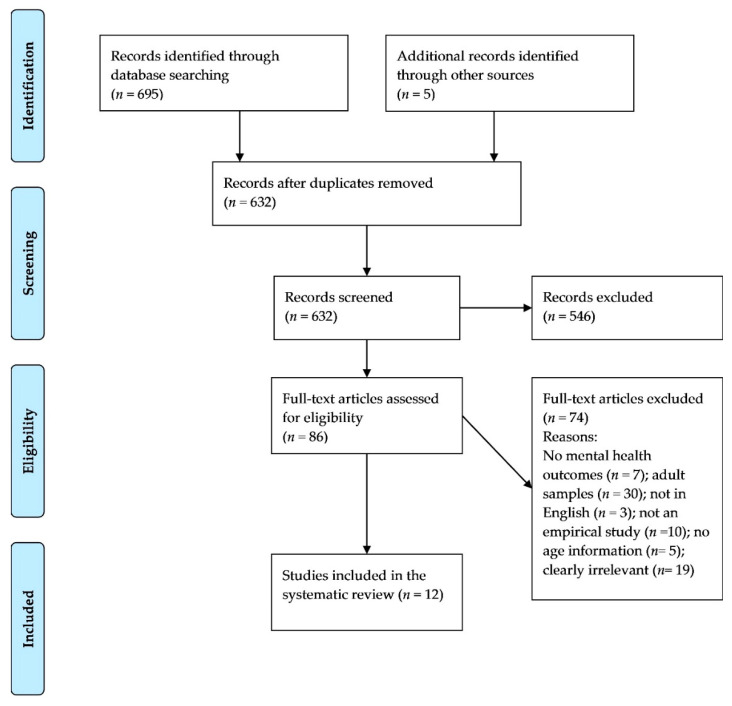
- From 700 records imported, 632 remained after duplicates, 74 underwent full-text review, and 12 studies were included (n = 12,262); findings were synthesized narratively because of heterogeneity, with quality assessed using JBI and MMAT tools.
Limitations
- Stated: included studies had low to moderate methodological quality regarding sampling, unclear validity of measurement, and statistical analysis; studies were excluded due to lacking or unclear information; only English-language studies were included; and few studies were available because COVID-19 was only declared a pandemic in March 2020.
- Evident from the text: five studies targeted the general population and included very small youth subgroups (n = 17–34), and one university study included n = 1118 young people <18 years but reported only descriptive statistics.
- Evident from the text: one included study did not conduct separate analyses for its <18-year subgroup, and heterogeneity prevented a meta-analytical synthesis.
Model-written summary. Check it against the paper before relying on it.
Integrity signals
Registry
Cites
Statistics
Figures
Verification
Claims the paper makes
27 Valid · 2 Not valid · 78 Not checked · 85 Own results and interpretations
Some cited sources support this claim and some don’t — read each source’s verdict below.
In the paper
“No conclusions can be drawn from the studies with very small sample sizes of young people [37,40,43,44].”
§ Exploring the Impact of COVID-19 on Mental Health Outcomes in Children and Adolescents: A Systematic Review > 4. Discussion > 4.2. Age and Gender Differences
What the sources say
- Disputedcites [37] Liu X. Luo W.T. Li Y. Li C.N. Hong Z.S. Chen H.L. Xiao F. Xia J.Y. Psychological status and behavior changes of the public during the COVID-19 epidemic in China Infect. Dis. Poverty 2020 9 58 10.1186/s40249-020-00678-3 32471513 PMC7256340 sourceExperimental — accuracy not yet measured
The paper does not say that its sample of young people was too small to draw conclusions. In “Anxiety by age groups” (page unavailable), it reports findings for respondents aged 19–39; in the Conclusions (page unavailable), it draws the qualified conclusion that this group appears likely to experience psychological stress during an epidemic. (LLM, conf=0.86)
Checked by a reasoning model — may be wrong.
- Partly supportedcites [40] Casanova M. Pagani Bagliacca E. Silva M. Patriarca C. Veneroni L. Clerici C.A. Spreafico F. Luksch R. Terenziani M. Meazza C. How young patients with cancer perceive the COVID-19 (coronavirus) epidemic in Milan, Italy: Is there room for other fears? Pediatr. Blood Cancer 2020 67 e28318 10.1002/pbc.28318 32240567 sourceExperimental — accuracy not yet measured
The Methods (p. 2) report three small groups of 25 young people, and the Discussion (p. 2) says the survey was not intended as an epidemiological study. But the Results (p. 2) explicitly report findings, so the source does not support the categorical assertion that no conclusions can be drawn. (LLM, conf=0.85)
- Not checked yetcites [43] Trzebiński J. Cabański M. Czarnecka J.Z. Reaction to the COVID-19 Pandemic: The Influence of Meaning in Life, Life Satisfaction, and Assumptions on World Orderliness and Positivity J. Loss Trauma. 2020 25 544 557 10.1080/15325024.2020.1765098 source
- Supportedcites [44] Tian F. Li H. Tian S. Yang J. Shao J. Tian C. Psychological symptoms of ordinary Chinese citizens based on SCL-90 during the level I emergency response to COVID-19 Psychiatry Res. 2020 288 112992 10.1016/j.psychres.2020.112992 32302816 PMC7151383 source
Table 3 (Results, ANOVA of different groups; page unavailable) shows that this study included only 22 participants under 18, supporting its citation as an example of a study with a very small sample of minors. The statement that no conclusions can be drawn is the citing authors’ assessment, not a conclusion attributed to Tian et al. (LLM, conf=0.86)
plain- Asserted: passes — The authors put it forward as true.
- Checkable: passes — It can be checked against evidence.
- Load-bearing: unclear — It is unclear whether the paper’s conclusions depend on it.
- Based: passes — The paper gives a reason why it holds.
- Disputed
The sources with a verdict support this claim; the rest weren’t checked yet, have no full text we could read, or their verdicts aren’t rated yet.
In the paper
“With social distancing measures and movement restrictions come serious risks of loneliness.”
§ Exploring the Impact of COVID-19 on Mental Health Outcomes in Children and Adolescents: A Systematic Review > 1. Introduction > 1.3. The Present Study
What the sources say
- Not checked yetcites [21] Caspi A. Harrington H.L. Moffitt T.E. Milne B.J. Poulton R. Socially isolated children 20 years later: Risk of cardiovascular disease Arch. Pediatr. Adolesc. Med. 2006 160 805 811 10.1001/archpedi.160.8.805 16894079 source
- Supportedcites [23] Loades M.E. Chatburn E. Higson-Sweeney N. Reynolds S. Shafran R. Brigden A. Linney C. McManus M.N. Borwick C. Crawley E. Rapid Systematic Review: The Impact of Social Isolation and Loneliness on the Mental Health of Children and Adolescents in the Context of COVID-19 J. Am. Acad. Child. Adolesc. Psychiatry 2020 59 1218 1239 10.1016/j.jaac.2020.05.009 32504808 PMC7267797 source
The paper states that social distancing and school closures are likely to increase loneliness in children and adolescents whose usual social contacts are curtailed (Abstract > Conclusion; page not provided). The Discussion also describes loneliness as an unintended consequence of disease-containment measures. (LLM, conf=0.91)
plainstates a cause- Asserted: passes — The authors put it forward as true.
- Checkable: passes — It can be checked against evidence.
- Load-bearing: passes — The paper’s conclusions depend on it.
- Based: passes — The paper gives a reason why it holds.
The sources with a verdict support this claim; the rest weren’t checked yet, have no full text we could read, or their verdicts aren’t rated yet.
In the paper
“The prevalence of depression in young people across the three studies that reported such information ranged from 22.6% to 43.7% [36,37,39].”
§ Exploring the Impact of COVID-19 on Mental Health Outcomes in Children and Adolescents: A Systematic Review > 3. Results > 3.2. Mental Health Outcomes
What the sources say
- Supportedcites [36] Zhou S.J. Zhang L.G. Wang L.L. Guo Z.C. Wang J.Q. Chen J.C. Liu M. Chen X. Chen J.X. Prevalence and socio-demographic correlates of psychological health problems in Chinese adolescents during the outbreak of COVID-19 Eur. Child. Adolesc. Psychiatry 2020 29 749 758 10.1007/s00787-020-01541-4 32363492 PMC7196181 source
The Discussion reports depressive symptoms in 43.7% of Chinese middle and high school students, supporting this paper's contribution to the upper end of the range. The 22.6% lower end is attributed to the other studies cited in the same sentence. Page numbers are not supplied in our copy. (LLM, conf=0.92)
- Supportedcites [37] Liu X. Luo W.T. Li Y. Li C.N. Hong Z.S. Chen H.L. Xiao F. Xia J.Y. Psychological status and behavior changes of the public during the COVID-19 epidemic in China Infect. Dis. Poverty 2020 9 58 10.1186/s40249-020-00678-3 32471513 PMC7256340 source
Table 4 (rendered under Conclusions; page unavailable) reports depression in 102 of 321 respondents aged 19–39, a prevalence of 31.8%, within the stated range. The 22.6% and 43.7% endpoints are attributed to the three studies collectively, not necessarily to this source alone. (LLM, conf=0.85)
- Not checked yetcites [39] Xie X. Xue Q. Zhou Y. Zhu K. Liu Q. Zhang J. Song R. Mental Health Status among Children in Home Confinement during the Coronavirus Disease 2019 Outbreak in Hubei Province, China JAMA Pediatr. 2020 174 898 900 10.1001/jamapediatrics.2020.1619 32329784 PMC7182958 source
plain- Asserted: passes — The authors put it forward as true.
- Checkable: passes — It can be checked against evidence.
- Load-bearing: unclear — It is unclear whether the paper’s conclusions depend on it.
- Based: passes — The paper gives a reason why it holds.
- Supported
Every source the paper cites for this claim was checked and supports it.
In the paper
“One study showed that as age increases, the intensity of behaviour problems induced by the pandemic in children with ASD decreases [34].”
§ Exploring the Impact of COVID-19 on Mental Health Outcomes in Children and Adolescents: A Systematic Review > 3. Results > 3.4. Age Differences
What the sources say
- Supportedcites [34] Colizzi M. Sironi E. Antonini F. Ciceri M.L. Bovo C. Zoccante L. Psychosocial and behavioral impact of COVID-19 in autism spectrum disorder: An online parent survey Brain Sci. 2020 10 341 10.3390/brainsci10060341 PMC7349059 32503172 source
The Results (section 3.3) report that increasing age was associated with a lower likelihood of more intense behavior problems following the COVID-19 outbreak. The Discussion (section 4) likewise suggests that older age may protect against emergency-induced intensification. This is an association in a parent survey, not evidence that an individual child’s problems diminish as they age. (LLM, conf=0.88)
plainstates a cause- Asserted: passes — The authors put it forward as true.
- Checkable: passes — It can be checked against evidence.
- Load-bearing: unclear — It is unclear whether the paper’s conclusions depend on it.
- Based: passes — The paper gives a reason why it holds.
- Supported
The sources with a verdict support this claim; the rest weren’t checked yet, have no full text we could read, or their verdicts aren’t rated yet.
In the paper
“Four studies reported mean scores of anxiety using Likert-point scales, with higher scores indicating higher levels of anxiety [35,38,42,43]”
§ Exploring the Impact of COVID-19 on Mental Health Outcomes in Children and Adolescents: A Systematic Review > 3. Results > 3.2. Mental Health Outcomes
What the sources say
- Supportedcites [35] Liu S. Liu Y. Liu Y. Somatic symptoms and concern regarding COVID-19 among Chinese college and primary school students: A cross-sectional survey Psychiatry Res. 2020 289 113070 10.1016/j.psychres.2020.113070 32422501 PMC7227526 source
The Method describes the Somatic Self-rating Scale as using items scored from 1 to 4, including anxiety symptoms. Results Table 2 reports mean anxiety scores for college and primary school students. This supports the paper’s inclusion as one of the four studies; the citation does not require this paper alone to establish the count of four. (LLM, conf=0.90)
- Not checked yetcites [38] Yang H. Bin P. He A.J. Opinions from the epicenter: An online survey of university students in Wuhan amidst the COVID-19 outbreak11 J. Chin. Gov. 2020 5 234 248 10.1080/23812346.2020.1745411 source
- Supportedcites [42] Oosterhoff B. Palmer C.A. Wilson J. Shook N. Adolescents’ motivations to engage in social distancing during the COVID-19 pandemic: Associations with mental and social health J. Adolesc. Health 2020 67 179 185 10.1016/j.jadohealth.2020.05.004 32487491 PMC7205689 source
The Anxiety symptoms section states that adolescents rated anxiety items on a 5-point scale and that mean scores were calculated, with higher values indicating greater anxiety symptoms. This confirms the measurement description for this cited study; the statement that four studies did so also depends on the other three citations. (LLM, conf=0.94)
- Not checked yetcites [43] Trzebiński J. Cabański M. Czarnecka J.Z. Reaction to the COVID-19 Pandemic: The Influence of Meaning in Life, Life Satisfaction, and Assumptions on World Orderliness and Positivity J. Loss Trauma. 2020 25 544 557 10.1080/15325024.2020.1765098 source
plain- Asserted: passes — The authors put it forward as true.
- Checkable: passes — It can be checked against evidence.
- Load-bearing: unclear — It is unclear whether the paper’s conclusions depend on it.
- Based: passes — The paper gives a reason why it holds.
- Supported
96 more claims · 17 with their cited sources checked
Create a free account to see all 192 claims and to verify the 109 references still open.
- Probably not a substantial claim. 73
- It may state two separate claims as one. 25
- The quote only partly states this claim. 1
Claims other papers make about this one
Each is checked against this paper’s own text: does it say what the citing paper says it does?
The cited source says what the claim attributes to it.
In the citing paper
“Systematic reviews of studies from early in the pandemic also found similar results of pandemic impacts on child and adolescent depression and anxiety symptoms [22,23,24].”
From Loneliness and Well-Being in Children and Adolescents during the COVID-19 Pandemic: A Systematic Review (2023) · cites this paper as [22]
In the citing paper
“Nearchou et al. [22] noted potential age-related differences in the pandemic’s impact. Older children may be impacted directly by school closures, whereas younger children may be impacted by pandemic-related stress placed on caregivers.”
From Loneliness and Well-Being in Children and Adolescents during the COVID-19 Pandemic: A Systematic Review (2023) · cites this paper as [22]
In the citing paper
“Parental stress caused by the pandemic-related factors may have a more significant impact on younger children, which can result in behavioural problems and can have a substantial effect on children with developmental disabilities [20].”
From A Qualitative Study of Child and Adolescent Mental Health during the COVID-19 Pandemic in Ireland (2021) · cites this paper as [20]
Self-check
Percentages, sums and reported differences re-computed from the paper’s own numbers.
Each contradiction between two passages listed here was confirmed by an independent check.
Rated minor: it would not touch a result — a value no result rests on, a p-value that stays on the same side of the significance level, or a conflict that is clerical, resolved elsewhere in the paper, or outside its own findings.
In the paper
§ Exploring the Impact of COVID-19 on Mental Health Outcomes in Children and Adolescents: A Systematic Review > 2. Methods > 2.3. Screening and Data Extraction
“Disagreements after full text review were resolved through discussion, and eight studies were included in the final stage of data extraction.”
§ Exploring the Impact of COVID-19 on Mental Health Outcomes in Children and Adolescents: A Systematic Review > 3. Results > 3.1. Methodological Characteristics of the Studies
“Of the 12 studies that were included in this systematic review, seven were conducted in China, two in Italy, one in Poland, one in Turkey and one in the United States.”
Citations
Cites
Preferred Reporting Items for Systematic Reviews and Meta-Analyses: the PRISMA statement
Moher, D., Liberati, A., Tetzlaff, J., Altman, D. G., & for the PRISMA Group (2009) · BMJ · doi:10.1136/bmj.b2535 · Cited by 83,823
Preferred Reporting Items for Systematic Reviews and Meta-Analyses: The PRISMA Statement
Moher, D., Liberati, A., Tetzlaff, J., Altman, D. G., & The PRISMA Group (2009) · PLoS Medicine · doi:10.1371/journal.pmed.1000097 · Cited by 64,042 · cited 1×
“The present systematic review was conducted in accordance with the Preferred Reporting Items for Systematic Reviews and Meta-Analysis (PRISMA) guidelines [28].”
Kessler, R. C., Berglund, P., Demler, O., Jin, R., Merikangas, K. R., & Walters, E. E. (2005) · Archives of General Psychiatry · doi:10.1001/archpsyc.62.6.593 · Cited by 20,391 · cited 1×
“It has been well established in the literature that children, and especially adolescents, are susceptible to experiencing mental health problems, while most mental disorders have their onset in this age period [51,52].”
BackgroundMerikangas, K. R., He, J.-P., Burstein, M., Swanson, S. A., Avenevoli, S., Cui, L., Benjet, C., Georgiades, K., & Swendsen, J. (2010) · Journal of the American Academy of Child & Adolescent Psychiatry · doi:10.1016/j.jaac.2010.05.017 · Cited by 6,278
The Mixed Methods Appraisal Tool (MMAT) version 2018 for information professionals and researchers
Hong, Q. N., Fàbregues, S., Bartlett, G., Boardman, F., Cargo, M., Dagenais, P., Gagnon, M.-P., Griffiths, F., Nicolau, B., O’Cathain, A., et al. (2018) · Education for Information · doi:10.3233/efi-180221 · Cited by 4,737 · cited 7×
“l ssess ent Tool [31] scree ing criteria.”
BackgroundMethodInfluentialWhy do many psychiatric disorders emerge during adolescence?
Paus, T., Keshavan, M., & Giedd, J. N. (2008) · Nature Reviews Neuroscience · doi:10.1038/nrn2513 · Cited by 3,123 · cited 1×
“It has been well established in the literature that children, and especially adolescents, are susceptible to experiencing mental health problems, while most mental disorders have their onset in this age period [51,52].”
BackgroundLoades, M. E., Chatburn, E., Higson-Sweeney, N., Reynolds, S., Shafran, R., Brigden, A., Linney, C., McManus, M. N., Borwick, C., & Crawley, E. (2020) · Journal of the American Academy of Child & Adolescent Psychiatry · doi:10.1016/j.jaac.2020.05.009 · Cited by 2,906 · cited 2×
“A rapid systematic review assessed the impact of social isolation and loneliness on the mental health of children and adolescents in the context of COVID-19 and concluded that there would be higher levels of depression and anxiety, both during and after imposed isolation periods come to an end [23].”
BackgroundMental health problems and social media exposure during COVID-19 outbreak
Gao, J., Zheng, P., Jia, Y., Chen, H., Mao, Y., Chen, S., Wang, Y., Fu, H., & Dai, J. (2020) · PLoS ONE · doi:10.1371/journal.pone.0231924 · Cited by 2,830 · cited 1×
“Frequent social media exposure during this pandemic has been associated with increased likelihood of depression and anxiety in adults [68].”
BackgroundMental Health Problems and Social Media Exposure During COVID-19 Outbreak
Gao, J., Zheng, P., Jia, Y., Chen, H., Mao, Y., Chen, S., Wang, Y., Fu, H., & Dai, J. (2020) · SSRN Electronic Journal · doi:10.2139/ssrn.3541120 · Cited by 2,830
Hankin, B. L., Abramson, L. Y., Moffitt, T. E., Silva, P. A., McGee, R., & Angell, K. E. (1998) · Journal of Abnormal Psychology · doi:10.1037/0021-843x.107.1.128 · Cited by 2,333 · cited 1×
“This is also consistent with evidence from other pre-COVID studies indicating that middle and late adolescents are likely to experience more heightened levels of distress than their younger peers [65,66].”
Result
Research works printed but not linked: 1
- Veritas Health Innovation Covidence Systematic Review Software Veritas Health Innovation Melbourne, Australia 2020 Available online: www.covidence.org (accessed on 21 June 2020)
Cited by
Items 501–600 of 629
Recent advances in understanding tourette syndrome, tic disorders and functional tics
(2023) · Frontiers research topics · doi:10.3389/978-2-8325-2164-9
Feeling Uncertain During Lockdown: Exploring Emotional Experience among Adolescents amidst Covid-19Preprint
Amran, M. S., Sahuri, S. N. S., & Marzuki, M. A. (2023) · Research Square · doi:10.21203/rs.3.rs-2825143/v1
Stojan, R., Utesch, K., Jetzke, M., Niessner, C., Worth, A., & Utesch, T. (2023) · OSF Preprints (OSF Preprints) · doi:10.31219/osf.io/23nqb
COVID-19 and Children’s Mental Health
Phelps, C. M., Liner, A., Sperry, L. L., Amakye, R., & Austin, Z. (2023) · Autism and child psychopathology series · doi:10.1007/978-3-031-24926-6_46
White, J. T., Kohn, T. P., Rivero, M., Muthigi, A., Thomas, J., Ghomeshi, A., Petrella, F., Miller, D., Rueda-Lara, M. A., & Ramasamy, R. (2023) · Adolescent Psychiatry · doi:10.2174/2210676613666230619142223
Silva, B. E. R., Silva, J. R., & Cé, R. (2023) · Revista Multidisciplinar em Saúde · doi:10.51161/integrar/rems/3807
McDougal, L., Majnoonian, A., Stone, G., & Fielding-Miller, R. K. (2023) · PLoS ONE · doi:10.1371/journal.pone.0288628
“Moreover, while the effects of the pandemic and pandemic-related mitigation measures have been the subject of much political debate, relatively little actual evidence exists on trends in child mental health outcomes among children whose communities have been the most directly affected [14,15].”
BackgroundMental Health Outcomes and Vulnerability to COVID-19: A Systematic ReviewPreprint
Dondashe, N., Anakpo, G., & Mishi, S. (2023) · Preprints.org · doi:10.20944/preprints202308.0469.v1
Impact of COVID-19 Pandemic on Mental Health of People: Scoping Review
Syomushkina, E. N. (2022) · Journal of Employment and Career · doi:10.56414/jeac.2022.15
Chang, F., Chang, C., & Tao, C.-C. (2023) · Cambridge Prisms Global Mental Health · doi:10.1017/gmh.2023.44.pr8
Chang, F., Chang, C., & Tao, C.-C. (2023) · Cambridge Prisms Global Mental Health · doi:10.1017/gmh.2023.44.pr9
Chang, F., Chang, C., & Tao, C.-C. (2023) · Cambridge Prisms Global Mental Health · doi:10.1017/gmh.2023.44.pr7
Chang, F. (2023) · Cambridge Prisms Global Mental Health · doi:10.1017/gmh.2023.44.pr6
Chang, F., Chang, C., & Tao, C.-C. (2023) · Cambridge Prisms Global Mental Health · doi:10.1017/gmh.2023.44.pr5
Chang, F., Chang, C., & Tao, C.-C. (2023) · Cambridge Prisms Global Mental Health · doi:10.1017/gmh.2023.44.pr4
Chang, F., Chang, C., & Tao, C.-C. (2023) · Cambridge Prisms Global Mental Health · doi:10.1017/gmh.2023.44.pr2
Chang, F., Chang, C., & Tao, C.-C. (2023) · Cambridge Prisms Global Mental Health · doi:10.1017/gmh.2023.44.pr3
Chang, F. (2023) · Cambridge Prisms Global Mental Health · doi:10.1017/gmh.2023.44.pr1
Adaptación de la actividad de la Red de Salud Mental de Navarra durante la pandemia de COVID-19
Etxegoena, A., Basterra, V., Ladrón-Arana, S., Lasheras, S. C., de Mendoza, E. A. H., & Goñi-Sarriés, A. (2023) · Gobierno de Navarra eBooks · doi:10.23938/spas08.0504
Keshky, M. E. S. E., & Samak, Y. A. A. (2023) · Elsevier eBooks · doi:10.1016/b978-0-323-96023-6.00052-x
Taylor, A. L., Kogan, J. N., Meyers, J., Lupe, S. E., Click, B. H., Cohen, B., Szigethy, E., Keefer, L., & Nikolajski, C. (2023) · Journal of Clinical Psychology in Medical Settings · doi:10.1007/s10880-023-09979-9
“…evidence of the outsized impact of the pandemic on mental health for this age group in general, these findings highlight the critical importance of developing timely and appropriate interventions tailored for youth diagnosed with IBD (Alonzi et al., 2020; Beal, 2021; Nearchou et al., 2020).”
Haselgruber, A., Weindl, D., Sandra, S., Rusinek, M., Maletzky, A., Singer, V., Zajec, K., & Noske, J. (2023) · Psychotherapie Forum · doi:10.1007/s00729-023-00236-w
Abbas, Q., Shahzadi, M., Rauf, U., Rashid, S., & Aljhani, S. (2023) · Pakistan Journal of Psychological Research · doi:10.33824/pjpr.2023.38.4.37
Martínez-Lorca, M., Criado‐Álvarez, J. J., Romo, R. A., & Lorca, A. M. (2023) · MLS Psychology Research · doi:10.33000/mlspr.v6i2.1414
DİKEÇ, Z., İslim, Ö. F., & Yakın, İ. (2024) · Uluslararası Sosyal Bilgilerde Yeni Yaklaşımlar Dergisi (IJONASS) · doi:10.38015/sbyy.1405668
Mental health in selected MENA countries during COVID-19: an empirical investigation
Fikry, P. M. (2024) · Seikei ronsō/Review of economics and political science · doi:10.1108/reps-06-2023-0050 · Cited by 1
Depression in the Paediatric Population: Current Therapeutic Context and Challenges to Innovation
Rodrigues, A. R., Palavra, F., Bell, V., Mascarenhas‐Melo, F., Almeida, L., & Veiga, F. (2026) · Sinapse · doi:10.46531/sinapse/ar/230029/2023
WHAT ABOUT AFTER THE COVID-19 PANDEMIC? ADOLESCENTS' VOICES ON THIS PERIOD IN THEIR LIVES
Branquinho, C., & de Matos, M. G. (2022) · Análisis y Modificación de Conducta · doi:10.33776/amc.v48i177.6999
Wallace, D. C., & Stoner, C. R. (2024) · Minerva Psychiatry · doi:10.23736/s2724-6612.22.02391-0
Lessons Learned from COVID-19 Mitigation Strategies for Youth
Kainth, M. K., & Rubin, L. G. (2024) · Springer eBooks · doi:10.1007/978-3-031-58141-0_3
Markoulakis, R., & LEVITT, A. J. (2024) · Elsevier eBooks · doi:10.1016/b978-0-323-95650-5.00044-6
USO DE TELAS NA INFÂNCIA: UMA REVISÃO SISTEMÁTICA
LIZOTT, H. B., PASETTI, B. G., Saretta, C. S., RODRIGUES, É. C., ZBOROWSKI, F. N., MARCHIORO, G., SCHOENARDIE, G. Z., SARTORI, I. F., Kunzler, I. L., Rodrigues, J. M., et al. (2024) · doi:10.59290/978-65-6029-125-6.18
Sohn, J. N. (2024) · Asia-pacific Journal of Convergent Research Interchange · doi:10.47116/apjcri.2024.06.44
Seeking Care: Youth’s Counterstories Within the Context of Mental Health
Menon, J., Lavoie, M., Caine, V., Jackson, M., & Symonds‐Brown, H. (2024) · LEARNing Landscapes · doi:10.36510/learnland.v17i1.1130 · Cited by 1
Шаймерденова, Д. С., Е., А. Л., Т., Ж. С., А., С. Т., В., К. Л., & Бибекова, Ж. Б. (2024) · Vestnik · doi:10.53065/kaznmu.2024.69.2.005
Changes in School-Age Children’s Well-being and School-Related Needs Post COVID-19 Pandemic
Spronz, R. G., Dudovitz, R., Thomas, K., Szilagyi, P. G., Vizueta, N., Vangala, S., & Kapteyn, A. (2024) · Clinical Pediatrics · doi:10.1177/00099228241273343
Suicide during the global COVID-19 pandemic
Wasserman, D., Iosue, M., & Carli, V. (2024) · Oxford University Press eBooks · doi:10.1093/med/9780198843405.003.0021
Contemporary Perspectives in Adolescent Mental Health
(2024) · Frontiers research topics · doi:10.3389/978-2-8325-4498-3
Dowdy-Hazlett, T., Boel-Studt, S. M., & Collins, C. (2024) · Child and Adolescent Social Work Journal · doi:10.1007/s10560-024-00988-7
“These shifts impacted the educational progress (Chaabane et al., 2021) and emotional wellbeing of children in RGC (Liang et al., 2020; Nearchou et al., 2020) and overwhelmed RGC providers, who were still responsible for providing essential services (Carnevale & Hatak, 2020; Carvalho et al., 2022).”
Sullivan, K., Gilreath, T. D., Barry, A. E., & Wadsworth, S. M. (2024) · Journal of Military Veteran and Family Health · doi:10.3138/jmvfh-2023-0107
Němečková, K., & Hricová, A. (2023) · Journal of Nursing Social Studies Public Health and Rehabilitation · doi:10.32725/jnss.2023.003
Alexandrova‐Karamanova, A., Mineva, K., Dimitrova, E., & Kotzeva, T. (2025) · Child & Youth Care Forum · doi:10.1007/s10566-024-09850-4
“…pandemic on adolescent mental health (e.g., Alexandrova-Karamanova et al., 2023; Jost et al., 2023; Magson et al., 2021; Marchi et al., 2021; Nearchou et al., 2020; Paunova-Markova et al., 2023; Ravens-Sieberer et al., 2023; Richard et al., 2023; Samji et al., 2021; Wolf & Schmitz, 2024) in…”
Labib, N. N., Hassan, I. H., & AbdelMohsen, M. M. (2025) · مجلة البحث العلمى فى التربية · doi:10.21608/jsre.2024.312966.1735
“In addition, the UNESCO estimated that COVID-19 affected 862 million children and young people, which means half of the global student population (Nearchou et al., 2020).”
Dimitrov, L. V., & Lewin, A. B. (2025) · Child Psychiatry & Human Development · doi:10.1007/s10578-025-01817-3
Trauma- and Stress-Related Disorders
Reichert, R. A., Fidalgo, T. M., Reichert, N. C. M., Legal, E. J., de MICHELI, D., & da Silveira, D. X. (2025) · Springer eBooks · doi:10.1007/978-3-031-82614-6_21
Pre and Post Covid Pandemic Effect on Adolescent Mental Health - An Exploration
Parimala, G., Pruthvish, S., & Harave, V. S. (2025) · JOURNAL OF CLINICAL AND BIOMEDICAL SCIENCES · doi:10.58739/jcbs/v15i1.59
Andersen, A. H., Sørensen, V. H., & Schumann, A. (2025) · Nordic Psychology · doi:10.1080/19012276.2025.2486199
“A strong association between social isolation and anxiety and depression was found, and higher levels of cortisol and worse cognitive development were also related to social isolation (Almeida et al., 2021; Nearchou et al., 2020).”
Ängste an Schulen – ein Überblick
Weber, P., Baumgarten, M., Haagen, M., & Metzler, E. (2025) · Springer eBooks · doi:10.1007/978-3-658-46278-9_1
Didaskalou, E. S., & Briesch, A. M. (2025) · International Journal of Changes in Education · doi:10.47852/bonviewijce52023769
Dobrostan dziecka – konceptualizacja i metody pomiaru
Sikorska, I. (2025) · Edukacja Elementarna w Teorii i Praktyce · doi:10.35765/eetp.2025.2077.01
Meca, K., Czogalik, Ł., Florek, S., Dębski, P. G., Piegza, M. J., & Pudło, R. (2023) · Zeszyty Naukowe Wyższej Szkoły Humanitas w Sosnowcu Pedagogika · doi:10.5604/01.3001.0054.4344
Barišić, A., & Voloder, D. (2025) · Annual of Social Work · doi:10.3935/ljsr.v31i3.555
Cruickshank, A. H., Andreou, P., Emberly, D. J., Meier, S. M., & Campbell, L. A. (2025) · JMIR Mental Health · doi:10.2196/70650
“Moreover, clients had to adjust to this new way of receiving care [35].”
Exploring Mental Health Symptoms Among Canadian Adolescents and Young Adults
Pang, N., Taiwo-Hanna, T., Nagata, J. M., Testa, A. M., Jackson, D. B., & Ganson, K. T. (2025) · Clinical Social Work Journal · doi:10.1007/s10615-025-01007-7
“Many studies have cited that the COVID-19 pandemic has had a negative impact on the mental health of youth (Jones et al., 2021; Nearchou et al., 2020).”
Gómez, N. N., & Trigueros, R. (2025) · Clínica Contemporánea · doi:10.5093/cc2025a10 · Cited by 1
Woodward, M. L., Wolsey, M. W., Shalchy-Tabrizi, S., Bone, J. N., Black, T. R., & Doan, Q. H. (2025) · PLoS ONE · doi:10.1371/journal.pone.0329898
Lavoie, M., Menon, J., Caine, V., Symonds‐Brown, H., & Jackson, M. (2025) · Journal of Applied Youth Studies · doi:10.1007/s43151-025-00201-1
A Holt-Winter Approach to Forecasting Admission in the Psychiatric Department
Karim, M., & Pazil, N. S. M. (2025) · Information Management and Business Review · doi:10.22610/imbr.v17i4(i).4470
“While these findings underscore the profound impact of COVID-19 on mental health, they also highlight the complexities and inconsistencies in patient admission trends, warranting further investigation (Jones et al., 2021; Nearchou et al., 2020).”
Additional file 2 of Work-family interface and children's mental health: a systematic review
Bilodeau, J., Mikutra-Cencora, M., & Quesnel‐Vallée, A. (2024) · Figshare · doi:10.6084/m9.figshare.26579345
Additional file 4 of Work-family interface and children's mental health: a systematic review
Bilodeau, J., Mikutra-Cencora, M., & Quesnel‐Vallée, A. (2024) · Figshare · doi:10.6084/m9.figshare.26579351
Additional file 3 of Work-family interface and children's mental health: a systematic review
Bilodeau, J., Mikutra-Cencora, M., & Quesnel‐Vallée, A. (2024) · Figshare · doi:10.6084/m9.figshare.26579348
Fujimoto, H., Heywood, A. E., Maston, K., Brown, L., Bartholomew, A., Werner‐Seidler, A., Christensen, H. M., & Batterham, P. J. (2024) · Figshare · doi:10.6084/m9.figshare.26728663
Brooks, H. L., Irmansyah, I., Syarif, A. K., Pedley, R., Renwick, L., Rahayu, A. P., Manik, C. G., Prawira, B., Hann, M., Brierley, H., et al. (2024) · Figshare · doi:10.6084/m9.figshare.26599963
Impact of COVID-19 on Parent and Child Mental Health in India: A Mixed-methods Longitudinal Study
Havewala, M. (2023) · University Libraries (University of Maryland) · doi:10.13016/u4zj-yqoi
(2023) · UpSpace Institutional Repository (University of Pretoria) · doi:10.25403/upresearchdata.23258027
Krijger, A., Dulfer, K., van Oers, H., Teela, L., de Jong-van Kempen, B., van, A. L., Haverman, L., & Joosten, K. (2022) · Figshare · doi:10.6084/m9.figshare.20001021
Georgeades, C., Collings, A. T., Farazi, M. R., Bergner, C., Fallat, M. E., Minneci, P. C., Speck, K. E., Arendonk, K. J. V., Deans, K. J., Falcone, R. A., et al. (2024) · Figshare · doi:10.6084/m9.figshare.26646424
Additional file 1 of Work-family interface and children's mental health: a systematic review
Bilodeau, J., Mikutra-Cencora, M., & Quesnel‐Vallée, A. (2024) · Figshare · doi:10.6084/m9.figshare.26579342
Vulnerabilität und unerfüllte Behandlungswünsche im Kontext der Gesundheitsversorgung
Heidenreiter, S. (2025) · EPub Bayreuth (University of Bayreuth) · doi:10.15495/epub_ubt_00008546
Vibert, B., Segura, P., Gallagher, L., Georgiades, S., Pervanidou, P., Thurm, A., Alexander, L. M., Anagnostou, E. A., Aoki, Y. Y., Birken, C. S., et al. (2024) · Figshare · doi:10.6084/m9.figshare.26568676
Matsumoto, N., Kadowaki, T., Takanaga, S., Shigeyasu, Y., Okada, A., & Yorifuji, T. (2024) · Figshare · doi:10.6084/m9.figshare.26602915
Απόψεις εκπαιδευτικών για την γονεϊκή εμπλοκή στην προσχολική αγωγή στο πλαίσιο της πανδημίας covid
Περνάρη, Ι. Τ. (2023) · Institutional Repository Hellanicus · doi:10.26215/heal.uoa.3086
Fujimoto, H., Heywood, A. E., Maston, K., Brown, L., Bartholomew, A., Werner‐Seidler, A., Christensen, H. M., & Batterham, P. J. (2024) · Figshare · doi:10.6084/m9.figshare.26728666
Aksoy, O., Wu, A. F.-W., Aksoy, S., & Rivas, C. A. (2024) · Figshare · doi:10.6084/m9.figshare.25389523
Markoulakis, R., Silva, A. D., Kodeeswaran, S., & LEVITT, A. J. (2022) · Figshare · doi:10.6084/m9.figshare.19746410
Brooks, H. L., Irmansyah, I., Syarif, A. K., Pedley, R., Renwick, L., Rahayu, A. P., Manik, C. G., Prawira, B., Hann, M., Brierley, H., et al. (2024) · Figshare · doi:10.6084/m9.figshare.26599960
Fujimoto, H., Heywood, A. E., Maston, K., Brown, L., Bartholomew, A., Werner‐Seidler, A., Christensen, H. M., & Batterham, P. J. (2024) · Figshare · doi:10.6084/m9.figshare.26728669
Courbet, O., Daviot, Q., Kalamarides, V., Habib, M., Castillo, M.-C. C., & Villemonteix, T. (2024) · Figshare · doi:10.6084/m9.figshare.26557727
Vlooswijk, C. C. P., Janssen, S. H. M., van de Poll-Franse, L. V., Bijlsma, R. M., Kaal, S. E. J., Kerst, J. M., Tromp, J. M., Bos, M. E. M. M., Lalisang, R. I., Nuver, J., et al. (2024) · Figshare · doi:10.6084/m9.figshare.26617222
Ganem, F. (2024) · Tesis Doctorals en Xarxa (Consorci de Serveis Universitaris de Catalunya)
Diplock, B. D. (2024) · York University Digital Library (York University)
Family Mealtime Experience of Traditional Fathers Post-COVID-19 Pandemic: A Qualitative Study
Tibbs, E. C. (2025) · Scholars Crossing (Liberty University)
La salud mental de los adolescentes de Vilanova i la Geltrú durante la tercera ola de COVID-19
Bedoya Marcos, E. (2021) · Rovira & Virgili repository
Mena, A. J., & Argimon, I. I. D. L. (2024) · Dialnet (Universidad de la Rioja)
Els trastorns del neurodesenvolupament com predictors del baix rendiment acadèmic
Munso, R. B. (2022) · Tesis Doctorals en Xarxa (Consorci de Serveis Universitaris de Catalunya)
Harrison, C. E. (2023) · University of Birmingham Institutional Research Archive (University of Birmingham)
Catunda, C., MENDES, F. G., LOPES FERREIRA, J., & Residori, C. (2023) · Open Repository and Bibliography (University of Luxembourg) · Cited by 1
Catunda, C., MENDES, F. G., LOPES FERREIRA, J., & Residori, C. (2023) · Open Repository and Bibliography (University of Luxembourg) · Cited by 2
Covid-19 : repercussões do isolamento social na saúde mental infantojuvenil
Ribeiro, B. L. F. (2021) · Lume (Universidade Federal do Rio Grande do Sul) · Cited by 6
Catunda, C., MENDES, F. G., LOPES FERREIRA, J., & Residori, C. (2023) · Open Repository and Bibliography (University of Luxembourg) · Cited by 1
Barbas Rebollo, C. (2023) · Repository of Digital Objects for Teaching Research and Culture (University of Valencia)
Adams-Burnett, S. L. (2024) · D-Scholarship@Pitt (University of Pittsburgh)
Vall‐Roqué, H. (2023) · Dipòsit Digital de la Universitat de Barcelona (Universitat de Barcelona)
Fabi, R. M., Gasparini, D. A., Martinez, N. V. D. C., Carlos, D. M., & Cid, M. F. B. (2025) · Pro-Posições · doi:10.1590/1980-6248-2024-0069en
A 'pandemic snapshot' of the health of Calgarians
Kobza, E. S., Burt, L., Boyd, S. K., & Billington, E. (2024) · Canadian Journal of Undergraduate Research · doi:10.14288/cjur.v10i1.199064
Nsofor, M., Rominger, A. H., Puchalski, A. L., Allen, T., Waddell, M., & TEICH, S. A. (2026) · Pediatric Emergency Care · doi:10.1097/pec.0000000000003535
Gun Violence: A Decade of Experience at a Free-Standing Children’s Hospital
Wilson, C., Brown, M. F., & White, P. C. (2026) · Clinical Pediatrics · doi:10.1177/00099228251404291
“22,23,38 22-25 A striking feature of the data presented is the risk faced by black, teenage males in an urban environment.”
Metadata
- Authors
- Nearchou, F., Flinn, C., Niland, R., Subramaniam, S. S., & Hennessy, E.
- Affiliations
- University College Dublin (IE)
- Corresponding author
- Nearchou, Finiki
- Venue
- International Journal of Environmental Research and Public Health
- Publisher
- MDPI AG
- Published
- 2020-11-16
- Volume
- 17
- Issue
- 22
- Pages
- 8479
- ISSN
- 1660-4601 (ISSN-L)
- PMC
- PMC7698263
- OpenAlex
- W3098856005
- Cited by
- 577
- References
- 71
- Citations by year
- 2026: 15 · 2025: 37 · 2024: 98 · 2023: 147 · 2022: 174 · 2021: 105 · 2020: 1
- FWCI
- 8.35
- Type
- journal article
- Language
- en
- Open access
- gold
- doi.org
- Licence
- Locations
- International Journal of Environmental Research and Public Health (publishedVersion, cc-by)
- PubMed Central (publishedVersion, cc-by)
- PubMed (publishedVersion)
- RePEc: Research Papers in Economics (submittedVersion)
- DOAJ (DOAJ: Directory of Open Access Journals) (submittedVersion, cc-by-sa)
- Topics
- Social Sciences › Psychology › Clinical Psychology › COVID-19 and Mental Health
- Social Sciences › Psychology › Clinical Psychology › Child and Adolescent Psychosocial and Emotional Development
- Health Sciences › Medicine › Public Health, Environmental and Occupational Health › Maternal Mental Health During Pregnancy and Postpartum
- Keywords
- COVID-19 pandemic, youth mental health, children and adolescents, depression, anxiety, psychological impact of pandemic, mental health outcomes
- MeSH terms
- Child Health, Adolescent Health, Betacoronavirus, COVID-19, SARS-CoV-2, Adolescent, Anxiety, Child, Depression, Humans, Mental Health, Pneumonia, Viral, Outcome Assessment, Health Care, Coronavirus Infections, Pandemics
About these checks
Registry, retraction, Cites and statistics results are computed, not judged, with one exception: a printed reference that no index lists is read once by a model before it counts as a citation error. Claims are extracted by a model and kept only when their quote appears verbatim in the text; each cited source is then checked, with a model’s help, for whether it says what the claim relies on. Those verdicts can be wrong — read the claim’s quote and the cited source before relying on one.
The claim verdicts this report counts are experimental: their accuracy is not yet measured.
A language model drew the claims from the paper on 2026-10-05, under version 3 of the claim definition (model deepseek-v4.1-flash, prompt extract-v3).
A second model labelled each claim on 2026-10-05 (model jev-1.13-20260917, definition revision gold-guideline-v0.2).
Cited sources are checked with a language model’s help (gpt-6-sol).
Statistics and arithmetic are recomputed, not judged.
Confidence bands are shown only for fields calibrated on our annotated test set. None is calibrated yet, so no band is shown.
What counts as a claim ›How we measure confidence ›How we check this ›
Are you an author, or do you see a problem with this page? Request a review
Data sources
Bibliographic data: Semantic Scholar, OpenAlex, Crossref.
Contains information from the Semantic Scholar Academic Graph Datasets, made available under the ODC Attribution License (ODC-BY 1.0).
Semantic Scholar’s data is described in: Kinney, R., et al. (2023). The Semantic Scholar Open Data Platform. arXiv:2301.10140.
