

Exploring the Impact of COVID-19 on Mental Health Outcomes in Children and Adolescents: A Systematic Review
Open accessThe DOI matches its Crossref record; 70 of the 71 references it cites were found in a registry or an index; 38 of the 147 sources its claims cite were checked for support.
Abstract
The psychological impact of the COVID-19 pandemic has been widely discussed during the past few months, with scholars expressing concern about its potential debilitating consequences on youth mental health. Hence, this research aimed to provide a systematic review of the evidence on the COVID-19 pandemic’s impact on youth mental health. We conducted a mixed methods integrated review to identify any empirical study that focused on young people ≤ 18 years old. Eight databases were systematically searched to identify studies of any type of research design. The selection procedure followed the Preferred Reporting Items for Systematic Review and Meta-Analyses (PRISMA) guidelines. The protocol of this systematic review was registered with PROSPERO (protocol ID: CRD4202019375). Twelve studies deemed eligible for data extraction (n = 12,262). The findings show that COVID-19 has an impact on youth mental health and is particularly associated with depression and anxiety in adolescent cohorts. The quality appraisal indicated that all studies were of low or moderate methodological quality. The COVID-19 pandemic is affecting young people’s lives, and thus generating robust research evidence to inform policy decisions is essential. Hence, the methodological quality of future research should be drastically improved.
Overview
CoChat Summary
TL;DR
This systematic review synthesizes 12 studies (n = 12,262) on COVID-19’s impact on youth mental health and concludes that the pandemic affected young people’s mental health, particularly with depression and anxiety in adolescent cohorts. The included evidence was methodologically limited, with all studies rated low or moderate quality.
Key findings
- Across three studies reporting depression prevalence in young people, rates ranged from 22.6% to 43.7%; across two studies reporting anxiety, rates were 18.9% (SCARED) and 37.4% (GAD-7).
- COVID-19-related emotional reactions were present in children and adolescents, with reported rates ranging from 22% to 62.2% across three studies.
- COVID-19-related worry, fear, and stress predicted mental health outcomes including depression, anxiety, OCD symptoms, somatic symptoms, and intensified behaviour problems.
- Quality appraisal rated most included studies as low (n = 3) or moderate (n = 9) methodological quality.
Methods
- Mixed methods integrated systematic review following PRISMA, registered with PROSPERO (CRD4202019375), including quantitative, qualitative, and mixed methods designs.
- Eight databases were searched on 21 June 2020 with no time limit; inclusion required English, peer-reviewed empirical research, human participants aged ≤18 years, and COVID-19 specificity.
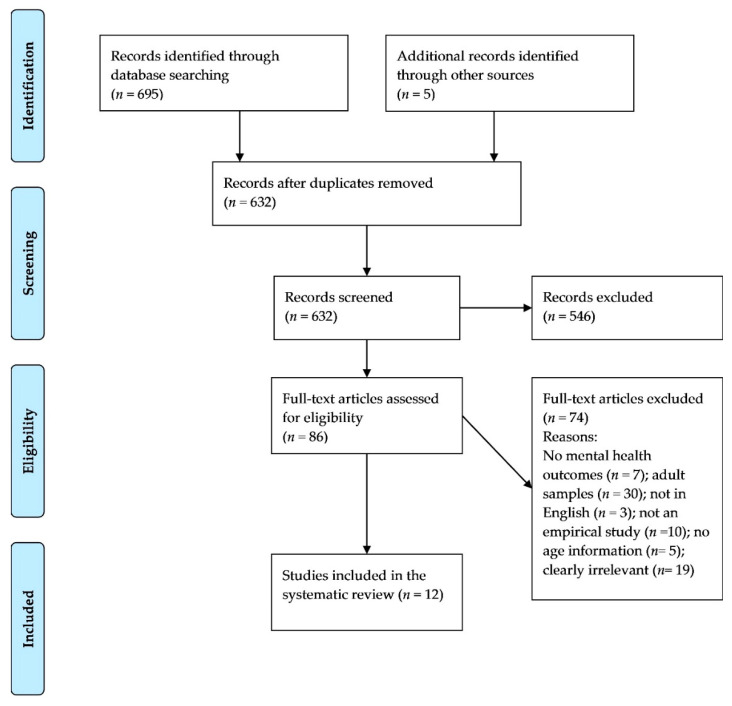
- From 700 records imported, 632 remained after duplicates, 74 underwent full-text review, and 12 studies were included (n = 12,262); findings were synthesized narratively because of heterogeneity, with quality assessed using JBI and MMAT tools.
Limitations
- Stated: included studies had low to moderate methodological quality regarding sampling, unclear validity of measurement, and statistical analysis; studies were excluded due to lacking or unclear information; only English-language studies were included; and few studies were available because COVID-19 was only declared a pandemic in March 2020.
- Evident from the text: five studies targeted the general population and included very small youth subgroups (n = 17–34), and one university study included n = 1118 young people <18 years but reported only descriptive statistics.
- Evident from the text: one included study did not conduct separate analyses for its <18-year subgroup, and heterogeneity prevented a meta-analytical synthesis.
Model-written summary. Check it against the paper before relying on it.
Integrity signals
Registry
Cites
Statistics
Figures
Verification
Claims the paper makes
27 Valid · 2 Not valid · 78 Not checked · 85 Own results and interpretations
Some cited sources support this claim and some don’t — read each source’s verdict below.
In the paper
“No conclusions can be drawn from the studies with very small sample sizes of young people [37,40,43,44].”
§ Exploring the Impact of COVID-19 on Mental Health Outcomes in Children and Adolescents: A Systematic Review > 4. Discussion > 4.2. Age and Gender Differences
What the sources say
- Disputedcites [37] Liu X. Luo W.T. Li Y. Li C.N. Hong Z.S. Chen H.L. Xiao F. Xia J.Y. Psychological status and behavior changes of the public during the COVID-19 epidemic in China Infect. Dis. Poverty 2020 9 58 10.1186/s40249-020-00678-3 32471513 PMC7256340 sourceExperimental — accuracy not yet measured
The paper does not say that its sample of young people was too small to draw conclusions. In “Anxiety by age groups” (page unavailable), it reports findings for respondents aged 19–39; in the Conclusions (page unavailable), it draws the qualified conclusion that this group appears likely to experience psychological stress during an epidemic. (LLM, conf=0.86)
Checked by a reasoning model — may be wrong.
- Partly supportedcites [40] Casanova M. Pagani Bagliacca E. Silva M. Patriarca C. Veneroni L. Clerici C.A. Spreafico F. Luksch R. Terenziani M. Meazza C. How young patients with cancer perceive the COVID-19 (coronavirus) epidemic in Milan, Italy: Is there room for other fears? Pediatr. Blood Cancer 2020 67 e28318 10.1002/pbc.28318 32240567 sourceExperimental — accuracy not yet measured
The Methods (p. 2) report three small groups of 25 young people, and the Discussion (p. 2) says the survey was not intended as an epidemiological study. But the Results (p. 2) explicitly report findings, so the source does not support the categorical assertion that no conclusions can be drawn. (LLM, conf=0.85)
- Not checked yetcites [43] Trzebiński J. Cabański M. Czarnecka J.Z. Reaction to the COVID-19 Pandemic: The Influence of Meaning in Life, Life Satisfaction, and Assumptions on World Orderliness and Positivity J. Loss Trauma. 2020 25 544 557 10.1080/15325024.2020.1765098 source
- Supportedcites [44] Tian F. Li H. Tian S. Yang J. Shao J. Tian C. Psychological symptoms of ordinary Chinese citizens based on SCL-90 during the level I emergency response to COVID-19 Psychiatry Res. 2020 288 112992 10.1016/j.psychres.2020.112992 32302816 PMC7151383 source
Table 3 (Results, ANOVA of different groups; page unavailable) shows that this study included only 22 participants under 18, supporting its citation as an example of a study with a very small sample of minors. The statement that no conclusions can be drawn is the citing authors’ assessment, not a conclusion attributed to Tian et al. (LLM, conf=0.86)
plain- Asserted: passes — The authors put it forward as true.
- Checkable: passes — It can be checked against evidence.
- Load-bearing: unclear — It is unclear whether the paper’s conclusions depend on it.
- Based: passes — The paper gives a reason why it holds.
- Disputed
The sources with a verdict support this claim; the rest weren’t checked yet, have no full text we could read, or their verdicts aren’t rated yet.
In the paper
“With social distancing measures and movement restrictions come serious risks of loneliness.”
§ Exploring the Impact of COVID-19 on Mental Health Outcomes in Children and Adolescents: A Systematic Review > 1. Introduction > 1.3. The Present Study
What the sources say
- Not checked yetcites [21] Caspi A. Harrington H.L. Moffitt T.E. Milne B.J. Poulton R. Socially isolated children 20 years later: Risk of cardiovascular disease Arch. Pediatr. Adolesc. Med. 2006 160 805 811 10.1001/archpedi.160.8.805 16894079 source
- Supportedcites [23] Loades M.E. Chatburn E. Higson-Sweeney N. Reynolds S. Shafran R. Brigden A. Linney C. McManus M.N. Borwick C. Crawley E. Rapid Systematic Review: The Impact of Social Isolation and Loneliness on the Mental Health of Children and Adolescents in the Context of COVID-19 J. Am. Acad. Child. Adolesc. Psychiatry 2020 59 1218 1239 10.1016/j.jaac.2020.05.009 32504808 PMC7267797 source
The paper states that social distancing and school closures are likely to increase loneliness in children and adolescents whose usual social contacts are curtailed (Abstract > Conclusion; page not provided). The Discussion also describes loneliness as an unintended consequence of disease-containment measures. (LLM, conf=0.91)
plainstates a cause- Asserted: passes — The authors put it forward as true.
- Checkable: passes — It can be checked against evidence.
- Load-bearing: passes — The paper’s conclusions depend on it.
- Based: passes — The paper gives a reason why it holds.
The sources with a verdict support this claim; the rest weren’t checked yet, have no full text we could read, or their verdicts aren’t rated yet.
In the paper
“The prevalence of depression in young people across the three studies that reported such information ranged from 22.6% to 43.7% [36,37,39].”
§ Exploring the Impact of COVID-19 on Mental Health Outcomes in Children and Adolescents: A Systematic Review > 3. Results > 3.2. Mental Health Outcomes
What the sources say
- Supportedcites [36] Zhou S.J. Zhang L.G. Wang L.L. Guo Z.C. Wang J.Q. Chen J.C. Liu M. Chen X. Chen J.X. Prevalence and socio-demographic correlates of psychological health problems in Chinese adolescents during the outbreak of COVID-19 Eur. Child. Adolesc. Psychiatry 2020 29 749 758 10.1007/s00787-020-01541-4 32363492 PMC7196181 source
The Discussion reports depressive symptoms in 43.7% of Chinese middle and high school students, supporting this paper's contribution to the upper end of the range. The 22.6% lower end is attributed to the other studies cited in the same sentence. Page numbers are not supplied in our copy. (LLM, conf=0.92)
- Supportedcites [37] Liu X. Luo W.T. Li Y. Li C.N. Hong Z.S. Chen H.L. Xiao F. Xia J.Y. Psychological status and behavior changes of the public during the COVID-19 epidemic in China Infect. Dis. Poverty 2020 9 58 10.1186/s40249-020-00678-3 32471513 PMC7256340 source
Table 4 (rendered under Conclusions; page unavailable) reports depression in 102 of 321 respondents aged 19–39, a prevalence of 31.8%, within the stated range. The 22.6% and 43.7% endpoints are attributed to the three studies collectively, not necessarily to this source alone. (LLM, conf=0.85)
- Not checked yetcites [39] Xie X. Xue Q. Zhou Y. Zhu K. Liu Q. Zhang J. Song R. Mental Health Status among Children in Home Confinement during the Coronavirus Disease 2019 Outbreak in Hubei Province, China JAMA Pediatr. 2020 174 898 900 10.1001/jamapediatrics.2020.1619 32329784 PMC7182958 source
plain- Asserted: passes — The authors put it forward as true.
- Checkable: passes — It can be checked against evidence.
- Load-bearing: unclear — It is unclear whether the paper’s conclusions depend on it.
- Based: passes — The paper gives a reason why it holds.
- Supported
Every source the paper cites for this claim was checked and supports it.
In the paper
“One study showed that as age increases, the intensity of behaviour problems induced by the pandemic in children with ASD decreases [34].”
§ Exploring the Impact of COVID-19 on Mental Health Outcomes in Children and Adolescents: A Systematic Review > 3. Results > 3.4. Age Differences
What the sources say
- Supportedcites [34] Colizzi M. Sironi E. Antonini F. Ciceri M.L. Bovo C. Zoccante L. Psychosocial and behavioral impact of COVID-19 in autism spectrum disorder: An online parent survey Brain Sci. 2020 10 341 10.3390/brainsci10060341 PMC7349059 32503172 source
The Results (section 3.3) report that increasing age was associated with a lower likelihood of more intense behavior problems following the COVID-19 outbreak. The Discussion (section 4) likewise suggests that older age may protect against emergency-induced intensification. This is an association in a parent survey, not evidence that an individual child’s problems diminish as they age. (LLM, conf=0.88)
plainstates a cause- Asserted: passes — The authors put it forward as true.
- Checkable: passes — It can be checked against evidence.
- Load-bearing: unclear — It is unclear whether the paper’s conclusions depend on it.
- Based: passes — The paper gives a reason why it holds.
- Supported
The sources with a verdict support this claim; the rest weren’t checked yet, have no full text we could read, or their verdicts aren’t rated yet.
In the paper
“Four studies reported mean scores of anxiety using Likert-point scales, with higher scores indicating higher levels of anxiety [35,38,42,43]”
§ Exploring the Impact of COVID-19 on Mental Health Outcomes in Children and Adolescents: A Systematic Review > 3. Results > 3.2. Mental Health Outcomes
What the sources say
- Supportedcites [35] Liu S. Liu Y. Liu Y. Somatic symptoms and concern regarding COVID-19 among Chinese college and primary school students: A cross-sectional survey Psychiatry Res. 2020 289 113070 10.1016/j.psychres.2020.113070 32422501 PMC7227526 source
The Method describes the Somatic Self-rating Scale as using items scored from 1 to 4, including anxiety symptoms. Results Table 2 reports mean anxiety scores for college and primary school students. This supports the paper’s inclusion as one of the four studies; the citation does not require this paper alone to establish the count of four. (LLM, conf=0.90)
- Not checked yetcites [38] Yang H. Bin P. He A.J. Opinions from the epicenter: An online survey of university students in Wuhan amidst the COVID-19 outbreak11 J. Chin. Gov. 2020 5 234 248 10.1080/23812346.2020.1745411 source
- Supportedcites [42] Oosterhoff B. Palmer C.A. Wilson J. Shook N. Adolescents’ motivations to engage in social distancing during the COVID-19 pandemic: Associations with mental and social health J. Adolesc. Health 2020 67 179 185 10.1016/j.jadohealth.2020.05.004 32487491 PMC7205689 source
The Anxiety symptoms section states that adolescents rated anxiety items on a 5-point scale and that mean scores were calculated, with higher values indicating greater anxiety symptoms. This confirms the measurement description for this cited study; the statement that four studies did so also depends on the other three citations. (LLM, conf=0.94)
- Not checked yetcites [43] Trzebiński J. Cabański M. Czarnecka J.Z. Reaction to the COVID-19 Pandemic: The Influence of Meaning in Life, Life Satisfaction, and Assumptions on World Orderliness and Positivity J. Loss Trauma. 2020 25 544 557 10.1080/15325024.2020.1765098 source
plain- Asserted: passes — The authors put it forward as true.
- Checkable: passes — It can be checked against evidence.
- Load-bearing: unclear — It is unclear whether the paper’s conclusions depend on it.
- Based: passes — The paper gives a reason why it holds.
- Supported
96 more claims · 17 with their cited sources checked
Create a free account to see all 192 claims and to verify the 109 references still open.
- Probably not a substantial claim. 73
- It may state two separate claims as one. 25
- The quote only partly states this claim. 1
Claims other papers make about this one
Each is checked against this paper’s own text: does it say what the citing paper says it does?
The cited source says what the claim attributes to it.
In the citing paper
“Systematic reviews of studies from early in the pandemic also found similar results of pandemic impacts on child and adolescent depression and anxiety symptoms [22,23,24].”
From Loneliness and Well-Being in Children and Adolescents during the COVID-19 Pandemic: A Systematic Review (2023) · cites this paper as [22]
In the citing paper
“Nearchou et al. [22] noted potential age-related differences in the pandemic’s impact. Older children may be impacted directly by school closures, whereas younger children may be impacted by pandemic-related stress placed on caregivers.”
From Loneliness and Well-Being in Children and Adolescents during the COVID-19 Pandemic: A Systematic Review (2023) · cites this paper as [22]
In the citing paper
“Parental stress caused by the pandemic-related factors may have a more significant impact on younger children, which can result in behavioural problems and can have a substantial effect on children with developmental disabilities [20].”
From A Qualitative Study of Child and Adolescent Mental Health during the COVID-19 Pandemic in Ireland (2021) · cites this paper as [20]
Self-check
Percentages, sums and reported differences re-computed from the paper’s own numbers.
Each contradiction between two passages listed here was confirmed by an independent check.
Rated minor: it would not touch a result — a value no result rests on, a p-value that stays on the same side of the significance level, or a conflict that is clerical, resolved elsewhere in the paper, or outside its own findings.
In the paper
§ Exploring the Impact of COVID-19 on Mental Health Outcomes in Children and Adolescents: A Systematic Review > 2. Methods > 2.3. Screening and Data Extraction
“Disagreements after full text review were resolved through discussion, and eight studies were included in the final stage of data extraction.”
§ Exploring the Impact of COVID-19 on Mental Health Outcomes in Children and Adolescents: A Systematic Review > 3. Results > 3.1. Methodological Characteristics of the Studies
“Of the 12 studies that were included in this systematic review, seven were conducted in China, two in Italy, one in Poland, one in Turkey and one in the United States.”
Citations
Cites
Preferred Reporting Items for Systematic Reviews and Meta-Analyses: the PRISMA statement
Moher, D., Liberati, A., Tetzlaff, J., Altman, D. G., & for the PRISMA Group (2009) · BMJ · doi:10.1136/bmj.b2535 · Cited by 83,823
Preferred Reporting Items for Systematic Reviews and Meta-Analyses: The PRISMA Statement
Moher, D., Liberati, A., Tetzlaff, J., Altman, D. G., & The PRISMA Group (2009) · PLoS Medicine · doi:10.1371/journal.pmed.1000097 · Cited by 64,042 · cited 1×
“The present systematic review was conducted in accordance with the Preferred Reporting Items for Systematic Reviews and Meta-Analysis (PRISMA) guidelines [28].”
Kessler, R. C., Berglund, P., Demler, O., Jin, R., Merikangas, K. R., & Walters, E. E. (2005) · Archives of General Psychiatry · doi:10.1001/archpsyc.62.6.593 · Cited by 20,391 · cited 1×
“It has been well established in the literature that children, and especially adolescents, are susceptible to experiencing mental health problems, while most mental disorders have their onset in this age period [51,52].”
BackgroundMerikangas, K. R., He, J.-P., Burstein, M., Swanson, S. A., Avenevoli, S., Cui, L., Benjet, C., Georgiades, K., & Swendsen, J. (2010) · Journal of the American Academy of Child & Adolescent Psychiatry · doi:10.1016/j.jaac.2010.05.017 · Cited by 6,278
The Mixed Methods Appraisal Tool (MMAT) version 2018 for information professionals and researchers
Hong, Q. N., Fàbregues, S., Bartlett, G., Boardman, F., Cargo, M., Dagenais, P., Gagnon, M.-P., Griffiths, F., Nicolau, B., O’Cathain, A., et al. (2018) · Education for Information · doi:10.3233/efi-180221 · Cited by 4,737 · cited 7×
“l ssess ent Tool [31] scree ing criteria.”
BackgroundMethodInfluentialWhy do many psychiatric disorders emerge during adolescence?
Paus, T., Keshavan, M., & Giedd, J. N. (2008) · Nature Reviews Neuroscience · doi:10.1038/nrn2513 · Cited by 3,123 · cited 1×
“It has been well established in the literature that children, and especially adolescents, are susceptible to experiencing mental health problems, while most mental disorders have their onset in this age period [51,52].”
BackgroundLoades, M. E., Chatburn, E., Higson-Sweeney, N., Reynolds, S., Shafran, R., Brigden, A., Linney, C., McManus, M. N., Borwick, C., & Crawley, E. (2020) · Journal of the American Academy of Child & Adolescent Psychiatry · doi:10.1016/j.jaac.2020.05.009 · Cited by 2,906 · cited 2×
“A rapid systematic review assessed the impact of social isolation and loneliness on the mental health of children and adolescents in the context of COVID-19 and concluded that there would be higher levels of depression and anxiety, both during and after imposed isolation periods come to an end [23].”
BackgroundMental health problems and social media exposure during COVID-19 outbreak
Gao, J., Zheng, P., Jia, Y., Chen, H., Mao, Y., Chen, S., Wang, Y., Fu, H., & Dai, J. (2020) · PLoS ONE · doi:10.1371/journal.pone.0231924 · Cited by 2,830 · cited 1×
“Frequent social media exposure during this pandemic has been associated with increased likelihood of depression and anxiety in adults [68].”
BackgroundMental Health Problems and Social Media Exposure During COVID-19 Outbreak
Gao, J., Zheng, P., Jia, Y., Chen, H., Mao, Y., Chen, S., Wang, Y., Fu, H., & Dai, J. (2020) · SSRN Electronic Journal · doi:10.2139/ssrn.3541120 · Cited by 2,830
Hankin, B. L., Abramson, L. Y., Moffitt, T. E., Silva, P. A., McGee, R., & Angell, K. E. (1998) · Journal of Abnormal Psychology · doi:10.1037/0021-843x.107.1.128 · Cited by 2,333 · cited 1×
“This is also consistent with evidence from other pre-COVID studies indicating that middle and late adolescents are likely to experience more heightened levels of distress than their younger peers [65,66].”
Result
Research works printed but not linked: 1
- Veritas Health Innovation Covidence Systematic Review Software Veritas Health Innovation Melbourne, Australia 2020 Available online: www.covidence.org (accessed on 21 June 2020)
Cited by
Items 401–500 of 629
The Influence of COVID-19 on the Psychological Well-being of Different Populations in China
Chen, H., Xiao, X., Wang, W., Tong, Z., Zhang, L., Zhong, J., Li, X., Zhang, X., Tong, Y., Shen, B., et al. (2021) · Exploratory Research and Hypothesis in Medicine · doi:10.14218/erhm.2020.00067 · Cited by 2
Ansiedade e depressão: Transtornos psiquiátricos mais prevalentes na pandemia da COVID-19
Ramos, M. L. C. D. C., Krauss, G. P. D. O., Silveira, L. T., Vieira, M. E. S. V. N. D. C., Soares, M. S. G., de Azevedo, M. R. D., Ramos, M. S. C. D. C., de Oliveira, P. F., Santos, S. O., & Oliveira, H. F. (2021) · Research Society and Development · doi:10.33448/rsd-v10i15.22509 · Cited by 7
Foster, M., Al‐Motlaq, M., Carter, B., Neill, S., O’Sullivan, T. A., Quayle, A., Majamanda, M. D., Abdullah, K. L., Hallström, I., English, C., et al. (2021) · Nursing Praxis in Aotearoa New Zealand · doi:10.36951/27034542.2021.039 · Cited by 2
“…closure of schools, variable access to alternative online learning, inability for children to socialize, limited opportunities to develop important social and behavioural skills, the loss of loved ones and adverse news about the virus (de Figueiredo et al., 2021; Lee, 2020; Nearchou et al., 2020).”
Muhmann, D., Droste, M., Schulz, J., Linge, F., Ladewig, L., Eisenberg, U., Röder, S., & Büscher, R. (2022) · World Journal of Pediatrics · doi:10.1007/s12519-022-00541-5 · Cited by 3
“Although children without comorbidities seem to be less endangered of becoming seriously ill from COVID19 [13–15], the negative effects of the pandemic such as increasing obesity, emotional imbalances and other risks are unneglectable [13, 15, 16].”
BackgroundEfectos de la pandemia por COVID-19 en la salud mental de adolescentes
López-Medina, L. I., Monar-González, J. I., Andrade-Cáceres, A. R., & Alfonso-González, I. (2022) · Revista Arbitrada Interdisciplinaria de Ciencias de la Salud Salud y Vida · doi:10.35381/s.v.v6i1.1726 · Cited by 2
Youn, H.-S., Lee, E.-J., Sukou, R., Mizno, C., Chul-Min, K., & Okade, Y. (2022) · Journal of Men s Health · doi:10.31083/j.jomh1811211 · Cited by 2
Toussaint, E., Florin, A., Galharret, J., Mercier, C., & Zanna, O. (2022) · Enfance · doi:10.3917/enf2.224.0435 · Cited by 3
Zaffaroni, L. G., Cino, D., Thiel, K., & Lampert, C. (2022) · Media Education · doi:10.36253/me-13169 · Cited by 2
“, due to stress, anxiety, and powerlessness, which is also often attributed to the increased use of social media, but also to virally distributed content (Nearchou et al., 2020; Ravens-Sieberer et al., 2021a; Thakur, 2020).”
InfluentialMuro, M. D., Janssen, A. J., Amadori, S., de Fabritiis, P., Sabatino, D., Niscola, P., Torti, L., Trawinska, M. M., Tesei, C., Bombaci, F., et al. (2023) · Therapeutic Advances in Hematology · doi:10.1177/20406207231190683 · Cited by 2
Gorostiaga, A., Balluerka, N., Aliri, J., Echeveste, U., & Lameirinhas, J. (2024) · Psicothema · doi:10.7334/psicothema2023.37 · Cited by 2
Increasing Physical Activity in Children and Adolescents During the COVID-19 Pandemic
Plisic, A. (2021) · Digital USD (University of San Diego) · doi:10.22371/07.2021.044 · Cited by 2
“The increase in psychological symptoms coupled with a decrease in positive mental health influencers—such as PA, socialization in organized sports, and interactions with coaches or teachers, is devastating for the well-being of children and adolescents (Nearchou et al., 2020).”
BackgroundEmotional impact on children during home confinement in SpainPreprint
Sánchez-Ferrer, F., Cervantes-García, E., Gavilán-Martín, C., Quesada, J. A., Cortés‐Castell, E., & Nso‐Roca, A. P. (2022) · Research Square · doi:10.21203/rs.3.rs-1341840/v1 · Cited by 2
Neugebauer, M., Patzina, A., Dietrich, H. W., & Sandner, M. (2023) · SSRN Electronic Journal · doi:10.2139/ssrn.4651057 · Cited by 3
Pavarini, G., Reardon, T., Hollowell, A., Bennett, V., Lawrance, E., Group, P. S. Y. P. A., Pinfold, V., & Singh, I. (2021) · doi:10.31234/osf.io/m7syr · Cited by 1
MENTAL HEALTH OF CHILDREN AND ADOLESCENTS IN TIMES OF PANDEMIC: AN INTEGRATIVE REVIEW
Silva, H. T. R., ARAUJO, I. D. O., Cabral, P., Sanson, D. M., Araújo, C. T., Nolasco, M. S., de Oliveira, C. E., Santos, F. J. M., Silva, K. L., Assis, J. D. D. S., et al. (2021) · Brazilian Medical Students · doi:10.53843/bms.v5i8.97 · Cited by 4
Pruccoli, J., Biagi, C., Andreozzi, L., Fetta, A., Sacrato, L., Tartarini, C., Cordelli, D. M., & Lanari, M. (2023) · European Journal of Pediatrics · doi:10.1007/s00431-023-04850-3 · Cited by 1
“More relevant mental health concerns have been reported in children whose parents were more involved in the pandemic [14, 17].”
BackgroundAbramovich, A., Pang, N., Kim, K. V., Stark, R. K., Lange, S., Chaiton, M., Logie, C. H., Hamilton, H. A., & Kidd, S. A. (2023) · PLoS ONE · doi:10.1371/journal.pone.0288591 · Cited by 1
Rayas, Q. V. G., González, A. P., Villegas, M., Sosa-Bustamante, G. P., Paque-Bautista, C., & Ruiz-Jaramillo, M. D. L. C. (2023) · Revista de Psiquiatría Infanto-Juvenil · doi:10.31766/revpsij.v40n4a3 · Cited by 1
Marques, E. S., Reichenheim, M. E., dos Santos, É. B., Taquette, S. R., & de Moraes, C. L. (2024) · Ciência & Saúde Coletiva · doi:10.1590/1413-81232024291.18182022en · Cited by 1
(2024) · Frontiers research topics · doi:10.3389/978-2-8325-3786-2 · Cited by 1
COVID-19 pandemic experiences of LGBTQIA + Asian youth in Canada
Chee, K., & Coleman, T. A. (2024) · International journal of LGBTQ+ youth studies. · doi:10.1080/19361653.2024.2329879 · Cited by 1
“Major life disruptions caused by the pandemic had profound impacts on our participants’ mental health, consistent with Nearchou et al.’s (2020) findings in which major life disruptions caused deterioration in youth’s anxiety and depression.”
Assessment of anxiety in children during the COVID‐19 pandemic
Lastra, C. R., Abrahams, R., Anash, G., Prisby, K., Goyco‐Ortiz, L., Melean, A., Moreno, R. P., & Schramm, A. R. (2024) · Annals of the Child Neurology Society · doi:10.1002/cns3.20072 · Cited by 1
“5 Childhood anxiety rates have increased signi fi cantly during the pandemic due to various stressors.”
BackgroundMcMahon, J., Dowling, K., Gallagher, E. A., Donnellan, A., Houghton, S., Ryan, M., O’Connor, C., & Walsh, E. H. (2024) · Frontiers in Psychology · doi:10.3389/fpsyg.2023.1095892 · Cited by 1
Chirica, M. G., Carreon, S. A., Buscemi, J., Greenley, R. N., Tran, S. T., & Miller, S. A. (2024) · Journal of American College Health · doi:10.1080/07448481.2024.2409678 · Cited by 1
Brzezewska, K., Sitnik‐Warchulska, K., Lipowska, M., Markevych, I., Baumbach, C., Mysak, Y., Buczyłowska, D., Szwed, M., & Izydorczyk, B. (2025) · Psychiatria i Psychologia Kliniczna · doi:10.15557/pipk.2024.0026 · Cited by 1
Nada, C. I., Rios, C., Miguel, I., Cailliau, B., Arbués, D., & Días, T. S. (2025) · Leisure Studies · doi:10.1080/02614367.2025.2486091 · Cited by 1
“Recent research has indicated that the COVID-19 pandemic has further exacerbated depression and anxiety in young people (Nearchou et al., 2020).”
Assessment of mental health in Cook Island adolescents: a baseline survey
Daniel-Atutolu, M., Daniela-Wong, E., Bay, J. L., Tamarua-Herman, N., Porio, C., & Vickers, M. H. (2025) · Journal of the Royal Society of New Zealand · doi:10.1080/03036758.2025.2486046 · Cited by 1
“These increasing rates have further been compounded by the recent COVID-19 pandemic with reported increases in mental health problems in adolescents, particularly in females (Nearchou et al. 2020; Ravens-Sieberer et al. 2022; Samji et al. 2022).”
Mizuno, T., Nawa, N., Isumi, A., Doi, S. K., Morio, T., & Fujiwara, T. (2025) · Frontiers in Public Health · doi:10.3389/fpubh.2025.1466209 · Cited by 1
Youth perspectives on information and trust during COVID-19: evidence from Egypt
Seddik, S. A., Aboushady, A. T., Seddik, S., Emam, O., Hemida, M., Zohny, M., Aboismail, E., Khattab, L., Elsaid, N. M. A. B., & Hegazy, A. A. (2025) · Frontiers in Digital Health · doi:10.3389/fdgth.2025.1563203 · Cited by 1
Gómez-Estern, B. M., Lozano, V. M., & Lalueza, J. L. (2025) · Ethnography & Education · doi:10.1080/17457823.2025.2565009 · Cited by 1
“The lack of social interaction with peers and teachers, the disruption of family and school routines, and exposure to a constantly changing environment increased stress and anxiety levels among students (Nearchou et al. 2020).”
Family communication and child behavior problems during the COVID-19 pandemic.
Lamoreau, R., Wilson, A. C., Pequet, A., Skov, H. E., & Gray, S. A. O. (2026) · Developmental Psychology · doi:10.1037/dev0002078 · Cited by 1
Fabi, R. M., Gasparini, D. A., Martinez, N. V. D. C., Carlos, D. M., & Cid, M. F. B. (2025) · Pro-Posições · doi:10.1590/1980-6248-2024-0069br · Cited by 1
Pakpour, A. H., Eriksson, M., Ahorsu, D. K., Broström, A., Bengtsson, S., Jakobsson, M., & Huus, K. (2025) · BMC Psychology · doi:10.1186/s40359-025-03737-2 · Cited by 1
Youth Leisure during the Covid-19 Pandemic and Relations with Mental Health: A Systematic Review
Freire, T., Pereira, T., & Vieira, D. A. (2026) · Journal of Child and Family Studies · doi:10.1007/s10826-025-03247-0 · Cited by 1
“…reviews have sought to understand how the Covid-19 period affected the mental health of young people (Marciano et al., 2022; Jones et al., 2021; Stavridou et al., 2020; Rajkumar, 2020; Panchal et al., 2021; Tsamakis et al., 2021; Nearchou et al., 2020; Meherali et al., 2021; Elharake et al., 2022).”
Duc, T. M. (2026) · International Journal of Education and Practice · doi:10.18488/61.v14i1.4689 · Cited by 1
Vieira, Y. P., Alexandrino, E. G., Dutra, R. P., Castro, Y. M., Mattos, V. G. W., Sá, A. M., & Dumith, S. D. C. (2026) · Revista Paulista de Pediatria · doi:10.1590/1984-0462/2026/44/2025016 · Cited by 1
Vásquez, G. I. V., Ochoa, E. D. Q., Quizhpe, C. F. B., & Orellana, S. M. (2026) · Veredas do Direito Direito Ambiental e Desenvolvimento Sustentável · doi:10.18623/rvd.v23.n4.4708 · Cited by 1
Pérez‐Jiménez, J. M., Dávila, A. F., & Val, E. T. (2026) · Healthcare · doi:10.3390/healthcare14162582 · Cited by 2
“Research conducted during the initial waves of the pandemic documented substantial increases in adolescent psychological distress, as evidenced by elevated rates of depression, anxiety, and suicidal ideation [3].”
Ströhl, S., Lauerer, M., Etzelsberger, D., Weichselbraun, R., & Nagel, E. (2021) · Physikalische Medizin Rehabilitationsmedizin Kurortmedizin · doi:10.1055/a-1613-5814 · Cited by 1
Impacts of long‐term coronavirus disease 2019 school closures on Japanese school children
Hayano, C., Shimakawa, S., Fukui, M., Yoshida, S., Tsuda‐Kitahara, H., & Ashida, A. (2022) · Pediatrics International · doi:10.1111/ped.15131 · Cited by 1
Covid 2 years on: What is the evidence?
Boddy, B. (2022) · Journal of Health Visiting · doi:10.12968/johv.2022.10.3.128 · Cited by 1
Küçük, E. E., & Küçük, D. (2022) · Advances in computational intelligence and robotics book series · doi:10.4018/978-1-7998-9012-6.ch001 · Cited by 1
Child and Adolescent Mental Health: Implications of COVID-19
Klostermann, K. (2022) · Mental Health & Human Resilience International Journal · doi:10.23880/mhrij-16000171 · Cited by 1
Cummings, C. A., & Reilly‐Chammat, R. (2023) · Education and human development · doi:10.5772/intechopen.108980 · Cited by 1
Sekaran, V. C., Ashok, L., & Bhagawati, D. (2022) · Journal of Datta Meghe Institute of Medical Sciences University · doi:10.4103/jdmimsu.jdmimsu_482_21 · Cited by 1
Gutiérrez, A. R. M., García, G. M. P., & Zaldívar-Colado, A. (2023) · Dilemas contemporáneos Educación Política y Valores · doi:10.46377/dilemas.v10i3.3639 · Cited by 1
Andersen, A. H., Viftrup, D. T., & Bank, M. (2023) · Tidsskrift for Forskning i Sygdom og Samfund · doi:10.7146/tfss.v20i38.130260 · Cited by 1
Ordóñez-Camblor, N., Landa, S. U., Castro, J. L. G., & Pizarro-Ruiz, J. P. (2023) · Current Psychology · doi:10.1007/s12144-023-04893-7 · Cited by 1
“In contrast, other cross-sectional studies have found associations between the lockdown and adverse emotional, psychological, somatic and behavioral effects in children and adolescents (Liu et al., 2020a, b; Nearchou et al., 2020; Ren et al., 2021).”
Substance Use and Mental Health Responses to COVID-19 among Rural Adolescents
Monico, L. B. (2023) · Archives of Pediatrics · doi:10.29011/2575-825x.100274 · Cited by 1
“One recent systematic review found that the COVID-19 pandemic impacted adolescent mental health, and lockdowns were associated with increases in anxiety and depression [6].”
Ocakoğlu, B. K., Erata, M. C., Alkaş, G. E., Tonyalı, A., & Karaçetin, G. (2023) · Journal of Clinical Psychiatry · doi:10.5505/kpd.2023.99075 · Cited by 1
Wray, A. J. D., Martin, G., Ferguson, K. N., Coen, S. E., Seabrook, J. A., & Gilliland, J. (2023) · Cities & Health · doi:10.1080/23748834.2023.2282850 · Cited by 1
“A systematic review of international studies found that the pandemic has had a detrimental impact on youth mental wellbeing outcomes (Nearchou et al .”
BackgroundOng, J. J., Nor, N. K., Ahmad, N., & Ismail, J. (2024) · International Journal of Developmental Disabilities · doi:10.1080/20473869.2023.2301190 · Cited by 2
“Pre-COVID studies have also described similar age difference trends and are thought to be attributed to the exposure to information through the use of social media among adolescents (Nearchou et al. 2020).”
Morales, A., Amorós-Reche, V., Espada, J. P., & Orgilés, M. (2024) · European Journal of Developmental Psychology · doi:10.1080/17405629.2024.2315754 · Cited by 1
“The COVID-19 pandemic and the circumstances derived from it have negatively affected the mental health of this population (Amorós-Reche et al., 2022; Francisco et al., 2020; Nearchou et al., 2020).”
BackgroundLiu, M., & Xu, Z. (2024) · Children and Youth Services Review · doi:10.1016/j.childyouth.2024.107533 · Cited by 1
Chul-Min, K., Huang, Y.-H., Zhou, T., Kim, M.-J., & Youn, H.-S. (2024) · Healthcare · doi:10.3390/healthcare12070763 · Cited by 1
“The Ministry of Education and schools have worked to promote the physical activity of adolescents, in particular [16,17], based on reports [7,18] of insufficient physical activity among adolescents.”
BackgroundSikorska, I., Stępień‐Nycz, M., & Białecka‐Pikul, M. (2024) · Studia Paedagogica Ignatiana · doi:10.12775/spi.2024.1.008 · Cited by 1
“Social contact during the pandemic was considered a supporting factor for adolescents’ resilience and wellbeing, as it buffered against psychopathology (Rodman et al. 2022) and reduced feelings of loneliness (Nearchou et al. 2020).”
BackgroundCOVID-19 across the Life Course
Kuh, D. J., & Blodgett, J. M. (2024) · Oxford University Press eBooks · doi:10.1093/oso/9780197625217.003.0002 · Cited by 3
Xavier, S. D., Dokkedal‐Silva, V., Fernandes, G. L., Pires, G. N., Tufik, S., & Andersen, M. L. (2024) · Research in Autism · doi:10.1016/j.rasd.2024.102439 · Cited by 1
Pinto, T. M., Campos, F. M., Laurence, P. G., Serpa, A. L. D. O., & de Macedo, E. C. (2024) · Psicologia - Teoria e Prática · doi:10.5935/1980-6906/eptpcp15556.en · Cited by 1
“In addition, it should be highlighted that, unlike other studies, no differences were found according to age or sex (Hawes et al., 2021; Kirsch et al., 2020; Nearchou et al., 2020; Racine et al., 2021).”
(2024) · European Journal of Contemporary Education · doi:10.13187/ejced.2024.3.536 · Cited by 1
Yang, D., Zhou, M., Zhang, Y., Geng, M., & Cheng, X. (2024) · Psychology and Health · doi:10.1080/08870446.2024.2414797 · Cited by 2
“…studies (Assante et al., 2020; Brooks et al., 2020; Garcia de Avila et al., 2020; Idoiaga et al., 2020; Jiao et al., 2020; Jiloha et al., 2020; Nearchou et al., 2020; Wang et al., 2020), potentially contributing to various mental health problems (Matovu et al., 2021; Nearchou et al., 2020;…”
Orlando, E. M., Buodo, G., & Moretta, T. (2024) · Journal of Affective Disorders Reports · doi:10.1016/j.jadr.2024.100864 · Cited by 1
Haven schools: A pilot evaluation of a school‐based programme to reduce anxiety in young people
Grohmann, D., Banham, C., Mengoni, S. E., Wellsted, D. M., & Irvine, K. (2025) · Counselling and Psychotherapy Research · doi:10.1002/capr.12873 · Cited by 1
Gómez-Estern, B. M., Lozano, V. M., Lalueza, J. L., & Valdivia, I. M. Á. (2025) · Perspectives in cultural-historical research · doi:10.1007/978-3-031-92131-5_3 · Cited by 1
Yoo, H. J. (2021) · Journal of korean Academy of Child and Adolescent Psychiatry · doi:10.5765/jkacap.200046 · Cited by 1
COVID-19 pandemic and mental health: From risk to resilience
Kuruthukulangara, S., & Goyal, S. (2020) · Journal of Marine Medical Society · doi:10.4103/jmms.jmms_188_20 · Cited by 1
Majnoonian, A., Duong, D., Vo, A. T., Wijaya, C., Nguyen, M., Flores, M., Omaleki, V., Le, T., & Fielding-Miller, R. K. (2023) · Research Square · doi:10.21203/rs.3.rs-2488760/v1 · Cited by 1
When to panic about a panic attack: A challenging case of hypersensitivity pneumonitis
Hicks, T. D., Yousif, D., Perez, I. A., Keens, T. G., & Bansal, M. (2023) · Paediatric Respiratory Reviews · doi:10.1016/j.prrv.2023.05.002 · Cited by 1
Carbone, P. (2024) · Adolescents · doi:10.3390/adolescents4040039 · Cited by 1
“The study found that different parenting styles (authoritative, authoritarian, and permissive) are closely linked to various aspects of the parent–adolescent relationship, influencing adolescent behavior and development [22].”
PHYSICAL BODY, LIVED BODY & EMPATHY DURING CORONAVIRUS PANDEMIC. WHAT’S THE MATTER?
Bellantonio, S., & Colella, D. (2021) · Giornale Italiano di Educazione alla Salute, Sport e Didattica Inclusiva · doi:10.32043/gsd.v5i1.326
Postrzegany wpływ COVID-19 i związanych z nim ograniczeń dla młodych ludzi w Polsce
Roman, K., & Tomaszek, A. (2021) · Horyzonty Polityki · doi:10.35765/hp.2043
Mental health interest groups: a strategy by students for students in times of COVID-19
Arango-Ospina, C. M., LÓPEZ-JIMÉNEZ, Y. M., TOVAR-RUEDA, S. P., Castillo-Pastuzan, H. S., & Lozada-Martínez, I. D. (2021) · Minerva Pediatrics · doi:10.23736/s2724-5276.21.06517-4
Calkins, H. (2021) · ISU Red - Research and eData (Illinois State University) · doi:10.30707/etd2021.20211012065802142445.999995
Review of the effects of SARS-CoV2 infection and COVID-19 on common pediatric psychiatric illnesses
Balaram, K., Ahmed, M., & Marwaha, R. (2021) · World Journal of Meta-Analysis · doi:10.13105/wjma.v9.i5.455
MUDANÇAS DECORRENTES DA PANDEMIA DE CORONAVÍRUS NA VOZ DE ADOLESCENTES ACOLHIDOS
da Silveira, A., Cazuni, M. H., Schenkel, Y. V. D. S., Vargas, T. G. C. D., Fávero, N. B., & Soccol, K. L. S. (2021) · Revista Enfermagem Atual In Derme · doi:10.31011/reaid-2021-v.95-n.36-art.1225
Cundy, M. B., Becerra, S. I., & Garcia-Martin, M. (2021) · International Journal of Human Sciences Research · doi:10.22533/at.ed.5582110115
Sehlabane, K., & Hlabana, T. (2022) · Springer eBooks · doi:10.1007/978-3-030-84678-7_12
Adolescents and Mental Health: COVID-19 Quarantine ConsequencesPreprint
Parvaz, M., & Jofreh, M. G. (2021) · SSRN Electronic Journal · doi:10.2139/ssrn.3987995
COVID-19 lockdown and overweight in schoolchildren: 2 sides of the coin
Castillo-Montalvo, M. D. C., Bedoya-Arango, K. Y., Cadena-Delgado, L. M., Delgado-Marrugo, R. D., Lozada-Martínez, I. D., & Rahman, S. (2022) · International Journal of Surgery Global Health · doi:10.1097/gh9.0000000000000067
Exploring the Impact of COVID-19 on Mental Health
Wang, Y. (2022) · Advances in Social Science, Education and Humanities Research/Advances in social science, education and humanities research · doi:10.2991/assehr.k.220110.017
“’s review published on 16 November 2020, an integrated mixed methods approach was applied, in order to expand the latitude of the field [8].”
MethodIreland The Impact of COVID-19 on Children’s Rights in Ireland
Forde, L. (2021) · Intersentia eBooks · doi:10.1017/9781839702020.013
Korlakunta, A., Dharaneedhar, Khairkar, P. H., & Sarada, D. (2022) · IP Indian Journal of Neurosciences · doi:10.18231/j.ijn.2022.009
Li, Y., Hou, Z., Sun, K., Ma, J., Zhou, C., Zhang, W., Chen, F., Chen, M.-X., Wong, N.-K., & Zhang, X. (2022) · Research Square · doi:10.21203/rs.3.rs-1423289/v1
Parsekar, S. S., Dhyani, V. S., Rajwar, E., Krishnan, J. B., Venkatesh, B. T., Saravu, K., & Brand, H. (2022) · F1000Research · doi:10.12688/f1000research.74273.1
Niñez confinada. Una mirada desde la salud y la educación
de Colima, U., Guzmán-Sandoval, V. M., & Cabellos, N. G. M. (2022) · Qartuppi eBooks · doi:10.29410/qtp.22.03
Assessing the Pandemic Impact on Students around Abuja, Nigeria
Patrick-Agulonye, U. V., & Bahago, S. B. (2022) · Advances in psychology, mental health, and behavioral studies (APMHBS) book series · doi:10.4018/978-1-6684-3484-0.ch007
Systematic Analysis of Studies on Emergency Remote K-12 Teaching (ERKT)
Karataş, S., Göksu, H., Sarıkoç, Z., Şimşek, E., & Kandin, E. (2022) · Advances in educational technologies and instructional design book series · doi:10.4018/978-1-7998-9168-0.ch001
Menculini, G., Pomili, G., Brufani, F., Minuti, A., Mancini, N., D’Angelo, M., Biscontini, S., Mancini, E., Savini, A., Orsolini, L., et al. (2022) · Frontiers in Psychiatry · doi:10.3389/fpsyt.2022.869326
“First, school closure may have significantly impacted children and adolescents, particularly those aged between 5 and 18 (79).”
BackgroundChildren Exposed to Intimate Partner Violence During Confinement: Characteristics by Age and Sex
Alcántara-López, M., Sáez, M. C., Pérez, A. M., Fernández, V., Negrón-Medina, K., & Soler, C. L. (2022) · Frontiers in Psychology · doi:10.3389/fpsyg.2022.889697
Michel, G., Hou, S., Tran, A., Cho, S., Forbes, C., Forster, V. J., Stokoe, M., Allapitan, E., Wakefield, C. E., Wiener, L. S., et al. (2022) · Frontiers in Psychology · doi:10.5281/zenodo.6760032
COVID-19 IN PEDIATRICS AND OUR EXPERIENCES
Rehar, M., Fujs, N., Skubic, J., Rožič, B., Kolar, M., Herček, T., Čamernik, M., Šumljak, U., Pance, S., Kozmus, N., et al. (2022) · Slovenska pediatrija revija pediatrov Slovenije in specialistov šolske ter visokošolske medicine Slovenije · doi:10.38031/slovpediatr-2022-2-07
Changes in Adolescents’ Mental Health After COVID-19
Estrada, S., Loreto, I., Mina, M., Santoyo, I., & Varela, A. (2022) · DHR Proceedings · doi:10.47488/dhrp.v2is2.4
Jia, S., Zhao, Y., Liu, J., Gu, X., Chen, M., Zhou, S., & Zhou, J.-L. (2022) · SSRN Electronic Journal · doi:10.2139/ssrn.4156308
Lessons from Covid-19: Building a fairer, healthier, inclusive and sustainable post-pandemic society
(2023) · Frontiers research topics · doi:10.3389/978-2-83251-107-7
The lapse of federal COVID-19 funding: implications for health equity
Kobayashi, K., Miller-Fitzwater, A., Grier, C., Montez, K. G., Shah, S. I., Raphael, J. L., Patel, M. S., Keller, D., Chamberlain, L. J., Cheng, T. L., et al. (2023) · Pediatric Research · doi:10.1038/s41390-023-02487-4
ERGENLERDE GÖRÜLEN COVİD-19 FOBİSİNİN ANKSİYETE DÜZEYLERİNE ETKİSİ
GÜLEY, B. (2023) · Premium e-Journal of Social Science · doi:10.37242/pejoss.4358
Ayyıldız, D., & Gümüştaş, F. (2023) · The European Research Journal · doi:10.18621/eurj.1128133
Merino‐Hernández, A., Blanco, A. J., Palacios-Bermejo, A., Rodríguez-Represa, J., García‐Loygorri, C. F., & Vázquez-López, P. (2023) · Andes pediatrica · doi:10.32641/andespediatr.v94i2.4471 · Cited by 1
Literatur Review: Dampak Pandemi Covid-19 terhadap Kesehatan Anak
Rosida, S. R., Lestyani, L., & Warti, N. (2023) · Jurnal Keperawatan · doi:10.32583/keperawatan.v15i2.756
Metadata
- Authors
- Nearchou, F., Flinn, C., Niland, R., Subramaniam, S. S., & Hennessy, E.
- Affiliations
- University College Dublin (IE)
- Corresponding author
- Nearchou, Finiki
- Venue
- International Journal of Environmental Research and Public Health
- Publisher
- MDPI AG
- Published
- 2020-11-16
- Volume
- 17
- Issue
- 22
- Pages
- 8479
- ISSN
- 1660-4601 (ISSN-L)
- PMC
- PMC7698263
- OpenAlex
- W3098856005
- Cited by
- 577
- References
- 71
- Citations by year
- 2026: 15 · 2025: 37 · 2024: 98 · 2023: 147 · 2022: 174 · 2021: 105 · 2020: 1
- FWCI
- 8.35
- Type
- journal article
- Language
- en
- Open access
- gold
- doi.org
- Licence
- Locations
- International Journal of Environmental Research and Public Health (publishedVersion, cc-by)
- PubMed Central (publishedVersion, cc-by)
- PubMed (publishedVersion)
- RePEc: Research Papers in Economics (submittedVersion)
- DOAJ (DOAJ: Directory of Open Access Journals) (submittedVersion, cc-by-sa)
- Topics
- Social Sciences › Psychology › Clinical Psychology › COVID-19 and Mental Health
- Social Sciences › Psychology › Clinical Psychology › Child and Adolescent Psychosocial and Emotional Development
- Health Sciences › Medicine › Public Health, Environmental and Occupational Health › Maternal Mental Health During Pregnancy and Postpartum
- Keywords
- COVID-19 pandemic, youth mental health, children and adolescents, depression, anxiety, psychological impact of pandemic, mental health outcomes
- MeSH terms
- Child Health, Adolescent Health, Betacoronavirus, COVID-19, SARS-CoV-2, Adolescent, Anxiety, Child, Depression, Humans, Mental Health, Pneumonia, Viral, Outcome Assessment, Health Care, Coronavirus Infections, Pandemics
About these checks
Registry, retraction, Cites and statistics results are computed, not judged, with one exception: a printed reference that no index lists is read once by a model before it counts as a citation error. Claims are extracted by a model and kept only when their quote appears verbatim in the text; each cited source is then checked, with a model’s help, for whether it says what the claim relies on. Those verdicts can be wrong — read the claim’s quote and the cited source before relying on one.
The claim verdicts this report counts are experimental: their accuracy is not yet measured.
A language model drew the claims from the paper on 2026-10-05, under version 3 of the claim definition (model deepseek-v4.1-flash, prompt extract-v3).
A second model labelled each claim on 2026-10-05 (model jev-1.13-20260917, definition revision gold-guideline-v0.2).
Cited sources are checked with a language model’s help (gpt-6-sol).
Statistics and arithmetic are recomputed, not judged.
Confidence bands are shown only for fields calibrated on our annotated test set. None is calibrated yet, so no band is shown.
What counts as a claim ›How we measure confidence ›How we check this ›
Are you an author, or do you see a problem with this page? Request a review
Data sources
Bibliographic data: Semantic Scholar, OpenAlex, Crossref.
Contains information from the Semantic Scholar Academic Graph Datasets, made available under the ODC Attribution License (ODC-BY 1.0).
Semantic Scholar’s data is described in: Kinney, R., et al. (2023). The Semantic Scholar Open Data Platform. arXiv:2301.10140.
