

Does Pain Acceptance Contribute to Improved Functionality through Walking in Women with Fibromyalgia? Looking at Depressive Comorbidity
Open accessThe DOI matches its Crossref record; 69 of the 70 references it cites were found in a registry or an index; 8 of the 23 sources its claims cite were checked for support.
Abstract
In the last decade, research has pointed to physical exercise as an effective treatment in fibromyalgia patients. Some studies have highlighted the role of acceptance and commitment therapy in optimizing the benefits of exercise in patients. However, given the high comorbidity in fibromyalgia, it is necessary to value its possible influence on the effect of certain variables, such as acceptance, on the benefits of treatments, such as physical exercise. Our aim is to test the role of acceptance in the benefits of walking over functional limitation, further assessing whether this model is equally valid, considering depressive symptomatology as an additional differential diagnosis. A cross-sectional study with a convenience sample through contacting Spanish fibromyalgia associations was carried out. A total of 231 women with fibromyalgia (mean age 56.91 years) participated in the study. Data were analyzed with the Process program (Model 4, Model 58, Model 7). The results highlight the role of acceptance as a mediator between walking and functional limitation (B = −1.86, SE = 0.93, 95% CI = [−3.83, −0.15]). This model, when depression is incorporated as a moderator, is significant only in patients without depression, revealing the need for personalized treatments in fibromyalgia, considering their most prevalent comorbidity. © 2023 by the authors.
Overview
CoChat Summary
TL;DR
This cross-sectional study of 231 women with fibromyalgia found that pain acceptance mediated the association between walking and lower functional limitation. When depression was added as a moderator, the model held only for patients without depression.
Key findings
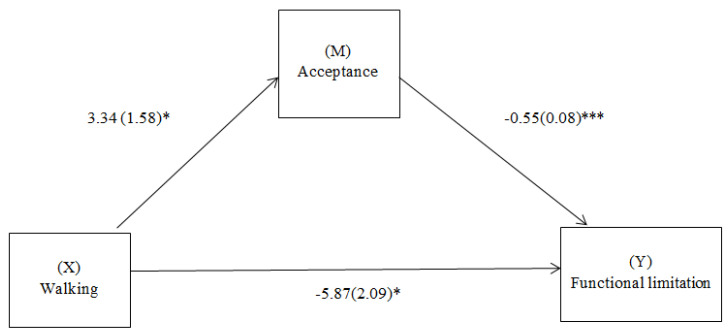
- In the mediation model, acceptance fully mediated the effect of walking on functional limitation; the total model effect was significant (B = −1.86, SE = 0.93, 95% CI [−3.83, −0.15]).
- The direct effect of walking on functional limitation remained significant (B = −5.87, SE = 2.09, t = −2.80, 95% CI [−10.00, −1.74], p = 0.05), and the model explained 46% of the variance.
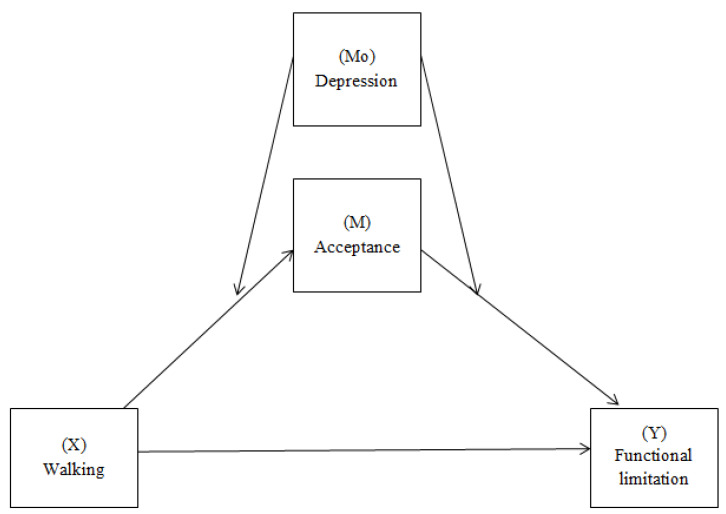
- In the moderated mediation model, the indirect effect was conditioned by depression (moderate mediation index = 2.82, SE = 1.47, 95% CI [0.157, 5.978]); the walking → acceptance path was significant only in patients without depression (B = −2.05, SE = 1.11, 95% CI [−4.53, −0.22]).
- Descriptively, 65.9% of patients without depression walked, versus 46.1% of patients with depression; acceptance was negatively correlated with functional limitation (p < 0.001).
Methods
- Cross-sectional design using a convenience sample recruited through Spanish fibromyalgia associations; 268 agreed, and 231 women with fibromyalgia were included (mean age 53.89 years in the results; mean age 56.91 years in the abstract).
- Measures included a dichotomous walking item, pain acceptance (CPAQ pain willingness subscale), functional limitation (FIQ-R functional limitation subscale), depression (medical history plus HADS depression cutoff ≥ 12), and pain intensity (Brief Pain Inventory); pain intensity was a covariate.
- Analyses used SPSS 22 and PROCESS macro models 4 and 58 with OLS regression and 5,000 bootstrap samples; mediation and moderated mediation tested walking as predictor, acceptance as mediator, depression as moderator, and functional limitation as outcome.
Limitations
- The paper states that the cross-sectional design prevents establishing cause–effect relationships.
- The sample included only women, limiting generalizability; the authors note more research is needed in other populations and in men.
- Self-report questionnaires were used for most measures, which the authors say could affect the results.
Model-written summary. Check it against the paper before relying on it.
Integrity signals
Registry
Cites
Statistics
Figures
Verification
Claims the paper makes
5 Valid · 1 Not valid · 10 Not checked · 25 Own results and interpretations
The cited sources support only part of this claim — read each source’s verdict below.
In the paper
“Within the different modalities of aerobic physical exercise, it has been proven that regular walking offers multiple benefits in these patients [5,6].”
§ Does Pain Acceptance Contribute to Improved Functionality through Walking in Women with Fibromyalgia? Looking at Depressive Comorbidity > 1. Introduction
What the sources say
- Not checked — no full text of the sourcecites [5] Rooks, 2007, Group Exercise, Education, and Combination Self-management in Women with Fibromyalgia A Randomized Trial, Arch. Intern. Med. source
- Partly supportedcites [6] Terrier, P., Praz, C., Le Carré, J., Vuistiner, P., Léger, B., and Luthi, F. (2019). Influencing walking behavior can increase the physical activity of patients with chronic pain hospitalized for multidisciplinary rehabilitation: An observational study. BMC Musculoskelet. Disord., 20. sourceExperimental — accuracy not yet measured
The Background and Discussion state that walking can reduce pain and improve physical function in people with chronic pain. They do not establish these benefits specifically for patients with fibromyalgia; the study concerns hospitalized patients with chronic pain, and it notes uncertainty about whether discontinuous everyday walking has the same effects as structured walking exercise. (LLM, conf=0.86)
boostedstates a cause- Asserted: passes — The authors put it forward as true.
- Checkable: passes — It can be checked against evidence.
- Load-bearing: passes — The paper’s conclusions depend on it.
- Based: passes — The paper gives a reason why it holds.
A result the paper reports from its own data — it cites no other source for it, so there is none to check. The quote shows it is in the paper.
In the paper
“Patients without depression obtained higher scores in acceptance and lower scores in functional limitation.”
§ Does Pain Acceptance Contribute to Improved Functionality through Walking in Women with Fibromyalgia? Looking at Depressive Comorbidity > 3. Results > 3.2. Descriptive Analysis and Correlations
plainstates an association- Asserted: passes — The authors put it forward as true.
- Checkable: passes — It can be checked against evidence.
- Load-bearing: unclear — It is unclear whether the paper’s conclusions depend on it.
- Based: passes — The paper gives a reason why it holds.
A result the paper reports from its own data — it cites no other source for it, so there is none to check. The quote shows it is in the paper.
In the paper
“The mediation model explains a total variance of 46% (F = 64.20, p < 0.001).”
§ Does Pain Acceptance Contribute to Improved Functionality through Walking in Women with Fibromyalgia? Looking at Depressive Comorbidity > 3. Results > 3.3. Mediation Model of the Relationship between Walking and Functional Limitation with Acceptance as a Mediator
plainstates an association- Asserted: passes — The authors put it forward as true.
- Checkable: passes — It can be checked against evidence.
- Load-bearing: passes — The paper’s conclusions depend on it.
- Based: passes — The paper gives a reason why it holds.
- Rests on an assumption not shown here.
A result the paper reports from its own data — it cites no other source for it, so there is none to check. The quote shows it is in the paper.
In the paper
“Regarding the correlations between the variables under study, acceptance was negatively correlated with functional limitation (p < 0.001).”
§ Does Pain Acceptance Contribute to Improved Functionality through Walking in Women with Fibromyalgia? Looking at Depressive Comorbidity > 3. Results > 3.2. Descriptive Analysis and Correlations
plainstates an association- Asserted: passes — The authors put it forward as true.
- Checkable: passes — It can be checked against evidence.
- Load-bearing: passes — The paper’s conclusions depend on it.
- Based: passes — The paper gives a reason why it holds.
A result the paper reports from its own data — it cites no other source for it, so there is none to check. The quote shows it is in the paper.
In the paper
“The total model effect was significant (B = −1.86, SE = 0.93, 95% CI = [−3.83, −0.15]).”
§ Does Pain Acceptance Contribute to Improved Functionality through Walking in Women with Fibromyalgia? Looking at Depressive Comorbidity > 3. Results > 3.3. Mediation Model of the Relationship between Walking and Functional Limitation with Acceptance as a Mediator
plainstates an association- Asserted: passes — The authors put it forward as true.
- Checkable: passes — It can be checked against evidence.
- Load-bearing: passes — The paper’s conclusions depend on it.
- Based: passes — The paper gives a reason why it holds.
- Rests on an assumption not shown here.
16 more claims
Create a free account to see all 41 claims and to verify the 1 reference still open.
- Probably not a substantial claim. 16
- It may state two separate claims as one. 7
- The quote only partly states this claim. 1
Self-check
Percentages, sums and reported differences re-computed from the paper’s own numbers.
Each contradiction between two passages listed here was confirmed by an independent check.
Rated major: it would touch a result — a value a result rests on, reported and recomputed p-values on opposite sides of the significance level, two passages that conflict with no sign which is right, or a cited work retracted before this paper was published.
In the paper
§ Does Pain Acceptance Contribute to Improved Functionality through Walking in Women with Fibromyalgia? Looking at Depressive Comorbidity > Abstract
“A total of 231 women with fibromyalgia (mean age 56.91 years) participated in the study.”
§ Does Pain Acceptance Contribute to Improved Functionality through Walking in Women with Fibromyalgia? Looking at Depressive Comorbidity > 3. Results > 3.1. Sample Characteristics
“The age of the participants ranged from 19 to 78 years (mean = 53.89; SD = 9.25).”
Citations
Cites
The Hospital Anxiety and Depression Scale
Zigmond, A. S., & Snaith, R. P. (1983) · Acta Psychiatrica Scandinavica · doi:10.1111/j.1600-0447.1983.tb09716.x · Cited by 47,139 · cited 1×
“In addition, this diagnosis was verified through the administration of the Spanish version of the Hospital Anxiety and Depression Scale (HADS) [46,47], depression dimension, establishing a cut-off point score of 12 or higher in this population [48].”
MethodDepression and quality of life in older persons: A review
Sivertsen, H., Bjørkløf, G. H., Engedal, K., Selbæk, G., & Helvik, A.-S. (2015) · Dementia and Geriatric Cognitive Disorders · doi:10.1159/000437299 · Cited by 14,152
Pain assessment: global use of the Brief Pain Inventory.
Cs, C., & Km, R. (1994) · PubMed · Cited by 5,421
Wolfe, F., Clauw, D. J., Fitzcharles, M., Goldenberg, D. L., Katz, R. S., Mease, P., Russell, A. S., Russell, I. J., Winfield, J. B., & Yunus, M. B. (2010) · Arthritis Care & Research · doi:10.1002/acr.20140 · Cited by 3,952 · cited 1×
“All of them were diagnosed according to the American College of Rheumatology criteria [37].”
BackgroundLower bounds on sample size in structural equation modeling
Christopher Westland, J. (2010) · Electronic Commerce Research and Applications · doi:10.1016/j.elerap.2010.07.003 · Cited by 1,846
EULAR revised recommendations for the management of fibromyalgia
Macfarlane, G. J., Kronisch, C., Dean, L. E., Atzeni, F., Häuser, W., Fluß, E., Choy, E., Kosek, E., Amris, K., Branco, J., et al. (2017) · Annals of the Rheumatic Diseases · doi:10.1136/annrheumdis-2016-209724 · Cited by 1,566 · cited 1×
“In recent times, health research has recommended multidisciplinary treatments for fibromyalgia patients, which combine psycho-education, recommendations to carry out a healthy lifestyle, and non-pharmacological interventions [4].”
BackgroundAcceptance of chronic pain: component analysis and a revised assessment method
McCracken, L. M., Vowles, K. E., & Eccleston, C. (2004) · Pain · doi:10.1016/j.pain.2003.10.012 · Cited by 1,101 · cited 4×
“In this context, it has also been pointed out that the acceptance of pain allows patients to better adapt to suffering from chronic pain [55] and to maintain adaptive daily functioning while continui g to experience pain [34].”
BackgroundInfluentialA validation study of the hospital anxiety and depression scale (HADS) in a Spanish population
Herrero, M. J., Blanch, J., Peri, J. M., De Pablo, J., Pintor, L., & Bulbena, A. (2003) · General Hospital Psychiatry · doi:10.1016/s0163-8343(03)00043-4 · Cited by 892 · cited 1×
“In addition, this diagnosis was verified through the administration of the Spanish version of the Hospital Anxiety and Depression Scale (HADS) [46,47], depression dimension, establishing a cut-off point score of 12 or higher in this population [48].”
MethodThe Revised Fibromyalgia Impact Questionnaire (FIQR): validation and psychometric properties
Bennett, R. M., Friend, R., Jones, K. D., Ward, R., Han, B. K., & Ross, R. L. (2009) · Arthritis Research & Therapy · doi:10.1186/ar2783 · Cited by 814 · cited 2×
“For this study, the functional limitation subscale of the Spanish version of FIQ-R [44] was used, which evaluates the degree of difficulty experienced by the patients when performing a series of physical exercises in activities of daily living (for example, “going shopping” or “climbing stairs”).”
BackgroundLearning to live with the pain: acceptance of pain predicts adjustment in persons with chronic pain
McCracken, L. M. (1998) · Pain · doi:10.1016/s0304-3959(97)00146-2 · Cited by 685
Pain and Depression: A Systematic Review
IsHak, W. W., Wen, R. Y., Naghdechi, L., Vanle, B., Dang, J., Knosp, M., Dascal, J., Marcia, L., Gohar, Y., Eskander, L., et al. (2018) · Harvard Review of Psychiatry · doi:10.1097/hrp.0000000000000198 · Cited by 498 · cited 1×
“In addition, it has been proven that depression can exacerbate physical pain and cause fatigue and a feeling of exhaustion, which could make it even more difficult for these patients to find benefits in carrying out the behavior of walking [70,71].”
BackgroundThieme, K., Turk, D. C., & Flor, H. (2004) · Psychosomatic Medicine · doi:10.1097/01.psy.0000146329.63158.40 · Cited by 467 · cited 2×
“However, it is important to note that in the latter case, it would be interesting to study depression independently, since different studies have reported that anxiety and depression are independently associated with the severity of pain symptoms in fibromyalgia [67,68], and that the proportions of comorbid anxiety an…”
BackgroundGiesecke, T., Williams, D. A., Harris, R. E., Cupps, T. R., Tian, X., Tian, T. X., Gracely, R. H., & Clauw, D. J. (2003) · Arthritis & Rheumatism · doi:10.1002/art.11272 · Cited by 424 · cited 1×
“Specifically, pain catastrophism is included in some of these clusters [56,57].”
BackgroundPain Catastrophizing: An Updated Review
Leung, L. (2012) · Indian Journal of Psychological Medicine · doi:10.4103/0253-7176.106012 · Cited by 295 · cited 1×
“Fibromyalgia patients with high catastrophizing scores perform less physical activity and present greater pain and fatigue and greater functional limitation [14,15].”
BackgroundViane, I., Crombez, G., Eccleston, C., Poppe, C., Devulder, J., Van Houdenhove, B., & De Corte, W. (2003) · Pain · doi:10.1016/s0304-3959(03)00291-4 · Cited by 282 · cited 1×
“According to acceptance and commitment therapy, acceptance not only implies accepting pain passively, but also makes it easier to carry out valuable ctivities for the person without the need to avoid or control pain [53].”
BackgroundUnderstanding pain catastrophizing: Putting pieces together
Petrini, L., & Arendt-Nielsen, L. (2020) · Frontiers in Psychology · doi:10.3389/fpsyg.2020.603420 · Cited by 259 · cited 1×
“Fibromyalgia patients with high catastrophizing scores perform less physical activity and present greater pain and fatigue and greater functional limitation [14,15].”
BackgroundVowles, K. E., McCracken, L. M., & Eccleston, C. (2007) · European Journal of Pain · doi:10.1016/j.ejpain.2006.12.007 · Cited by 253
The use of multiple-item scales for pain intensity measurement in chronic pain patients
Jensen, M. P., Turner, L. R., Turner, J. A., & Romano, J. M. (1996) · Pain · doi:10.1016/0304-3959(96)03078-3 · Cited by 227 · cited 1×
“This procedure for measuring pain intensity has been widely used in the pain literature [50].”
MethodEsteve, R., Ramírez-Maestre, C., & López-Martínez, A. E. (2007) · Annals of Behavioral Medicine · doi:10.1007/bf02879899 · Cited by 226
Rooks, D. S. (2007) · Archives of Internal Medicine · doi:10.1001/archinte.167.20.2192 · Cited by 219 · cited 1×
“Within the different modalities of aerobic physical exercise, it has been proven that regular walking offers multiple benefits in these patients [5,6].”
BackgroundGeneral psychological acceptance and chronic pain: There is more to accept than the pain itself
McCracken, L. M., & Zhao‐O'Brien, J. (2010) · European Journal of Pain · doi:10.1016/j.ejpain.2009.03.004 · Cited by 203
Kleykamp, B. A., Ferguson, M. C., McNicol, E., Bixho, I., Arnold, L. M., Edwards, R. R., Fillingim, R., Grol-Prokopczyk, H., Turk, D. C., & Dworkin, R. H. (2021) · Seminars in Arthritis and Rheumatism · doi:10.1016/j.semarthrit.2020.10.006 · Cited by 202 · cited 4×
“However, anxiety-related disorders were much less common [32].”
BackgroundInfluentialValidation of a Spanish version of the Revised Fibromyalgia Impact Questionnaire (FIQR)
Salgueiro, M., García-Leiva, J. M., Ballesteros, J., Hidalgo, J., Molina, R., & Calandre, E. P. (2013) · Health and Quality of Life Outcomes · doi:10.1186/1477-7525-11-132 · Cited by 171 · cited 2×
“For this study, the functional limitation subscale of the Spanish version of FIQ-R [44] was used, which evaluates the degree of difficulty experienced by the patients when performing a series of physical exercises in activities of daily living (for example, “going shopping” or “climbing stairs”).”
MethodComorbidity of fibromyalgia and psychiatric disorders
Buskila, D., & Cohen, H. (2007) · Current Pain and Headache Reports · doi:10.1007/s11916-007-0214-4 · Cited by 167 · cited 1×
“Increasing data support the comorbidity of fibromyalgia and psychiatric conditions [31,32].”
BackgroundMcCracken, L. M., & Eccleston, C. (2006) · European Journal of Pain · doi:10.1016/j.ejpain.2005.01.004 · Cited by 164 · cited 1×
“A current study noted that pain acceptance explained six times the variance in seven measures of physical and psychosocial functioning compared to five widely studied coping strategies [17].”
BackgroundHaugmark, T., Hagen, K. B., Smedslund, G., & Zangi, H. A. (2019) · PLoS ONE · doi:10.1371/journal.pone.0221897 · Cited by 161 · cited 2×
“A recent review that analyzes the effectiveness of the interventions in patients with fibromyalgia of the therapy of acceptance commitment and full attention already indicated that in patients with depression, the effects are small [24].”
BackgroundFibromyalgia: evidence for deficits in positive affect regulation.
Zautra, A. J., Fasman, R., Reich, J. W., Harakas, P., Johnson, L. M., Olmsted, M. E., & Davis, M. C. (2005) · Psychosomatic Medicine · doi:10.1097/01.psy.0000146328.52009.23 · Cited by 152
McCracken, L. M., & Vowles, K. E. (2006) · Current Pain and Headache Reports · doi:10.1007/s11916-006-0018-y · Cited by 148 · cited 1×
“The process of acceptance of chronic pain is associated with a lower impact of the disease, including less disability [34,35].”
BackgroundKratz, A. L., Davis, M. C., & Zautra, A. J. (2007) · Annals of Behavioral Medicine · doi:10.1007/bf02879911 · Cited by 143 · cited 3×
“The latest research shows that the benefits of pain acceptance go beyond standard coping strategies [2].”
BackgroundInfluentialIzquierdo-Alventosa, R., Inglés, M., Cortés-Amador, S., Gimeno-Mallench, L., Chirivella-Garrido, J., Kropotov, J., & Serra-Añó, P. (2020) · International Journal of Environmental Research and Public Health · doi:10.3390/ijerph17103634 · Cited by 134 · cited 1×
“Despite having results on the role of acceptance in adherence to the behavior of walking and its benefits [69], in view of our results it seems that this role of acceptance does not work in the same way in patients with depressive comorbidity.”
ResultLaChapelle, D. L., Lavoie, S., & Boudreau, A. (2008) · Pain Research and Management · doi:10.1155/2008/258542 · Cited by 126 · cited 1×
“In this context, it has also been pointed out that the acceptance of pain allows patients to better adapt to suffering from chronic pain [55] and to maintain adaptive daily functioning while continui g to experience pain [34].”
BackgroundThe complexities of fibromyalgia and its comorbidities
Lichtenstein, A., Tiosano, S., & Amital, H. (2018) · Current Opinion in Rheumatology · doi:10.1097/bor.0000000000000464 · Cited by 119 · cited 1×
“Knowing the heterogeneity among patients with fibromyalgia, due in large part to the complexity of the disorder and the high associated comorbidity [25], it is possible that the mechanisms involved do not work the same in all patients [26].”
BackgroundWhat we already know about the effects of exercise in patients with fibromyalgia: An umbrella review
Andrade, A., Dominski, F. H., & Sieczkowska, S. M. (2020) · Seminars in Arthritis and Rheumatism · doi:10.1016/j.semarthrit.2020.02.003 · Cited by 95 · cited 1×
“Some of the most notable benefits are the reduction of the impact of the disease on daily life, fatigue or improvement in functional limitation, and pain control [7,8].”
BackgroundMcCracken, L. M. (1999) · Journal of Back and Musculoskeletal Rehabilitation · doi:10.3233/bmr-1999-132-306 · Cited by 87
Fatigue as a residual symptom of depression.
Targum, S. D., & D, M. F. M. (2011) · PubMed · Cited by 82
Rodero, B., García-Campayo, J., Casanueva, B., del Hoyo, Y. L., Serrano-Blanco, A., & Luciano, J. V. (2010) · Health and Quality of Life Outcomes · doi:10.1186/1477-7525-8-37 · Cited by 79
The relationship between affect balance style and clinical outcomes in fibromyalgia
Hassett, A. L., Simonelli, L. E., Radvanski, D. C., Buyske, S., Savage, S. V., & Sigal, L. H. (2008) · Arthritis Care & Research · doi:10.1002/art.23708 · Cited by 78
Pain Measurement and Brain Activity: Will Neuroimages Replace Pain Ratings?
Robinson, M. E., Staud, R., & Price, D. D. (2013) · The Journal of Pain · doi:10.1016/j.jpain.2012.05.007 · Cited by 74
Alonso-Fernández, M., López-López, A., Losada, A., González, J. L., & Wetherell, J. L. (2016) · Pain Medicine · doi:10.1111/pme.12885 · Cited by 73
Unravelling Fibromyalgia—Steps toward Individualized Management
Häuser, W., Perrot, S., Clauw, D. J., & Fitzcharles, M.-A. (2018) · The Journal of Pain · doi:10.1016/j.jpain.2017.08.009 · Cited by 72
Karsdorp, P. A., & Vlaeyen, J. W. S. (2011) · Pain · doi:10.1016/j.pain.2011.02.018 · Cited by 70 · cited 1×
“Pain catastrophizing has been analyzed within motivational approaches, which understand it as the result of the conflict of goals: goals aimed at pain control (basically through activity avoidance behaviors) and goals with a vital purpose for patients (normally associated with carrying out an activity) [13].”
BackgroundCurrent trends in colchicine treatment in familial Mediterranean fever.
Salaffi, F., Franchignoni, F., Giordano, A., Ciapetti, A., Sarzi-Puttini, P., & Ottonello, M. (2013) · PubMed · Cited by 69
OMERACT-based fibromyalgia symptom subgroups: an exploratory cluster analysis
Vincent, A., Hoskin, T. L., Whipple, M. O., Clauw, D. J., Barton, D. L., Benzo, R. P., & Williams, D. A. (2014) · Arthritis Research & Therapy · doi:10.1186/s13075-014-0463-7 · Cited by 66 · cited 1×
“[30], using the usual symptomatology in patients with fibromyalgia (i.”
MethodKurtze, N., Gundersen, K. T., & Svebak, S. (1998) · British Journal of Medical Psychology · doi:10.1111/j.2044-8341.1998.tb01379.x · Cited by 66 · cited 1×
“However, it is important to note that in the latter case, it would be interesting to study depression independently, since different studies have reported that anxiety and depression are independently associated with the severity of pain symptoms in fibromyalgia [67,68], and that the proportions of comorbid anxiety an…”
BackgroundKurtze, N., Gundersen, K. T., & Svebak, S. (1999) · British Journal of Medical Psychology · doi:10.1348/000711299160185 · Cited by 62 · cited 1×
“In studies in which anxiety and depression are studied jointly as comorbid symptoms in FM patients, compared with fibromyalgia patients without those diagnoses, it has been verified that the main effects of anxiety and depression were significant for the index scores on activity-related discomfort, subjective work cap…”
BackgroundPhysical activity in the treatment of fibromyalgia
Masquelier, É., & D’Haeyere, J. (2021) · Joint Bone Spine · doi:10.1016/j.jbspin.2021.105202 · Cited by 61 · cited 1×
“Despite the positive effects of walking as a form of physical exercise, the results are not always as desired, given the low adherence that patients with fibromyalgia have to this healthy behavior [11].”
BackgroundSegura‐Jiménez, V., Estévez‐López, F., Soriano‐Maldonado, A., Álvarez‐Gallardo, I. C., Delgado‐Fernández, M., Ruiz, J. R., & Aparicio, V. A. (2016) · Pain Research and Management · doi:10.1155/2016/5135176 · Cited by 60
Identifying fibromyalgia subgroups using cluster analysis: Relationships with clinical variables
Yim, Y. ‐., Lee, K. ‐., Park, D. ‐., Kim, S. ‐., Nah, S. ‐., Lee, J. H., Kim, S. ‐., Lee, Y. ‐., Hong, S. ‐., Kim, H. ‐., et al. (2017) · European Journal of Pain · doi:10.1002/ejp.935 · Cited by 59 · cited 2×
“In this line, different subgroups derived from exploratory cluster analyses of a wide range of variables have been published [29,62,63].”
BackgroundCabrera, V., Martín-Aragón, M., Terol, M. D. C., Núñez, R., & Pastor, M. D. L. Á. (2015) · Terapia psicológica · doi:10.4067/s0718-48082015000300003 · Cited by 51
Koçyiğit, B. F., & Akaltun, M. S. (2020) · Archives of Rheumatology · doi:10.46497/archrheumatol.2020.7432 · Cited by 50
Management of Fibromyalgia Syndrome: Review of Evidence
Okifuji, A., & Hare, B. D. (2013) · Pain and Therapy · doi:10.1007/s40122-013-0016-9 · Cited by 49 · cited 1×
“Knowing the heterogeneity among patients with fibromyalgia, due in large part to the complexity of the disorder and the high associated comorbidity [25], it is possible that the mechanisms involved do not work the same in all patients [26].”
BackgroundVarallo, G., Scarpina, F., Giusti, E. M., Suso-Ribera, C., Cattivelli, R., Guerrini Usubini, A., Capodaglio, P., & Castelnuovo, G. (2021) · Journal of Personalized Medicine · doi:10.3390/jpm11080810 · Cited by 48 · cited 1×
“In a recent study comparing both pain catastrophizing and acceptance in fibromyalgia and obese patients, an association was found between lower levels of activity (both self-reported and through the 6-min walking test (6MWT)) with higher pain catastrophizing and lower acceptance scores [16].”
BackgroundLuciano, J. V., Forero, C. G., Cerdà-Lafont, M., Peñarrubia-María, M. T., Fernández-Vergel, R., Cuesta-Vargas, A. I., Ruíz, J. M., Rozadilla-Sacanell, A., Sirvent-Alierta, E., Santo-Panero, P., et al. (2016) · The Clinical Journal of Pain · doi:10.1097/ajp.0000000000000336 · Cited by 40 · cited 2×
“Previous studies already mentioned the usefulness of establishing subsets based on symptomatology and biopsychosocial factors [57,61,62].”
BackgroundPain acceptance and its impact on function and symptoms in fibromyalgia
Tangen, S. F., Helvik, A.-S., Eide, H., & Fors, E. A. (2020) · Scandinavian Journal of Pain · doi:10.1515/sjpain-2020-0049 · Cited by 39 · cited 4×
“The challenge of the most current research lies in revealing what factors are influencing the results [3].”
BackgroundInfluentialPérez-Aranda, A., Andrés-Rodríguez, L., Feliu-Soler, A., Núñez, C., Stephan-Otto, C., Pastor-Mira, M. A., López-Roig, S., Peñacoba, C., Calandre, E. P., Slim, M., et al. (2019) · Pain · doi:10.1097/j.pain.0000000000001468 · Cited by 36
Self-citationSanz-Baños, Y., Pastor-Mira, M.-Á., Lledó, A., López-Roig, S., Peñacoba, C., & Sánchez-Meca, J. (2018) · Disability and Rehabilitation · doi:10.1080/09638288.2017.1347722 · Cited by 35
Self-citationSanz-Baños, Y., Pastor, M.-Á., Velasco, L., López-Roig, S., Peñacoba, C., Lledo, A., & Rodríguez, C. (2016) · Rheumatology International · doi:10.1007/s00296-016-3459-6 · Cited by 34
Self-citationTriñanes, Y., González-Villar, A. J., Gómez‐Perretta, C., & Carrillo‐de‐la‐Peña, M. T. (2014) · Rheumatology International · doi:10.1007/s00296-014-3007-1 · Cited by 31
Santos E Campos, M. A., Párraga‐Montilla, J. A., Aragón‐Vela, J., & Latorre‐Román, P. A. (2020) · Scandinavian Journal of Medicine & Science in Sports · doi:10.1111/sms.13640 · Cited by 31
Catala, P., Lopez-Roig, S., Ecija, C., Suso-Ribera, C., & Peñacoba Puente, C. (2021) · Rheumatology International · doi:10.1007/s00296-020-04719-w · Cited by 25 · cited 1×
“These results are consistent with previous studies showing that the benefits of leading an active lifestyle vary depending on the characteristics of the population examined [12,72,73].”
ResultMartínez, M. P., Sánchez, A. I., Prados, G., Lami, M. J., Villar, B., & Miró, E. (2021) · The Spanish Journal of Psychology · doi:10.1017/sjp.2021.30 · Cited by 24
Pérez‐Aranda, A., Feliu‐Soler, A., Mist, S. D., Jones, K. D., del Hoyo, Y. L., Oliván-Arévalo, R., Kratz, A. L., Williams, D. A., & Luciano, J. V. (2020) · International Journal of Environmental Research and Public Health · doi:10.3390/ijerph18010247 · Cited by 20
Sanz, Y., Pastor-Mira, M. D. L. Á., Furlong, L. V., López-Roig, S., Peñacoba, C., Boyer, A. L., & Rodríguez, C. (2016) · Rheumatology International · doi:10.1007/s00296-016-3479-2 · Cited by 17
Self-citationSitges, C., González‐Roldán, A. M., Duschek, S., & Montoya, P. (2018) · Clinical Journal of Pain · doi:10.1097/ajp.0000000000000637 · Cited by 17 · cited 1×
“Specifically, it has been observed that fibromyalgia patients with depression have lower scores on positive affect, higher scores on pain vigilance and negative affect, and slower reaction times than FM patients with low depression and pain-free controls [65].”
BackgroundÉcija, C., Catalá, P., López-Roig, S., Pastor-Mira, M. D. L. Á., Pino, C. G., & Peñacoba, C. (2021) · Journal of Clinical Psychology in Medical Settings · doi:10.1007/s10880-021-09762-8 · Cited by 17 · cited 1×
“It has been shown that patients who accept their experiences are more willing to undertake efforts to relieve their pain [54] such as going for regular walks.”
BackgroundSelf-citationIdentification of subgroups among fibromyalgia patients
Auvinet, B., & Chaleil, D. (2012) · Reumatismo · doi:10.4081/reumatismo.2012.250 · Cited by 16 · cited 1×
“Previous studies already mentioned the usefulness of establishing subsets based on symptomatology and biopsychosocial factors [57,61,62].”
BackgroundTerrier, P., Praz, C., Le Carré, J., Vuistiner, P., Léger, B., & Luthi, F. (2019) · BMC Musculoskeletal Disorders · doi:10.1186/s12891-019-2561-9 · Cited by 14 · cited 1×
“Within the different modalities of aerobic physical exercise, it has been proven that regular walking offers multiple benefits in these patients [5,6].”
BackgroundCatala, P., Gutierrez, L., Écija, C., Serrano del Moral, Á., & Peñacoba, C. (2021) · International Journal of Environmental Research and Public Health · doi:10.3390/ijerph182413148 · Cited by 13 · cited 1×
“There are data that confirm that a greater acceptance is related to less intensity of pain, symptoms, and disability and to better physical functionality [3,23,24].”
BackgroundSelf-citationCiapetti, A., Salaffi, F., Franchignoni, F., Giordano, A., Sarzi Puttini, P., & Ottonello, M. (2013) · Annals of the Rheumatic Diseases · doi:10.1136/annrheumdis-2013-eular.2112 · Cited by 8
Research works printed but not linked: 4
- 2017, Fibromialgia, Med.-Programa Form. Méd. Contin. Acreditado, 12, 1586
- McCracken, L.M. (2005). Contextual Cognitive-Behavioral Therapy for Pain, IASP Press.
- 2019, El análisis de moderación en el ámbito socioeducativo a través de la macro Process en SPSS Statisti, REIRE. Rev. d’Innovació i Recer. Educ., 12, 1
- Hayes, A. (2013). Introduction to Mediation, Moderation, and Conditional Process Analysis: A Regression-Based Approach, Guilford Press.
Cited by
Positive Affect Moderates Walking's Impact on Depression in Fibromyalgia Patients
Écija, C., Catalá, P., Gutiérrez, L., & Peñacoba, C. (2025) · Pain Management Nursing · doi:10.1016/j.pmn.2025.02.002 · Cited by 2
Self-citationTopal, İ., Bozkurt, S., Üşen, A., & Atayoğlu, A. G. (2024) · International Journal of Traditional and Complementary Medicine Research · doi:10.53811/ijtcmr.1507281 · Cited by 2
Metadata
- Authors
- Peñacoba, C., Ecija, C., Gutiérrez, L., & Catalá, P.
- Affiliations
- Universidad Rey Juan Carlos (ES)
- Departamento de Psicología, Facultad de Ciencias de la Salud, Universidad Rey Juan Carlos, 28922 Madrid, Spain
- Corresponding author
- Peñacoba, Cecilia
- Venue
- International Journal of Environmental Research and Public Health
- Publisher
- MDPI AG
- Published
- 2023-03-12
- Volume
- 20
- Issue
- 6
- Pages
- 5005
- ISSN
- 1660-4601 (ISSN-L)
- PMC
- PMC10048968
- OpenAlex
- W4324095418
- Cited by
- 2
- References
- 70
- Citations by year
- 2025: 1 · 2024: 1
- FWCI
- 0.34
- Type
- journal article
- Language
- en
- Open access
- gold
- doi.org
- Licence
- Locations
- International Journal of Environmental Research and Public Health (publishedVersion, cc-by)
- PubMed Central (publishedVersion, cc-by)
- PubMed (publishedVersion)
- RePEc: Research Papers in Economics (submittedVersion)
- Funders
- Health Research (PI17/00858)
- Topics
- Health Sciences › Medicine › Psychiatry and Mental health › Fibromyalgia and Chronic Fatigue Syndrome Research
- Social Sciences › Psychology › Clinical Psychology › Mindfulness and Compassion Interventions
- Health Sciences › Health Professions › Physical Therapy, Sports Therapy and Rehabilitation › Musculoskeletal pain and rehabilitation
- Keywords
- fibromyalgia, pain acceptance, walking, physical activity, functional limitations, depression, comorbid depression, acceptance and commitment therapy, women, mediation, moderation
- MeSH terms
- Cross-Sectional Studies, Female, Fibromyalgia, Humans, Middle Aged, Pain, Surveys and Questionnaires, Comorbidity, Walking, Acceptance and Commitment Therapy
About these checks
Registry, retraction, Cites and statistics results are computed, not judged, with one exception: a printed reference that no index lists is read once by a model before it counts as a citation error. Claims are extracted by a model and kept only when their quote appears verbatim in the text; each cited source is then checked, with a model’s help, for whether it says what the claim relies on. Those verdicts can be wrong — read the claim’s quote and the cited source before relying on one.
The claim verdicts this report counts are experimental: their accuracy is not yet measured.
A language model drew the claims from the paper on 2026-10-11, under version 3 of the claim definition (model deepseek-v4.1-flash, prompt extract-v3).
A second model labelled each claim on 2026-10-11 (model jev-1.13-20260917, definition revision gold-guideline-v0.2).
Cited sources are checked with a language model’s help (gpt-6-sol).
Statistics and arithmetic are recomputed, not judged.
Confidence bands are shown only for fields calibrated on our annotated test set. None is calibrated yet, so no band is shown.
What counts as a claim ›How we measure confidence ›How we check this ›
Are you an author, or do you see a problem with this page? Request a review
Data sources
Bibliographic data: Semantic Scholar, OpenAlex, Crossref.
Contains information from the Semantic Scholar Academic Graph Datasets, made available under the ODC Attribution License (ODC-BY 1.0).
Semantic Scholar’s data is described in: Kinney, R., et al. (2023). The Semantic Scholar Open Data Platform. arXiv:2301.10140.
