

Effectiveness of Nola Pender’s Health Promotion Model: A Comprehensive Approach for Enhancing Healthy Behaviors and Quality of Life in Adults
Open accessThe DOI matches its Crossref record; 19 of the 20 references it cites were found in a registry or an index; 8 of the 16 sources its claims cite were checked for support.
Abstract
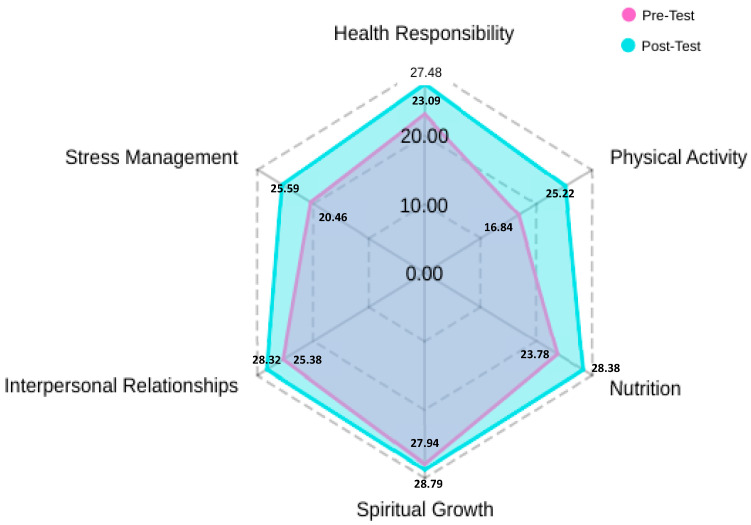
Health behavior encompasses the attitudes, decisions, and actions that individuals adopt in their daily lives and that directly influence their well-being. The objective of this study was to evaluate the effectiveness of a nursing intervention based on Nola Pender's Health Promotion Model in promoting healthy behaviors among adults over 20 years of age. A quasi-experimental design was used with a sample of adults from a Colombian community. In 2022, sociodemographic data were collected, and the Health-Promoting Lifestyle Profile II (HPLP-II), developed by Nola Pender to measure healthy lifestyles, was administered. In 2023, the intervention was carried out in 24 group sessions of 40 min each, supported by printed educational material and focused on the dimensions of Pender's theory. Statistical analysis using nonparametric tests such as the Mann-Whitney U and Kruskal-Wallis tests showed significant improvements: the overall score increased from 22.92 in the pre-test to 27.30 in the post-test. The physical activity dimension received the lowest score, while the spiritual growth dimension showed the highest improvement. The results indicate that nursing interventions based on Pender's model led to statistically significant improvements in multiple dimensions of healthy behavior, with the greatest impact on spiritual growth and health responsibility.
Overview
CoChat Summary
TL;DR
This quasi-experimental single-group study in a Colombian community found that a 24-session educational intervention based on Nola Pender’s Health Promotion Model was associated with improved healthy lifestyle scores in adults over 20. The overall HPLP-II score increased from 22.92 pre-test to 27.30 post-test, with the largest gains in physical activity (8.38) and health responsibility (4.39).
Key findings
- The final analytic sample was 117 participants out of 165 initially invited; 60% (n = 70) were women, 25% (n = 29) were aged 20–25, 41% (n = 48) were housewives, 43% (n = 50) had completed high school, and 72% (n = 84) were in the subsidized SGSSS regime.
- The overall HPLP-II score increased from 22.92 in the pre-test to 27.30 in the post-test; the paper reports significant improvements across all evaluated dimensions.
- Reported dimension gains were: health responsibility 4.39, physical activity 8.38, nutrition 4.6, spiritual growth 0.85, interpersonal relationships 2.94, and stress management 5.13.
- Significant pre/post associations with sociodemographic variables were reported: age with health responsibility, physical activity, and stress management; sex with health responsibility; occupation and SGSSS affiliation with spiritual growth; and SGSSS affiliation with interpersonal relationships.
Methods
- Quasi-experimental pre-test/post-test design with a single group, conducted in a community in Barranquilla, Colombia, targeting adults over 20 years old.
- Convenience sample recruited with community leaders’ help; 117 participants completed the study after exclusions and non-completion.
- Data collection used sociodemographic questions and the Spanish HPLP-II (52 items, six dimensions); the intervention consisted of 24 group sessions over 2023, each 40–45 minutes, supported by printed materials. Analysis used SPSS 20 and nonparametric tests (Mann–Whitney U and Kruskal–Wallis), with p < 0.05 as the significance threshold.
Limitations
- The paper states that convenience sampling may limit generalizability to other populations with different characteristics.
- The paper states that recruitment with community leaders may have introduced selection bias/self-selection, possibly favoring more motivated or health-conscious participants. This could have inflated the observed effects beyond the intervention itself.
- The paper explicitly states that the pre-test/post-test design without a control group limits causal inference.
Model-written summary. Check it against the paper before relying on it.
Integrity signals
Registry
Cites
Statistics
Figures
Verification
Claims the paper makes
5 Valid · 2 Not valid · 5 Not checked · 28 Own results and interpretations
The cited sources support only part of this claim — read each source’s verdict below.
In the paper
“Its application is particularly effective in community contexts, where its benefits extend not only to individuals but also to their families and social circles [12,13].”
§ Effectiveness of Nola Pender’s Health Promotion Model: A Comprehensive Approach for Enhancing Healthy Behaviors and Quality of Life in Adults > 1. Introduction
What the sources say
- Not checked — no full text of the sourcecites [12] Lizcano A. Villar T. López L. Menor C.G. Rodríguez R.L. Zarataín G.F. Efectividad de un programa de capacitación en cuidados integrales para la prevención secundaria cardiovascular en enfermeras de atención primaria Rev. Enfermería Clínica 2021 31 303 312 10.1016/j.enfcli.2020.10.031 33288465 source
- Partly supportedcites [13] Cadena J. González Y. El cuidado de enfermería en pacientes con riesgo cardiovascular sustentado en la teoría de Nola J Pender Investig. En Enfermería Imagen Y Desarro. 2017 19 107 10.11144/Javeriana.ie19-1.ecep sourceExperimental — accuracy not yet measured
Our copy states that Pender's model 'ha demostrado ser aplicable en la práctica clínica' (Desarrollo del tema) — a clinical, not community, setting — and it repeatedly frames the proposal around hospitalisation, discharge and home follow-up of cardiovascular-risk patients. The interpersonal reach is present only as model components and care-delivery considerations (Desarrollo del tema: 'factores personales... interpersonales (familia, pareja, cuidadores), normas, apoyo, modelos'; INVITACIÓN: seguimiento via 'enfermería familiar', 'visita domiciliaria' and TICs 'donde se tenga en cuenta a la familia y al cuidador principal', and strategies that 'contemplen la participación de la población y se acerquen más a la realidad social'). No passage asserts that the model's application is particularly effective in community contexts, nor that its benefits extend to individuals, families and social circles; that comparative/effectiveness claim is not supported by this source. (LLM, conf=0.68)
plainstates a cause- Asserted: passes — The authors put it forward as true.
- Checkable: passes — It can be checked against evidence.
- Load-bearing: passes — The paper’s conclusions depend on it.
- Based: passes — The paper gives a reason why it holds.
The cited sources that could be checked couldn’t confirm or dispute this claim.
In the paper
“A study conducted in Peru with university adolescents also showed positive results in improving exercise, health responsibility, and stress management by focusing on motivational strategies during the sessions [15,23].”
§ Effectiveness of Nola Pender’s Health Promotion Model: A Comprehensive Approach for Enhancing Healthy Behaviors and Quality of Life in Adults > 4. Discussion
What the sources say
- Could not verifycites [15] Triviño Z. López M. Factores predictores de conductas promotoras de salud en docentes de enfermería de tres universidades de Cali, Colombia Univ. Y Salud 2018 20 160 10.22267/rus.182002.120 sourceExperimental — accuracy not yet measured
The Conclusions recommend strategies to strengthen physical activity, health responsibility, and stress management among nursing faculty in Cali; they do not report improvements from an intervention. Searches for Peruvian university adolescents and motivational sessions found no passage describing the study or results claimed. (LLM, conf=0.76)
- Could not verifycites [23] Herrera Molina A.S. Machado Herrera P.M. Tierra Tierra V.R. Coro Tierra E.M. Remache Ati K.A. El profesional de enfermería en la promoción de salud en el segundo nivel de atención Rev. Eugenio Espejo 2022 16 98 111 sourceExperimental — accuracy not yet measured
The DESARROLLO section discusses exercise, stress control, and motivation as general aspects of health promotion, but does not report the claimed intervention or its results. Searches for Peruvian university adolescents and for motivational sessions improving exercise, health responsibility, and stress management found no such study in our copy; page numbers were not available. (LLM, conf=0.75)
plainstates a cause- Asserted: passes — The authors put it forward as true.
- Checkable: passes — It can be checked against evidence.
- Load-bearing: unclear — It is unclear whether the paper’s conclusions depend on it.
- Based: passes — The paper gives a reason why it holds.
- Could not verify
The cited sources support only part of this claim — read each source’s verdict below.
In the paper
“Similar studies have also demonstrated improvements in promoting healthy habits, especially in areas such as nutrition, physical activity, stress management, adherence to medical treatments, and among patients with chronic diseases [15,16,17].”
§ Effectiveness of Nola Pender’s Health Promotion Model: A Comprehensive Approach for Enhancing Healthy Behaviors and Quality of Life in Adults > 4. Discussion
What the sources say
- Partly supportedcites [15] Triviño Z. López M. Factores predictores de conductas promotoras de salud en docentes de enfermería de tres universidades de Cali, Colombia Univ. Y Salud 2018 20 160 10.22267/rus.182002.120 sourceExperimental — accuracy not yet measured
The Results (p. 163) assess nutrition, physical activity, stress management, and health responsibility among nursing faculty. The Conclusions describe nutrition as favorable but call for strategies to strengthen physical activity and stress management; they do not demonstrate improvements. The paper does not establish treatment adherence or improvements among patients with chronic diseases. (LLM, conf=0.87)
- Not matchedcites [16] Carranza F. Caycho T. Salinas S. Guerra M.R. Vilchez C.C. Orci K.C. Rivera J.P. Efectividad de intervención basada en modelo de Nola Pender en promoción de estilos de vida saludables de universitarios peruanos Rev. Cuba. De Enferm. 2019 35 e2859
We searched by its title and found no matching paper.
- Partly supportedcites [17] Habibzadeh H. Shariati A. Mohammadi F. Babayi S. The effect of educational intervention based on Pender’s health promotion model on quality of life and health promotion in patients with heart failure: An experimental study BMC Cardiovasc. Disord. 2021 21 478 10.1186/s12872-021-02294-x 34610821 PMC8491755 sourceExperimental — accuracy not yet measured
The Results (Health-promoting behaviors; page unavailable) report improved nutrition and stress-management scores after the intervention in patients with heart failure. Physical activity did not improve significantly, however, and the paper does not report improved adherence to medical treatment; the Discussion also notes that the stress-management difference was no longer significant at three months. (LLM, conf=0.88)
boostedstates a cause- Asserted: passes — The authors put it forward as true.
- Checkable: passes — It can be checked against evidence.
- Load-bearing: unclear — It is unclear whether the paper’s conclusions depend on it.
- Based: passes — The paper gives a reason why it holds.
- Partly supported
The paper states this without a source or data behind it here, so there is nothing to check it against. The quote shows it is in the paper.
In the paper
“the overall score increased from 22.92 in the pre-test to 27.30 in the post-test.”
§ Effectiveness of Nola Pender’s Health Promotion Model: A Comprehensive Approach for Enhancing Healthy Behaviors and Quality of Life in Adults > Abstract
- Asserted: passes — The authors put it forward as true.
- Checkable: passes — It can be checked against evidence.
- Load-bearing: passes — The paper’s conclusions depend on it.
- Based: unclear — It is unclear why the paper says it holds.
A result the paper reports from its own data — it cites no other source for it, so there is none to check. The quote shows it is in the paper.
In the paper
“the spiritual growth dimension showed the highest improvement.”
§ Effectiveness of Nola Pender’s Health Promotion Model: A Comprehensive Approach for Enhancing Healthy Behaviors and Quality of Life in Adults > Abstract
plain- Asserted: passes — The authors put it forward as true.
- Checkable: passes — It can be checked against evidence.
- Load-bearing: passes — The paper’s conclusions depend on it.
- Based: passes — The paper gives a reason why it holds.
16 more claims
Create a free account to see all 40 claims and to verify the 2 references still open.
- It may state two separate claims as one. 14
- Probably not a substantial claim. 7
- The quote only partly states this claim. 1
Citations
Cites
The Health-Promoting Lifestyle Profile: Development and Psychometric Characteristics
WALKER, S. N., SECHRIST, K. R., & PENDER, N. J. (1987) · Nursing Research · doi:10.1097/00006199-198703000-00002 · Cited by 1,427
Management and Prevention Strategies for Non-communicable Diseases (NCDs) and Their Risk Factors
Budreviciute, A., Damiati, S., Sabir, D. K., Onder, K., Schuller-Goetzburg, P., Plakys, G., Katileviciute, A., Khoja, S., & Kodzius, R. (2020) · Frontiers in Public Health · doi:10.3389/fpubh.2020.574111 · Cited by 946 · cited 1×
“Research has shown that risky behaviors, such as alcohol consumption, smoking, unhealthy diets, physical inactivity, and uncontrolled stress, are closely associated with the development of non-communicable diseases (NCDs), posing a significant threat to health and quality of life [4,5].”
Albert Bandura: Impacto en la educación de la teoría cognitiva social del aprendizaje
Rodríguez‐Rey, R., & Cantero-García, M. (2020) · Revista Padres y Maestros / Journal of Parents and Teachers · doi:10.14422/pym.i384.y2020.011 · Cited by 301
Habibzadeh, H., Shariati, A., Mohammadi, F., & Babayi, S. (2021) · BMC Cardiovascular Disorders · doi:10.1186/s12872-021-02294-x · Cited by 42 · cited 1×
“Similar studies have also demonstrated improvements in promoting healthy habits, especially in areas such as nutrition, physical activity, stress management, adherence to medical treatments, and among patients with chronic diseases [15–17].”
Estilo de vida saludable en estudiantes de enfermería del Estado de México
Morales, M., Gómez, V., Cleotilde García, R., Chaparro-Díaz, L., & Carreño-Moreno, S. (2018) · Revista Colombiana de Enfermería · doi:10.18270/rce.v16i13.2300 · Cited by 34 · cited 1×
“The proper adoption of these healthy habits supports satisfactory levels of well-being; however, poor practices can have negative repercussions for health [3].”
Custos de doenças: classificação e perspectivas de análise
Ripari, N. V., Elorza, M. E., & Moscoso, N. S. (2017) · Revista Ciencias de la Salud · doi:10.12804/revistas.urosario.edu.co/revsalud/a.5376 · Cited by 23 · cited 1×
“In this context, health promotion and maintenance are key strategies for reducing the incidence of NCDs and promoting long-term well-being [7].”
El profesional de enfermería en la promoción de salud en el segundo nivel de atención
(2022) · REVISTA EUGENIO ESPEJO · doi:10.37135/ee.04.13.11 · Cited by 22 · cited 1×
“A study conducted in Peru with university adolescents also showed positive results in improving exercise, health responsibility, and stress management by focusing on motivational strategies during the sessions [15,23].”
Vakilian, P., Mahmoudi, M., Oskouie, F., Firouzian, A. A., & Khachian, A. (2021) · Journal of Education and Health Promotion · doi:10.4103/jehp.jehp_1301_20 · Cited by 17
Sany, S. B. T., Vahedian-Shahroodi, M., Khaboshan, Z. H., Orooji, A., Esmaeily, H., Jafari, A., & Tajfard, M. (2021) · Archives of Public Health · doi:10.1186/s13690-021-00698-x · Cited by 15 · cited 2×
“A similar study states that each person, group, or institution must select the most appropriate techniques based on the type of risk to which they are exposed, the nature of the stress they experience, and their personal and organizational characteristics [20].”
Modelo de Promoción de la salud en el lugar de trabajo: Una propuesta
De Arco Canoles, O. D. C., Puenayan Portilla, Y. G., & Vaca Morales, L. V. (2019) · Avances en Enfermería · doi:10.15446/av.enferm.v37n2.73145 · Cited by 11 · cited 1×
“As suggested in the literature, Pender’s model facilitates effective health management through educational and nursing interventions, contributing to the self-care process by promoting healthy eating, physical activity, motivation, and self-esteem, among other aspects [10,11].”
Research works printed but not linked: 5
- Lorenzo D.J. Díaz A. Estilos y calidad de vida, su vínculo con la depresión en el siglo XXI Rev. Ciencias. Médicas 2019 23 170
- Vázquez E. Calderón Z. Arias J. Ledezma J.C.R. Ramírez L.A.R. Ramírez E. Moreno Sedentarismo, alimentación, obesidad, consumo de alcohol y tabaco como factores de riesgo para el desarrollo de diabetes tipo 2 J. Negat. No Posit. Results 2019 4 1011 1021 10.19230/jonnpr.3068 · doi:10.19230/jonnpr.3068
- Aristizábal G. Blanco D. Sánchez A. Meléndez R.M.O. El modelo de promoción de la salud de Nola Pender. Una reflexión en torno a su comprensión Enferm. Univ. 2011 8 16 23 10.22201/eneo.23958421e.2011.4.248 · DOI
- Carranza F. Caycho T. Salinas S. Guerra M.R. Vilchez C.C. Orci K.C. Rivera J.P. Efectividad de intervención basada en modelo de Nola Pender en promoción de estilos de vida saludables de universitarios peruanos Rev. Cuba. De Enferm. 2019 35 e2859
- Díaz R. Arias D. Efectividad de intervención de enfermería en hábitos de vida saludable desde el modelo de Nola Pender Rev. Esp. Nutr. Comunitaria 2022 28 2
Cited by
Efficacy of an Intervention to Increase Commitment to Handwashing in SchoolchildrenPreprint
Rojas, M. E. M., Mex, G. M. C., Canul, D. F. A., Cob, S. M. C., & Gómez, M. B. (2026) · Research Square · doi:10.21203/rs.3.rs-9349775/v1
Naloxone Distribution at Inpatient Discharge: A Narrative Review of Evidence-Based Strategies
Dee, S. A., Delonnay, K.-A., Bernard, D., & Jean-Baptiste, F. (2026) · Journal of Psychosocial Nursing and Mental Health Services · doi:10.3928/02793695-20260520-03
Özgölet, M., & Gür, K. (2026) · Fenerbahçe Üniversitesi Sağlık Bilimleri Dergisi · doi:10.56061/fbujohs.1954397
Muñoz, J. F. V., Muñoz, E. R., & Asenjo‐Alarcón, J. A. (2026) · Investigación y Educación en Enfermería · doi:10.17533/udea.iee.v44n2e16
Amin, S. M., Alkubati, S. A., El-hie, H. A. A., Khedr, M. A., Abdelaliem, S. M. F., AbouZeid, N. A., & El-Ashry, A. M. (2026) · Frontiers in Public Health · doi:10.3389/fpubh.2026.1897518
Metadata
- Authors
- Rojas-Torres, I. L., Garizábalo Dávila, C. M., Ruidíaz Gómez, K. S., Fernández Aragón, S. P., Perea-Rojas, D. M., Rodelo Olmos, G. M., & Liñán Meléndez, N. I.
- Affiliations
- Faculty of Health Sciences, Universidad Simón Bolívar, Barranquilla 080002, Colombia
- Department of Health Sciences, Universidad de la Costa, Barranquilla 080002, Colombia
- Department of Nursing, Faculty of Health Sciences, University of Sinú, Cartagena 130001, Colombia
- Faculty of Nursing, Universidad de Cartagena, Cartagena 130001, Colombia
- ORCID
- Venue
- International Journal of Environmental Research and Public Health
- Publisher
- MDPI AG
- Published
- 2025-09-30
- Volume
- 22
- Issue
- 10
- Pages
- 1506
- ISSN
- 1660-4601 (ISSN-L)
- PMC
- PMC12563317
- OpenAlex
- W4414653124
- Semantic Scholar
- 8c5437d4fcf8f1bbaa853f0ccca67e2a80ebcc43
- Cited by
- 5
- References
- 14
- Citations by year
- 2026: 5
- FWCI
- 6.26
- Type
- journal article
- Language
- en
- Open access
- gold
- doi.org
- Licence
- Locations
- International Journal of Environmental Research and Public Health (publishedVersion, cc-by)
- Europe PMC (PubMed Central) (publishedVersion, cc-by)
- PubMed (publishedVersion)
- Topics
- Health Sciences › Health Professions › General Health Professions › Health and Wellbeing Research
- Social Sciences › Psychology › Applied Psychology › Behavioral Health and Interventions
- Health Sciences › Nursing › Research and Theory › Nursing care and research
- Keywords
- Nola Pender's Health Promotion Model, health promotion, health behavior, nursing interventions, Health-Promoting Lifestyle Profile II, spiritual development, health responsibility, physical activity, quality of life, adults
- MeSH terms
- Adult, Aged, Colombia, Female, Health Promotion, Humans, Male, Middle Aged, Quality of Life, Health Behavior, Exercise, Young Adult
About these checks
Registry, retraction, Cites and statistics results are computed, not judged, with one exception: a printed reference that no index lists is read once by a model before it counts as a citation error. Claims are extracted by a model and kept only when their quote appears verbatim in the text; each cited source is then checked, with a model’s help, for whether it says what the claim relies on. Those verdicts can be wrong — read the claim’s quote and the cited source before relying on one.
The claim verdicts this report counts are experimental: their accuracy is not yet measured.
A language model drew the claims from the paper on 2026-10-10, under version 3 of the claim definition (model deepseek-v4.1-flash, prompt extract-v3).
A second model labelled each claim on 2026-10-10 (model jev-1.13-20260917, definition revision gold-guideline-v0.2).
Cited sources are checked with a language model’s help (qwen3.8-omni-flash and gpt-6-sol).
Statistics and arithmetic are recomputed, not judged.
Confidence bands are shown only for fields calibrated on our annotated test set. None is calibrated yet, so no band is shown.
What counts as a claim ›How we measure confidence ›How we check this ›
Are you an author, or do you see a problem with this page? Request a review
Data sources
Bibliographic data: Semantic Scholar, OpenAlex, Crossref.
Contains information from the Semantic Scholar Academic Graph Datasets, made available under the ODC Attribution License (ODC-BY 1.0).
Semantic Scholar’s data is described in: Kinney, R., et al. (2023). The Semantic Scholar Open Data Platform. arXiv:2301.10140.
