

The DOI matches its Crossref record; 146 of the 149 references it cites were found in a registry or an index.
NADPH Oxidases and Mitochondria in Vascular Senescence
Open accessAbstract
Aging is the major risk factor in the development of cardiovascular diseases (CVDs), including hypertension, atherosclerosis, and myocardial infarction. Oxidative stress caused by overproduction of reactive oxygen species (ROS) and/or by reduced expression of antioxidant enzymes is a major contributor to the progression of vascular senescence, pathologic remodeling of the vascular wall, and disease. Both oxidative stress and inflammation promote the development of senescence, a process by which cells stop proliferating and become dysfunctional. This review focuses on the role of the mitochondria and the nicotinamide adenine dinucleotide phosphate (NADPH) oxidases Nox1 and Nox4 in vascular senescence, and their contribution to the development of atherosclerosis. Recent findings are reviewed, supporting a critical role of the mitochondrial regulator peroxisome proliferator-activated receptor gamma (PPARγ) coactivator-1α (PGC-1α), the inflammatory gene nuclear factor κB (NF-κB), zinc, the zinc transporters (ZnTs) ZnT3 and ZnT10, and angiotensin II (Ang II) in mitochondrial function, and their role in telomere stability, which provides new mechanistic insights into a previously proposed unified theory of aging.
Overview
The claims and statistics of this paper haven’t been checked yet.
Run the check — free, no account needed. It reads the open-access text and checks the sources it cites.
Integrity signals
Registry
Cites
Statistics
Figures
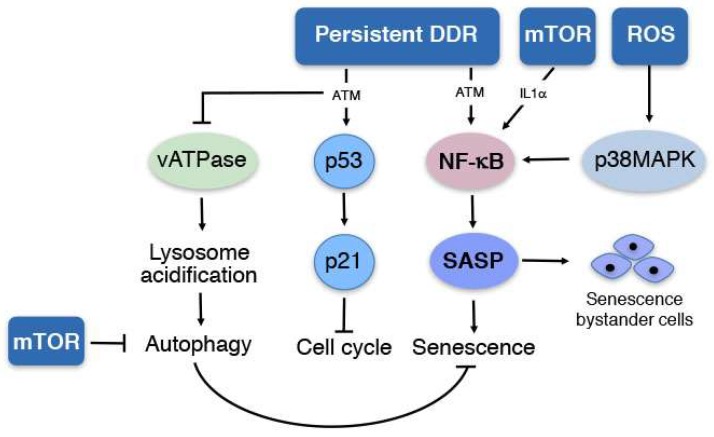
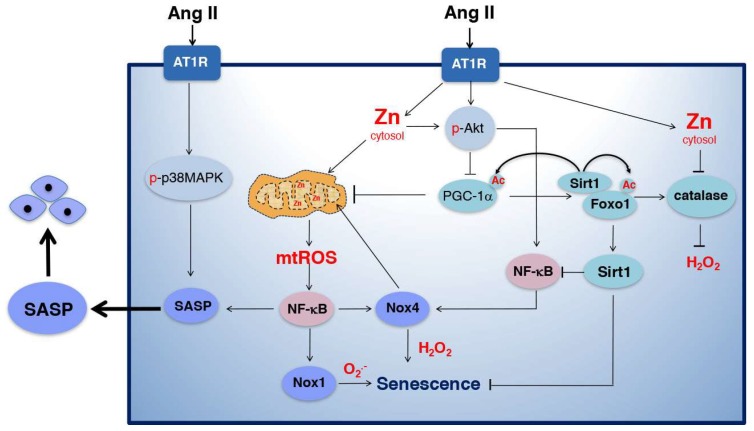
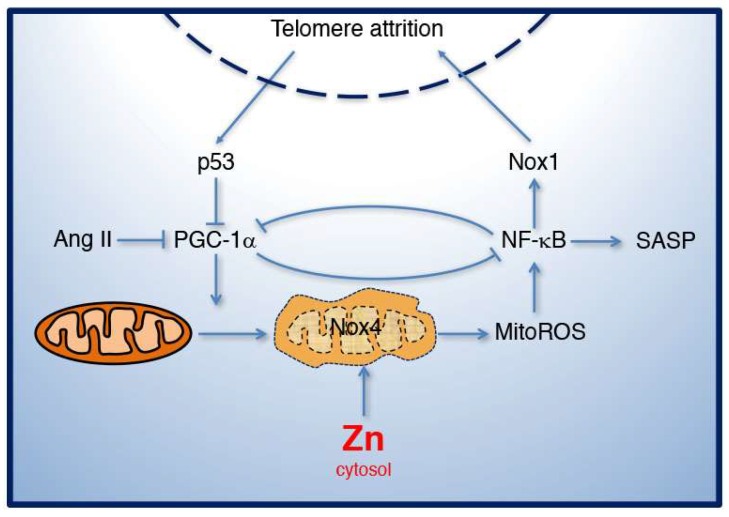
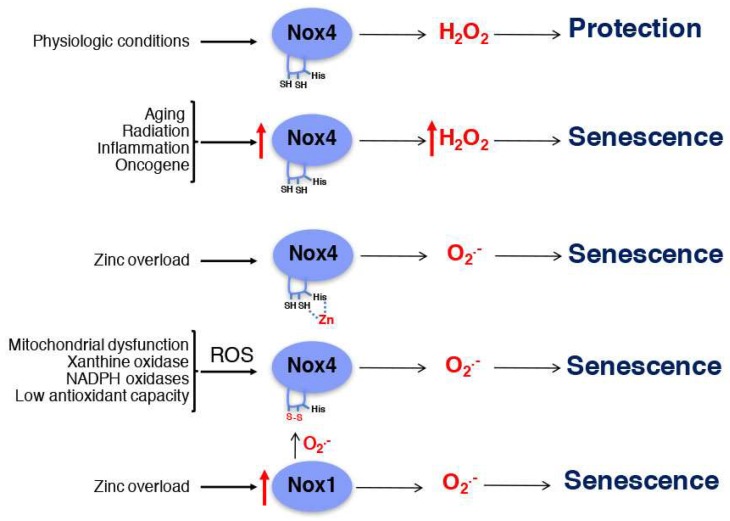
Verification
Claims the paper makes
The claims and statistics of this paper haven’t been checked yet.
Run the check — free, no account needed. It reads the open-access text and checks the sources it cites.
Claims other papers make about this one
Each is checked against this paper’s own text: does it say what the citing paper says it does?
In the citing paper
“On the other hand, Zn overload can contribute to augment cellular OS and senescence through different mechanisms not yet well-defined, but possibly related to organelles dysfunction [411,427,438].”
From The Role of Antioxidants in the Interplay between Oxidative Stress and Senescence (2022) · cites this paper as [438]
Self-check
Percentages, sums and reported differences re-computed from the paper’s own numbers.
The self-check needs the paper’s full text.
Citations
Cites
The senescence-associated secretory phenotype: the dark side of tumor suppression
Coppé, J.-P., Desprez, P.-Y., Krtolica, A., & Campisi, J. (2010) · Annual Review of Pathology: Mechanisms of Disease · doi:10.1146/annurev-pathol-121808-102144 · Cited by 5,206
Stress-dependent regulation of FOXO transcription factors by the SIRT1 deacetylase
Brunet, A., Sweeney, L. B., Sturgill, J. F., Chua, K. F., Greer, P. L., Lin, Y., Tran, H., Ross, S. E., Mostoslavsky, R., Cohen, H. Y., et al. (2004) · Science · doi:10.1126/science.1094637 · Cited by 3,239
NAD(P)H Oxidase: Role in Cardiovascular Biology and Disease
Griendling, K. K., Sorescu, D., & Ushio-Fukai, M. (2000) · Circulation Research · doi:10.1161/01.res.86.5.494 · Cited by 2,886
Cellular senescence in aging and age-related disease: from mechanisms to therapy
Childs, B. G., Durik, M., Baker, D. J., & van Deursen, J. M. (2015) · Nature Medicine · doi:10.1038/nm.4000 · Cited by 2,363
A complex secretory program orchestrated by the inflammasome controls paracrine senescence
Acosta, J. C., Banito, A., Wuestefeld, T., Georgilis, A., Janich, P., Morton, J. P., Athineos, D., Kang, T.-W., Lasitschka, F., Andrulis, M., et al. (2013) · Nature Cell Biology · doi:10.1038/ncb2784 · Cited by 2,278 · cited 1×
“In many cell types, the SASP is driven by IL1α [10] and by IL1β [13].”
BackgroundSt-Pierre, J., Drori, S., Uldry, M., Silvaggi, J. M., Rhee, J., Jäger, S., Handschin, C., Zheng, K., Lin, J., Yang, W., et al. (2006) · Cell · doi:10.1016/j.cell.2006.09.024 · Cited by 2,233
Cellular senescence and the senescent secretory phenotype: therapeutic opportunities
Tchkonia, T., Zhu, Y., van Deursen, J., Campisi, J., & Kirkland, J. L. (2013) · Journal of Clinical Investigation · doi:10.1172/jci64098 · Cited by 1,774
Increased dosage of a sir-2 gene extends lifespan in Caenorhabditis elegans
Tissenbaum, H. A., & Guarente, L. (2001) · Nature · doi:10.1038/35065638 · Cited by 1,603
Sir2 mediates longevity in the fly through a pathway related to calorie restriction
Rogina, B., & Helfand, S. L. (2004) · Proceedings of the National Academy of Sciences · doi:10.1073/pnas.0404184101 · Cited by 1,361
Telomere dysfunction induces metabolic and mitochondrial compromise
Sahin, E., Colla, S., Liesa, M., Moslehi, J., Müller, F. L., Guo, M., Cooper, M., Kotton, D., Fabian, A. J., Walkey, C., et al. (2011) · Nature · doi:10.1038/nature09787 · Cited by 1,319 · cited 1×
“demonstrated that telomere dysfunction causes mitochondrial dysfunction by p53-dependent downregulation of PGC-1α and PGC-1β, leading to mitochondrial dysfunction and increased ROS production [83].”
Background
Cited by
Sorted by citations
The Role of NADPH Oxidases and Oxidative Stress in Neurodegenerative Disorders
Tarafdar, A., & Pula, G. (2018) · International Journal of Molecular Sciences · doi:10.3390/ijms19123824 · Cited by 373
“Indeed, within the last decade several studies have directly linked NOX upregulation to neuronal death and cerebrovascular damage [3,36,131,142,144,145].”
BackgroundCross-Talk between NADPH Oxidase and Mitochondria: Role in ROS Signaling and Angiogenesis
Fukai, T., & Ushio‐Fukai, M. (2020) · Cells · doi:10.3390/cells9081849 · Cited by 313
“In addition, Angiotensin II (Ang II)-induced Nox1 activation stimulates mitochondrial ROS, resulting in mitochondrial dysfunction and vascular senescence [108,109].”
BackgroundRoles of Oxidative Stress and Inflammation in Vascular Endothelial Dysfunction-Related Disease
Higashi, Y. (2022) · Antioxidants · doi:10.3390/antiox11101958 · Cited by 326
“Furthermore, other NADPH oxidase subunits, including p40phox, p47phox, p67phox and p22phox, have been found to be present in human resistance artery VSMCs [47].”
BackgroundProtective Role of Polyphenols against Vascular Inflammation, Aging and Cardiovascular Disease
Serino, A., & Salazar, G. (2018) · Nutrients · doi:10.3390/nu11010053 · Cited by 263
“We have also recently reviewed more specifically the contribution of Nox1 and Nox4 to vascular senescence [27].”
BackgroundSelf-citationSQSTM1/p62 and PPARGC1A/PGC-1alpha at the interface of autophagy and vascular senescence
Salazar, G., Cullen, A. E., Huang, J., Zhao, Y., Serino, A., Hilenski, L. L., Patrushev, N. A., Forouzandeh, F., & Hwang, H. S. (2019) · Autophagy · doi:10.1080/15548627.2019.1659612 · Cited by 186
“PPARGC1A is central to this regulatory network [64] by regulating mitochondrial function, the expression of antioxidant enzymes, and as shown here, autophagy.”
BackgroundSelf-citationGlucose Metabolism and Glucose Transporters in Breast Cancer
Shin, E., & Koo, J. S. (2021) · Frontiers in Cell and Developmental Biology · doi:10.3389/fcell.2021.728759 · Cited by 172
“Glycolysis by the Warburg effect maintains redox homeostasis by being independent of mitochondrial OXPHOS that produces a large amount of ROS (Lee and Yoon, 2015), and PPP by producing ROS-detoxifying molecule, NADPH, by G6PD and 6-Phosphogluconate dehydrogenase (6PGDH) (Salazar, 2018).”
BackgroundThe multifaceted role of the SASP in atherosclerosis: from mechanisms to therapeutic opportunities
Sun, Y., Wang, X., Liu, T., Zhu, X., & Pan, X. (2022) · Cell & Bioscience · doi:10.1186/s13578-022-00815-5 · Cited by 156
PPARα: An emerging target of metabolic syndrome, neurodegenerative and cardiovascular diseases
Lin, Y., Wang, Y., & Li, P. (2022) · Frontiers in Endocrinology · doi:10.3389/fendo.2022.1074911 · Cited by 166
The Role of Antioxidants in the Interplay between Oxidative Stress and Senescence
Varesi, A., Chirumbolo, S., Campagnoli, L. I. M., Pierella, E., Piccini, G. B., Carrara, A., Ricevuti, G., Scassellati, C., Bonvicini, C., & Pascale, A. (2022) · Antioxidants · doi:10.3390/antiox11071224 · Cited by 145
“On the other hand, Zn overload can contribute to augment cellular OS and senescence through different mechanisms not yet well-defined, but possibly related to organelles dysfunction [411,427,438].”
BackgroundMaamoun, H., Benameur, T., Pintus, G., Munusamy, S., & Agouni, A. (2019) · Frontiers in Physiology · doi:10.3389/fphys.2019.00070 · Cited by 143
“They are the only family of enzymes with a primary function to generate ROS (H2O2, O2) by catalyzing the electron transfer from cytosolic NADPH to molecular O2 across plasma and lysosomal membranes (Thannickal and Fanburg, 2000; Salazar, 2018).”
BackgroundInfluentialNew Dawn for Atherosclerosis: Vascular Endothelial Cell Senescence and Death
Bu, L.-L., Yuan, H., Xie, L., Guo, M.-H., Liao, D., & Zheng, X. (2023) · International Journal of Molecular Sciences · doi:10.3390/ijms242015160 · Cited by 133
Liu, K., Luo, M., & Wei, S. (2019) · Oxidative Medicine and Cellular Longevity · doi:10.1155/2019/6713194 · Cited by 128
“However, as major producers of ROS, all those members could generate hydrogen peroxide and superoxide [92].”
BackgroundXu, T., Zhang, H., Wang, S., Xiang, Z., Kong, H., Xue, Q., He, M., Yu, X., Li, Y., Sun, D., et al. (2022) · International Journal of Biological Macromolecules · doi:10.1016/j.ijbiomac.2022.07.070 · Cited by 107
Frailty as a phenotypic manifestation of underlying oxidative stress
Assar, M. E., Angulo, J., & Rodríguez‐Mañas, L. (2019) · Free Radical Biology and Medicine · doi:10.1016/j.freeradbiomed.2019.08.011 · Cited by 111
Zinc at the crossroads of exercise and proteostasis
Hernández‐Camacho, J. D., Vicente‐García, C., Parsons, D. S., & Navas‐Enamorado, I. (2020) · Redox Biology · doi:10.1016/j.redox.2020.101529 · Cited by 107
“As it has been discussed above, exercise could lead to a cytosolic zinc levels increase that could also promote zinc accumulation in mitochondria [127].”
BackgroundFoote, C. A., Soares, R. N., Ramirez‐Perez, F. I., Ghiarone, T., Aroor, A., Manrique‐Acevedo, C., Padilla, J., & Martinez‐Lemus, L. (2022) · Comprehensive Physiology · doi:10.1002/j.2040-4603.2022.tb00232.x · Cited by 89
Chen, Z., Yu, J., Fu, M., Dong, R., Yang, Y., Luo, J., Hu, S., Li, W., Xu, X., & Tu, L. (2020) · Biochemical Pharmacology · doi:10.1016/j.bcp.2020.113951 · Cited by 85
Al‐Dabet, M. M., Shahzad, K., Elwakiel, A., Sulaj, A., Kopf, S., Bock, F. M., Gadi, I., Zimmermann, S., Rana, R., Krishnan, S., et al. (2022) · Nature Communications · doi:10.1038/s41467-022-32477-9 · Cited by 92
Nicotine in Senescence and Atherosclerosis
Centner, A. M., Bhide, P. G., & Salazar, G. (2020) · Cells · doi:10.3390/cells9041035 · Cited by 86
Self-citationTherapeutic targets for endothelial dysfunction in vascular diseases
Huynh, D. T. N., & Heo, K. (2019) · Archives of Pharmacal Research · doi:10.1007/s12272-019-01180-7 · Cited by 59
“Another study suggested that Nox1 plays an important role in Ang IIinduced hypertension via ROS generation and NO inactivation (Salazar 2018; Das et al.”
BackgroundRedox Signaling from Mitochondria: Signal Propagation and Its Targets
Ježek, P., Holendová, B., & Plecitá‐Hlavatá, L. (2020) · Biomolecules · doi:10.3390/biom10010093 · Cited by 59
“Redox signaling from mitochondria is required for LPS‐induced secretion of IL‐6, TNFα, and IL‐ 1β, while the target is MAPK kinase [138] (Figure 6).”
BackgroundOxidative Stress and the Kidney in the Space Environment
Pavlakou, P., Dounousi, E., Roumeliotis, S., Eleftheriadis, T., & Liakopoulos, V. (2018) · International Journal of Molecular Sciences · doi:10.3390/ijms19103176 · Cited by 52
“This increase translates into superoxide upregulation, phosphorylation of serine/threonine kinases (p38MAPK, Akt, ERK1/2), vascular senescence, and mitochondrial dysfunction, through the acetylation of the PGC-1a transcription factor by angiotensin II [76].”
BackgroundAlsereidi, F. R., Khashim, Z., Marzook, H., Gupta, A., Al-Rawi, A. M., Ramadan, M. M., & Saleh, M. A. (2024) · Current Problems in Cardiology · doi:10.1016/j.cpcardiol.2024.102524 · Cited by 61
SGLT2 inhibition ameliorates nano plastics-induced premature endothelial senescence and dysfunction
Dhakal, B., Shiwakoti, S., Park, E., Kang, K., Schini‐Kerth, V. B., Park, S., Ji, H., Park, J. S., Ko, J.-Y., & Oak, M. (2023) · Scientific Reports · doi:10.1038/s41598-023-33086-2 · Cited by 53
“ROS derived from NADPH oxidase is considered to be the major regulator of ECs senescence and endothelial dysfunction contributing to atherosclerosis, diabetes, hypertension and other cardiovascular complications 37,38 .”
Sundquist, K., Sundquist, J., Palmér, K., & Memon, A. A. (2021) · Atherosclerosis · doi:10.1016/j.atherosclerosis.2021.11.020 · Cited by 51
Zhang, R.-L., Chen, J., Mao, X., Qi, P., & Zhang, X. (2019) · Marine Drugs · doi:10.3390/md17100586 · Cited by 38
Mitochondrial Metabolism, Redox, and Calcium Homeostasis in Pulmonary Arterial Hypertension
Liang, S., Yegambaram, M., Wang, T., Wang, J., Black, S. M., & Tang, H. (2022) · Biomedicines · doi:10.3390/biomedicines10020341 · Cited by 46
“Abnormal expression and activity of NOX4 can cause oxidative stress, senescence, aortic stiffening, and endothelial dysfunction [111,112].”
BackgroundMiyao, M., Cicalese, S. M., Kawai, T., Cooper, H. A., Boyer, M. J., Elliott, K. J., Forrester, S. J., Kuroda, R., Rizzo, V., Hashimoto, T. N., et al. (2020) · International Journal of Molecular Sciences · doi:10.3390/ijms21093112 · Cited by 45
“Accumulating literature suggests the importance of VSMC senescence in AngII-related cardiovascular pathology [5,35].”
BackgroundLi, J., Wu, N., Cheng, X. J., Chen, H., Yang, X., & Liu, C. (2019) · Islets · doi:10.1080/19382014.2019.1690944 · Cited by 43
Ortega, M. A., García-Puente, L. M., Fraile‐Μartinez, O., Pekarek, T., Montero, C. G., Buján, J., Pekarek, L., Barrena-Blázquez, S., Gragera, R., Rodríguez‐Rojo, I. C., et al. (2024) · Antioxidants · doi:10.3390/antiox13050591 · Cited by 42
“NADPH oxidase 1 (NOX-1) and NOX-2 are two isoforms of NADPH oxidase enzymes associated with the production of ROS [24,25], aiding to explore potential increases in oxidative stress in different tissues.”
Xu, M., Hua, Y., Qi, Y., Meng, G., & Yang, S. (2019) · Experimental Dermatology · doi:10.1111/exd.13930 · Cited by 42
Zhang, X., Wang, Y., Zhao, R. Z., Hu, X., Baoren, Z., Lv, X., Guo, Z., Zhang, Z., Yuan, J., Chu, X., et al. (2019) · Oxidative Medicine and Cellular Longevity · doi:10.1155/2019/4569614 · Cited by 44
“Elevated ROS simulate cellular senescence and induce the alternative SASP [37].”
Ren, H., Hu, W., Jiang, T., Yao, Q., Qi, Y., & Huang, K. (2024) · Biomedicine & Pharmacotherapy · doi:10.1016/j.biopha.2024.116545 · Cited by 41
Vascular Aging in Ischemic Stroke
Liu, L., Zhao, B., Yu, Y., Gao, W., Liu, W., Chen, L., Xia, Z., & Cao, Q. (2024) · Journal of the American Heart Association · doi:10.1161/jaha.123.033341 · Cited by 43
“4,14,23,24 Oxidative stress has been proven to contribute to endothelial dysfunction by promoting lipid peroxidation and initiating atherosclerotic progression.”
Huang, Z., Su, Q., Li, W., Ren, H., Huang, H., & Wang, A. (2021) · Journal of genetics and genomics/Journal of Genetics and Genomics · doi:10.1016/j.jgg.2021.06.014 · Cited by 37
Tracy, E. P., Hughes, W. E., Beare, J. E., Rowe, G., Beyer, A., & LeBlanc, A. J. (2021) · Antioxidants and Redox Signaling · doi:10.1089/ars.2021.0031 · Cited by 39
“Further details on the vascular protective and deleterious effects of NOX4 are reviewed by Salazar (380).”
Liang, Y., Kaushal, D., & Wilson, R. B. (2024) · International Journal of Molecular Sciences · doi:10.3390/ijms25147943 · Cited by 40
Yu, W.-Y., Li, L., Wu, F., Zhang, H., Fang, J., Zhong, Y.-S., & Yu, C.-H. (2020) · Journal of Ethnopharmacology · doi:10.1016/j.jep.2020.112641 · Cited by 35
Zeng, X., Sun, L., Zheng, H., Wang, G., Du, Y., Lv, X., Ma, M.-M., & Guan, Y. (2019) · Journal of Molecular and Cellular Cardiology · doi:10.1016/j.yjmcc.2019.07.002 · Cited by 34
Senescence Alterations in Pulmonary Hypertension
Roger, I., Milara, J., Belhadj, N., & Cortijo, J. (2021) · Cells · doi:10.3390/cells10123456 · Cited by 41
Park, H. J., Byun, K.-A., Oh, S., Kim, H. M., Chung, M. S., Son, K. H., & Byun, K. (2022) · Molecules · doi:10.3390/molecules27154923 · Cited by 31
“GPX uses hydrogen peroxide, which is generated from superoxide anions by the action of superoxide dismutase (SOD) to protect cells against reactive oxygen species (ROS)-induced injury [22,23,31,32].”
BackgroundSerino, A., Zhao, Y., Hwang, J., Cullen, A. E., Deeb, C., Akhavan, N. S., Arjmandi, B. H., & Salazar, G. (2020) · The Journal of Nutritional Biochemistry · doi:10.1016/j.jnutbio.2020.108375 · Cited by 32
Self-citationNew insights into vascular aging: Emerging role of mitochondria function
Li, Y., Jin, X., Li, D. X., Lu, J. Z., Zhang, X., Yang, S., Zhao, Y., & Wu, M. (2022) · Biomedicine & Pharmacotherapy · doi:10.1016/j.biopha.2022.113954 · Cited by 30
Role of angiotensin II in aging
Yi, W., Chen, F., Zhang, H., Tang, P., Yuan, M., Wen, J., Wang, S., & Cai, Z. (2022) · Frontiers in Aging Neuroscience · doi:10.3389/fnagi.2022.1002138 · Cited by 31
“Further evidence for the relevance of the RAS in aging is derived from numerous experiments in vivo and in vitro, indicating that aging is accompanied by the increased activity of angiotensin II (Ang II), which is the major bioactive peptide of this system (Benigni et al., 2009; Salazar, 2018; Okuno et al., 2020).”
BackgroundInfluentialNADPH Oxidase Overactivity Underlies Telomere Shortening in Human Atherosclerosis
Pejenaute, Á., Cortés, A., Marqués, J., Montero, L., Beloqui, Ó., Fortuño, A., Martí, A., Orbe, J., & Zalba, G. (2020) · International Journal of Molecular Sciences · doi:10.3390/ijms21041434 · Cited by 29
“Nox-mediated ROS could be involved in both telomere shortening and cellular senescence [32].”
BackgroundOkuno, K., Cicalese, S. M., Elliott, K. J., Kawai, T., Hashimoto, T. N., & Eguchi, S. (2020) · International Journal of Molecular Sciences · doi:10.3390/ijms21186579 · Cited by 28
“In VSMCs, Nox is activated by AngII via AT1R leading to superoxide production and subsequent activation of downstream tyrosine and serine/threonine kinases [86,87].”
BackgroundNew insights of epigenetics in vascular and cellular senescence
Zhu, M., Ding, Q., Lin, Z., Chen, X., Chen, S., & Zhu, Y. Z. (2021) · Journal of Translational Internal Medicine · doi:10.2478/jtim-2021-0049 · Cited by 28
“[10] The expression of the cell cycle inhibitors p53, p21, and p16 is upregulated in senescent cells.[17] In vascular Figure 1: The relationship between senescence and its hallmarks mtDNA, mitochondrial DNA; ROS, reactive oxygen species; SASP, senescence-associated”
BackgroundCoenzyme Q homeostasis in aging: Response to non-genetic interventions
López‐Lluch, G. (2021) · Free Radical Biology and Medicine · doi:10.1016/j.freeradbiomed.2021.01.024 · Cited by 29
Sung, J. Y., Kim, S. G., Kang, Y. J., & Choi, H. C. (2022) · Mechanisms of Ageing and Development · doi:10.1016/j.mad.2022.111708 · Cited by 29
Xie, Y., Deng, Q., Guo, M., Li, X., Xian, D., & Zhong, J. (2023) · Experimental and Therapeutic Medicine · doi:10.3892/etm.2023.11999 · Cited by 27
The mechanisms of vascular aging
Wang, S., Hu, S., & Mao, Y. (2021) · Aging Medicine · doi:10.1002/agm2.12151 · Cited by 25
Vannier, D., Shapeti, A., Chuffart, F., Planus, E., Manet, S., Rivier, P., Destaing, O., Albigès‐Rizo, C., Oosterwyck, H. V., & Faurobert, E. (2021) · Angiogenesis · doi:10.1007/s10456-021-09809-2 · Cited by 27
Zhan, M., Li, Z., Li, X., Tao, B., Zhang, Q., & Wang, J. (2021) · Environmental Pollution · doi:10.1016/j.envpol.2021.117983 · Cited by 25
Sakurada, R., Odagiri, K., Hakamata, A., Kamiya, C., Wei, J., & Watanabe, H. (2019) · International Journal of Molecular Sciences · doi:10.3390/ijms20071644 · Cited by 27
Elwakiel, A., Gupta, D., Rana, R., Manoharan, J., Al‐Dabet, M. M., Ambreen, S., Fatima, S., Zimmermann, S., Mathew, A., Li, Z., et al. (2024) · Nature Communications · doi:10.1038/s41467-024-52214-8 · Cited by 27
“Rac1 activates NADPH oxidases (NOXs), increasing ROS generation, DNA damage and senescence 97,98 .”
Guo, Q., Wu, M., Li, H., Ouyang, H., Sun, R., Wang, J., Liu, Z., Wang, J., & Zhang, Y. (2020) · BMJ Open · doi:10.1136/bmjopen-2020-040291 · Cited by 25
Zhang, W., Wang, L., Wang, Y., Fang, Y., Cao, R., Fang, Z., Han, D. G., Huang, X., Gu, Z., Zhang, Y., et al. (2024) · Science China Life Sciences · doi:10.1007/s11427-024-2602-7 · Cited by 22
“Previous research has shown that the generation of ROS and a decrease in antioxidant levels can promote cellular aging and induce vascular aging (Salazar, 2018).”
Chao, C., Kuo, F.-C., & Lin, S. (2022) · Seminars in Cell and Developmental Biology · doi:10.1016/j.semcdb.2022.09.012 · Cited by 22
Xie, W., Deng, L., Zhang, X., Huang, X., Ding, J., Liu, W. Q., & Tang, S. (2024) · Journal of Agricultural and Food Chemistry · doi:10.1021/acs.jafc.4c04887 · Cited by 20
Recurrent Hypoglycemia Impaired Vascular Function in Advanced T2DM Rats by Inducing Pyroptosis
Luo, M., Hu, Y., Lv, D., Xie, L., Yang, S., Zuo, D., Xue, Y., & He, A. (2022) · Oxidative Medicine and Cellular Longevity · doi:10.1155/2022/7812407 · Cited by 20
“NADPH oxidase (NOX) 2 and 4 are key enzymes involved in electron transfer in the cell membrane and are sources of ROS in the cardiovascular sys-tem [36, 37].”
Yu, H., Xie, Y., Lan, L., Ma, S., Mok, S. W. F., Wong, I. N., Wang, Y., Zhong, G., Yuan, L., Zhao, H., et al. (2024) · Free Radical Biology and Medicine · doi:10.1016/j.freeradbiomed.2024.07.021 · Cited by 20
“Oxidative stress resulting from overproduction of reactive oxygen species (ROS) and/or by reduced expression of antioxidant enzymes is a major stimulus for vascular cell senescence [14].”
BackgroundResearch progress on the interaction between circadian clock and early vascular aging
Chen, Z., Xiong, Z., & Liu, X. (2021) · Experimental Gerontology · doi:10.1016/j.exger.2021.111241 · Cited by 19
Wang, D., Wu, J. P., Le, S., Wang, H., Luo, J., Li, R., Chen, X., Song, Y. M., Wu, L., Ye, P., et al. (2022) · European Journal of Pharmacology · doi:10.1016/j.ejphar.2022.175361 · Cited by 18
A Literature Review on the Antiviral Mechanism of Luteolin
Lu, P., Zhang, T., Ren, Y., Rao, H., Lei, J., Zhao, G., Wang, M., Gong, D., & Cao, Z. (2023) · Natural Product Communications · doi:10.1177/1934578x231171521 · Cited by 19
“In addition, NF-κB induces inflammation by first activating NOX4, leading to NF-κB signal transduction.(36) The COPI complex comprises 9 different subunits.”
BackgroundExosomes in aging and age-related disorders: mechanisms, therapeutic potentials, and challenges
Safaei, S., Sohrabi, S., Zahmatkesh, P., Soltani‐Zangbar, M. S., & Maleki, L. A. (2025) · Journal of Translational Medicine · doi:10.1186/s12967-025-07379-1 · Cited by 19
“Exosomes released by senescent cells accelerate the aging of endothelial cells by increasing the production of reactive oxygen species, including superoxide and hydrogen peroxide, primarily via the activation of NADPH oxidase and mitochondrial oxidase pathways [27].”
Inflachromene inhibits intimal hyperplasia through the HMGB1/2- regulated TLR4-NF-κB pathway
Teng, S., Zhu, Z., Wu, C., He, Y., & Zhou, S. (2023) · International Immunopharmacology · doi:10.1016/j.intimp.2023.110198 · Cited by 16
Peng, Y., Guo, M., Luo, M., Lv, D., Liao, K., Luo, S., & Zhang, B. (2024) · Heliyon · doi:10.1016/j.heliyon.2024.e29160 · Cited by 16
“NADPH oxidase (NOX) 2 and 4 are key enzymes involved in electron transfer in cell membranes and contribute to oxidative stress under pathological environments [21 – 23].”
BackgroundGavish, L., Gilon, D., Beeri, R., Zuckerman, A., Nachman, D., & Gertz, S. D. (2020) · Journal of Biophotonics · doi:10.1002/jbio.202000329 · Cited by 17
Sazonova, M. A., Sinyov, V. V., Ryzhkova, A. I., Sazonova, M. D., Khasanova, Z. B., Shkurat, T. P., Karagodin, V. P., Orekhov, A. N., & Sobenin, I. A. (2019) · Biomolecules · doi:10.3390/biom9090499 · Cited by 16
Vascular Senescence: A Potential Bridge Between Physiological Aging and Neurogenic Decline
Rojas-Vázquez, S., Blasco-Chamarro, L., López-Fabuel, I., Martínez-Máñez, R., & Fariñas, I. (2021) · Frontiers in Neuroscience · doi:10.3389/fnins.2021.666881 · Cited by 15
“Many of the upregulated genes are closely related to the molecular profile of senescent cells and to biological programs of response to cell damage, release of pro-inflammatory factors and generation reactive oxygen species (ROS), among others (Zhang et al., 2019; Kalamakis et al., 2019; Kiss et al., 2020).”
BackgroundInfluentialVelatooru, L. R., Abe, R. J., Imanishi, M., Gi, Y. J., Ko, K. A., Heo, K., Fujiwara, K., Le, N.-T., & Kotla, S. (2021) · Free Radical Biology and Medicine · doi:10.1016/j.freeradbiomed.2021.09.023 · Cited by 14
Berezin, A. Е. (2019) · Australasian Medical Journal · doi:10.21767/amj.2018.3464 · Cited by 14
SOD2 confers anlotinib resistance via regulation of mitochondrial damage in OSCC
Li, S., Cao, C., Huang, Z., Tang, D., Chen, J., Wang, A., & He, Q. (2022) · Oral Diseases · doi:10.1111/odi.14404 · Cited by 13
The relationship of redox signaling with the risk for atherosclerosis
Lei, S., Liu, C., Zheng, T., Fu, W., & Huang, M.-Z. (2024) · Frontiers in Pharmacology · doi:10.3389/fphar.2024.1430293 · Cited by 14
“An in-depth study of oxidative homeostasis in blood vessels has shown that the alteration of oxidation homeostasis in the vascular system contributes to the occurrence and development of atherosclerosis, drawing more attention (Salazar, 2018; Marchio et al., 2019).”
BackgroundThe Role of NF-κB, PPAR-α, and PPAR-γ in Older Adults with Metabolic Syndrome
Demırdağ, F., Yavuzer, S., Cengız, M., Yavuzer, H., Kara, Z., Ayvacı, A., Avcı, S., Yürüyen, M., Uzun, H., Altıparmak, M. R., et al. (2023) · Hormone and Metabolic Research · doi:10.1055/a-2109-1958 · Cited by 12
Baroi, S., Czernik, P. J., Khan, M. P., Letson, J., Crowe, E., Chougule, A., Griffin, P. R., Rosen, C. J., & Lecka‐Czernik, B. (2024) · Molecular Metabolism · doi:10.1016/j.molmet.2024.102000 · Cited by 12
Ortega, M. A., Fraile‐Μartinez, O., Pekarek, L., Álvarez-Mon, M. Á., Asúnsolo, Á., Sánchez‐Trujillo, L., Coca, S., Buján, J., Álvarez‐Mon, M., García‐Honduvilla, N., et al. (2021) · PubMed · doi:10.14670/hh-18-322 · Cited by 12
Liu, L., Yang, X., Liao, Y., Wang, C., & Wang, Y. (2022) · Toxicology Research · doi:10.1093/toxres/tfac051 · Cited by 11
SGLT2 inhibitors in the treatment of type 2 cardiorenal syndrome: Focus on renal tubules
Wang, Y., Mao, X., Shi, S., Xu, X., Lv, J., Zhang, B., Wu, H., & Song, Q. (2023) · Frontiers in Nephrology · doi:10.3389/fneph.2022.1109321 · Cited by 12
“Ang II mediates oxidative stress by activating NADPH oxidase to form ROS in cardiac and renal tissues, which leads to inflammation, promotes inflammatory responses and neurohormonal activation (75), and thus exacerbates heart and kidney failure.”
BackgroundLi, M., & Ren, C. (2022) · BMC Complementary Medicine and Therapies · doi:10.1186/s12906-022-03738-3 · Cited by 13
Intersection of the Orphan G Protein-Coupled Receptor, GPR19, with the Aging Process
Maudsley, S. R., Walter, D., Schrauwen, C., Loon, N. V., Harputluoğlu, İ., Lenaerts, J., & McDonald, P. H. (2022) · International Journal of Molecular Sciences · doi:10.3390/ijms232113598 · Cited by 9
Metabolic Reprogramming and Adaption in Breast Cancer Progression and Metastasis
Zuo, Q., & Kang, Y. (2025) · Advances in experimental medicine and biology · doi:10.1007/978-3-031-70875-6_17 · Cited by 9
Aging and lung diseases: Unraveling mechanisms and therapeutic targets
Zhou, Y., Chen, G., Li, X., Li, X., Lin, Z., Liu, L., Pu, D., Chen, J., Chen, Y., Lin, Z., et al. (2025) · Chinese Medical Journal - Pulmonary and Critical Care Medicine · doi:10.1016/j.pccm.2025.11.005 · Cited by 10
“216 , 217”
Yang, M., Zhang, M., Li, Z., Liu, J., Li, Y., Yang, Z., Wang, X., Huang, X., Yu, B., Hou, J., et al. (2023) · Genomics · doi:10.1016/j.ygeno.2023.110573 · Cited by 9
Yamamoto, S., Lee, S., Matsuzaki, H., Kumagai-Τakei, N., Yoshitome, K., Sada, N., Shimizu, Y., Tastsuo, I., Nishimura, Y., & Otsuki, T. (2020) · Environment International · doi:10.1016/j.envint.2020.105654 · Cited by 8
“The OXPHOS complex comprises five multimeric enzymes located on the mitochondrial membrane (Rydström 2006; Papa et al., 2012; Ciccarese and Ciminale, 2017; Maio et al., 2017; Salazar, 2018).”
BackgroundSmooth Muscle LRRC8A Knockout Preserves Vascular Function in Ang II Hypertension
Choi, H., Panja, S., Nguyen, H. N., Stark, R. J., & Lamb, F. S. (2025) · Hypertension · doi:10.1161/hypertensionaha.125.25222 · Cited by 8
Xiao, S.-T., & Kuang, C. (2021) · World Journal of Clinical Cases · doi:10.12998/wjcc.v9.i30.8953 · Cited by 7
Consequences of Glucose Enriched Diet on Oncologic Patients
González, D., Gripo, A.-A., Rodríguez, A.-B., & Franco, L. (2023) · Applied Sciences · doi:10.3390/app13052757 · Cited by 7
Islam, R. A., Han, X., Shaligram, S. S., Esfandiarei, M., Stallone, J. N., & Rahimian, R. (2024) · International Journal of Molecular Sciences · doi:10.3390/ijms252011328 · Cited by 5
“One major source of cellular stress is superoxide, which is primarily generated in the mitochondria and by the NOX family [44].”
BackgroundRadiation-Induced Cardiac Remodeling: Mechanisms and Therapeutic Approaches
Ghnim, Z. S., Adhab, A. H., Mahdi, M. S., Kyada, A., Roopashree, R., Thakur, V., Kaur, M., Gupta, A., Mansoor, A. S., Radi, U. K., et al. (2025) · Cardiovascular Toxicology · doi:10.1007/s12012-025-10006-6 · Cited by 5
“2 ER stress after exposure of cardiomyocytes to IR and subsequent consequences in the heart cells, including cardiomyocytes, endothelial cells, and fibroblasts [86, 87].”
Liu, X., Jin, Y., Li, Z., Zhao, H.-S., Zhou, X., Zhu, Y., Gu, Y., Zhang, L., Zhang, Y., He, P., et al. (2025) · Journal of Ethnopharmacology · doi:10.1016/j.jep.2025.120525 · Cited by 7
Mitochondria-Targeted Catalase Does Not Suppress Development of Cellular Senescence during Aging
Mogck, B. A., Jezak, S. T., & Wiley, C. D. (2024) · Biomedicines · doi:10.3390/biomedicines12020414 · Cited by 6
“For example, NAD(P)H oxidases [40,41], lipoxygenases [42], and increased labile iron [43] have been shown to drive senescence.”
BackgroundDing, H., Tong, J., Lin, H., Ping, F., Yao, T., Ye, Z., Chu, J., Yuan, D., Wang, K., Liu, X., et al. (2024) · Aging · doi:10.18632/aging.205805 · Cited by 6
“An increasing number of studies have found that reactive oxygen species (ROS) may be the major inducer of vascular senescence, and the NAD + /mitochondrial ROS (MitoROS) pathway seems to be the most important pathway for ROS production [38].”
BackgroundHagisawa, K., Ayaori, M., Ikewaki, K., Nakajima, M., & Morimoto, Y. (2019) · Circulation Reports · doi:10.1253/circrep.cr-19-0089 · Cited by 6
Role of Matricellular Proteins in Endothelial Cell Inflammation and Atherosclerosis
Aithabathula, R. V., Kumar, S., & Singla, B. (2025) · Antioxidants · doi:10.3390/antiox14111338 · Cited by 5
“Similarly, in various cell types and tissues, NOX4-induced senescence contributes to the development of CVDs [125,126].”
Cicalese, S. M., Okuno, K., & Eguchi, S. (2020) · Journal of Cardiovascular Pharmacology · doi:10.1097/fjc.0000000000000934 · Cited by 5
Liu, H., Jie, P., Zhao, M., & Xu, Y. (2022) · Life Sciences · doi:10.1016/j.lfs.2022.120567 · Cited by 5
Chen, G., Yang, J., Qian, G., Xu, W., & Zhang, X. (2020) · Journal of Diabetes Research · doi:10.1155/2020/7574245 · Cited by 5
Remodeling of the Aged and Emphysematous Lungs: Roles of Microenvironmental Cues
Suki, B., Bates, J. H. T., & Bartolák‐Suki, E. (2022) · Comprehensive physiology · doi:10.1002/cphy.c210033 · Cited by 12
“Aging also leads to the inhibition of clathrin-mediated integrin endocytosis, which generates abnormal focal adhesions that activate Rac and ROS production and induce cellular senescence through the p16Ink4a-pRb pathway (142, 153, 154).”
p-Coumaric acid modulates cholesterol efflux and lipid accumulation and inflammation in foam cells
Moon, H.-R., & Yun, J. (2024) · Nutrition Research and Practice · doi:10.4162/nrp.2024.18.6.774 · Cited by 4
Metadata
- Authors
- Salazar, G.
- Affiliations
- Florida State University (US)
- Corresponding author
- Salazar, Gloria
- ORCID
- Salazar, Gloria
- Venue
- International Journal of Molecular Sciences
- Publisher
- MDPI AG
- Published
- 2018-04-29
- Volume
- 19
- Issue
- 5
- Pages
- 1327
- ISSN
- 1422-0067 (ISSN-L)
- PMC
- PMC5983750
- OpenAlex
- W2800217088
- Cited by
- 133
- References
- 149
- Citations by year
- 2026: 5 · 2025: 14 · 2024: 21 · 2023: 14 · 2022: 27 · 2021: 18 · 2020: 17 · 2019: 14 · 2018: 3
- FWCI
- 1.71
- Type
- journal article
- Language
- en
- Open access
- gold
- doi.org
- Licence
- Locations
- International Journal of Molecular Sciences (publishedVersion, cc-by)
- Europe PMC (PubMed Central) (publishedVersion, cc-by)
- PubMed Central (publishedVersion, cc-by)
- PubMed (publishedVersion)
- DOAJ (DOAJ: Directory of Open Access Journals) (submittedVersion, cc-by-sa)
- Funders
- American Heart Association (14GRNT20180028)
- Topics
- Health Sciences › Medicine › Physiology (medical) › Nitric Oxide and Endothelin Effects
- Life Sciences › Biochemistry, Genetics and Molecular Biology › Cell Biology › Telomeres, Telomerase, and Senescence
- Life Sciences › Biochemistry, Genetics and Molecular Biology › Molecular Biology › Mitochondrial Function and Pathology
- Keywords
- vascular aging, NADPH oxidase, NOX1, NOX4, mitochondria, oxidative stress, reactive oxygen species, atherosclerosis, PGC-1α, NF-κB, zinc transporters, ZnT3, zinc, angiotensin II, telomere stability, aging, cardiovascular disease, inflammation
- MeSH terms
- Animals, Blood Vessels, Humans, Mitochondria, Cellular Senescence, Oxidative Stress, NADPH Oxidases, Atherosclerosis
About these checks
Registry, retraction, Cites and statistics results are computed, not judged, with one exception: a printed reference that no index lists is read once by a model before it counts as a citation error. Claims are extracted by a model and kept only when their quote appears verbatim in the text; each cited source is then checked, with a model’s help, for whether it says what the claim relies on. Those verdicts can be wrong — read the claim’s quote and the cited source before relying on one.
Statistics and arithmetic are recomputed, not judged.
Confidence bands are shown only for fields calibrated on our annotated test set. None is calibrated yet, so no band is shown.
What counts as a claim ›How we measure confidence ›How we check this ›
Are you an author, or do you see a problem with this page? Request a review
