

The DOI matches its Crossref record; 190 of the 192 references it cites were found in a registry or an index.
Dual Roles of Astrocyte-Derived Factors in Regulation of Blood-Brain Barrier Function after Brain Damage
Open accessAbstract
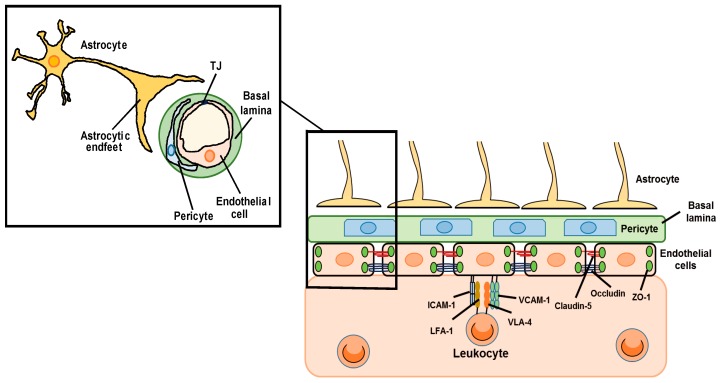
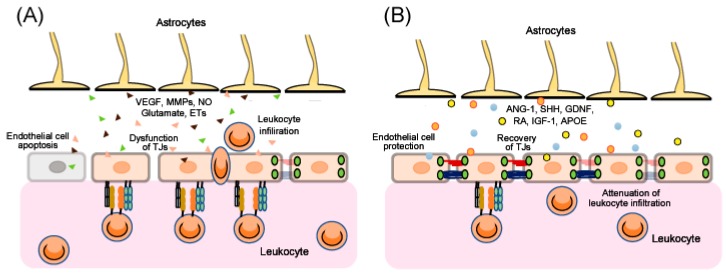
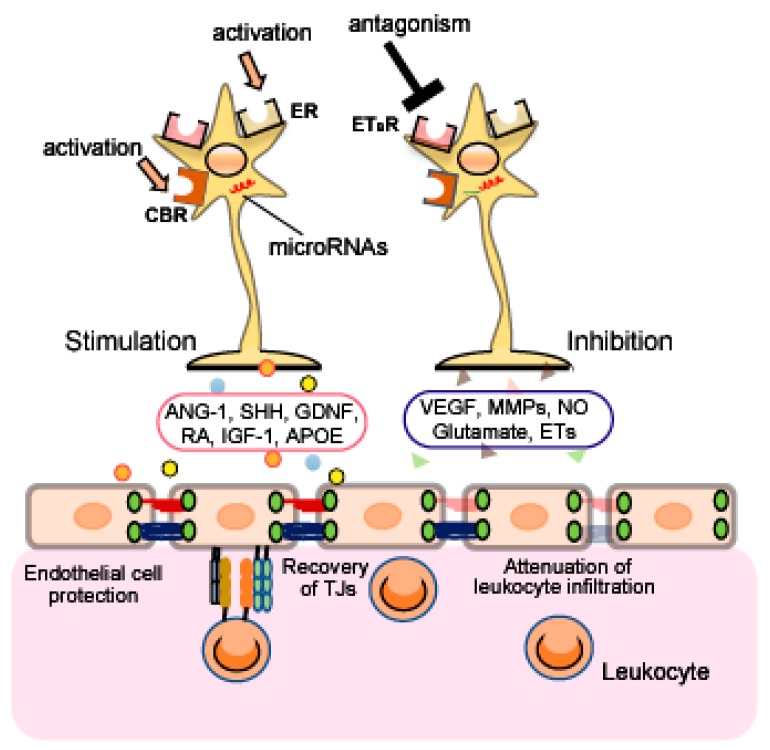
The blood-brain barrier (BBB) is a major functional barrier in the central nervous system (CNS), and inhibits the extravasation of intravascular contents and transports various essential nutrients between the blood and the brain. After brain damage by traumatic brain injury, cerebral ischemia and several other CNS disorders, the functions of the BBB are disrupted, resulting in severe secondary damage including brain edema and inflammatory injury. Therefore, BBB protection and recovery are considered novel therapeutic strategies for reducing brain damage. Emerging evidence suggests key roles of astrocyte-derived factors in BBB disruption and recovery after brain damage. The astrocyte-derived vascular permeability factors include vascular endothelial growth factors, matrix metalloproteinases, nitric oxide, glutamate and endothelin-1, which enhance BBB permeability leading to BBB disruption. By contrast, the astrocyte-derived protective factors include angiopoietin-1, sonic hedgehog, glial-derived neurotrophic factor, retinoic acid and insulin-like growth factor-1 and apolipoprotein E which attenuate BBB permeability resulting in recovery of BBB function. In this review, the roles of these astrocyte-derived factors in BBB function are summarized, and their significance as therapeutic targets for BBB protection and recovery after brain damage are discussed.
Overview
The claims and statistics of this paper haven’t been checked yet.
Run the check — free, no account needed. It reads the open-access text and checks the sources it cites.
Integrity signals
Registry
Cites
Statistics
Figures
Verification
Claims the paper makes
The claims and statistics of this paper haven’t been checked yet.
Run the check — free, no account needed. It reads the open-access text and checks the sources it cites.
Claims other papers make about this one
Each is checked against this paper’s own text: does it say what the citing paper says it does?
The source backs part of the claim, not all of it — or backs it for a different population, condition or comparison.
In the citing paper
“Reactive astrocytes are a major source of various vascular permeability factors [44–47].”
From Chronic stress-induced depression requires the recruitment of peripheral Th17 cells into the brain (2022) · cites this paper as [46]
Experimental — accuracy not yet measured
Self-check
Percentages, sums and reported differences re-computed from the paper’s own numbers.
The self-check needs the paper’s full text.
Citations
Cites
1 retracted
Hou, X., & Pei, F. (2015) · Cell Biochemistry and Biophysics · doi:10.1007/s12013-015-0522-y · Cited by 33
RetractedApolipoprotein E and Alzheimer disease: risk, mechanisms and therapy
Liu, C.-C., Kanekiyo, T., Xu, H., & Bu, G. (2013) · Nature Reviews Neurology · doi:10.1038/nrneurol.2012.263 · Cited by 3,459
Yang, Y., Estrada, E. Y., Thompson, J. F., Liu, W., & Rosenberg, G. A. (2007) · Journal of Cerebral Blood Flow & Metabolism · doi:10.1038/sj.jcbfm.9600375 · Cited by 1,060
Asahi, M., Wang, X., Mori, T., Sumii, T., Jung, J.-C., Moskowitz, M. A., Fini, M. E., & Lo, E. H. (2001) · The Journal of Neuroscience · doi:10.1523/jneurosci.21-19-07724.2001 · Cited by 1,004
The Hedgehog Pathway Promotes Blood-Brain Barrier Integrity and CNS Immune Quiescence
Alvarez, J. I., Dodelet-Devillers, A., Kebir, H., Ifergan, I., Fabre, P. J., Terouz, S., Sabbagh, M., Wosik, K., Bourbonnière, L., Bernard, M., et al. (2011) · Science · doi:10.1126/science.1206936 · Cited by 845
Astrocyte roles in traumatic brain injury
Burda, J. E., Bernstein, A. M., & Sofroniew, M. V. (2015) · Experimental Neurology · doi:10.1016/j.expneurol.2015.03.020 · Cited by 791
Crosstalk of tight junction components with signaling pathways
González-Mariscal, L., Tapia, R., & Chamorro, D. (2008) · Biochimica et Biophysica Acta (BBA) - Biomembranes · doi:10.1016/j.bbamem.2007.08.018 · Cited by 759
Astrocyte-derived VEGF-A drives blood-brain barrier disruption in CNS inflammatory disease
Argaw, A. T., Asp, L., Zhang, J., Navrazhina, K., Pham, T., Mariani, J. N., Mahase, S., Dutta, D. J., Seto, J., Kramer, E. G., et al. (2012) · Journal of Clinical Investigation · doi:10.1172/jci60842 · Cited by 733
VEGF-mediated disruption of endothelial CLN-5 promotes blood-brain barrier breakdown
Argaw, A. T., Gurfein, B. T., Zhang, Y., Zameer, A., & John, G. R. (2009) · Proceedings of the National Academy of Sciences · doi:10.1073/pnas.0808698106 · Cited by 666
Luissint, A.-C., Artus, C., Glacial, F., Ganeshamoorthy, K., & Couraud, P.-O. (2012) · Fluids and Barriers of the CNS · doi:10.1186/2045-8118-9-23 · Cited by 654
Cited by
Sorted by citations
Takata, F., Nakagawa, S., Matsumoto, J., & Dohgu, S. (2021) · Frontiers in Cellular Neuroscience · doi:10.3389/fncel.2021.661838 · Cited by 651
Inoue, Y., Shue, F., Bu, G., & Kanekiyo, T. (2023) · Molecular Neurodegeneration · doi:10.1186/s13024-023-00640-5 · Cited by 380
Mechanisms of Blood–Brain Barrier Dysfunction in Traumatic Brain Injury
Cash, A., & Theus, M. H. (2020) · International Journal of Molecular Sciences · doi:10.3390/ijms21093344 · Cited by 337
Blood-Brain Barrier Overview: Structural and Functional Correlation
Alahmari, A. (2021) · Neural Plasticity · doi:10.1155/2021/6564585 · Cited by 299
Factors influencing the blood-brain barrier permeability
Zhao, Y., Gan, L., Ren, L., Lin, Y., Ma, C., & Lin, X. (2022) · Brain Research · doi:10.1016/j.brainres.2022.147937 · Cited by 291
Metadata
- Authors
- Michinaga, S., & Koyama, Y.
- Affiliations
- Osaka Ohtani University (JP)
- Laboratory of Pharmacology, Kobe Pharmaceutical University, 4-19-1 Motoyama-Kita Higashinada, Kobe 668-8558, Japan
- ORCID
- Michinaga, Shotaro
- Venue
- International Journal of Molecular Sciences
- Publisher
- MDPI AG
- Published
- 2019-01-29
- Volume
- 20
- Issue
- 3
- Pages
- 571
- ISSN
- 1422-0067 (ISSN-L)
- PMC
- PMC6387062
- OpenAlex
- W2912925231
- Cited by
- 263
- References
- 192
- Citations by year
- 2026: 30 · 2025: 21 · 2024: 38 · 2023: 44 · 2022: 43 · 2021: 48 · 2020: 28 · 2019: 11
- FWCI
- 3.38
- Type
- journal article
- Language
- en
- Open access
- gold
- dx.doi.org
- Licence
- Locations
- International Journal of Molecular Sciences (publishedVersion, cc-by)
- Europe PMC (PubMed Central) (publishedVersion, other-oa)
- PubMed Central (publishedVersion, cc-by)
- PubMed (publishedVersion)
- DOAJ (DOAJ: Directory of Open Access Journals) (submittedVersion, cc-by-sa)
- Funders
- Japan Society for the Promotion of Science (16K18890, 18K06695)
- Topics
- Life Sciences › Neuroscience › Neurology › Barrier Structure and Function Studies
- Health Sciences › Medicine › Oncology › Drug Transport and Resistance Mechanisms
- Health Sciences › Medicine › Clinical Neurology › Traumatic Brain Injury and Neurovascular Disturbances
- Keywords
- blood-brain barrier, astrocytes, blood-brain barrier permeability, brain damage, traumatic brain injury, cerebral ischemia, vascular endothelial growth factor, matrix metalloproteinases, nitric oxide, endothelin-1, glutamate, angiopoietin-1, Sonic hedgehog, glial cell line-derived neurotrophic factor, retinoic acid, insulin-like growth factor I, apolipoprotein E, cerebral edema, neuroinflammation
- MeSH terms
- Animals, Astrocytes, Blood-Brain Barrier, Brain Injuries, Humans, Tight Junctions
About these checks
Registry, retraction, Cites and statistics results are computed, not judged, with one exception: a printed reference that no index lists is read once by a model before it counts as a citation error. Claims are extracted by a model and kept only when their quote appears verbatim in the text; each cited source is then checked, with a model’s help, for whether it says what the claim relies on. Those verdicts can be wrong — read the claim’s quote and the cited source before relying on one.
Statistics and arithmetic are recomputed, not judged.
Confidence bands are shown only for fields calibrated on our annotated test set. None is calibrated yet, so no band is shown.
What counts as a claim ›How we measure confidence ›How we check this ›
Are you an author, or do you see a problem with this page? Request a review
