

The DOI matches its Crossref record; 36 of the 36 references it cites were found in a registry or an index.
Cuffless Single-Site Photoplethysmography for Blood Pressure Monitoring
Open accessAbstract
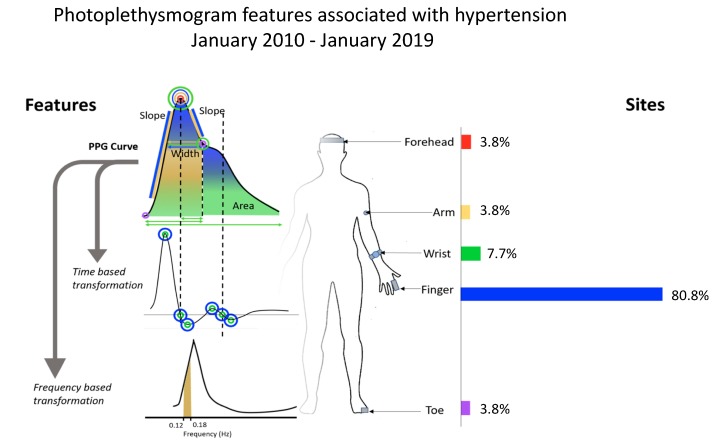
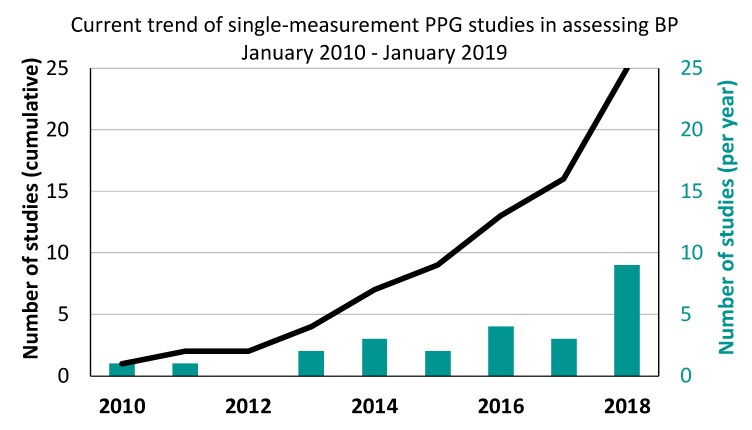
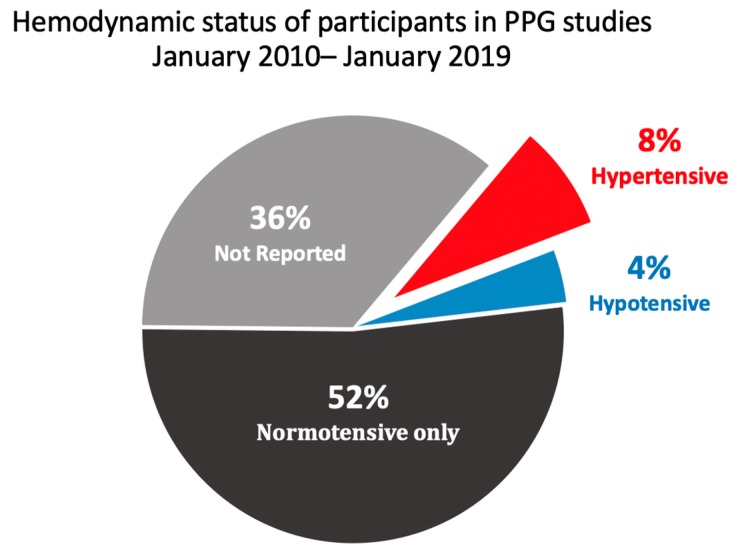
One in three adults worldwide has hypertension, which is associated with significant morbidity and mortality. Consequently, there is a global demand for continuous and non-invasive blood pressure (BP) measurements that are convenient, easy to use, and more accurate than the currently available methods for detecting hypertension. This could easily be achieved through the integration of single-site photoplethysmography (PPG) readings into wearable devices, although improved reliability and an understanding of BP estimation accuracy are essential. This review paper focuses on understanding the features of PPG associated with BP and examines the development of this technology over the 2010–2019 period in terms of validation, sample size, diversity of subjects, and datasets used. Challenges and opportunities to move single-site PPG forward are also discussed.
Overview
The claims and statistics of this paper haven’t been checked yet.
Run the check — free, no account needed. It reads the open-access text and checks the sources it cites.
Integrity signals
Registry
Cites
Statistics
Figures
Verification
Claims the paper makes
The claims and statistics of this paper haven’t been checked yet.
Run the check — free, no account needed. It reads the open-access text and checks the sources it cites.
Claims other papers make about this one
Each is checked against this paper’s own text: does it say what the citing paper says it does?
In the citing paper
“it is less suitable for use in wearable devices due to the need for a cuff”
From Wearable Photoplethysmography for Cardiovascular Monitoring (2022) · cites this paper as [19]
In the citing paper
“Many algorithms are known where systolic and diastolic BP are estimated from the shape of the PPG curve [55,102].”
From The Current State of Optical Sensors in Medical Wearables (2022) · cites this paper as [102]
Self-check
Percentages, sums and reported differences re-computed from the paper’s own numbers.
The self-check needs the paper’s full text.
Citations
Cites
Global burden of hypertension: analysis of worldwide data
Kearney, P. M., Whelton, M., Reynolds, K., Muntner, P., Whelton, P. K., & He, J. (2005) · The Lancet · doi:10.1016/s0140-6736(05)17741-1 · Cited by 8,698
Epidemiology of pre-eclampsia and the other hypertensive disorders of pregnancy
Hutcheon, J. A., Lisonkova, S., & Joseph, K. S. (2011) · Best Practice & Research Clinical Obstetrics & Gynaecology · doi:10.1016/j.bpobgyn.2011.01.006 · Cited by 1,056
The use of photoplethysmography for assessing hypertension
Elgendi, M., Fletcher, R., Liang, Y., Howard, N., Lovell, N. H., Abbott, D., Lim, K., & Ward, R. (2019) · npj Digital Medicine · doi:10.1038/s41746-019-0136-7 · Cited by 625
Self-citationWhite, W. B., Berson, A., Robbins, C., Jamieson, M. J., Prisant, L. M., Roccella, E. J., & Sheps, S. G. (1993) · Hypertension · doi:10.1161/01.hyp.21.4.504 · Cited by 382
Monte-Moreno, E. (2011) · Artificial Intelligence in Medicine · doi:10.1016/j.artmed.2011.05.001 · Cited by 311
An optimal filter for short photoplethysmogram signals
Liang, Y., Elgendi, M., Chen, Z., & Ward, R. (2018) · Scientific Data · doi:10.1038/sdata.2018.76 · Cited by 242
Self-citationSmartphone-Based Blood Pressure Measurement Using Transdermal Optical Imaging Technology
Hong, L., Yang, D., Barszczyk, A., Vempala, N. N., Wei, J., Wu, S. J., Zheng, P. P., Fu, G., Lee, K., & Feng, Z. (2019) · Circulation Cardiovascular Imaging · doi:10.1161/circimaging.119.008857 · Cited by 242
Smartphone-based blood pressure monitoring via the oscillometric finger-pressing method
Chandrasekhar, A., Kim, C., Naji, M. B., Natarajan, K., Hahn, J., & Mukkamala, R. (2018) · Science Translational Medicine · doi:10.1126/scitranslmed.aap8674 · Cited by 208
Ding, X., Zhao, N., Yang, G., Pettigrew, R. I., Lo, B. P. L., Miao, F., Li, Y., Liu, J., & Zhang, Y. (2016) · IEEE Journal of Biomedical and Health Informatics · doi:10.1109/jbhi.2016.2620995 · Cited by 184
Photoplethysmography and Deep Learning: Enhancing Hypertension Risk Stratification
Liang, Y., Chen, Z., Ward, R. K., & Elgendi, M. (2018) · Biosensors · doi:10.3390/bios8040101 · Cited by 176
Self-citation
Research works printed but not linked: 1
- Albert, R., Vogt, W., and Helbig, W. (1973). Photoelectric measurement of blood pressure and flow in the finger. The Digest of 10th Inernational Conference of Medical Biological Engineering, Dresden, GDR, Germany, 13–17 August, 1973, The Conference Committee.
Cited by
Sorted by citations
Thin, soft, wearable system for continuous wireless monitoring of artery blood pressure
Li, J., Jia, H., Zhou, J., Huang, X., Xu, L., Jia, S., Gao, Z., Yao, K., Li, D., Zhang, B., et al. (2023) · Nature Communications · doi:10.1038/s41467-023-40763-3 · Cited by 321
Wearable Photoplethysmography for Cardiovascular Monitoring
Charlton, P. H., Kyriacou, P. A., Mant, J., Marozas, V., Chowienczyk, P., & Alastruey, J. (2022) · Proceedings of the IEEE · doi:10.1109/jproc.2022.3149785 · Cited by 250
Self-citationStergiou, G. S., Mukkamala, R., Avolio, A. P., Kyriakoulis, K. G., Mieke, S., Murray, A., Parati, G., Schutte, A. E., Sharman, J. E., Asmar, R. G., et al. (2022) · Journal of Hypertension · doi:10.1097/hjh.0000000000003224 · Cited by 231
Multi-Task Temporal Shift Attention Networks for On-Device Contactless Vitals MeasurementPreprint
Liu, X., Fromm, J., Patel, S., & McDuff, D. (2020) · arXiv (Cornell University) · doi:10.48550/arxiv.2006.03790 · Cited by 235
Evaluation of the Accuracy of Cuffless Blood Pressure Measurement Devices: Challenges and Proposals
Mukkamala, R., Yavarimanesh, M., Natarajan, K., Hahn, J.-O., Kyriakoulis, K. G., Avolio, A. P., & Stergiou, G. S. (2021) · Hypertension · doi:10.1161/hypertensionaha.121.17747 · Cited by 211
Transducer Technologies for Biosensors and Their Wearable Applications
Polat, E. O., Çetin, M. M., Tabak, A. F., Güven, E. B., Uysal, B. Ö., Arsan, T., Kabbani, A., Hamed, H., & GÜL, S. B. (2022) · Biosensors · doi:10.3390/bios12060385 · Cited by 215
The 2023 wearable photoplethysmography roadmap
Charlton, P. H., Allen, J., Bailón, R., Baker, S., Behar, J. A., Chen, F., Clifford, G. D., Clifton, D. A., Davies, H. J., Ding, C., et al. (2023) · Physiological Measurement · doi:10.1088/1361-6579/acead2 · Cited by 233
Self-citationDiagnostic Features and Potential Applications of PPG Signal in Healthcare: A Systematic Review
Almarshad, M. A., Islam, M. S., Al-Ahmadi, S. A., & BaHammam, A. S. (2022) · Healthcare · doi:10.3390/healthcare10030547 · Cited by 215
Cuffless Blood Pressure Measurement
Mukkamala, R., Stergiou, G. S., & Avolio, A. P. (2022) · Annual Review of Biomedical Engineering · doi:10.1146/annurev-bioeng-110220-014644 · Cited by 180
Charlton, P. H., Paliakaitė, B., Pilt, K., Bachler, M., Zanelli, S., Kulin, D., Allen, J., Hallab, M., Bianchini, E., Mayer, C. C., et al. (2021) · American Journal of Physiology-Heart and Circulatory Physiology · doi:10.1152/ajpheart.00392.2021 · Cited by 166
Self-citationPhotoplethysmography signal processing and synthesis
Mejía-Mejía, E., Allen, J., Budidha, K., El-Hajj, C., Kyriacou, P. A., & Charlton, P. H. (2022) · Photoplethysmography · doi:10.1016/b978-0-12-823374-0.00015-3 · Cited by 138
Self-citationWearable Photoplethysmography for Cardiovascular Monitoring.
Charlton, P. H., Kyriacou, P. A., Mant, J., Marozas, V., Chowienczyk, P., & Alastruey, J. (2022) · KTUePubl (Repository of Kaunas University of Technology) · doi:10.17863/cam.81148 · Cited by 113
Self-citationAguirre, N. A., Grall‐Maës, E., Cymberknop, L. J., & Armentano, R. L. (2021) · Sensors · doi:10.3390/s21062167 · Cited by 115
A review of IoT systems to enable independence for the elderly and disabled individuals
Pérez, A. J., Siddiqui, F. A., Zeadally, S., & Lane, D. R. (2022) · Internet of Things · doi:10.1016/j.iot.2022.100653 · Cited by 107
The Current State of Optical Sensors in Medical Wearables
Vavrinsky, E., Esfahani, N. E., Hausner, M., Kuzma, A., Rezo, V., Donoval, M., & Kosnacova, H. (2022) · Biosensors · doi:10.3390/bios12040217 · Cited by 103
“Many algorithms are known where systolic and diastolic BP are estimated from the shape of the PPG curve [55,102].”
BackgroundDeep learning models for the prediction of intraoperative hypotension
Lee, S., Lee, H., Chu, Y., Song, S. W., Ahn, G. J., Lee, H., Yang, S., & Koh, S. B. (2021) · British Journal of Anaesthesia · doi:10.1016/j.bja.2020.12.035 · Cited by 101
A Comparison of Deep Learning Techniques for Arterial Blood Pressure Prediction
Paviglianiti, A., Randazzo, V., Villata, S., Cirrincione, G., & Pasero, E. G. A. (2021) · Cognitive Computation · doi:10.1007/s12559-021-09910-0 · Cited by 84
Continuous Non-Invasive Blood Pressure Monitoring: A Methodological Review on Measurement Techniques
Le, T., Ellington, F., Lee, T.-Y., Vo, K., Khine, M., Krishnan, S. K., Dutt, N. D., & Cao, H. (2020) · IEEE Access · doi:10.1109/access.2020.3040257 · Cited by 84
Finnegan, E., Davidson, S. M., Harford, M., Watkinson, P., Tarassenko, L., & Villarroel, M. (2023) · Scientific Reports · doi:10.1038/s41598-022-27170-2 · Cited by 87
Jin, H., Zheng, Z., Cui, Z., Jiang, Y., Chen, G., Li, W., Wang, Z., Wang, J., Yang, C., Song, W., et al. (2023) · Nature Communications · doi:10.1038/s41467-023-40181-5 · Cited by 81
Synthetic photoplethysmogram generation using two Gaussian functions
Tang, Q., Chen, Z., Ward, R., & Elgendi, M. (2020) · Scientific Reports · doi:10.1038/s41598-020-69076-x · Cited by 62
Self-citationeHealth: A Survey of Architectures, Developments in mHealth, Security Concerns and Solutions
Alenoghena, C. O., Onumanyi, A. J., Ohize, H. O., Adejo, A. O., Oligbi, M., Ali, S. I., & Okoh, S. A. (2022) · International Journal of Environmental Research and Public Health · doi:10.3390/ijerph192013071 · Cited by 66
Trends and Challenges of Wearable Multimodal Technologies for Stroke Risk Prediction
Chen, Y.-H., & Sawan, M. (2021) · Sensors · doi:10.3390/s21020460 · Cited by 55
Blood pressure measurement using only a smartphone
Frey, L., Menon, C., & Elgendi, M. (2022) · npj Digital Medicine · doi:10.1038/s41746-022-00629-2 · Cited by 55
Self-citationMultimodal Photoplethysmography-Based Approaches for Improved Detection of Hypertension
Welykholowa, K., Hosanee, M., Chan, G., Cooper, R. E., Kyriacou, P. A., Zheng, D., Allen, J., Abbott, D., Menon, C., Lovell, N. H., et al. (2020) · Journal of Clinical Medicine · doi:10.3390/jcm9041203 · Cited by 51
Self-citationDeep convolutional neural network-based signal quality assessment for photoplethysmogram
Shin, H. (2022) · Computers in Biology and Medicine · doi:10.1016/j.compbiomed.2022.105430 · Cited by 42
Byfield, R., Miller, M., Miles, J., Guidoboni, G., & Lin, J. (2021) · IEEE Sensors Journal · doi:10.1109/jsen.2021.3134890 · Cited by 40
Qin, K., Huang, W. X., Zhang, T., & Tang, S. (2022) · Artificial Intelligence Review · doi:10.1007/s10462-022-10353-8 · Cited by 42
Recommendations for evaluating photoplethysmography-based algorithms for blood pressure assessment
Elgendi, M., Haugg, F., Fletcher, R., Allen, J., Shin, H., Alian, A. A., & Menon, C. (2024) · Communications Medicine · doi:10.1038/s43856-024-00555-2 · Cited by 40
Self-citationBlood Pressure Measurement: From Cuff-Based to Contactless Monitoring
Man, P.-K., Cheung, K.-L., Sangsiri, N., Shek, W., Wong, K. L., Chin, J. W., Chan, T. T., & So, R. H. Y. (2022) · Healthcare · doi:10.3390/healthcare10102113 · Cited by 40
Mamun, M. M. R. K., & Sherif, A. (2022) · Bioengineering · doi:10.3390/bioengineering10010027 · Cited by 41
Blood pressure stratification using photoplethysmography and light gradient boosting machine
Hu, X., Yin, S., Zhang, X., Menon, C., Fang, C., Chen, Z., Elgendi, M., & Liang, Y. (2023) · Frontiers in Physiology · doi:10.3389/fphys.2023.1072273 · Cited by 38
Self-citationTechnologies for non-invasive physiological sensing: Status, challenges, and future horizons
Yu, Y., Jain, B., Anand, G., Heidarian, M., Lowe, A., & Kalra, A. M. (2023) · Biosensors and Bioelectronics X · doi:10.1016/j.biosx.2023.100420 · Cited by 38
Mejía‐Mejía, E., May, J. M., Elgendi, M., & Kyriacou, P. A. (2021) · Computer Methods and Programs in Biomedicine · doi:10.1016/j.cmpb.2021.106222 · Cited by 36
Self-citationKim, J., Chang, S., & Park, S. W. (2023) · Journal of Korean Medical Science · doi:10.3346/jkms.2024.39.e18 · Cited by 34
Assessment of Hypertension Using Clinical Electrocardiogram Features: A First-Ever Review
Bird, K., Chan, G., Lu, H. Y., Greeff, H., Allen, J., Abbott, D., Menon, C., Lovell, N. H., Howard, N., Chan, W., et al. (2020) · Frontiers in Medicine · doi:10.3389/fmed.2020.583331 · Cited by 32
Self-citationApplication of Modern Multi-Sensor Holter in Diagnosis and Treatment
Vavrinský, E., Subjak, J., Donoval, M., Wagner, A., Zavodnik, T., & Svobodová, H. (2020) · Sensors · doi:10.3390/s20092663 · Cited by 35
The Concept of Advanced Multi-Sensor Monitoring of Human Stress
Vavrinský, E., Stopjaková, V., Kopáni, M., & Kosnacova, H. (2021) · Sensors · doi:10.3390/s21103499 · Cited by 35
Robust Reconstruction of Electrocardiogram Using Photoplethysmography: A Subject-Based Model
Tang, Q., Chen, Z., Guo, Y., Liang, Y., Ward, R. K., Menon, C., & Elgendi, M. (2022) · Frontiers in Physiology · doi:10.3389/fphys.2022.859763 · Cited by 31
Self-citationRachim, V. P., Kang, S., Baek, J., & Park, S. (2021) · IEEE Sensors Journal · doi:10.1109/jsen.2021.3059864 · Cited by 27
Wearables in Cardiovascular Disease
Kumar, S., Victoria‐Castro, A. M., Melchinger, H. C., O’Connor, K. D., Psotka, M. A., Desai, N. R., Ahmad, T., & Wilson, F. P. (2022) · Journal of Cardiovascular Translational Research · doi:10.1007/s12265-022-10314-0 · Cited by 27
Cuffless Blood Pressure Estimation Using Dual Physiological Signal and Its Morphological Features
Wang, L.-H., Sun, K.-K., Xie, C.-X., Fan, M.-H., Abu, P. A. R., & Huang, P.-C. (2023) · IEEE Sensors Journal · doi:10.1109/jsen.2023.3267695 · Cited by 26
Speth, J., Vance, N., Sporrer, B., Niu, L., Flynn, P. J., & Czajka, A. (2024) · IEEE Transactions on Instrumentation and Measurement · doi:10.1109/tim.2024.3476556 · Cited by 25
Remote Estimation of Blood Pressure Using Millimeter-Wave Frequency-Modulated Continuous-Wave Radar
Singh, L., You, S., Jeong, B. J., Koo, C., & Kim, Y. (2023) · Sensors · doi:10.3390/s23146517 · Cited by 24
Machine Learning-Based Wearable Devices for Smart Healthcare Application With Risk Factor Monitoring
Alex, S. A., Ponkamali, S., Andrew, T. R., Jhanjhi, N. Z., & Tayyab, M. A. (2022) · Advances in logistics, operations, and management science book series · doi:10.4018/978-1-7998-9201-4.ch009 · Cited by 23
Tang, Q., Chen, Z., Ward, R. K., Menon, C., & Elgendi, M. (2023) · Bioengineering · doi:10.3390/bioengineering10060630 · Cited by 26
Self-citationHawthorne, G., Richardson, M., Greening, N. J., Esliger, D., Briggs‐Price, S., Chaplin, E., Clinch, L., STEINER, M. C., Singh, S. J., & Orme, M. W. (2022) · Respiratory Research · doi:10.1186/s12931-022-02018-5 · Cited by 19
Photoplethysmography in noninvasive blood pressure monitoring
Mukkamala, R., Hahn, J., & Chandrasekhar, A. (2021) · Elsevier eBooks · doi:10.1016/b978-0-12-823374-0.00010-4 · Cited by 21
Haugg, F., Elgendi, M., & Menon, C. (2022) · Frontiers in Cardiovascular Medicine · doi:10.3389/fcvm.2022.894224 · Cited by 23
Self-citationMejía‐Mejía, E., Budidha, K., Kyriacou, P. A., & Mamouei, M. (2022) · Biomedical Signal Processing and Control · doi:10.1016/j.bspc.2022.103968 · Cited by 22
Self-citationSarkar, S., Ghosh, A., & Kalra, J. (2023) · Computers in Biology and Medicine · doi:10.1016/j.compbiomed.2023.107558 · Cited by 21
Noninvasive Continuous Blood Pressure Measurement with Wearable Millimeter Wave Device
Liao, C., Shay, O., Gomes, E., & Bikhchandani, N. (2021) · Wearable and Implantable Body Sensor Networks · doi:10.1109/bsn51625.2021.9507020 · Cited by 19
iPhone App compared with standard blood pressure measurement –The iPARR trial
Dörr, M., Weber, S., Birkemeyer, R., Leonardi, L., Winterhalder, C., Raichle, C. J., Brasier, N., Burkard, T., & Eckstein, J. (2020) · American Heart Journal · doi:10.1016/j.ahj.2020.12.003 · Cited by 18
Odette, O. (2024) · Wiley eBooks · doi:10.1002/9781119830306.ch12 · Cited by 18
Blood pressure assessment with in-ear photoplethysmography
Xing, X., Ma, Z., Xu, S., Zhang, M., Zhao, W., Song, M., & Dong, W. (2021) · Physiological Measurement · doi:10.1088/1361-6579/ac2a71 · Cited by 16
Wong, M. K. F., Hei, H., Lim, S. Z., & Ng, E. Y. K. (2022) · Mathematical Biosciences & Engineering · doi:10.3934/mbe.2023045 · Cited by 18
Han, X., Yang, X., Fang, S., Song, R., Li, L., & Zhang, J. (2023) · IEEE Transactions on Instrumentation and Measurement · doi:10.1109/tim.2023.3279448 · Cited by 16
Wearable Blood Pressure Monitoring Devices: Understanding Heterogeneity in Design and Evaluation
Cheung, M. Y., Sabharwal, A., Coté, G. L., & Veeraraghavan, A. (2024) · IEEE Transactions on Biomedical Engineering · doi:10.1109/tbme.2024.3434344 · Cited by 23
Insights into vascular physiology from sleep photoplethysmography
Yılmaz, G., Ong, J. L., Ling, L. H., & Chee, M. W. L. (2023) · SLEEP · doi:10.1093/sleep/zsad172 · Cited by 18
A Novel Cuffless Blood Pressure Prediction: Uncovering New Features and New Hybrid ML Models
Nour, M., Polat, K., Şentürk, Ü., & Arıcan, M. (2023) · Diagnostics · doi:10.3390/diagnostics13071278 · Cited by 15
Jiang, N., Chen, G., Zhou, F., Ma, B., Zhao, C., & Liu, H. (2024) · Journal of Materials Chemistry C · doi:10.1039/d4tc02494j · Cited by 15
Bapir, M., Campagnolo, P., Rodriguez‐Mateos, A., Skene, S. S., & Heiß, C. (2022) · Frontiers in Nutrition · doi:10.3389/fnut.2022.886597 · Cited by 13
Liang, C., Zhou, J., Qiu, S., Zhao, L., Mao, X., Yang, X., Zhang, Y., & Zhao, N. (2025) · Nature Communications · doi:10.1038/s41467-025-67118-4 · Cited by 17
Blood Pressure Estimation Based on Photoplethysmography for Personalized Healthcare
Chakraborty, A., Goswami, D., Mukhopadhyay, J., & Chakrabarti, S. (2023) · IEEE Transactions on Consumer Electronics · doi:10.1109/tce.2023.3316514 · Cited by 14
Garrett, A., Kim, B., Gurel, N. Z., Sie, E. J., Wilson, B. K., Marsili, F., Forman, J. P., Hamburg, N. M., Boas, D. A., & Roblyer, D. M. (2025) · Biomedical Optics Express · doi:10.1364/boe.560022 · Cited by 12
Blood Pressure Estimation Based on Photoplethysmography: Finger Versus Wrist
Paliakaite, B., Charlton, P. H., Rapalis, A., Plusciauskaite, V., Piartli, P., Kaniusas, E., & Marozas, V. (2021) · 2021 Computing in Cardiology (CinC) · doi:10.23919/cinc53138.2021.9662716 · Cited by 11
Cuffless Blood Pressure Estimation Using Cardiovascular Dynamics
Samimi, H., & Dajani, H. R. (2022) · International Conference on Electrical, Computer and Energy Technologies (ICECET) · doi:10.1109/icecet55527.2022.9872800 · Cited by 11
Machine Learning-Based VO2 Estimation Using a Wearable Multiwavelength Photoplethysmography Device
Hsiao, C., Tong, C. W.-C., & Coté, G. L. (2025) · Biosensors · doi:10.3390/bios15040208 · Cited by 14
Digital health—high tech or high touch?
Gangl, C., & Krychtiuk, K. A. (2023) · Wiener Medizinische Wochenschrift · doi:10.1007/s10354-022-00991-6 · Cited by 10
Chen, C., Zhao, H. Y., Zheng, S. H., Ramachandra, R. A., He, X., Zhang, Y. H., & Sudarshan, V. K. (2023) · Computer Methods and Programs in Biomedicine Update · doi:10.1016/j.cmpbup.2023.100097 · Cited by 10
Awelisah, Y. M., Li, G., Ijaz, M., & Lin, L. (2020) · Optics & Laser Technology · doi:10.1016/j.optlastec.2020.106515 · Cited by 10
Wearable photoplethysmography devices
Charlton, P. H., & Marozas, V. (2021) · Elsevier eBooks · doi:10.1016/b978-0-12-823374-0.00011-6 · Cited by 10
Temporal complexity in photoplethysmography and its influence on blood pressure
Xing, X., Huang, R., Hao, L., Jiang, C., & Dong, W. (2023) · Frontiers in Physiology · doi:10.3389/fphys.2023.1187561 · Cited by 10
Frequency Domain Deep Learning With Non-Invasive Features for Intraoperative Hypotension Prediction
Moon, J.-H., Lee, G., Lee, S. M., Ryu, J., Kim, D., & Sohn, K.-A. (2024) · IEEE Journal of Biomedical and Health Informatics · doi:10.1109/jbhi.2024.3403109 · Cited by 9
An ultralow power wearable vital sign sensor using an electromagnetically reactive near field
Seo, S., Jo, H., Kim, J., Lee, B., & Bien, F. D. (2023) · Bioengineering & Translational Medicine · doi:10.1002/btm2.10502 · Cited by 8
Intra-beat biomarker for accurate continuous non-invasive blood pressure monitoring
Abiri, A., Chou, E., Qian, C., Rinehart, J. B., & Khine, M. (2022) · Scientific Reports · doi:10.1038/s41598-022-19096-6 · Cited by 10
Kanoga, S., Hoshino, T., Kamei, S., Kobayashi, T., Ohmori, T., Uchiyama, M., & Tada, M. (2022) · Biomedical Signal Processing and Control · doi:10.1016/j.bspc.2023.105029 · Cited by 9
Sheng‐Kai, K., Hao, H., Huang, H.-C., & Tang, Y.-H. (2021) · International Congress on Image and Signal Processing (CISP) · doi:10.1109/cisp-bmei53629.2021.9624370 · Cited by 9
Jeong, H., Kim, D.-H., Kim, D. W., Baek, S., Lee, H., Kim, Y., & Ahn, H. J. (2024) · Journal of Clinical Monitoring and Computing · doi:10.1007/s10877-024-01206-6 · Cited by 8
Hove, C., Sæter, F. W., Stepanov, A., Bøtker-Rasmussen, K. G., Seeberg, T. M., Westgaard, E., Heimark, S., Waldum-Grevbo, B. E., Hisdal, J., & Larstorp, A. C. K. (2024) · Frontiers in Medical Technology · doi:10.3389/fmedt.2024.1464473 · Cited by 8
Photoplethysmography-based cuffless blood pressure estimation: an image encoding and fusion approach
Liu, Y., Yu, J., & Mou, H. (2023) · Physiological Measurement · doi:10.1088/1361-6579/ad0426 · Cited by 8
Evaluation of PPG Feature Values Toward Biometric Authentication Against Presentation Attacks
Hinatsu, S., Suzuki, D., Ishizuka, H., Ikeda, S., & Oshiro, O. (2022) · IEEE Access · doi:10.1109/access.2022.3167667 · Cited by 8
Schukraft, S., Haddad, S., Faucherre, Y., Arroyo, D., Togni, M., Barison, A., Boukhayma, A., Cook, S., & Caizzone, A. (2022) · Blood Pressure Monitoring · doi:10.1097/mbp.0000000000000615 · Cited by 8
Eid, A.-M., Elgamal, M. H., Fiol, A. G., Shelley, K. H., Wu, H., & Alian, A. A. (2023) · Physiological Measurement · doi:10.1088/1361-6579/acd165 · Cited by 8
Xing, X., Dong, W., Xiao, R., Song, M., & Jiang, C. (2023) · Entropy · doi:10.3390/e25121582 · Cited by 7
Device design and data processing strategies for self-powered cardiovascular sensors
Lin, Z., Zou, M., Lu, Y., Deng, Y., Nie, S., Yang, J., & Guo, H. (2025) · Device · doi:10.1016/j.device.2025.100726 · Cited by 7
Piezoelectric Nanofibers for Noninvasive Wearable Blood Pressure Monitoring
Closson, A. B., Xu, Z. Y., Bargamian, J., Bryan, A. C., Abess, A., & Zhang, J. X. J. (2024) · ACS Applied Electronic Materials · doi:10.1021/acsaelm.4c00840 · Cited by 6
Temperature-less-sensitive trans-impedance amplifier with background light cancellation loop
Tantawy, A. G., Wahba, A., Hamed, H. F. A., & Mohamed, A. R. (2024) · AEU - International Journal of Electronics and Communications · doi:10.1016/j.aeue.2024.155625 · Cited by 6
MAHAJAN, P., & KAUL, A. (2025) · TURKISH JOURNAL OF ELECTRICAL ENGINEERING & COMPUTER SCIENCES · doi:10.55730/1300-0632.4127 · Cited by 6
Atef, M., Hassan, O., Awwad, F. R., & Khan, M. A. (2021) · Electronics · doi:10.3390/electronics10222769 · Cited by 6
Sharma, S., Pradhan, G. B., Lim, S., Sapkota, S., Lee, Y., & Park, J. Y. (2025) · Advanced Functional Materials · doi:10.1002/adfm.202516764 · Cited by 5
Cuff-less blood pressure estimation using wrist photoplethysmography
Pediaditis, M., Spanakis, E., Zacharakis, G., & Sakkalis, V. (2021) · Annual International Conference of the IEEE Engineering in Medicine and Biology Society (EMBC) · doi:10.1109/embc46164.2021.9629544 · Cited by 5
Cuffless Blood Pressure Monitoring Devices: Technical Foundations and Clinical Implications
Parati, G., Ochoa, J. E., Abreu, A. B. A., Brouwers, S., Bruno, R. M., Caiani, E. G., Casado-Arroyo, R., Cluitmans, M. J. M., Davos, C. H., LUCIA, R. D., et al. (2026) · European Journal of Preventive Cardiology · doi:10.1093/eurjpc/zwag058 · Cited by 5
Camera-based blood pressure monitoring
Natarajan, K., Yavarimanesh, M., Wang, W., & Mukkamala, R. (2021) · Elsevier eBooks · doi:10.1016/b978-0-12-822281-2.00014-7 · Cited by 4
Balaraman, K., & Claret, S. P. A. (2023) · International Conference on Circuit, Power and Computing Technologies · doi:10.1109/iccpct58313.2023.10245666 · Cited by 4
Relatability of Blood Pressure Monitoring With Wearable Cuffless Devices
Chrysant, S. G. (2022) · The American Journal of Cardiology · doi:10.1016/j.amjcard.2021.12.028 · Cited by 4
Design and Implementation of Low-Cost Blood grouping Prediction Using Machine Learning
Vijayarani, R., & Anbarasi, S. (2023) · International Conference on System, Computation, Automation and Networking (ICSCAN) · doi:10.1109/icscan58655.2023.10395238 · Cited by 3
Scandelli, A., Lombardi, C., Castiglioni, P., Merati, G., Villa, F., & Faini, A. (2024) · IEEE Sensors Journal · doi:10.1109/jsen.2024.3486565 · Cited by 3
Chen, C., Zhao, H. Y., Zheng, S. H., Ramachandra, R. A., He, X., Zhang, Y. H., & Sudarshan, V. K. (2022) · SSRN Electronic Journal · doi:10.2139/ssrn.4132904 · Cited by 3
Cuffless BP Measurement Using Single Site Photoplethysmography
Maharajan, R. (2023) · International Conference on Bio Signals, Images, and Instrumentation (ICBSII) · doi:10.1109/icbsii58188.2023.10181082 · Cited by 2
Metadata
- Authors
- Hosanee, M., Chan, G., Welykholowa, K., Cooper, R., Kyriacou, P. A., Zheng, D., Allen, J., Abbott, D., Menon, C., Lovell, N. H., Howard, N., Chan, W.-S., Lim, K., Fletcher, R., Ward, R., & Elgendi, M.
- Affiliations
- University of British Columbia (CA)
- City, University of London (GB)
- Coventry University (GB)
- Freeman Hospital (GB)
- The University of Adelaide (AU)
- Simon Fraser University (CA)
- UNSW Sydney (AU)
- University of Oxford (GB)
- University of Massachusetts Chan Medical School (US)
- Corresponding author
- Elgendi, Mohamed
- ORCID
- Venue
- Journal of Clinical Medicine
- Publisher
- MDPI AG
- Published
- 2020-03-07
- Volume
- 9
- Issue
- 3
- Pages
- 723
- ISSN
- 2077-0383 (ISSN-L)
- PMC
- PMC7141397
- OpenAlex
- W3009202705
- Cited by
- 136
- References
- 36
- Citations by year
- 2026: 10 · 2025: 8 · 2024: 17 · 2023: 36 · 2022: 35 · 2021: 22 · 2020: 8
- FWCI
- 2.11
- Type
- journal article
- Language
- en
- Open access
- gold
- dx.doi.org
- Licence
- Locations
- Journal of Clinical Medicine (publishedVersion, cc-by)
- PubMed Central (publishedVersion, cc-by)
- PubMed (publishedVersion)
- Pure (Coventry University) (acceptedVersion, cc-by)
- City Research Online (City University London) (acceptedVersion)
- DSpace@MIT (Massachusetts Institute of Technology) (submittedVersion, cc-by)
- eScholarship@UMassChan (submittedVersion, cc-by)
- Summit (Simon Fraser University) (submittedVersion)
- cIRcle (University of British Columbia) (submittedVersion, cc-by)
- Adelaide Research & Scholarship (AR&S) (University of Adelaide) (submittedVersion, cc-by)
- DOAJ (DOAJ: Directory of Open Access Journals) (submittedVersion, cc-by-sa)
- Summit (Simon Fraser University) (submittedVersion, cc-by)
- UNSWorks (UNSW Sydney) (submittedVersion, cc-by)
- Open Collections
- Funders
- Canada Research Chair (CRC)
- Natural Sciences and Engineering Research Council of Canada (RGPIN-2014-04462)
- Topics
- Physical Sciences › Engineering › Biomedical Engineering › Non-Invasive Vital Sign Monitoring
- Health Sciences › Medicine › Cardiology and Cardiovascular Medicine › Cardiovascular Health and Disease Prevention
- Health Sciences › Medicine › Surgery › Hemodynamic Monitoring and Therapy
- Keywords
- cuffless blood pressure measurement, non-invasive blood pressure estimation, hypertension detection, wearable devices
About these checks
Registry, retraction, Cites and statistics results are computed, not judged, with one exception: a printed reference that no index lists is read once by a model before it counts as a citation error. Claims are extracted by a model and kept only when their quote appears verbatim in the text; each cited source is then checked, with a model’s help, for whether it says what the claim relies on. Those verdicts can be wrong — read the claim’s quote and the cited source before relying on one.
Statistics and arithmetic are recomputed, not judged.
Confidence bands are shown only for fields calibrated on our annotated test set. None is calibrated yet, so no band is shown.
What counts as a claim ›How we measure confidence ›How we check this ›
Are you an author, or do you see a problem with this page? Request a review
