

The DOI matches its Crossref record; 175 of the 176 references it cites were found in a registry or an index, and 1 are not checked yet.
Candida albicans—The Virulence Factors and Clinical Manifestations of Infection
Open accessAbstract
Candida albicans is a common commensal fungus that colonizes the oropharyngeal cavity, gastrointestinal and vaginal tract, and healthy individuals’ skin. In 50% of the population, C. albicans is part of the normal flora of the microbiota. The various clinical manifestations of Candida species range from localized, superficial mucocutaneous disorders to invasive diseases that involve multiple organ systems and are life-threatening. From systemic and local to hereditary and environmental, diverse factors lead to disturbances in Candida’s normal homeostasis, resulting in a transition from normal flora to pathogenic and opportunistic infections. The transition in the pathophysiology of the onset and progression of infection is also influenced by Candida’s virulence traits that lead to the development of candidiasis. Oral candidiasis has a wide range of clinical manifestations, divided into primary and secondary candidiasis. The main supply of C. albicans in the body is located in the gastrointestinal tract, and the development of infections occurs due to dysbiosis of the residential microbiota, immune dysfunction, and damage to the muco-intestinal barrier. The presence of C. albicans in the blood is associated with candidemia–invasive Candida infections. The commensal relationship exists as long as there is a balance between the host immune system and the virulence factors of C. albicans. This paper presents the virulence traits of Candida albicans and clinical manifestations of specific candidiasis.
Overview
The claims and statistics of this paper haven’t been checked yet.
Run the check — free, no account needed. It reads the open-access text and checks the sources it cites.
Integrity signals
Registry
Cites
Statistics
Figures
Verification
Claims the paper makes
The claims and statistics of this paper haven’t been checked yet.
Run the check — free, no account needed. It reads the open-access text and checks the sources it cites.
Claims other papers make about this one
Each is checked against this paper’s own text: does it say what the citing paper says it does?
The source backs part of the claim, not all of it — or backs it for a different population, condition or comparison.
In the citing paper
“The infection advance of C. albicans to the host is determined by the joint action of growth ability and virulence factors [56], but not all factors play an equally important role in the pathogenic process.”
From The F 1 F o -ATP synthase α subunit of Candida albicans induces inflammatory responses by controlling amino acid catabolism (2023) · cites this paper as [56]
Experimental — accuracy not yet measured
Self-check
Percentages, sums and reported differences re-computed from the paper’s own numbers.
The self-check needs the paper’s full text.
Citations
Cites
Changes of Intestinal Functions in Liver Cirrhosis
Fukui, H., & Wiest, R. (2016) · Inflammatory Intestinal Diseases · doi:10.1159/000444436 · Cited by 6,820
Pappas, P. G., Kauffman, C. A., Andes, D. R., Clancy, C. J., Marr, K. A., Ostrosky-Zeichner, L., Reboli, A. C., Schuster, M. G., Vazquez, J. A., Walsh, T. J., et al. (2016) · Clinical Infectious Diseases · doi:10.1093/cid/civ933 · Cited by 4,200
Gut microbiota in health and disease
Sekirov, I., Russell, S. L., Antunes, L. C. M., & Finlay, B. B. (2010) · Physiological Reviews · doi:10.1152/physrev.00045.2009 · Cited by 4,182
Patterson, T. F., Thompson, G. R., Denning, D. W., Fishman, J. A., Hadley, S., Herbrecht, R., Kontoyiannis, D. P., Marr, K. A., Morrison, V. A., Nguyen, M. H., et al. (2016) · Clinical Infectious Diseases · doi:10.1093/cid/ciw326 · Cited by 2,926
The Long-Term Stability of the Human Gut Microbiota
Faith, J. J., Guruge, J. L., Charbonneau, M., Subramanian, S., Seedorf, H., Goodman, A. L., Clemente, J. C., Knight, R., Heath, A. C., Leibel, R. L., et al. (2013) · Science · doi:10.1126/science.1237439 · Cited by 2,058
Candida albicans pathogenicity mechanisms
Mayer, F. L., Wilson, D., & Hube, B. (2013) · Virulence · doi:10.4161/viru.22913 · Cited by 1,848 · cited 1×
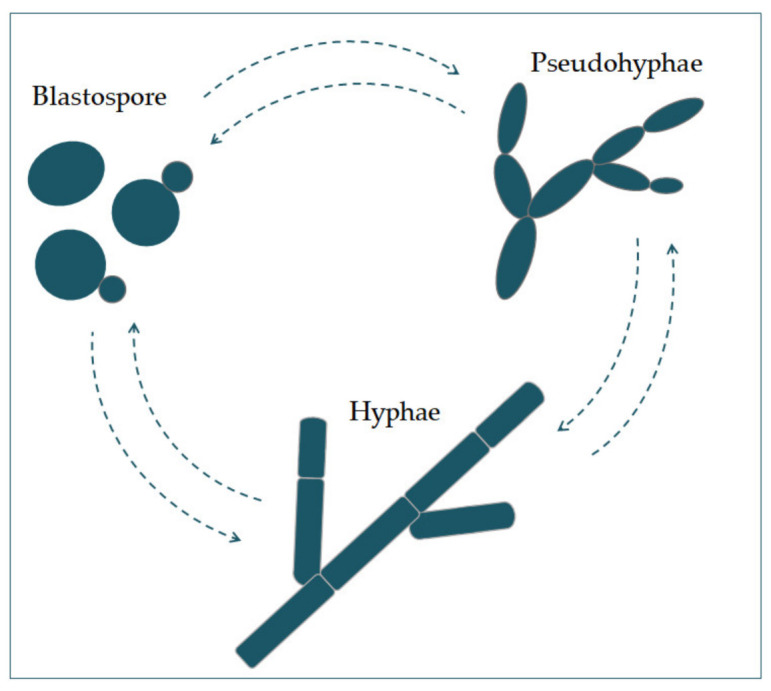
“The transition from yeast to the hyphal form is a transition into a pathogenic form [22,23].”
BackgroundPappas, P. G., Lionakis, M. S., Arendrup, M. C., Ostrosky-Zeichner, L., & Kullberg, B. J. (2018) · Nature Reviews Disease Primers · doi:10.1038/nrdp.2018.26 · Cited by 1,636
Biofilm Matrixome: Extracellular Components in Structured Microbial Communities
Karygianni, L., Ren, Z. F., Koo, H., & Thurnheer, T. (2020) · Trends in Microbiology · doi:10.1016/j.tim.2020.03.016 · Cited by 1,563 · cited 1×
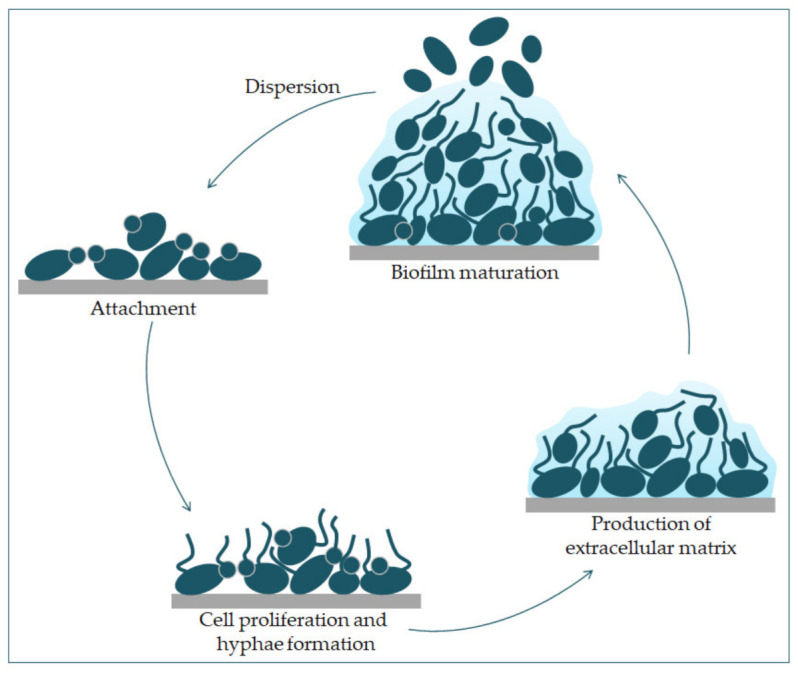
“An essential part of the extracellular matrix are β-1,3-glucans, which significantly contribute to the biofilm’s resistance to antifungal drugs because they prevent contact with target cells [36].”
BackgroundCandida albicans Secreted Aspartyl Proteinases in Virulence and Pathogenesis
Naglik, J. R., Challacombe, S. J., & Hube, B. (2003) · Microbiology and Molecular Biology Reviews · doi:10.1128/mmbr.67.3.400-428.2003 · Cited by 1,179
Impaired TH17 cell differentiation in subjects with autosomal dominant hyper-IgE syndrome
Milner, J. D., Brenchley, J. M., Laurence, A., Freeman, A. F., Hill, B. J., Elias, K. M., Kanno, Y., Spalding, C., Elloumi, H. Z., Paulson, M. L., et al. (2008) · Nature · doi:10.1038/nature06764 · Cited by 1,157 · cited 1×
“, IL-23, IL-21, IL-6) in the differentiation of IL-17 producing T helper cells [116].”
Background
Research works printed but not linked: 3
- Wibawa, 2016, The role of virulence factors in Candida albicans pathogenicity, J. Med. Sci., 48, 58
- Bolognia, J., Schaffer, J., and Cerroni, L. (2018). Dermatology, Elsevier. [4th ed.].
- Fenichel, G.M. (2007). Infectious Diseases. Neonatal Neurology, Elsevier Inc.
Cited by
Sorted by citations
Lass‐Flörl, C., Kanj, S. S., Govender, N. P., Thompson, G. R., Ostrosky-Zeichner, L. L., & Govrins, M. A. (2024) · Nature Reviews Disease Primers · doi:10.1038/s41572-024-00503-3 · Cited by 345
“Each morphological form possesses distinct surface molecules 53 .”
InfluentialKhane, Y., Benouis, K., Albukhaty, S., Sulaiman, G. M., Abomughaid, M. M., Ali, A. A., Aouf, D., Fenniche, F., Khane, S., Chaibi, W., et al. (2022) · Nanomaterials · doi:10.3390/nano12122013 · Cited by 322
Candida albicans the main opportunistic pathogenic fungus in humans
Macias-Paz, I. U., Pérez-Hernández, S., Tavera-Tapia, A., Luna-Arias, J. P., Guerra-Cárdenas, J. E., & Reyna-Beltrán, E. (2023) · Revista Argentina de Microbiología · doi:10.1016/j.ram.2022.08.003 · Cited by 141
“…is the main causative agent of candidiasis and the primary fungal infection in adults and pediatric patients 8,66,82 In the USA, it was reported that sepsis caused by C. albicans has a mortality rate of approximately 40%, which is higher than any other sepsis caused by bacteria or fungi 89 .”
BackgroundImmunity to Invasive Fungal Diseases
Casadevall, A. (2022) · Annual Review of Immunology · doi:10.1146/annurev-immunol-101220-034306 · Cited by 124
Czechowicz, P., Nowicka, J., & Gościniak, G. (2022) · International Journal of Molecular Sciences · doi:10.3390/ijms23115895 · Cited by 122
Metadata
- Authors
- Talapko, J., Juzbašić, M., Matijević, T., Pustijanac, E., Bekić, S., Kotris, I., & Škrlec, I.
- Affiliations
- University of Osijek (HR)
- Klinički bolnički centar Osijek (HR)
- Juraj Dobrila University of Pula (HR)
- Department of Internal Medicine, General County Hospital Vukovar, HR-3200 Vukovar, Croatia
- Corresponding author
- Škrlec, Ivana
- Venue
- Journal of Fungi
- Publisher
- MDPI AG
- Published
- 2021-01-22
- Volume
- 7
- Issue
- 2
- Pages
- 79
- ISSN
- 2309-608X (ISSN-L)
- PMC
- PMC7912069
- OpenAlex
- W3124481512
- Cited by
- 794
- References
- 175
- Citations by year
- 2026: 149 · 2025: 231 · 2024: 187 · 2023: 121 · 2022: 89 · 2021: 15
- FWCI
- 12.05
- Type
- journal article
- Language
- en
- Open access
- gold
- doi.org
- Licence
- Locations
- Journal of Fungi (publishedVersion, cc-by)
- PubMed Central (publishedVersion, cc-by)
- PubMed (publishedVersion)
- DOAJ (DOAJ: Directory of Open Access Journals) (submittedVersion, cc-by-sa)
- Topics
- Health Sciences › Medicine › Infectious Diseases › Antifungal resistance and susceptibility
- Health Sciences › Medicine › Infectious Diseases › Fungal Infections and Studies
- Life Sciences › Biochemistry, Genetics and Molecular Biology › Molecular Biology › Fungal and yeast genetics research
- Keywords
- Candida albicans, virulence factors, candidiasis, oral candidiasis, invasive candidiasis, candidemia, commensalism, dysbiosis, mucosal barrier, host immune response, opportunistic fungal infection, clinical features
About these checks
Registry, retraction, Cites and statistics results are computed, not judged, with one exception: a printed reference that no index lists is read once by a model before it counts as a citation error. Claims are extracted by a model and kept only when their quote appears verbatim in the text; each cited source is then checked, with a model’s help, for whether it says what the claim relies on. Those verdicts can be wrong — read the claim’s quote and the cited source before relying on one.
Statistics and arithmetic are recomputed, not judged.
Confidence bands are shown only for fields calibrated on our annotated test set. None is calibrated yet, so no band is shown.
What counts as a claim ›How we measure confidence ›How we check this ›
Are you an author, or do you see a problem with this page? Request a review
