

The DOI matches its Crossref record; 169 of the 171 references it cites were found in a registry or an index.
Role of Intestinal Microbiota in the Bioavailability and Physiological Functions of Dietary Polyphenols
Open accessAbstract
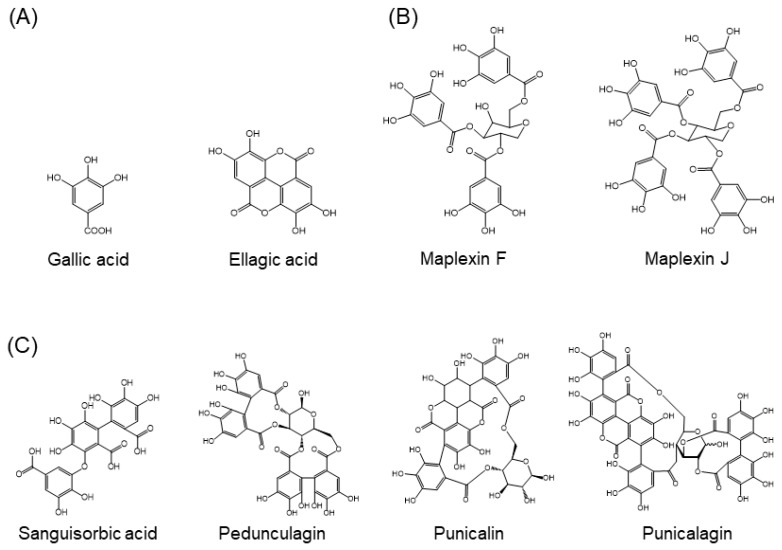
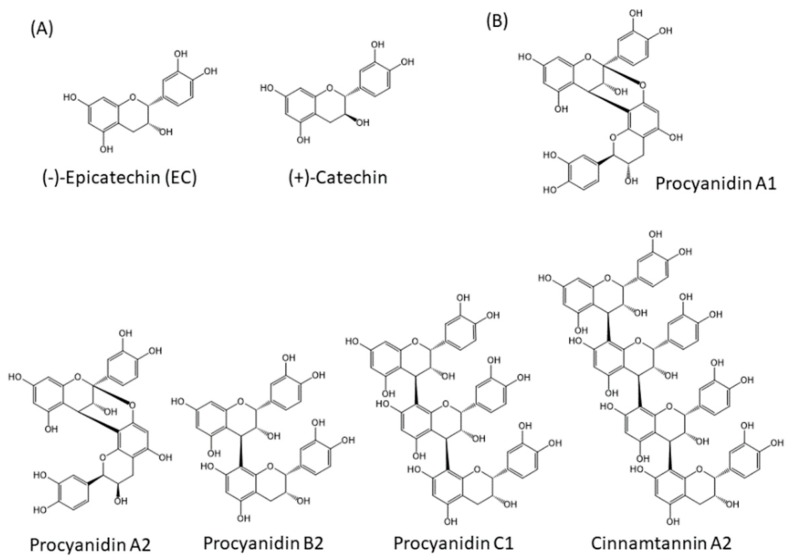
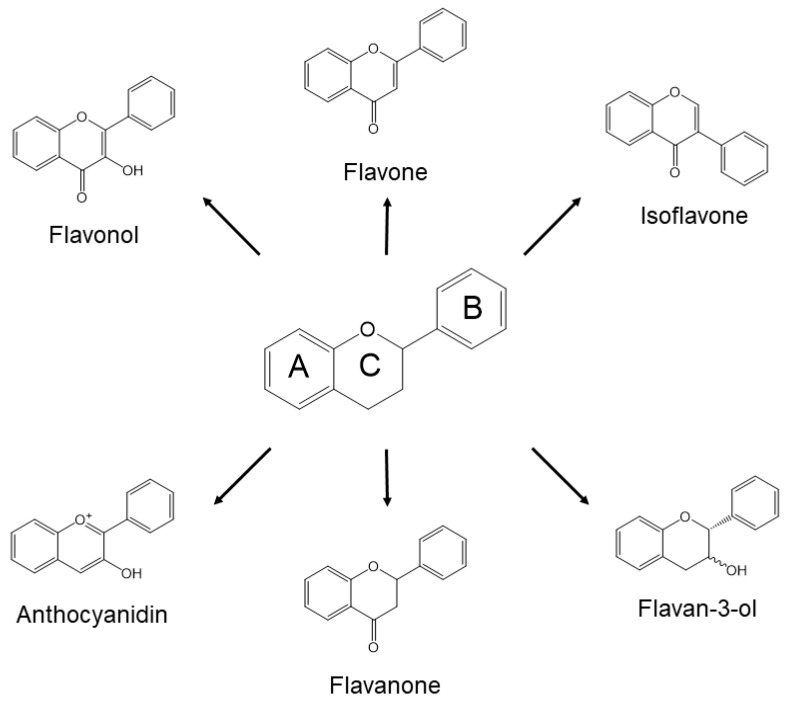
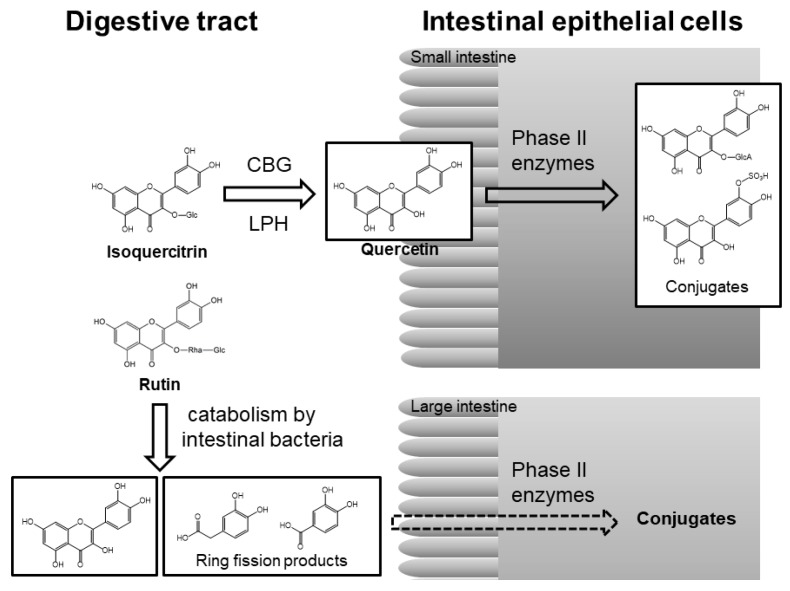
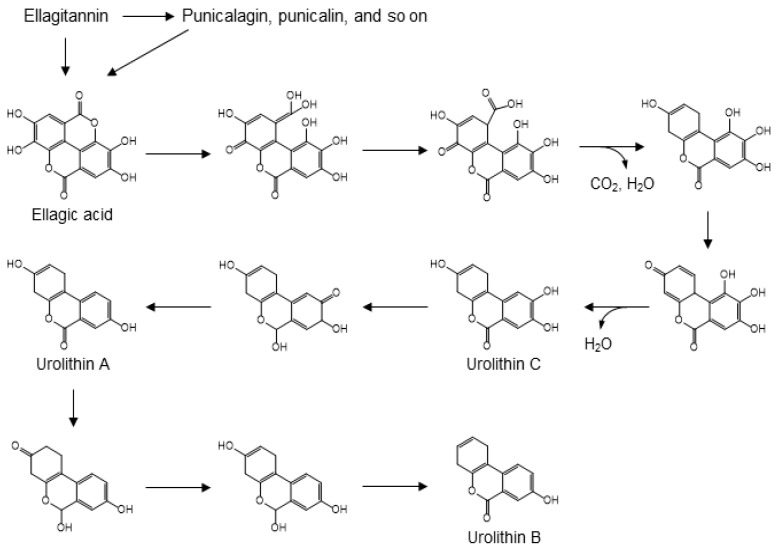
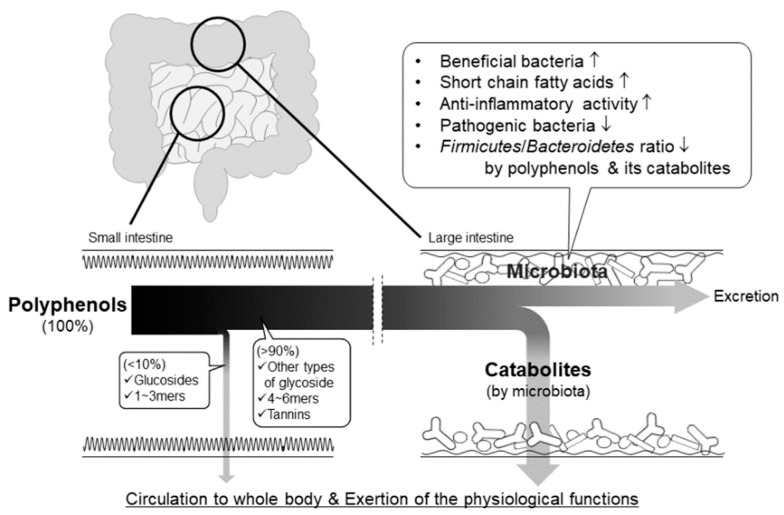
Polyphenols are categorized as plant secondary metabolites, and they have attracted much attention in relation to human health and the prevention of chronic diseases. In recent years, a considerable number of studies have been published concerning their physiological function in the digestive tract, such as their prebiotic properties and their modification of intestinal microbiota. It has also been suggested that several hydrolyzed and/or fission products, derived from the catabolism of polyphenols by intestinal bacteria, exert their physiological functions in target sites after transportation into the body. Thus, this review article focuses on the role of intestinal microbiota in the bioavailability and physiological function of dietary polyphenols. Monomeric polyphenols, such as flavonoids and oligomeric polyphenols, such as proanthocyanidins, are usually catabolized to chain fission products by intestinal bacteria in the colon. Gallic acid and ellagic acid derived from the hydrolysis of gallotannin, and ellagitannin are also subjected to intestinal catabolism. These catabolites may play a large role in the physiological functions of dietary polyphenols. They may also affect the microbiome, resulting in health promotion by the activation of short chain fatty acids (SCFA) excretion and intestinal immune function. The intestinal microbiota is a key factor in mediating the physiological functions of dietary polyphenols.
Overview
The claims and statistics of this paper haven’t been checked yet.
Run the check — free, no account needed. It reads the open-access text and checks the sources it cites.
Integrity signals
Registry
Cites
Statistics
Figures
Verification
Claims the paper makes
The claims and statistics of this paper haven’t been checked yet.
Run the check — free, no account needed. It reads the open-access text and checks the sources it cites.
Claims other papers make about this one
Each is checked against this paper’s own text: does it say what the citing paper says it does?
In the citing paper
“Considering the reported anti-muscle atrophy effect of some nutraceuticals, such as resveratrol and epicatechin, and the fact that they could modulate the gut microbiome composition and increase circulating levels of short-chain fatty acids [167,168], it is likely that they may improve muscle atrophy by regulating the gut microbiota and their metabolites; nevertheless, future confirmatory studies”
From Nutraceuticals in the Prevention and Treatment of the Muscle Atrophy (2021) · cites this paper as [168]
Self-check
Percentages, sums and reported differences re-computed from the paper’s own numbers.
The self-check needs the paper’s full text.
Citations
Cites
An obesity-associated gut microbiome with increased capacity for energy harvest
Turnbaugh, P. J., Ley, R. E., Mahowald, M. A., Magrini, V., Mardis, E. R., & Gordon, J. I. (2006) · Nature · doi:10.1038/nature05414 · Cited by 12,444
From Dietary Fiber to Host Physiology: Short-Chain Fatty Acids as Key Bacterial Metabolites
Koh, A., De Vadder, F., Kovatcheva-Datchary, P., & Bäckhed, F. (2016) · Cell · doi:10.1016/j.cell.2016.05.041 · Cited by 7,070
Mind-altering microorganisms: the impact of the gut microbiota on brain and behaviour
Cryan, J. F., & Dinan, T. G. (2012) · Nature Reviews Neuroscience · doi:10.1038/nrn3346 · Cited by 4,572
Dietary antioxidant flavonoids and risk of coronary heart disease: the Zutphen Elderly Study
Hertog, M. G. L., Feskens, E. J. M., Kromhout, D., Hertog, M. G. L., Hollman, P. C. H., Hertog, M. G. L., & Katan, M. (1993) · The Lancet · doi:10.1016/0140-6736(93)92876-u · Cited by 4,336
Dietary Intake and Bioavailability of Polyphenols
Scalbert, A., & Williamson, G. (2000) · The Journal of Nutrition · doi:10.1093/jn/130.8.2073s · Cited by 3,658
Sudo, N., Chida, Y., Aiba, Y., Sonoda, J., Oyama, N., Yu, X., Kubo, C., & Koga, Y. (2004) · The Journal of Physiology · doi:10.1113/jphysiol.2004.063388 · Cited by 2,735
Del Rio, D., Rodriguez-Mateos, A., Spencer, J. P. E., Tognolini, M., Borges, G., & Crozier, A. (2013) · Antioxidants & Redox Signaling · doi:10.1089/ars.2012.4581 · Cited by 2,601
Plovier, H., Everard, A., Druart, C., Depommier, C., Van Hul, M., Geurts, L., Chilloux, J., Ottman, N., Duparc, T., Lichtenstein, L., et al. (2017) · Nature Medicine · doi:10.1038/nm.4236 · Cited by 2,204
Akkermansia muciniphila gen. nov., sp. nov., a human intestinal mucin-degrading bacterium
Derrien, M., Vaughan, E. E., Plugge, C. M., & de Vos, W. M. (2004) · International Journal of Systematic and Evolutionary Microbiology · doi:10.1099/ijs.0.02873-0 · Cited by 2,094
Benefits of polyphenols on gut microbiota and implications in human health
Cardona, F., Andrés‐Lacueva, C., Tulipani, S., Tinahones, F. J., & Queipo‐Ortuño, M. I. (2013) · The Journal of Nutritional Biochemistry · doi:10.1016/j.jnutbio.2013.05.001 · Cited by 1,615
Research works printed but not linked: 2
- Silverman, R.B. (2002). Organic Chemistry of Enzyme-Catalyzed Reactions, Academic Press. Revised ed.
- Has, 2006, Of the Major Phenolic Acids Formed during Human Microbial Fermentation of Tea, Citrus, and Soy Flavonoid Supplements, Only, Joournal Nutr., 136, 52
Cited by
Sorted by citations
Polymeric Nanoparticles for Drug Delivery: Recent Developments and Future Prospects
Begines, B., Ortiz, T., Pérez-Aranda, M., Martínez, G., Merinero, M., Argüelles-Arias, F., & Alcudia, A. (2020) · Nanomaterials · doi:10.3390/nano10071403 · Cited by 1,061
Role of dietary polyphenols on gut microbiota, their metabolites and health benefits
Aravind, S. M., Wichienchot, S., Tsao, R., Ramakrishnan, S., & Chakkaravarthi, S. (2021) · Food Research International · doi:10.1016/j.foodres.2021.110189 · Cited by 502
Polyphenol-Mediated Gut Microbiota Modulation: Toward Prebiotics and Further
Rodríguez-Daza, M.-C., Pulido-Mateos, E. C., Lupien‐Meilleur, J., Guyonnet, D., Desjardins, Y., & Roy, D. (2021) · Frontiers in Nutrition · doi:10.3389/fnut.2021.689456 · Cited by 511
Phenolic acids from vegetables: A review on processing stability and health benefits
Rashmi, H. B., & Negi, P. S. (2020) · Food Research International · doi:10.1016/j.foodres.2020.109298 · Cited by 493
The Effects of Flavonoids in Cardiovascular Diseases
Ciumărnean, L., Milaciu, M. V., Runcan, O., Vesa, Ș. C., Răchişan, A. L., Negrean, V., Perné, M.-G., Donca, V., Alexescu, T., Para, I., et al. (2020) · Molecules · doi:10.3390/molecules25184320 · Cited by 474
Metadata
- Authors
- Kawabata, K., Yoshioka, Y., & Terao, J.
- Affiliations
- Konan Women's University (JP)
- Corresponding author
- Terao, Junji
- Venue
- Molecules
- Publisher
- MDPI AG
- Published
- 2019-01-21
- Volume
- 24
- Issue
- 2
- Pages
- 370
- ISSN
- 1420-3049 (ISSN-L)
- PMC
- PMC6359708
- OpenAlex
- W2909540292
- Cited by
- 563
- References
- 171
- Citations by year
- 2026: 36 · 2025: 63 · 2024: 61 · 2023: 82 · 2022: 103 · 2021: 105 · 2020: 82 · 2019: 31
- FWCI
- 7.74
- Type
- journal article
- Language
- en
- Open access
- gold
- dx.doi.org
- Licence
- Locations
- Molecules (publishedVersion, cc-by)
- Europe PMC (PubMed Central) (publishedVersion, other-oa)
- PubMed Central (publishedVersion, cc-by)
- PubMed (publishedVersion)
- DOAJ (DOAJ: Directory of Open Access Journals) (submittedVersion)
- Funders
- Japan Society for the Promotion of Science (16K00815)
- Topics
- Health Sciences › Medicine › Biochemistry (medical) › Phytochemicals and Antioxidant Activities
- Life Sciences › Biochemistry, Genetics and Molecular Biology › Molecular Biology › Gut microbiota and health
- Health Sciences › Nursing › Nutrition and Dietetics › Pomegranate: compositions and health benefits
- Keywords
- gut microbiota, dietary polyphenols, polyphenol bioavailability, prebiotic properties, flavonoids, proanthocyanidins, gallotannins, ellagitannins, gallic acid, ellagic acid, short-chain fatty acids, intestinal immunity, chronic disease prevention
- MeSH terms
- Gastrointestinal Microbiome, Animals, Biological Availability, Energy Metabolism, Humans, Hydrolysis, Intestinal Mucosa, Research, Dietary Supplements, Gastrointestinal Tract, Prebiotics, Polyphenols, Gastrointestinal Absorption
About these checks
Registry, retraction, Cites and statistics results are computed, not judged, with one exception: a printed reference that no index lists is read once by a model before it counts as a citation error. Claims are extracted by a model and kept only when their quote appears verbatim in the text; each cited source is then checked, with a model’s help, for whether it says what the claim relies on. Those verdicts can be wrong — read the claim’s quote and the cited source before relying on one.
Statistics and arithmetic are recomputed, not judged.
Confidence bands are shown only for fields calibrated on our annotated test set. None is calibrated yet, so no band is shown.
What counts as a claim ›How we measure confidence ›How we check this ›
Are you an author, or do you see a problem with this page? Request a review
