

The DOI matches its Crossref record; 119 of the 120 references it cites were found in a registry or an index.
Regulation of Muscle Glycogen Metabolism during Exercise: Implications for Endurance Performance and Training Adaptations
Open accessAbstract
Since the introduction of the muscle biopsy technique in the late 1960s, our understanding of the regulation of muscle glycogen storage and metabolism has advanced considerably. Muscle glycogenolysis and rates of carbohydrate (CHO) oxidation are affected by factors such as exercise intensity, duration, training status and substrate availability. Such changes to the global exercise stimulus exert regulatory effects on key enzymes and transport proteins via both hormonal control and local allosteric regulation. Given the well-documented effects of high CHO availability on promoting exercise performance, elite endurance athletes are typically advised to ensure high CHO availability before, during and after high-intensity training sessions or competition. Nonetheless, in recognition that the glycogen granule is more than a simple fuel store, it is now also accepted that glycogen is a potent regulator of the molecular cell signaling pathways that regulate the oxidative phenotype. Accordingly, the concept of deliberately training with low CHO availability has now gained increased popularity amongst athletic circles. In this review, we present an overview of the regulatory control of CHO metabolism during exercise (with a specific emphasis on muscle glycogen utilization) in order to discuss the effects of both high and low CHO availability on modulating exercise performance and training adaptations, respectively.
Overview
The claims and statistics of this paper haven’t been checked yet.
Run the check — free, no account needed. It reads the open-access text and checks the sources it cites.
Integrity signals
Registry
Cites
Statistics
Figures
Verification
Claims the paper makes
The claims and statistics of this paper haven’t been checked yet.
Run the check — free, no account needed. It reads the open-access text and checks the sources it cites.
Claims other papers make about this one
Each is checked against this paper’s own text: does it say what the citing paper says it does?
The cited source says what the claim attributes to it.
In the citing paper
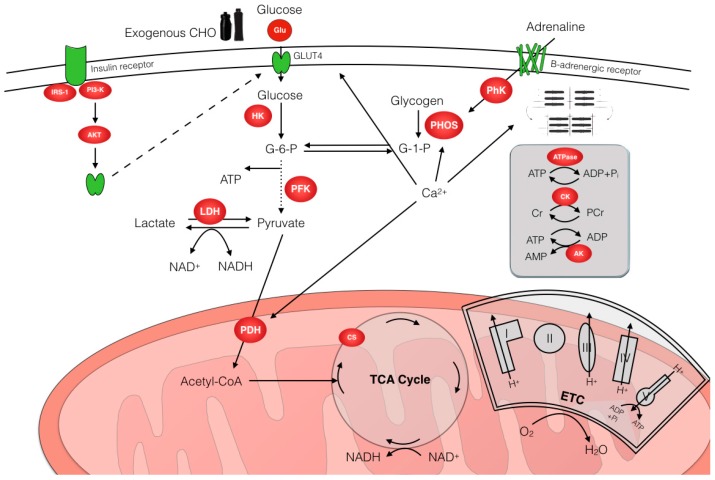
“Mechanistically, low initial muscle glycogen reduces substrate availability by limiting glycogen phosphorylase activity and indirectly downregulates carbohydrate oxidation via reduced activation of pyruvate dehydrogenase (78).”
From Carbohydrate ingestion during prolonged exercise and net skeletal muscle glycogen utilization: A meta-analysis. (2026) · cites this paper as [78]
In the citing paper
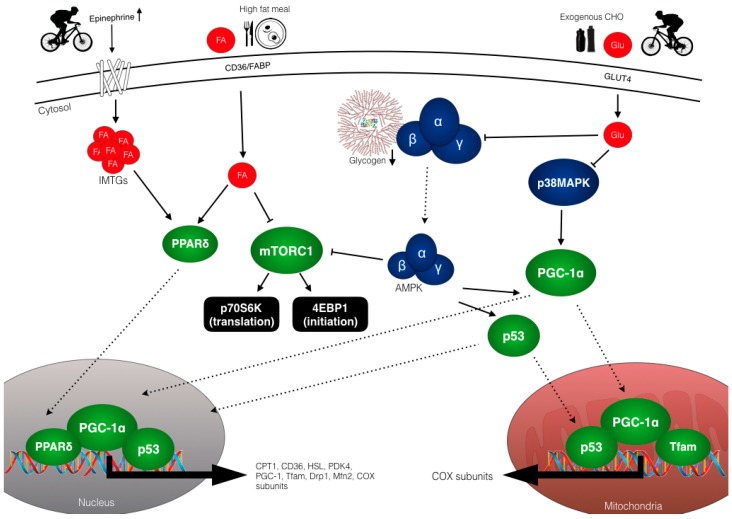
“Glycogen is currently not only considered an energy substrate but also a regulator of the signaling pathways that regulate exercise-induced adaptations.”
From Carbohydrate Availability and Physical Performance: Physiological Overview and Practical Recommendations (2019) · cites this paper as [13]
Self-check
Percentages, sums and reported differences re-computed from the paper’s own numbers.
The self-check needs the paper’s full text.
Citations
Cites
Exercise Metabolism and the Molecular Regulation of Skeletal Muscle Adaptation
Egan, B., & Zierath, J. R. (2013) · Cell Metabolism · doi:10.1016/j.cmet.2012.12.012 · Cited by 2,084
Adaptations of skeletal muscle to endurance exercise and their metabolic consequences
Holloszy, J. O., & Coyle, E. F. (1984) · Journal of Applied Physiology · doi:10.1152/jappl.1984.56.4.831 · Cited by 1,985
Diet, muscle glycogen and physical performance.
Bergström, J., Hermansen, L., Hultman, E., & Saltin, B. (1967) · Acta Physiologica Scandinavica · doi:10.1111/j.1748-1716.1967.tb03720.x · Cited by 1,740 · cited 1×
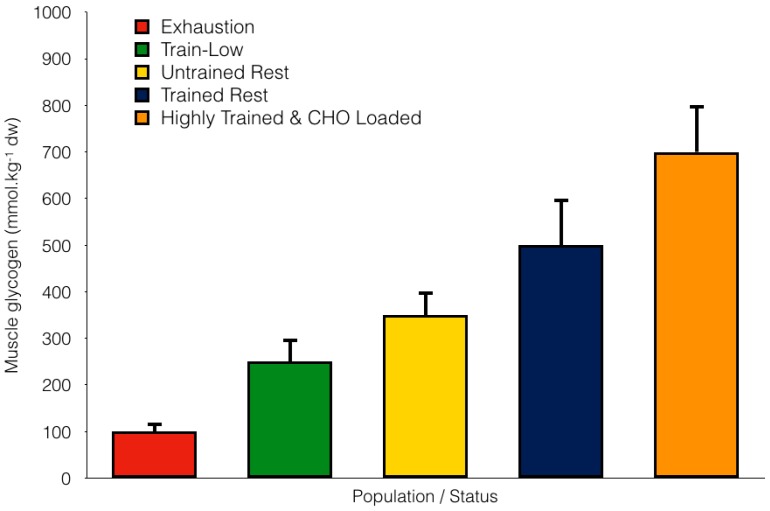
“The basic principles of CHO loading were developed in the late 1960s where it was identified that a period of exhaustive exercise followed by several days of high dietary CHO intake induces a super-compensation effect so that glycogen storage is augmented [3,4].”
BackgroundThomas, D. T., Erdman, K. A., & Burke, L. M. (2016) · Journal of the Academy of Nutrition and Dietetics · doi:10.1016/j.jand.2015.12.006 · Cited by 1,359
Muscle glycogen utilization during prolonged strenuous exercise when fed carbohydrate
Coyle, E. F., Coggan, A. R., Hemmert, M. K., & Ivy, J. L. (1986) · Journal of Applied Physiology · doi:10.1152/jappl.1986.61.1.165 · Cited by 1,022
The effects of increasing exercise intensity on muscle fuel utilisation in humans
van Loon, L. J. C., Greenhaff, P. L., Constantin‐Teodosiu, D., Saris, W. H. M., & Wagenmakers, A. J. M. (2001) · The Journal of Physiology · doi:10.1111/j.1469-7793.2001.00295.x · Cited by 897
Muscle Glycogen during Prolonged Severe Exercise
Hermansen, L., Hultman, E., & Saltin, B. (1967) · Acta Physiologica Scandinavica · doi:10.1111/j.1748-1716.1967.tb03719.x · Cited by 752
Muscle and Blood Metabolites during a Soccer Game: Implications for Sprint Performance
KRUSTRUP, P., MOHR, M., STEENSBERG, A., BENCKE, J., KJÆR, M., & BANGSBO, J. (2006) · Medicine & Science in Sports & Exercise · doi:10.1249/01.mss.0000222845.89262.cd · Cited by 742
Gollnick, P. D., Piehl, K., & Saltin, B. (1974) · The Journal of Physiology · doi:10.1113/jphysiol.1974.sp010639 · Cited by 643
Carbohydrate sensing in the human mouth: effects on exercise performance and brain activity
Chambers, E. S., Bridge, M., & Jones, D. A. (2009) · The Journal of Physiology · doi:10.1113/jphysiol.2008.164285 · Cited by 625
Cited by
Sorted by citations
Egan, B., & Sharples, A. P. (2023) · Physiological Reviews · doi:10.1152/physrev.00054.2021 · Cited by 278
Muscle Glycogen Metabolism and High-Intensity Exercise Performance: A Narrative Review
Vigh-Larsen, J. F., Ørtenblad, N., Spriet, L. L., Overgaard, K., & Mohr, M. (2021) · Sports Medicine · doi:10.1007/s40279-021-01475-0 · Cited by 169
Gut-Muscle Axis Exists and May Affect Skeletal Muscle Adaptation to Training
Przewłócka, K., Folwarski, M., Kaźmierczak-Siedlecka, K., Skonieczna‐Żydecka, K., & Kaczor, J. J. (2020) · Nutrients · doi:10.3390/nu12051451 · Cited by 166
Exercise-induced oxidative stress and melatonin supplementation: current evidence
Kruk, J., Aboul-Enein, B., & Duchnik, E. (2021) · Journal of Physiological Sciences · doi:10.1186/s12576-021-00812-2 · Cited by 125
Burke, L. M., Hawley, J. A., Jeukendrup, A., Morton, J. P., Stellingwerff, T., & Maughan, R. J. (2018) · International Journal of Sport Nutrition and Exercise Metabolism · doi:10.1123/ijsnem.2018-0289 · Cited by 132
Self-citation
Metadata
- Authors
- Hearris, M., Hammond, K., Fell, J., & Morton, J.
- Affiliations
- Liverpool John Moores University (GB)
- Corresponding author
- Morton, James
- Venue
- Nutrients
- Publisher
- MDPI AG
- Published
- 2018-03-02
- Volume
- 10
- Issue
- 3
- Pages
- 298
- ISSN
- 2072-6643 (ISSN-L)
- PMC
- PMC5872716
- OpenAlex
- W2792934062
- Cited by
- 252
- References
- 120
- Citations by year
- 2026: 30 · 2025: 31 · 2024: 34 · 2023: 26 · 2022: 38 · 2021: 40 · 2020: 27 · 2019: 17 · 2018: 9
- FWCI
- 2.61
- Type
- journal article
- Language
- en
- Open access
- gold
- doi.org
- Licence
- Locations
- Nutrients (publishedVersion, cc-by)
- Europe PMC (PubMed Central) (publishedVersion, cc-by)
- PubMed Central (publishedVersion, cc-by)
- PubMed (publishedVersion)
- Liverpool John Moores University (acceptedVersion)
- e-space (Manchester Metropolitan University) (acceptedVersion)
- Figshare (submittedVersion, cc-by)
- Funders
- GlaxoSmithKline
- Topics
- Health Sciences › Nursing › Nutrition and Dietetics › Muscle metabolism and nutrition
- Health Sciences › Medicine › Physiology (medical) › Cardiovascular and exercise physiology
- Life Sciences › Biochemistry, Genetics and Molecular Biology › Molecular Biology › Metabolism, Diabetes, and Cancer
- Keywords
- muscle glycogen metabolism, glycogenolysis, carbohydrate oxidation, endurance performance, training effects, carbohydrate availability, glycogen storage, allosteric regulation, hormonal regulation, exercise intensity
- MeSH terms
- Adaptation, Physiological, Animals, Dietary Carbohydrates, Energy Metabolism, Glycogen, Humans, Muscle Contraction, Oxidation-Reduction, Phenotype, Physical Endurance, Signal Transduction, Muscle, Skeletal, Diet, Carbohydrate-Restricted
About these checks
Registry, retraction, Cites and statistics results are computed, not judged, with one exception: a printed reference that no index lists is read once by a model before it counts as a citation error. Claims are extracted by a model and kept only when their quote appears verbatim in the text; each cited source is then checked, with a model’s help, for whether it says what the claim relies on. Those verdicts can be wrong — read the claim’s quote and the cited source before relying on one.
Statistics and arithmetic are recomputed, not judged.
Confidence bands are shown only for fields calibrated on our annotated test set. None is calibrated yet, so no band is shown.
What counts as a claim ›How we measure confidence ›How we check this ›
Are you an author, or do you see a problem with this page? Request a review
