

Bioaccesibility, Metabolism, and Excretion of Lipids Composing Spent Coffee Grounds
Open accessThe DOI matches its Crossref record; 35 of the 35 references it cites were found in a registry or an index.
Abstract
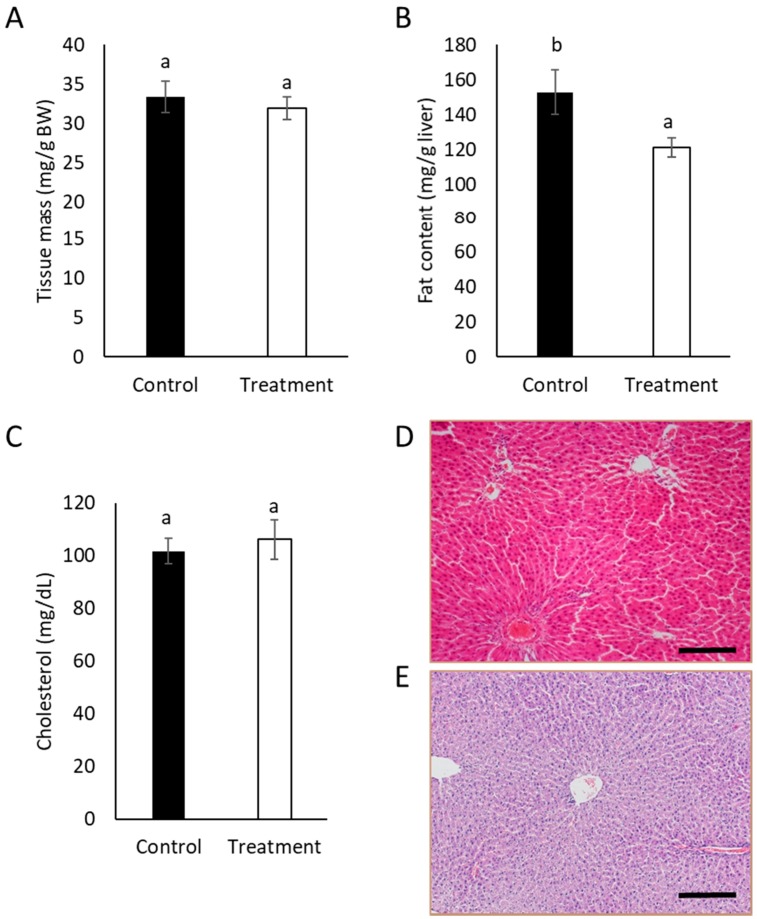
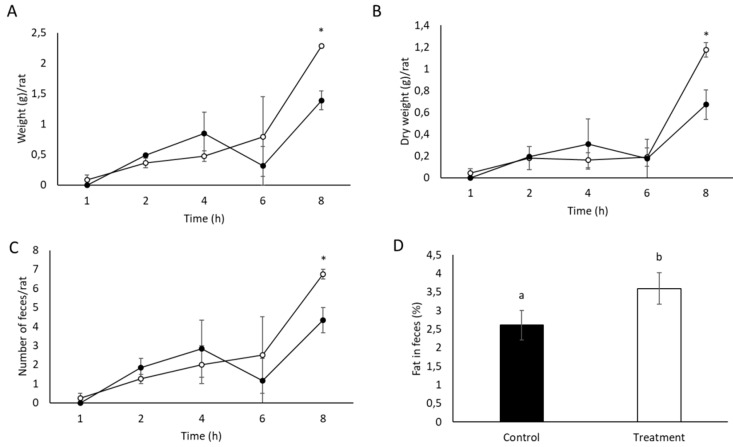
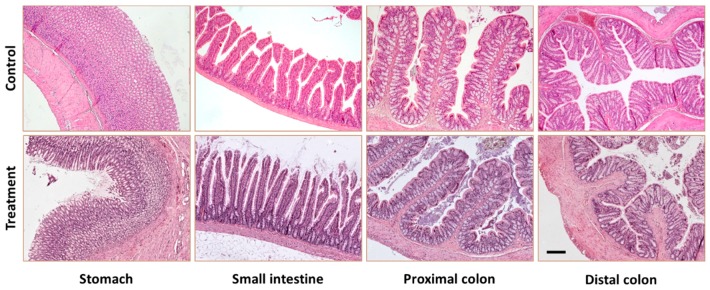
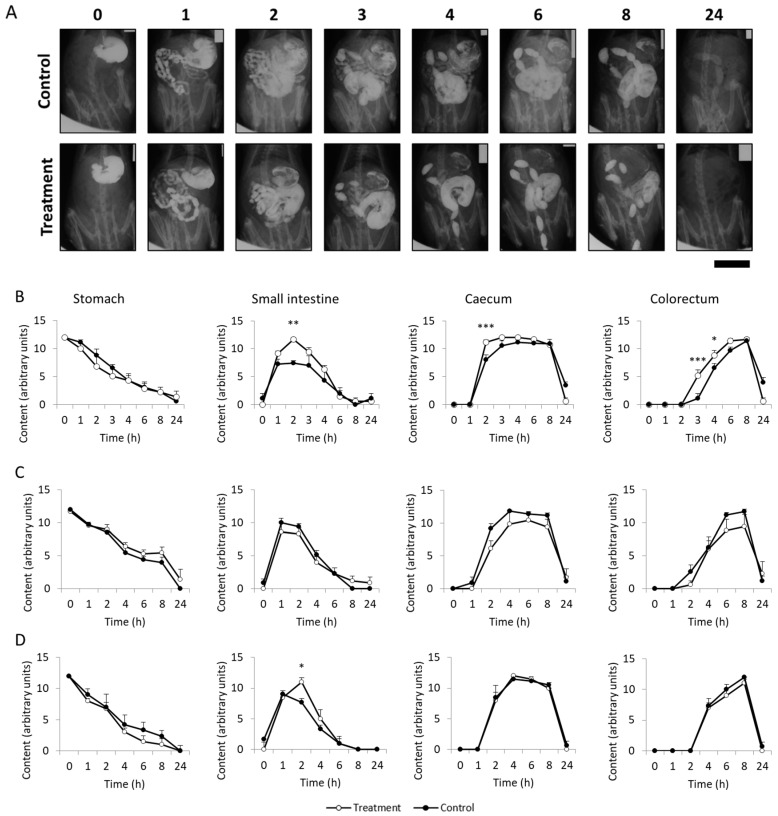
The bioaccessibility, metabolism, and excretion of lipids composing spent coffee grounds (SCGs) were investigated. An analysis of mycotoxins and an acute toxicity study in rats were performed for safety evaluation. Total fat, fatty acids, and diterpenes (cafestol and kahweol) were determined in SCGs and their digests obtained in vitro. A pilot repeated intake study was carried out in Wistar rats using a dose of 1 g SCGs/kg b.w. for 28 days. Fat metabolism was evaluated by analysis of total fat, cholesterol, and histology in liver. The dietary fiber effect of SCGs was measured radiographically. The absence of mycotoxins and toxicity was reported in SCGs. A total of 77% of unsaturated fatty acids and low amounts of kahweol (7.09 µg/g) and cafestol (414.39 µg/g) were bioaccessible after in vitro digestion. A significantly lower (p < 0.1) accumulation of lipids in the liver and a higher excretion of these in feces was found in rats treated with SCGs for 28 days. No lipid droplets or liver damage were observed by histology. SCGs acutely accelerated intestinal motility in rats. SCGs might be considered a sustainable, safe, and healthy food ingredient with potential for preventing hepatic steatosis due to their effect as dietary fiber with a high fat-holding capacity.
Overview
The claims and statistics of this paper haven’t been checked yet.
Free: it reads the open-access text and checks the first 5 claims that cite a source we can check. Create a free account to check every claim.
Integrity signals
Registry
Cites
Statistics
Figures
Verification
Claims the paper makes
The claims and statistics of this paper haven’t been checked yet.
Free: it reads the open-access text and checks the first 5 claims that cite a source we can check. Create a free account to check every claim.
Claims other papers make about this one
Each is checked against this paper’s own text: does it say what the citing paper says it does?
The cited source says what the claim attributes to it.
In the citing paper
“The product accelerated transit in both the small intestine (since the cecum of the rats was reached significantly more quickly than that of control rats), and the colon (since formation of fecal pellets occurred also much more quickly in SCGs-exposed than in vehicle-treated animals).”
From Effects of Coffee and Its Components on the Gastrointestinal Tract and the Brain–Gut Axis (2020) · cites this paper as [174]
The cited source says what the claim attributes to it.
In the citing paper
“However, this effect was restricted to the first radiographic session, after the first SCG dose, whereas it was not apparent after the 14th or the 28th doses.”
From Effects of Coffee and Its Components on the Gastrointestinal Tract and the Brain–Gut Axis (2020) · cites this paper as [174]
Self-check
Percentages, sums and reported differences re-computed from the paper’s own numbers.
The self-check needs the paper’s full text.
Citations
Cites
Sustainable management of coffee industry by-products and value addition—a review
Murthy, P. S., & Madhava Naidu, M. (2012) · Resources, Conservation and Recycling · doi:10.1016/j.resconrec.2012.06.005 · Cited by 1,055 · cited 1×
“Spent coffee grounds (SCGs) are the most abundant coffee byproduct (45%) generated during the treatment of coffee powder with hot water to prepare coffee infusion or steam for the instant coffee preparation [2].”
BackgroundChemical, Functional, and Structural Properties of Spent Coffee Grounds and Coffee Silverskin
Ballesteros, L. F., Teixeira, J. A., & Mussatto, S. I. (2014) · Food and Bioprocess Technology · doi:10.1007/s11947-014-1349-z · Cited by 870 · cited 4×
“In addition, lignin is also present in a significant amount in SCGs (19–26%, w/w) [6,9].”
BackgroundInfluentialSpent coffee grounds: A review on current research and future prospects
Campos-Vega, R., Loarca-Piña, G., Vergara-Castañeda, H. A., & Oomah, B. D. (2015) · Trends in Food Science & Technology · doi:10.1016/j.tifs.2015.04.012 · Cited by 679 · cited 2×
“The second most predominant ingredient in SCGs are lipids, which range from 10 to 30% [3,4].”
BackgroundMyths and Misconceptions About Chronic Constipation
Muller-Lissner, S. A., Kamm, M. A., Scarpignato, C., & Wald, A. (2005) · The American Journal of Gastroenterology · doi:10.1111/j.1572-0241.2005.40885.x · Cited by 620 · cited 1×
“This suggests that upon chronic treatment, tolerance may develop to the intestinal stimulating effect of SCGs [34].”
BackgroundCoffee, Caffeine, and Health Outcomes: An Umbrella Review
Grosso, G., Godos, J., Galvano, F., & Giovannucci, E. L. (2017) · Annual Review of Nutrition · doi:10.1146/annurev-nutr-071816-064941 · Cited by 531
Short-chain fatty acids stimulate colonic transit via intraluminal 5-HT release in rats
Fukumoto, S., Tatewaki, M., Yamada, T., Fujimiya, M., Mantyh, C., Voss, M., Eubanks, S., Harris, M., Pappas, T. N., & Takahashi, T. (2003) · American Journal of Physiology-Regulatory, Integrative and Comparative Physiology · doi:10.1152/ajpregu.00442.2002 · Cited by 465 · cited 1×
“However, it has been shown that luminal administration of SCFAs (10–200 mM) stimulates colonic motility [37].”
BackgroundA study on chemical constituents and sugars extraction from spent coffee grounds
Mussatto, S. I., Carneiro, L. M., Silva, J. P. A., Roberto, I. C., & Teixeira, J. A. (2011) · Carbohydrate Polymers · doi:10.1016/j.carbpol.2010.07.063 · Cited by 444 · cited 1×
“5%, w/w) [6,7], and there is also high content of galactomannans [8].”
BackgroundThe chemical composition of exhausted coffee waste
Pujol, D., Liu, C., Gominho, J., Olivella, M. À., Fiol, N., Villaescusa, I., & Pereira, H. (2013) · Industrial Crops and Products · doi:10.1016/j.indcrop.2013.07.056 · Cited by 342 · cited 2×
“In addition, lignin is also present in a significant amount in SCGs (19–26%, w/w) [6,9].”
BackgroundResultOchratoxin A: Molecular Interactions, Mechanisms of Toxicity and Prevention at the Molecular Level
Kőszegi, T., & Poór, M. (2016) · Toxins · doi:10.3390/toxins8040111 · Cited by 330
Valorization of spent coffee grounds: A review
Kovalcik, A., Obruca, S., & Marova, I. (2018) · Food and Bioproducts Processing · doi:10.1016/j.fbp.2018.05.002 · Cited by 277 · cited 1×
“Several applications have been proposed for SCGs, which include their use as biofuels, biosorbents, animal feed, ceramic manufacturing, and composite materials, among others [14,15].”
Background
Cited by
Klingel, T., Kremer, J. I., Gottstein, V., Rajcic de Rezende, T., Schwarz, S., & Lachenmeier, D. W. (2020) · Foods · doi:10.3390/foods9050665 · Cited by 264
Applications of Compounds from Coffee Processing By-Products
Iriondo-DeHond, A., Iriondo-DeHond, M., & del Castillo, M. D. (2020) · Biomolecules · doi:10.3390/biom10091219 · Cited by 167
Self-citationEffects of Coffee and Its Components on the Gastrointestinal Tract and the Brain–Gut Axis
Iriondo-DeHond, A., Uranga, J. A., del Castillo, M. D., & Abalo, R. (2020) · Nutrients · doi:10.3390/nu13010088 · Cited by 126
“In one of them, different experiments were performed to evaluate the properties of instant spent coffee grounds (SCGs) [174].”
BackgroundSelf-citationLi, H., Gan, R., Shang, A., Mao, Q., Quan-cai, S., Wu, D., Geng, F., He, X.-Q., & Li, H. (2021) · Oxidative Medicine and Cellular Longevity · doi:10.1155/2021/6621644 · Cited by 123
“Furthermore, an in vivo study reported that spent coffee grounds did not show mycotoxins and toxicity based on the pilot repeated intake study with Wistar rats and could be a sustainable and safe ingredient for preventing hepatic steatosis [201].”
BackgroundZhao, N., Liu, Z., Yu, T., & Yan, F. (2023) · Trends in Food Science & Technology · doi:10.1016/j.tifs.2023.104312 · Cited by 124
Metadata
- Authors
- Iriondo-DeHond, A., Cornejo, F. S., Fernandez-Gomez, B., Vera, G., Guisantes-Batan, E., Alonso, S. G., Andres, M. I. S., Sanchez-Fortun, S., Lopez-Gomez, L., Uranga, J. A., Abalo, R., & del Castillo, M. D.
- Affiliations
- Instituto de Investigación en Ciencias de la Alimentación (CIAL) (CSIC-UAM), Campus de la Universidad Autónoma de Madrid, 28049 Madrid, Spain
- Universidad Rey Juan Carlos (ES)
- Instituto Regional de Investigación Científica Aplicada (IRICA), Universidad de Castilla-La Mancha, 13005 Ciudad Real, Spain
- Facultad de Veterinaria, Universidad Complutense de Madrid, 28040 Madrid, Spain
- Departamento de Ciencias Básicas de la Salud, Facultad de Ciencias de la Salud, Universidad Rey Juan Carlos (URJC), Alcorcón, 28922 Madrid, Spain
- Venue
- Nutrients
- Publisher
- MDPI AG
- Published
- 2019-06-23
- Volume
- 11
- Issue
- 6
- Pages
- 1411
- ISSN
- 2072-6643 (ISSN-L)
- PMC
- PMC6627363
- OpenAlex
- W2950336986
- Cited by
- 26
- References
- 34
- Citations by year
- 2026: 1 · 2025: 3 · 2024: 5 · 2023: 4 · 2022: 5 · 2021: 2 · 2020: 4 · 2019: 1
- FWCI
- 1.86
- Type
- journal article
- Language
- en
- Open access
- gold
- dx.doi.org
- Licence
- Locations
- Nutrients (publishedVersion, cc-by)
- PubMed Central (publishedVersion, cc-by)
- PubMed (publishedVersion)
- Docta Complutense (Universidad Complutense de Madrid) (submittedVersion, cc-by)
- BURJC Digital (King Juan Carlos University) (submittedVersion, cc-by)
- DIGITAL.CSIC (Spanish National Research Council (CSIC)) (submittedVersion, cc-by)
- DOAJ (DOAJ: Directory of Open Access Journals) (submittedVersion, cc-by-sa)
- Hispana (submittedVersion, cc-by)
- Funders
- MINECO (COFFEE4BGA (RTI2018-101511-B-I00), SUSCOFFEE (AGL2014-57239-R), BES-2015-072191)
- Social European Fund and Junta de Comunidades de Castilla-La Mancha (OE-154)
- Comunidad de Madrid and Fondo Social Europeo (PEJ15/BIO/TL-0580)
- Topics
- Health Sciences › Medicine › Pharmacology (medical) › Coffee research and impacts
- Health Sciences › Nursing › Nutrition and Dietetics › Food composition and properties
- Life Sciences › Agricultural and Biological Sciences › Food Science › Food Nutrient Composition and Product Development
- Keywords
- spent coffee grounds, bioaccessibility, lipid metabolism, cafestol, kahweol, diterpenoids, fatty acids, mycotoxins, acute toxicity, dietary fiber, fat-holding capacity, hepatic steatosis, liver cholesterol, fecal excretion, intestinal motility, food waste valorization
- MeSH terms
- Animals, Biological Availability, Biotransformation, Diterpenes, Fatty Acids, Feces, Female, Gastrointestinal Motility, Liver, Male, Pilot Projects, Seeds, Time Factors, Rats, Wistar, Coffea, Intestinal Elimination
About these checks
Registry, retraction, Cites and statistics results are computed, not judged, with one exception: a printed reference that no index lists is read once by a model before it counts as a citation error. Claims are extracted by a model and kept only when their quote appears verbatim in the text; each cited source is then checked, with a model’s help, for whether it says what the claim relies on. Those verdicts can be wrong — read the claim’s quote and the cited source before relying on one.
Statistics and arithmetic are recomputed, not judged.
Confidence bands are shown only for fields calibrated on our annotated test set. None is calibrated yet, so no band is shown.
What counts as a claim ›How we measure confidence ›How we check this ›
Are you an author, or do you see a problem with this page? Request a review
How to cite
Cite CoChat for the checks on this page, and the paper for its own findings.
- This page
- CoChat. (2026). Citation check: Bioaccesibility, Metabolism, and Excretion of Lipids Composing Spent Coffee Grounds. https://app.cochat.ai/papers/10.3390/nu11061411
- The paper
- Iriondo-DeHond, A., Cornejo, F. S., Fernandez-Gomez, B., Vera, G., Guisantes-Batan, E., Alonso, S. G., Andres, M. I. S., Sanchez-Fortun, S., Lopez-Gomez, L., Uranga, J. A., Abalo, R., & del Castillo, M. D. (2019). Bioaccesibility, Metabolism, and Excretion of Lipids Composing Spent Coffee Grounds. Nutrients. https://doi.org/10.3390/nu11061411
Data sources
Bibliographic data: Semantic Scholar, OpenAlex, Crossref.
Contains information from the Semantic Scholar Academic Graph Datasets, made available under the ODC Attribution License (ODC-BY 1.0).
Semantic Scholar’s data is described in: Kinney, R., et al. (2023). The Semantic Scholar Open Data Platform. arXiv:2301.10140.
