

Relationship between Dispositional Mindfulness, Psychological Health, and Diet Quality among Healthy Midlife Adults
Open accessThe DOI matches its Crossref record; 96 of the 96 references it cites were found in a registry or an index.
Abstract
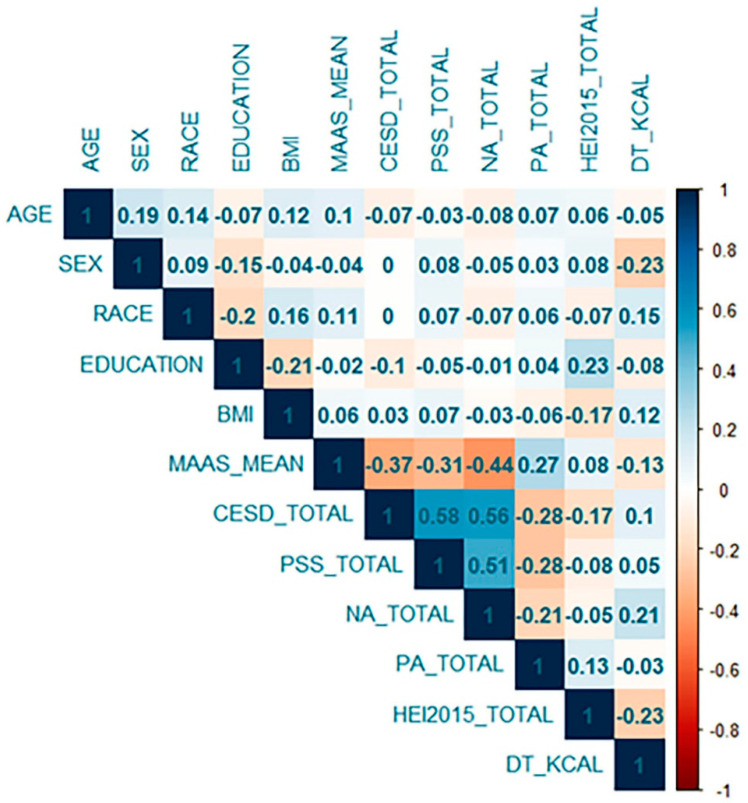
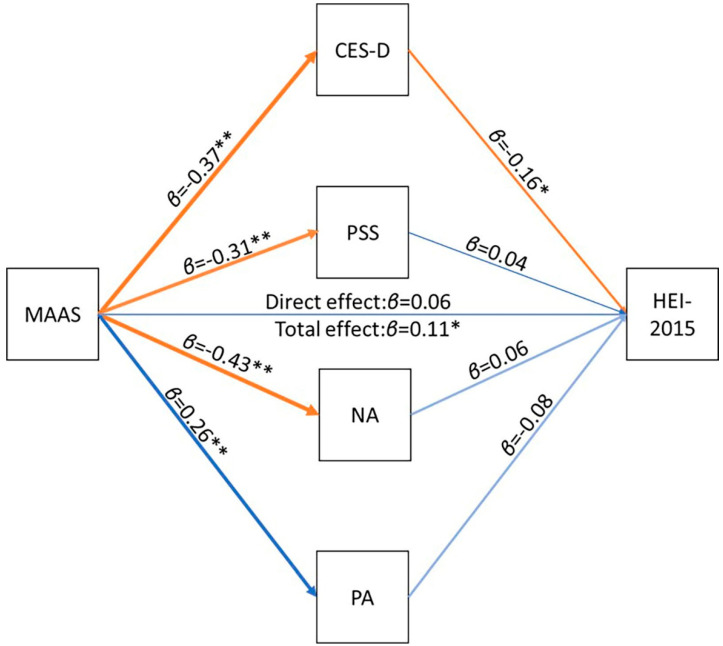
Mindfulness, a practice of non-judgmental awareness of present experience, has been associated with reduced eating psychopathology and emotion-driven eating. However, it remains unclear whether mindfulness relates to diet quality. Thus, the purpose of this study was to examine whether dispositional mindfulness is associated with diet quality and to explore psychological factors relating dispositional mindfulness to diet quality. Community-dwelling adults (N = 406; Mage = 43.19, SD = 7.26; Mbody mass index [BMI] = 27.08, SD = 5.28; 52% female) completed ratings of dispositional mindfulness, depressive symptoms, perceived stress, positive affect (PA), and negative affect (NA). Dietary intake was assessed using the Block Food Frequency Questionnaire, from which the 2015 Healthy Eating Index was derived. Analyses were conducted using the “lavaan” package in R with bias-corrected bootstrapped confidence intervals (BootCI). Age, sex, race, education, and BMI were entered as covariates in all models. Higher dispositional mindfulness was associated with higher diet quality (β = 0.11, p = 0.03), and this effect was mediated through lower depressive symptoms (indirect effect β = 0.06, p = 0.02, BootCI = 0.104–1.42, p = 0.03). Dispositional mindfulness was negatively correlated with perceived stress (β = −0.31, p < 0.01) and NA (β = −0.43, p < 0.01), as well as positively correlated with PA (β = −0.26, p < 0.01). However, these factors were unrelated to diet quality. These cross-sectional data provide initial evidence that dispositional mindfulness relates to diet quality among midlife adults, an effect that may be explained in part by less depressive symptomatology. Given that lifestyle behaviors in midlife are leading determinants of risk for cardiovascular disease and neurocognitive impairment in late life, interventions to enhance mindfulness in midlife may mitigate disease risk. Additional research assessing the impact of mindfulness interventions on diet quality are warranted.
Overview
The claims and statistics of this paper haven’t been checked yet.
Free: it reads the open-access text and checks the first 5 claims that cite a source we can check. Create a free account to check every claim.
Integrity signals
Registry
Cites
Statistics
Figures
Verification
Claims the paper makes
The claims and statistics of this paper haven’t been checked yet.
Free: it reads the open-access text and checks the first 5 claims that cite a source we can check. Create a free account to check every claim.
Self-check
Percentages, sums and reported differences re-computed from the paper’s own numbers.
The self-check needs the paper’s full text.
Citations
Cites
The CES-D Scale: A Self-Report Depression Scale for Research in the General Population
Radloff, L. S. (1977) · Applied Psychological Measurement · doi:10.1177/014662167700100306 · Cited by 53,267 · cited 1×
“Depressive symptoms were assessed using the Center for Epidemiologic Studies-Depression Scale (CES-D) [63], a self-report measure of the frequency of 20 common depressive symptoms rated along a 0 (“Rarely or none of the time”) to 3 (“Most or all of the time”) on the Likert scale.”
A Global Measure of Perceived Stress
Cohen, S., Kamarck, T., & Mermelstein, R. (1983) · Journal of Health and Social Behavior · doi:10.2307/2136404 · Cited by 32,807 · cited 1×
“The 10-item version of the Perceived Stress Scale (PSS) [65] was administered to assess experiences of daily life stress.”
lavaan : An R Package for Structural Equation Modeling
Rosseel, Y. (2012) · Journal of Statistical Software · doi:10.18637/jss.v048.i02 · Cited by 27,955
The benefits of being present: Mindfulness and its role in psychological well-being
Brown, K. W., & Ryan, R. M. (2003) · Journal of Personality and Social Psychology · doi:10.1037/0022-3514.84.4.822 · Cited by 13,448 · cited 3×
“74), comparable to scores obtained in prior investigations among healthy adults [54,55].”
The PANAS-X: Manual for the Positive and Negative Affect Schedule - Expanded Form
Watson, D., & Clark, L. A. (1994) · University of Iowa · doi:10.17077/48vt-m4t2 · Cited by 3,700 · cited 5×
“To evaluate individual differences in trait positive affect (PA) and negative affect (NA), participants were administered the Positive Affect Negative Affect Schedule-Expanded Form (PANAS-X; see Reference [67].”
InfluentialCrawford, J. R., & Henry, J. D. (2004) · British Journal of Clinical Psychology · doi:10.1348/0144665031752934 · Cited by 2,957
Diet, lifestyle, and the risk of type 2 diabetes mellitus in women.
Hu, F. B., Manson, J. E., Stampfer, M. J., Colditz, G., Liu, S., Solomon, C. G., & Willett, W. C. (2001) · New England Journal of Medicine · doi:10.1056/nejmoa010492 · Cited by 2,901
Effects of mindfulness on psychological health: A review of empirical studies
Keng, S.-L., Smoski, M. J., & Robins, C. J. (2011) · Clinical Psychology Review · doi:10.1016/j.cpr.2011.04.006 · Cited by 2,687
Mozaffarian, D. (2016) · Circulation · doi:10.1161/circulationaha.115.018585 · Cited by 2,216 · cited 1×
“Among the complex and interacting factors that have been shown to influence dietary intake patterns [14], the capacity to engage self-regulation skills in response to cognitive, social and emotional triggers for eating has been identified as one of the most important predictors of eating and weight…”
Update of the Healthy Eating Index: HEI‐2015
Krebs-Smith, S. M., Pannucci, T. E., Subar, A. F., Kirkpatrick, S. I., Lerman, J. L., Tooze, J. A., Wilson, M. M., & Reedy, J. (2018) · Journal of the Academy of Nutrition and Dietetics · doi:10.1016/j.jand.2018.05.021 · Cited by 2,198 · cited 1×
“…the FFQ were then used to calculate the 2015 version of the healthy eating index (HEI), a measure of dietary quality developed to quantify the degree to which an individual’s dietary intake patterns conform to the recommendations put forth in the 2015–2020 Dietary Guidelines for Americans [73].”
Cited by
Does mindful eating affect the diet quality of adults?
Dogan, B. G., & Tengilimoglu-Metin, M. M. (2023) · Nutrition · doi:10.1016/j.nut.2023.112010 · Cited by 32
Preissner, C. E., Vilier, L., de Vries, H., & Oenema, A. (2024) · Health Psychology Review · doi:10.1080/17437199.2024.2310115 · Cited by 12
“…et al., 2021; Stanszus et al., 2019; Strowger et al., 2018; van Berkel et al., 2014; Werner et al., 2020) 24 53.3 (Kang et al., 2017; Tsafou et al., 2016) 2 4.4 (Donofry et al., 2020; Gillman & Bryan, 2020; Huberty et al., 2019; Martin et al., 2013; Murphy et al., 2012; Shi et al., 2019; Slonim…”
InfluentialZhang, Z., He, Z., Qian, J., Qi, X., & Tong, J. S. (2023) · Perceptual and Motor Skills · doi:10.1177/00315125221149833 · Cited by 11
“For example, Murphy et al. (2012) and Donofry et al. (2020) showed that individuals reporting higher dispositional mindfulness were more likely to have better diet quality and healthier eating practices; and several studies suggested that greater dispositional mindfulness was associated with less…”
BackgroundAlYousef, N. H., Alhakeem, F. M., AlNasser, K. A., AlSinan, Z. H., Alessa, Z. K., AlDawood, F. M., Shafey, M. M., & Al-Johani, W. M. (2025) · Journal of Family and Community Medicine · doi:10.4103/jfcm.jfcm_223_25 · Cited by 4
American Heart Association EPI|Lifestyle Scientific Sessions: 2020 Meeting Highlights
Razavi, A. C., Gingras, V., Michos, E. D., Návar, A. M., Brown, S.-A. N., Delker, E., Foti, K. E., Harrison, S. L., Lü, Y., Nierenberg, J. L., et al. (2020) · Journal of the American Heart Association · doi:10.1161/jaha.120.017252 · Cited by 2
Metadata
- Authors
- Donofry, S. D., Erickson, K. I., Levine, M. D., Gianaros, P. J., Muldoon, M. F., & Manuck, S. B.
- Affiliations
- University of Pittsburgh (US)
- Corresponding author
- Donofry, Shannon D.
- ORCID
- Venue
- Nutrients
- Publisher
- MDPI AG
- Published
- 2020-11-06
- Volume
- 12
- Issue
- 11
- Pages
- 3414
- ISSN
- 2072-6643 (ISSN-L)
- PMC
- PMC7695007
- OpenAlex
- W3097769914
- Cited by
- 22
- References
- 96
- Citations by year
- 2026: 5 · 2025: 4 · 2024: 7 · 2023: 3 · 2021: 2 · 2020: 1
- FWCI
- 0.60
- Type
- journal article
- Language
- en
- Open access
- gold
- doi.org
- Licence
- Locations
- Nutrients (publishedVersion, cc-by)
- PubMed Central (publishedVersion, cc-by)
- PubMed (publishedVersion)
- DOAJ (DOAJ: Directory of Open Access Journals) (submittedVersion, cc-by-sa)
- Funders
- National Heart, Lung, and Blood Institute (P01 HL40962, T32 HL007560)
- National Institute on Aging (R01 AG56043)
- Topics
- Social Sciences › Psychology › Clinical Psychology › Mindfulness and Compassion Interventions
- Health Sciences › Medicine › Public Health, Environmental and Occupational Health › Nutritional Studies and Diet
- Health Sciences › Nursing › Nutrition and Dietetics › Nutrition, Health and Food Behavior
- Keywords
- trait mindfulness, diet quality, depressive symptoms, perceived stress, positive affect, negative affect, middle-aged adults, Healthy Eating Index, dietary habits, cardiovascular risk, neurocognitive impairment
- MeSH terms
- Adult, Diet, Female, Humans, Male, Mental Health, Middle Aged, Mindfulness
About these checks
Registry, retraction, Cites and statistics results are computed, not judged, with one exception: a printed reference that no index lists is read once by a model before it counts as a citation error. Claims are extracted by a model and kept only when their quote appears verbatim in the text; each cited source is then checked, with a model’s help, for whether it says what the claim relies on. Those verdicts can be wrong — read the claim’s quote and the cited source before relying on one.
Statistics and arithmetic are recomputed, not judged.
Confidence bands are shown only for fields calibrated on our annotated test set. None is calibrated yet, so no band is shown.
What counts as a claim ›How we measure confidence ›How we check this ›
Are you an author, or do you see a problem with this page? Request a review
How to cite
Cite CoChat for the checks on this page, and the paper for its own findings.
- This page
- CoChat. (2026). Citation check: Relationship between Dispositional Mindfulness, Psychological Health, and Diet Quality among Healthy Midlife Adults. https://app.cochat.ai/papers/10.3390/nu12113414
- The paper
- Donofry, S. D., Erickson, K. I., Levine, M. D., Gianaros, P. J., Muldoon, M. F., & Manuck, S. B. (2020). Relationship between Dispositional Mindfulness, Psychological Health, and Diet Quality among Healthy Midlife Adults. Nutrients. https://doi.org/10.3390/nu12113414
Data sources
Bibliographic data: Semantic Scholar, OpenAlex, Crossref.
Contains information from the Semantic Scholar Academic Graph Datasets, made available under the ODC Attribution License (ODC-BY 1.0).
Semantic Scholar’s data is described in: Kinney, R., et al. (2023). The Semantic Scholar Open Data Platform. arXiv:2301.10140.
