

The DOI matches its Crossref record; 32 of the 32 references it cites were found in a registry or an index; none of the 27 sources its claims cite is checked for support yet.
Dietary Intake of Athletes at the World Masters Athletics Championships as Assessed by Single 24 h Recall
Open accessAbstract
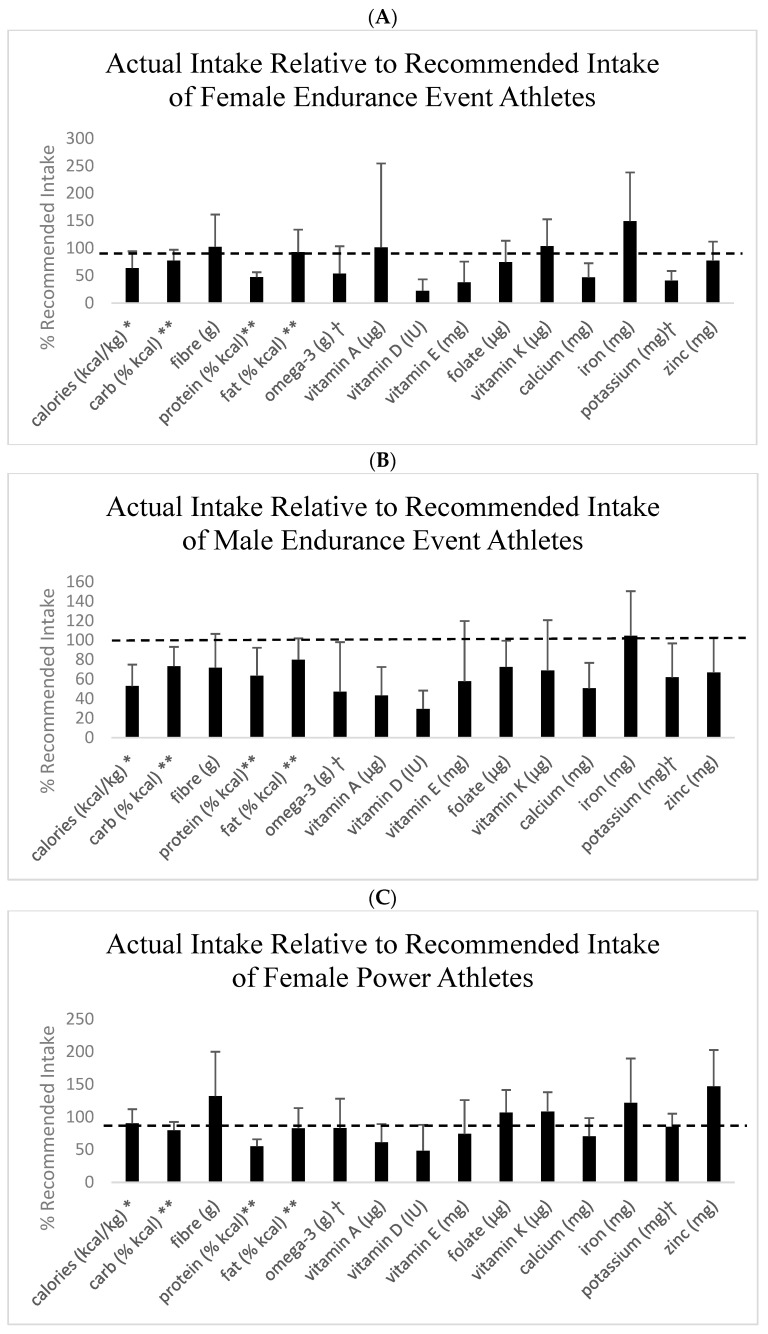
Proper dietary intake is important for masters athletes because of the physiological changes that occur with aging and the unique nutritional needs when competing at high levels. We evaluated the dietary intake of masters athletes competing at the World Masters Athletics Championships (outdoor games, Tampere, Finland, 2022, and indoor games, Torun, Poland, 2023). A total of 43 athletes (16 females and 27 males, mean age 59.2 ± 10.3 y, height 168 ± 8 cm, and body mass 62.3 ± 10.8 kg) participating in endurance (n = 21), sprint (n = 16), jumping (2), multi-component (e.g., decathlon; n = 3), and throwing (n = 1) events provided 24 h dietary recalls while participating in the games. Carbohydrate intake was below the recommended levels for endurance athletes. Protein intake was below the recommended levels for masters athletes, except for female athletes involved in power events (i.e., sprinters and jumpers). Other nutrient intakes that were below the recommended levels included vitamins D and E, calcium, potassium, vitamin A (except for female endurance athletes), folate (except for female power athletes), vitamin C for female endurance athletes, vitamin K and fiber for males, and zinc for endurance athletes. We conclude that while competing at world championships, many athletes are not consuming the recommended levels of carbohydrates, protein, and micronutrients. Athletes attending these games would benefit from increased nutritional support.
Overview
CoChat Summary
TL;DR
In 43 masters athletes competing at the 2022 outdoor and 2023 indoor World Masters Athletics Championships, single 24 h recalls showed carbohydrate and protein intakes below recommendations for most groups, along with low intakes of several micronutrients. Athletes attending these games would benefit from increased nutritional support.
Key findings
- Carbohydrate intake was below endurance athlete recommendations; endurance athletes averaged ~3.2 g/kg/d, with females ~4.0 g/kg and males ~3.0 g/kg, versus guidelines of 5–7 g/kg/d or 6–10 g/kg/d.
- Protein intake was below masters athlete recommendations in most groups except female power athletes. Power athletes had greater intakes of energy, absolute protein, folate, potassium, vitamin B1, and vitamin D than endurance athletes (p < 0.05).
- Below-recommended micronutrients included vitamins D and E, calcium, and potassium in all groups; vitamin A except female endurance; vitamin C in female endurance; zinc in male and female endurance; vitamin K and fiber in male endurance and power; and folate except female power. The only sex difference was greater carbohydrate relative to body mass in females than males (p < 0.05).
- The proportion meeting recommended intakes differed between groups for all nutrients except vitamin B2 and sodium (p < 0.05); female power athletes generally had the greatest proportion meeting recommendations, with exceptions for fat, vitamin A/K, and vitamin E/calcium/iron.
Methods
- Cross-sectional dietary assessment: 43 athletes (16 females, 27 males; mean age 59.2 ± 10.3 y; height 168 ± 8 cm; body mass 62.3 ± 10.8 kg) from endurance (n = 21), sprint (n = 16), jumping (n = 2), multi-component (n = 3), and throwing (n = 1) events at the outdoor Tampere 2022 or indoor Torun 2023 championships.
- Single 24 h dietary recalls were analyzed with Food Processor Software (ESHA Research, Version 11.1) for energy, macronutrients, and micronutrients; endurance was defined as running ≥800 m or racewalking, and power as sprinting, jumping, throwing, decathlon, heptathlon, or pentathlon.
- Descriptive means/SD were compared with recommended values; two-way ANOVA tested athletic group, sex, and group–sex interactions; chi-squared tests compared proportions meeting recommendations; significance was p ≤ 0.05.
Limitations
- Stated: multi-sport athletes were classified as power athletes even though decathlon/heptathlon/pentathlon include one endurance-type event; 3 multi-sport athletes were included, and 2 of 5 female power athletes were multi-sport.
- Stated: single 24 h recalls may underreport intake by 8–30%; even assuming 30% underreporting, vitamin D, vitamin E, and vitamin A in males, zinc in male endurance athletes, and carbohydrates and calcium in endurance athletes would still be below recommendations. Single 24 h recalls were used because of participant burden during competition and may be less accurate than multiple days/recalls; data collected during competition may not represent typical dietary routine.
- Evident from text: small subgroup sizes (e.g., jumping n = 2, throwing n = 1, multi-component n = 3; female power group n = 5) limit precision and generalizability of group/sex comparisons.
Model-written summary. Check it against the paper before relying on it.
Integrity signals
Registry
Cites
Statistics
Figures
Verification
Claims the paper makes
0 Valid · 1 Not valid · 20 Not checked · 30 Own results and interpretations
A check of a cited source is scheduled, or we don’t hold its full text yet; the claim is checked once it runs.
In the paper
“Fat and saturated fat intake were at acceptable levels, but omega-3 fatty acid intake was below the level recommended for masters athletes [2,3].”
- Also stated in: § 4. Discussion · plain
“Omega-3 fatty acid intake was relatively low in our athletes and this is in agreement with other studies of elite masters track and field athletes which determined low intakes of foods high in omega-3 (i.e., fatty fish) [5,6].”
§ Dietary Intake of Athletes at the World Masters Athletics Championships as Assessed by Single 24 h Recall > 3. Results
What the sources say
- Not checked yetcites [2] Strasser, B., Pesta, D., Rittweger, J., Burtscher, J., and Burtscher, M. (2021). Nutrition for Older Athletes: Focus on Sex-Differences. Nutrients, 13. source
A check is scheduled.
- Not checked yetcites [3] Desbrow, 2019, Nutrition for Special Populations: Young, Female, and Masters Athletes, Int. J. Sport Nutr. Exerc. Metab. source
A check is scheduled.
plain- Asserted: passes — The authors put it forward as true.
- Checkable: passes — It can be checked against evidence.
- Load-bearing: passes — The paper’s conclusions depend on it.
- Based: passes — The paper gives a reason why it holds.
- Also stated in: § 4. Discussion · plain
In the paper
“Fat and saturated fat intake were at acceptable levels”
- Also stated in: § 4. Discussion · plain
“Fat and saturated fat intakes of our athletes met the guidelines for athletes, which recommend <10% of calories from saturated fats and not less than 20% of calories from total fats, as adequate fat intake is important for the absorption of fat-soluble vitamins and the maintenance of cellular membranes [1].”
§ Dietary Intake of Athletes at the World Masters Athletics Championships as Assessed by Single 24 h Recall > 3. Results
What the sources say
- Not checked yetcites [1] Thomas, 2016, American College of Sports Medicine Joint Position Statement. Nutrition and Athletic Performance, Med. Sci. Sports Exerc. source
plain- Asserted: passes — The authors put it forward as true.
- Checkable: passes — It can be checked against evidence.
- Load-bearing: passes — The paper’s conclusions depend on it.
- Based: passes — The paper gives a reason why it holds.
- Also stated in: § 4. Discussion · plain
In the paper
“Carbohydrate intake was below the recommended levels for endurance athletes.”
- Also stated in: § 3. Results · plain
“For macronutrients, carbohydrate intake was lower than recommended by sport nutrition guidelines for endurance athletes [1].”
- Also stated in: § 4. Discussion · hedged
“These intakes are still below guidelines [1], indicating that the athletes in our study may have found it challenging to consume sufficient carbohydrates or sufficient calories during competition when traveling to a foreign environment.”
§ Dietary Intake of Athletes at the World Masters Athletics Championships as Assessed by Single 24 h Recall > Abstract
What the sources say
- Not checked yetcites [1] Thomas, 2016, American College of Sports Medicine Joint Position Statement. Nutrition and Athletic Performance, Med. Sci. Sports Exerc. source
plainn = 21- Asserted: passes — The authors put it forward as true.
- Checkable: passes — It can be checked against evidence.
- Load-bearing: passes — The paper’s conclusions depend on it.
- Based: passes — The paper gives a reason why it holds.
- Also stated in: § 3. Results · plain
A result the paper reports from its own data — it cites no other source for it, so there is none to check. The quote shows it is in the paper.
In the paper
“All groups had intakes of vitamins D and E, calcium, and potassium below the recommended levels.”
§ Dietary Intake of Athletes at the World Masters Athletics Championships as Assessed by Single 24 h Recall > 3. Results
plain- Asserted: passes — The authors put it forward as true.
- Checkable: passes — It can be checked against evidence.
- Load-bearing: unclear — It is unclear whether the paper’s conclusions depend on it.
- Based: passes — The paper gives a reason why it holds.
A result the paper reports from its own data — it cites no other source for it, so there is none to check. The quote shows it is in the paper.
In the paper
“vitamin C for female endurance athletes”
- Also stated in: § 3. Results · plain
“vitamin C for female endurance athletes”
§ Dietary Intake of Athletes at the World Masters Athletics Championships as Assessed by Single 24 h Recall > Abstract
plain- Asserted: passes — The authors put it forward as true.
- Checkable: passes — It can be checked against evidence.
- Load-bearing: passes — The paper’s conclusions depend on it.
- Based: passes — The paper gives a reason why it holds.
- Also stated in: § 3. Results · plain
30 more claims
Create a free account to see all 51 claims and to verify the 27 references still open.
- It may state two separate claims as one. 12
- Probably not a substantial claim. 6
Claims other papers make about this one
Each is checked against this paper’s own text: does it say what the citing paper says it does?
In the citing paper
“Six cross-sectional studies [17,22,29,30,31] and one before–after study [27] reported daily protein intakes, ranging between 1.0 and 1.9 g/kg/d.”
From Protein Intake, Physical Performance and Body Composition in Master Athletes—A Short Scoping Review (2025) · cites this paper as [31]
In the citing paper
“four studies reported on athletes from multi-sport backgrounds [17,29,30,31]”
From Protein Intake, Physical Performance and Body Composition in Master Athletes—A Short Scoping Review (2025) · cites this paper as [31]
Citations
Cites
Nutrition and Athletic Performance
(2016) · Medicine & Science in Sports & Exercise · doi:10.1249/mss.0000000000000852 · Cited by 1,305 · cited 16×
“Although mean intakes were at recommended levels, the proportion (i.e., percentage) of endurance athletes consuming the recommended levels of vitamins B1 and B6 and iron were relatively low (Table 1).”
InfluentialKumar, V., Selby, A., Rankin, D., Patel, R., Atherton, P., Hildebrandt, W., Williams, J., Smith, K., Seynnes, O., Hiscock, N., et al. (2009) · The Journal of Physiology · doi:10.1113/jphysiol.2008.164483 · Cited by 740 · cited 1×
“Anabolic resistance may increase with age, as older adults have lower muscle protein synthesis in response to muscle contraction [12,13] and amino acid intake [14] and therefore require a greater amount of protein to stimulate muscle protein synthesis [14].”
BackgroundFreedman, L. S., Commins, J. M., Moler, J. E., Arab, L., Baer, D. J., Kipnis, V., Midthune, D., Moshfegh, A. J., Neuhouser, M. L., Prentice, R. L., et al. (2014) · American Journal of Epidemiology · doi:10.1093/aje/kwu116 · Cited by 528
Anabolic Resistance of Muscle Protein Synthesis with Aging
Burd, N. A., Gorissen, S. H., & van Loon, L. J. C. (2013) · Exercise and Sport Sciences Reviews · doi:10.1097/jes.0b013e318292f3d5 · Cited by 384
Burrows, T. L., Ho, Y. Y., Rollo, M. E., & Collins, C. E. (2019) · Frontiers in Endocrinology · doi:10.3389/fendo.2019.00850 · Cited by 212
Larson-Meyer, D. E., & Willis, K. S. (2010) · Current Sports Medicine Reports · doi:10.1249/jsr.0b013e3181e7dd45 · Cited by 169
Forbes, S. C., Candow, D. G., Little, J. P., Magnus, C., & Chilibeck, P. D. (2007) · International Journal of Sport Nutrition and Exercise Metabolism · doi:10.1123/ijsnem.17.5.433 · Cited by 145 · cited 1×
“…consumption at the level observed in our athletes (~3 mg/kg/d, Table 1) was at a level that may induce improvements in performance because caffeine acts as a central nervous system stimulant and blocks adenosine receptors and may increase the mobilization of fats from adipose tissue [26,27].”
BackgroundSelf-citationEnergy system contribution to 400-metre and 800-metre track running
Duffield, R., Dawson, B., & Goodman, C. (2005) · Journal of Sports Sciences · doi:10.1080/02640410410001730043 · Cited by 119
The anabolic response to resistance exercise and a protein-rich meal is not diminished by age
Symonsi, T. B., Sheffield-Moore, M., Mamerow, M. M., Wolfe, R. R., & Paddon-Jones, D. (2011) · The Journal of nutrition, health and aging · doi:10.1007/s12603-010-0319-z · Cited by 112
A pulse-based diet is effective for reducing total and LDL-cholesterol in older adults
Abeysekara, S., Chilibeck, P. D., Vatanparast, H., & Zello, G. A. (2012) · British Journal Of Nutrition · doi:10.1017/s0007114512000748 · Cited by 112
Self-citationNutrition for Special Populations: Young, Female, and Masters Athletes
Desbrow, B., Burd, N. A., Tarnopolsky, M., Moore, D. R., & Elliott-Sale, K. J. (2019) · International Journal of Sport Nutrition and Exercise Metabolism · doi:10.1123/ijsnem.2018-0269 · Cited by 100
Aging Skeletal Muscle: Response to Exercise
Cartee, G. D. (1994) · Exercise and Sport Sciences Reviews · doi:10.1249/00003677-199401000-00006 · Cited by 96
The effects of caffeine, nicotine, ethanol, and tetrahydrocannabinol on exercise performance
Pesta, D. H., Angadi, S. S., Burtscher, M., & Roberts, C. K. (2013) · Nutrition & Metabolism · doi:10.1186/1743-7075-10-71 · Cited by 91
Self-citationZinc at the crossroads of exercise and proteostasis
Hernández-Camacho, J. D., Vicente-García, C., Parsons, D. S., & Navas-Enamorado, I. (2020) · Redox Biology · doi:10.1016/j.redox.2020.101529 · Cited by 88
Benefits of a plant-based diet and considerations for the athlete
Shaw, K. A., Zello, G. A., Rodgers, C. D., Warkentin, T. D., Baerwald, A., & Chilibeck, P. D. (2022) · European Journal of Applied Physiology · doi:10.1007/s00421-022-04902-w · Cited by 85
Self-citationLukaski, H. C. (2005) · American Journal of Clinical Nutrition · doi:10.1093/ajcn/81.5.1045 · Cited by 82
Regulation of muscle potassium: exercise performance, fatigue and health implications
Lindinger, M. I., & Cairns, S. P. (2021) · European Journal of Applied Physiology · doi:10.1007/s00421-020-04546-8 · Cited by 78
Endocrinology of anorexia of ageing
Chapman, I. M. (2004) · Best Practice & Research Clinical Endocrinology & Metabolism · doi:10.1016/j.beem.2004.02.004 · Cited by 77
Johnson, K. O., Shannon, O. M., Matu, J., Holliday, A., Ispoglou, T., & Deighton, K. (2020) · Aging Clinical and Experimental Research · doi:10.1007/s40520-019-01292-6 · Cited by 68
Effect of low sodium and high potassium diet on lowering blood pressure and cardiovascular events
Kim, B. S., Yu, M., & Shin, J. (2024) · Clinical Hypertension · doi:10.1186/s40885-023-00259-0 · Cited by 48
Considerations for the Consumption of Vitamin and Mineral Supplements in Athlete Populations
Peeling, P., Sim, M., & McKay, A. K. A. (2023) · Sports Medicine · doi:10.1007/s40279-023-01875-4 · Cited by 45
Gao, R., & Chilibeck, P. D. (2020) · Nutrition Research · doi:10.1016/j.nutres.2020.07.001 · Cited by 43
Self-citationValidation of a self-administered 24-hour recall questionnaire used in a large-scale dietary survey
Beer-Borst, S., & Amadò, R. (1995) · Zeitschrift für Ernährungswissenschaft · doi:10.1007/bf01623156 · Cited by 31
Lower Integrated Muscle Protein Synthesis in Masters Compared with Younger Athletes
DOERING, T. M., JENKINS, D. G., REABURN, P. R., BORGES, N. R., HOHMANN, E., & PHILLIPS, S. M. (2016) · Medicine & Science in Sports & Exercise · doi:10.1249/mss.0000000000000935 · Cited by 29
Nutrition for Older Athletes: Focus on Sex-Differences
Strasser, B., Pesta, D., Rittweger, J., Burtscher, J., & Burtscher, M. (2021) · Nutrients · doi:10.3390/nu13051409 · Cited by 25
Self-citationEffects of Long-Term Physical Activity and Diet on Skin Glycation and Achilles Tendon Structure
Hjerrild, J. N., Wobbe, A., Stausholm, M. B., Larsen, A. E., Josefsen, C. O., Malmgaard-Clausen, N. M., Dela, F., Kjaer, M., Magnusson, S. P., Hansen, M., et al. (2019) · Nutrients · doi:10.3390/nu11061409 · Cited by 24
Higher protein intake is associated with improved muscle strength in elite senior athletes
Di Girolamo, F. G., Situlin, R., Fiotti, N., Tence, M., De Colle, P., Mearelli, F., Minetto, M. A., Ghigo, E., Pagani, M., Lucini, D., et al. (2017) · Nutrition · doi:10.1016/j.nut.2017.05.003 · Cited by 22
Dietary Intake of Masters Athletes: A Systematic Review
Guo, S., Shaoni, G. L. L., Stuart-Smith, W. A., Davies, A. J., & Gifford, J. A. (2023) · Nutrients · doi:10.3390/nu15234973 · Cited by 21
Nutrition for Master Athletes: Is There a Need for Specific Recommendations?
Louis, J., Vercruyssen, F., Dupuy, O., & Bernard, T. (2020) · Journal of Aging and Physical Activity · doi:10.1123/japa.2019-0190 · Cited by 15
Pro-Healthy Diet Properties and Its Determinants among Aging Masters Athletes
Ratajczak, J., Czerniak, U., Wieliński, D., Ciekot-Sołtysiak, M., Zieliński, J., Gronek, P., & Demuth, A. (2021) · International Journal of Environmental Research and Public Health · doi:10.3390/ijerph18147614 · Cited by 13
The importance of protein intake in master marathon runners
Methenitis, S., Mouratidis, A., Manga, K., Chalari, E., Feidantsis, K., Arnaoutis, G., Arailoudi-Alexiadou, X., Skepastianos, P., Hatzitolios, A., Mourouglakis, A., et al. (2021) · Nutrition · doi:10.1016/j.nut.2021.111154 · Cited by 12
Liberato, S. C., Bressan, J., & Hills, A. P. (2009) · Revista de Nutrição · doi:10.1590/s1415-52732009000500003 · Cited by 4
Cited by
Organic Food in Athletes Diet—Narrative Review of Alternative Products in Sports Nutrition
Dobrowolski, H., Kopczyńska, K., Kazimierczak, R., Rembiałkowska, E., & Włodarek, D. (2024) · Nutrients · doi:10.3390/nu16142347 · Cited by 6
Protein Intake, Physical Performance and Body Composition in Master Athletes—A Short Scoping Review
Franzke, B., Maierhofer, R., & Putz, P. (2025) · Nutrients · doi:10.3390/nu17030498 · Cited by 3
Ružić, L., Rakovac, M., Bilić-Čurčić, I., Jakovac, D., & Berković, M. C. (2025) · Healthcare · doi:10.3390/healthcare13182328
CORSI, I. (2024) · Electronic Theses and Dissertations Repository (University of Pisa)
Performance and Health in Combined Events: A Scoping Review
Édouard, P. (2025) · Scandinavian Journal of Medicine and Science in Sports · doi:10.1111/sms.70190
Metadata
- Authors
- Leonhardt, T. P. M., Bristol, A., McLaurin, N., Forbes, S. C., Tanaka, H., Frings-Meuthen, P., Pesta, D., Rittweger, J., & Chilibeck, P. D.
- Affiliations
- University of Saskatchewan (CA)
- The University of Texas at Austin (US)
- Brandon University (CA)
- Institute of Aerospace Medicine, German Aerospace Center (DLR), D-51147 Cologne, Germany
- Deutsches Zentrum für Luft- und Raumfahrt e. V. (DLR) (DE)
- Corresponding author
- Chilibeck, Philip D.
- ORCID
- Venue
- Nutrients
- Publisher
- MDPI AG
- Published
- 2024-02-19
- Volume
- 16
- Issue
- 4
- Pages
- 564
- ISSN
- 2072-6643 (ISSN-L)
- PMC
- PMC10893199
- OpenAlex
- W4391983217
- Cited by
- 8
- References
- 32
- Citations by year
- 2026: 3 · 2025: 3 · 2024: 2
- FWCI
- 1.82
- Type
- journal article
- Language
- en
- Open access
- gold
- doi.org
- Licence
- Locations
- Nutrients (publishedVersion, cc-by)
- PubMed Central (publishedVersion, cc-by)
- PubMed (publishedVersion)
- elib (German Aerospace Center) (acceptedVersion)
- Funders
- University of Saskatchewan International Research Partnership Fund
- Topics
- Health Sciences › Nursing › Nutrition and Dietetics › Muscle metabolism and nutrition
- Health Sciences › Medicine › Public Health, Environmental and Occupational Health › Nutrition and Health Studies
- Health Sciences › Nursing › Nutrition and Dietetics › Nutrition, Health and Food Behavior
- Keywords
- masters athletes, dietary intake, carbohydrate intake, protein intake, micronutrient deficiency, endurance athletes, nutritional support, vitamin D, vitamin E, calcium, potassium, folic acid, vitamin C, zinc, fibers
- MeSH terms
- Aged, Energy Intake, Dietary Carbohydrates, Dietary Proteins, Eating, Female, Humans, Male, Middle Aged, Sports, Athletes
About these checks
Registry, retraction, Cites and statistics results are computed, not judged, with one exception: a printed reference that no index lists is read once by a model before it counts as a citation error. Claims are extracted by a model and kept only when their quote appears verbatim in the text; each cited source is then checked, with a model’s help, for whether it says what the claim relies on. Those verdicts can be wrong — read the claim’s quote and the cited source before relying on one.
A language model drew the claims from the paper on 2026-11-14, under version 3 of the claim definition (model deepseek-v4.1-flash, prompt extract-v3).
A second model labelled each claim on 2026-11-14 (model jev-1.13-20260917, definition revision gold-guideline-v0.2).
Statistics and arithmetic are recomputed, not judged.
Confidence bands are shown only for fields calibrated on our annotated test set. None is calibrated yet, so no band is shown.
What counts as a claim ›How we measure confidence ›How we check this ›
Are you an author, or do you see a problem with this page? Request a review
Data sources
Bibliographic data: Semantic Scholar, OpenAlex, Crossref.
Contains information from the Semantic Scholar Academic Graph Datasets, made available under the ODC Attribution License (ODC-BY 1.0).
Semantic Scholar’s data is described in: Kinney, R., et al. (2023). The Semantic Scholar Open Data Platform. arXiv:2301.10140.
