

The DOI matches its Crossref record; 113 of the 114 references it cites were found in a registry or an index.
Dietary Sugars and Endogenous Formation of Advanced Glycation Endproducts: Emerging Mechanisms of Disease
Open accessPublished version of a preprint
Abstract
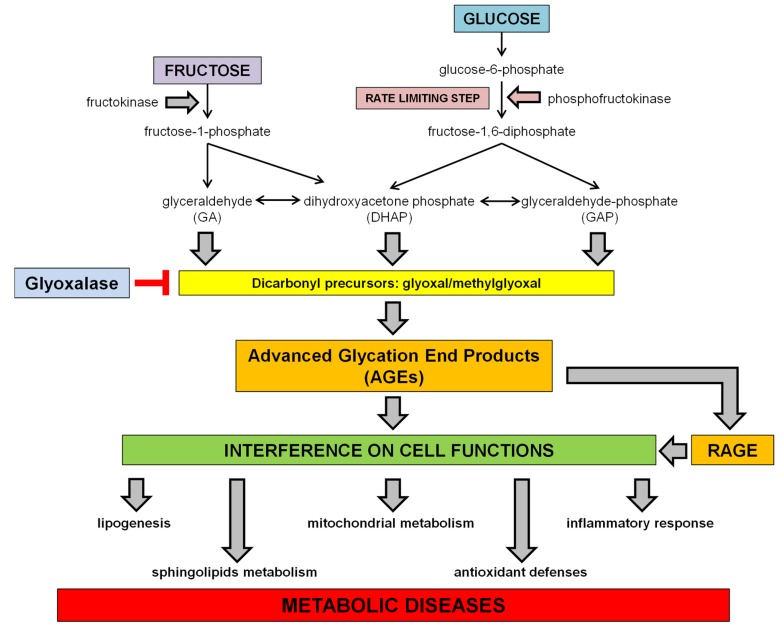
The rapid increase in metabolic diseases, which occurred in the last three decades in both industrialized and developing countries, has been related to the rise in sugar-added foods and sweetened beverages consumption. An emerging topic in the pathogenesis of metabolic diseases related to modern nutrition is the role of Advanced Glycation Endproducts (AGEs). AGEs can be ingested with high temperature processed foods, but also endogenously formed as a consequence of a high dietary sugar intake. Animal models of high sugar consumption, in particular fructose, have reported AGE accumulation in different tissues in association with peripheral insulin resistance and lipid metabolism alterations. The in vitro observation that fructose is one of the most rapid and effective glycating agents when compared to other sugars has prompted the investigation of the in vivo fructose-induced glycation. In particular, the widespread employment of fructose as sweetener has been ascribed by many experimental and observational studies for the enhancement of lipogenesis and intracellular lipid deposition. Indeed, diet-derived AGEs have been demonstrated to interfere with many cell functions such as lipid synthesis, inflammation, antioxidant defences, and mitochondrial metabolism. Moreover, emerging evidence also in humans suggest that this impact of dietary AGEs on different signalling pathways can contribute to the onset of organ damage in liver, skeletal and cardiac muscle, and the brain, affecting not only metabolic control, but global health. Indeed, the most recent reports on the effects of high sugar consumption and diet-derived AGEs on human health reviewed here suggest the need to limit the dietary sources of AGEs, including added sugars, to prevent the development of metabolic diseases and related comorbidities.
Overview
The claims and statistics of this paper haven’t been checked yet.
Run the check — free, no account needed. It reads the open-access text and checks the sources it cites.
Integrity signals
Registry
Cites
Statistics
Figures
Verification
Claims the paper makes
The claims and statistics of this paper haven’t been checked yet.
Run the check — free, no account needed. It reads the open-access text and checks the sources it cites.
Claims other papers make about this one
Each is checked against this paper’s own text: does it say what the citing paper says it does?
In the citing paper
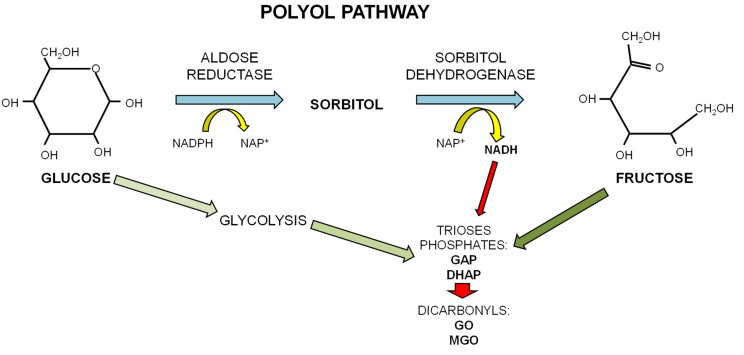
“In addition to nonenzymatic glycation, AGEs can be formed through the polyol pathway and lipid peroxidation in the presence and absence of hyperglycemia, depending on the substrate type, reactant concentration, exposure time, and host cellular context14–17.”
From Advanced glycation end products (AGEs) and other adducts in aging-related diseases and alcohol-mediated tissue injury (2021) · cites this paper as [14]
Self-check
Percentages, sums and reported differences re-computed from the paper’s own numbers.
The self-check needs the paper’s full text.
Citations
Cites
1 retracted
Targeting the NLRP3 inflammasome to Reduce Diet-induced Metabolic Abnormalities in Mice
Chiazza, F., Couturier-Maillard, A., Benetti, E., Mastrocola, R., Nigro, D., Cutrìn, J. C., Serpe, L., Aragno, M., Fantozzi, R., Ryffel, B., et al. (2015) · Molecular Medicine · doi:10.2119/molmed.2015.00104 · Cited by 80
Self-citationRetractedInflammation and metabolic disorders
Hotamisligil, G. S. (2006) · Nature · doi:10.1038/nature05485 · Cited by 9,199
Changes in diet and lifestyle and long-term weight gain in women and men
Mozaffarian, D., Hao, T., Rimm, E. B., Willett, W. C., & Hu, F. B. (2011) · New England Journal of Medicine · doi:10.1056/nejmoa1014296 · Cited by 2,527
Consumption of high-fructose corn syrup in beverages may play a role in the epidemic of obesity
Bray, G. A., Nielsen, S. J., & Popkin, B. M. (2004) · The American Journal of Clinical Nutrition · doi:10.1093/ajcn/79.4.537 · Cited by 1,990
Stanhope, K. L., Schwarz, J. M., Keim, N. L., Griffen, S. C., Bremer, A. A., Graham, J. L., Hatcher, B., Cox, C. L., Dyachenko, A., Zhang, W., et al. (2009) · Journal of Clinical Investigation · doi:10.1172/jci37385 · Cited by 1,765
Sugar-Sweetened Beverages, Obesity, Type 2 Diabetes Mellitus, and Cardiovascular Disease Risk
Malik, V. S., Popkin, B. M., Bray, G. A., Després, J.-P., & Hu, F. B. (2010) · Circulation · doi:10.1161/circulationaha.109.876185 · Cited by 1,641
Schulze, M. B. (2004) · JAMA · doi:10.1001/jama.292.8.927 · Cited by 1,639
Avena, N. M., Rada, P., & Hoebel, B. G. (2008) · Neuroscience & Biobehavioral Reviews · doi:10.1016/j.neubiorev.2007.04.019 · Cited by 1,358
Understanding RAGE, the receptor for advanced glycation end products
Bierhaus, A., Humpert, P. M., Morcos, M., Wendt, T., Chavakis, T., Arnold, B., Stern, D. M., & Nawroth, P. P. (2005) · Journal of Molecular Medicine · doi:10.1007/s00109-005-0688-7 · Cited by 1,297
Added sugar intake and cardiovascular diseases mortality among US adults
Yang, Q., Zhang, Z., Gregg, E. W., Flanders, W. D., Merritt, R., & Hu, F. B. (2014) · JAMA Internal Medicine · doi:10.1001/jamainternmed.2013.13563 · Cited by 947 · cited 1×
“On the other hand, results from experimental models confirm that the consumption of sugar-added foods is associated with increased risk for obesity [7], as well as cardiovascular diseases [8,9], metabolic disorders [10], non-alcoholic fatty liver disease (NAFLD) [11,12], and cognitive decline [13].”
Background
Cited by
Sorted by citations
Rungratanawanich, W., Qu, Y., Wang, X., Essa, M. M., & Song, B.-J. (2021) · Experimental & Molecular Medicine · doi:10.1038/s12276-021-00561-7 · Cited by 411
Periodontal Disease: The Good, The Bad, and The Unknown
Sedghi, L. M., Bacino, M. S., & Kapila, Y. L. (2021) · Frontiers in Cellular and Infection Microbiology · doi:10.3389/fcimb.2021.766944 · Cited by 409
Shen, C., Lu, C., Wu, C.-H., Li, K., Kuo, Y., Hsieh, S., & Yu, C. (2020) · Molecules · doi:10.3390/molecules25235591 · Cited by 316
Grosso, G., Laudisio, D., Frias-Toral, E., Barrea, L., Muscogiuri, G., Savastano, S., & Colao, A. (2022) · Nutrients · doi:10.3390/nu14061137 · Cited by 255
Snelson, M., & Coughlan, M. (2019) · Nutrients · doi:10.3390/nu11020215 · Cited by 230
Metadata
- Authors
- Aragno, M., & Mastrocola, R.
- Affiliations
- University of Turin (IT)
- Corresponding author
- Mastrocola, Raffaella
- Venue
- Nutrients
- Publisher
- MDPI AG
- Published
- 2017-04-14
- Volume
- 9
- Issue
- 4
- Pages
- 385
- ISSN
- 2072-6643 (ISSN-L)
- PMC
- PMC5409724
- OpenAlex
- W2593393776
- Cited by
- 239
- References
- 114
- Citations by year
- 2026: 10 · 2025: 23 · 2024: 27 · 2023: 24 · 2022: 34 · 2021: 36 · 2020: 28 · 2019: 33 · 2018: 14 · 2017: 10
- FWCI
- 3.04
- Type
- journal article
- Language
- en
- Open access
- gold
- doi.org
- Licence
- Locations
- Nutrients (publishedVersion, cc-by)
- Preprints.org (acceptedVersion, cc-by)
- PubMed Central (publishedVersion, cc-by)
- PubMed (publishedVersion)
- Institutional Research Information System University of Turin (University of Turin) (submittedVersion, other-oa)
- Funders
- Università degli Studi di Torino
- Topics
- Life Sciences › Biochemistry, Genetics and Molecular Biology › Clinical Biochemistry › Advanced Glycation End Products research
- Health Sciences › Medicine › Endocrinology, Diabetes and Metabolism › Diet, Metabolism, and Disease
- Life Sciences › Agricultural and Biological Sciences › Food Science › Potato Plant Research
- Keywords
- advanced glycation end products, dietary sugar, fructose, insulin resistance, lipid metabolism, lipogenesis, inflammation, mitochondrial metabolism, antioxidant defense, metabolic disorders, organ damage, sweetened beverages, added sugars
- MeSH terms
- Animals, Brain, Diet, Feeding Behavior, Fructose, Glycosylation, Heart, Humans, Insulin Resistance, Liver, Metabolic Diseases, Muscles, Sweetening Agents, Glycation End Products, Advanced, Lipid Metabolism
About these checks
Registry, retraction, Cites and statistics results are computed, not judged, with one exception: a printed reference that no index lists is read once by a model before it counts as a citation error. Claims are extracted by a model and kept only when their quote appears verbatim in the text; each cited source is then checked, with a model’s help, for whether it says what the claim relies on. Those verdicts can be wrong — read the claim’s quote and the cited source before relying on one.
Statistics and arithmetic are recomputed, not judged.
Confidence bands are shown only for fields calibrated on our annotated test set. None is calibrated yet, so no band is shown.
What counts as a claim ›How we measure confidence ›How we check this ›
Are you an author, or do you see a problem with this page? Request a review
