

Long-Term Dexamethasone Exposure Down-Regulates Hepatic TFR1 and Reduces Liver Iron Concentration in Rats
Open accessThe DOI matches its Crossref record; 62 of the 63 references it cites were found in a registry or an index.
Abstract
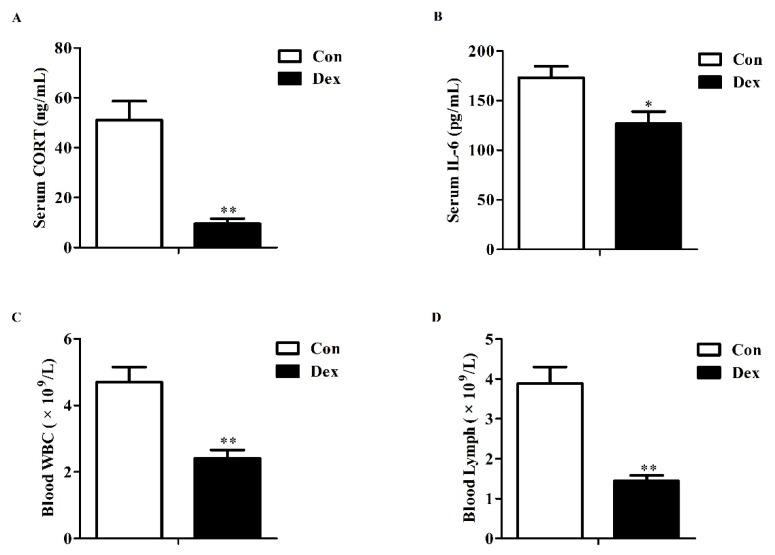
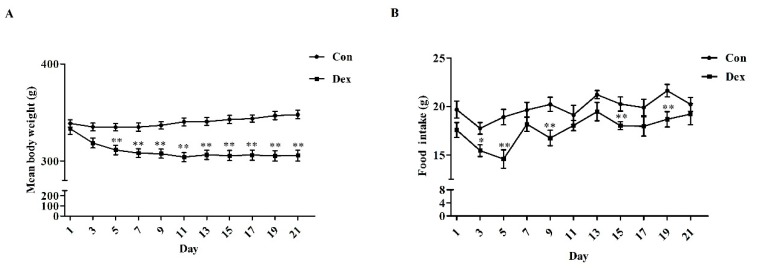
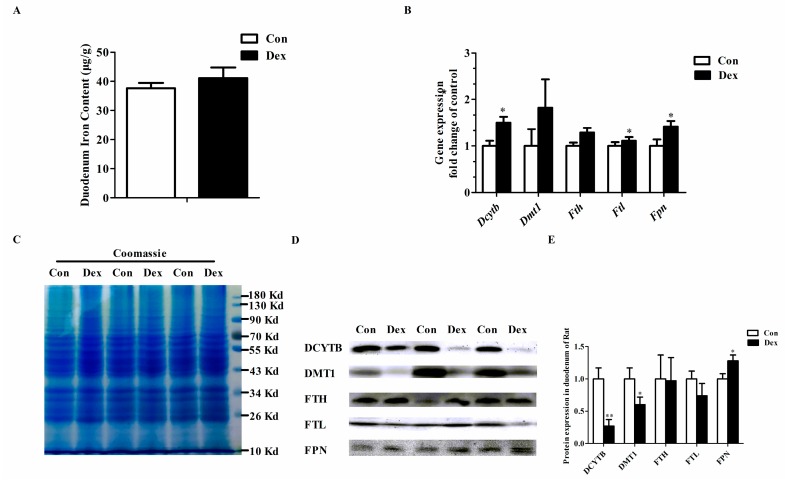
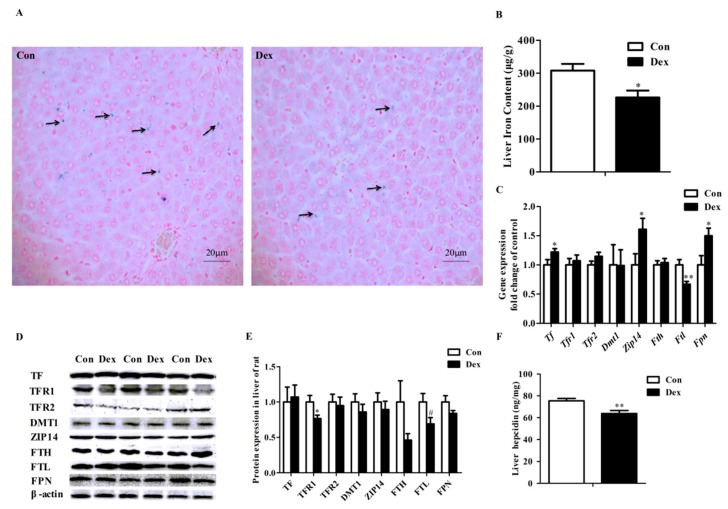
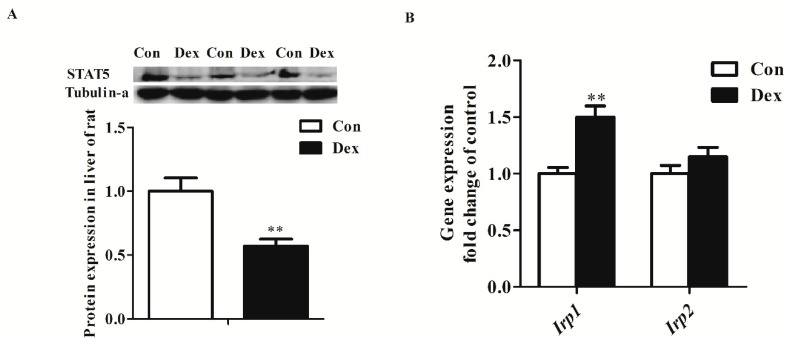
Exposure to stress is known to cause hepatic iron dysregulation, but the relationship between prolonged stress and liver iron metabolism is not yet fully understood. Thirty 13-week-old female Sprague–Dawley rats were randomly divided into two groups, as follows: the control group (saline-injection) and the dexamethasone group (Dexamethasone (Dex)-injection 0.1 mg/kg/day). After the 21-day stress trial, the results showed that chronic Dex administration not only impaired serum corticosterone (p = 0.00) and interleukin-6 (IL-6) (p = 0.01) levels, but also decreased white blood cell counts (p = 0.00), and reduced blood lymphocyte counts (p = 0.00). The daily Dex-injection also significantly reduced body weight (p < 0.01) by inhibiting food intake. Consecutive Dex administration resulted in decreased iron intake (p = 0.00), enhanced serum iron levels (p = 0.01), and increased the serum souble transferrin receptor (sTfR) content (p = 0.00) in rats. Meanwhile, long-term Dex exposure down-regulated duodenal cytochrome b (DCYTB) (p = 0.00) and the divalent metal transporter 1 (DMT1) (p = 0.04) protein expression, but up-regulated ferroportin (FPN) protein expression (p = 0.04). Chronic Dex administration reduced liver iron concentration (p = 0.02) in rats. Hepatic transferrin receptor 1 (TFR1) expression was lowered at the protein level (p = 0.03), yet with uncoupled mRNA abundance in Dex-treated rats. Enhanced iron-regulatory protein (IRP)/iron-responsive element (IRE) binding activity was observed, but did not line up with lowered hepatic TFR1 protein expression. This study indicates that long-term Dex exposure reduces liver iron content, which is closely associated with down-regulated hepatic TFR1 protein expression.
Overview
The claims and statistics of this paper haven’t been checked yet.
Free: it reads the open-access text and checks the first 5 claims that cite a source we can check. Create a free account to check every claim.
Integrity signals
Registry
Cites
Statistics
Figures
Verification
Claims the paper makes
The claims and statistics of this paper haven’t been checked yet.
Free: it reads the open-access text and checks the first 5 claims that cite a source we can check. Create a free account to check every claim.
Claims other papers make about this one
Each is checked against this paper’s own text: does it say what the citing paper says it does?
The check wasn’t confident either way, so it gives no verdict — never disputed.
In the citing paper
“In addition, deficient vitamin D levels are positively correlated with lower high-density lipoprotein levels, which might lead to abnormal cholesterol metabolism [172].”
From Emerging role of liver-bone axis in osteoporosis (2024) · cites this paper as [172]
Experimental — accuracy not yet measuredIn the citing paper
“In addition, deficient vitamin D levels are positively correlated with lower high-density lipoprotein levels, which might lead to abnormal cholesterol metabolism [172].”
From Emerging role of liver-bone axis in osteoporosis (2024) · cites this paper as [172]
In the citing paper
“Maintenance of systemic and cellular iron homeostasis predominantly regulated by the liver through the iron regulatory hormone hepcidin is vital for normal physiological functions in mammals [172].”
From Emerging role of liver-bone axis in osteoporosis (2024) · cites this paper as [172]
Self-check
Percentages, sums and reported differences re-computed from the paper’s own numbers.
The self-check needs the paper’s full text.
Citations
Cites
Analysis of Relative Gene Expression Data Using Real-Time Quantitative PCR and the 2−ΔΔCT Method
Livak, K. J., & Schmittgen, T. D. (2001) · Methods · doi:10.1006/meth.2001.1262 · Cited by 180,860 · cited 1×
“The 2−∆∆Ct method was used to analyze real-time PCR data [28].”
Hepcidin Regulates Cellular Iron Efflux by Binding to Ferroportin and Inducing Its Internalization
Nemeth, E., Tuttle, M. S., Powelson, J., Vaughn, M. B., Donovan, A., Ward, D. M., Ganz, T., & Kaplan, J. (2004) · Science · doi:10.1126/science.1104742 · Cited by 4,803 · cited 4×
“FPN is the only known mammalian iron exporter, and transports iron across the basolateral membrane into the circulation [6,43].”
BackgroundInfluentialMutation of the mouse klotho gene leads to a syndrome resembling ageing
Kuro-o, M., Matsumura, Y., Aizawa, H., Kawaguchi, H., Suga, T., Utsugi, T., Ohyama, Y., Kurabayashi, M., Kaname, T., Kume, E., et al. (1997) · Nature · doi:10.1038/36285 · Cited by 3,837
Two to tango: Regulation of Mammalian iron metabolism
Hentze, M. W., Muckenthaler, M. U., Galy, B., & Camaschella, C. (2010) · Cell · doi:10.1016/j.cell.2010.06.028 · Cited by 2,120 · cited 1×
“Iron homeostasis is maintained by two regulatory systems: hepcidin/ferroportin, and iron-regulatory protein (IRP)/iron-responsive element (IRE), to ensure appropriate supplies [5].”
BackgroundDysmetabolic Hyperferritinemia: All Iron Overload Is Not Hemochromatosis
Makker, J., Hanif, A., Bajantri, B., & Chilimuri, S. (2015) · Case Reports in Gastroenterology · doi:10.1159/000373883 · Cited by 1,351
Effects of stress on immune function: The good, the bad, and the beautiful
Dhabhar, F. S. (2014) · Immunologic Research · doi:10.1007/s12026-014-8517-0 · Cited by 1,343 · cited 5×
“physical), intensity, and duration of the stressors [17,18].”
BackgroundInfluentialThe iron exporter ferroportin/Slc40a1 is essential for iron homeostasis
Donovan, A., Lima, C. A., Pinkus, J. L., Pinkus, G. S., Zon, L. I., Robine, S., & Andrews, N. C. (2005) · Cell Metabolism · doi:10.1016/j.cmet.2005.01.003 · Cited by 1,275 · cited 2×
“FPN is the only known mammalian iron exporter, and transports iron across the basolateral membrane into the circulation [6,43].”
BackgroundGanz, T. (2013) · Physiological Reviews · doi:10.1152/physrev.00008.2013 · Cited by 1,122
Regulation of cellular iron metabolism
Wang, J., & Pantopoulos, K. (2011) · Biochemical Journal · doi:10.1042/bj20101825 · Cited by 986 · cited 1×
“IRP1/2 binds to IREs in the 3′ or 5′ UTR of mRNAs encoding for important proteins of iron uptake (transferrin receptor 1 (Tfr1) and divalent metal transporter 1 (Dmt1), storage (ferritin) and export (ferroportin) to regulate cellular iron metabolism [9,10].”
BackgroundInterleukin-6 induces hepcidin expression through STAT3
Wrighting, D. M., & Andrews, N. C. (2006) · Blood · doi:10.1182/blood-2006-06-027631 · Cited by 983 · cited 1×
“It is proved that hepcidin synthesis is up-regulated by IL-6 through STAT3 signaling pathway [46,47].”
Background
Research works printed but not linked: 1
- Lilienbaum A. Relationship between the proteasomal system and autophagy Int. J. Biochem. Mol. Biol. 2013 4 1 26 23638318 PMC3627065
Cited by
Hirota, K. (2018) · Free Radical Biology and Medicine · doi:10.1016/j.freeradbiomed.2018.07.018 · Cited by 111
Wofford, K. L., Singh, B. S., Cullen, D. K., & Spiller, K. L. (2020) · Acta Biomaterialia · doi:10.1016/j.actbio.2019.11.021 · Cited by 39
Emerging role of liver-bone axis in osteoporosis
Gao, H., Peng, X., Li, N., Gou, L., Xu, T., Wang, Y., Qin, J., Liang, H., Ma, P., Li, S., et al. (2024) · Journal of Orthopaedic Translation · doi:10.1016/j.jot.2024.07.008 · Cited by 36
“Maintenance of systemic and cellular iron homeostasis predominantly regulated by the liver through the iron regulatory hormone hepcidin is vital for normal physiological functions in mammals [172].”
BackgroundReid, B. M., & Georgieff, M. (2023) · Nutrients · doi:10.3390/nu15173798 · Cited by 49
“In contrast, the administration of dexamethasone for three weeks increases serum iron levels and reduces liver content and the expression of transferrin receptor 1 (TFR1) [30], while repeat restraint stress upregulates liver TFR2 expression and leads to liver iron accumulation [31].”
BackgroundIncreased DMT1 and FPN1 expression with enhanced iron absorption in ulcerative colitis human colon
Minor, E. A., Kupec, J. T., Nickerson, A. J., Narayanan, K., & Rajendran, V. M. (2019) · American Journal of Physiology-Cell Physiology · doi:10.1152/ajpcell.00128.2019 · Cited by 36
Metadata
- Authors
- Li, H., Jiang, S., Yang, C., Yang, S., He, B., Ma, W., & Zhao, R.
- Affiliations
- Nanjing Agricultural University (CN)
- Corresponding author
- Ma, Wenqiang
- Venue
- Nutrients
- Publisher
- MDPI AG
- Published
- 2017-06-17
- Volume
- 9
- Issue
- 6
- Pages
- 617
- ISSN
- 2072-6643 (ISSN-L)
- PMC
- PMC5490596
- OpenAlex
- W2624988977
- Cited by
- 27
- References
- 63
- Citations by year
- 2026: 1 · 2025: 9 · 2024: 3 · 2023: 2 · 2022: 1 · 2021: 1 · 2020: 1 · 2019: 6 · 2018: 3
- FWCI
- 2.11
- Type
- journal article
- Language
- en
- Open access
- gold
- doi.org
- Licence
- Locations
- Nutrients (publishedVersion, cc-by)
- Europe PMC (PubMed Central) (publishedVersion, cc-by)
- PubMed Central (publishedVersion, cc-by)
- PubMed (publishedVersion)
- Funders
- National Natural Science Foundation of China (31302053)
- Government of Jiangsu Province
- Priority Academic Program Development of Jiangsu Higher Education Institutions (2013CXLX13_292)
- Fundamental Research Funds for the Central Universities (KJQN201404)
- Topics
- Health Sciences › Medicine › Hematology › Iron Metabolism and Disorders
- Health Sciences › Nursing › Nutrition and Dietetics › Trace Elements in Health
- Physical Sciences › Environmental Science › Health, Toxicology and Mutagenesis › Heavy Metal Exposure and Toxicity
- Keywords
- dexamethasone, chronic glucocorticoid exposure, hepatic iron metabolism, liver iron concentration, transferrin receptor 1, iron regulatory proteins, iron-responsive element, ferroportin, DMT1, duodenal cytochrome b, iron intake, serum iron, corticosterone, interleukin-6
- MeSH terms
- Animals, Anti-Inflammatory Agents, Dexamethasone, Drug Administration Schedule, Female, Gene Expression Regulation, Iron, Liver, Random Allocation, Receptors, Transferrin, Rats, Sprague-Dawley, Rats
About these checks
Registry, retraction, Cites and statistics results are computed, not judged, with one exception: a printed reference that no index lists is read once by a model before it counts as a citation error. Claims are extracted by a model and kept only when their quote appears verbatim in the text; each cited source is then checked, with a model’s help, for whether it says what the claim relies on. Those verdicts can be wrong — read the claim’s quote and the cited source before relying on one.
Statistics and arithmetic are recomputed, not judged.
Confidence bands are shown only for fields calibrated on our annotated test set. None is calibrated yet, so no band is shown.
What counts as a claim ›How we measure confidence ›How we check this ›
Are you an author, or do you see a problem with this page? Request a review
Data sources
Bibliographic data: Semantic Scholar, OpenAlex, Crossref.
Contains information from the Semantic Scholar Academic Graph Datasets, made available under the ODC Attribution License (ODC-BY 1.0).
Semantic Scholar’s data is described in: Kinney, R., et al. (2023). The Semantic Scholar Open Data Platform. arXiv:2301.10140.
