

Long-Term Dexamethasone Exposure Down-Regulates Hepatic TFR1 and Reduces Liver Iron Concentration in Rats
Open accessThe DOI matches its Crossref record; 62 of the 63 references it cites were found in a registry or an index.
Abstract
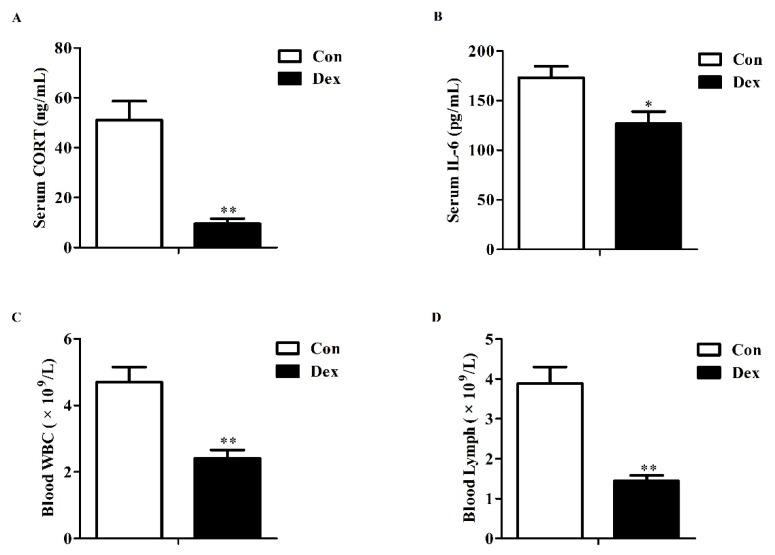
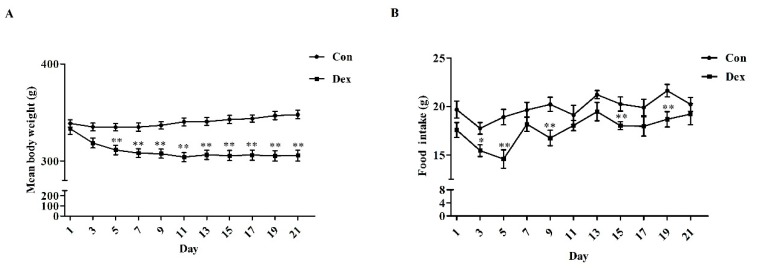
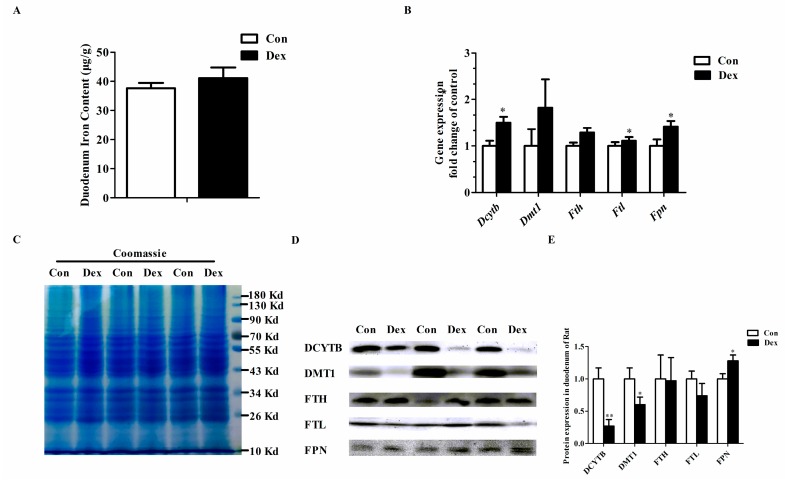
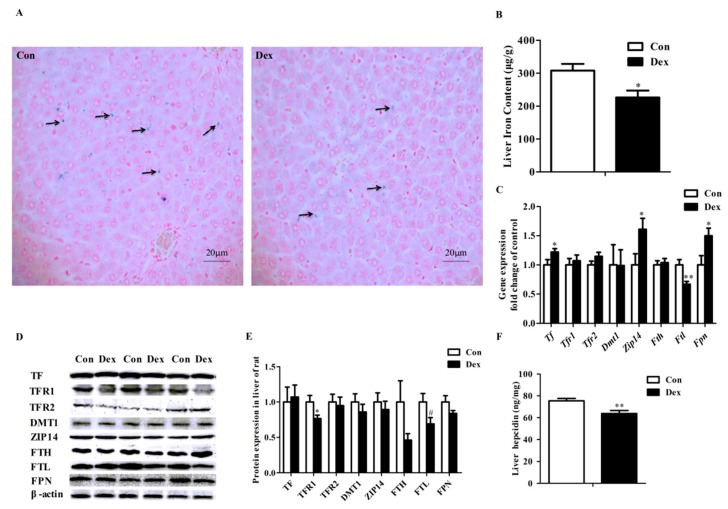
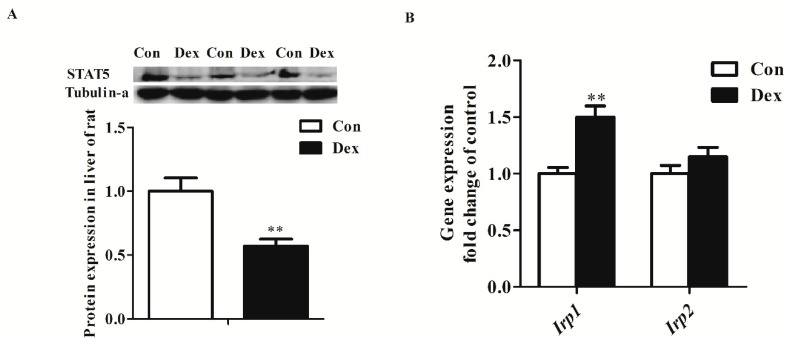
Exposure to stress is known to cause hepatic iron dysregulation, but the relationship between prolonged stress and liver iron metabolism is not yet fully understood. Thirty 13-week-old female Sprague–Dawley rats were randomly divided into two groups, as follows: the control group (saline-injection) and the dexamethasone group (Dexamethasone (Dex)-injection 0.1 mg/kg/day). After the 21-day stress trial, the results showed that chronic Dex administration not only impaired serum corticosterone (p = 0.00) and interleukin-6 (IL-6) (p = 0.01) levels, but also decreased white blood cell counts (p = 0.00), and reduced blood lymphocyte counts (p = 0.00). The daily Dex-injection also significantly reduced body weight (p < 0.01) by inhibiting food intake. Consecutive Dex administration resulted in decreased iron intake (p = 0.00), enhanced serum iron levels (p = 0.01), and increased the serum souble transferrin receptor (sTfR) content (p = 0.00) in rats. Meanwhile, long-term Dex exposure down-regulated duodenal cytochrome b (DCYTB) (p = 0.00) and the divalent metal transporter 1 (DMT1) (p = 0.04) protein expression, but up-regulated ferroportin (FPN) protein expression (p = 0.04). Chronic Dex administration reduced liver iron concentration (p = 0.02) in rats. Hepatic transferrin receptor 1 (TFR1) expression was lowered at the protein level (p = 0.03), yet with uncoupled mRNA abundance in Dex-treated rats. Enhanced iron-regulatory protein (IRP)/iron-responsive element (IRE) binding activity was observed, but did not line up with lowered hepatic TFR1 protein expression. This study indicates that long-term Dex exposure reduces liver iron content, which is closely associated with down-regulated hepatic TFR1 protein expression.
Overview
The claims and statistics of this paper haven’t been checked yet.
Free: it reads the open-access text and checks the first 5 claims that cite a source we can check. Create a free account to check every claim.
Integrity signals
Registry
Cites
Statistics
Figures
Verification
Claims the paper makes
The claims and statistics of this paper haven’t been checked yet.
Free: it reads the open-access text and checks the first 5 claims that cite a source we can check. Create a free account to check every claim.
Claims other papers make about this one
Each is checked against this paper’s own text: does it say what the citing paper says it does?
The check wasn’t confident either way, so it gives no verdict — never disputed.
In the citing paper
“In addition, deficient vitamin D levels are positively correlated with lower high-density lipoprotein levels, which might lead to abnormal cholesterol metabolism [172].”
From Emerging role of liver-bone axis in osteoporosis (2024) · cites this paper as [172]
Experimental — accuracy not yet measuredIn the citing paper
“In addition, deficient vitamin D levels are positively correlated with lower high-density lipoprotein levels, which might lead to abnormal cholesterol metabolism [172].”
From Emerging role of liver-bone axis in osteoporosis (2024) · cites this paper as [172]
In the citing paper
“Maintenance of systemic and cellular iron homeostasis predominantly regulated by the liver through the iron regulatory hormone hepcidin is vital for normal physiological functions in mammals [172].”
From Emerging role of liver-bone axis in osteoporosis (2024) · cites this paper as [172]
Self-check
Percentages, sums and reported differences re-computed from the paper’s own numbers.
The self-check needs the paper’s full text.
Citations
Cites
Analysis of Relative Gene Expression Data Using Real-Time Quantitative PCR and the 2−ΔΔCT Method
Livak, K. J., & Schmittgen, T. D. (2001) · Methods · doi:10.1006/meth.2001.1262 · Cited by 180,860 · cited 1×
“The 2−∆∆Ct method was used to analyze real-time PCR data [28].”
Hepcidin Regulates Cellular Iron Efflux by Binding to Ferroportin and Inducing Its Internalization
Nemeth, E., Tuttle, M. S., Powelson, J., Vaughn, M. B., Donovan, A., Ward, D. M., Ganz, T., & Kaplan, J. (2004) · Science · doi:10.1126/science.1104742 · Cited by 4,803 · cited 4×
“FPN is the only known mammalian iron exporter, and transports iron across the basolateral membrane into the circulation [6,43].”
BackgroundInfluentialMutation of the mouse klotho gene leads to a syndrome resembling ageing
Kuro-o, M., Matsumura, Y., Aizawa, H., Kawaguchi, H., Suga, T., Utsugi, T., Ohyama, Y., Kurabayashi, M., Kaname, T., Kume, E., et al. (1997) · Nature · doi:10.1038/36285 · Cited by 3,837
Two to tango: Regulation of Mammalian iron metabolism
Hentze, M. W., Muckenthaler, M. U., Galy, B., & Camaschella, C. (2010) · Cell · doi:10.1016/j.cell.2010.06.028 · Cited by 2,120 · cited 1×
“Iron homeostasis is maintained by two regulatory systems: hepcidin/ferroportin, and iron-regulatory protein (IRP)/iron-responsive element (IRE), to ensure appropriate supplies [5].”
BackgroundDysmetabolic Hyperferritinemia: All Iron Overload Is Not Hemochromatosis
Makker, J., Hanif, A., Bajantri, B., & Chilimuri, S. (2015) · Case Reports in Gastroenterology · doi:10.1159/000373883 · Cited by 1,351
Effects of stress on immune function: The good, the bad, and the beautiful
Dhabhar, F. S. (2014) · Immunologic Research · doi:10.1007/s12026-014-8517-0 · Cited by 1,343 · cited 5×
“physical), intensity, and duration of the stressors [17,18].”
BackgroundInfluentialThe iron exporter ferroportin/Slc40a1 is essential for iron homeostasis
Donovan, A., Lima, C. A., Pinkus, J. L., Pinkus, G. S., Zon, L. I., Robine, S., & Andrews, N. C. (2005) · Cell Metabolism · doi:10.1016/j.cmet.2005.01.003 · Cited by 1,275 · cited 2×
“FPN is the only known mammalian iron exporter, and transports iron across the basolateral membrane into the circulation [6,43].”
BackgroundGanz, T. (2013) · Physiological Reviews · doi:10.1152/physrev.00008.2013 · Cited by 1,122
Regulation of cellular iron metabolism
Wang, J., & Pantopoulos, K. (2011) · Biochemical Journal · doi:10.1042/bj20101825 · Cited by 986 · cited 1×
“IRP1/2 binds to IREs in the 3′ or 5′ UTR of mRNAs encoding for important proteins of iron uptake (transferrin receptor 1 (Tfr1) and divalent metal transporter 1 (Dmt1), storage (ferritin) and export (ferroportin) to regulate cellular iron metabolism [9,10].”
BackgroundInterleukin-6 induces hepcidin expression through STAT3
Wrighting, D. M., & Andrews, N. C. (2006) · Blood · doi:10.1182/blood-2006-06-027631 · Cited by 983 · cited 1×
“It is proved that hepcidin synthesis is up-regulated by IL-6 through STAT3 signaling pathway [46,47].”
BackgroundForging a field: the golden age of iron biology.
Andrews, N. C. (2008) · Blood · doi:10.1182/blood-2007-12-077388 · Cited by 623
Mechanisms of mammalian iron homeostasis
Pantopoulos, K., Porwal, S. K., Tartakoff, A., & Devireddy, L. (2012) · Biochemistry · doi:10.1021/bi300752r · Cited by 598 · cited 1×
“Transferrin-bound iron is taken up through a TFR1/2-mediated endocytosis [50,51], whereas non-transferrin-bound iron is transported via DMT1 and ZIP14.”
BackgroundLaVaute, T., Smith, S., Cooperman, S., Iwai, K., Land, W., Meyron-Holtz, E., Drake, S. K., Miller, G., Abu-Asab, M., Tsokos, M., et al. (2001) · Nature Genetics · doi:10.1038/84859 · Cited by 509 · cited 1×
“The blocks were subsequently sectioned at 5 μm on the longitudinal plane and stained using the Mallory method of Prussian blue staining [26].”
MethodMammalian iron metabolism and its control by iron regulatory proteins
Anderson, C. P., Shen, M., Eisenstein, R. S., & Leibold, E. A. (2012) · Biochimica et Biophysica Acta (BBA) - Molecular Cell Research · doi:10.1016/j.bbamcr.2012.05.010 · Cited by 493 · cited 1×
“IRP1/2 binds to IREs in the 3′ or 5′ UTR of mRNAs encoding for important proteins of iron uptake (transferrin receptor 1 (Tfr1) and divalent metal transporter 1 (Dmt1), storage (ferritin) and export (ferroportin) to regulate cellular iron metabolism [9,10].”
BackgroundAn inflammatory review of glucocorticoid actions in the CNS
Sorrells, S. F., & Sapolsky, R. M. (2007) · Brain, Behavior, and Immunity · doi:10.1016/j.bbi.2006.11.006 · Cited by 458 · cited 1×
“Therefore, glucocorticoid exposure-induced immunosuppression associated with decreased IL-6, could play a role in iron metabolism, via inhibition of hepcidin synthesis [20].”
BackgroundRegulation of the Iron Homeostatic Hormone Hepcidin
Sangkhae, V., & Nemeth, E. (2017) · Advances in Nutrition · doi:10.3945/an.116.013961 · Cited by 443 · cited 1×
“Hepcidin is mainly produced and secreted by hepatocytes [45], which induces degradation of FPN to regulate systemic iron homeostasis.”
BackgroundGunshin, H., Fujiwara, Y., Custodio, A. O., DiRenzo, C., Robine, S., & Andrews, N. C. (2005) · Journal of Clinical Investigation · doi:10.1172/jci24356 · Cited by 419 · cited 2×
“DCYTB is a ferric reductas that reduces ferric to ferrous iron [40], then ferrous ron is mainly transported from lumen into the ente ocytes by DMT1 in the du denum [41,42].”
BackgroundFerroportin-mediated iron transport: Expression and regulation
Ward, D. M., & Kaplan, J. (2012) · Biochimica et Biophysica Acta (BBA) - Molecular Cell Research · doi:10.1016/j.bbamcr.2012.03.004 · Cited by 373
Regulation of the Hypothalamic-Pituitary-Adrenal Axis
Papadimitriou, A., & Priftis, K. N. (2009) · Neuroimmunomodulation · doi:10.1159/000216184 · Cited by 366 · cited 1×
“The physiological stress responses to stressful stimuli induces the activation of the hypothalamic-pituitary-adrenal axis and releases the glucocorticoids (cortisol in humans; corticosterone in rodents) from the adrenal cortex [21,22].”
BackgroundIron Homeostasis in Health and Disease
Gozzelino, R., & Arosio, P. (2016) · International Journal of Molecular Sciences · doi:10.3390/ijms17010130 · Cited by 359 · cited 1×
“Iron deficiency results in reduced oxygen transport, diminished activity of iron-dependent enzymes, poor growth development and cognitive skills [2,3].”
BackgroundHepcidin-Induced Endocytosis of Ferroportin Is Dependent on Ferroportin Ubiquitination
Qiao, B., Sugianto, P., Fung, E., del-Castillo-Rueda, A., Moran-Jimenez, M.-J., Ganz, T., & Nemeth, E. (2012) · Cell Metabolism · doi:10.1016/j.cmet.2012.03.018 · Cited by 334
Martí, O., Martí, J., & Armario, A. (1994) · Physiology & Behavior · doi:10.1016/0031-9384(94)90055-8 · Cited by 305 · cited 4×
“Stress affects immune function and food intake in a bidirectional way, mainly depending on the intensity and duration of stressors [18,23,29].”
BackgroundInfluentialHow do delays in treatment affect patient prognosis in head and neck cancer?
Mohamedbhai, H., Thomas, S., Ali, S., Whitley, S., Liew, C., Sadiq, Z., Kalavrezos, N., & Hutchinson, I. (2017) · British Journal of Oral and Maxillofacial Surgery · doi:10.1016/j.bjoms.2017.08.058 · Cited by 304
Binder, R., Horowitz, J. A., Basilion, J. P., Koeller, D. M., Klausner, R. D., & Harford, J. B. (1994) · The EMBO Journal · doi:10.1002/j.1460-2075.1994.tb06466.x · Cited by 290 · cited 1×
“When cellular iron is deficient, IRPs bind to IREs of Tfr1 mRNA 3′ UTR and decrease its mRNA turnover and degradation [56].”
BackgroundStressor-specific alterations in corticosterone and immune responses in mice
Bowers, S. L., Bilbo, S. D., Dhabhar, F. S., & Nelson, R. J. (2008) · Brain, Behavior, and Immunity · doi:10.1016/j.bbi.2007.07.012 · Cited by 222 · cited 1×
“Exposure to uncontrollable and unpredictable stressors is a common daily occurrence in the lifestyle of modern society [11].”
BackgroundAnderson, E. R., & Shah, Y. M. (2013) · Comprehensive Physiology · doi:10.1002/cphy.c120016 · Cited by 219 · cited 1×
“The mechanisms of iron uptake in the liver are through TFR-dependent pathways (TFR1 and TFR2) and TFR-independent (DMT1 and ZIP14) pathways, respectively [48,49].”
BackgroundCole, M. A., Kim, P. J., Kalman, B. A., & Spencer, R. L. (2000) · Psychoneuroendocrinology · doi:10.1016/s0306-4530(99)00045-1 · Cited by 215 · cited 2×
“In addition, similar hyper-suppres ion was observed that the lowered serum glucocorticoid (CORT) lev l was caused by the fe dback inhibition of the HPA axis response to a lower d se of Dex exposur [30,31].”
BackgroundJux, C., Leiber, K., Hügel, U., Blum, W. F., Ohlsson, C., Klaus, G., & Mehls, O. (1998) · Endocrinology · doi:10.1210/en.139.7.3296 · Cited by 192
Effect of restraint stress on food intake and body weight is determined by time of day
Rybkin, I. I., Zhou, Y., Volaufova, J., Smagin, G. N., Ryan, D. H., & Harris, R. B. S. (1997) · American Journal of Physiology-Regulatory, Integrative and Comparative Physiology · doi:10.1152/ajpregu.1997.273.5.r1612 · Cited by 184
Graham, R. M. (2007) · World Journal of Gastroenterology · doi:10.3748/wjg.v13.i35.4725 · Cited by 177 · cited 1×
“The mechanisms of iron uptake in the liver are through TFR-dependent pathways (TFR1 and TFR2) and TFR-independent (DMT1 and ZIP14) pathways, respectively [48,49].”
BackgroundA Systems Biology Approach to Iron Metabolism
Chifman, J., Laubenbacher, R., & Torti, S. V. (2014) · Advances in Experimental Medicine and Biology · doi:10.1007/978-1-4939-2095-2_10 · Cited by 167 · cited 1×
“It has been proven that the alteration of iron homeostasis underlies a variety of pathological conditions in mammals [1].”
BackgroundShawki, A., Anthony, S. R., Nose, Y., Engevik, M. A., Niespodzany, E. J., Barrientos, T., Öhrvik, H., Worrell, R. T., Thiele, D. J., & Mackenzie, B. (2015) · American Journal of Physiology-Gastrointestinal and Liver Physiology · doi:10.1152/ajpgi.00160.2015 · Cited by 157 · cited 2×
“DCYTB is a ferric reductas that reduces ferric to ferrous iron [40], then ferrous ron is mainly transported from lumen into the ente ocytes by DMT1 in the du denum [41,42].”
BackgroundSingle exposure to stressors causes long-lasting, stress-dependent reduction of food intake in rats
Vallès, A., Martí, O., García, A., & Armario, A. (2000) · American Journal of Physiology-Regulatory, Integrative and Comparative Physiology · doi:10.1152/ajpregu.2000.279.3.r1138 · Cited by 145
Teague, C. R., Dhabhar, F. S., Barton, R. H., Beckwith-Hall, B., Powell, J., Cobain, M., Singer, B., McEwen, B. S., Lindon, J. C., Nicholson, J. K., et al. (2007) · Journal of Proteome Research · doi:10.1021/pr060412s · Cited by 120 · cited 1×
“The physiological stress responses to stressful stimuli induces the activation of the hypothalamic-pituitary-adrenal axis and releases the glucocorticoids (cortisol in humans; corticosterone in rodents) from the adrenal cortex [21,22].”
BackgroundStat5 regulates cellular iron uptake of erythroid cells via IRP-2 and TfR-1
Kerenyi, M. A., Grebien, F., Gehart, H., Schifrer, M., Artaker, M., Kovacic, B., Beug, H., Moriggl, R., & Müllner, E. W. (2008) · Blood · doi:10.1182/blood-2008-02-138339 · Cited by 114 · cited 1×
“It has been reported that the signal transducer and activator of transcription 5 (STAT5) is an important transcriptional regulator of Tfr1, and its mutation causes microcytic anemia associated with severe iron deficiency in mice [52].”
BackgroundWon Jahng, J., Kim, N. Y., Ryu, V., Yoo, S. B., Kim, B.-T., Kang, D.-W., & Lee, J.-H. (2008) · European Journal of Pharmacology · doi:10.1016/j.ejphar.2007.11.029 · Cited by 93 · cited 5×
“Stres affects function and food intake in a bidirection l way, mainly depending o the intensity nd duration of stressors [18,23,29].”
BackgroundMethodInfluentialIron metabolism: current facts and future decisions
Tandara, L., & Salamunic, I. (2012) · Biochemia Medica · doi:10.11613/bm.2012.034 · Cited by 93 · cited 1×
“Chronic iron overload could cause oxidative stress and increase the risk of liver cirrhosis, cancer, and neurodegenerative diseases [4].”
BackgroundLee, M.-J., Wang, Y., Ricci, M. R., Sullivan, S., Russell, C. D., & Fried, S. K. (2007) · American Journal of Physiology-Endocrinology and Metabolism · doi:10.1152/ajpendo.00439.2006 · Cited by 93 · cited 2×
“Long-term and severe stress results in inhibition of growth and food intake, in part because the increasing release of leptin functions as feeding reductions and enhances energy output [23,37,38].”
BackgroundDuodenal Cytochrome B Expression Stimulates Iron Uptake by Human Intestinal Epithelial Cells
Latunde-Dada, G. O., Simpson, R. J., & McKie, A. T. (2008) · Journal of Nutrition · doi:10.1093/jn/138.6.991 · Cited by 82 · cited 2×
“DCYTB is a ferric reductas that reduces ferric to ferrous iron [40], then ferrous ron is mainly transported from lumen into the ente ocytes by DMT1 in the du denum [41,42].”
BackgroundRegulation of Hepcidin by Erythropoiesis: The Story So Far
Pasricha, S.-R., McHugh, K., & Drakesmith, H. (2016) · Annual Review of Nutrition · doi:10.1146/annurev-nutr-071715-050731 · Cited by 80 · cited 1×
“It is proved that hepcidin synthesis is up-regulated by IL-6 through STAT3 signaling pathway [46,47].”
BackgroundEffects of psychological stress on serum iron and erythropoiesis
Wei, C., Zhou, J., Huang, X., & Li, M. (2008) · International Journal of Hematology · doi:10.1007/s12185-008-0105-4 · Cited by 68 · cited 1×
“However, the 7-day or 14-day psychological stress exposure induced by the communication box did not affect food intake and body weight [13,35,36].”
BackgroundSun, L., Trausch-Azar, J. S., Muglia, L. J., & Schwartz, A. L. (2008) · Proceedings of the National Academy of Sciences · doi:10.1073/pnas.0800165105 · Cited by 67 · cited 2×
“It has been demonstrated that accelerated protein degradation is induced by glucocorticoids (dexamethasone or cortisol) in vitro [57,58] or in vivo [59].”
BackgroundKoob, T. J., & Summers, A. P. (2002) · Comparative Biochemistry and Physiology Part A Molecular & Integrative Physiology · doi:10.1016/s1095-6433(02)00255-6 · Cited by 60 · cited 1×
“physical), intensity, and duration of the stressors [17,18].”
BackgroundCortisol suppression and hearing thresholds in tinnitus after low-dose dexamethasone challenge
Simoens, V. L., & Hébert, S. (2012) · BMC Ear Nose and Throat Disorders · doi:10.1186/1472-6815-12-4 · Cited by 54 · cited 2×
“In addition, similar hyper-suppres ion was observed that the lowered serum glucocorticoid (CORT) lev l was caused by the fe dback inhibition of the HPA axis response to a lower d se of Dex exposur [30,31].”
BackgroundMIELL, J. P., Corder, R., Pralong, F. P., & Gaillard, R. C. (1991) · The Journal of Clinical Endocrinology & Metabolism · doi:10.1210/jcem-72-3-675 · Cited by 53
Effects of stress simulated by dexamethasone on jejunal glucose transport in broilers
Li, Y., Cai, H., Liu, G. H., Dong, X., Chang, W., Zhang, S., Zheng, A., & Chen, G. L. (2009) · Poultry Science · doi:10.3382/ps.2008-00257 · Cited by 50
Psychological stress induces hypoferremia through the IL-6–hepcidin axis in rats
Zhao, M., Chen, J., Wang, W., Wang, L., Ma, L., Shen, H., & Li, M. (2008) · Biochemical and Biophysical Research Communications · doi:10.1016/j.bbrc.2008.05.166 · Cited by 48 · cited 4×
“The psychological stress could up-regulate expressions of IL-6 and hepcidin [14].”
BackgroundInfluentialStimulation by glucocorticoids of protein degradation in hepatocyte monolayers
Hopgood, M. F., Clark, M. G., & Ballard, F. J. (1981) · Biochemical Journal · doi:10.1042/bj1960033 · Cited by 48 · cited 1×
“It has been demonstrated that accelerated protein degradation is induced by glucocorticoids (dexamethasone or cortisol) in vitro [57,58] or in vivo [59].”
BackgroundEffect of dexamethasone, feeding time, and insulin infusion on leptin concentrations in stallions1
Cartmill, J. A., Thompson, D. L., Storer, W. A., Crowley, J. C., Huff, N. K., & Waller, C. A. (2005) · Journal of Animal Science · doi:10.2527/2005.8381875x · Cited by 47 · cited 2×
“Long-term and severe stress results in inhibition of growth and food intake, in part because the increasing release of leptin functions as feeding reductions and enhances energy output [23,37,38].”
BackgroundThe effect of psychological stress on iron absorption in rats
Chen, J., Shen, H., Chen, C., Wang, W., Yu, S., Zhao, M., & Li, M. (2009) · BMC Gastroenterology · doi:10.1186/1471-230x-9-83 · Cited by 44 · cited 2×
“It is repo ted that psychological st e s does n t affect iron intake, but inhibits iron transport via decreased duodenal FPN expression [14,15].”
BackgroundXue, T., Zheng, Y., Li, Y., Shen, Z., Tao, L., Dou, X., Qian, J., & Shen, H. (2014) · BMC Gastroenterology · doi:10.1186/1471-230x-14-32 · Cited by 44 · cited 1×
“However, the 7-day or 14-day psychological stress exposure induced by the communication box did not affect food intake and body weight [13,35,36].”
BackgroundTransferrin receptor 2 mediates uptake of transferrin-bound and non-transferrin-bound iron
Graham, R. M., Reutens, G. M., Herbison, C. E., Delima, R. D., Chua, A. C. G., Olynyk, J. K., & Trinder, D. (2008) · Journal of Hepatology · doi:10.1016/j.jhep.2007.10.009 · Cited by 38 · cited 1×
“Transferrin-bound iron is taken up through a TFR1/2-mediated endocytosis [50,51], whereas non-transferrin-bound iron is transported via DMT1 and ZIP14.”
BackgroundEffects of Restraint Stress on Iron, Zinc, Calcium, and Magnesium Whole Blood Levels in Mice
Wen-feng, T., Sun, W., Shi, L.-F., Hou, D., & Liu, H. (2007) · Biological Trace Element Research · doi:10.1007/s12011-007-8047-x · Cited by 36
Psychological Stress-Induced Lower Serum Zinc and Zinc Redistribution in Rats
Tao, L., Zheng, Y., Shen, Z., Li, Y., Xue, T., Dou, X., Qian, J., & Shen, H. (2013) · Biological Trace Element Research · doi:10.1007/s12011-013-9762-0 · Cited by 35 · cited 1×
“However, the 7-day or 14-day psychological stress exposure induced by the communication box did not affect food intake and body weight [13,35,36].”
BackgroundAutophagic Degradation of Collagen 1A1 by Cortisol in Human Amnion Fibroblasts
Mi, Y., Wang, W., Zhang, C., Liu, C., Lu, J., Li, W., Zuo, R., Myatt, L., & Sun, K. (2017) · Endocrinology · doi:10.1210/en.2016-1829 · Cited by 31 · cited 3×
“(2017) reported that the reduction in COL1A1 protein abundance induced by cortisol was associated with lysosome-mediated autophagic degradation of COL1A1 in fibroblasts [58].”
BackgroundExpression of epithelial cell iron-related genes upon infection by Neisseria meningitidis
Bonnah, R. A., Muckenthaler, M. U., Carlson, H. L., Miñana, B., Enns, C. A., Hentze, M. W., & So, M. (2004) · Cellular Microbiology · doi:10.1111/j.1462-5822.2004.00376.x · Cited by 30 · cited 1×
“On the other hand, Tfr1 expression is mainly regulated post-transcriptionally by cellular iron levels through the IRP–IRE system [55].”
BackgroundChronic psychological stress activates BMP 4‐dependent extramedullary erythropoiesis
Vignjević, S., Budeč, M., Marković, D. C., Đikić, D., Ajtić, O. M., Mojsilović, S. B., Vranješ‐Đurić, S., Koko, V., Čokić, B. B., Čokić, V. P., et al. (2013) · Journal of Cellular and Molecular Medicine · doi:10.1111/jcmm.12167 · Cited by 29
Ma, W., Gu, Y., Lu, J., Yuan, L., & Zhao, R. (2013) · Biological Trace Element Research · doi:10.1007/s12011-013-9875-5 · Cited by 27 · cited 1×
“Digestion of samples was conducted using the electric heating method, according to previous study [27].”
MethodSelf-citationThe role of hepcidin in chronic mild stress-induced depression
Farajdokht, F., Soleimani, M., Mehrpouya, S., Barati, M., & Nahavandi, A. (2015) · Neuroscience Letters · doi:10.1016/j.neulet.2015.01.008 · Cited by 27 · cited 1×
“It is noted that chronic mild stress elevates interleukin-6 (IL-6) to stimulate hepcidin expression in rats [6,19].”
BackgroundEffects of Dexamethasone Immunosuppression on Turkey Clostridial Dermatitis
Thachil, A. J., Shaw, D. P., & Nagaraja, K. V. (2014) · Avian Diseases · doi:10.1637/10819-031314-reg.1 · Cited by 17
Troglitazone Reduces Leptinemia during Experimental Dexamethasone-induced Stress
Caldefie‐Chezet, F., Poulin, A., Enreille-Leger, A., & Vasson, M. (2005) · Hormone and Metabolic Research · doi:10.1055/s-2005-861302 · Cited by 16
He, F., Ma, L., Wang, H., Shen, Z., & Li, M. (2011) · Cell Biochemistry and Biophysics · doi:10.1007/s12013-011-9162-z · Cited by 14
Research works printed but not linked: 1
- Lilienbaum A. Relationship between the proteasomal system and autophagy Int. J. Biochem. Mol. Biol. 2013 4 1 26 23638318 PMC3627065
Cited by
Hirota, K. (2018) · Free Radical Biology and Medicine · doi:10.1016/j.freeradbiomed.2018.07.018 · Cited by 111
Wofford, K. L., Singh, B. S., Cullen, D. K., & Spiller, K. L. (2020) · Acta Biomaterialia · doi:10.1016/j.actbio.2019.11.021 · Cited by 39
Emerging role of liver-bone axis in osteoporosis
Gao, H., Peng, X., Li, N., Gou, L., Xu, T., Wang, Y., Qin, J., Liang, H., Ma, P., Li, S., et al. (2024) · Journal of Orthopaedic Translation · doi:10.1016/j.jot.2024.07.008 · Cited by 36
“Maintenance of systemic and cellular iron homeostasis predominantly regulated by the liver through the iron regulatory hormone hepcidin is vital for normal physiological functions in mammals [172].”
BackgroundReid, B. M., & Georgieff, M. (2023) · Nutrients · doi:10.3390/nu15173798 · Cited by 49
“In contrast, the administration of dexamethasone for three weeks increases serum iron levels and reduces liver content and the expression of transferrin receptor 1 (TFR1) [30], while repeat restraint stress upregulates liver TFR2 expression and leads to liver iron accumulation [31].”
BackgroundIncreased DMT1 and FPN1 expression with enhanced iron absorption in ulcerative colitis human colon
Minor, E. A., Kupec, J. T., Nickerson, A. J., Narayanan, K., & Rajendran, V. M. (2019) · American Journal of Physiology-Cell Physiology · doi:10.1152/ajpcell.00128.2019 · Cited by 36
Metadata
- Authors
- Li, H., Jiang, S., Yang, C., Yang, S., He, B., Ma, W., & Zhao, R.
- Affiliations
- Nanjing Agricultural University (CN)
- Corresponding author
- Ma, Wenqiang
- Venue
- Nutrients
- Publisher
- MDPI AG
- Published
- 2017-06-17
- Volume
- 9
- Issue
- 6
- Pages
- 617
- ISSN
- 2072-6643 (ISSN-L)
- PMC
- PMC5490596
- OpenAlex
- W2624988977
- Cited by
- 27
- References
- 63
- Citations by year
- 2026: 1 · 2025: 9 · 2024: 3 · 2023: 2 · 2022: 1 · 2021: 1 · 2020: 1 · 2019: 6 · 2018: 3
- FWCI
- 2.11
- Type
- journal article
- Language
- en
- Open access
- gold
- doi.org
- Licence
- Locations
- Nutrients (publishedVersion, cc-by)
- Europe PMC (PubMed Central) (publishedVersion, cc-by)
- PubMed Central (publishedVersion, cc-by)
- PubMed (publishedVersion)
- Funders
- National Natural Science Foundation of China (31302053)
- Government of Jiangsu Province
- Priority Academic Program Development of Jiangsu Higher Education Institutions (2013CXLX13_292)
- Fundamental Research Funds for the Central Universities (KJQN201404)
- Topics
- Health Sciences › Medicine › Hematology › Iron Metabolism and Disorders
- Health Sciences › Nursing › Nutrition and Dietetics › Trace Elements in Health
- Physical Sciences › Environmental Science › Health, Toxicology and Mutagenesis › Heavy Metal Exposure and Toxicity
- Keywords
- dexamethasone, chronic glucocorticoid exposure, hepatic iron metabolism, liver iron concentration, transferrin receptor 1, iron regulatory proteins, iron-responsive element, ferroportin, DMT1, duodenal cytochrome b, iron intake, serum iron, corticosterone, interleukin-6
- MeSH terms
- Animals, Anti-Inflammatory Agents, Dexamethasone, Drug Administration Schedule, Female, Gene Expression Regulation, Iron, Liver, Random Allocation, Receptors, Transferrin, Rats, Sprague-Dawley, Rats
About these checks
Registry, retraction, Cites and statistics results are computed, not judged, with one exception: a printed reference that no index lists is read once by a model before it counts as a citation error. Claims are extracted by a model and kept only when their quote appears verbatim in the text; each cited source is then checked, with a model’s help, for whether it says what the claim relies on. Those verdicts can be wrong — read the claim’s quote and the cited source before relying on one.
Statistics and arithmetic are recomputed, not judged.
Confidence bands are shown only for fields calibrated on our annotated test set. None is calibrated yet, so no band is shown.
What counts as a claim ›How we measure confidence ›How we check this ›
Are you an author, or do you see a problem with this page? Request a review
Data sources
Bibliographic data: Semantic Scholar, OpenAlex, Crossref.
Contains information from the Semantic Scholar Academic Graph Datasets, made available under the ODC Attribution License (ODC-BY 1.0).
Semantic Scholar’s data is described in: Kinney, R., et al. (2023). The Semantic Scholar Open Data Platform. arXiv:2301.10140.
