

Real-Time Surface EMG Pattern Recognition for Hand Gestures Based on an Artificial Neural Network
Open accessThe DOI matches its Crossref record; 39 of the 39 references it cites were found in a registry or an index.
Abstract
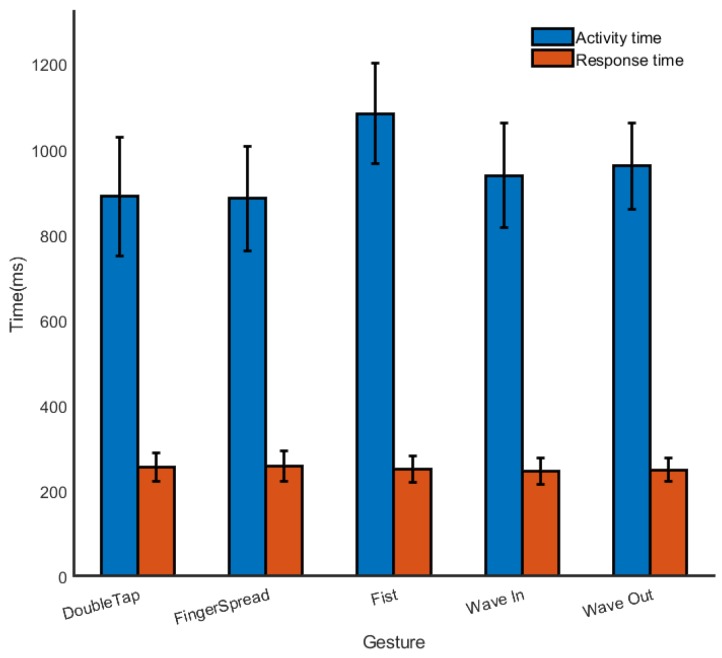
In recent years, surface electromyography (sEMG) signals have been increasingly used in pattern recognition and rehabilitation. In this paper, a real-time hand gesture recognition model using sEMG is proposed. We use an armband to acquire sEMG signals and apply a sliding window approach to segment the data in extracting features. A feedforward artificial neural network (ANN) is founded and trained by the training dataset. A test method is used in which the gesture will be recognized when recognized label times reach the threshold of activation times by the ANN classifier. In the experiment, we collected real sEMG data from twelve subjects and used a set of five gestures from each subject to evaluate our model, with an average recognition rate of 98.7% and an average response time of 227.76 ms, which is only one-third of the gesture time. Therefore, the pattern recognition system might be able to recognize a gesture before the gesture is completed.
Overview
The claims and statistics of this paper haven’t been checked yet.
Free: it reads the open-access text and checks the first 5 claims that cite a source we can check. Create a free account to check every claim.
Integrity signals
Registry
Cites
Statistics
Figures




Verification
Claims the paper makes
The claims and statistics of this paper haven’t been checked yet.
Free: it reads the open-access text and checks the first 5 claims that cite a source we can check. Create a free account to check every claim.
Claims other papers make about this one
Each is checked against this paper’s own text: does it say what the citing paper says it does?
The check wasn’t confident either way, so it gives no verdict — never disputed.
In the citing paper
“CNNs have additionally been shown to detect Alzheimer’s disease in MRI images.[445]”
From Flexible Electronics and Devices as Human–Machine Interfaces for Medical Robotics (2022) · cites this paper as [445]
Experimental — accuracy not yet measured
Self-check
Percentages, sums and reported differences re-computed from the paper’s own numbers.
The self-check needs the paper’s full text.
Citations
Cites
(2008) · Journal of Machine Learning Research · Cited by 33,051
Feature reduction and selection for EMG signal classification
Phinyomark, A., Phukpattaranont, P., & Limsakul, C. (2012) · Expert Systems with Applications · doi:10.1016/j.eswa.2012.01.102 · Cited by 1,542 · cited 1×
“The conventional features used for hand gesture recognition are defined in the following domains: time domain, such as mean absolute value (MAV) and zero crossing (ZC) [28]; frequency domain, such as median frequency and power spectrum ratio [29]; and time-frequency domain, such as wavelets [30].”
BackgroundInfluentialRobust Part-Based Hand Gesture Recognition Using Kinect Sensor
Ren, Z., Yuan, J., Meng, J., & Zhang, Z. (2013) · IEEE Transactions on Multimedia · doi:10.1109/tmm.2013.2246148 · Cited by 746 · cited 1×
“Microsoft’s Kinect sensor is used to obtain depth images and bone information to identify gestures in [15].”
MethodSelf-citationDeep Learning for Electromyographic Hand Gesture Signal Classification Using Transfer Learning
Cote-Allard, U., Fall, C. L., Drouin, A., Campeau-Lecours, A., Gosselin, C., Glette, K., Laviolette, F., & Gosselin, B. (2019) · IEEE Transactions on Neural Systems and Rehabilitation Engineering · doi:10.1109/tnsre.2019.2896269 · Cited by 738 · cited 2×
“92 X Model usi deep learning [38] 98 31 X”
BackgroundMethodVision-based hand-gesture applications
Wachs, J. P., Kölsch, M., Stern, H., & Edan, Y. (2011) · Communications of the ACM · doi:10.1145/1897816.1897838 · Cited by 659 · cited 1×
“There are many sensors used in hand gesture recognition for data acquisition, including cameras [5–8], cyber gloves [9,10], surface electromyography (sEMG) [11,12], and radio frequency [13].”
MethodA Framework for Hand Gesture Recognition Based on Accelerometer and EMG Sensors
Zhang, X., Chen, X., Li, Y., Lantz, V., Wang, K., & Yang, J. (2011) · IEEE Transactions on Systems, Man, and Cybernetics - Part A: Systems and Humans · doi:10.1109/tsmca.2011.2116004 · Cited by 618 · cited 1×
“It shows great potential in the control of bionic hands [1], virtual game control [2], sign language translation [3], and intelligent robotics [4].”
BackgroundHand gesture recognition with 3D convolutional neural networks
Molchanov, P., Gupta, S., Kim, K., & Kautz, J. (2015) · 2015 IEEE Conference on Computer Vision and Pattern Recognition Workshops (CVPRW) · doi:10.1109/cvprw.2015.7301342 · Cited by 543 · cited 1×
“The most common classifiers for hand gesture recognition include support vector machines [17,18], k-nearest neighbors (k-NN) [11,12], decision trees [19], random forest [20], linear discriminant analysis [21,22], artificial neural network (ANN) [23,24], convolutional neural networks [25,26], and gated recurrent unit n…”
BackgroundDardas, N. H., & Georganas, N. D. (2011) · IEEE Transactions on Instrumentation and Measurement · doi:10.1109/tim.2011.2161140 · Cited by 481 · cited 1×
“The most common classifiers for hand gesture recognition include support vector machines [17,18], k-nearest neighbors (k-NN) [11,12], decision trees [19], random forest [20], linear discriminant analysis [21,22], artificial neural network (ANN) [23,24], convolutional neural networks [25,26], and…”
BackgroundCapturing the human figure through a wall
Adib, F., Hsu, C.-Y., Mao, H., Katabi, D., & Durand, F. (2015) · ACM Transactions on Graphics · doi:10.1145/2816795.2818072 · Cited by 443 · cited 1×
“There are many sensors used in hand gesture recognition for data acquisition, including cameras [5–8], cyber gloves [9,10], surface electromyography (sEMG) [11,12], and radio frequency [13].”
MethodWang, S., Song, J., Lien, J., Poupyrev, I., & Hilliges, O. (2016) · Proceedings of the 29th Annual Symposium on User Interface Software and Technology · doi:10.1145/2984511.2984565 · Cited by 433 · cited 1×
“A new sensing technology that uses miniature radar to detect touchless gesture interactions has been developed by Google [16].”
BackgroundEgoGesture: A New Dataset and Benchmark for Egocentric Hand Gesture Recognition
Zhang, Y., Cao, C., Cheng, J., & Lu, H. (2018) · IEEE Transactions on Multimedia · doi:10.1109/tmm.2018.2808769 · Cited by 372
Taylor, J., Bordeaux, L., Cashman, T., Corish, B., Keskin, C., Sharp, T., Soto, E., Sweeney, D., Valentin, J., Luff, B., et al. (2016) · ACM Transactions on Graphics · doi:10.1145/2897824.2925965 · Cited by 294 · cited 1×
“Taylor et al. [7] proposed a new real-time hand tracking system based on a single depth camera, which can accurately reconstruct the complex joint posture of the hand.”
BackgroundApplication of Wavelet Analysis in EMG Feature Extraction for Pattern Classification
Phinyomark, A., Limsakul, C., & Phukpattaranont, P. (2011) · Measurement Science Review · doi:10.2478/v10048-011-0009-y · Cited by 236 · cited 1×
“The conventional features used for hand gesture recognition are defined in the following domains: time domain, such as mean absolute value (MAV) and zero crossing (ZC) [28]; frequency domain, such as median frequency and power spectrum ratio [29]; and time-frequency domain, such as wavelets [30].”
Underactuated robotics: A review
He, B., Wang, S., & Liu, Y. (2019) · International Journal of Advanced Robotic Systems · doi:10.1177/1729881419862164 · Cited by 210 · cited 1×
“It shows great potential in the control of bionic hands [1], virtual game control [2], sign language translation [3], and intelligent robotics [4].”
BackgroundTavakoli, M., Benussi, C., Alhais Lopes, P., Osorio, L. B., & de Almeida, A. T. (2018) · Biomedical Signal Processing and Control · doi:10.1016/j.bspc.2018.07.010 · Cited by 173 · cited 2×
“…[11,24] 89.5,90.54 Model using Discriminant Analysis [37] Model using Naive Bayes [37 76 Model using deep learning [38] 98.31 X Model using SVM [11,36] 92,93.99 X Model using ANN [24] 90.7 X Model using Discriminant Analysis [37] 94.54 X Model using Naive Bayes [37] 81.76 X Model using Random…”
MethodInfluentialHuman-machine interfaces based on EMG and EEG applied to robotic systems
Ferreira, A., Celeste, W. C., Cheein, F. A., Bastos-Filho, T., Sarcinelli-Filho, M., & Carelli, R. O. (2008) · Journal of NeuroEngineering and Rehabilitation · doi:10.1186/1743-0003-5-10 · Cited by 172
Electromygraphy (EMG) signal based hand gesture recognition using artificial neural network (ANN)
Ahsan, M. R., Ibrahimy, M. I., & Khalifa, O. O. (2011) · International Conference on Mechatronics Engineering (ICOM) · doi:10.1109/icom.2011.5937135 · Cited by 172 · cited 14×
“Trained ANN Classifier Step 1 Preprocessing For each user’s data T Do For each user’s data T Do For one user’s data T Train the ANN Classifier with Features D and Gesture labels y i End”
BackgroundInfluentialA Chinese sign language recognition system based on SOFM/SRN/HMM
Gao, W., Fang, G., Zhao, D., & Chen, Y. (2004) · Pattern Recognition · doi:10.1016/j.patcog.2004.04.008 · Cited by 161 · cited 1×
“There are many sensors used in hand gesture recognition for data acquisition, including cameras [5–8], cyber gloves [9,10], surface electromyography (sEMG) [11,12], and radio frequency [13].”
MethodHand Gesture Recognition Based Omnidirectional Wheelchair Control Using IMU and EMG Sensors
Kundu, A. S., Mazumder, O., Lenka, P. K., & Bhaumik, S. (2018) · Journal of Intelligent & Robotic Systems · doi:10.1007/s10846-017-0725-0 · Cited by 152
Hand gesture recognition using machine learning and the Myo armband
Benalcazar, M. E., Jaramillo, A. G., Jonathan, Zea, A., Paez, A., & Andaluz, V. H. (2017) · 2017 25th European Signal Processing Conference (EUSIPCO) · doi:10.23919/eusipco.2017.8081366 · Cited by 141 · cited 2×
“The most common classifiers for hand gesture recognition include support vector machines [17,18], k-nearest neighbors (k-NN) [11,12], decision trees [19], random forest [20], linear discriminant analysis [21,22], artificial neural network (ANN) [23,24], convolutional neural networks [25,26], and gated recurrent unit n…”
BackgroundMethodA convolutional neural network for robotic arm guidance using sEMG based frequency-features
Cote Allard, U., Nougarou, F., Fall, C. L., Giguere, P., Gosselin, C., Laviolette, F., & Gosselin, B. (2016) · 2016 IEEE/RSJ International Conference on Intelligent Robots and Systems (IROS) · doi:10.1109/iros.2016.7759384 · Cited by 135 · cited 1×
“The most common classifiers for hand gesture recognition include support vector machines [17,18], k-nearest neighbors (k-NN) [11,12], decision trees [19], random forest [20], linear discriminant analysis [21,22], artificial neural network (ANN) [23,24], convolutional neural networks [25,26], and gated recurrent unit n…”
BackgroundSubject-independent hand gesture recognition using normalization and machine learning algorithms
Wahid, M. F., Tafreshi, R., Al-Sowaidi, M., & Langari, R. (2018) · Journal of Computational Science · doi:10.1016/j.jocs.2018.04.019 · Cited by 126 · cited 3×
“…sensors MYO armband method [24] 83.1 X Model using k-NN with DTW [11,24] 89.5,90.54 Model using Discriminant Analysis [37] Model using Naive Bayes [37 76 Model using deep learning [38] 98.31 X Model using SVM [11,36] 92,93.99 X Model using ANN [24] 90.7 X Model using Discriminant Analysis [37]…”
MethodInfluentialReal-time hand gesture recognition using the Myo armband and muscle activity detection
Benalcazar, M. E., Motoche, C., Zea, J. A., Jaramillo, A. G., Anchundia, C. E., Zambrano, P., Segura, M., Benalcazar Palacios, F., & Perez, M. (2017) · 2017 IEEE Second Ecuador Technical Chapters Meeting (ETCM) · doi:10.1109/etcm.2017.8247458 · Cited by 123 · cited 5×
“Model only using only the results functions Other methods with MYO armband sensors MYO armband method [24] 83.1 X Model using k-NN with DTW [11,24] 89.5, 90.54 X Model using SVM [11,36] 92, 93.99 X Model using ANN [24] 90.7 X 94.54 X ] 81.”
BackgroundMethodInfluentialAl-Angari, H. M., Kanitz, G., Tarantino, S., & Cipriani, C. (2016) · Biomedical Signal Processing and Control · doi:10.1016/j.bspc.2016.01.011 · Cited by 103 · cited 1×
“The conventional features used for hand gesture recognition are defined in the following domains: time domain, such as mean absolute value (MAV) and zero crossing (ZC) [28]; frequency domain, such as median frequency and power spectrum ratio [29]; and time-frequency domain, such as wavelets [30].”
Chinese Sign Language Recognition Based on an Optimized Tree-Structure Framework
Yang, X., Chen, X., Cao, X., Wei, S., & Zhang, X. (2017) · IEEE Journal of Biomedical and Health Informatics · doi:10.1109/jbhi.2016.2560907 · Cited by 93 · cited 1×
“It shows great potential in the control of bionic hands [1], virtual game control [2], sign language translation [3], and intelligent robotics [4].”
BackgroundReal-Time Control of an Exoskeleton Hand Robot with Myoelectric Pattern Recognition
Lu, Z., Chen, X. '., Zhang, X., Tong, R. K., & Zhou, P. (2016) · International Journal of Neural Systems · doi:10.1142/s0129065717500095 · Cited by 79 · cited 3×
“Lu et al. [34] proposed a myoelectric pattern recognition scheme that uses four channels of sEMG signals to detect and identify the user’s intentions for six di ff erent hand movements and then drives the exoskeleton to help the user complete the desired motion.”
MethodInfluentialReal-time robust vision-based hand gesture recognition using stereo images
Liu, K., & Kehtarnavaz, N. (2013) · Journal of Real-Time Image Processing · doi:10.1007/s11554-013-0333-6 · Cited by 67 · cited 1×
“There are many sensors used in hand gesture recognition for data acquisition, including cameras [5–8], cyber gloves [9,10], surface electromyography (sEMG) [11,12], and radio frequency [13].”
MethodA Prosthetic Hand Body Area Controller Based on Efficient Pattern Recognition Control Strategies
Benatti, S., Milosevic, B., Farella, E., Gruppioni, E., & Benini, L. (2017) · Sensors · doi:10.3390/s17040869 · Cited by 63
Comparing random forest approaches to segmenting and classifying gestures
Joshi, A., Monnier, C. S., Betke, M., & Sclaroff, S. (2016) · Image and Vision Computing · doi:10.1016/j.imavis.2016.06.001 · Cited by 56 · cited 1×
“The most common classifiers for hand gesture recognition include support vector machines [17,18], k-nearest neighbors (k-NN) [11,12], decision trees [19], random forest [20], linear discriminant analysis [21,22], artificial neural network (ANN) [23,24], convolutional neural networks [25,26], and gated recurrent unit n…”
BackgroundFabric-based self-powered noncontact smart gloves for gesture recognition
Wu, H., Guo, H., Su, Z., Shi, M., Chen, X., Cheng, X., Han, M., & Zhang, H. (2018) · Journal of Materials Chemistry A · doi:10.1039/c8ta08276f · Cited by 52 · cited 1×
“There are many sensors used in hand gesture recognition for data acquisition, including cameras [5–8], cyber gloves [9,10], surface electromyography (sEMG) [11,12], and radio frequency [13].”
MethodInferring Static Hand Poses from a Low-Cost Non-Intrusive sEMG Sensor
Nasri, N., Orts‐Escolano, S., Gomez‐Donoso, F., & Cazorla, M. (2019) · Sensors · doi:10.3390/s19020371 · Cited by 45 · cited 1×
“…hand gesture recognition include support vector machines [17,18], k-nearest neighbors (k-NN) [11,12], decision trees [19], random forest [20], linear discriminant analysis [21,22], artificial neural network (ANN) [23,24], convolutional neural networks [25,26], and gated recurrent unit network [27].”
Real-Time Hand Gesture Recognition Based on Artificial Feed-Forward Neural Networks and EMG
Benalcázar, M. E., Anchundia, C. E., Zea, J. A., Zambrano, P., Jaramillo, A. G., & Segura, M. (2018) · European Signal Processing Conference (EUSIPCO) · doi:10.23919/eusipco.2018.8553126 · Cited by 37 · cited 2×
“Furthermore, compared with the existing hand gesture recognition models based on the ANN algorithm [24,39] which do not include the gesture duration in the eventual system response time, our proposed ANN pattern recognition system is not only capable of sharply reducing the total response time, but also lowers the com…”
MethodResultReal-Time Hand Motion Recognition Using sEMG Patterns Classification
Crépin, R., Fall, C. L., Mascret, Q., Gosselin, C., Campeau‐Lecours, A., & Gosselin, B. J. (2018) · Annual International Conference of the IEEE Engineering in Medicine and Biology Society (EMBC) · doi:10.1109/embc.2018.8512820 · Cited by 36 · cited 2×
“The most common classifiers for hand gesture recognition include support vector machines [17,18], k-nearest neighbors (k-NN) [11,12], decision trees [19], random forest [20], linear discriminant analysis [21,22], artificial neural network (ANN) [23,24], convolutional neural networks [25,26], and gated recurrent unit n…”
BackgroundMethodForearm motion discrimination technique using real-time EMG signals
Mizuno, H., TSUJIUCHI, N., & KOIZUMI, T. (2011) · doi:10.1109/iembs.2011.6091100 · Cited by 34 · cited 1×
“Many applications for gesture recognition, such as prothetic limb control, often require real-time response, which means that the total time available for signal acquisition and pattern recognition cannot exceed 300 ms [33].”
BackgroundReal-Time Hand Gesture Recognition Based on Electromyographic Signals and Artificial Neural Networks
Motoche, C., & Benalcázar, M. E. (2018) · Lecture notes in computer science · doi:10.1007/978-3-030-01418-6_35 · Cited by 26 · cited 17×
“Furthermore, compared with the existing hand gesture recognition models based on the ANN algorithm [24,39] which do not include the gesture duration in the eventual system response time, Figure 10.”
BackgroundMethodResultInfluentialBastani, K., Kim, S., Kong, Z., Nussbaum, M. A., & Huang, W. (2016) · IEEE Transactions on Human-Machine Systems · doi:10.1109/thms.2016.2537747 · Cited by 23 · cited 1×
“Moreover, some researchers have investigated the featureless approach that directly feeds the preprocessed data without feature extraction into a classifier, a process which may reduce the computational cost [31,32].”
BackgroundReal Time Hand Gesture Recognition Using Random Forest and Linear Discriminant Analysis
Sangjun, O., Mallipeddi, R., & Lee, M. (2015) · International Conference on Human-Agent Interaction (HAI) · doi:10.1145/2814940.2814997 · Cited by 14 · cited 1×
“The most common classifiers for hand gesture recognition include support vector machines [17,18], k-nearest neighbors (k-NN) [11,12], decision trees [19], random forest [20], linear discriminant analysis [21,22], artificial neural network (ANN) [23,24], convolutional neural networks [25,26], and gated recurrent unit n…”
Background3D hand gesture recognition based on Polar Rotation Feature and Linear Discriminant Analysis
Wang, Y., & Zhang, L. (2013) · International Conference on Intelligent Control and Information Processing · doi:10.1109/icicip.2013.6568070 · Cited by 8 · cited 1×
“The most common classifiers for hand gesture recognition include support vector machines [17,18], k-nearest neighbors (k-NN) [11,12], decision trees [19], random forest [20], linear discriminant analysis [21,22], artificial neural network (ANN) [23,24], convolutional neural networks [25,26], and gated recurrent unit n…”
BackgroundSelf-citationToo, J., Abdullah, A. R., Saad, N. M., Ali, N. M., & Zawawi, T. N. S. T. (2018) · Sensor Letters · doi:10.1166/sl.2018.3926 · Cited by 6 · cited 2×
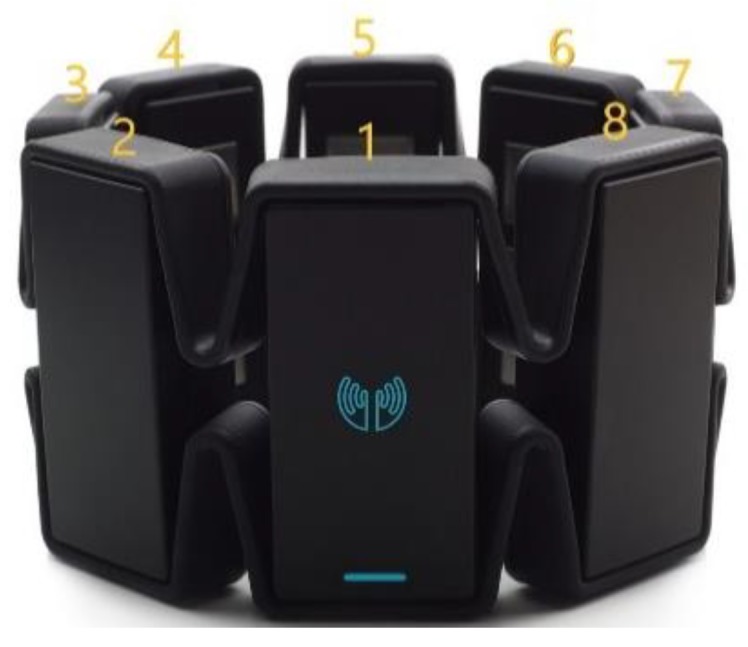
“To facilitate real-time processing, we use the MYO armband (Thalmic Labs, Waterloo, Canada) to acquisition of sEMG data [32].”
BackgroundMethod
Cited by
Flexible Electronics and Devices as Human–Machine Interfaces for Medical Robotics
Heng, W., Solomon, S., & Gao, W. (2022) · Advanced Materials · doi:10.1002/adma.202107902 · Cited by 609
Jaramillo-Yánez, A., Benalcázar, M. E., & Mena-Maldonado, E. (2020) · Sensors · doi:10.3390/s20092467 · Cited by 259
Li, W., Shi, P., & Yu, H. (2021) · Frontiers in Neuroscience · doi:10.3389/fnins.2021.621885 · Cited by 211
Xu, Z., Wu, D., Chen, Z., Wang, Z., Cao, C., Shao, X., Zhou, G., Zhang, S., Wang, L., & Sun, D. (2023) · Microsystems & Nanoengineering · doi:10.1038/s41378-022-00477-w · Cited by 164
Electromyogram-Based Classification of Hand and Finger Gestures Using Artificial Neural Networks
Lee, K. H., Min, J. Y., & Byun, S. (2021) · Sensors · doi:10.3390/s22010225 · Cited by 146
Metadata
- Authors
- Zhang, Z., Yang, K., Qian, J., & Zhang, L.
- Affiliations
- Shanghai University (CN)
- Tongji University (CN)
- Corresponding author
- Zhang, Zhen
- Zhang, Lunwei
- Venue
- Sensors
- Publisher
- MDPI AG
- Published
- 2019-07-18
- Volume
- 19
- Issue
- 14
- Pages
- 3170
- ISSN
- 1424-8220 (ISSN-L)
- PMC
- PMC6679304
- OpenAlex
- W2957121425
- Cited by
- 165
- References
- 39
- Citations by year
- 2026: 9 · 2025: 17 · 2024: 16 · 2023: 31 · 2022: 37 · 2021: 32 · 2020: 19 · 2019: 4
- FWCI
- 8.08
- Type
- journal article
- Language
- en
- Open access
- gold
- dx.doi.org
- Licence
- Locations
- Sensors (publishedVersion, cc-by)
- Europe PMC (PubMed Central) (publishedVersion, cc-by)
- PubMed Central (publishedVersion, cc-by)
- PubMed (publishedVersion)
- DOAJ (DOAJ: Directory of Open Access Journals) (submittedVersion, cc-by-sa)
- Funders
- Shanghai science and technology commission (18JC1410402)
- National Natural Science Foundation of China (61573236, 61875115)
- Topics
- Physical Sciences › Engineering › Biomedical Engineering › Muscle activation and electromyography studies
- Physical Sciences › Computer Science › Human-Computer Interaction › Hand Gesture Recognition Systems
- Physical Sciences › Computer Science › Computer Vision and Pattern Recognition › Context-Aware Activity Recognition Systems
- Keywords
- surface electromyography, hand gesture recognition, real-time recognition, artificial neural networks, sliding window feature extraction, feedforward neural networks, gesture classification, response time
- MeSH terms
- Adult, Algorithms, Electromyography, Female, Gestures, Hand, Humans, Male, Pattern Recognition, Automated, Signal Processing, Computer-Assisted, Biosensing Techniques, Neural Networks, Computer
About these checks
Registry, retraction, Cites and statistics results are computed, not judged, with one exception: a printed reference that no index lists is read once by a model before it counts as a citation error. Claims are extracted by a model and kept only when their quote appears verbatim in the text; each cited source is then checked, with a model’s help, for whether it says what the claim relies on. Those verdicts can be wrong — read the claim’s quote and the cited source before relying on one.
Statistics and arithmetic are recomputed, not judged.
Confidence bands are shown only for fields calibrated on our annotated test set. None is calibrated yet, so no band is shown.
What counts as a claim ›How we measure confidence ›How we check this ›
Are you an author, or do you see a problem with this page? Request a review
Data sources
Bibliographic data: Semantic Scholar, OpenAlex, Crossref.
Contains information from the Semantic Scholar Academic Graph Datasets, made available under the ODC Attribution License (ODC-BY 1.0).
Semantic Scholar’s data is described in: Kinney, R., et al. (2023). The Semantic Scholar Open Data Platform. arXiv:2301.10140.
