

The DOI matches its Crossref record; 29 of the 29 references it cites were found in a registry or an index.
Motion artifact reduction in wearable photoplethysmography based on multi-channel sensors with multiple wavelengths.
Open accessAbstract
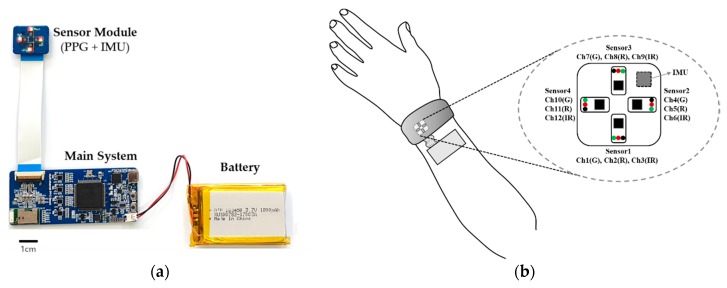
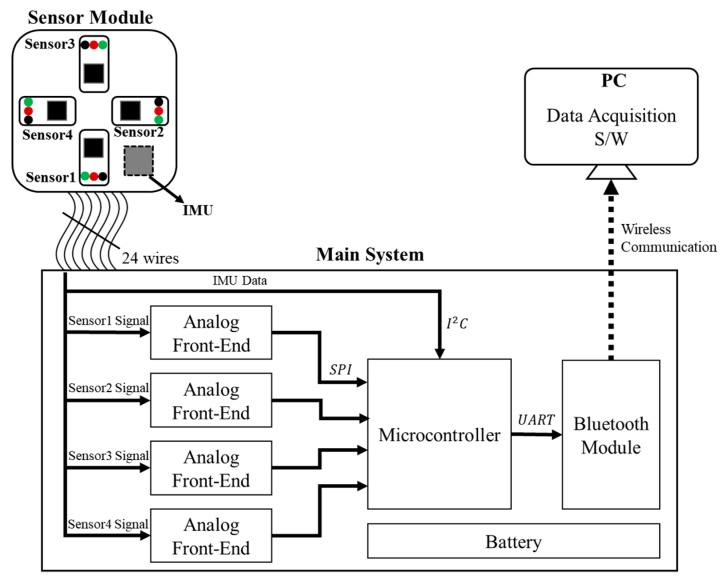
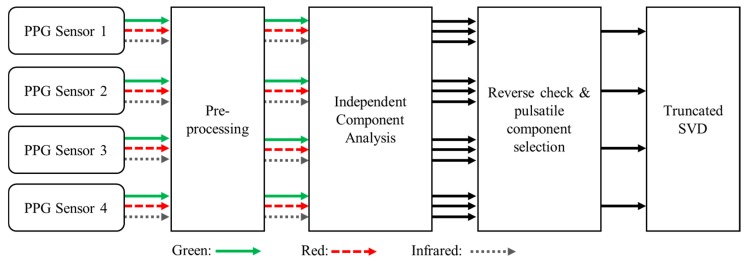
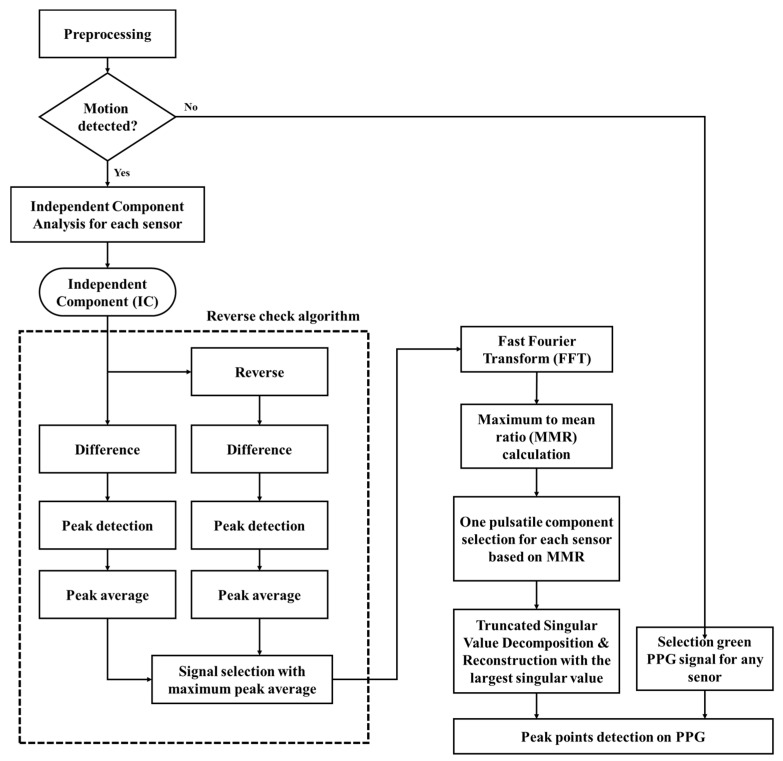
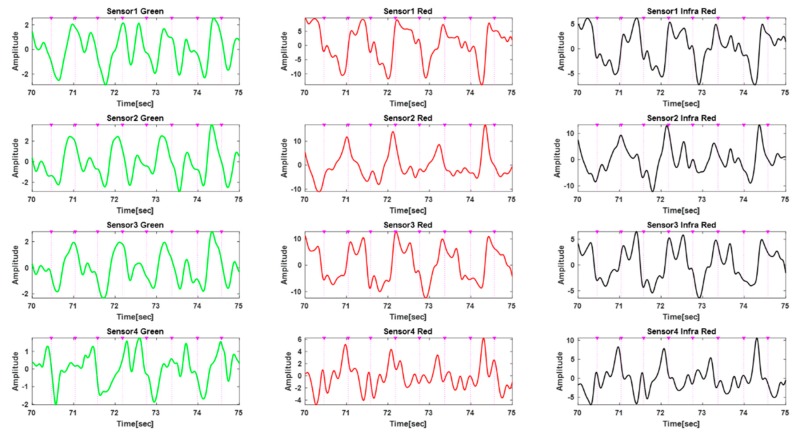
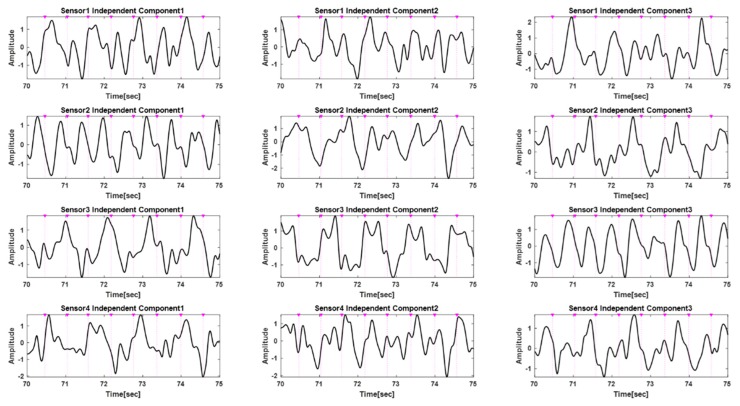
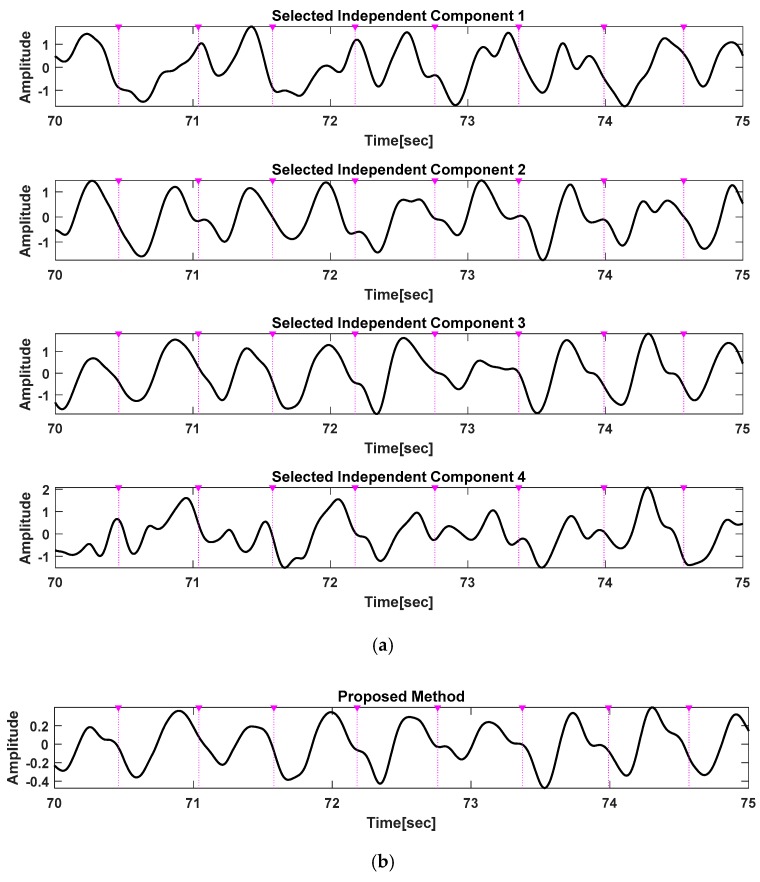
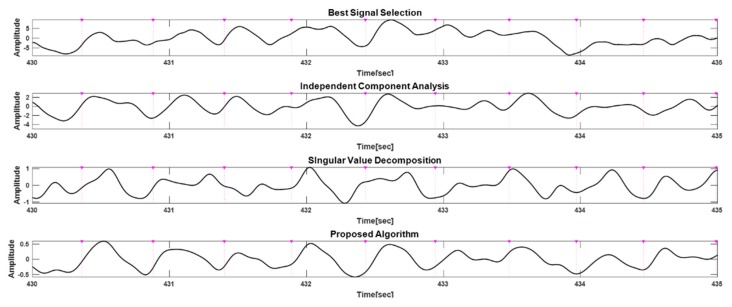
Photoplethysmography (PPG) is an easy and convenient method by which to measure heart rate (HR). However, PPG signals that optically measure volumetric changes in blood are not robust to motion artifacts. In this paper, we develop a PPG measuring system based on multi-channel sensors with multiple wavelengths and propose a motion artifact reduction algorithm using independent component analysis (ICA). We also propose a truncated singular value decomposition for 12-channel PPG signals, which contain direction and depth information measured using the developed multi-channel PPG measurement system. The performance of the proposed method is evaluated against the R-peaks of an electrocardiogram in terms of sensitivity (Se), positive predictive value (PPV), and failed detection rate (FDR). The experimental results show that Se, PPV, and FDR were 99%, 99.55%, and 0.45% for walking, 96.28%, 99.24%, and 0.77% for fast walking, and 82.49%, 99.83%, and 0.17% for running, respectively. The evaluation shows that the proposed method is effective in reducing errors in HR estimation from PPG signals with motion artifacts in intensive motion situations such as fast walking and running.
Overview
The claims and statistics of this paper haven’t been checked yet.
Run the check — free, no account needed. It reads the open-access text and checks the sources it cites.
Integrity signals
Registry
Cites
Statistics
Figures
Verification
Claims the paper makes
The claims and statistics of this paper haven’t been checked yet.
Run the check — free, no account needed. It reads the open-access text and checks the sources it cites.
Claims other papers make about this one
Each is checked against this paper’s own text: does it say what the citing paper says it does?
In the citing paper
“First, our approximation of wear time was based on available per-minute HR values, which have been used in previous studies22; however, wearable device data are affected by motion artifacts.64,65 Thus, our measure of wear time may be an imperfect proxy.”
From Association of Demographic and Socioeconomic Indicators With the Use of Wearable Devices Among Children (2023) · cites this paper as [65]
Self-check
Percentages, sums and reported differences re-computed from the paper’s own numbers.
The self-check needs the paper’s full text.
Citations
Cites
A Real-Time QRS Detection Algorithm
Pan, J., & Tompkins, W. J. (1985) · IEEE Transactions on Biomedical Engineering · doi:10.1109/tbme.1985.325532 · Cited by 7,855
Photophysical processes in recent medical laser developments: A review
Boulnois, J.-L. (1986) · Lasers in Medical Science · doi:10.1007/bf02030737 · Cited by 663
Multiparameter Respiratory Rate Estimation From the Photoplethysmogram
Karlen, W., Raman, S., Ansermino, J. M., & Dumont, G. A. (2013) · IEEE Transactions on Biomedical Engineering · doi:10.1109/tbme.2013.2246160 · Cited by 486
RR interval signal quality of a heart rate monitor and an ECG Holter at rest and during exercise
Gilgen-Ammann, R., Schweizer, T., & Wyss, T. (2019) · European Journal of Applied Physiology · doi:10.1007/s00421-019-04142-5 · Cited by 438
Motion Artifact Reduction in Photoplethysmography Using Independent Component Analysis
Kim, B., & Yoo, S. K. (2006) · IEEE Transactions on Biomedical Engineering · doi:10.1109/tbme.2005.869784 · Cited by 400
A Novel Approach for Motion Artifact Reduction in PPG Signals Based on AS-LMS Adaptive Filter
Ram, M. R., Madhav, K. V., Krishna, E. H., Komalla, N. R., & Reddy, K. A. (2011) · IEEE Transactions on Instrumentation and Measurement · doi:10.1109/tim.2011.2175832 · Cited by 345
Cuff-Less and Continuous Blood Pressure Monitoring: A Methodological Review
Sharma, M., Barbosa, K., Ho, V., Griggs, D., Ghirmai, T., Krishnan, S., Hsiai, T., Chiao, J.-C., & Cao, H. (2017) · Technologies · doi:10.3390/technologies5020021 · Cited by 226
Motion-tolerant magnetic earring sensor and wireless earpiece for wearable photoplethysmography
Poh, M., Swenson, N. C., & Picard, R. W. (2010) · IEEE Transactions on Information Technology in Biomedicine · doi:10.1109/titb.2010.2042607 · Cited by 189
Reddy, K. A., George, B., & Kumar, V. J. (2008) · IEEE Transactions on Instrumentation and Measurement · doi:10.1109/tim.2008.2009136 · Cited by 165
A Real Time Analysis of PPG Signal for Measurement of SpO2 and Pulse Rate
Bagha, S., & Shaw, L. (2011) · International Journal of Computer Applications · Cited by 143
Cited by
Sorted by citations
Photoplethysmogram Analysis and Applications: An Integrative Review
Park, J., Seok, H. S., Kim, S.-S., & Shin, H. (2022) · Frontiers in Physiology · doi:10.3389/fphys.2021.808451 · Cited by 514
Sources of inaccuracy in photoplethysmography for continuous cardiovascular monitoring
Fine, J., Branan, K. L., Rodriguez, A. J., Boonya-ananta, T., Ajmal, Ramella-Roman, J. C., McShane, M. J., & Coté, G. L. (2021) · Biosensors · doi:10.3390/bios11040126 · Cited by 348
Kim, K. B., & Baek, H. J. (2023) · Electronics · doi:10.3390/electronics12132923 · Cited by 260
The 2023 wearable photoplethysmography roadmap
Charlton, P. H., Allen, J., Bailón, R., Baker, S., Behar, J. A., Chen, F., Clifford, G. D., Clifton, D. A., Davies, H. J., Ding, C., et al. (2023) · Physiological Measurement · doi:10.1088/1361-6579/acead2 · Cited by 233
A Review of Wearable Multi-Wavelength Photoplethysmography
Ray, D., Collins, T., Woolley, S., & Ponnapalli, P. (2023) · IEEE Reviews in Biomedical Engineering · doi:10.1109/rbme.2021.3121476 · Cited by 155
Metadata
- Authors
- Lee, J., Kim, M., Park, H.-K., & Kim, I. Y.
- Affiliations
- Hanyang University (KR)
- Corresponding author
- Park, Hoon-Ki
- Kim, In Young
- Venue
- Sensors
- Publisher
- MDPI AG
- Published
- 2020-03-09
- Volume
- 20
- Issue
- 5
- Pages
- 1493
- ISSN
- 1424-8220 (ISSN-L)
- PMC
- PMC7085621
- OpenAlex
- W3009321689
- Cited by
- 153
- References
- 29
- Citations by year
- 2026: 34 · 2025: 27 · 2024: 13 · 2023: 15 · 2022: 35 · 2021: 19 · 2020: 10
- FWCI
- 6.20
- Type
- journal article
- Language
- en
- Open access
- gold
- dx.doi.org
- Licence
- Locations
- Sensors (publishedVersion, cc-by)
- PubMed Central (publishedVersion, cc-by)
- PubMed (publishedVersion)
- DOAJ (DOAJ: Directory of Open Access Journals) (submittedVersion, cc-by-sa)
- Funders
- National Research Foundation of Korea (2018R1A5A7025522)
- Topics
- Physical Sciences › Engineering › Biomedical Engineering › Non-Invasive Vital Sign Monitoring
- Health Sciences › Medicine › Cardiology and Cardiovascular Medicine › Heart Rate Variability and Autonomic Control
- Health Sciences › Medicine › Cardiology and Cardiovascular Medicine › ECG Monitoring and Analysis
- Keywords
- photoplethysmography, motion artifact reduction, wearable sensors, multi-channel sensor, multiple wavelengths, independent component analysis, truncated singular value decomposition, heart rate estimation, R-peak detection, electrocardiogram, walking and running
- MeSH terms
- Wearable Electronic Devices, Adult, Electrocardiography, Equipment Design, Female, Heart Rate, Humans, Male, Signal Processing, Computer-Assisted, Walking, Artifacts, Photoplethysmography, Young Adult
About these checks
Registry, retraction, Cites and statistics results are computed, not judged, with one exception: a printed reference that no index lists is read once by a model before it counts as a citation error. Claims are extracted by a model and kept only when their quote appears verbatim in the text; each cited source is then checked, with a model’s help, for whether it says what the claim relies on. Those verdicts can be wrong — read the claim’s quote and the cited source before relying on one.
Statistics and arithmetic are recomputed, not judged.
Confidence bands are shown only for fields calibrated on our annotated test set. None is calibrated yet, so no band is shown.
What counts as a claim ›How we measure confidence ›How we check this ›
Are you an author, or do you see a problem with this page? Request a review
