

The DOI matches its Crossref record; 29 of the 29 references it cites were found in a registry or an index.
Motion artifact reduction in wearable photoplethysmography based on multi-channel sensors with multiple wavelengths.
Open accessAbstract
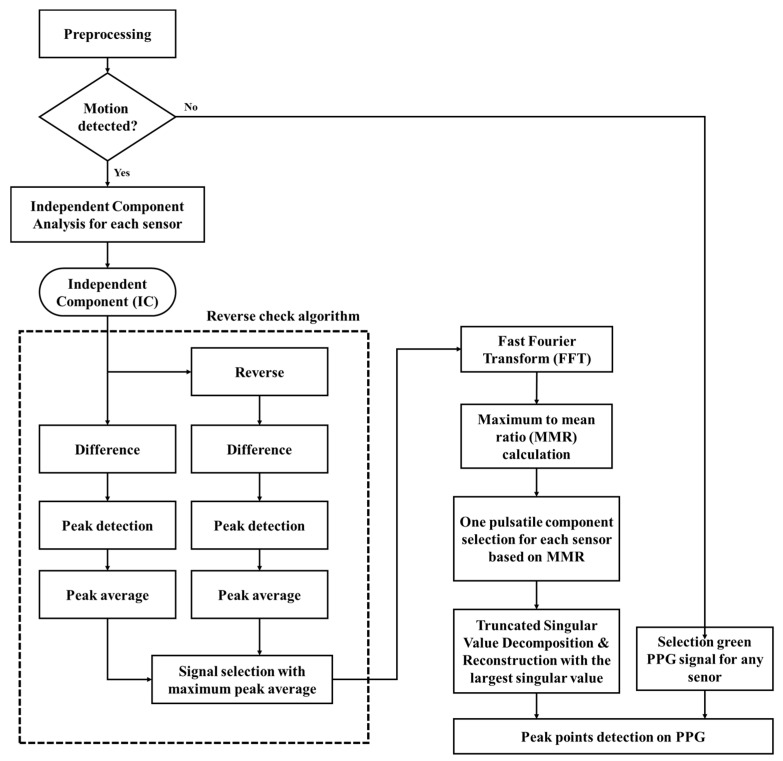
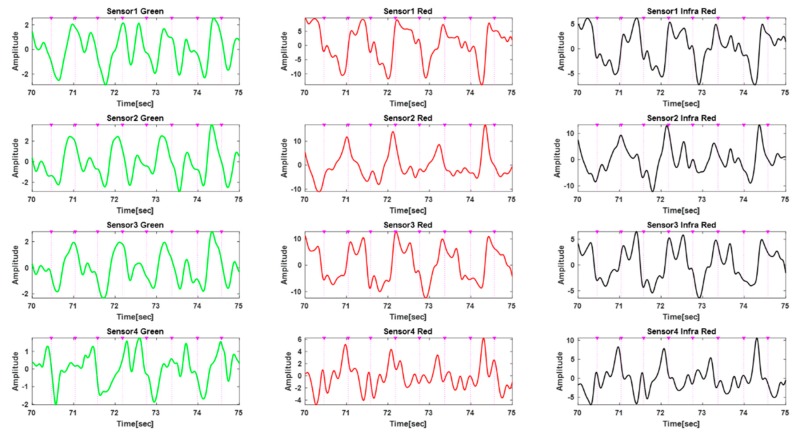
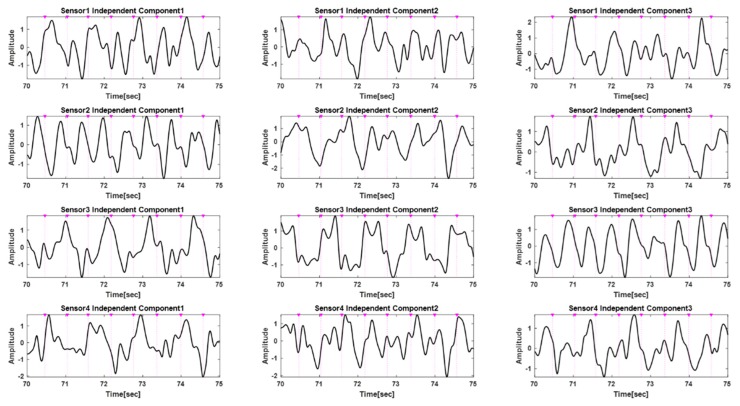
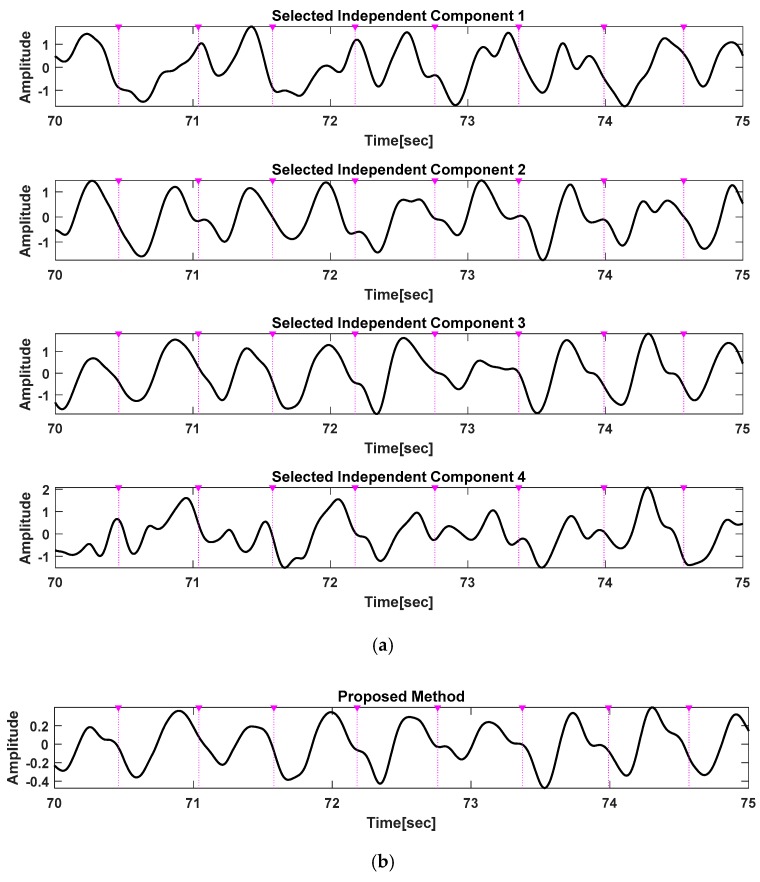
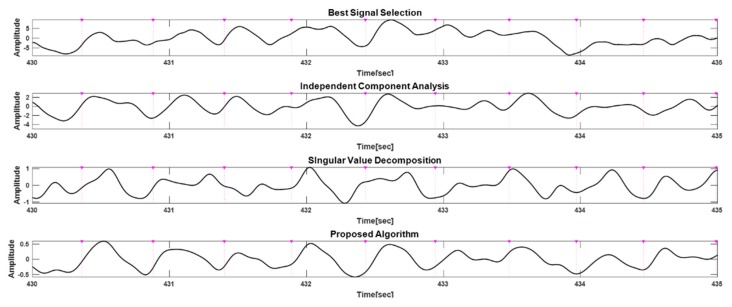
Photoplethysmography (PPG) is an easy and convenient method by which to measure heart rate (HR). However, PPG signals that optically measure volumetric changes in blood are not robust to motion artifacts. In this paper, we develop a PPG measuring system based on multi-channel sensors with multiple wavelengths and propose a motion artifact reduction algorithm using independent component analysis (ICA). We also propose a truncated singular value decomposition for 12-channel PPG signals, which contain direction and depth information measured using the developed multi-channel PPG measurement system. The performance of the proposed method is evaluated against the R-peaks of an electrocardiogram in terms of sensitivity (Se), positive predictive value (PPV), and failed detection rate (FDR). The experimental results show that Se, PPV, and FDR were 99%, 99.55%, and 0.45% for walking, 96.28%, 99.24%, and 0.77% for fast walking, and 82.49%, 99.83%, and 0.17% for running, respectively. The evaluation shows that the proposed method is effective in reducing errors in HR estimation from PPG signals with motion artifacts in intensive motion situations such as fast walking and running.
Overview
The claims and statistics of this paper haven’t been checked yet.
Run the check — free, no account needed. It reads the open-access text and checks the sources it cites.
Integrity signals
Registry
Cites
Statistics
Figures
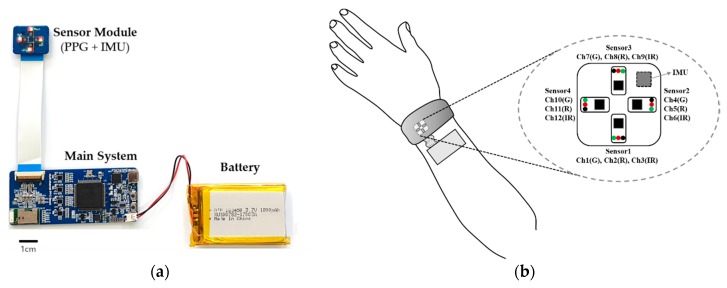
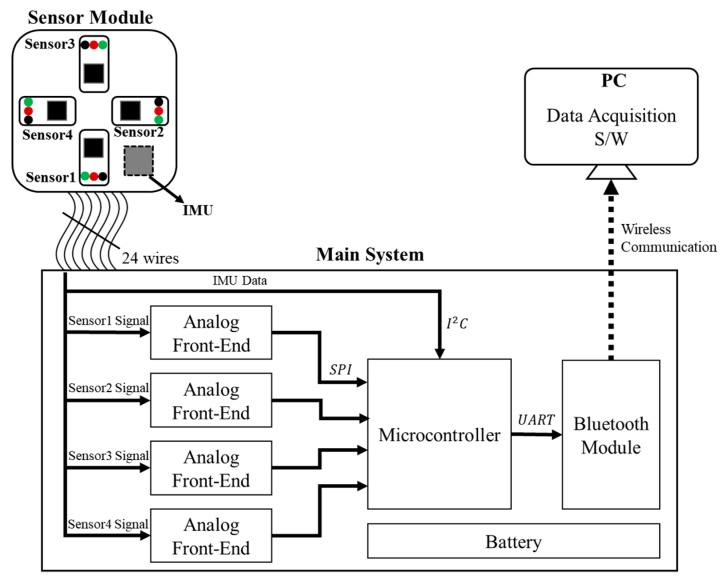
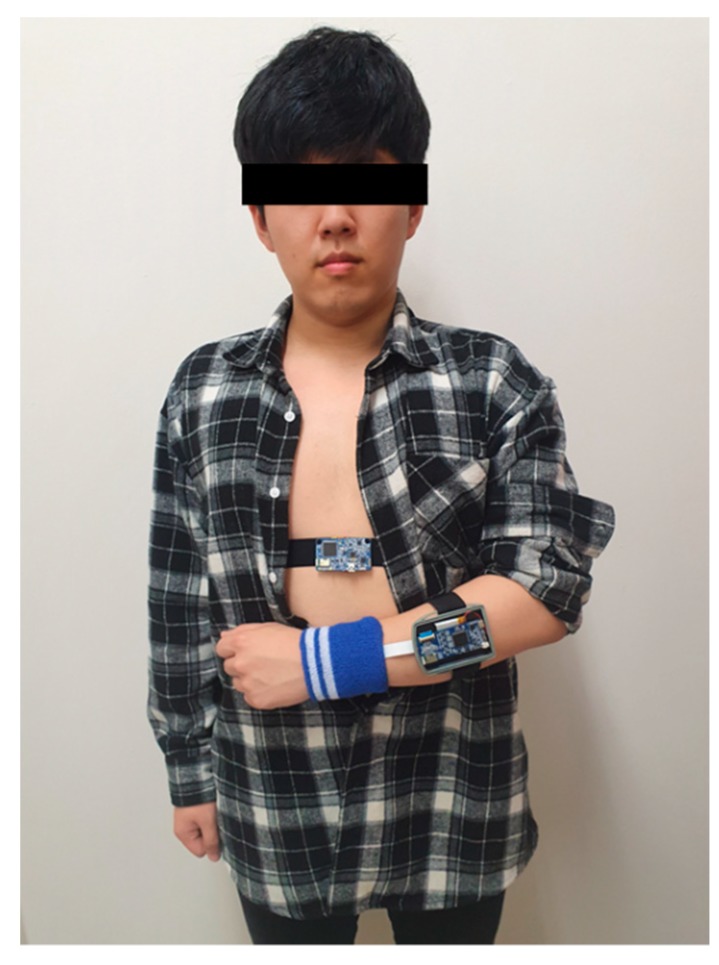
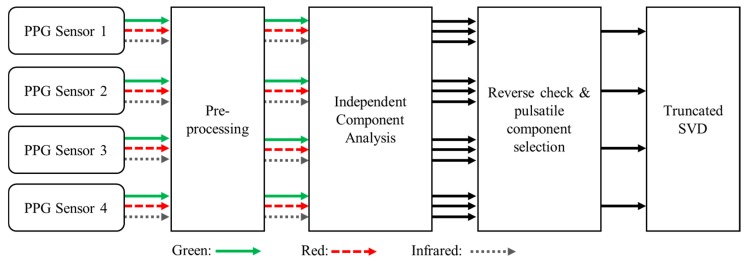
Verification
Claims the paper makes
The claims and statistics of this paper haven’t been checked yet.
Run the check — free, no account needed. It reads the open-access text and checks the sources it cites.
Claims other papers make about this one
Each is checked against this paper’s own text: does it say what the citing paper says it does?
In the citing paper
“First, our approximation of wear time was based on available per-minute HR values, which have been used in previous studies22; however, wearable device data are affected by motion artifacts.64,65 Thus, our measure of wear time may be an imperfect proxy.”
From Association of Demographic and Socioeconomic Indicators With the Use of Wearable Devices Among Children (2023) · cites this paper as [65]
Self-check
Percentages, sums and reported differences re-computed from the paper’s own numbers.
The self-check needs the paper’s full text.
Citations
Cites
A Real-Time QRS Detection Algorithm
Pan, J., & Tompkins, W. J. (1985) · IEEE Transactions on Biomedical Engineering · doi:10.1109/tbme.1985.325532 · Cited by 7,855
Photophysical processes in recent medical laser developments: A review
Boulnois, J.-L. (1986) · Lasers in Medical Science · doi:10.1007/bf02030737 · Cited by 663
Multiparameter Respiratory Rate Estimation From the Photoplethysmogram
Karlen, W., Raman, S., Ansermino, J. M., & Dumont, G. A. (2013) · IEEE Transactions on Biomedical Engineering · doi:10.1109/tbme.2013.2246160 · Cited by 486
RR interval signal quality of a heart rate monitor and an ECG Holter at rest and during exercise
Gilgen-Ammann, R., Schweizer, T., & Wyss, T. (2019) · European Journal of Applied Physiology · doi:10.1007/s00421-019-04142-5 · Cited by 438
Motion Artifact Reduction in Photoplethysmography Using Independent Component Analysis
Kim, B., & Yoo, S. K. (2006) · IEEE Transactions on Biomedical Engineering · doi:10.1109/tbme.2005.869784 · Cited by 400
A Novel Approach for Motion Artifact Reduction in PPG Signals Based on AS-LMS Adaptive Filter
Ram, M. R., Madhav, K. V., Krishna, E. H., Komalla, N. R., & Reddy, K. A. (2011) · IEEE Transactions on Instrumentation and Measurement · doi:10.1109/tim.2011.2175832 · Cited by 345
Cuff-Less and Continuous Blood Pressure Monitoring: A Methodological Review
Sharma, M., Barbosa, K., Ho, V., Griggs, D., Ghirmai, T., Krishnan, S., Hsiai, T., Chiao, J.-C., & Cao, H. (2017) · Technologies · doi:10.3390/technologies5020021 · Cited by 226
Motion-tolerant magnetic earring sensor and wireless earpiece for wearable photoplethysmography
Poh, M., Swenson, N. C., & Picard, R. W. (2010) · IEEE Transactions on Information Technology in Biomedicine · doi:10.1109/titb.2010.2042607 · Cited by 189
Reddy, K. A., George, B., & Kumar, V. J. (2008) · IEEE Transactions on Instrumentation and Measurement · doi:10.1109/tim.2008.2009136 · Cited by 165
A Real Time Analysis of PPG Signal for Measurement of SpO2 and Pulse Rate
Bagha, S., & Shaw, L. (2011) · International Journal of Computer Applications · Cited by 143
Cited by
Sorted by citations
Photoplethysmogram Analysis and Applications: An Integrative Review
Park, J., Seok, H. S., Kim, S.-S., & Shin, H. (2022) · Frontiers in Physiology · doi:10.3389/fphys.2021.808451 · Cited by 514
Sources of inaccuracy in photoplethysmography for continuous cardiovascular monitoring
Fine, J., Branan, K. L., Rodriguez, A. J., Boonya-ananta, T., Ajmal, Ramella-Roman, J. C., McShane, M. J., & Coté, G. L. (2021) · Biosensors · doi:10.3390/bios11040126 · Cited by 348
Kim, K. B., & Baek, H. J. (2023) · Electronics · doi:10.3390/electronics12132923 · Cited by 260
The 2023 wearable photoplethysmography roadmap
Charlton, P. H., Allen, J., Bailón, R., Baker, S., Behar, J. A., Chen, F., Clifford, G. D., Clifton, D. A., Davies, H. J., Ding, C., et al. (2023) · Physiological Measurement · doi:10.1088/1361-6579/acead2 · Cited by 233
A Review of Wearable Multi-Wavelength Photoplethysmography
Ray, D., Collins, T., Woolley, S., & Ponnapalli, P. (2023) · IEEE Reviews in Biomedical Engineering · doi:10.1109/rbme.2021.3121476 · Cited by 155
Martinez-Ríos, E. A., Montesinos, L., Alfaro-Ponce, M., & Pecchia, L. (2021) · Biomedical Signal Processing and Control · doi:10.1016/j.bspc.2021.102813 · Cited by 147
Scardulla, F., Cosoli, G., Spinsante, S., Poli, A., Iadarola, G., Pernice, R., Busacca, A., Pasta, S., Scalise, L., & D’Acquisto, L. (2023) · Measurement · doi:10.1016/j.measurement.2023.113150 · Cited by 134
The Current State of Optical Sensors in Medical Wearables
Vavrinsky, E., Esfahani, N. E., Hausner, M., Kuzma, A., Rezo, V., Donoval, M., & Kosnacova, H. (2022) · Biosensors · doi:10.3390/bios12040217 · Cited by 103
“Wrist-worn reflectance LED Motion artifact reduction PP: Four x OSRAM SFH7050, Motion Sensor: InvenSense MPU9250 Wavelengths 530, 660, 940 nm [75]”
BackgroundStretchable PPG sensor with light polarization for physical activity–permissible monitoring
Lee, G. H., Kang, H., Chung, J. W., Lee, Y., Yoo, H., Jeong, S., Cho, H. K., Kim, J., Kang, S., Jung, J. Y., et al. (2022) · Science Advances · doi:10.1126/sciadv.abm3622 · Cited by 95
Self-citationTrovato, V., Sfameni, S., Rando, G., Rosace, G., Libertino, S., Ferri, A., & Plutino, M. R. (2022) · Molecules · doi:10.3390/molecules27175709 · Cited by 96
Pankaj, Kumar, A., Komaragiri, R., & Kumar, M. (2021) · Archives of Computational Methods in Engineering · doi:10.1007/s11831-021-09597-4 · Cited by 84
Ultralow-Power Photoplethysmography (PPG) Sensors: A Methodological Review
Ebrahimi, Z., & Gosselin, B. J. (2023) · IEEE Sensors Journal · doi:10.1109/jsen.2023.3284818 · Cited by 86
Ueafuea, K., Boonnag, C., Sudhawiyangkul, T., Leelaarporn, P., Gulistan, A., Chen, W., Mukhopadhyay, S. C., Wilaiprasitporn, T., & Piyayotai, S. (2020) · IEEE Sensors Journal · doi:10.1109/jsen.2020.3046259 · Cited by 72
Saganowski, S. (2022) · Electronics · doi:10.3390/electronics11030496 · Cited by 72
Kim, E. H., Jenness, J. L., Miller, A. B., Halabi, R., de Zambotti, M., Bagot, K. S., Baker, F. C., & Pratap, A. (2023) · JAMA Network Open · doi:10.1001/jamanetworkopen.2023.5681 · Cited by 53
Li, J., Chu, H., Chen, Z., Yiu, C. K., Qu, Q., Li, Z.-Y., & Yu, X. (2024) · ACS Nano · doi:10.1021/acsnano.4c04291 · Cited by 50
Moscato, S., Giudice, S. L., Massaro, G., & Chiari, L. (2022) · Sensors · doi:10.3390/s22155831 · Cited by 51
Shi, Z., Gu, T., Zhang, Y., & Zhang, X. (2022) · ACM Conference on Embedded Networked Sensor Systems (SenSys) · doi:10.1145/3560905.3568506 · Cited by 48
Pankaj, Kumar, A., Komaragiri, R., & Kumar, M. (2021) · Computers in Biology and Medicine · doi:10.1016/j.compbiomed.2021.105081 · Cited by 42
Detection and Monitoring of Viral Infections via Wearable Devices and Biometric Data
Goergen, C. J., Tweardy, M. J., Steinhubl, S. R., Wegerich, S., Singh, K., Mieloszyk, R. J., & Dunn, J. (2021) · Annual Review of Biomedical Engineering · doi:10.1146/annurev-bioeng-103020-040136 · Cited by 44
Zeng, T., Wu, Y., & Lei, M. (2024) · Advanced Composites and Hybrid Materials · doi:10.1007/s42114-024-00949-9 · Cited by 42
State-of-the-art wearable sensors for cardiovascular health: a review
Xie, H., Yang, L., Jiang, B., Huang, Z., & Lin, Y. (2025) · npj Cardiovascular Health · doi:10.1038/s44325-025-00090-6 · Cited by 48
Choi, S., Gao, Y., Jin, Y., Kim, S. J., Li, J., Xu, W., & Jin, Z. (2022) · Proceedings of the ACM on Interactive Mobile Wearable and Ubiquitous Technologies · doi:10.1145/3534597 · Cited by 34
A Dual-Channel PPG Readout System With Motion-Tolerant Adaptability for OLED-OPD Sensors
Pandey, R. K., & Chao, P. C.-P. (2021) · IEEE Transactions on Biomedical Circuits and Systems · doi:10.1109/tbcas.2021.3138996 · Cited by 32
Reddy, G. N. K., Manikandan, M. S., & Murty, N. V. L. N. (2022) · IEEE Access · doi:10.1109/access.2022.3148256 · Cited by 34
A review: Blood pressure monitoring based on PPG and circadian rhythm
Chen, G., Zou, L., & Ji, Z. (2024) · APL Bioengineering · doi:10.1063/5.0206980 · Cited by 34
Application of Modern Multi-Sensor Holter in Diagnosis and Treatment
Vavrinský, E., Subjak, J., Donoval, M., Wagner, A., Zavodnik, T., & Svobodová, H. (2020) · Sensors · doi:10.3390/s20092663 · Cited by 35
Iqbal, S. M. A., Mahgoub, I., Du, E., Leavitt, M. A., & Asghar, W. (2022) · Scientific Reports · doi:10.1038/s41598-022-23680-1 · Cited by 31
Singh, S., Kozłowski, M., García-López, I., Jiang, Z., & Rodriguez–Villegas, E. (2021) · IEEE Transactions on Instrumentation and Measurement · doi:10.1109/tim.2021.3083415 · Cited by 28
Gautam, Y., & Jebelli, H. (2024) · Automation in Construction · doi:10.1016/j.autcon.2024.105537 · Cited by 27
PPG and Bioimpedance-Based Wearable Applications in Heart Rate Monitoring—A Comprehensive Review
Lapsa, D., Janeliukštis, R., Metshein, M., & Selavo, L. (2024) · Applied Sciences · doi:10.3390/app14177451 · Cited by 30
Uncertainties in the Analysis of Heart Rate Variability: A Systematic Review
Lü, L., Zhu, T., Morelli, D., Creagh, A. P., Liu, Z., Yang, J., Liu, F., Zhang, Y., & Clifton, D. A. (2023) · IEEE Reviews in Biomedical Engineering · doi:10.1109/rbme.2023.3271595 · Cited by 28
Park, P., Lee, W., & Cho, S. (2023) · IEEE Transactions on Biomedical Circuits and Systems · doi:10.1109/tbcas.2023.3315297 · Cited by 24
Fazio, R. D., Vittorio, M. D., & Visconti, P. (2022) · Future Internet · doi:10.3390/fi14060183 · Cited by 20
Reali, P., Lolatto, R., Coelli, S., Tartaglia, G., & Bianchi, A. M. (2022) · Sensors · doi:10.3390/s22041428 · Cited by 21
Seamlessly Integrable Optoelectronics for Clinical Grade Wearables
Polat, E. O. (2021) · Advanced Materials Technologies · doi:10.1002/admt.202000853 · Cited by 18
Multi-point sensing organic light-emitting diode display based mobile cardiovascular monitor
Kim, C., Lee, K. J., Kim, J., Yang, D., Lee, H., Moon, G., Kim, Y., Cho, D., Bae, K. S., Kim, G.-H., et al. (2025) · Nature Communications · doi:10.1038/s41467-025-56915-6 · Cited by 18
Huang, K., Ma, Z., & Khoo, B. L. (2025) · Advanced Science · doi:10.1002/advs.202415215 · Cited by 25
Two-Stage Motion Artifact Reduction Algorithm for rPPG Signals Obtained from Facial Video Recordings
Abdulrahaman, L. Q. (2023) · Arabian Journal for Science and Engineering · doi:10.1007/s13369-023-07845-2 · Cited by 17
An ML-Based Approach to Reconstruct Heart Rate from PPG in Presence of Motion Artifacts
Vicente-Samper, J. M., Tamantini, C., Ávila-Navarro, E., de la Casa, M. A., Zollo, L., Sabater-Navarro, J. M., & Cordella, F. (2023) · Biosensors · doi:10.3390/bios13070718 · Cited by 17
Thakur, S., Chao, P. C.-P., & Tsai, C.-H. (2023) · Sensors · doi:10.3390/s23136180 · Cited by 16
Ahn, J., Ra, H.-K., Yoon, H. J., Son, S. H., & Ko, J. (2020) · IEEE Access · doi:10.1109/access.2020.3025776 · Cited by 17
Pankaj, Kumar, A., Ashdhir, A., Komaragiri, R., & Kumar, M. (2022) · Computer Methods and Programs in Biomedicine · doi:10.1016/j.cmpb.2022.107294 · Cited by 16
Sawangjai, P., Seesawad, N., & Wilaiprasitporn, T. (2025) · IEEE Transactions on Instrumentation and Measurement · doi:10.1109/tim.2025.3529546 · Cited by 13
Tsiakaka, O., Gosselin, B. J., & Feruglio, S. (2020) · Sensors · doi:10.3390/s20113302 · Cited by 18
Measuring Arterial Oxygen Saturation Using Wearable Devices Under Varying Conditions
Hearn, E. L., Byford, J., Wolfe, C., Agyei, C., Hodkinson, P. D., Pollock, R. D., & Smith, T. G. (2023) · Aerospace Medicine and Human Performance · doi:10.3357/amhp.6078.2023 · Cited by 12
vital_sqi: A Python package for physiological signal quality control
Khoa, L. D. V., Ho, H. B., Karolcik, S., Hernandez, B., Greeff, H., Nguyen, V. H., Phan, N. Q. K., Le, T. P., Thwaites, L., Georgiou, P., et al. (2022) · Frontiers in Physiology · doi:10.3389/fphys.2022.1020458 · Cited by 11
Morresi, N., Casaccia, S., & Revel, G. M. (2021) · IEEE International Symposium on Medical Measurements and Applications (MeMeA) · doi:10.1109/memea52024.2021.9478713 · Cited by 11
Tunable Multi-Channels Bandpass InGaAsP Plasmonic Filter Using Coupled Arrow Shape Cavities
Abd-Elsamee, S., Areed, N. F. F., El-Mikati, H. A., & Obayya, S. S. A. (2022) · Photonics · doi:10.3390/photonics9100720 · Cited by 11
de Pedro-Carracedo, J., Ugena, A. M., & Gonzalez-Marcos, A. P. (2021) · Applied Sciences · doi:10.3390/app11146508 · Cited by 11
Machine Learning-Based VO2 Estimation Using a Wearable Multiwavelength Photoplethysmography Device
Hsiao, C., Tong, C. W.-C., & Coté, G. L. (2025) · Biosensors · doi:10.3390/bios15040208 · Cited by 14
PPG Earring: Wireless Smart Earring for Heart Health Monitoring
Xue, Q. S., Nissanka, D., Yan, J. T., Wang, R., Patel, S., & Iyer, V. (2025) · CHI Conference on Human Factors in Computing Systems · doi:10.1145/3706598.3713856 · Cited by 10
Generative adversarial networks with fully connected layers to denoise PPG signals
Castro, I. A. A., Oliveira, H. P., Correia, R. G., Hayes‐Gill, B., Morgan, S. P., Korposh, S., Gomez, D., & Pereira, T. (2025) · Physiological Measurement · doi:10.1088/1361-6579/ada9c1 · Cited by 9
Merschel, S., & Reinhardt, L. (2022) · JMIR Formative Research · doi:10.2196/29479 · Cited by 8
Bradke, B. S., Miller, T. A., & Everman, B. (2021) · Sensors · doi:10.3390/s21134543 · Cited by 9
Posada-Quintero, H. F., Derrick, B. J., Winstead‐Derlega, C., Gonzalez, S. I., Ellis, M. C., Freiberger, J. J., & Chon, K. H. (2021) · Annual International Conference of the IEEE Engineering in Medicine and Biology Society (EMBC) · doi:10.1109/embc46164.2021.9629924 · Cited by 9
The importance of physiological data variability in wearable devices for digital health applications
Cosoli, G., Poli, A., Spinsante, S., & Scalise, L. (2022) · ACTA IMEKO · doi:10.21014/acta_imeko.v11i2.1135 · Cited by 9
Performance Analysis for Human Crowd Monitoring to Control COVID-19 disease by Drone Surveillance
Conte, C., de Alteriis, G., de Pandi, F., Caputo, E., Moriello, R. S. L., Rufino, G., & Accardo, D. (2021) · IEEE International Workshop on Metrology for AeroSpace (MetroAeroSpace) · doi:10.1109/metroaerospace51421.2021.9511671 · Cited by 9
Chen, K., Tseng, C.-H., Lee, H., Liu, W., Chou, K., & Wu, H. (2025) · SLEEP · doi:10.1093/sleep/zsae317 · Cited by 10
Zhang, Y., Zhu, H., Liu, H., Zheng, D., Zhang, S., & Pan, Y. (2022) · Annual International Conference of the IEEE Engineering in Medicine and Biology Society (EMBC) · doi:10.1109/embc48229.2022.9871902 · Cited by 8
Deep Learning Model for Blood Pressure Estimation from PPG Signal
Kim, M., Lee, H., Kim, K., & Kim, K. H. (2022) · IEEE International Conference on Metrology for eXtended Reality, Artificial Intelligence and Neural Engineering (MetroXRAINE) · doi:10.1109/metroxraine54828.2022.9967606 · Cited by 8
Self-citationZhu, W., Xiang, L., Long, Y., Xun, Q., Kuang, J.-L., & He, L. (2022) · Sleep Medicine · doi:10.1016/j.sleep.2022.12.023 · Cited by 8
Mascret, Q., Gurve, D., Abdou, A., Bhadra, S., Lasry, N., Mai, K., Krishnan, S., & Gosselin, B. J. (2024) · IEEE Sensors Journal · doi:10.1109/jsen.2024.3388950 · Cited by 8
A Power-Efficient Sensing Approach for Pulse Wave Palpation-Based Heart Rate Measurement
Bravo, G., Silva, J. M., Morales, S. A. N., Gómez, E. A. M., Aguilera, F. J. E., & Sifuentes, E. (2021) · Sensors · doi:10.3390/s21227549 · Cited by 8
He, Q., Sun, Z., Li, Y., Wang, W., & Wang, R. K. (2021) · Biomedical Optics Express · doi:10.1364/boe.423160 · Cited by 9
Wearable Sensors for Monitoring Abnormalities in Sleep-Related Breathing
Wang, J., Xu, J., Ma, J., Gong, J., Ji, L., Guo, W., Yue, H., Qiao, Y., & Zhou, J. (2026) · ACS Applied Materials & Interfaces · doi:10.1021/acsami.5c22504 · Cited by 7
Nantume, A., Kiwanuka, N., Muyinda, A., Cauvel, T., & Shah, S. (2022) · Digital Health · doi:10.1177/20552076221102262 · Cited by 9
Pandey, R. K., & Chao, P. C.-P. (2021) · IEEE International Symposium on Circuits and Systems proceedings · doi:10.1109/iscas51556.2021.9401265 · Cited by 7
An Effective Photoplethysmography Denosing Method Based on Diffusion Probabilistic Model
Xia, Z., Luo, Z., Chen, C., & Shen, X. (2025) · IEEE Journal of Biomedical and Health Informatics · doi:10.1109/jbhi.2025.3530517 · Cited by 7
mmBP+: Contact-Free Blood Pressure Measurement Using Millimeter-Wave Radar
Shi, Z., Gu, T., Zhang, Y., & Zhang, X. (2025) · IEEE Transactions on Mobile Computing · doi:10.1109/tmc.2025.3594316 · Cited by 6
Artificial Intelligence-Driven Wearable Sensors for Cardiovascular Health Monitoring
Deng, H. T., Ma, B., Chen, G., Chi, J., Tong, J., Yu, F., Lü, B., Chen, Y., Zhao, C., Zhang, C., et al. (2026) · ACS Sensors · doi:10.1021/acssensors.5c04840 · Cited by 6
Principal component analysis of photoplethysmography signals for improved gesture recognition
Ruan, Y., Chen, X. '., Zhang, X., & Chen, X. (2022) · Frontiers in Neuroscience · doi:10.3389/fnins.2022.1047070 · Cited by 6
Hwang, C., Kim, Y. H., Hyun, J. K., Kim, J. H., Lee, S. R., Kim, C. M., Nam, J., & Kim, E. Y. (2023) · Bioengineering · doi:10.3390/bioengineering10101222 · Cited by 6
Development and Feasibility Assessment of Virtual Reality-Based Relaxation Self-Training Program
Jeong, H. S., Oh, J., Paik, M., Kim, H., Jang, S., Kim, B. S., & Kim, J. (2022) · Frontiers in Virtual Reality · doi:10.3389/frvir.2021.722558 · Cited by 7
Continuous Blood Pressure Estimation in Wearable Devices Using Photoplethysmography: A Review
Medina, A., Colque, N. L., Galdos, J., Supo, E., Rendulich, J., & Espinoza, E. S. (2022) · International Journal of Emerging Technology and Advanced Engineering · doi:10.46338/ijetae1022_12 · Cited by 9
Artifacts classification and apnea events detection in neck photoplethysmography signals
García-López, I., Pramono, R. X. A., & Rodriguez–Villegas, E. (2022) · Medical & Biological Engineering & Computing · doi:10.1007/s11517-022-02666-1 · Cited by 6
Micromotion Artefact Reduction of a Wrist Worn PPG Sensor Using Green Light PPG and Surface EMG
Silverio, A. A., Asilo, J. E., Balagat, S. L. D., Pineda, A. A., Tangi, J. A., Tuazon, D. T. P., & Piedra, B. M. B. (2020) · IEEE Region Humanitarian Technology Conference · doi:10.1109/r10-htc49770.2020.9356956 · Cited by 6
Nawar, A., Kilic, O. S., Rahman, F. N., Chen, C., Berkebile, J. A., Chan, M., Shah, A. J., & Inan, O. T. (2025) · IEEE Sensors Journal · doi:10.1109/jsen.2025.3596522 · Cited by 5
PPGANet: Removal of Motion Artifacts from the PPG Signal Using Generative Adversarial Networks
Sawangjai, P., & Wilaiprasitporn, T. (2023) · IEEE Biomedical Circuits and Systems Conference (BioCAS) · doi:10.1109/biocas58349.2023.10388620 · Cited by 5
Intraoperative Optical Monitoring of Spinal Cord Hemodynamics Using Multiwavelength Imaging System
Mainard, N., Tsiakaka, O., Li, S., Denoulet, J., Messaoudene, K., Vialle, R., & Feruglio, S. (2022) · Sensors · doi:10.3390/s22103840 · Cited by 5
Regalia, G., Resnati, D., & Tognetti, S. (2022) · Elsevier eBooks · doi:10.1016/b978-0-12-822548-6.00130-8 · Cited by 9
Posada-Quintero, H. F., Derrick, B. J., Ellis, M. C., Natoli, M. J., Winstead‐Derlega, C., Gonzalez, S. I., Allen, C. M., Makowski, M. S., Keuski, B. M., Moon, R. E., et al. (2024) · Communications Medicine · doi:10.1038/s43856-024-00688-4 · Cited by 7
Mobile and Wireless Autofluorescence Detection Systems and Their Application for Skin Tissues
Wang, Y., Zhang, Y., Li, Y., & Cai, F. (2025) · Biosensors · doi:10.3390/bios15080501 · Cited by 4
Mbihi, J., Otam, U. S., Lonla, B. M., & Ngounou, C. E. R. G. (2020) · Journal of Electrical Engineering, Electronics, Control and Computer Science · Cited by 4
Photoplethysmogram analysis and applications: An Integrative Review (Preprint)
Shin, H., Park, J., Seok, H. S., & Kim, S. (2020) · JMIR Biomedical Engineering · doi:10.2196/25567 · Cited by 4
Ahmed, M. M., Othman, Z. K., Mahamed, S. M., Okesanya, O. J., Musa, S. S., Branda, F., & Lucero‐Prisno, D. E. (2025) · Digital Health · doi:10.1177/20552076251396563 · Cited by 3
Advancing entropy analysis for heart rate variability: clinical insights for aging and diabetes
Yang, S., Wu, H., Liao, X., Lin, Y., & Liou, J. J. (2026) · Frontiers in Physiology · doi:10.3389/fphys.2026.1795118 · Cited by 3
Time Series Analysis of Muscle Deformation During Physiotherapy Using Optical Wearable Sensors
Shimabukuro, S., Miyake, T., & Tamaki, E. (2025) · Sensors · doi:10.3390/s25113507 · Cited by 3
Edge computing design space exploration for heart rate monitoring
Miranda, J., Canabal, M. F., Gutiérrez-Martín, L., Lanza-Gutiérrez, J. M., & López-Ongil, C. (2022) · Integration · doi:10.1016/j.vlsi.2022.02.003 · Cited by 3
A Robust Beat-to-Beat Artifact Detection Algorithm for Pulse Wave
Hu, Q., Deng, X., Liu, X., Wang, A., & Yang, C. (2020) · Mathematical Problems in Engineering · doi:10.1155/2020/5691805 · Cited by 3
Research progress on emotion recognition based on electroencephalogram signals
Li, X., Yan, Z., Gong, P., Lin, D., & Chen, F. (2025) · Biomedical Signal Processing and Control · doi:10.1016/j.bspc.2025.109188 · Cited by 5
Moghaddam, M., Collins, J. P., Gardner, C. E., & Rabel, M. C. (2025) · Sensors · doi:10.3390/s26010176 · Cited by 3
Fotiadou, E., Melaet, R., & Vullings, R. (2022) · Frontiers in Signal Processing · doi:10.3389/frsip.2022.981453 · Cited by 2
Blood Oxygen (SpO2) and Pulse Rate(PR) Wearable Sensor for Hemodialysis Patients
Liou, J., Lin, Z., & Hsieh, Z.-X. (2023) · International Conference on Applied System Innovation · doi:10.1109/icasi57738.2023.10179568 · Cited by 2
Botrugno, C., & Dell’Olio, F. (2024) · IEEE Sensors Applications Symposium (SAS) · doi:10.1109/sas60918.2024.10636647 · Cited by 2
Special Issue “Advanced Signal Processing in Wearable Sensors for Health Monitoring”
Abbod, M., & Shieh, J.-S. (2022) · Sensors · doi:10.3390/s22062189 · Cited by 2
Low-Noise and Cost-Effective Active Electrodes for Dry Contact ECG Applications
Voropai, A., & Sarana, V. (2022) · Science and innovation · doi:10.15407/scine18.01.112 · Cited by 1
80‐1: Sensor OLED Display‐Based Mobile Cardiovascular Health Monitor
Kim, C., Yang, D., Moon, G., Kim, G., Kim, Y., & Lee, C. (2025) · SID Symposium Digest of Technical Papers · doi:10.1002/sdtp.18365 · Cited by 1
Representation biases in remote photoplethysmography datasets – a narrative review
Khan, S. S., & Mostafa, N. (2025) · Applied Computing and Informatics · doi:10.1108/aci-06-2025-0270 · Cited by 1
FlexiMA: Robust Motion Artifact Removal in PPG Signals Using an Adversarial Variational Autoencoder
Liu, Q., Zou, H., Wu, Y., Chen, Y., Ma, H., & Wang, B. (2026) · IEEE Internet of Things Journal · doi:10.1109/jiot.2025.3650539 · Cited by 1
Metadata
- Authors
- Lee, J., Kim, M., Park, H.-K., & Kim, I. Y.
- Affiliations
- Hanyang University (KR)
- Corresponding author
- Park, Hoon-Ki
- Kim, In Young
- Venue
- Sensors
- Publisher
- MDPI AG
- Published
- 2020-03-09
- Volume
- 20
- Issue
- 5
- Pages
- 1493
- ISSN
- 1424-8220 (ISSN-L)
- PMC
- PMC7085621
- OpenAlex
- W3009321689
- Cited by
- 153
- References
- 29
- Citations by year
- 2026: 34 · 2025: 27 · 2024: 13 · 2023: 15 · 2022: 35 · 2021: 19 · 2020: 10
- FWCI
- 6.20
- Type
- journal article
- Language
- en
- Open access
- gold
- dx.doi.org
- Licence
- Locations
- Sensors (publishedVersion, cc-by)
- PubMed Central (publishedVersion, cc-by)
- PubMed (publishedVersion)
- DOAJ (DOAJ: Directory of Open Access Journals) (submittedVersion, cc-by-sa)
- Funders
- National Research Foundation of Korea (2018R1A5A7025522)
- Topics
- Physical Sciences › Engineering › Biomedical Engineering › Non-Invasive Vital Sign Monitoring
- Health Sciences › Medicine › Cardiology and Cardiovascular Medicine › Heart Rate Variability and Autonomic Control
- Health Sciences › Medicine › Cardiology and Cardiovascular Medicine › ECG Monitoring and Analysis
- Keywords
- photoplethysmography, motion artifact reduction, wearable sensors, multi-channel sensor, multiple wavelengths, independent component analysis, truncated singular value decomposition, heart rate estimation, R-peak detection, electrocardiogram, walking and running
- MeSH terms
- Wearable Electronic Devices, Adult, Electrocardiography, Equipment Design, Female, Heart Rate, Humans, Male, Signal Processing, Computer-Assisted, Walking, Artifacts, Photoplethysmography, Young Adult
About these checks
Registry, retraction, Cites and statistics results are computed, not judged, with one exception: a printed reference that no index lists is read once by a model before it counts as a citation error. Claims are extracted by a model and kept only when their quote appears verbatim in the text; each cited source is then checked, with a model’s help, for whether it says what the claim relies on. Those verdicts can be wrong — read the claim’s quote and the cited source before relying on one.
Statistics and arithmetic are recomputed, not judged.
Confidence bands are shown only for fields calibrated on our annotated test set. None is calibrated yet, so no band is shown.
What counts as a claim ›How we measure confidence ›How we check this ›
Are you an author, or do you see a problem with this page? Request a review
