

Deep Metallic Surface Defect Detection: The New Benchmark and Detection Network
Open accessThe DOI matches its Crossref record; 42 of the 42 references it cites were found in a registry or an index; 2 of the 6 sources its claims cite were checked for support.
Abstract
Metallic surface defect detection is an essential and necessary process to control the qualities of industrial products. However, due to the limited data scale and defect categories, existing defect datasets are generally unavailable for the deployment of the detection model. To address this problem, we contribute a new dataset called GC10-DET for large-scale metallic surface defect detection. The GC10-DET dataset has great challenges on defect categories, image number, and data scale. Besides, traditional detection approaches are poor in both efficiency and accuracy for the complex real-world environment. Thus, we also propose a novel end-to-end defect detection network (EDDN) based on the Single Shot MultiBox Detector. The EDDN model can deal with defects with different scales. Furthermore, a hard negative mining method is designed to alleviate the problem of data imbalance, while some data augmentation methods are adopted to enrich the training data for the expensive data collection problem. Finally, the extensive experiments on two datasets demonstrate that the proposed method is robust and can meet accuracy requirements for metallic defect detection.
Overview
CoChat Summary
## TL;DR
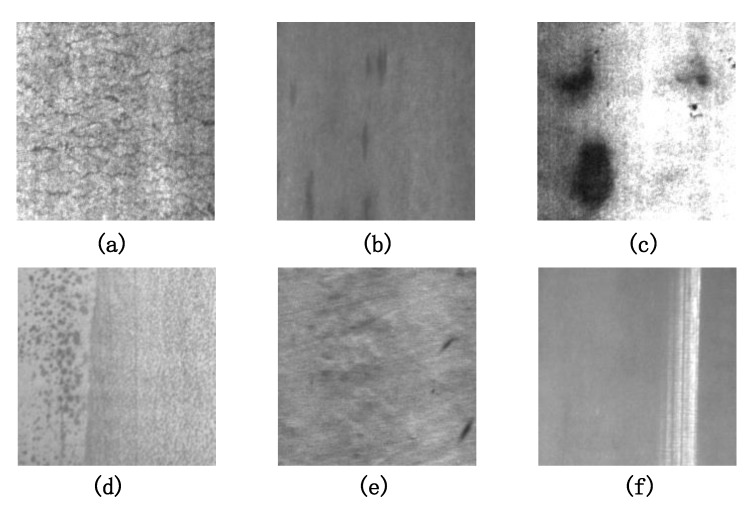
The paper introduces GC10-DET, a new real-industry metallic surface defect dataset with 10 defect types and 3,570 grayscale images, and proposes an end-to-end defect detector (EDDN) based on SSD. Experiments on GC10-DET and NEU-DET show the method is robust, improves multi-scale defect detection, and achieves the best mAP on GC10-DET.
## Key findings
- GC10-DET contains 10 defect types and 3,570 grayscale images collected in a real industrial setting; NEU-DET has 6 defect types and 1,800 grayscale images.
- On NEU-DET, the proposed method achieves the best mAP of 0.724 and the best results on most defect categories; SSD300 is slightly better on Sc recall (0.990 vs. 0.981) and on In AP (0.796 vs. 0.763) and Rs AP (0.621 vs. 0.581).
- On GC10-DET, the proposed method achieves the best mAP and the best results on most categories; SSD300 is slightly better on Rp recall (0.667 vs. 0.333) and Faster-RCNN is better on Cr recall (1 vs. 0.857).
- Runtime is reported as 27 ms/image on NEU-DET and 33 ms/image on GC10-DET for the proposed method; the paper says this is fast enough for real-time use, though YOLO-V2 is slightly faster on GC10-DET testing set time (4.49 s vs. 8 s).
## Methods
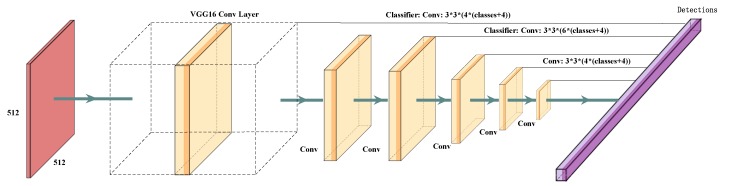
- The paper proposes EDDN, an end-to-end detector built on Single Shot MultiBox Detector (SSD) with VGG16, multi-scale feature maps, default boxes, and non-maximum suppression.
- It introduces hard negative mining, limiting negatives to at most a 3:1 ratio with positives, and applies data augmentation using full images, random patches, and patches with minimum Jaccard overlaps of 0.1, 0.3, 0.5, 0.7, or 0.9.
- Evaluation uses Recall, AP, and mAP on NEU-DET and GC10-DET, with comparisons against SSD, Faster-RCNN, YOLO-V2, YOLO-V3, and traditional LBP/HOG methods.
## Limitations
- The paper states that existing defect datasets are generally unavailable for deployment because of limited data scale and defect categories, and that metallic defect detection is difficult due to illumination, light reflection, and metal material effects.
- It notes that traditional methods are sensitive to lighting and background clutter and need repeated parameter tuning; this is a limitation of prior work, not the proposed method.
- Evident from the text: some reported gains are modest or mixed across categories, since other methods outperform the proposed method on a few defect classes (for example, SSD300 and Faster-RCNN on some NEU-DET and GC10-DET classes).
Model-written summary. Check it against the paper before relying on it.
Integrity signals
Registry
Cites
Statistics
Figures



Verification
Claims the paper makes
2 Valid · 1 Not valid · 1 Not checked · 29 Own results and interpretations
Every source the paper cites for this claim was checked and supports it.
In the paper
“we propose an end-to-end metallic surface defect network based on the Single Shot MultiBox Detector [6].”
- Also stated in: § 5. Conclusions · plain
“we propose an end-to-end defect detection and classification network based on the Single Shot MultiBox Detector.”
§ Deep Metallic Surface Defect Detection: The New Benchmark and Detection Network > 1. Introduction
What the sources say
- Supportedcites [6] Liu, W., Anguelov, D., Erhan, D., Szegedy, C., Reed, S., Fu, C.Y., and Berg, A.C. (2016, January 8–16). Ssd: Single Shot Multibox Detector. Proceedings of the European conference on computer vision, Amsterdam, The Netherlands. source
The citation identifies the Single Shot MultiBox Detector as the basis for the citing authors’ proposed network. The cited paper introduces SSD (Introduction, p. 2) and describes its single-network object detection method (p. 1); it need not describe the citing authors’ metallic-surface defect network. (LLM, conf=0.93)
plain- Asserted: passes — The authors put it forward as true.
- Checkable: passes — It can be checked against evidence.
- Load-bearing: passes — The paper’s conclusions depend on it.
- Based: passes — The paper gives a reason why it holds.
- Also stated in: § 5. Conclusions · plain
A result the paper reports from its own data — it cites no other source for it, so there is none to check. The quote shows it is in the paper.
In the paper
“Besides, the proposed method shows the best mAP accuracy.”
- Also stated in: § 4.4. Accuracy Comparisons with Deep Methods · plain
“the proposed method shows the best mAP accuracy.”
§ Deep Metallic Surface Defect Detection: The New Benchmark and Detection Network > 4. Experiments > 4.4. Accuracy Comparisons with Deep Methods
plain- Asserted: passes — The authors put it forward as true.
- Checkable: passes — It can be checked against evidence.
- Load-bearing: passes — The paper’s conclusions depend on it.
- Based: passes — The paper gives a reason why it holds.
- Also stated in: § 4.4. Accuracy Comparisons with Deep Methods · plain
A result the paper reports from its own data — it cites no other source for it, so there is none to check. The quote shows it is in the paper.
In the paper
“we contribute a new dataset called GC10-DET for large-scale metallic surface defect detection.”
- Also stated in: § 1. Introduction · plain
“We contribute a new dataset named”
- Also stated in: § 4.1. Datasets · plain
“GC10-DET is the surface defect dataset collected in a real industry. It contains ten types of surface defects”
§ Deep Metallic Surface Defect Detection: The New Benchmark and Detection Network > Abstract
plain- Asserted: passes — The authors put it forward as true.
- Checkable: passes — It can be checked against evidence.
- Load-bearing: passes — The paper’s conclusions depend on it.
- Based: passes — The paper gives a reason why it holds.
- Rests on an assumption not shown here.
- Also stated in: § 1. Introduction · plain
A result the paper reports from its own data — it cites no other source for it, so there is none to check. The quote shows it is in the paper.
In the paper
“the mAP can reach 0.724.”
§ Deep Metallic Surface Defect Detection: The New Benchmark and Detection Network > 4. Experiments > 4.4. Accuracy Comparisons with Deep Methods
plain- Asserted: passes — The authors put it forward as true.
- Checkable: passes — It can be checked against evidence.
- Load-bearing: passes — The paper’s conclusions depend on it.
- Based: passes — The paper gives a reason why it holds.
A result the paper states — it cites no source for it, so there is none to check. The quote shows it is in the paper.
In the paper
“the YOLO methods are difficult to distinguish the six types of defects.”
§ Deep Metallic Surface Defect Detection: The New Benchmark and Detection Network > 4. Experiments > 4.4. Accuracy Comparisons with Deep Methods
plain- Asserted: passes — The authors put it forward as true.
- Checkable: passes — It can be checked against evidence.
- Load-bearing: passes — The paper’s conclusions depend on it.
- Based: passes — The paper gives a reason why it holds.
7 more claims
Create a free account to see all 33 claims and to verify the 1 reference still open.
- Probably not a substantial claim. 8
- It may state two separate claims as one. 14
Citations
Cites
ImageNet classification with deep convolutional neural networks
Krizhevsky, A., Sutskever, I., & Hinton, G. E. (2017) · Communications of the ACM · doi:10.1145/3065386 · Cited by 112,155 · cited 1×
“Since the introduction of AlexNet [26], convolutional neural networks have been successfully deployed to detect surface defects.”
MethodFaster R-CNN: Towards Real-Time Object Detection with Region Proposal Networks
Ren, S., He, K., Girshick, R., & Sun, J. (2017) · IEEE Transactions on Pattern Analysis and Machine Intelligence · doi:10.1109/tpami.2016.2577031 · Cited by 73,472
Faster R-CNN: Towards Real-Time Object Detection with Region Proposal Networks
Ren, S., He, K., Girshick, R., & Sun, J. (2015) · arXiv · doi:10.48550/arxiv.1506.01497 · Cited by 70,812
Microsoft COCO: Common Objects in Context
Lin, T.-Y., Maire, M., Belongie, S., Hays, J., Perona, P., Ramanan, D., Dollár, P., & Zitnick, C. L. (2014) · Lecture Notes in Computer Science · doi:10.1007/978-3-319-10602-1_48 · Cited by 45,460 · cited 1×
“The pre-trained models are often trained on ImageNet [34] and MS COCO [35] datasets.”
MethodImageNet Large Scale Visual Recognition Challenge
Russakovsky, O., Deng, J., Su, H., Krause, J., Satheesh, S., Ma, S., Huang, Z., Karpathy, A., Khosla, A., Bernstein, M., et al. (2015) · International Journal of Computer Vision · doi:10.1007/s11263-015-0816-y · Cited by 39,380 · cited 1×
“The pre-trained models are often trained on ImageNet [34] and MS COCO [35] datasets.”
Method(2016) · Cited by 31,590
SSD: Single Shot MultiBox Detector
Liu, W., Anguelov, D., Erhan, D., Szegedy, C., Reed, S., Fu, C.-Y., & Berg, A. C. (2016) · Lecture Notes in Computer Science · doi:10.1007/978-3-319-46448-0_2 · Cited by 22,128 · cited 15×
“The proposed method can obtain the best results on the defects of Pu, In, and Rp, while the SSD300 is slightly higher than proposed on Wl (0.974 vs. 0.885), Ss, (0.689 vs. 0.650) and Wf (1 vs. 0.919).”
MethodInfluentialYOLO9000: Better, Faster, Stronger
Redmon, J., & Farhadi, A. (2017) · 2017 IEEE Conference on Computer Vision and Pattern Recognition (CVPR) · doi:10.1109/cvpr.2017.690 · Cited by 19,892 · cited 8×
“Therefore, the SSD method utilizes VGG16 as the pre-trained model, YOLO-V2 uses Darknet19 model, YOLO-V3 uses Darknet53 model, and Faster R-CNN adopts Resnet50 model.”
MethodInfluentialYOLOv3: An Incremental Improvement
Redmon, J., & Farhadi, A. (2018) · arXiv · doi:10.48550/arxiv.1804.02767 · Cited by 17,141
OverFeat: Integrated Recognition, Localization and Detection using Convolutional Networks
Sermanet, P., Eigen, D., Zhang, X., Mathieu, M., Fergus, R., & LeCun, Y. (2013) · arXiv · doi:10.48550/arxiv.1312.6229 · Cited by 2,680 · cited 1×
“In [29], the OverFeat network [30] was implemented to detect 5 different types of surface defects.”
Method
Cited by
Items 101–200 of 592
An efficient targeted design for real-time defect detection of surface defects
Cui, W., Song, K., Jia, X., Chen, H., Zhang, Y., Yan, Y., & Jiang, W. (2024) · Optics and Lasers in Engineering · doi:10.1016/j.optlaseng.2024.108174 · Cited by 27
DEW-YOLO: An Efficient Algorithm for Steel Surface Defect Detection
Li, J., & Chen, M. (2024) · Applied Sciences · doi:10.3390/app14125171 · Cited by 29
Li, W., Solihin, M. I., Saruchi, S. A., Astuti, W., Hong, L. W., & Kit, A. C. (2024) · Operations Research Forum · doi:10.1007/s43069-024-00337-5 · Cited by 33
Lightweight defect detection network based on steel strip raw images
Huang, Y., Chen, Z., Chen, Z., Zhou, D., & Pan, E. (2025) · Engineering Applications of Artificial Intelligence · doi:10.1016/j.engappai.2025.110179 · Cited by 26
A high precision YOLO model for surface defect detection based on PyConv and CISBA
Ruan, S., Zhan, C., Liu, B., Wan, Q., & Song, K. (2025) · Scientific Reports · doi:10.1038/s41598-025-91930-z · Cited by 30
Metal Defect Detection Based on Yolov5
Wang, K., Teng, Z., & Zou, T. (2022) · Journal of Physics Conference Series · doi:10.1088/1742-6596/2218/1/012050 · Cited by 30
“Even though the traditional image processing method can alleviate the cost and efficiency problems of manual visual inspection, the difficulty of parameter setting and poor applicability still cannot meet the needs of the industry [4].”
BackgroundClassification and Fast Few-Shot Learning of Steel Surface Defects with Randomized Network
Nagy, A. M., & Czúni, L. (2022) · Applied Sciences · doi:10.3390/app12083967 · Cited by 30
Strip Surface Defect Detection Algorithm Based on YOLOv5
Wang, H., Yang, X., Zhou, B., Shi, Z., Zhan, D., Huang, R., Lin, J., Wu, Z., & Long, D. (2023) · Materials · doi:10.3390/ma16072811 · Cited by 26
“These factors greatly increase the difficulty of surface defect detection [2].”
BackgroundAdaptive-MAML: Few-shot metal surface defects diagnosis based on model-agnostic meta-learning
Pang, S., Zhang, L., Yuan, Y., Zhao, W., Wang, S., & Wang, S. (2023) · Measurement · doi:10.1016/j.measurement.2023.113612 · Cited by 26
Wu, Y., Chen, R., Li, Z., Ye, M., & Dai, M. (2024) · Metals · doi:10.3390/met14060650 · Cited by 25
Zheng, X., Liu, W., & Huang, Y. (2025) · Measurement · doi:10.1016/j.measurement.2025.117393 · Cited by 26
Deep Neural Network Recognition of Rivet Joint Defects in Aircraft Products
Amosov, O. S., Amosova, S. G., & Iochkov, I. O. (2022) · Sensors · doi:10.3390/s22093417 · Cited by 24
“In 2020, a new GC10-DET dataset for detecting metal surface defects was proposed to replace NEU-DET [2].”
MethodRSTD-YOLOv7: a steel surface defect detection based on improved YOLOv7
Song, H. (2025) · Scientific Reports · doi:10.1038/s41598-025-04811-w · Cited by 27
Swin Transformer Combined with Convolution Neural Network for Surface Defect Detection
Li, Y., Xiang, Y., Guo, H., Liu, P., & Liu, C. (2022) · Machines · doi:10.3390/machines10111083 · Cited by 25
Multiscale Local and Global Feature Fusion for the Detection of Steel Surface Defects
Zhang, L., Fu, Z., Guo, H., Sun, Y., Li, X., & Xu, M. (2023) · Electronics · doi:10.3390/electronics12143090 · Cited by 22
“With the purpose of proving the superiority of the proposed method, we conducted comparisons of the detection result with other detection results, which were from some previous object detectors [32–37] and defect detectors [31,38–43].”
MethodRattanaphan, S., & Briassouli, A. (2024) · Processes · doi:10.3390/pr12030456 · Cited by 23
Enhanced multiscale attentional feature fusion model for defect detection on steel surfaces
Xia, Y., Lu, Y., Jiang, X., & Xu, M. (2024) · Pattern Recognition Letters · doi:10.1016/j.patrec.2024.11.024 · Cited by 21
Synthetic Data for Defect Segmentation on Complex Metal Surfaces
Fulir, J., Bosnar, L., Hagen, H., & Gospodnetić, P. (2023) · IEEE/CVF Conference on Computer Vision and Pattern Recognition Workshops (CVPRW) · doi:10.1109/cvprw59228.2023.00465 · Cited by 31
“Most available datasets focus on inspection of hot-rolled steel [16, 31, 40, 41] which is a planar surface with various defects.”
BackgroundSu, Y., Yan, P., Lin, J., Wen, C., & Fan, Y. (2023) · Knowledge-Based Systems · doi:10.1016/j.knosys.2023.111265 · Cited by 23
MPFANet: a multipath feature aggregation network for steel surface defect detection
Li, Z., Tai, Y., Huang, Z., Peng, T., & Zhang, Z. (2024) · Measurement Science and Technology · doi:10.1088/1361-6501/ad1daf · Cited by 19
Resilient machine learning for steel surface defect detection based on lightweight convolution
Liu, L., Zhang, Y., & Karimi, H. R. (2024) · The International Journal of Advanced Manufacturing Technology · doi:10.1007/s00170-024-14403-z · Cited by 23
“Two publicly available datasets for detecting defects on steel surfaces are employed, namely NEU-DET [29] and GC10-DET [30].”
Zhang, H., Fu, W., Wang, X., Li, D., Zhu, D., & Su, X. (2024) · The Journal of Supercomputing · doi:10.1007/s11227-024-06591-y · Cited by 24
“GC-DET dataset [39] A publicly available dataset of surface defects from real industrial settings.”
Chen, X., Zhang, X., Shi, Y., & Pang, J. (2025) · Sensors · doi:10.3390/s25051333 · Cited by 27
“In The GC10-DET dataset [19] is another dataset collected from real industrial environments, speci fi cally corresponding to surface defect recognition.”
InfluentialGeometric spatial constraints network for slender and tiny surface defect detection
Pu, C., Wang, J., Zhang, Y., Niu, M., Wu, Q., & Lin, Z. (2025) · Advanced Engineering Informatics · doi:10.1016/j.aei.2025.103138 · Cited by 27
YOLO-MSD: a robust industrial surface defect detection model via multi-scale feature fusion
Ge, Y., Li, Z., & Meng, L. (2025) · Applied Intelligence · doi:10.1007/s10489-025-06739-0 · Cited by 29
Bi, L. H., & Gao, Q. (2023) · Sensors · doi:10.3390/s23073761 · Cited by 24
“[30] proposed an end-to-end defect detection network based on the Single Shot Multi-box Detector that can detect defects at different scales.”
BackgroundA Novel ST-YOLO Network for Steel-Surface-Defect Detection
Ma, H., Zhang, Z., & Zhao, J. (2023) · Sensors · doi:10.3390/s23229152 · Cited by 25
“The steel-sheet-surface dataset GC10-DET [37] contains 2292 annotated steel surface images, including punching hole (Pu), welding line (Wl), crescent gap (Cg), water spot (Ws), oil spot (Os), silk spot (Ss), inclusion (In), rolled pit (Rp), crease (Cr), and waste folding (Wf), with a total of 10…”
BackgroundLi, C., Pan, X., Zhu, P., Zhu, S., Liao, C., Tian, H., Qian, X., Li, X., Wang, X., & Li, X. (2024) · Computers in Industry · doi:10.1016/j.compind.2024.104084 · Cited by 26
Faster Metallic Surface Defect Detection Using Deep Learning with燙hannel燬huffling
Yasir, S. M., & Ahn, H. (2023) · Computers, materials & continua/Computers, materials & continua (Print) · doi:10.32604/cmc.2023.035698 · Cited by 35
“The commonly used pre-defined features contain local binary patterns (LBP), a histogram of the oriented gradient (HOG), a gray-level co-occurrence matrix (GLCM), and other statistical features [3].”
BackgroundFu, M., Wu, J., Wang, Q., Sun, L., Ma, Z., Zhang, C., Guan, W., Li, W., Chen, N., Wang, D., et al. (2023) · IET Signal Processing · doi:10.1049/sil2.12208 · Cited by 18
Defect Recognition in High-Pressure Die-Casting Parts Using Neural Networks and Transfer Learning
Andriosopoulou, G., Mastakouris, A., Masouros, D., Benardos, P., Vosniakos, G.-C., & Soudris, D. (2023) · Metals · doi:10.3390/met13061104 · Cited by 24
YOLO-RDP: Lightweight Steel Defect Detection through Improved YOLOv7-Tiny and Model Pruning
Zhang, G., Liu, S., Nie, S., & Yun, L. (2024) · Symmetry · doi:10.3390/sym16040458 · Cited by 18
“The experiment utilizes five evaluation metrics: precision (P), recall (R), parameters (Params), mean average precision (mAP), FPS, and FLOPs.”
MethodLi, X., Xu, C., Li, J., Zhou, X., & Li, Y. (2024) · Nondestructive Testing And Evaluation · doi:10.1080/10589759.2024.2408441 · Cited by 19
“In order to verify the effectiveness of the proposed method, experiments are conducted on the NEU-DET [31] and GC10-DET [37] datasets.”
CSDD: A Benchmark Dataset for Casting Surface Defect Detection and Segmentation
Mao, K., Wei, P., Wang, Y., Liu, M., Wang, S., & Zheng, N. (2025) · IEEE/CAA Journal of Automatica Sinica · doi:10.1109/jas.2025.125228 · Cited by 24
Collaborative Filter Pruning for Efficient Automatic Surface Defect Detection
Wang, H., Fan, X. N., Ling, P., Wang, B., Chen, H., & Jin, Y. (2023) · IEEE Transactions on Industrial Informatics · doi:10.1109/tii.2023.3288208 · Cited by 17
“ON THE ELPV-DC [23], GC10-DET [24], AND X-SDD [25] D ATASETS the CFP can efficiently compress and accelerate the CNN model with depthwise separable convolution blocks.”
BackgroundMethodMetal Surface Defect Detection Based on Metal-YOLOX
Yue, X., Chen, J., & Zhong, G. (2023) · International Journal of Network Dynamics and Intelligence · doi:10.53941/ijndi.2023.100020 · Cited by 21
A defect detection method of gear end-face based on modified YOLO-V3
Su, Y., & Yan, P. (2020) · doi:10.1109/cyber50695.2020.9279161 · Cited by 16
“Lv et al.[2]proposed a new end-to-end defect detection network (EDDN), Combined with hard negative mining method, the problem of poor efficiency and accuracy of defect detection caused by the limitation of data size and defect category is solved.”
MethodWang, Y., Khan, W., & Chung, S.-H. (2024) · IEEE Transactions on Industrial Informatics · doi:10.1109/tii.2024.3431069 · Cited by 18
“Four common public location-level defect datasets-HRIPCB [35], GC10-DET [36], NEU-DET [6], and Tianchi-glass [31]—were used for base training, with subsequent evaluation of their impact.”
MethodPost-earthquake structural damage detection with tunable semi-synthetic image generation
Dondi, P., Gullotti, A., Inchingolo, M., Senaldi, I., Casarotti, C., Lombardi, L., & Piastra, M. (2025) · Engineering Applications of Artificial Intelligence · doi:10.1016/j.engappai.2025.110302 · Cited by 20
DSP-YOLO: an improved YOLO11-based method for steel surface defect detection
Li, X., Fan, Z., Liu, Q., & Wan, X. (2025) · Measurement Science and Technology · doi:10.1088/1361-6501/adfc88 · Cited by 24
“We chose two widely utilized datasets for steel surface defects: NEU-DET [58], constructed by Northeastern University, and GC10-DET [59], released by Tianjin University.”
Chen, F., Deng, M., Gao, H., Yang, X., & Zhang, D. (2023) · Cluster Computing · doi:10.1007/s10586-023-04181-w · Cited by 15
“The GC10 [48] defect dataset contains 2294 images from weld assemblies.”
He, X., Jin, J., Chen, D., & Feng, Y. (2024) · Journal of Manufacturing Processes · doi:10.1016/j.jmapro.2024.02.006 · Cited by 16
AEDN-YOLO: an efficient one-stage detection network for strip steel surface defects
Wei, M., Chen, B., Liu, J., Yuan, N., Liu, J., & Ji, Z. (2024) · Engineering Research Express · doi:10.1088/2631-8695/ad681d · Cited by 15
Li, L., Zhang, R., Xie, T., He, Y., Zhou, H., & Zhang, Y. (2024) · Electronics · doi:10.3390/electronics13183783 · Cited by 17
Wei, C., Bao, Y., Zheng, C., & Ji, Z. (2025) · Journal of Intelligent Manufacturing · doi:10.1007/s10845-025-02613-5 · Cited by 19
“To further verify the generalization of our network, we also employ the GC10-DET (Lv et al., 2020) dataset.”
InfluentialWang, T., Li, Z., Xu, Y. W., Chen, J., Genovese, A., Piuri, V., & Scotti, F. (2023) · IEEE Transactions on Instrumentation and Measurement · doi:10.1109/tim.2023.3315404 · Cited by 22
Dual-branch information extraction and local attention anchor-free network for defect detection
Wang, X., Zhang, Q., & Chen, C. (2024) · Scientific Reports · doi:10.1038/s41598-024-61324-8 · Cited by 16
A Defect Detection Method Based on YOLOv7 for Automated Remanufacturing
Satsangee, G. R., Al-Musaibeli, H., & Ahmad, R. (2024) · Applied Sciences · doi:10.3390/app14135503 · Cited by 18
Optimization Algorithm of Steel Surface Defect Detection Based on YOLOv8n-SDEC
Jiang, X., Cui, Y., Cui, Y., Xu, R., Yang, J., & Zhou, J. (2024) · IEEE Access · doi:10.1109/access.2024.3426318 · Cited by 20
TSEDNet:Task-specific encoder–decoder network for surface defects of strip steel
Guo, Y., Wei, J., & Feng, X. (2024) · Measurement · doi:10.1016/j.measurement.2024.115438 · Cited by 22
Multi-scale and dynamic snake convolution-based YOLOv9 for steel surface defect detection
Chen, J., Jin, W., Liu, Y., Huang, X., & Zhang, Y. (2025) · The Journal of Supercomputing · doi:10.1007/s11227-025-07036-w · Cited by 18
“To further evaluate the generalization capability of our proposed method, we also conducted experiments on the GC10-DET dataset , which contains 10 types of steel surface defects, such as Welding_line (Wl), Oil_spot (Os), and Silk_spot (Ss), among others [38].”
Lin, Y., Pan, S., Yu, J., Hong, Y., Wang, F., Zheng, L., Tang, J., & Chen, S. (2025) · Optics and Lasers in Engineering · doi:10.1016/j.optlaseng.2025.109082 · Cited by 19
MESC-DETR: An Improved RT-DETR Algorithm for Steel Surface Defect Detection
Zhou, S., Cai, Y., Zhang, Z., & Yin, J. (2025) · Electronics · doi:10.3390/electronics14112232 · Cited by 20
GS-YOLO: A lightweight and high-performance method for PCB surface defect detection
Li, G., Gan, Y., Zhang, W., & Che, H. (2025) · Expert Systems with Applications · doi:10.1016/j.eswa.2025.130583 · Cited by 24
Feng, Q., Li, F., Li, H., Liu, X., Fei, J., Xu, S., Lu, C. B., & Yang, Q. (2023) · The Visual Computer · doi:10.1007/s00371-023-03056-w · Cited by 14
“DCC-CenterNet achieves excellent performance on two steel surface defect detection datasets NEU-DET [18] and GC10-DET [23].”
Fast and efficient computing for deep learning-based defect detection models in lightweight devices
Fișne, A., Kalay, A., & Eken, S. (2024) · Journal of Intelligent Manufacturing · doi:10.1007/s10845-024-02487-z · Cited by 15
“An unsupervised background reconstruction technique is presented by Lv et al. (2020a) to identify defects on surfaces with unevenly dispersed textures.”
YOLO-LFPD: A Lightweight Method for Strip Surface Defect Detection
Lu, J., Zhu, M., Qin, K., & Ma, X. (2024) · Biomimetics · doi:10.3390/biomimetics9100607 · Cited by 14
“The NEU-DET dataset, the industrial metal surface defects GC10-DET dataset [30], and the circuit board surface defects PKU-Market-PCB dataset used in the experiments in this section are all from real production products, and their defects are closer to the actual situation.”
MethodZhang, H., Liu, H., Guo, R., Liu, Q., Liang, L., Ma, W., & Liu, D. (2024) · IEEE Sensors Journal · doi:10.1109/jsen.2024.3488000 · Cited by 14
“It, collected and made by Song et al., is derived from multiple sources, including NEU-CLS [44], X-SDD [45], and GC10-DET [46].”
Parallel Dilated CNN for Detecting and Classifying Defects in Surface Steel Strips in Real-Time
Ragab, K. (2021) · Lecture notes in networks and systems · doi:10.1007/978-3-030-82193-7_11 · Cited by 13
YOLO-LSDI: An Enhanced Algorithm for Steel Surface Defect Detection Using a YOLOv11 Network
Wang, F., Jiang, X., Han, Y., & Wu, L. (2025) · Electronics · doi:10.3390/electronics14132576 · Cited by 19
Ma, Y., & Zhang, Z. (2025) · Engineering Applications of Artificial Intelligence · doi:10.1016/j.engappai.2025.112741 · Cited by 18
Wu, S., Yang, H., Liao, L., Song, C., Fang, Y., & Yang, Y. (2025) · PLoS ONE · doi:10.1371/journal.pone.0334048 · Cited by 18
“The GC10-DET [36] dataset is a publicly available resource specifically curated and annotated to include typical samples of industrial steel surface defects.”
A steel surface defect detection model using machine learning
Chigateri, K. B., & Hebbale, A. M. (2023) · Materials Today Proceedings · doi:10.1016/j.matpr.2023.04.646 · Cited by 13
A Highly Efficient and Lightweight Detection Method for Steel Surface Defect
Xu, C., Li, J., & Li, X. (2024) · Journal of Nondestructive Evaluation · doi:10.1007/s10921-024-01084-7 · Cited by 16
“GC10-DET [40] is an industrial steel surface defect dataset, including ten types of surface defects, namely punching (Pu), weld line (Wl), crescent gap (Cg), water spot (Ws), oil spot (Os), silk spot (Ss), inclusion (In), rolled pit (Rp), crease (Cr), waist folding (Wf).”
Yedukondalu, J., Karaddi, S. H., Bindu, C. H., Sharma, D., Sarkar, A. K., & Sharma, L. D. (2024) · Arabian Journal for Science and Engineering · doi:10.1007/s13369-024-09230-z · Cited by 15
“To address the wide variety of surface defects, Lv et al. [15] suggested a novel end-to-end defect detection network (EDDN).”
Han, F., Hua, H., Zhang, R., Zou, Y., Xue, L., & Wang, C. (2024) · Physica Scripta · doi:10.1088/1402-4896/ad65bd · Cited by 12
Active Learning to Support In-situ Process Monitoring in Additive Manufacturing
Dasari, S. K., Cheddad, A., Lundberg, L., & Palmquist, J. (2021) · International Conference on Machine Learning and Applications · doi:10.1109/icmla52953.2021.00190 · Cited by 13
Wang, J., Zhang, Q., & Liu, G. (2022) · Measurement Science and Technology · doi:10.1088/1361-6501/ac6fb2 · Cited by 12
“Lv et al proposed a deep learning model fused with VGG19 and a residual-connection method for detecting steel surface defects [14].”
Xu, Y. W., Chen, J., Liang, Y., Zhai, Y., Ying, Z., Zhou, W., Genovese, A., Piuri, V., & Scotti, F. (2023) · IEEE Transactions on Instrumentation and Measurement · doi:10.1109/tim.2023.3249221 · Cited by 15
“GC10 [38] is a data set with ten types of surface defects of steel plate, including punching (Pu), welding line (Wl), crescent gap (Cg), water spot (Ws), oil spot (Os), silk spot (Ss), inclusion (In), rolled pit (Rp), crease (Cr), and waist folding (Wf).”
BackgroundSpace to depth convolution bundled with coordinate attention for detecting surface defects
Wan, W., Wang, L., Wang, B., Yu, H., Shi, K., & Liu, G. (2024) · Signal Image and Video Processing · doi:10.1007/s11760-024-03122-3 · Cited by 13
“To further test and verify the effectiveness and robustness of the method proposed in this paper, a series of ablative experiments on GC10-DET [35] dataset are also performed.”
SDMS-YOLOv10: improved Yolov10-based algorithm for identifying steel surface flaws
Xie, H., Zhou, H., Chen, R., & Wang, B. (2025) · Nondestructive Testing And Evaluation · doi:10.1080/10589759.2025.2474103 · Cited by 13
“Experiments comparing the routine of the original YOLOv10n process and the modified algorithm SDMS-YOLOv10 were implemented using the GC10-DET [48] dataset and the aluminium defect detection dataset to confirm the generality of the improved approach in this study.”
A New Graph-Based Method for Class Imbalance in Surface Defect Recognition
Wang, Y., Gao, L., Li, X., Gao, Y., & Xie, X. (2021) · IEEE Transactions on Instrumentation and Measurement · doi:10.1109/tim.2021.3063755 · Cited by 15
“…in four famous benchmarks, NEU-CLS-64 [18], wood data set [19], textile data set [20] and GC10 (GC10-DET-Metallic-Surface-Defect-Data Sets) [21], to fully show that the method can address the coupling between class imbalance and ISIV, so it can extract discriminative features and perform…”
MethodWang, Z., Zhou, W., & Li, Y. (2025) · Measurement · doi:10.1016/j.measurement.2025.118640 · Cited by 19
Hybrid CNN-Transformer models for industrial defect detection: A systematic review
Assad, S., Isa, N. A. M., & Saleh, S. A. M. (2026) · Results in Engineering · doi:10.1016/j.rineng.2026.109457 · Cited by 16
Enhanced Non-Maximum Suppression for the Detection of Steel Surface Defects
Kang, S., Palakonda, V., Kim, I., Kang, J., & Yun, S. (2023) · Mathematics · doi:10.3390/math11183898 · Cited by 11
Yang, S., Wang, X., Qian, X., Yu, Y., & Jin, W. (2023) · IEEE Access · doi:10.1109/access.2023.3333918 · Cited by 11
Li, Z., Gao, L., Li, X., & Gao, Y. (2024) · Advanced Engineering Informatics · doi:10.1016/j.aei.2024.102527 · Cited by 11
MoL-YOLOv7: Streamlining Industrial Defect Detection With an Optimized YOLOv7 Approach
Raj, G. D., & Prabadevi, B. (2024) · IEEE Access · doi:10.1109/access.2024.3447035 · Cited by 14
Sun, W., Na, M., Chen, L., Yang, S., Li, Y., & Tian, S. (2025) · Machines · doi:10.3390/machines13040301 · Cited by 13
Chaudhry, N. J., Khan, M. B., Iqbal, M. J., & Yasir, S. M. (2022) · Journal on artificial intelligence · doi:10.32604/jai.2022.038875 · Cited by 22
“The NEU dataset is unique in that it includes images of various metallic surfaces under different lighting conditions, which makes it more realistic than other datasets [49].”
BackgroundAn Enhanced YOLOv5-Based Algorithm for Metal Surface Defect Detection
Zhao, Y., Wang, H., Xie, X., Xie, Y., & Yang, C. (2023) · Applied Sciences · doi:10.3390/app132011473 · Cited by 14
An improved YOLOX method for surface defect detection of steel strips
Wang, X., & Zhuang, K. (2023) · IEEE International Conference on Power, Electronics and Computer Applications (ICPECA) · doi:10.1109/icpeca56706.2023.10075827 · Cited by 10
“The effectiveness of the improved YOLOX method is evaluated and validated on the GC10-DET dataset [1].”
BackgroundMethodTRIDENet: A noise-robust and boundary-aware detection framework for industrial surface defects
Pan, W., Wang, G., Lv, C., Ma, Z., & Wang, X. (2026) · Optics & Laser Technology · doi:10.1016/j.optlastec.2026.114843 · Cited by 19
ECM-YOLO: a real-time detection method of steel surface defects based on multiscale convolution
Yan, C., & Xu, E. (2024) · Journal of the Optical Society of America A · doi:10.1364/josaa.533407 · Cited by 10
Surface Defect Detector Based on Deformable Convolution and Lightweight Multi‐Scale Attention
Xia, Z., Huang, Z., Gu, J., & Wang, W. (2025) · Concurrency and Computation Practice and Experience · doi:10.1002/cpe.70003 · Cited by 10
“In contrast, our proposed method [23], CenterNet [52], ATSS [53] and other research work on defect detection such as EDDN [29] and Improved YOLOV3 [30].”
Zhou, Z., Lu, Y., & Lv, L. (2025) · Annals of the New York Academy of Sciences · doi:10.1111/nyas.15332 · Cited by 11
Fu, R., Huang, Z., Cao, M., Novák, D., Xie, C., & Huang, J. (2025) · Engineering Applications of Artificial Intelligence · doi:10.1016/j.engappai.2025.111521 · Cited by 9
Liu, J., Zhang, Z., Alam, M. D. K., Cai, Q., Xia, C., & Tang, Y. (2025) · Digital Signal Processing · doi:10.1016/j.dsp.2025.105432 · Cited by 10
Hao, Z., Liu, B., & Xu, B. (2025) · Journal of Nondestructive Evaluation · doi:10.1007/s10921-025-01251-4 · Cited by 18
“…several generic object detection models, such as YOLOv7x [36], YOLOv8m [37], YOLOv9m [57] and YOLOv10l [38], as well as surface defect detection models, such as DCC-CenterNet [58], GFYOLOv7 [59], EDDN [43], LAACNet [45], FOHR-Net [60], Siddiqui’s method [61], EC-YOLO [62], and YOLOv10n-SFDC [63].”
Usamentiaga, R., Lema, D. G., Pedrayes, O. D., & Garcia, D. F. (2021) · IEEE Industry Applications Society Annual Meeting (IAS) · doi:10.1109/ias48185.2021.9677231 · Cited by 12
Chen, S., Zhou, F., Gao, G., Ge, X., & Wang, R. (2024) · PeerJ Computer Science · doi:10.7717/peerj-cs.1727 · Cited by 12
Metal surface defect detection based on Latitude-Longitude light sources
Li, S., Yan, Z., Li, P., Duan, R., & Xin, T. (2024) · Measurement · doi:10.1016/j.measurement.2024.114315 · Cited by 12
AI Landing for Sheet Metal-Based Drawer Box Defect Detection Using Deep Learning (ALDB-DL)
Sheu, R., Chen, L.-C., Pardeshi, M. S., Pai, K.-C., & Chen, C.-Y. (2021) · Processes · doi:10.3390/pr9050768 · Cited by 10
“The accuracy and F1-score also add up to the quality measure and defect detection [41,42].”
Steel Surface Defect Classification Via Deep Learning
Tunalι, M. M., Yıldız, A., & Çakar, T. E. (2022) · International Conference on Computer Science and Engineering (UBMK) · doi:10.1109/ubmk55850.2022.9919470 · Cited by 11
“This dataset includes 6 classes such as crazing, inclusion, patches, pitted surface, rolled-in scale, and scratches [11].”
MethodChu, Y., He, Y., Xiong, X., Lou, Y., Yu, C., & Duan, L. (2024) · IEEE Transactions on Industrial Informatics · doi:10.1109/tii.2024.3370228 · Cited by 8
Dubey, P., Miller, S., Günay, E. E., Jackman, J. K., Kremer, G. E. O., & Kremer, P. A. (2024) · Advanced Engineering Informatics · doi:10.1016/j.aei.2024.102727 · Cited by 8
Chen, S., Zhou, F., Gao, G., Ge, X., & Wang, R. (2025) · Digital Signal Processing · doi:10.1016/j.dsp.2025.105029 · Cited by 14
An efficient lightweight detection model for steel surface defects with dynamic deformable head
Li, C., Wen, Z., Huang, H., Mo, H., Zhou, S., & Zhu, Z. (2025) · Engineering Research Express · doi:10.1088/2631-8695/adbab4 · Cited by 9
Adaptive shape imitation and selective semantic guidance for industrial surface defect detection
Liang, X., Li, Y. Y., Wang, X., Liu, P., Shen, Y., & Guo, J. (2025) · Expert Systems with Applications · doi:10.1016/j.eswa.2025.127334 · Cited by 12
Gong, K., Ding, X., Guo, F., Wang, Z., Zhang, F., & He, C. (2025) · IEEE Transactions on Instrumentation and Measurement · doi:10.1109/tim.2025.3598383 · Cited by 8
“FSC-20 is constructed by selecting and integrating samples from three widely used datasets: NEU-CLS, Xiangtan Steel Surface Defect Dataset (X-SDD) [45], and GC10-DET [46].”
Metadata
- Authors
- Lv, X., Duan, F., Jiang, J.-J., Fu, X., & Gan, L.
- Affiliations
- Tianjin University (CN)
- The State Key Lab of Precision Measuring Technology and Instruments, Tianjin University, Tianjin 300072, China
- Corresponding author
- Duan, Fajie
- Venue
- Sensors
- Publisher
- MDPI AG
- Published
- 2020-03-11
- Volume
- 20
- Issue
- 6
- Pages
- 1562
- ISSN
- 1424-8220 (ISSN-L)
- PMC
- PMC7146379
- OpenAlex
- W3012374719
- Cited by
- 643
- References
- 38
- Citations by year
- 2026: 188 · 2025: 188 · 2024: 125 · 2023: 81 · 2022: 40 · 2021: 18 · 2020: 3
- FWCI
- 18.23
- Type
- journal article
- Language
- en
- Open access
- gold
- dx.doi.org
- Licence
- Locations
- Sensors (publishedVersion, cc-by)
- PubMed Central (publishedVersion, cc-by)
- PubMed (publishedVersion)
- DOAJ (DOAJ: Directory of Open Access Journals) (submittedVersion, cc-by-sa)
- Funders
- National Natural Science Foundations of China (No.61905175, 51775377, 61971307)
- National key research and development plan (2017YFF0204800)
- the TianJin Natural Science Foundations of China (No. 17JCQNJC01100)
- Equipment pre-research field fund (61405180505, 61400040303)
- Science and Technology on Underwater Information and Control Laboratory (6142218081811)
- Topics
- Physical Sciences › Engineering › Industrial and Manufacturing Engineering › Industrial Vision Systems and Defect Detection
- Physical Sciences › Engineering › Mechanical Engineering › Non-Destructive Testing Techniques
- Physical Sciences › Engineering › Civil and Structural Engineering › Infrastructure Maintenance and Monitoring
- Keywords
- Single Shot MultiBox Detector, hard negative mining, class imbalance, data augmentation, industrial inspection, object detection
About these checks
Registry, retraction, Cites and statistics results are computed, not judged, with one exception: a printed reference that no index lists is read once by a model before it counts as a citation error. Claims are extracted by a model and kept only when their quote appears verbatim in the text; each cited source is then checked, with a model’s help, for whether it says what the claim relies on. Those verdicts can be wrong — read the claim’s quote and the cited source before relying on one.
A language model drew the claims from the paper on 2026-10-10, under version 3 of the claim definition (model deepseek-v4.1-flash, prompt extract-v3).
A second model labelled each claim on 2026-10-10 (model jev-1.13-20260917, definition revision gold-guideline-v0.2).
Cited sources are checked with a language model’s help (gpt-6-sol).
Statistics and arithmetic are recomputed, not judged.
Confidence bands are shown only for fields calibrated on our annotated test set. None is calibrated yet, so no band is shown.
What counts as a claim ›How we measure confidence ›How we check this ›
Are you an author, or do you see a problem with this page? Request a review
Data sources
Bibliographic data: Semantic Scholar, OpenAlex, Crossref.
Contains information from the Semantic Scholar Academic Graph Datasets, made available under the ODC Attribution License (ODC-BY 1.0).
Semantic Scholar’s data is described in: Kinney, R., et al. (2023). The Semantic Scholar Open Data Platform. arXiv:2301.10140.
