

Deep Metallic Surface Defect Detection: The New Benchmark and Detection Network
Open accessThe DOI matches its Crossref record; 42 of the 42 references it cites were found in a registry or an index; 2 of the 6 sources its claims cite were checked for support.
Abstract
Metallic surface defect detection is an essential and necessary process to control the qualities of industrial products. However, due to the limited data scale and defect categories, existing defect datasets are generally unavailable for the deployment of the detection model. To address this problem, we contribute a new dataset called GC10-DET for large-scale metallic surface defect detection. The GC10-DET dataset has great challenges on defect categories, image number, and data scale. Besides, traditional detection approaches are poor in both efficiency and accuracy for the complex real-world environment. Thus, we also propose a novel end-to-end defect detection network (EDDN) based on the Single Shot MultiBox Detector. The EDDN model can deal with defects with different scales. Furthermore, a hard negative mining method is designed to alleviate the problem of data imbalance, while some data augmentation methods are adopted to enrich the training data for the expensive data collection problem. Finally, the extensive experiments on two datasets demonstrate that the proposed method is robust and can meet accuracy requirements for metallic defect detection.
Overview
CoChat Summary
## TL;DR
The paper introduces GC10-DET, a new real-industry metallic surface defect dataset with 10 defect types and 3,570 grayscale images, and proposes an end-to-end defect detector (EDDN) based on SSD. Experiments on GC10-DET and NEU-DET show the method is robust, improves multi-scale defect detection, and achieves the best mAP on GC10-DET.
## Key findings
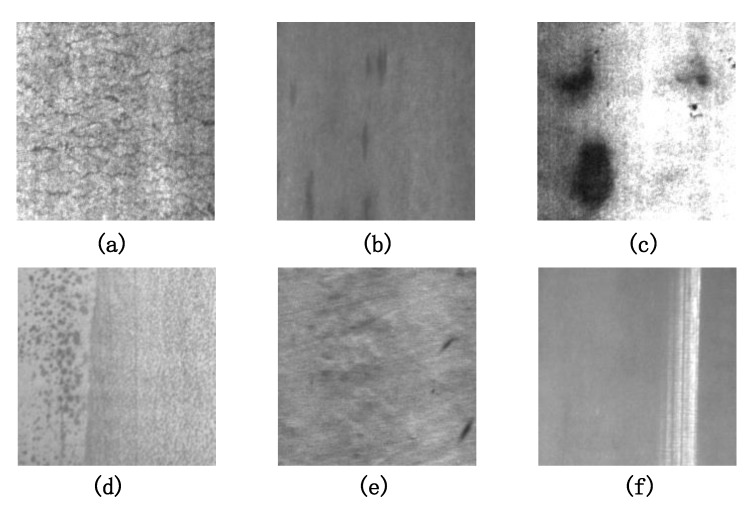
- GC10-DET contains 10 defect types and 3,570 grayscale images collected in a real industrial setting; NEU-DET has 6 defect types and 1,800 grayscale images.
- On NEU-DET, the proposed method achieves the best mAP of 0.724 and the best results on most defect categories; SSD300 is slightly better on Sc recall (0.990 vs. 0.981) and on In AP (0.796 vs. 0.763) and Rs AP (0.621 vs. 0.581).
- On GC10-DET, the proposed method achieves the best mAP and the best results on most categories; SSD300 is slightly better on Rp recall (0.667 vs. 0.333) and Faster-RCNN is better on Cr recall (1 vs. 0.857).
- Runtime is reported as 27 ms/image on NEU-DET and 33 ms/image on GC10-DET for the proposed method; the paper says this is fast enough for real-time use, though YOLO-V2 is slightly faster on GC10-DET testing set time (4.49 s vs. 8 s).
## Methods
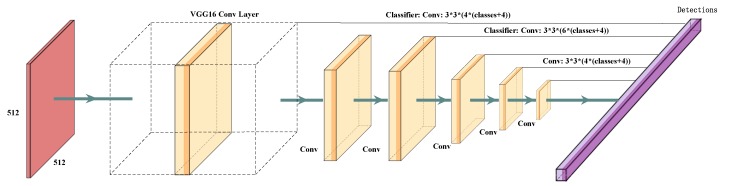
- The paper proposes EDDN, an end-to-end detector built on Single Shot MultiBox Detector (SSD) with VGG16, multi-scale feature maps, default boxes, and non-maximum suppression.
- It introduces hard negative mining, limiting negatives to at most a 3:1 ratio with positives, and applies data augmentation using full images, random patches, and patches with minimum Jaccard overlaps of 0.1, 0.3, 0.5, 0.7, or 0.9.
- Evaluation uses Recall, AP, and mAP on NEU-DET and GC10-DET, with comparisons against SSD, Faster-RCNN, YOLO-V2, YOLO-V3, and traditional LBP/HOG methods.
## Limitations
- The paper states that existing defect datasets are generally unavailable for deployment because of limited data scale and defect categories, and that metallic defect detection is difficult due to illumination, light reflection, and metal material effects.
- It notes that traditional methods are sensitive to lighting and background clutter and need repeated parameter tuning; this is a limitation of prior work, not the proposed method.
- Evident from the text: some reported gains are modest or mixed across categories, since other methods outperform the proposed method on a few defect classes (for example, SSD300 and Faster-RCNN on some NEU-DET and GC10-DET classes).
Model-written summary. Check it against the paper before relying on it.
Integrity signals
Registry
Cites
Statistics
Figures



Verification
Claims the paper makes
2 Valid · 1 Not valid · 1 Not checked · 29 Own results and interpretations
Every source the paper cites for this claim was checked and supports it.
In the paper
“we propose an end-to-end metallic surface defect network based on the Single Shot MultiBox Detector [6].”
- Also stated in: § 5. Conclusions · plain
“we propose an end-to-end defect detection and classification network based on the Single Shot MultiBox Detector.”
§ Deep Metallic Surface Defect Detection: The New Benchmark and Detection Network > 1. Introduction
What the sources say
- Supportedcites [6] Liu, W., Anguelov, D., Erhan, D., Szegedy, C., Reed, S., Fu, C.Y., and Berg, A.C. (2016, January 8–16). Ssd: Single Shot Multibox Detector. Proceedings of the European conference on computer vision, Amsterdam, The Netherlands. source
The citation identifies the Single Shot MultiBox Detector as the basis for the citing authors’ proposed network. The cited paper introduces SSD (Introduction, p. 2) and describes its single-network object detection method (p. 1); it need not describe the citing authors’ metallic-surface defect network. (LLM, conf=0.93)
plain- Asserted: passes — The authors put it forward as true.
- Checkable: passes — It can be checked against evidence.
- Load-bearing: passes — The paper’s conclusions depend on it.
- Based: passes — The paper gives a reason why it holds.
- Also stated in: § 5. Conclusions · plain
A result the paper reports from its own data — it cites no other source for it, so there is none to check. The quote shows it is in the paper.
In the paper
“Besides, the proposed method shows the best mAP accuracy.”
- Also stated in: § 4.4. Accuracy Comparisons with Deep Methods · plain
“the proposed method shows the best mAP accuracy.”
§ Deep Metallic Surface Defect Detection: The New Benchmark and Detection Network > 4. Experiments > 4.4. Accuracy Comparisons with Deep Methods
plain- Asserted: passes — The authors put it forward as true.
- Checkable: passes — It can be checked against evidence.
- Load-bearing: passes — The paper’s conclusions depend on it.
- Based: passes — The paper gives a reason why it holds.
- Also stated in: § 4.4. Accuracy Comparisons with Deep Methods · plain
A result the paper reports from its own data — it cites no other source for it, so there is none to check. The quote shows it is in the paper.
In the paper
“we contribute a new dataset called GC10-DET for large-scale metallic surface defect detection.”
- Also stated in: § 1. Introduction · plain
“We contribute a new dataset named”
- Also stated in: § 4.1. Datasets · plain
“GC10-DET is the surface defect dataset collected in a real industry. It contains ten types of surface defects”
§ Deep Metallic Surface Defect Detection: The New Benchmark and Detection Network > Abstract
plain- Asserted: passes — The authors put it forward as true.
- Checkable: passes — It can be checked against evidence.
- Load-bearing: passes — The paper’s conclusions depend on it.
- Based: passes — The paper gives a reason why it holds.
- Rests on an assumption not shown here.
- Also stated in: § 1. Introduction · plain
A result the paper reports from its own data — it cites no other source for it, so there is none to check. The quote shows it is in the paper.
In the paper
“the mAP can reach 0.724.”
§ Deep Metallic Surface Defect Detection: The New Benchmark and Detection Network > 4. Experiments > 4.4. Accuracy Comparisons with Deep Methods
plain- Asserted: passes — The authors put it forward as true.
- Checkable: passes — It can be checked against evidence.
- Load-bearing: passes — The paper’s conclusions depend on it.
- Based: passes — The paper gives a reason why it holds.
A result the paper states — it cites no source for it, so there is none to check. The quote shows it is in the paper.
In the paper
“the YOLO methods are difficult to distinguish the six types of defects.”
§ Deep Metallic Surface Defect Detection: The New Benchmark and Detection Network > 4. Experiments > 4.4. Accuracy Comparisons with Deep Methods
plain- Asserted: passes — The authors put it forward as true.
- Checkable: passes — It can be checked against evidence.
- Load-bearing: passes — The paper’s conclusions depend on it.
- Based: passes — The paper gives a reason why it holds.
7 more claims
Create a free account to see all 33 claims and to verify the 1 reference still open.
- Probably not a substantial claim. 8
- It may state two separate claims as one. 14
Citations
Cites
ImageNet classification with deep convolutional neural networks
Krizhevsky, A., Sutskever, I., & Hinton, G. E. (2017) · Communications of the ACM · doi:10.1145/3065386 · Cited by 112,155 · cited 1×
“Since the introduction of AlexNet [26], convolutional neural networks have been successfully deployed to detect surface defects.”
MethodFaster R-CNN: Towards Real-Time Object Detection with Region Proposal Networks
Ren, S., He, K., Girshick, R., & Sun, J. (2017) · IEEE Transactions on Pattern Analysis and Machine Intelligence · doi:10.1109/tpami.2016.2577031 · Cited by 73,472
Faster R-CNN: Towards Real-Time Object Detection with Region Proposal Networks
Ren, S., He, K., Girshick, R., & Sun, J. (2015) · arXiv · doi:10.48550/arxiv.1506.01497 · Cited by 70,812
Microsoft COCO: Common Objects in Context
Lin, T.-Y., Maire, M., Belongie, S., Hays, J., Perona, P., Ramanan, D., Dollár, P., & Zitnick, C. L. (2014) · Lecture Notes in Computer Science · doi:10.1007/978-3-319-10602-1_48 · Cited by 45,460 · cited 1×
“The pre-trained models are often trained on ImageNet [34] and MS COCO [35] datasets.”
MethodImageNet Large Scale Visual Recognition Challenge
Russakovsky, O., Deng, J., Su, H., Krause, J., Satheesh, S., Ma, S., Huang, Z., Karpathy, A., Khosla, A., Bernstein, M., et al. (2015) · International Journal of Computer Vision · doi:10.1007/s11263-015-0816-y · Cited by 39,380 · cited 1×
“The pre-trained models are often trained on ImageNet [34] and MS COCO [35] datasets.”
Method(2016) · Cited by 31,590
SSD: Single Shot MultiBox Detector
Liu, W., Anguelov, D., Erhan, D., Szegedy, C., Reed, S., Fu, C.-Y., & Berg, A. C. (2016) · Lecture Notes in Computer Science · doi:10.1007/978-3-319-46448-0_2 · Cited by 22,128 · cited 15×
“The proposed method can obtain the best results on the defects of Pu, In, and Rp, while the SSD300 is slightly higher than proposed on Wl (0.974 vs. 0.885), Ss, (0.689 vs. 0.650) and Wf (1 vs. 0.919).”
MethodInfluentialYOLO9000: Better, Faster, Stronger
Redmon, J., & Farhadi, A. (2017) · 2017 IEEE Conference on Computer Vision and Pattern Recognition (CVPR) · doi:10.1109/cvpr.2017.690 · Cited by 19,892 · cited 8×
“Therefore, the SSD method utilizes VGG16 as the pre-trained model, YOLO-V2 uses Darknet19 model, YOLO-V3 uses Darknet53 model, and Faster R-CNN adopts Resnet50 model.”
MethodInfluentialYOLOv3: An Incremental Improvement
Redmon, J., & Farhadi, A. (2018) · arXiv · doi:10.48550/arxiv.1804.02767 · Cited by 17,141
OverFeat: Integrated Recognition, Localization and Detection using Convolutional Networks
Sermanet, P., Eigen, D., Zhang, X., Mathieu, M., Fergus, R., & LeCun, Y. (2013) · arXiv · doi:10.48550/arxiv.1312.6229 · Cited by 2,680 · cited 1×
“In [29], the OverFeat network [30] was implemented to detect 5 different types of surface defects.”
Method
Cited by
Items 501–592 of 592
Research on Steel Surface Defect Detection Algorithm Based on Improved YOLOv12
Chen, J., Zhang, J., & Liu, D. (2025) · International Conference on Image Processing, Multimedia Technology and Machine Learning (IPMML) · doi:10.1109/ipmml68499.2025.11407396
“…surface defects—including crazing, inclusions, patches, pitting, rolled-in scale, and scratches—arise from raw material impurities, fluctuating rolling conditions, and equipment degradation [3],[4]. thereby impairing surface integrity, fatigue resistance, and corrosion performance in strip steel.”
LA-DETR: Local Attention and Multi-Scale Aggregation for Real-Time Steel Defect Detection
Fu, R., Tong, J., Zhao, Q., et al. (2025) · International Conference on Electronic Information Engineering and Computer Communication (EIECC) · doi:10.1109/eiecc67963.2025.11409533
“We perform experiments on the NEU-DET dataset [20].”
YOLO-GVMamba: An Efficient Steel Surface Defect Object Detection Method Based on State Space Model
Lei, C., Wang, C., Xing, Z., et al. (2025) · International Conference on Virtual Reality and Visualization · doi:10.1109/icvrv67992.2025.00114
“• Experiments conducted on the GC10-DET [10] dataset demonstrate that our method achieves significant improvements in detection accuracy compared to baseline models, surpassing most of current algorithms for steel surface defect detection.”
Lightweight WSSG-YOLO for efficient and accurate steel surface defect detection
Peng, Y., He, S. T., Li, Z., Liu, J., Qian, Y., & Liu, B. (2026) · Multimedia Systems · doi:10.1007/s00530-026-02256-3
“This study primarily validates the model’s generalization performance using two steel surface defect datasets: NEU-DET [ 58 ] and GC10-DET [59], and an additional PCB defect dataset PKU-Market-PCB [ 60 ].”
A Weight‐Complementary Confusing Background Network for Industrial Defect Detection
Zhu, Y., Bai, S., Wan, G., et al. (2026) · Concurrency and Computation Practice and Experience · doi:10.1002/cpe.70656
Fine-grained vehicle damage classification based on applicability network
Zhai, Y., Zhang, Z., Zhou, X., Wang, Z., & Wang, Q. (2026) · Applied Soft Computing · doi:10.1016/j.asoc.2026.115076
Enhanced Multi-Scale Defect Detection in Steel Surfaces via Innovative Deep Learning Architecture
Zhou, Z., & Cao, Y. (2026) · Sensors · doi:10.3390/s26062001 · Cited by 1
“In this paper, the NEU-DET dataset [27] and the GC10-DET dataset [28] are used for training and validation to prove the effectiveness of the improved model.”
Cui, J., & Yang, X. (2026) · IEEE Transactions on Components Packaging and Manufacturing Technology · doi:10.1109/tcpmt.2026.3677795
“To further assess the generalization capability of the proposed network beyond specific chip geometries, we extend the evaluation to the GC10-DET [33] steel surface defect dataset.”
Xiao, Y., Chen, X., Xie, L., Chen, S., Xiao, X., & Peng, L. (2026) · Expert Systems with Applications · doi:10.1016/j.eswa.2026.132025 · Cited by 1
Explainable hybrid AI CAD framework for advanced prediction of steel surface defects
Moon, C.-I., Al-antari, M. A., & Gu, Y. (2026) · Scientific Reports · doi:10.1038/s41598-025-34320-9 · Cited by 1
“The GC10-DET dataset 29 consists of ten surface defect types encountered during the manufacturing process: Crease (Cr), Crescent_gap (Cg), Inclusion (In), Oil_spot (Os), Punching_hole (Pu), Rolled_pit (Rp), Silk_spot (Ss), Waist-folding (Wf), Water_spot (Ws) and Welding_line (Wl).”
Research on Strip Steel Defect Detection Technology Based on Improved YOLO11
Yang, L., Xiao, J., Zhu, M., et al. (2026) · International Conference on Communication Networks and Machine Learning (CNML) · doi:10.1109/cnml68938.2026.11453193
“The dataset used in the experiments is the open-source GC10-DET dataset [13] collected by Tianjin University in a real industrial environment.”
Nam, C., & Lee, S. J. (2026) · Measurement · doi:10.1016/j.measurement.2026.121432 · Cited by 3
Towards efficient Knowledge Graph-based Retrieval Augmented Generation for conversational agents
Schaeffer, M. (2025) · theses.fr (ABES) · doi:10.70675/d674545fzad62z4631z9327zab503346771d · Cited by 1
Chen, M., Sun, P., Liu, Y., & Chen, G. (2026) · Journal of Real-Time Image Processing · doi:10.1007/s11554-026-01885-1 · Cited by 1
“We evaluate our method on two public steel surface defect benchmarks, NEU-DET [30] and GC10-DET [23].”
Li, X., Wu, Q., Zhu, F., Huang, P., & Gu, Y. (2026) · Quality and Reliability Engineering International · doi:10.1002/qre.70218
“The proposed method’s generalization capability and robustness were evaluated through experiments on the GC10-DET dataset [ 46 ].”
Machine vision-based metal workpiece surface defect detection system
Li, Y., Zhang, H., Ba, P., et al. (2026) · Measurement · doi:10.1016/j.measurement.2026.121520
Liu, Z., Li, K., Chen, Y., & Wang, D. (2026) · Advances in Mechanical Engineering · doi:10.1177/16878132261442325
Applications of Deep Learning to Metal Surface Defect Detection: Status and Challenges
Wang, Y., Zhou, M., Zhang, C., & Sedraoui, K. (2026) · Processes · doi:10.3390/pr14081305 · Cited by 3
A railway surface defect detector with frequency–state modeling and multi-scale reverse fusion
Gan, Y., Ren, X., Xu, J., Lin, P. J., & Chen, Y. (2026) · Measurement Science and Technology · doi:10.1088/1361-6501/ae6296
“To further verify the generalization capability of the proposed model and minimize potential dataset-specific bias, an additional evaluation is conducted on the publicly available GC10-DET dataset [31], which contains 2293 industrial images spanning ten categories of steel surface defects.”
FREDNET: A Frequency and Decomposed-Spatial Network for Industrial Defect Signal Detection
Zhou, H., Lai, T., Hao, C., Yue, W., Yue, S., & Zhang, H. (2026) · IEEE International Conference on Acoustics Speech and Signal Processing · doi:10.1109/icassp55912.2026.11462834
EFI-YOLO: An enhanced framework for industrial object detection
Zhao, K., Miao, X., Huang, C., & Li, J. (2026) · Journal of Visual Communication and Image Representation · doi:10.1016/j.jvcir.2026.104796
CDCM-DETR: cross-domain consistency-modulated fusion network for steel surface defect detection
Zhao, B., Guo, S., Jia, X., Liang, Z., & Hu, R. (2026) · Measurement Science and Technology · doi:10.1088/1361-6501/ae652a · Cited by 1
“(2) GC10-DET [32]: This dataset comprises 2280 images of steel surface defects captured in real industrial settings, encompassing 10 defect types such as punching hole (Ph), welding line (Wl), and crescent gap (Cg).”
A Wavelet-Based Efficient Defect Detection Model for Resource-Constrained Devices
Xiao, W., Wang, Y., Chen, Z., et al. (2025) · China Automation Congress (CAC) · doi:10.1109/cac67268.2025.11486607
“Datasets: This study uses two publicly available steel surface defect datasets, NEU-DET [13] and GC10-DET [14], to evaluate the performance of the proposed model.”
A robust model for fast and reliable surface defect detection in Micro-LED production
Chen, Y., Yin, Y., Song, Y., & Gong, Z. (2026) · Digital Signal Processing · doi:10.1016/j.dsp.2026.106211
MINOR SURFACE DEFECT DETECTION IN AGRICULTURAL MACHINERY USING AN OPTIMIZED YOLOv11N ARCHITECTURE
Min, L. I., Shuai, Y. U. A. N., & Wenhong, T. A. N. G. (2026) · INMATEH Agricultural Engineering · doi:10.35633/inmateh-78-10
Qiao, H., Wang, J., & Zhang, S. (2026) · Engineering Research Express · doi:10.1088/2631-8695/ae6f8b
“The performance of RCMFNet was evaluated using NEU-DET [2] and GC10-DET [38] datasets.”
Sun, Z., Chen, J., Lin, C., Yue, X., Wang, K., & Meng, L. (2026) · Journal of Advanced Computational Intelligence and Intelligent Informatics · doi:10.20965/jaciii.2026.p0825
Xu, Y., Jin, J., Ning, P., Xu, Z., Zhang, C., Cao, Y., Guo, B., Wang, W., & Tang, D. (2026) · Measurement · doi:10.1016/j.measurement.2026.121917 · Cited by 1
Shi, L., Shen, Y., Lin, L., Wang, L., Li, X., Qiao, G., Wang, C., Yang, Y., & Zhou, W. (2026) · Signal Image and Video Processing · doi:10.1007/s11760-026-05416-0
Meng, P., Zhang, W., & Chen, H. (2026) · IEEE Access · doi:10.1109/access.2026.3697892 · Cited by 1
“GC10-DET dataset [25], which was used to evaluate the model’s generalization ability.”
Ma, C., Yu, Q., & Ma, S. (2026) · Measurement Science and Technology · doi:10.1088/1361-6501/ae7620
“Two publicly available industrial steel defect benchmarks, namely NEU-DET [37] and GC10-DET [38], were adopted for model training and evaluation; representative defect samples from both collections are depicted in figure 6.”
Gao, H., Zhang, Z., Zeng, L., Yin, Y., Xu, Y., & Guo, S. (2026) · IEEE Internet of Things Journal · doi:10.1109/jiot.2026.3699312 · Cited by 1
“NEU-DET [32] assesses detection accuracy on typical steel surface defects, while GC10-DET [33] evaluates generalization performance under higher resolution, greater defect diversity, and increased detection di ffi culty.”
Research on Improved RT-DETR for Steel Surface Defect Detection
Liu, H., & Han, J. (2026) · International Conference on Intelligent Computing and Signal Processing (ICSP) · doi:10.1109/icsp69961.2026.11540967
“The proposed model uses the public GC10-DET dataset [7] , which contains 2,294 steel surface defect images with a resolution of 2048×1000.”
Mou, Z., Dai, Y., Cao, Z., Lv, Z., Wang, L. N., Shen, Y., & Fu, G. (2026) · Sensors · doi:10.3390/s26123662
“GC10-DET [53] is a benchmark dataset for industrial steel surface defect detection, collected from real manufacturing inspection scenarios.”
FAS-YOLO: A Lightweight Network for Steel Defects Detection Based on Deep Learning
Luo, Y., Liu, H., Feng, H., & Tian, H. (2026) · Journal of Nondestructive Evaluation · doi:10.1007/s10921-026-01373-3
“The GC10-DET dataset [48] contains ten types of defects: Punching (Pu), Welding line (Wl), Crescent gap(Cg), Water spot (Ws), Oil spot (Os), Silk spot (Ss), Inclusion (In), Rolled pit (Rp), Crease (Cr) and Waist folding(Wf).”
Schiller, V., Mezina, A., Bürget, R., & Dutta, M. K. (2026) · Image and Vision Computing · doi:10.1016/j.imavis.2026.106077 · Cited by 1
OAD-YOLOv8n: A Lightweight Direction-Adaptive Framework for Steel Strip Surface Defect Detection
Liu, Y., & Chen, P. (2026) · Metals · doi:10.3390/met16060666
“This dataset was introduced by Lv et al. [39] for large-scale metallic surface defect detection and is publicly released through the official GC10-DET repository.”
Liu, K., Huang, D., Li, Z., & Luo, W. (2026) · Journal of Power Sources · doi:10.1016/j.jpowsour.2026.240738
Liu, K., Huang, C., & Huang, S. (2026) · Chinese Control and Decision Conference (CCDC) · doi:10.1109/ccdc69976.2026.11560303
“In addition, lightweight architectures have been developed to balance accuracy and efficiency for industrial defect detection [8].”
Uncertainty-Aware Industrial Defect Detection: A Unified Evaluation and Learning Framework
Liu, K., Wang, Y., & LI, Y. (2026) · Chinese Control and Decision Conference (CCDC) · doi:10.1109/ccdc69976.2026.11559828
Steel Surface Defect Detection Method Based on an Improved YOLOv11s
Xue, Q., Hu, Y., & Li, C. (2026) · Chinese Control and Decision Conference (CCDC) · doi:10.1109/ccdc69976.2026.11559990
“Lv et al. [5] proposed the SSD-based end-to-end defect detection network EDDN.”
Zhang, X., Li, C. B., & Zhao, S. (2026) · Symmetry · doi:10.3390/sym18071104
LDS-Net: a lightweight detection network for real-time steel surface-defect detection
Xue, C., & Wang, J. (2026) · Journal of Real-Time Image Processing · doi:10.1007/s11554-026-01927-8 · Cited by 1
“This study used two publicly available datasets of steel surface defects: NEU-DET [40] and GC10-DET [41].”
SHMNet: A lightweight backbone network with an auxiliary branch for blister pharmaceutical detection
Wang, G., Wang, J., Wu, C., et al. (2026) · Neurocomputing · doi:10.1016/j.neucom.2026.134412
Li, X., Zhao, J., Zhang, X., & Ruan, W. (2026) · International Conference on Computer Supported Cooperative Work in Design (CSCWD) · doi:10.1109/cscwd68734.2026.11582144
“The GC10-DET dataset [20], collected from real industrial production lines, consists of 2,294 images across ten defect categories.”
DyFA-YOLO: Towards Robust and Efficient Industrial Defect Detection
He, J., & Wang, H. (2026) · International Conference on Computer Supported Cooperative Work in Design (CSCWD) · doi:10.1109/cscwd68734.2026.11582491
“To evaluate our method for industrial defect detection, we used three datasets: NEU-DET [14], GC10-DET [15], and DsPCBSD+ [16].”
Rasak, A., & Ifada, S. (2026) · Research Square · doi:10.21203/rs.3.rs-10158108/v1
MCM-YOLO: A Lightweight Conflict Mitigation Network for Industrial Metal Surface Defect Detection
Zhang, S., He, K., Xu, J. Q., Sha, H., & Chen, Z. L. (2026) · Sensors · doi:10.3390/s26144349
“To evaluate MCM-YOLO for industrial metal surface defect detection and assess its performance on different public benchmarks, this article conducts experiments on two representative public datasets, namely, NEU-DET [37] and GC-10 [38].”
Wang, L., Ma, Y., Gong, T., & Li, Q. (2026) · International Journal of Machine Learning and Cybernetics · doi:10.1007/s13042-026-03199-x
“To further validate the effectiveness of the proposed algo - rithm on large-scale datasets, we conduct experiments on”
Metal surface defect detection model based on multi-scale feature fusion and attention mechanism
Ni, R., CHEN, H., Xu, S., Liang, X., Xia, Y., & He, M. (2026) · Engineering Applications of Artificial Intelligence · doi:10.1016/j.engappai.2026.115674 · Cited by 1
Wang, T., & Zou, K. (2026) · Eng—Advances in Engineering · doi:10.3390/eng7070344
“The GC10-DET dataset [37] contains ten categories of steel surface defects—Punching Hole, Welding Line, Crescent Gap, Water Spot, Oil Spot, Silk Spot, Inclusion, Rolled Pit, Crease, and Waist Folding.”
Yang, Y., & Li, N. (2026) · Measurement Science and Technology · doi:10.1088/1361-6501/ae8bce
“Unlike GC10-DET [35], which is dominated by dense, microscopic targets, NEU-DET features anomalies with extreme aspect ratios spanning the entire surface, such as extended scratches and crazing.”
SPF-YOLO: A Synergistic Perception and Fusion YOLO Architecture for Defect Detection
Zhang, D., & Wang, J. (2026) · IEEE Sensors Journal · doi:10.1109/jsen.2026.3712718
Chen, Y., Liu, Y., Hu, J. B., et al. (2026) · Expert Systems with Applications · doi:10.1016/j.eswa.2026.133702
Wang, X., Zhao, J., Zheng, R., et al. (2026) · Electronics · doi:10.3390/electronics15143199
Zero-Shot Anomaly Detection via Learnable Complementary Prompts and Cross-Modal Interaction
Wang, G., & Wang, Z. (2026) · International Journal of Pattern Recognition and Artificial Intelligence · doi:10.1142/s0218001426510122
Zhang, T., Wang, W., Ji, H.-B., et al. (2026) · Fusion engineering and design · doi:10.1016/j.fusengdes.2026.115980
RCSNet: A recalibration-driven cross-scale collaborative network for steel surface defect detection
Li, L., Lu, S., Ren, Z., Tang, C., & Liang, Y. (2026) · Neurocomputing · doi:10.1016/j.neucom.2026.134684 · Cited by 1
Huang, W., Ma, Y., Wang, B., Yang, F., He, W., & Chen, Y. (2026) · Lecture notes in computer science · doi:10.1007/978-3-032-31930-2_10
Liang, P. (2026) · Lecture notes in computer science · doi:10.1007/978-3-032-31452-9_3
Yu, J., Chen, Y., Ma, F., et al. (2026) · Journal of Real-Time Image Processing · doi:10.1007/s11554-026-01951-8
“The proposed method is evaluated on two steel surface defect datasets, namely GC10-DET [38] and NEU-DET [39].”
A domain-adaptive contrastive and context-enhanced framework for steel surface defect detection
Gao, K., Wang, S., & Li, B. (2026) · Measurement Science and Technology · doi:10.1088/1361-6501/ae9570
“The effectiveness of the proposed method for steel surface defect detection is evaluated on two widely used public datasets, NEU-DET [13] and GC10-DET [34].”
SFEDet: edge-guided spatial-frequency fusion network for steel surface defect detection
Chen, W., Wei, J., Guo, X., & Chen, B. (2026) · Scientific Reports · doi:10.1038/s41598-026-64588-4
GSLA-YOLOV11: lightweight steel surface defect detector with gated multi-branch aggregation
Chen, L., & wang, Y. (2026) · Measurement Science and Technology · doi:10.1088/1361-6501/ae9976
“GC10-DET [53] was collected from actual steel production processes and contains 2294 defect images with an original resolution of 2048 × 1000 pixels.”
Efficient Surface Defect Detection for Industrial Components
Chen, Z., Wu, L., Jia, Z., et al. (2026) · International Conference on Artificial Intelligence and Big Data (ICAIBD) · doi:10.1109/icaibd69640.2026.11637239
“To Fully validate the effectiveness of the proposed method for detecting multiple classes of defects, the public GC10-DET [15] dataset and the Aluminum Profile Surface Detection Dataset (APDDD) [16] are used as the training data in this experiment.”
EMA-YOLO: An Efficient, Lightweight Network for Surface Defect Detection on Metal Substrates
Ouyang, Q., Li, Y., Huang, L., & Meng, Y. (2026) · IEEE Access · doi:10.1109/access.2026.3723959
DPSNet: a dynamic sharpening and perception network for real-time metal surface defect detection
Li, W., Wang, W., Zhang, D., et al. (2026) · Journal of Intelligent Manufacturing · doi:10.1007/s10845-026-02945-w
Li, G., Liu, Y., Li, X., Li, Y., & Li, Y. (2026) · Nondestructive Testing And Evaluation · doi:10.1080/10589759.2026.2721365 · Cited by 1
Zhang, C., Ma, Z., Zeng, B., & Zhang, S. (2026) · International Conference on Electronics and Communication, Network and Computer Technology (ECNCT) · doi:10.1109/ecnct70535.2026.11661422
“Public benchmarks such as the NEU hot-rolled steel surface database [13] and GC10-DET [14] have supported this progress, and comprehensive surveys catalog deep-learning-based surface-defect detection and its remaining challenges, notably the dependence on large, balanced, labeled datasets [15]–[17].”
High-Frequency Guided Feature Aggregation for Strip Steel Surface Defect Detection
Sun, Y., Xu, C., Guo, H., Zhang, L., Feng, Y., Zhang, W., & Tang, Y. (2026) · IEEE Transactions on Automation Science and Engineering · doi:10.1109/tase.2026.3728911
“E XPERIMENTS A. Experimental Settings 1) Datasets: We conduct experiments on three challenging strip steel surface defect datasets, i.e., NEU-DET [43], GC10-DET [44] and CR7-DET [45], to validate the performance of our HFFA.”
Deep Learning-Based Steel Surface Defect Detection: A Survey
Wen, X., Yu, Z., He, Y., Wang, Z., Chen, X., & Song, K. (2026) · Coatings · doi:10.3390/coatings16091040 · Cited by 2
An Improved YOLOv11 Algorithm for Metal Surface Defect Detection
Dai, F., Chen, J., Sun, H., et al. (2026) · IEEJ Transactions on Electrical and Electronic Engineering · doi:10.1002/tee.70428
Li, Y., Peng, Y., & Liu, Z. (2026) · Journal of Industrial Information Integration · doi:10.1016/j.jii.2026.101190
Wang, Y., Xie, H., Yang, J., Sheng, Z., & Xing, F. (2026) · Optics & Laser Technology · doi:10.1016/j.optlastec.2026.116339
Jiang, S., Hua, Y., Wang, L., et al. (2026) · Optics & Laser Technology · doi:10.1016/j.optlastec.2026.116383
RLL-YOLO-seg: an improved instance segmentation model for pixel-level steel surface defect detection
Tang, J., Tang, J., Pan, Y., et al. (2026) · Engineering Research Express · doi:10.1088/2631-8695/aea8da
Self-citationSong, L., Xu, E., Yang, T., et al. (2026) · International Conference on Image, Vision and Computing (ICIVC) · doi:10.1109/icivc70586.2026.11686731
FOD-YOLO: A Steel Surface Defect Detection Model Based on Multi-Dimensional Dynamic Convolution
Peng, Y. (2026) · Procedia Computer Science · doi:10.1016/j.procs.2026.08.171
DGAF-Net: a dynamic gated adaptive fusion network for real-time steel surface defect detection
Chen, Y., Liao, Y., Chen, J., & Du, T. (2026) · Journal of Real-Time Image Processing · doi:10.1007/s11554-026-01983-0 · Cited by 1
YOLO-SDNet: An enhanced lightweight detector for industrial steel surface defect recognition
Shi, L., Tian, S., Wu, Y., et al. (2026) · Signal Image and Video Processing · doi:10.1007/s11760-026-05717-4
Asymmetric CNN–ViT Residual Fusion for Industrial Surface Defect Detection
Ding, C., Zou, K., Zhong, Y., et al. (2026) · Eng—Advances in Engineering · doi:10.3390/eng7090492
Early Porosity Detection in High-Pressure Die Casting Using Explainable Multimodal Data Fusion
Michno, T. P., Holom, R.-M., Schmalzer, S., Meyer-Heye, P., Scampone, G., Riegler, E., Hartmann, M., Repanšek, U., Košir, N., Šifrer, P., et al. (2026) · Applied Sciences · doi:10.3390/app16199472
A Study on a Method for Detecting Surface Defects in Hot-Rolled Steel Based on MDPC-YOLO11
Zeng, H., Huang, Y., Xie, C., et al. (2026) · doi:10.1109/eicars71536.2026.11694995
“To further evaluate generalization and robustness across diverse industrial scenarios, the publicly available GC10-DET dataset [18] is introduced for extended experiments.”
DSA-YOLO: Coupling Spectral and Spatial Cues for Lightweight Strip Steel Surface Defect Detection
Cheng, C., & You, Q. (2026) · IEEE Access · doi:10.1109/access.2026.3737532
Zhang, H., Chen, Z., Huang, Y., et al. (2026) · Nondestructive Testing And Evaluation · doi:10.1080/10589759.2026.2737805
A prototype-aligned multi-scale attention network for few-shot industrial surface defect detection
Huang, R., & Zhao, L. (2026) · PLoS ONE · doi:10.1371/journal.pone.0359400
“This experiment used two publicly available industrial surface defect detection datasets, NEU-DET [22,23] and GC10-DET [27], to train and evaluate the proposed model.”
CDS-YOLO: Industrial Surface Defect Detection Based on an Improved YOLO11 Framework
罗天平 (2026) · International Conference on Computer Vision and Data Mining (ICCVDM) · doi:10.1109/iccvdm71812.2026.11709204
“Defects are typically small in scale and low in contrast, and are submerged in strong textural backgrounds such as roll marks, oxidation, and routing patterns; public metal-surface defect benchmarks also commonly include directionally structured categories such as scratches and creases [1] .”
Lian, Z., Li, X., Qi, B., et al. (2026) · Journal of Intelligent Manufacturing · doi:10.1007/s10845-026-02979-0
Sensing the cut: a review of sensor technologies for saw-process monitoring
Hassan, M., Sarker, A., Kirwin, R. M., et al. (2026) · Manufacturing Letters · doi:10.1016/j.mfglet.2026.08.053
Jagupilla, A., Bandi, V. P., Chandupatla, R. R., Sankuratri, R., & Kakke, J. (2026) · IEEE World Conference on Applied Intelligence and Computing (AIC) · doi:10.1109/aic70896.2026.11716801
“However, recent surveys reveal that many surface defect studies are still focused on accuracy and took a minimalistic approach on deployment constraints like latency, bandwidth, and cloud costs [13].”
GER-DETR: efficient steel surface defect detection via lightweight RT-DETR optimization
Liu, X.-J., & Liang, Z.-P. (2026) · Journal of Real-Time Image Processing · doi:10.1007/s11554-026-01987-w
“The GC10-DET dataset [35] was collected in real industrial environments using grayscale cameras with an image resolution of 2048 × 1000 pixels and comprises ten surface defect categories (see Fig.”
Liu, Y., Yan, B., Li, Z., et al. (2026) · Expert Systems with Applications · doi:10.1016/j.eswa.2026.134647
Metadata
- Authors
- Lv, X., Duan, F., Jiang, J.-J., Fu, X., & Gan, L.
- Affiliations
- Tianjin University (CN)
- The State Key Lab of Precision Measuring Technology and Instruments, Tianjin University, Tianjin 300072, China
- Corresponding author
- Duan, Fajie
- Venue
- Sensors
- Publisher
- MDPI AG
- Published
- 2020-03-11
- Volume
- 20
- Issue
- 6
- Pages
- 1562
- ISSN
- 1424-8220 (ISSN-L)
- PMC
- PMC7146379
- OpenAlex
- W3012374719
- Cited by
- 643
- References
- 38
- Citations by year
- 2026: 188 · 2025: 188 · 2024: 125 · 2023: 81 · 2022: 40 · 2021: 18 · 2020: 3
- FWCI
- 18.23
- Type
- journal article
- Language
- en
- Open access
- gold
- dx.doi.org
- Licence
- Locations
- Sensors (publishedVersion, cc-by)
- PubMed Central (publishedVersion, cc-by)
- PubMed (publishedVersion)
- DOAJ (DOAJ: Directory of Open Access Journals) (submittedVersion, cc-by-sa)
- Funders
- National Natural Science Foundations of China (No.61905175, 51775377, 61971307)
- National key research and development plan (2017YFF0204800)
- the TianJin Natural Science Foundations of China (No. 17JCQNJC01100)
- Equipment pre-research field fund (61405180505, 61400040303)
- Science and Technology on Underwater Information and Control Laboratory (6142218081811)
- Topics
- Physical Sciences › Engineering › Industrial and Manufacturing Engineering › Industrial Vision Systems and Defect Detection
- Physical Sciences › Engineering › Mechanical Engineering › Non-Destructive Testing Techniques
- Physical Sciences › Engineering › Civil and Structural Engineering › Infrastructure Maintenance and Monitoring
- Keywords
- Single Shot MultiBox Detector, hard negative mining, class imbalance, data augmentation, industrial inspection, object detection
About these checks
Registry, retraction, Cites and statistics results are computed, not judged, with one exception: a printed reference that no index lists is read once by a model before it counts as a citation error. Claims are extracted by a model and kept only when their quote appears verbatim in the text; each cited source is then checked, with a model’s help, for whether it says what the claim relies on. Those verdicts can be wrong — read the claim’s quote and the cited source before relying on one.
A language model drew the claims from the paper on 2026-10-10, under version 3 of the claim definition (model deepseek-v4.1-flash, prompt extract-v3).
A second model labelled each claim on 2026-10-10 (model jev-1.13-20260917, definition revision gold-guideline-v0.2).
Cited sources are checked with a language model’s help (gpt-6-sol).
Statistics and arithmetic are recomputed, not judged.
Confidence bands are shown only for fields calibrated on our annotated test set. None is calibrated yet, so no band is shown.
What counts as a claim ›How we measure confidence ›How we check this ›
Are you an author, or do you see a problem with this page? Request a review
Data sources
Bibliographic data: Semantic Scholar, OpenAlex, Crossref.
Contains information from the Semantic Scholar Academic Graph Datasets, made available under the ODC Attribution License (ODC-BY 1.0).
Semantic Scholar’s data is described in: Kinney, R., et al. (2023). The Semantic Scholar Open Data Platform. arXiv:2301.10140.
