

Deep Metallic Surface Defect Detection: The New Benchmark and Detection Network
Open accessThe DOI matches its Crossref record; 42 of the 42 references it cites were found in a registry or an index; 2 of the 6 sources its claims cite were checked for support.
Abstract
Metallic surface defect detection is an essential and necessary process to control the qualities of industrial products. However, due to the limited data scale and defect categories, existing defect datasets are generally unavailable for the deployment of the detection model. To address this problem, we contribute a new dataset called GC10-DET for large-scale metallic surface defect detection. The GC10-DET dataset has great challenges on defect categories, image number, and data scale. Besides, traditional detection approaches are poor in both efficiency and accuracy for the complex real-world environment. Thus, we also propose a novel end-to-end defect detection network (EDDN) based on the Single Shot MultiBox Detector. The EDDN model can deal with defects with different scales. Furthermore, a hard negative mining method is designed to alleviate the problem of data imbalance, while some data augmentation methods are adopted to enrich the training data for the expensive data collection problem. Finally, the extensive experiments on two datasets demonstrate that the proposed method is robust and can meet accuracy requirements for metallic defect detection.
Overview
CoChat Summary
## TL;DR
The paper introduces GC10-DET, a new real-industry metallic surface defect dataset with 10 defect types and 3,570 grayscale images, and proposes an end-to-end defect detector (EDDN) based on SSD. Experiments on GC10-DET and NEU-DET show the method is robust, improves multi-scale defect detection, and achieves the best mAP on GC10-DET.
## Key findings
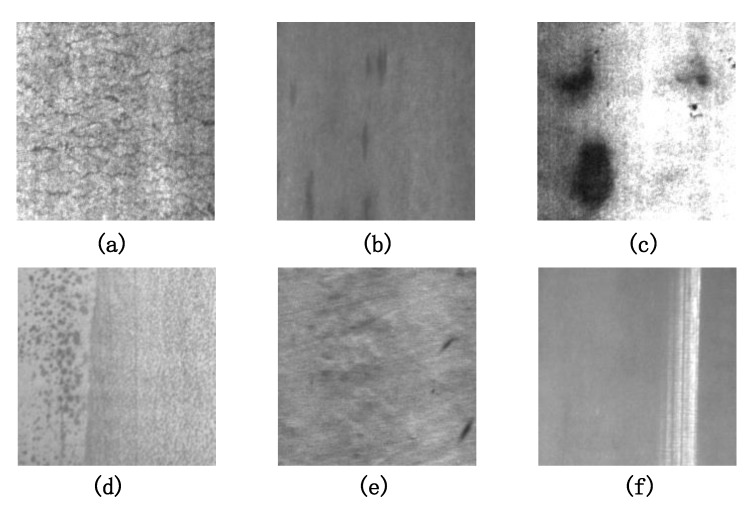
- GC10-DET contains 10 defect types and 3,570 grayscale images collected in a real industrial setting; NEU-DET has 6 defect types and 1,800 grayscale images.
- On NEU-DET, the proposed method achieves the best mAP of 0.724 and the best results on most defect categories; SSD300 is slightly better on Sc recall (0.990 vs. 0.981) and on In AP (0.796 vs. 0.763) and Rs AP (0.621 vs. 0.581).
- On GC10-DET, the proposed method achieves the best mAP and the best results on most categories; SSD300 is slightly better on Rp recall (0.667 vs. 0.333) and Faster-RCNN is better on Cr recall (1 vs. 0.857).
- Runtime is reported as 27 ms/image on NEU-DET and 33 ms/image on GC10-DET for the proposed method; the paper says this is fast enough for real-time use, though YOLO-V2 is slightly faster on GC10-DET testing set time (4.49 s vs. 8 s).
## Methods
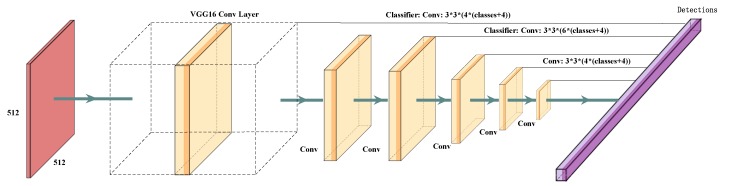
- The paper proposes EDDN, an end-to-end detector built on Single Shot MultiBox Detector (SSD) with VGG16, multi-scale feature maps, default boxes, and non-maximum suppression.
- It introduces hard negative mining, limiting negatives to at most a 3:1 ratio with positives, and applies data augmentation using full images, random patches, and patches with minimum Jaccard overlaps of 0.1, 0.3, 0.5, 0.7, or 0.9.
- Evaluation uses Recall, AP, and mAP on NEU-DET and GC10-DET, with comparisons against SSD, Faster-RCNN, YOLO-V2, YOLO-V3, and traditional LBP/HOG methods.
## Limitations
- The paper states that existing defect datasets are generally unavailable for deployment because of limited data scale and defect categories, and that metallic defect detection is difficult due to illumination, light reflection, and metal material effects.
- It notes that traditional methods are sensitive to lighting and background clutter and need repeated parameter tuning; this is a limitation of prior work, not the proposed method.
- Evident from the text: some reported gains are modest or mixed across categories, since other methods outperform the proposed method on a few defect classes (for example, SSD300 and Faster-RCNN on some NEU-DET and GC10-DET classes).
Model-written summary. Check it against the paper before relying on it.
Integrity signals
Registry
Cites
Statistics
Figures



Verification
Claims the paper makes
2 Valid · 1 Not valid · 1 Not checked · 29 Own results and interpretations
Every source the paper cites for this claim was checked and supports it.
In the paper
“we propose an end-to-end metallic surface defect network based on the Single Shot MultiBox Detector [6].”
- Also stated in: § 5. Conclusions · plain
“we propose an end-to-end defect detection and classification network based on the Single Shot MultiBox Detector.”
§ Deep Metallic Surface Defect Detection: The New Benchmark and Detection Network > 1. Introduction
What the sources say
- Supportedcites [6] Liu, W., Anguelov, D., Erhan, D., Szegedy, C., Reed, S., Fu, C.Y., and Berg, A.C. (2016, January 8–16). Ssd: Single Shot Multibox Detector. Proceedings of the European conference on computer vision, Amsterdam, The Netherlands. source
The citation identifies the Single Shot MultiBox Detector as the basis for the citing authors’ proposed network. The cited paper introduces SSD (Introduction, p. 2) and describes its single-network object detection method (p. 1); it need not describe the citing authors’ metallic-surface defect network. (LLM, conf=0.93)
plain- Asserted: passes — The authors put it forward as true.
- Checkable: passes — It can be checked against evidence.
- Load-bearing: passes — The paper’s conclusions depend on it.
- Based: passes — The paper gives a reason why it holds.
- Also stated in: § 5. Conclusions · plain
A result the paper reports from its own data — it cites no other source for it, so there is none to check. The quote shows it is in the paper.
In the paper
“Besides, the proposed method shows the best mAP accuracy.”
- Also stated in: § 4.4. Accuracy Comparisons with Deep Methods · plain
“the proposed method shows the best mAP accuracy.”
§ Deep Metallic Surface Defect Detection: The New Benchmark and Detection Network > 4. Experiments > 4.4. Accuracy Comparisons with Deep Methods
plain- Asserted: passes — The authors put it forward as true.
- Checkable: passes — It can be checked against evidence.
- Load-bearing: passes — The paper’s conclusions depend on it.
- Based: passes — The paper gives a reason why it holds.
- Also stated in: § 4.4. Accuracy Comparisons with Deep Methods · plain
A result the paper reports from its own data — it cites no other source for it, so there is none to check. The quote shows it is in the paper.
In the paper
“we contribute a new dataset called GC10-DET for large-scale metallic surface defect detection.”
- Also stated in: § 1. Introduction · plain
“We contribute a new dataset named”
- Also stated in: § 4.1. Datasets · plain
“GC10-DET is the surface defect dataset collected in a real industry. It contains ten types of surface defects”
§ Deep Metallic Surface Defect Detection: The New Benchmark and Detection Network > Abstract
plain- Asserted: passes — The authors put it forward as true.
- Checkable: passes — It can be checked against evidence.
- Load-bearing: passes — The paper’s conclusions depend on it.
- Based: passes — The paper gives a reason why it holds.
- Rests on an assumption not shown here.
- Also stated in: § 1. Introduction · plain
A result the paper reports from its own data — it cites no other source for it, so there is none to check. The quote shows it is in the paper.
In the paper
“the mAP can reach 0.724.”
§ Deep Metallic Surface Defect Detection: The New Benchmark and Detection Network > 4. Experiments > 4.4. Accuracy Comparisons with Deep Methods
plain- Asserted: passes — The authors put it forward as true.
- Checkable: passes — It can be checked against evidence.
- Load-bearing: passes — The paper’s conclusions depend on it.
- Based: passes — The paper gives a reason why it holds.
A result the paper states — it cites no source for it, so there is none to check. The quote shows it is in the paper.
In the paper
“the YOLO methods are difficult to distinguish the six types of defects.”
§ Deep Metallic Surface Defect Detection: The New Benchmark and Detection Network > 4. Experiments > 4.4. Accuracy Comparisons with Deep Methods
plain- Asserted: passes — The authors put it forward as true.
- Checkable: passes — It can be checked against evidence.
- Load-bearing: passes — The paper’s conclusions depend on it.
- Based: passes — The paper gives a reason why it holds.
7 more claims
Create a free account to see all 33 claims and to verify the 1 reference still open.
- Probably not a substantial claim. 8
- It may state two separate claims as one. 14
Citations
Cites
ImageNet classification with deep convolutional neural networks
Krizhevsky, A., Sutskever, I., & Hinton, G. E. (2017) · Communications of the ACM · doi:10.1145/3065386 · Cited by 112,155 · cited 1×
“Since the introduction of AlexNet [26], convolutional neural networks have been successfully deployed to detect surface defects.”
MethodFaster R-CNN: Towards Real-Time Object Detection with Region Proposal Networks
Ren, S., He, K., Girshick, R., & Sun, J. (2017) · IEEE Transactions on Pattern Analysis and Machine Intelligence · doi:10.1109/tpami.2016.2577031 · Cited by 73,472
Faster R-CNN: Towards Real-Time Object Detection with Region Proposal Networks
Ren, S., He, K., Girshick, R., & Sun, J. (2015) · arXiv · doi:10.48550/arxiv.1506.01497 · Cited by 70,812
Microsoft COCO: Common Objects in Context
Lin, T.-Y., Maire, M., Belongie, S., Hays, J., Perona, P., Ramanan, D., Dollár, P., & Zitnick, C. L. (2014) · Lecture Notes in Computer Science · doi:10.1007/978-3-319-10602-1_48 · Cited by 45,460 · cited 1×
“The pre-trained models are often trained on ImageNet [34] and MS COCO [35] datasets.”
MethodImageNet Large Scale Visual Recognition Challenge
Russakovsky, O., Deng, J., Su, H., Krause, J., Satheesh, S., Ma, S., Huang, Z., Karpathy, A., Khosla, A., Bernstein, M., et al. (2015) · International Journal of Computer Vision · doi:10.1007/s11263-015-0816-y · Cited by 39,380 · cited 1×
“The pre-trained models are often trained on ImageNet [34] and MS COCO [35] datasets.”
Method(2016) · Cited by 31,590
SSD: Single Shot MultiBox Detector
Liu, W., Anguelov, D., Erhan, D., Szegedy, C., Reed, S., Fu, C.-Y., & Berg, A. C. (2016) · Lecture Notes in Computer Science · doi:10.1007/978-3-319-46448-0_2 · Cited by 22,128 · cited 15×
“The proposed method can obtain the best results on the defects of Pu, In, and Rp, while the SSD300 is slightly higher than proposed on Wl (0.974 vs. 0.885), Ss, (0.689 vs. 0.650) and Wf (1 vs. 0.919).”
MethodInfluentialYOLO9000: Better, Faster, Stronger
Redmon, J., & Farhadi, A. (2017) · 2017 IEEE Conference on Computer Vision and Pattern Recognition (CVPR) · doi:10.1109/cvpr.2017.690 · Cited by 19,892 · cited 8×
“Therefore, the SSD method utilizes VGG16 as the pre-trained model, YOLO-V2 uses Darknet19 model, YOLO-V3 uses Darknet53 model, and Faster R-CNN adopts Resnet50 model.”
MethodInfluentialYOLOv3: An Incremental Improvement
Redmon, J., & Farhadi, A. (2018) · arXiv · doi:10.48550/arxiv.1804.02767 · Cited by 17,141
OverFeat: Integrated Recognition, Localization and Detection using Convolutional Networks
Sermanet, P., Eigen, D., Zhang, X., Mathieu, M., Fergus, R., & LeCun, Y. (2013) · arXiv · doi:10.48550/arxiv.1312.6229 · Cited by 2,680 · cited 1×
“In [29], the OverFeat network [30] was implemented to detect 5 different types of surface defects.”
Method
Cited by
Items 401–500 of 592
Efficient and Accurate Detector with Global Feature Aggregation for Steel Surface Defect Detection
Qian, K., Wang, Z., & Zou, L. (2023) · Lecture notes in computer science · doi:10.1007/978-981-99-6501-4_29 · Cited by 1
Yıldız, A., Tunalι, M. M., Sayar, A., Aslan, Y., Mutlu, İ., Şimşek, K., & Çakar, T. E. (2023) · International Conference on Computer Science and Engineering (UBMK) · doi:10.1109/ubmk59864.2023.10286748 · Cited by 2
Metal Surface Defect Detection Algorithm Based on Improved YOLOv5
Su, X., Zhang, F., Zhang, Y., Xu, H., & Chen, X. (2023) · IEEE Information Technology and Mechatronics Engineering Conference (ITOEC) · doi:10.1109/itoec57671.2023.10291687 · Cited by 1
“Since most of the current metal defect detection data sets have the problem of small number of samples, this experiment is carried out on the large sample data set GC10-DET[23], which is a surface defect data set collected on the actual production line.”
BackgroundDigital Images – The Bread and Butter of Computer Vision
Nassif, J., Tekli, J., & Kamradt, M. (2024) · Springer eBooks · doi:10.1007/978-3-031-47560-3_5 · Cited by 2
Methods for detecting surface defects on thin sheet materials for visual control automation (Review)
Novodranov, A. S. (2024) · Tehničeskaâ diagnostika i nerazrušaûŝij kontrol · doi:10.37434/tdnk2024.02.04 · Cited by 1
Detection Method of Steel Surface Defects Based on Semi-Supervised Frame
Lei, M., Qi, W., Chen, Y., Xinyi, H., Hujian, P., & Xinru, H. (2024) · IEEE International Conference on Software Engineering and Artificial Intelligence (SEAI) · doi:10.1109/seai62072.2024.10674129 · Cited by 1
“Sia et al. proposed a semi-supervised detection technique for the unbalanced steel defect data set and most of the data were unlabeled and verified the feasibility of the semi-supervised technique through data sampling [3].”
MethodAmbiguous Boundary Uncertainty Reduction in Single Stage Detector Models
Bharti, D., Puneeth, B., & Venkatesh, K. S. (2024) · IEEE International Conference on Computer Vision and Machine Intelligence (CVMI) · doi:10.1109/cvmi61877.2024.10782711 · Cited by 1
“This leads to a high number of false positives as observed by us in our custom metal defects and GC10-DET [5] datasets.”
InfluentialSteel surface defect detection based on bidirectional cross-scale fusion deep network
Xie, Z., & Jin, L. (2025) · Optical Review · doi:10.1007/s10043-025-00957-0 · Cited by 3
“…is the surface defect dataset captured from real industrial settings, consisting ten types of surface defects, namely punching (Pu), welding line (W l ), crescent gap (Cg), water spot (Ws), oil spot (Os), silk spot (Ss), inclusion (In), rolled pit (Rp), crease (Cr), and waist folding (Wf) [35].”
Performance Comparison of Machine Learning Classifiers for FPGA-Accelerated Surface Defect Detection
Johnson, V. C., Bali, J. S., Chanchal, A. K., Kumar, S., & Shukla, M. K. (2024) · IEEE Conference on Engineering Informatics (ICEI) · doi:10.1109/icei64305.2024.10912092 · Cited by 1
“These techniques, which aim to analyze and detect manufacturing defects, frequently, refer to traditional image processing, machine learning, and deep learning algorithms [9].”
Practical Teaching Reform of “Deep Learning” Course Based on Industrial Scenarios
李, 卫. (2025) · Vocational Education · doi:10.12677/ve.2025.144163 · Cited by 1
A Hierarchical Multi-Scale Feature Fusion-Based Classification Model for Metal Defects
Li, J., & Liu, J. (2025) · Arabian Journal for Science and Engineering · doi:10.1007/s13369-025-10223-9 · Cited by 2
Hajare, M., Rao, J., & Patil, P. (2025) · Algorithms for intelligent systems · doi:10.1007/978-981-97-8868-2_25 · Cited by 1
VPGFNet: Cross-domain few-shot visual prompt graph fusion network for industrial defect segmentation
Yang, Z., Chen, Q., Du, Y., & Gong, W. (2025) · Journal of Computational Design and Engineering · doi:10.1093/jcde/qwaf105 · Cited by 3
Dual-stream perception cross-flattening transformer for few-shot surface defect detection
LI, Y., Wang, S., Jing, Z., Zheng, J., Han, X. B., Zheng, X., & Sun, F. (2025) · Information Sciences · doi:10.1016/j.ins.2025.123017 · Cited by 2
Detecting aluminium tube surface defects by using faster region-based convolutional neural networks
Chen, S., Wang, D.-G., & Wang, F.-B. (2022) · Journal of Computational Methods in Sciences and Engineering · doi:10.3233/jcm-226107 · Cited by 2
Classification and Localization of Defects Using Single-Shot Multibox DetectorPreprint
Ihianle, I. K., Kaur, M., Chauhan, K. K., Aggarwal, N., Joshi, G., Vig, R., & Owa, K. (2023) · SSRN Electronic Journal · doi:10.2139/ssrn.4673716 · Cited by 1
Research on Industrial Defect Detection Method Based on Improved YoloxPreprint
Pei, X., Su, S., Yuan, Y., Jiang, L., Chen, C., & Chu, C. (2024) · SSRN Electronic Journal · doi:10.2139/ssrn.4697038 · Cited by 1
Siamese Basis Function Networks for Data-Efficient Defect Classification in Technical Domains
Schlagenhauf, T., Yildirim, F., & Brückner, B. (2023) · Lecture notes in computer science · doi:10.1007/978-3-031-26236-4_7 · Cited by 2
“Further approaches include [29], employing kernel classifiers for detection, and [30], where a CNN network is used.”
MethodMETAL SURFACE DEFECT DETECTION USING DEEP LEARNING
S, S. A. V. S. S. M., Tejashree, V. S., Chuphal, A., & Kumari, S. (2021) · International Journal of Engineering Applied Sciences and Technology · doi:10.33564/ijeast.2021.v06i03.022
Banf, M., & Steinhagen, G. (2022) · Proceedings of the World Congress on Electrical Engineering and Computer Systems and Science · doi:10.11159/mhci22.104 · Cited by 1
“Hence, we resort to a typically used benchmark dataset, i.e. the surface defect database from the North-Eastern University (NEU), China[6].”
MethodDefect Detection on Steel Surface with Deep Active Learning Methods on Fewer Data
Gölcük, B., & Omurca, S. İ. (2023) · Engineering cyber-physical systems and critical infrastructures · doi:10.1007/978-3-031-31956-3_47
Akın, E., AYDIN, A., & Aydın, İ. (2023) · Research Square · doi:10.21203/rs.3.rs-3231635/v1
Fast and High Precision Surface Defect Detection Method Based on New Label Assignment
Li, R., Wu, X., Zhou, J., & Zheng, J. (2023) · IEEE International Conference on Real-time Computing and Robotics (RCAR) · doi:10.1109/rcar58764.2023.10249914
“In this paper, experiments are conducted on the severstal Steel defect industrial defect dataset [22] , GC10-DET [23] and Tenchi cloth defect datasets [24].”
MethodOPTIMIZATION OF PREDICTION AND PREVENTION OF DEFECTS ON METAL BASED ON AI USING VGG16 ARCHITECTURE
Kosim, M., Wibowo, A., Setioputro, N. T., et al. (2023) · Journal of Mechanical and Manufacture · doi:10.31949/jmm.v3i1.6542
Metal Surface Defect Detection Based on Latitude-Longitude Light SourcesPreprint
Li, S., Yan, Z., Li, P., et al. (2023) · SSRN Electronic Journal · doi:10.2139/ssrn.4646874
Steel surface defect detection based on lightweight model
He, L., Huang, J., Li, X., & Guan, B. (2023) · Youth Academic Annual Conference of Chinese Association of Automation (YAC) · doi:10.1109/yac59482.2023.10401449
“[15] has proposed a new end-to-end network for defect detection.”
BackgroundAn Algorithm for Detecting Surface Defects in Steel Strips Based on an Improved Lightweight Network
Zhan, D., Wang, H., Yang, X. D., Ou, W. C., Huang, R. B., Lin, J., Yi, K., & Zhou, B. (2024) · Defect and diffusion forum/Diffusion and defect data, solid state data. Part A, Defect and diffusion forum · doi:10.4028/p-foi56w
“These methods are usually only aimed at a specific environment and are difficult to deploy in the more challenging real world due to their lack of robustness and adaptability [6].”
MethodResearch on Surface Defect Detection Method of Metal Materials Based on Improved YoloxPreprint
Pei, X., Su, S., Yuan, Y., Jiang, L., Chen, C., & Chu, C. (2024) · SSRN Electronic Journal · doi:10.2139/ssrn.4768920
AUTOMATED METALLIC SURFACE FLAW INSPECTION USING ARTIFICIAL INTELLIGENCE TECHNIQUES
Anwar, S. R., Thangarasu, N., Sahoo, G. S., & Saxena, K. (2024) · Proceedings on Engineering Sciences · doi:10.24874/pes.si.24.02.009
“These technologies have the ability to detect even minute defects that can be undetected by human observation (Lv et al., (2020)).”
BackgroundAn automatic inspection approach for remanufacturing components using object detection
Aravapalli, S. R. M. (2022) · doi:10.31274/td-20240329-53 · Cited by 3
“Table 2-1 Continued Authors Type of Inspection Architecture used Type of defects Achievements Limitations Lv et al. (2020) Automatic inspection EDDN using single shot multi box detector Metallic surface defects Better performance in comparison with SSD, Faster RCNN, YOLOv2 & YOLOv3 Achieved mAP…”
MethodInfluentialEANet: Enhanced Attention-based Model for Surface Defect Detection
Liu, G. (2024) · IEEE Advanced Information Technology, Electronic and Automation Control Conference (IAEAC) · doi:10.1109/iaeac59436.2024.10503680
“Lv et al. [17] introduced a single shot multibox detector to deal with defects under different scales.”
BackgroundA Novel Approach for Steel Defects Detection Using Yolo-Ae: Iiot Enabled Defect Detection SystemPreprint
Biswas, S., Ganesh, A., & Banerjee, K. (2024) · SSRN Electronic Journal · doi:10.2139/ssrn.4866209
Compare the effect of Rhodococcus erythropolis and Rhodococcus equi on crude oil by FT-IR technique
Riahi, M. A., & Rasti, A. (2023) · International Journal of Petrochemical Science & Engineering · doi:10.15406/ipcse.2023.06.00129
Novodranov, A. S. (2024) · The Paton Welding Journal · doi:10.37434/tpwj2024.08.05
Real-time defect detection systems for steel and wood inspection
Ghali, R., Benhafid, Z., & Selouani, S. (2024) · Conference proceedings - Canadian Conference on Electrical and Computer Engineering · doi:10.1109/ccece59415.2024.10667164 · Cited by 2
“The public GC10-DET steel surface defect dataset [26] was collected in a real industry setting by researchers from Tianjin University.”
MethodFeature Learning using Deep Variational Autoencoder for Prediction of Defects in Car Engine
Susanto, N., & Pardede, H. F. (2024) · International Conference on Information Technology Research and Innovation (ICITRI) · doi:10.1109/icitri62858.2024.10699115 · Cited by 2
Cutting Tool Surface Defect Detection based on Chaos Difference Method in Manufacturing Process
Wu, Z., Niu, W., Sun, X., et al. (2024) · 2022 IEEE 18th International Conference on Automation Science and Engineering (CASE) · doi:10.1109/case59546.2024.10711501
Deep Learning Application and Analysis In Detection of Metal Plate Surface Defects
Tuncer, C., Közkurt, C., & Kılıçarslan, S. (2024) · Journal of Materials and Mechatronics A · doi:10.55546/jmm.1512549
Deng, D., & Zhao, B. (2024) · International Conference on Testing Technology and Automation Engineering (TTAE) · doi:10.1117/12.3055482
“In addition, Lv et al [5] proposed an SSD-based detection network that pays more attention to the training of samples with larger losses, and the results show that this network has a large improvement for the recall rate.”
Adaptive Shape Imitation and Selective Semantic Guidance for Industrial Surface Defect DetectionPreprint
Liang, X., Li, Y., Wang, X., et al. (2025) · SSRN Electronic Journal · doi:10.2139/ssrn.5088043
Concrete Surface Defect Image Analysis Based on Novel Deep Learning Algorithm
Dong, N., Li, X., Ren, J., et al. (2025) · doi:10.1109/icmsci62561.2025.10894558
“Scholars such as Lv [6] proposed a new data set, named GC10-DET, to address the challenge of the precise defect detection on metal surfaces.”
PBD : Plastic Bottle Dataset for Defect Detection
Lin, Z., Liu, D., Wei, L., & Dong, Y. (2025) · IEEE International Conference on Acoustics Speech and Signal Processing · doi:10.1109/icassp49660.2025.10887639 · Cited by 1
“Lv et al. [3] proposed a dataset in 2020 with ten types of defects for industrial metal surfaces.”
Task-guided dynamic feature selection and loss optimization for multi-scale defect detection
Liu, P., Xia, G., Fang, L., et al. (2026) · Advanced Engineering Informatics · doi:10.1016/j.aei.2026.104772
Liu, C., Tao, Z., & Chen, B. (2026) · Applied Soft Computing · doi:10.1016/j.asoc.2026.115877
LAGNet: A Location-Aware Guidance Network for Weak and Strip Defect Detection
Cui, L., Jiao, H., Liu, T., Niu, C., Ma, M., Jiang, X., & Xu, M. (2025) · Lecture notes in computer science · doi:10.1007/978-981-96-5809-1_19
Melnyk, R. A., & Vipshovskyi, Y. (2024) · doi:10.1109/csit65290.2024.10982664
“We tested using booth datasets and compared them with data from the article [7] (Table 1).”
Sun, T. S., wang, W., & Ma, W. (2025) · SSRN Electronic Journal · doi:10.2139/ssrn.5252483
A YOLOv5-based Model Enhanced by Dynamic Convolution for Accurate Object Detection
Wang, Z., Chen, H., & Xing, J. (2025) · doi:10.1109/iscait64916.2025.11010310
“Collectively, these advancements contribute to improved detection accuracy, robustness, and efficiency across a wide range of real-world applications [8-10].”
Castilla, Y. C., Llerena, Y. F., Oliveira, J., Silva, A., Leal, N., García-Reyes, E. B., & Guevara, M. A. (2025) · Lecture notes in mechanical engineering · doi:10.1007/978-3-031-94223-5_25
Real time Application of Image Recognition Technology in Defect Detection of Mechanical Products
Wang, F., Hu, J., & Zhang, S. (2025) · ZKG International · doi:10.63386/618764
PHG-YOLO: A Lightweight Steel Surface Defect Detection Algorithm based on YOLOv8
Zhang, Y., Xie, Y., & Lu, Y. (2025) · International Conference on Computer Supported Cooperative Work in Design (CSCWD) · doi:10.1109/cscwd64889.2025.11033659
Tan, L., Liao, X., Zheng, A., et al. (2025) · doi:10.1109/cisce65916.2025.11065589
“To further evaluate the generalization ability of the proposed method, we conducted experiments using the GC10-DET dataset [8], which consists of 2294 images including 10 different defect classes: punched holes (Pu), fusion lines (WL), crescent gaps (Cg), water spots (Ws), oil spots (Os), silk…”
Zheng, C., Liu, H., & Zhang, H. (2025) · IEEE Data Driven Control and Learning Systems Conference (DDCLS) · doi:10.1109/ddcls66240.2025.11065548
“…FSC-20 dataset (Few-shot classification contains 20 types of strip steel surface defects)[10] was used in this project, which was constructed by Northeastern University in 2023 from the current collection of three world-recognised industrial defects datasets: NEU-CLS[13], X-SDD[14] and GC10-DET[15].”
Improved Lightweight Marine Oil Spill Detection Algorithm of Yolov8Preprint
shi, J., Jiao, T., Ames, D. P., & Li, Z. (2025) · SSRN Electronic Journal · doi:10.2139/ssrn.5353307
Li, Y., Lu, H., & Wan, Y. (2025) · Communications in computer and information science · doi:10.1007/978-981-96-9961-2_13
Efficient Surface Defect Detection via Multi-scale Features and Lightweight Attention
Huang, X., Yu, H., Liang, A., Gao, Y., & Si, P. (2025) · Lecture notes in computer science · doi:10.1007/978-981-96-9856-1_34
Atrous Convoluted VGG based Metal Surface Defect Classification
Preethaa, K. R. S., Devi, M. S., Natarajan, Y., & Shanmugapriya, K. (2025) · International Conference on Advances in Modern Age Technologies for Health and Engineering Science (AMATHE) · doi:10.1109/amathe65477.2025.11080947
“Pretrained CNN Models: • SPEED CNN [1], End-To-End Defect Detection Network (EDDN) [2], VGG [3], Attention based CNN [6], NasNetMobile [7], MobileNetV2 [7], ResNet50 [7], IncpetionV3 [7, 10].”
Zhang, Y., Zhou, H., Xu, S., Chen, Z., Xin, C., & Yan, C. (2025) · Nondestructive Testing And Evaluation · doi:10.1080/10589759.2025.2536072
“Building upon the previous discussion, this study integrates five publicly available datasets – NEU-DET, GC10-DET [31], APSPC, Kolektor, and Severstal – to develop a comprehensive dataset specifically designed for linear micro-damage defects.”
IFY-Net: Detecting Surface Defects in Real-Time on Intricate Steel Samples
Zhang, S., He, X., Li, Y., Wang, M., & Liu, Z. (2025) · Chinese Control and Decision Conference (CCDC) · doi:10.1109/ccdc65474.2025.11090562
“To validate the effectiveness of the proposed algorithm, we conducted experimental evaluations on the publicly available GC10-DET dataset[13].”
Pan, H., Yu-jin, Z., Song, J., & Xu, H. (2025) · Electronics · doi:10.3390/electronics14163302
Su, J., Luo, Q., Wang, Y., Yang, C., Gui, W., & Heikkilä, J. (2025) · SSRN Electronic Journal · doi:10.2139/ssrn.5400611
A detection method for surface defects on metal workpieces based on feature enhancement
Liu, J., Le, W., Jia, Z., & Tian, J. (2025) · International Conference on Software Engineering and Computer Applications · doi:10.1145/3747912.3747943
Yang, H., Xiao, S., Yang, Q., Wu, S., Bi, Q., & Jiang, Z. (2025) · Nondestructive Testing And Evaluation · doi:10.1080/10589759.2025.2562913
“The GC10-DET [42] dataset comprises 2,300 high-resolution images of steel surfaces, each exhibiting one of ten distinct defect categories – Punching Hole (Pu), Welding Line (Wl), Crescent Gap (Cg), Water Spot (Ws), Oil Spot (Os), Silk Spot (Ss), Inclusion (In), Rolled Pit (Rp), Crease (Cr), and…”
Enhanced Industrial Defect Detection with Multi-scale KAN Convolution and GSHilo Attention Mechanism
Zhang, X., & Wang, R. (2025) · Arabian Journal for Science and Engineering · doi:10.1007/s13369-025-10654-4
Sun, K., Sun, M., Zhou, H., et al. (2025) · The Journal of Supercomputing · doi:10.1007/s11227-025-07920-5
“To further verify the generalization and applicability of the proposed approach, additional experiments are conducted on the GC10-DET [35] and PASCAL VOC2007 [36] datasets.”
FS-SSDD: A Few-shot Steel Surface Defect Detection Network
Liu, G., Chu, M., Gong, R., et al. (2025) · Signal Image and Video Processing · doi:10.1007/s11760-025-04877-z
“All experiments in this work are conducted on the NEU-DET [29] and GC10-DET [30] datasets for training and validation purposes.”
Duarte, J., Claro, M. F., Vitoriano, P. M. A., Amaral, T. G., & Pires, V. F. (2025) · Eng—Advances in Engineering · doi:10.3390/eng6110302 · Cited by 4
“The characterization of each type of metal surface failure is described in [43].”
Liao, J., Liu, M., Jiang, L., & Li, K. (2025) · Measurement Science and Technology · doi:10.1088/1361-6501/ae1aa8
“This section comprehensively evaluates the proposed method on two benchmark steel surface defect datasets (NEU-DET dataset [43] and GC10-DET dataset [44]), and conducted comparative experiments with 14 representative detection networks.”
Steel surface defect detection based on dynamic receptive field and multi-scale features fusion
Zhang, H., Song, X., Yao, Y., Fan, X., Chen, J., Chan, S., Li, C., & Zhou, X. (2026) · Scientific Reports · doi:10.1038/s41598-026-70164-7
DMP-DETR: Dilation Multi-Scale and Partial Channel Gated Fusion Attention For Steel Defect Detection
Zhao, S., Wu, C., & Yu, F. (2025) · International Joint Conference on Neural Networks (IJCNN) · doi:10.1109/ijcnn64981.2025.11229140
“We employ two publicly available datasets, NEU-DET [21] and GC10-DET [22], in our experimental setup to evaluate and compare the efficacy of our proposed methodologies.”
Refining and adaption: multi-modal learning in wear debris analysis
Chen, Y., Lei, F., Zhen, X., Li, X. S., & Zhang, L. (2025) · International Joint Conference on Neural Networks (IJCNN) · doi:10.1109/ijcnn64981.2025.11227388 · Cited by 1
“FSC-20 dataset : In order to compare state-of-the-art performance, we also adopt an industrial dataset named FSC-20, which contains 20 types of strip steel surface defect [23] from NEU-CLS [24], X-SDD [25], and GC10-DET [26].”
metal‐dacl: Image‐Based Automated Damage Recognition for Steel Bridge Inspections
Flotzinger, J., Mediel‐Cuadra, D., Zausinger, J., Deuser, F., Rauch, L., & Braml, T. (2025) · ce/papers · doi:10.1002/cepa.3368 · Cited by 1
“It consists of 3,570 grayscale images with pixel-level annotations and has been used to evaluate more complex models in multi-class scenarios [9].”
A steel flaw detection method: lightweight edge information extraction network
You, H., & Chen, J. (2025) · Measurement Science and Technology · doi:10.1088/1361-6501/ae2531 · Cited by 2
“Due to the lack of labeling and the redundancy of the samples, we propose a new dataset after the data cleaning, labeling using labelme, and referring to GC10-DET [25].”
DGPE: A Dual-Stream Geometric-Aware Positional Encoding for Transformer-Based Object Detection
Hsiang, H.-C., Yan, Z., & Liu, Y. (2025) · IEEE Access · doi:10.1109/access.2025.3640410
Intelligent Surface Defect Detection for Hot-Rolled Steel Strips Using YOLOv11
Li, L., Hu, S., Hou, Y., et al. (2025) · CAA Symposium on Fault Detection, Supervision and Safety for Technical Processes (SAFEPROCESS) · doi:10.1109/safeprocess67117.2025.11267867
“To comprehensively assess the performance of DH-YOLO in detecting defects, experiments are conducted on the publicly available NEU-DET dataset[16].”
Night-time Lightweight Vehicle Detection Algorithm Based on Knowledge Distillation
Luo, Q., & Qian, Y. (2025) · International Conference on Computer Science and Network Technology (ICCSNT) · doi:10.1109/iccsnt67644.2025.11291435
“For example, rice pest detection [3], vehicle detection [4], drone aerial photography detection [5], metal gap detection [6], etc. Vehicle detection plays an important role in intelligent transportation systems and urban safety.”
ECGD-YOLO: An Efficient Convolutional Gated and Dynamic Network for Steel Surface Defect Detection
Chen, Z., Cheng, Y., & Song, Q. (2025) · doi:10.1145/3776759.3776830
“This paper mainly verifies the effectiveness of the method through the NEU-DET [ 6 ] and GC10-DET [ 7 ] datasets.”
Dynamic convolution and attention-based steel surface defect detection via LDSE-YOLO
Wei, S., Liang, L., Wei, F., & Wang, C. (2025) · Intelligent Data Analysis · doi:10.1177/1088467x251395496 · Cited by 1
“To comprehensively evaluate the generalization performance and robustness of the proposed algorithm in the task of small target detection for steel crack defects, two representative public datasets, NEU-DET 36 and GC10-DET, 37 were selected.”
Deformable Hierarchical Dynamic Context DETR for Real-Time Industrial Defect Detection
Fan, H., Wang, Z. J., Ma, K., et al. (2025) · International Conference on Computer Engineering and Intelligent Control (ICCEIC) · doi:10.1109/icceic67916.2025.11308814
“Namely GC10-DET[15] datasets.”
WECI-YOLO: Multi-Module Enhanced Steel Surface Quality Defect Detection
Zhou, H., Wang, J., & Jiang, T. (2026) · IEEE Access · doi:10.1109/access.2025.3650430 · Cited by 2
SLI-Net: Efficient Lightweight Networks Focused on Critical Defect Detection
Wang, X., Li, Z., Yu, J., Lin, Z., & Sun, W. (2026) · Lecture notes in computer science · doi:10.1007/978-981-95-5699-1_9
Optimization of YOLOv12 for Steel Surface Defect Detection Under Class Imbalance
Han, H., Yang, Y., Liu, X., et al. (2026) · Lecture notes in electrical engineering · doi:10.1007/978-981-95-4049-5_30
LCD-YOLO: an automatic steel surface defect detection model based on YOLOv11
Song, J., Liu, X., Du, H., & Yang, M. (2026) · International Journal of Structural Integrity · doi:10.1108/ijsi-07-2025-0176 · Cited by 2
Hou, K., Li, R., Liu, H., Zhou, J., Liu, X., & Gao, H. (2026) · Engineering Research Express · doi:10.1088/2631-8695/ae352c
Li, X., Xiao, H., Wu, H. Y., & Luo, S. (2026) · Measurement Science and Technology · doi:10.1088/1361-6501/ae2ef0
“( Row 3) Reproduced from [24].”
Contrastive learning enhanced MobileMamba for real time industrial defect detection on edge devices
Huang, J., Ariffin, S. A., Yang, Q., et al. (2026) · Scientific Reports · doi:10.1038/s41598-026-35515-4
RFG ‐ YOLO : Accurate and Lightweight Detection of Multi‐Scale Defects on Metallic Surfaces
Geng, J., Li, M., & Tang, C. (2026) · Concurrency and Computation Practice and Experience · doi:10.1002/cpe.70563 · Cited by 2
“We utilize three public datasets to evaluate RFG-YOLO model’s multi-scale defect detection performance: NEU-DET [33], GEAR-DET [34], and GC10-DET [35].”
Automatic Steel Surface Defects Classification using Lightweight MobileNetV2 and LGBM
Bhyrapuneni, S., Nagaraju, B., Subbareddy, P. V., Mounika, B. V. S., Chandra, K. V., & Kumar, M. R. (2025) · IEEE Silchar Subsection Conference (SILCON) · doi:10.1109/silcon67893.2025.11327378
“To tackle the diverse array of surface imperfections, Lv et al. [13] proposed an innovative end-to-end defect detection network (EDDN).”
AFFNet: Adaptive feature fusion network for defect detection of industrial product surface
Jia, Z., Wang, S., Zheng, J., Han, X., Tang, Y., & Sun, F. (2026) · Applied Intelligence · doi:10.1007/s10489-026-07099-z
“(2) GC10-DET [ 17 ]: This is a publicly available data-set collected from real industrial scenarios, featuring ten types of steel plate surface defects: weld line (Wl), punch hole (Pu), water spot (Ws), oil spot (Os), inclusions (In), silk spot (Ss), crescent gap (Cg), roll pit (Rp), waist folding…”
Steel Surface Defect Detection Algorithm Based on DCD-YOLO
唐, 世. (2026) · Computer Science and Application · doi:10.12677/csa.2026.162035
MAFSRM: A Multiangle Feature Separation and Reconstruction Module for Industrial Defect Detection
Zhang, Z., Gao, Y., Zhu, L., Rigall, E., Wang, X., & Dong, J. (2026) · IEEE Transactions on Instrumentation and Measurement · doi:10.1109/tim.2026.3659550
“4) GC10-DET Dataset: GC10-DET [35] is a dataset of surface defects collected in a real industry.”
Tiny machine learning for real-time defect detection on metallic surfaces
Dias, J. L., Bezerra, P. H. A., Rego, R. C. B., et al. (2025) · Symposium on Internet of Things (SIoT) · doi:10.1109/siot68426.2025.11368786
Huang, Y.-C., Lin, J.-C., & Wu, Y.-Z. (2026) · Scientific Reports · doi:10.1038/s41598-026-39233-9
“12, 13, 14 and 15.”
Tile-DCGAN: a tile defect image generation method
Wang, X., Wu, M., Yang, Y., & Wang, C. (2026) · Signal Image and Video Processing · doi:10.1007/s11760-026-05141-8
“Furthermore, robustness validation was conducted on the GC10-DET dataset [27], with performance characteristics detailed in Table 4 and Figure 11.”
CSFEM-YOLO: cross-scale fusion enhanced YOLO chip surface defect detection
Gao, Y., Gu, J., Wang, W., Xia, Z., Liu, W., Xiang, H., 孙培越, Shan, Y., & Zhu, Y. (2026) · Engineering Research Express · doi:10.1088/2631-8695/ae3b98 · Cited by 1
A low-complexity and lightweight detection network for surface defects on liquid crystal display
Ruan, G., Liao, Z., Shan, H., Ni, Y., Chen, L., Kong, X., & Yang, K. (2026) · The Journal of Supercomputing · doi:10.1007/s11227-026-08335-6
“Given the dearth of publicly accessible LCD defect datasets, the public dataset for steel surface defect detection (GC10–DET) [43], a representative publicly accessible dataset in the field of surface defect detection, is used as the assessment platform in Fig.”
Li, T., Zhang, T., Chen, Y., et al. (2025) · International Conference on Robotics, Intelligent Control and Artificial Intelligence (RICAI) · doi:10.1109/ricai68060.2025.11384870
“Deep learning enables robust feature extraction [6], [13] but faces four key challenges: 1) reflection-distorted imaging on glossy surfaces [4]; 2) scarce and imbalanced defect data [7], [8]; 3) micro-scale target detection [9]; 4) high visual similarity between defect types (e.g., scratches vs.…”
MCAM-Net: multi-scale convolutional attention for enhanced industrial surface defect detection
Zhang, Q., Dong, X., Xiong, J., Zhu, H., Wang, Q., Wang, J., & Dai, W. (2026) · The Visual Computer · doi:10.1007/s00371-026-04380-7 · Cited by 1
“GC10-DET: The GC10-DET dataset is a dataset of surface defects on steel plates collected by Lv et al. [37] in real industrial production.”
Huang, Y., Chen, Z., Zhou, D., & Pan, E. (2026) · Computers in Industry · doi:10.1016/j.compind.2026.104461 · Cited by 2
Metadata
- Authors
- Lv, X., Duan, F., Jiang, J.-J., Fu, X., & Gan, L.
- Affiliations
- Tianjin University (CN)
- The State Key Lab of Precision Measuring Technology and Instruments, Tianjin University, Tianjin 300072, China
- Corresponding author
- Duan, Fajie
- Venue
- Sensors
- Publisher
- MDPI AG
- Published
- 2020-03-11
- Volume
- 20
- Issue
- 6
- Pages
- 1562
- ISSN
- 1424-8220 (ISSN-L)
- PMC
- PMC7146379
- OpenAlex
- W3012374719
- Cited by
- 643
- References
- 38
- Citations by year
- 2026: 188 · 2025: 188 · 2024: 125 · 2023: 81 · 2022: 40 · 2021: 18 · 2020: 3
- FWCI
- 18.23
- Type
- journal article
- Language
- en
- Open access
- gold
- dx.doi.org
- Licence
- Locations
- Sensors (publishedVersion, cc-by)
- PubMed Central (publishedVersion, cc-by)
- PubMed (publishedVersion)
- DOAJ (DOAJ: Directory of Open Access Journals) (submittedVersion, cc-by-sa)
- Funders
- National Natural Science Foundations of China (No.61905175, 51775377, 61971307)
- National key research and development plan (2017YFF0204800)
- the TianJin Natural Science Foundations of China (No. 17JCQNJC01100)
- Equipment pre-research field fund (61405180505, 61400040303)
- Science and Technology on Underwater Information and Control Laboratory (6142218081811)
- Topics
- Physical Sciences › Engineering › Industrial and Manufacturing Engineering › Industrial Vision Systems and Defect Detection
- Physical Sciences › Engineering › Mechanical Engineering › Non-Destructive Testing Techniques
- Physical Sciences › Engineering › Civil and Structural Engineering › Infrastructure Maintenance and Monitoring
- Keywords
- Single Shot MultiBox Detector, hard negative mining, class imbalance, data augmentation, industrial inspection, object detection
About these checks
Registry, retraction, Cites and statistics results are computed, not judged, with one exception: a printed reference that no index lists is read once by a model before it counts as a citation error. Claims are extracted by a model and kept only when their quote appears verbatim in the text; each cited source is then checked, with a model’s help, for whether it says what the claim relies on. Those verdicts can be wrong — read the claim’s quote and the cited source before relying on one.
A language model drew the claims from the paper on 2026-10-10, under version 3 of the claim definition (model deepseek-v4.1-flash, prompt extract-v3).
A second model labelled each claim on 2026-10-10 (model jev-1.13-20260917, definition revision gold-guideline-v0.2).
Cited sources are checked with a language model’s help (gpt-6-sol).
Statistics and arithmetic are recomputed, not judged.
Confidence bands are shown only for fields calibrated on our annotated test set. None is calibrated yet, so no band is shown.
What counts as a claim ›How we measure confidence ›How we check this ›
Are you an author, or do you see a problem with this page? Request a review
Data sources
Bibliographic data: Semantic Scholar, OpenAlex, Crossref.
Contains information from the Semantic Scholar Academic Graph Datasets, made available under the ODC Attribution License (ODC-BY 1.0).
Semantic Scholar’s data is described in: Kinney, R., et al. (2023). The Semantic Scholar Open Data Platform. arXiv:2301.10140.
