

Deep Metallic Surface Defect Detection: The New Benchmark and Detection Network
Open accessThe DOI matches its Crossref record; 42 of the 42 references it cites were found in a registry or an index; 2 of the 6 sources its claims cite were checked for support.
Abstract
Metallic surface defect detection is an essential and necessary process to control the qualities of industrial products. However, due to the limited data scale and defect categories, existing defect datasets are generally unavailable for the deployment of the detection model. To address this problem, we contribute a new dataset called GC10-DET for large-scale metallic surface defect detection. The GC10-DET dataset has great challenges on defect categories, image number, and data scale. Besides, traditional detection approaches are poor in both efficiency and accuracy for the complex real-world environment. Thus, we also propose a novel end-to-end defect detection network (EDDN) based on the Single Shot MultiBox Detector. The EDDN model can deal with defects with different scales. Furthermore, a hard negative mining method is designed to alleviate the problem of data imbalance, while some data augmentation methods are adopted to enrich the training data for the expensive data collection problem. Finally, the extensive experiments on two datasets demonstrate that the proposed method is robust and can meet accuracy requirements for metallic defect detection.
Overview
CoChat Summary
## TL;DR
The paper introduces GC10-DET, a new real-industry metallic surface defect dataset with 10 defect types and 3,570 grayscale images, and proposes an end-to-end defect detector (EDDN) based on SSD. Experiments on GC10-DET and NEU-DET show the method is robust, improves multi-scale defect detection, and achieves the best mAP on GC10-DET.
## Key findings
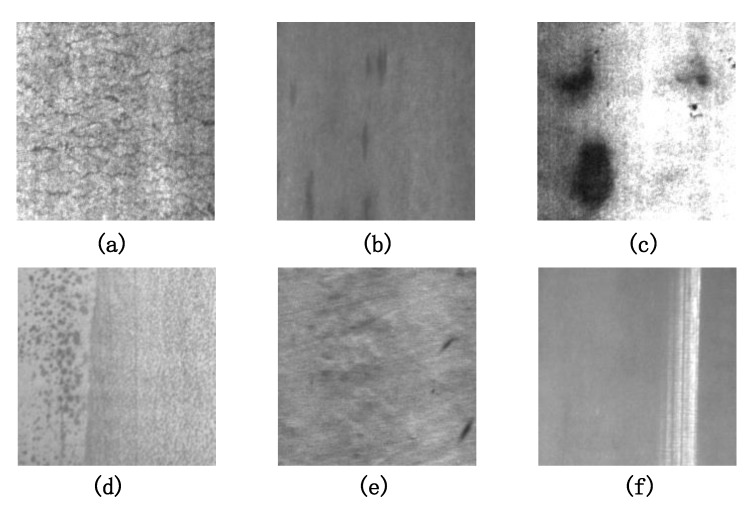
- GC10-DET contains 10 defect types and 3,570 grayscale images collected in a real industrial setting; NEU-DET has 6 defect types and 1,800 grayscale images.
- On NEU-DET, the proposed method achieves the best mAP of 0.724 and the best results on most defect categories; SSD300 is slightly better on Sc recall (0.990 vs. 0.981) and on In AP (0.796 vs. 0.763) and Rs AP (0.621 vs. 0.581).
- On GC10-DET, the proposed method achieves the best mAP and the best results on most categories; SSD300 is slightly better on Rp recall (0.667 vs. 0.333) and Faster-RCNN is better on Cr recall (1 vs. 0.857).
- Runtime is reported as 27 ms/image on NEU-DET and 33 ms/image on GC10-DET for the proposed method; the paper says this is fast enough for real-time use, though YOLO-V2 is slightly faster on GC10-DET testing set time (4.49 s vs. 8 s).
## Methods
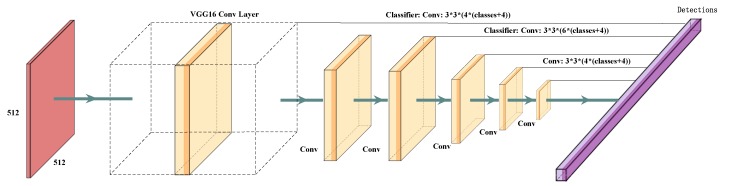
- The paper proposes EDDN, an end-to-end detector built on Single Shot MultiBox Detector (SSD) with VGG16, multi-scale feature maps, default boxes, and non-maximum suppression.
- It introduces hard negative mining, limiting negatives to at most a 3:1 ratio with positives, and applies data augmentation using full images, random patches, and patches with minimum Jaccard overlaps of 0.1, 0.3, 0.5, 0.7, or 0.9.
- Evaluation uses Recall, AP, and mAP on NEU-DET and GC10-DET, with comparisons against SSD, Faster-RCNN, YOLO-V2, YOLO-V3, and traditional LBP/HOG methods.
## Limitations
- The paper states that existing defect datasets are generally unavailable for deployment because of limited data scale and defect categories, and that metallic defect detection is difficult due to illumination, light reflection, and metal material effects.
- It notes that traditional methods are sensitive to lighting and background clutter and need repeated parameter tuning; this is a limitation of prior work, not the proposed method.
- Evident from the text: some reported gains are modest or mixed across categories, since other methods outperform the proposed method on a few defect classes (for example, SSD300 and Faster-RCNN on some NEU-DET and GC10-DET classes).
Model-written summary. Check it against the paper before relying on it.
Integrity signals
Registry
Cites
Statistics
Figures



Verification
Claims the paper makes
2 Valid · 1 Not valid · 1 Not checked · 29 Own results and interpretations
Every source the paper cites for this claim was checked and supports it.
In the paper
“we propose an end-to-end metallic surface defect network based on the Single Shot MultiBox Detector [6].”
- Also stated in: § 5. Conclusions · plain
“we propose an end-to-end defect detection and classification network based on the Single Shot MultiBox Detector.”
§ Deep Metallic Surface Defect Detection: The New Benchmark and Detection Network > 1. Introduction
What the sources say
- Supportedcites [6] Liu, W., Anguelov, D., Erhan, D., Szegedy, C., Reed, S., Fu, C.Y., and Berg, A.C. (2016, January 8–16). Ssd: Single Shot Multibox Detector. Proceedings of the European conference on computer vision, Amsterdam, The Netherlands. source
The citation identifies the Single Shot MultiBox Detector as the basis for the citing authors’ proposed network. The cited paper introduces SSD (Introduction, p. 2) and describes its single-network object detection method (p. 1); it need not describe the citing authors’ metallic-surface defect network. (LLM, conf=0.93)
plain- Asserted: passes — The authors put it forward as true.
- Checkable: passes — It can be checked against evidence.
- Load-bearing: passes — The paper’s conclusions depend on it.
- Based: passes — The paper gives a reason why it holds.
- Also stated in: § 5. Conclusions · plain
A result the paper reports from its own data — it cites no other source for it, so there is none to check. The quote shows it is in the paper.
In the paper
“Besides, the proposed method shows the best mAP accuracy.”
- Also stated in: § 4.4. Accuracy Comparisons with Deep Methods · plain
“the proposed method shows the best mAP accuracy.”
§ Deep Metallic Surface Defect Detection: The New Benchmark and Detection Network > 4. Experiments > 4.4. Accuracy Comparisons with Deep Methods
plain- Asserted: passes — The authors put it forward as true.
- Checkable: passes — It can be checked against evidence.
- Load-bearing: passes — The paper’s conclusions depend on it.
- Based: passes — The paper gives a reason why it holds.
- Also stated in: § 4.4. Accuracy Comparisons with Deep Methods · plain
A result the paper reports from its own data — it cites no other source for it, so there is none to check. The quote shows it is in the paper.
In the paper
“we contribute a new dataset called GC10-DET for large-scale metallic surface defect detection.”
- Also stated in: § 1. Introduction · plain
“We contribute a new dataset named”
- Also stated in: § 4.1. Datasets · plain
“GC10-DET is the surface defect dataset collected in a real industry. It contains ten types of surface defects”
§ Deep Metallic Surface Defect Detection: The New Benchmark and Detection Network > Abstract
plain- Asserted: passes — The authors put it forward as true.
- Checkable: passes — It can be checked against evidence.
- Load-bearing: passes — The paper’s conclusions depend on it.
- Based: passes — The paper gives a reason why it holds.
- Rests on an assumption not shown here.
- Also stated in: § 1. Introduction · plain
A result the paper reports from its own data — it cites no other source for it, so there is none to check. The quote shows it is in the paper.
In the paper
“the mAP can reach 0.724.”
§ Deep Metallic Surface Defect Detection: The New Benchmark and Detection Network > 4. Experiments > 4.4. Accuracy Comparisons with Deep Methods
plain- Asserted: passes — The authors put it forward as true.
- Checkable: passes — It can be checked against evidence.
- Load-bearing: passes — The paper’s conclusions depend on it.
- Based: passes — The paper gives a reason why it holds.
A result the paper states — it cites no source for it, so there is none to check. The quote shows it is in the paper.
In the paper
“the YOLO methods are difficult to distinguish the six types of defects.”
§ Deep Metallic Surface Defect Detection: The New Benchmark and Detection Network > 4. Experiments > 4.4. Accuracy Comparisons with Deep Methods
plain- Asserted: passes — The authors put it forward as true.
- Checkable: passes — It can be checked against evidence.
- Load-bearing: passes — The paper’s conclusions depend on it.
- Based: passes — The paper gives a reason why it holds.
7 more claims
Create a free account to see all 33 claims and to verify the 1 reference still open.
- Probably not a substantial claim. 8
- It may state two separate claims as one. 14
Citations
Cites
ImageNet classification with deep convolutional neural networks
Krizhevsky, A., Sutskever, I., & Hinton, G. E. (2017) · Communications of the ACM · doi:10.1145/3065386 · Cited by 112,155 · cited 1×
“Since the introduction of AlexNet [26], convolutional neural networks have been successfully deployed to detect surface defects.”
MethodFaster R-CNN: Towards Real-Time Object Detection with Region Proposal Networks
Ren, S., He, K., Girshick, R., & Sun, J. (2017) · IEEE Transactions on Pattern Analysis and Machine Intelligence · doi:10.1109/tpami.2016.2577031 · Cited by 73,472
Faster R-CNN: Towards Real-Time Object Detection with Region Proposal Networks
Ren, S., He, K., Girshick, R., & Sun, J. (2015) · arXiv · doi:10.48550/arxiv.1506.01497 · Cited by 70,812
Microsoft COCO: Common Objects in Context
Lin, T.-Y., Maire, M., Belongie, S., Hays, J., Perona, P., Ramanan, D., Dollár, P., & Zitnick, C. L. (2014) · Lecture Notes in Computer Science · doi:10.1007/978-3-319-10602-1_48 · Cited by 45,460 · cited 1×
“The pre-trained models are often trained on ImageNet [34] and MS COCO [35] datasets.”
MethodImageNet Large Scale Visual Recognition Challenge
Russakovsky, O., Deng, J., Su, H., Krause, J., Satheesh, S., Ma, S., Huang, Z., Karpathy, A., Khosla, A., Bernstein, M., et al. (2015) · International Journal of Computer Vision · doi:10.1007/s11263-015-0816-y · Cited by 39,380 · cited 1×
“The pre-trained models are often trained on ImageNet [34] and MS COCO [35] datasets.”
Method(2016) · Cited by 31,590
SSD: Single Shot MultiBox Detector
Liu, W., Anguelov, D., Erhan, D., Szegedy, C., Reed, S., Fu, C.-Y., & Berg, A. C. (2016) · Lecture Notes in Computer Science · doi:10.1007/978-3-319-46448-0_2 · Cited by 22,128 · cited 15×
“The proposed method can obtain the best results on the defects of Pu, In, and Rp, while the SSD300 is slightly higher than proposed on Wl (0.974 vs. 0.885), Ss, (0.689 vs. 0.650) and Wf (1 vs. 0.919).”
MethodInfluentialYOLO9000: Better, Faster, Stronger
Redmon, J., & Farhadi, A. (2017) · 2017 IEEE Conference on Computer Vision and Pattern Recognition (CVPR) · doi:10.1109/cvpr.2017.690 · Cited by 19,892 · cited 8×
“Therefore, the SSD method utilizes VGG16 as the pre-trained model, YOLO-V2 uses Darknet19 model, YOLO-V3 uses Darknet53 model, and Faster R-CNN adopts Resnet50 model.”
MethodInfluentialYOLOv3: An Incremental Improvement
Redmon, J., & Farhadi, A. (2018) · arXiv · doi:10.48550/arxiv.1804.02767 · Cited by 17,141
OverFeat: Integrated Recognition, Localization and Detection using Convolutional Networks
Sermanet, P., Eigen, D., Zhang, X., Mathieu, M., Fergus, R., & LeCun, Y. (2013) · arXiv · doi:10.48550/arxiv.1312.6229 · Cited by 2,680 · cited 1×
“In [29], the OverFeat network [30] was implemented to detect 5 different types of surface defects.”
Method
Cited by
Items 301–400 of 592
Mailhé, C., Ammar, A., Chinesta, F., & Baillargeat, D. (2024) · The Visual Computer · doi:10.1007/s00371-024-03325-2 · Cited by 3
“Typical examples are the detection of part defects on manufacturing lines [8, 18] or the monitoring of large-scale infrastructures [21, 22, 25].”
Automated AI-Based Annotation Framework for 3D Object Detection from LIDAR Data in Industrial Areas
Abdelhalim, G., Simon, K., Bensch, R., Parimi, S., & Qureshi, B. A. (2024) · SAE technical papers on CD-ROM/SAE technical paper series · doi:10.4271/2024-01-2999 · Cited by 3
Wang, P., Shi, D., & Aguilar, J. (2024) · Signal Image and Video Processing · doi:10.1007/s11760-024-03666-4 · Cited by 3
“To thoroughly validate the efficacy and generalization capability of the presented approach, this study utilizes three public datasets in the domain of defect detection: NEU-DET [32], GC10-DET [33] and PKU-PCB.”
LE-YOLOv5: A Lightweight and Efficient Neural Network for Steel Surface Defect Detection
Zhu, C., Sun, Y., Zhang, H., Yuan, S., & Zhang, H. (2024) · IEEE Access · doi:10.1109/access.2024.3519161 · Cited by 4
Surface Defect Detection Algorithm for Strip Alloy Material Based on Improved YOLOv8
Yang, W. P., Yang, J. A., & Xia, Y. (2025) · IEEE International Conference on Acoustics Speech and Signal Processing · doi:10.1109/icassp49660.2025.10890088 · Cited by 3
“In order to verify the generalization of the method proposed in this article, the metal surface defect dataset GC10-DET [26] and the general object detection dataset PASCAL VOC2012 [27] are selected as experimental datasets for generalization experiments.”
Fu, G., Le, W., Li, J., et al. (2025) · Measurement Science and Technology · doi:10.1088/1361-6501/adc9d7 · Cited by 3
“In this study, we assess the adaptability and accuracy of the novel approach using two renowned steel surface defects data-sets: NEU-DET [9] and GC10-DET [23].”
Steel Defect Detection Based on YOLO-SAFD
Yu, F., Zhang, J., & Mu, D. (2025) · IEEE Access · doi:10.1109/access.2025.3565587 · Cited by 5
Research on improved YOLOv8 fabric surface defect detection algorithm
Gao, Z., Zhang, S., Su, J., et al. (2025) · Textile Research Journal · doi:10.1177/00405175251356191 · Cited by 3
“Deep learning methods have been widely applied across various fields for surface defect detection, 9–12 and numerous researchers have explored fabric defect detection approaches based on convolutional neural networks (CNNs).”
An improved lightweight metal sheets surface defect detection algorithm based on YOLOv8
Bian, Y., Wu, H., Sun, F., Lv, Q., & Li, X. (2025) · Cluster Computing · doi:10.1007/s10586-025-05210-6 · Cited by 3
“The dataset used in this study is the GC10-DET dataset [19].”
Li, R., Zhao, L., Wei, H., Ouyang, B., Zhang, M., Fang, B., Hu, G., & Jin, T. (2025) · Machine Learning · doi:10.1007/s10994-025-06857-3 · Cited by 4
“Furthermore, this study employs the GC10-DET datasett (Lv et al., 2020) and the PCB-DET dataset to further evaluate the model’s performance.”
Hafizh, H., Rasib, A. H. A., Abdullah, R. Y., Bakar, M. H. A., & Kassim, A. M. (2021) · International Journal of Advanced Computer Science and Applications · doi:10.14569/ijacsa.2021.0120946 · Cited by 4
“[6] where CNN was utilised to detect defects in metallic surfaces.”
MethodDefect detection and recognition of SS plate using deep autoencoder neural network
Elanangai, V., & Vasanth, K. (2023) · International Conference on Artificial Intelligence and Knowledge Discovery in Concurrent Engineering (ICECONF) · doi:10.1109/iceconf57129.2023.10083834 · Cited by 3
Detection of Defects in Adhesive Coating Based on Machine Vision
Tao, X., Gao, H., Wu, Q., He, C., Zhang, L., & Zhao, Y. (2023) · IEEE Sensors Journal · doi:10.1109/jsen.2023.3344124 · Cited by 4
“Previous studies typically have an accuracy range of 88%–94% [47], [48], [49], [50], [51], with few exceeding 95% accuracy [52].”
BackgroundCar Brake Disc Surface Defect Detection Based on Improved YOLOv5
Guo, Y., Zhang, X., & Dong, Z. (2024) · IEEE Access · doi:10.1109/access.2024.3399547 · Cited by 3
Virtual Simulation and Experiment of Quality Inspection Robot Workstation
Liu, Z., Wang, D., Li, Y., et al. (2024) · Applied Sciences · doi:10.3390/app14135778 · Cited by 3
Research on strip surface defect detection based on improved YOLOv5 algorithm
Lv, S., Tao, C., Hao, Z., Ni, H., Hou, Z., Li, X., Gu, H., Shi, W., & Chen, L. (2024) · Ironmaking & Steelmaking Processes Products and Applications · doi:10.1177/03019233241260922 · Cited by 6
“Lv et al. 17 developed an end-to-end detection network based on the SSD model, adopted the hard negative mining (HNM) method to alleviate the problem of data imbalance, and was able to detect surface defects of strip steel at different scales.”
YOLOv7-Rep: a re-parameterization method for surface defect detection in workpieces
Xu, Z., Fang, P., Yang, X., & Wei, P. (2024) · Journal of Real-Time Image Processing · doi:10.1007/s11554-024-01583-w · Cited by 5
“Experimental analysis demonstrates that YOLOv7-Rep achieves detection accuracies of 78.3%, 87.3%, and 83.5% on three workpiece datasets (NEU-DET [14], TCAP-DET [15], GC10-DET [16]), respectively.”
InfluentialPMSE-YOLO: an efficient framework for detecting surface defects of hot-rolled strip steel
Zhou, M., Wang, R., & Chen, Y. (2025) · Signal Image and Video Processing · doi:10.1007/s11760-025-04189-2 · Cited by 5
Automated defect detection for coatings via height profiles obtained by laser-scanning microscopy
Hoseini, S., Zhang, G., Jongbloed, A., Schmitz, C., & Quix, C. (2022) · Machine Learning with Applications · doi:10.1016/j.mlwa.2022.100413 · Cited by 7
Deep Learning-Powered Visual Inspection Using SSD Mobile Net V1 with FPN
Dubey, P., Günay, E. E., Jackman, J. K., Kremer, G. E. O., & Kremer, P. A. (2023) · Lecture notes in mechanical engineering · doi:10.1007/978-3-031-17629-6_78 · Cited by 4
YOLOv8-FCS: A more focused YOLOv8 model for defect detection in images of steel surfacePreprint
Hu, B., Lu, R., Wan, D., et al. (2024) · Research Square · doi:10.21203/rs.3.rs-4368440/v1 · Cited by 3
He, X., Fan, H., Du, C., Zhu, X., Zhou, Y., Chen, R., Li, Z., Zheng, G., Zhong, Y., Liu, C., et al. (2024) · International Journal of Advanced Computer Science and Applications · doi:10.14569/ijacsa.2024.0150284 · Cited by 2
MCF: Multi-scale Context Fusion for Strip Steel Surface Detection
Hu, J., Chen, W., & Zhao, L. (2024) · International Joint Conference on Neural Networks (IJCNN) · doi:10.1109/ijcnn60899.2024.10650482 · Cited by 2
You Only Look Once v5 and Multi-Template Matching for Small-Crack Defect Detection on Metal Surfaces
Dubey, P., Miller, S., Günay, E. E., Jackman, J. K., Kremer, G. E. O., & Kremer, P. A. (2025) · Automation · doi:10.3390/automation6020016 · Cited by 7
“Also, YOLO models have shown higher mean average precision (mAP) than Single Shot MultiBox Detector (SSD), Faster Region-based Convolutional Neural Network (Faster R-CNN), and other feature-based object detection models for the GC10 DET metal defect dataset [11].”
InfluentialWang, J., Zheng, X., Liu, K., Niu, F., Zhang, D., Lin, Y., & Chen, J. (2025) · Engineering Research Express · doi:10.1088/2631-8695/add1ab · Cited by 3
Wu, R., Zhang, Y., Lan, R., & Zhou, L. (2025) · Expert Systems with Applications · doi:10.1016/j.eswa.2025.129867 · Cited by 5
Supervised Focused Feature Network for Steel Strip Surface Defect Detection
Liu, W., & Yuan, W. (2025) · Mathematics · doi:10.3390/math13203285 · Cited by 7
Self-Adaptive Gamma Context-Aware SSM-based Model for Metal Defect Detection
Sun, S., Deng, M., Yu, X., Xi, X., & Zhao, L. (2025) · International Joint Conference on Neural Networks (IJCNN) · doi:10.1109/ijcnn64981.2025.11229258 · Cited by 17
“Several metal defect detection datasets, such as NEU-DET [5] and GC10-DET [6], have been widely used in research.”
ALDS-YOLO: A Lightweight Defect Detection Model for Warehouse Carton Goods
Cao, B., Tian, M., Li, J., Li, W., & Li, Z. (2025) · IEEE Sensors Journal · doi:10.1109/jsen.2025.3631819 · Cited by 2
DFM-DETR: frequency-suppressed Mamba detector for high-reflectivity ceramic plates defects
Yang, L., Gu, Y., & Feng, H. (2025) · Nondestructive Testing And Evaluation · doi:10.1080/10589759.2025.2593427 · Cited by 3
Enhancing Few-Shot Surface Defect Recognition via Pre-Trained Large Generative Models
Jiang, X., Lin, Z., Kong, X., Chen, J., Song, Z., & Xie, M. (2025) · IEEE Transactions on Automation Science and Engineering · doi:10.1109/tase.2025.3641997 · Cited by 4
“2) GC10-DET [42]: In addition, another surface defect dataset from Tianjin University was introduced.”
Zhang, H., Liu, H., Ma, W., Zheng, C., Zhang, T., Guo, R., Liang, L., & Liu, Q. (2026) · Measurement · doi:10.1016/j.measurement.2026.120375 · Cited by 6
Chen, L., Guo, C., Wu, X., Xu, H., Chen, S., & Lin, J. (2026) · Scientific Reports · doi:10.1038/s41598-026-36543-w · Cited by 5
“In addition, to assess the cross-dataset generalization ability of GRACE, we further conduct experiments on two public steel surface defect datasets, GC10-DET and X-SDD.”
InfluentialFew-shot cross-episode adaptive memory for metal surface defect semantic segmentation
Zhang, J., Ding, H., Peng, M., Tu, S., Chen, G., & Liu, Y. (2026) · Scientific Reports · doi:10.1038/s41598-026-36445-x · Cited by 2
RenFei, C., & Zhongwen, L. (2026) · Expert Systems with Applications · doi:10.1016/j.eswa.2026.131265 · Cited by 3
YOLO-GSD-seg: YOLO for Guide Rail Surface Defect Segmentation and Detection
Lai, S., Zhao, Z., Mi, Y., Yuan, K., & Wang, Q. (2026) · Applied Sciences · doi:10.3390/app16031261 · Cited by 2
EMSD-YOLO: A Surface Defect Detection Model Based on Feature Extraction and Fusion
Zhang, W., & Geng, X. (2026) · Cognitive Robotics · doi:10.1016/j.cogr.2026.01.002 · Cited by 2
Wang, X., Pu, Y., Zhao, X., Peng, W., & Sun, J. (2026) · Computers in Industry · doi:10.1016/j.compind.2026.104464 · Cited by 2
SF-YOLO11: a spatial-frequency collaborative network for real-time steel surface defect detection
Liu, T., Li, H., Wu, S., & Dong, H. (2026) · Journal of Real-Time Image Processing · doi:10.1007/s11554-026-01866-4 · Cited by 4
EDS-YOLO: an enhanced steel surface defect detection method based on improved YOLO11
Fei, Z., Liu, L., Zhao, R., Yang, C., Li, Y., & Xiang, X. (2026) · Measurement Science and Technology · doi:10.1088/1361-6501/ae5271 · Cited by 3
A Review of Deep Learning Methods for Metal Surface Defect Detection
Qin, G., Liu, C., Li, H., & Xu, K. (2026) · steel research international · doi:10.1002/srin.202501060 · Cited by 4
YOLOv11-LLR: An Enhanced Framework for Steel Surface Defect Detection in Industrial Settings
Li, J., Yang, Y., Geng, R., et al. (2026) · Applied Sciences · doi:10.3390/app16104609 · Cited by 2
YOLOXD: A New Network for Metal Surface Defect Detection
Wang, H., Li, M., Gao, P., & Zhang, S. (2022) · International Conference on Computer Systems (ICCS) · doi:10.1109/iccs56273.2022.9988327 · Cited by 2
“The dataset used in this paper is the GC10-DET [13] dataset, which contains 2294 images of ten different categories of metal surface defects, including crease(Cr), crescent gap(Cg), inclusion(In), oil spot(Os), punching hole(Ph), roll pit( Rp), silk spot(Ss), waist folding(Wf), water spot(Ws),…”
BackgroundMethodInfluentialOn the use of synthetic images in deep learning for defect recognition in industrial infrastructures
Mailhé, C., Ammar, A., & Chinesta, F. (2023) · doi:10.1145/3589572.3589584 · Cited by 2
“As for in [16], a rich dataset was used, issued from experimental research [17] and aiming at developing a dedicated solution for the detection of damages on steel sheets.”
MethodDigital Defect Simulation-based Data Generation for Visual Quality Inspection
Wang, X., Xie, Y., Zhang, Y., Pi, X., & Ren, F. (2023) · International Conference on Computer Modeling and Simulation (ICCMS) · doi:10.1145/3608251.3608291 · Cited by 2
“Each type of defect contains 300 samples [19].”
BackgroundA Weld Surface Defect Detection System With Multi- Detection Function Integration
Wang, G.-Q., Lin, Y., Chen, M.-S., et al. (2023) · International Conference on Electrical Engineering and Mechatronics Technology (ICEEMT) · doi:10.1109/iceemt59522.2023.10263158 · Cited by 2
Fine-Tuned SqueezeNet Lightweight Model for Classifying Surface Defects in Hot-Rolled Steel
de la Rosa, F. L., Gómez-Sirvent, J. L., Belmonte, L. M., Morales, R., & Fernández‐Caballero, A. (2023) · Lecture notes in computer science · doi:10.1007/978-3-031-43085-5_18 · Cited by 3
New Possibilistic Formalism Based on Confidence Levels for Metallic Surface Defect Classification
Elleuch, J. F., Mehdi, M. Z., Kammoun, H. M., Bellaaj, M., & Sellami, D. (2024) · IEEE Access · doi:10.1109/access.2024.3414840 · Cited by 3
Xu, Q., Yu, J., & Dong, A. (2024) · International Joint Conference on Neural Networks (IJCNN) · doi:10.1109/ijcnn60899.2024.10650738 · Cited by 2
“The dataset contains 10 types of defects, including crescent gap, welding line, water spot, silk spot, inclusion, oil spot, crease, punching, waist folding, and rolled pit [32].”
Metal Surface Defect Detection Method Based on Improved YOLOv7
Zhang, Y., Chao, Y., Pei, R., et al. (2025) · Lecture notes in electrical engineering · doi:10.1007/978-981-96-2625-0_22 · Cited by 2
Improving Post-Earthquake Crack Detection Using Semi-Synthetic Generated Images
Dondi, P., Gullotti, A., Inchingolo, M., Senaldi, I., Casarotti, C., Lombardi, L., & Piastra, M. (2025) · Lecture notes in computer science · doi:10.1007/978-3-031-91907-7_2 · Cited by 5
Lu, Z., Wang, J., Zhu, J., & Sun, Y. (2025) · Expert Systems with Applications · doi:10.1016/j.eswa.2025.129811 · Cited by 3
Li, D., Ci, X., & Li, C. (2025) · Engineering Research Express · doi:10.1088/2631-8695/ae2762 · Cited by 4
Quality Inspection of Workpiece Camouflage Spraying Based on Improved YOLOv3-tiny
Gu, X., Guo, R., & Wang, H. (2020) · IEEE International Conference on Computer and Communications (ICCC) · doi:10.1109/iccc51575.2020.9345139 · Cited by 2
“Reference [4] provided GC10-DET data for largescale metal surface defect detection, and proposed a Single Shot MultiBox detector-based inspection network (EDDN) for end-to-end defect detection in complex environments.”
An Improved U-Net Image Segmentation Network for Crankshaft Surface Defect Detection
Moosavian, A., Bagheri, E., Yazdanijoo, A., & Barshooi, A. H. (2024) · Iranian Conference on Machine Vision and Image Processing · doi:10.1109/mvip62238.2024.10491179 · Cited by 2
“In another study [13], CNNs were used to detect defects on metal surfaces.”
MethodSurface Defect Detection of Remanufactured Products by Using the Improved Yolov5
Sun, W., Liu, Z., Wang, Q., & Zhu, B. (2024) · Lecture notes in mechanical engineering · doi:10.1007/978-3-031-52649-7_19 · Cited by 2
Wu, R., Zhang, Y., Lan, R., et al. (2025) · SSRN Electronic Journal · doi:10.2139/ssrn.5257434 · Cited by 2
Cut-Stitch: A Simple and Effective Data Augmentation Method for Industrial Inspection
Hu, H., Hong, J., Song, K., Zhu, J., & Ren, W. (2024) · Lecture notes in computer science · doi:10.1007/978-3-031-70359-1_24 · Cited by 1
Detection of Defects in Plastic Cup Production Using YOLO Method
Adhisaputra, S., & Harefa, J. (2024) · International Conference on Data Science and Its Applications (ICoDSA) · doi:10.1109/icodsa62899.2024.10651829 · Cited by 2
“Lv et al. [10] proposed a defect detection network (EDDN) for large-scale metallic surface based on the Single Shot MultiBox Detector.”
BackgroundEvstafev, O., & Shavetov, S. V. (2024) · International Conference on Control, Decision and Information Technologies (CoDIT) · doi:10.1109/codit62066.2024.10708499 · Cited by 1
“Texture segmentation highlights areas with varying textures, useful for defect detection but is limited by low contrast and high production speeds [17], [18].”
BackgroundReal-time surface defect detection algorithm on aluminum ingot alloy casting lines
Chen, H., Yan, F., Yang, J., yan, J., Qin, T., & Zhang, J. (2024) · Physica Scripta · doi:10.1088/1402-4896/ad9fab · Cited by 4
YOLOOI: YOLO with Robustness to Outliers and Illumination
Jiang, H., & Cheng, X. (2024) · International Conference on Computer, Vision and Intelligent Technology (ICCVIT) · doi:10.1109/iccvit63928.2024.10872438 · Cited by 1
“Complicating this task are the unique optical reflection properties of metal surfaces, which cause notable variations in the intensity, shape, and location of light reflections [11].”
Xinquan, L., Li, Z., & Lou, S.-T. (2025) · IEEE Transactions on Instrumentation and Measurement · doi:10.1109/tim.2025.3551034 · Cited by 1
“To comprehensively demonstrate the efficacy and robustness, the proposed method has also been evaluated on two publicly available industrial benchmark defect datasets, namely, NEU-DET [43] and GC10-DET [44].”
Large Visual Perception Network With Auxiliary Supervision for Surface Defect Detection
Huang, Q., Mu, Y., Han, Y., & Zhang, Y. (2025) · IEEE Transactions on Instrumentation and Measurement · doi:10.1109/tim.2025.3552394 · Cited by 3
“4) Experimental results demonstrate that the proposed LVPAS-Net under the NEU-DET [24], GC10-DET [25], APDDD, and PV multidefect datasets have better performance than the state-of-the-art methods.”
Microsurface Defect Recognition via Microlaser Line Projection and Affine Moment Invariants
Rodríguez, J. A. M. (2025) · Coatings · doi:10.3390/coatings15040385 · Cited by 1
Xu, J., Huang, D., Gan, F., Liao, S., Luo, F., Yu, S., & Gao, X. (2025) · Measurement · doi:10.1016/j.measurement.2025.117665 · Cited by 1
Development of an Intelligent Weld Surface Defect Detection System: Design and Application
Wang, G.-Q., He, Z., Chen, M., et al. (2025) · IEEE Instrumentation & Measurement Magazine · doi:10.1109/mim.2025.10982116 · Cited by 1
“In the industrial field, detecting surface defects in metal components is essential, as these defects can lead to uneven stress distribution during operation, which may significantly degrade performance [1].”
Interactive Explainable Anomaly Detection for Industrial Settings
Gramelt, D., Höfer, T., & Schmid, U. (2025) · Lecture notes in computer science · doi:10.1007/978-3-031-92805-5_9 · Cited by 5
MDC-Net: multimodal defect captioning network for surface steel defects
Chazhoor, A. A. P., Hu, S., Gao, B., & Woo, W. L. (2025) · The Visual Computer · doi:10.1007/s00371-025-04093-3 · Cited by 1
“The graph compares the mAP scores for small, medium, and large objects within the validation dataset, emphasizing the model’s capability in detecting objects of varying sizes across the GC-10 dataset [17, 41] benchmarks, as shown in Table 4.”
MAS-ZSAS: A Zero-Shot Anomaly Segmentation Framework with Multi-attribute Guided Text Prompts
Yuan, X., Liang, G., Hua, L., Xie, S., & Gan, W. (2025) · Lecture notes in computer science · doi:10.1007/978-981-96-9856-1_36 · Cited by 1
Edge-FastestDet: a real-time and ultra-lightweight model for detection
Wu, M., Peng, J., Yu, X., et al. (2025) · Journal of Real-Time Image Processing · doi:10.1007/s11554-025-01731-w · Cited by 1
Application of Contrastive Learning Based on ResNet34 in Unsupervised Image Classification
Chen, H., Feng, S., Luo, J., Li, Z., & Xie, Y. (2025) · Chinese Control and Decision Conference (CCDC) · doi:10.1109/ccdc65474.2025.11090171 · Cited by 1
“For instance, companies such as Google and NVIDIA have introduced end to end defect detection methods based on convolutional neural networks (CNNs) [2], [3], which have notably improved detection accuracy and speed.”
A Lightweight Steel Surface Defect Detection Algorithm Based on Improved YOLO
Song, J., & Zhang, P. (2025) · Chinese Control and Decision Conference (CCDC) · doi:10.1109/ccdc65474.2025.11091209 · Cited by 1
“To evaluate the robustness of the proposed SSEI-YOLO algorithm, the GC10-DET [14] dataset was used for comparative analysis.”
Cui, J., Li, J., Mei, Z., Ni, Y., Chen, W., & Li, Z. (2025) · IEEE Transactions on Instrumentation and Measurement · doi:10.1109/tim.2025.3593591 · Cited by 1
“3) GC10-DET: The GC10-DET dataset [36] depicts ten types of cold-rolled steel strip defect images, including punching, weld line, crescent gap, water spot, oil spot, silk spot, inclusion, rolled pit, crease, waist folding.”
Xiong, J., Zhang, Q., Wang, Q., Yang, J., Dong, X., & Liang, Q. (2025) · The International Journal of Advanced Manufacturing Technology · doi:10.1007/s00170-025-16431-9 · Cited by 1
CMH-Net: a structured and optimized network for real-time steel surface defect detection
Li, J., Liang-fu, L., & Ai, L. (2025) · Journal of Real-Time Image Processing · doi:10.1007/s11554-025-01786-9 · Cited by 1
“The experiments evaluate the proposed method on two publicly available steel surface defect datasets: NEU-DET [29] and GC10-DET [30].”
A Real‐Time Defect Detector With Content‐Guided Feature Extraction and Detail Enhancement
Huang, Y., Fang, T., & Ye, M. (2025) · Annals of the New York Academy of Sciences · doi:10.1111/nyas.70123 · Cited by 1
“We also replace the original optimizer with the Lion optimizer [47], which improves training efficiency.”
YOLOv10-CBAM: Lightweight Metal Surface Defect Detection Based on YOLOv10
Song, Y., Li, D., He, P., et al. (2025) · doi:10.1109/iceiom65271.2025.11239909 · Cited by 1
“To validate the effectiveness of the proposed method, this experiment adopts the GC10-DET dataset [1], which originates from ImageNet.”
Xu, S., Chen, H., Ni, R., He, M., Ge, Z., & Liang, X. (2025) · Egyptian Informatics Journal · doi:10.1016/j.eij.2025.100841 · Cited by 2
Li, L., & Zhou, W. (2025) · Digital Signal Processing · doi:10.1016/j.dsp.2025.105776 · Cited by 4
Zheng, T., Yu, L., Shi, Y., & Niu, F. (2025) · Journal of Computational Design and Engineering · doi:10.1093/jcde/qwaf138 · Cited by 1
Tan, S., Tan, J., Man, J., Ma, J., & Ding, X. (2025) · Journal of Real-Time Image Processing · doi:10.1007/s11554-025-01838-0 · Cited by 3
“To validate the generalization capability of the model, we tested it on the public dataset GC10-DET [19].”
Yin, Z., Zhang, L., Liu, H., Du, Q., & Yu, C. (2026) · Frontiers in Computer Science · doi:10.3389/fcomp.2025.1700167 · Cited by 1
“Lv et al. (2020) proposed an end-to-end defect detection and classification network based on a Single-Shot Multibox Detector (SSMD) for metal surface defect detection.”
Lu, Q., Gong, M., & Yin, L. (2026) · Applied Sciences · doi:10.3390/app16031181 · Cited by 1
Lightweight Small-Object surface defect detection method based on improved YOLOv11
Rao, H., Zhan, H., Wang, R., & Yu, J. (2026) · The International Journal of Advanced Manufacturing Technology · doi:10.1007/s00170-025-17276-y · Cited by 6
MCD-RTDETR: a multi-category defect detection algorithm for steel surface
Huang, X., Qiu, Y., Luo, K., & Liu, L. (2026) · The Journal of Supercomputing · doi:10.1007/s11227-025-08202-w · Cited by 1
Ge, R., Wang, Y., & Wei, Y. (2026) · Engineering Applications of Artificial Intelligence · doi:10.1016/j.engappai.2026.114101 · Cited by 3
Benchmarking Few-Shot Learning Techniques for Steel Surface Defect Detection
Ghali, R., Benhafid, Z., & Selouani, S. (2025) · IEEE Smart World Congress (SWC) · doi:10.1109/swc65939.2025.00031 · Cited by 1
“…via contrastive learning on unlabeled base defect images from NEU-DET combined with images from other in-domain defect datasets such as GC-10DET [22], Severstal [23], Magnetic Tiles [24], and RSDDs [25], and then fine-tuned on 10-shot labeled data for all NEU-DET classes), achieved 72.9% mAP@50…”
InfluentialYang, X., Li, T., Yang, T., Ding, S., Lyu, Z., Li, D., & Lu, Z. (2026) · IEEE Access · doi:10.1109/access.2026.3670661 · Cited by 1
MCF-Det: A Cross-Domain Fusion Framework for Few-Shot Blade Defect Detection
Wen, X., Li, K., He, Y., Yin, H., & Song, K. (2026) · IEEE Transactions on Industrial Informatics · doi:10.1109/tii.2026.3668204 · Cited by 1
“Beyond steel-to-blade transfer, we evaluate cross-material transfer in a multiclass N -way K -shot detection setting on two public target datasets with distinct materials and imaging pipelines, namely, DeepPCB [27] and GC10-DET [28].”
Efficient Detection Algorithm of Steel Surface Defects Based on YOLOv8
Liu, S., Miao, X., & Zhou, Y. (2026) · JOM · doi:10.1007/s11837-026-08174-z · Cited by 1
LRCR-YOLOv8: a method for detecting surface defects in steel
Huo, M., Chen, W., Zeng, X., Yang, G., & Ma, T. (2026) · Engineering Research Express · doi:10.1088/2631-8695/ae52a7 · Cited by 1
Wang, Q., & Yan, H. (2026) · Sensors · doi:10.3390/s26061990 · Cited by 1
“To verify the generalization ability of the model, this study additionally adopted the open-source GC-10 dataset [32].”
Torres-Torres, M., Soto-Díaz, R., Gutiérrez, J. E., & Valls, A. (2026) · MRS Advances · doi:10.1557/s43580-026-01566-y · Cited by 3
“Recent surveys show that traditional methods using hand-crafted features, thresh-olding, edge or morphological operations still perform reasonably under controlled conditions, but degrade sharply under lighting changes, texture background, and other noise (see [8, 10, 11]).”
A deformable convolution and shuffle attention enhanced network for surface defect detection
Tang, Y., Lv, X., & Sun, T. (2026) · Engineering Applications of Artificial Intelligence · doi:10.1016/j.engappai.2026.114864 · Cited by 1
Self-citationKumar, B., Singh, S. K., Kumar, S., & Sinha, B. B. (2026) · Australian Journal of Mechanical Engineering · doi:10.1080/14484846.2026.2675149 · Cited by 1
Jayawardena, A., Sul, J.-H., Moratuwage, D., Wijayaraja, J. L., & Piyathilaka, L. (2026) · Electronics · doi:10.3390/electronics15122727 · Cited by 12
Ruan, J., Cheng, Z., & Zeng, M. (2026) · Journal of Real-Time Image Processing · doi:10.1007/s11554-026-01920-1 · Cited by 3
“GC10-DET [37] contains 2294 industrialimagesoftendefecttypes,featuringdiverseresolu-tions, complex morphologies, and challenging backgrounds, enabling assessment of cross-domain generalization in realistic industrial scenarios.”
Sun, Y., Wang, M., Xu, C., Guo, H., Zhang, L., Yue, H., & Feng, Y. (2026) · Journal of Imaging · doi:10.3390/jimaging12070312 · Cited by 2
“…losses use cross-entropy, and the regression losses adopt the smooth L1 loss: To evaluate the effectiveness of the proposed A 2 S 2 C-Det framework, three publicly available steel strip surface defect datasets are utilized, namely NEU-DET [40,41], GC10-DET [42], and SD-saliency-900 [43].”
Enhanced multi-scale feature fusion for accurate steel surface defect detection
Liao, J., Wang, D., Liang, J., Yang, M. B., & Liang, C. (2026) · The Visual Computer · doi:10.1007/s00371-026-04575-y · Cited by 1
“In this study, two publicly available datasets are employed for performance evaluation, including the NEU-DET dataset [45]providedbyNortheasternUniversityandtheGC10-DET dataset [46] collected from real industrial environments.”
Metadata
- Authors
- Lv, X., Duan, F., Jiang, J.-J., Fu, X., & Gan, L.
- Affiliations
- Tianjin University (CN)
- The State Key Lab of Precision Measuring Technology and Instruments, Tianjin University, Tianjin 300072, China
- Corresponding author
- Duan, Fajie
- Venue
- Sensors
- Publisher
- MDPI AG
- Published
- 2020-03-11
- Volume
- 20
- Issue
- 6
- Pages
- 1562
- ISSN
- 1424-8220 (ISSN-L)
- PMC
- PMC7146379
- OpenAlex
- W3012374719
- Cited by
- 643
- References
- 38
- Citations by year
- 2026: 188 · 2025: 188 · 2024: 125 · 2023: 81 · 2022: 40 · 2021: 18 · 2020: 3
- FWCI
- 18.23
- Type
- journal article
- Language
- en
- Open access
- gold
- dx.doi.org
- Licence
- Locations
- Sensors (publishedVersion, cc-by)
- PubMed Central (publishedVersion, cc-by)
- PubMed (publishedVersion)
- DOAJ (DOAJ: Directory of Open Access Journals) (submittedVersion, cc-by-sa)
- Funders
- National Natural Science Foundations of China (No.61905175, 51775377, 61971307)
- National key research and development plan (2017YFF0204800)
- the TianJin Natural Science Foundations of China (No. 17JCQNJC01100)
- Equipment pre-research field fund (61405180505, 61400040303)
- Science and Technology on Underwater Information and Control Laboratory (6142218081811)
- Topics
- Physical Sciences › Engineering › Industrial and Manufacturing Engineering › Industrial Vision Systems and Defect Detection
- Physical Sciences › Engineering › Mechanical Engineering › Non-Destructive Testing Techniques
- Physical Sciences › Engineering › Civil and Structural Engineering › Infrastructure Maintenance and Monitoring
- Keywords
- Single Shot MultiBox Detector, hard negative mining, class imbalance, data augmentation, industrial inspection, object detection
About these checks
Registry, retraction, Cites and statistics results are computed, not judged, with one exception: a printed reference that no index lists is read once by a model before it counts as a citation error. Claims are extracted by a model and kept only when their quote appears verbatim in the text; each cited source is then checked, with a model’s help, for whether it says what the claim relies on. Those verdicts can be wrong — read the claim’s quote and the cited source before relying on one.
A language model drew the claims from the paper on 2026-10-10, under version 3 of the claim definition (model deepseek-v4.1-flash, prompt extract-v3).
A second model labelled each claim on 2026-10-10 (model jev-1.13-20260917, definition revision gold-guideline-v0.2).
Cited sources are checked with a language model’s help (gpt-6-sol).
Statistics and arithmetic are recomputed, not judged.
Confidence bands are shown only for fields calibrated on our annotated test set. None is calibrated yet, so no band is shown.
What counts as a claim ›How we measure confidence ›How we check this ›
Are you an author, or do you see a problem with this page? Request a review
Data sources
Bibliographic data: Semantic Scholar, OpenAlex, Crossref.
Contains information from the Semantic Scholar Academic Graph Datasets, made available under the ODC Attribution License (ODC-BY 1.0).
Semantic Scholar’s data is described in: Kinney, R., et al. (2023). The Semantic Scholar Open Data Platform. arXiv:2301.10140.
