

The DOI matches its Crossref record; 62 of the 63 references it cites were found in a registry or an index.
Investigation of the Impact of Infrared Sensors on Core Body Temperature Monitoring by Comparing Measurement Sites
Open accessAbstract
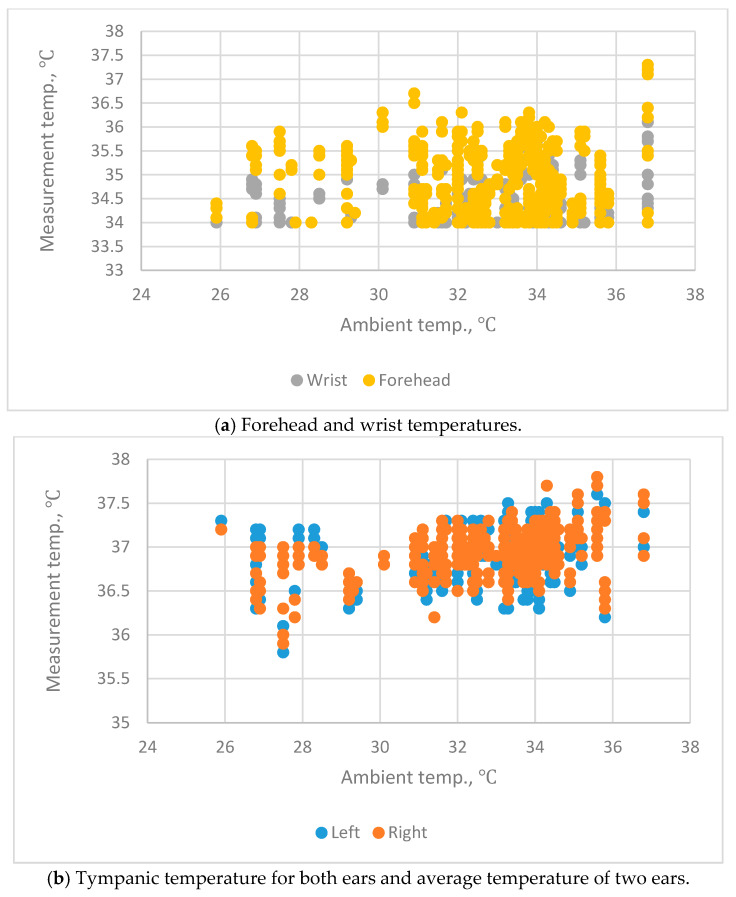
Many types of thermometers have been developed to measure body temperature. Infrared thermometers (IRT) are fast, convenient and ease to use. Two types of infrared thermometers are uses to measure body temperature: tympanic and forehead. With the spread of COVID-19 coronavirus, forehead temperature measurement is used widely to screen people for the illness. The performance of this type of device and the criteria for screening are worth studying. This study evaluated the performance of two types of tympanic infrared thermometers and an industrial infrared thermometer. The results showed that these infrared thermometers provide good precision. A fixed offset between tympanic and forehead temperature were found. The measurement values for wrist temperature show significant offsets with the tympanic temperature and cannot be used to screen fevers. The standard operating procedure (SOP) for the measurement of body temperature using an infrared thermometer was proposed. The suggestion threshold for the forehead temperature is 36 °C for screening of fever. The body temperature of a person who is possibly ill is then measured using a tympanic infrared thermometer for the purpose of a double check.
Overview
The claims and statistics of this paper haven’t been checked yet.
Run the check — free, no account needed. It reads the open-access text and checks the sources it cites.
Integrity signals
Registry
Cites
Statistics
Figures
Verification
Claims the paper makes
The claims and statistics of this paper haven’t been checked yet.
Run the check — free, no account needed. It reads the open-access text and checks the sources it cites.
Claims other papers make about this one
Each is checked against this paper’s own text: does it say what the citing paper says it does?
In the citing paper
“However, the determination of core body temperature by indirect measurement can be accomplished using several signal processing methods [144,145].”
From The Current State of Optical Sensors in Medical Wearables (2022) · cites this paper as [144]
Self-check
Percentages, sums and reported differences re-computed from the paper’s own numbers.
The self-check needs the paper’s full text.
Citations
Cites
Infrared ear thermometry compared with rectal thermometry in children: a systematic review
Craig, J. V., Lancaster, G., Taylor, S., Williamson, P. R., & Smyth, R. L. (2002) · The Lancet · doi:10.1016/s0140-6736(02)09783-0 · Cited by 337
Validity and Reliability of Devices That Assess Body Temperature During Indoor Exercise in the Heat
Ganio, M. S., Brown, C. M., Casa, D. J., Becker, S. M., Yeargin, S. W., McDermott, B. P., Boots, L. M., Boyd, P. W., Armstrong, L. E., & Maresh, C. M. (2009) · Journal of Athletic Training · doi:10.4085/1062-6050-44.2.124 · Cited by 201
Comparison of ear-based, bladder, oral, and axillary methods for core temperature measurement
Erickson, R. S., & Kirklin, S. K. (1993) · Critical Care Medicine · doi:10.1097/00003246-199310000-00022 · Cited by 190
Infrared camera assessment of skin surface temperature—Effect of emissivity
Bernard, V., Staffa, E., Mornstein, V., & Bourek, A. (2013) · Physica Medica · doi:10.1016/j.ejmp.2012.09.003 · Cited by 177
Accuracy and Precision of Noninvasive Temperature Measurement in Adult Intensive Care Patients
Lawson, L. L., Bridges, E. J., Ballou, I., Eraker, R., Greco, S. A., Shively, J., & Sochulak, V. (2007) · American Journal of Critical Care · doi:10.4037/ajcc2007.16.5.485 · Cited by 154
Yao, Y., Lian, Z., Liu, W., & Shen, Q. (2007) · Indoor and Built Environment · doi:10.1177/1420326x07084291 · Cited by 110
Insufficiency in a New Temporal-Artery Thermometer for Adult and Pediatric Patients
Suleman, M.-I., Doufas, A. G., Akça, O., Ducharme, M. B., & Sessler, D. I. (2002) · Anesthesia & Analgesia · doi:10.1097/00000539-200207000-00012 · Cited by 105
Liu, C., Chang, R., & Chang, W.-C. (2004) · Infection Control and Hospital Epidemiology · doi:10.1086/502351 · Cited by 94
Clinical accuracy of a non‐contact infrared skin thermometer in paediatric practice
Terán, C. G., Torrez‐Llanos, J., Teran‐Miranda, T. E., Balderrama, C. R., Shah, N. S., & Villarroel, P. (2011) · Child Care Health and Development · doi:10.1111/j.1365-2214.2011.01264.x · Cited by 90
Reliability of an infrared forehead skin thermometer for core temperature measurements
Kistemaker, J. A., DenHartog, E., & Daanen, H. A. M. (2006) · Journal of Medical Engineering & Technology · doi:10.1080/03091900600711381 · Cited by 87
Research works printed but not linked: 2
- Berksoy, 2018, Comparison of infrared tympanic, non-contact infrared skin, and axillary thermometer to rectal temperature measurements in a pediatric emergency observation unit, Int. J. Clin. Exp. Med., 11, 567
- Myers, R.H. (1990). Classical and Modern Regression with Applications, Duxbury Press. [2nd ed.].
Cited by
Sorted by citations
Significance of sensors for industry 4.0: Roles, capabilities, and applications
Javaid, M., Haleem, A., Singh, R. P., Rab, S., & Suman, R. (2021) · Sensors International · doi:10.1016/j.sintl.2021.100110 · Cited by 373
Feasibility of continuous fever monitoring using wearable devices
Smarr, B. L., Aschbacher, K., Fisher, S. M., Chowdhary, A., Dilchert, S., Puldon, K., Rao, A., Hecht, F. M., & Mason, A. E. (2020) · Scientific Reports · doi:10.1038/s41598-020-78355-6 · Cited by 133
Review of Stress Detection Methods Using Wearable Sensors
Taskasaplidis, G. V., Fotiadis, D. A., & Bamidis, P. D. (2024) · IEEE Access · doi:10.1109/access.2024.3373010 · Cited by 131
The Current State of Optical Sensors in Medical Wearables
Vavrinsky, E., Esfahani, N. E., Hausner, M., Kuzma, A., Rezo, V., Donoval, M., & Kosnacova, H. (2022) · Biosensors · doi:10.3390/bios12040217 · Cited by 103
Bioelectronic Implantable Devices for Physiological Signal Recording and Closed‐Loop Neuromodulation
Oh, S., Jekal, J., Jia Liu, B., Kim, J., Park, J., Lee, T., & Jang, K. (2024) · Advanced Functional Materials · doi:10.1002/adfm.202403562 · Cited by 104
Metadata
- Authors
- Chen, H.-Y., Chen, A., & Chen, C.
- Affiliations
- University of California San Diego (US)
- National Chung Hsing University (TW)
- Corresponding author
- Chen, Chiachung
- Venue
- Sensors
- Publisher
- MDPI AG
- Published
- 2020-05-19
- Volume
- 20
- Issue
- 10
- Pages
- 2885
- ISSN
- 1424-8220 (ISSN-L)
- PMC
- PMC7284737
- OpenAlex
- W3025566666
- Cited by
- 139
- References
- 63
- Citations by year
- 2026: 6 · 2025: 11 · 2024: 17 · 2023: 20 · 2022: 28 · 2021: 42 · 2020: 15
- FWCI
- 12.78
- Type
- journal article
- Language
- en
- Open access
- gold
- dx.doi.org
- Licence
- Locations
- Sensors (publishedVersion, cc-by)
- PubMed Central (publishedVersion, cc-by)
- PubMed (publishedVersion)
- DOAJ (DOAJ: Directory of Open Access Journals) (submittedVersion, cc-by-sa)
- Funders
- Ministry of Science and Technology, Taiwan (MOST107-2313-B005-012)
- Topics
- Health Sciences › Medicine › Radiology, Nuclear Medicine and Imaging › Infrared Thermography in Medicine
- Physical Sciences › Engineering › Biomedical Engineering › Non-Invasive Vital Sign Monitoring
- Health Sciences › Medicine › Critical Care and Intensive Care Medicine › Thermal Regulation in Medicine
- Keywords
- infrared thermometer, core body temperature, tympanic temperature, forehead temperature, wrist temperature, fever screening, COVID-19 pandemic, measurement site comparison, standard operating procedures, temperature measurement accuracy
- MeSH terms
- COVID-19, Body Temperature, Fever, Forehead, Humans, Infrared Rays, Pneumonia, Viral, Thermometers, Coronavirus Infections, Pandemics
About these checks
Registry, retraction, Cites and statistics results are computed, not judged, with one exception: a printed reference that no index lists is read once by a model before it counts as a citation error. Claims are extracted by a model and kept only when their quote appears verbatim in the text; each cited source is then checked, with a model’s help, for whether it says what the claim relies on. Those verdicts can be wrong — read the claim’s quote and the cited source before relying on one.
Statistics and arithmetic are recomputed, not judged.
Confidence bands are shown only for fields calibrated on our annotated test set. None is calibrated yet, so no band is shown.
What counts as a claim ›How we measure confidence ›How we check this ›
Are you an author, or do you see a problem with this page? Request a review
